Immigration & Consequences
I was astonished at how the open-borders advocate in the Summer 2012 magazine could be so utterly clueless as to the consequences of his position. I have never understood how many of the same “progressives” who love to prattle on about “sustainability” advocate at the same time for increased immigration. Are they so detached from reality that they do not understand that the two positions are irreconcilable? The mass immigration policies of the past were at a time when there was a continent to populate, railroads to be built, labor-intensive factories to staff. Mission accomplished. Country full.
We are already the third most populous country on Earth, exceeded only by those environmental showplaces, China and India. And, the environmental footprint of the average American is much greater than that of the average Asian. Let’s for a moment dream the “open borders” nightmare and assume that in 50 years our population has doubled to 600 million. Where are we going to put them without devastating most of the last “breathing-room” open spaces of the West?
How much arable flat land will be left to grow their food? Where will they find work in a time of increasing automation? And where are they going to get the water? The southwestern U.S. (case in point: Las Vegas) is already in a scramble for every drop of water they can get their hands on to sustain the current and projected population, and the Colorado River famously no longer runs to the sea.
The inevitable result of “open borders” will be environmental and social chaos and a drastic lowering of descendants’ standard of living. (No doubt immigration would taper off when living conditions in this country are as lousy as they
are for the average Asian.)
Immigration policy, like all other national policies, exists to benefit our own citizens, not everyone else. An environmentally trashed, overcrowded, Third World America is clearly not in the best interests of our current and future citizens. “Open borders” advocates must be stopped. Cold.
—Robert C. Michael ’66
Immigration is not only an issue in the U.S. In Europe, post-war labor shortages led to large- scale immigration from African and Middle Eastern countries, a phenomenon that has completely altered the racial and religious makeup of the host societies. Integrating these new people into European societies has proved to be the major social problem of the last half century. The problem is compounded by the fact that these immigrants are today not aliens. Many are second- or third-generation people who are citizens of the countries in which they reside, yet remain outsiders socially, economically and, in some cases, even linguistically.
Also, immigration is not only inward to the U.S. There is also emigration, as people become expatriates for jobs or personal reasons, and later become citizens where they reside. I know, since this was my path. I took my first job at a law firm in Brussels. The job was interesting, but Brussels was just a place where the train stopped on the way from Paris to Amsterdam. Over 40 years later, I’m still here, now a Belgian citizen, though also living part-time in Italy. For Pomona students of my generation, programs like semester abroad (then administered by the Experiment in Interna- tional Living) or the Peace Corps showed us that life could be interesting and rewarding in a lot of places.
—Fred Lukoff ’64
Serving Up Nostalgia
I simply could not resist penning this response to what Connie Fabula ’48 wrote in your spring 2012 issue regarding the Pomona College Wedgwood china. It was difficult to determine whether she was disparaging the china, simply stating a fact or aligning herself with other alumni who hold onto College memorabilia. Whichever the case, I only wish that I had shown the perspicuity to collect more of the set pieces. We didn’t begin to acquire individual items until relatively recently. We lost out entirely on special-purpose pieces such as the salad and dessert plates and the cups and saucers as they have gone out of stock.
However, we now own 10 of the dinner plates, including duplicates of some of the original eight designs, and one small ashtray which portrays the sophomore arch. The plates are strikingly done in that calming Staffordshire blue on white, depicting cam- pus scenes. The interesting border design
of a mixture of camellia flowers, oak leaves and eucalyptus flowers and leaves set off the center scenes handsomely.
The plates are large enough and beautiful enough to be useful for both formal and informal occasions. I remember many years ago, after phoning alumni from Seaver House, we volunteers were treated to a sit- down dinner using the College’s cache of Wedgwood china. It was a time and place which I have never forgotten.
At home, our dinner guests invariably comment on the Wedgwood. When there are just the two of us, the plates are poignant reminders of the campus as I knew it more than 60 years ago.
–Larry West ’49
Doing the Reunion Math
I had a wonderful reunion time at Pomona this past spring although it was not a reunion year for me. It was for a daughter, Caroline Johnson Hodge ’87, a son, Steve Johnson ’82 and a son- in-law, Ed Cerny ’92. I was there for the three grandchildren. (In the Alumni Weekend photo spread in the summer issue, they’re the two girls and the boy on the left helping to carry the 1992 banner.) We had a great time while their parents, Ed and our daughter Julia ’91, attended reunion events. As we walked the campus I could over- hear the two younger Cernys, a first grader and second grader, discussing who among the relatives would be at their own future five-year Pomona reunions. (Quinn thought he might be Class of 2026 and Sarah ’27.) Would it be grandmom ’54, aunts Polly ’56, Caroline ’87, Amy ’84, Marilou ’85 or uncles Tom ’84, Steve ’82, Paul ’85, Peter ’81, or mom or dad? Each will have several from among the DuBose, John- son, Pitsker, Hodge and Cerny alums to share their future reunion years.
—Frances DuBose Johnson ’54
Alumni and friends are invited to email letters to pcm@pomona.edu or to send them by mail to Pomona College Magazine, 550 North College Ave., Claremont, CA 91711. Letters are selected for publication based on relevance and interest to our readers and may be edited for length, style and clarity.
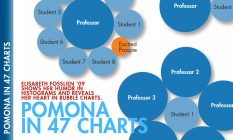
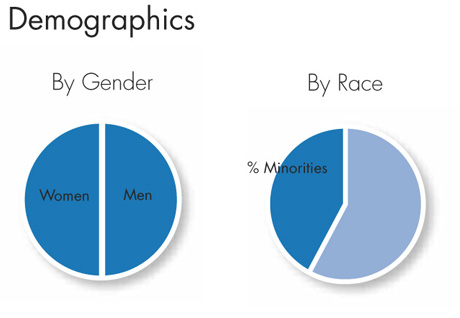
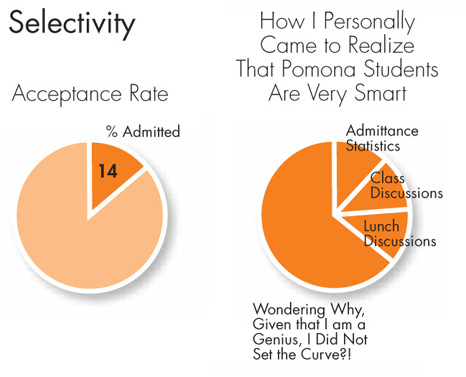
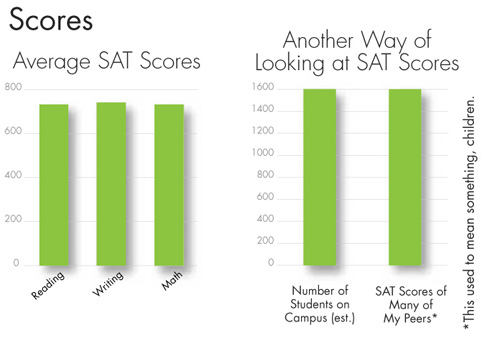


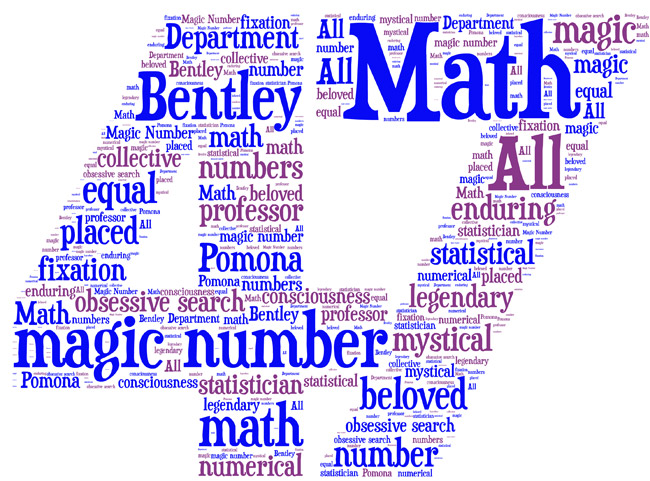 Don Bentley doesn’t want to talk about 47, the enduring numerical fixation the legendary math professor long ago placed in Pomona’s collective consciousness. It all started with a paradoxical proof Bentley put up on the chalk- board back in 1964, showing that all numbers are equal, which then morphed into all numbers equal 47—and spawned our endless, obsessive search for the magic number. But remember, Bentley doesn’t want to talk about that.
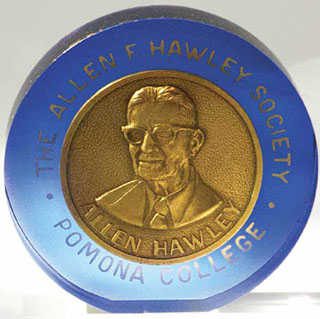 And we haven’t even covered the best part. Hawley returned to his alma mater in 1938, and his contributions over the next 24 years played a key role in the College’s rise. Launching what would later come to be known as the Pomona Plan, Hawley pioneered a game-changing vehicle in the world of educational fundraising. At the heart of what he hatched was this: a new kind of charitable-giving program in which the College, in essence, manages a donor’s money in return for a financial gift released to Pomona after the donor dies; the contributor earns a tax break and regular payments for the rest of his or her life.
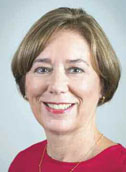 Susanne wanted those things, too. At Pomona, she embraced the life of the mind, engaging in those deep late-night conversations, and finding “just the right mix of serious study and social life.” She was an English major—Phi Beta Kappa and Mortar Board—who had many friends in the sciences. She served as arts and culture editor for The Student Life, and also took modern dance classes from Professor Jeannette Hypes, performing several times in her dance troupe. She soaked up everything she could from the small liberal arts college atmosphere.
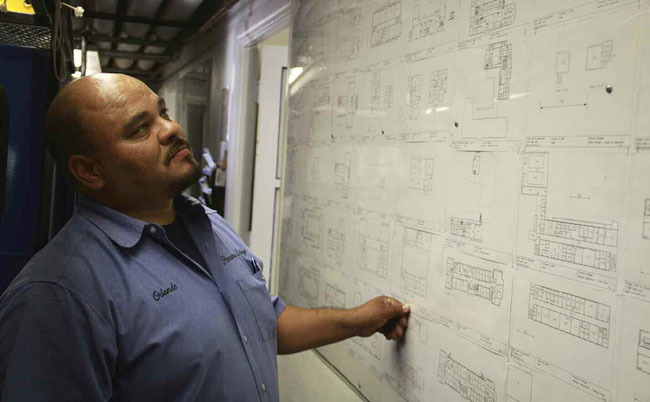 Maintenance Shop Supervisor Orlando Gonzalez is a hands-on kind of guy, working alongside his five-person crew on everything from unclogging shower drains to replacing shingles. But it’s his mind and his memory that are key to keeping the campus in tip-top shape.
 Williams: I want to talk about Berg’s policy arguments, which are controversial. He says we should consolidate all federal food programs into one efficient entity, have a universal school breakfast, reward states to reduce hunger; allow nonprofits to compete for federal funds; give recipients more choice, provide additional services such as job training. What do you think?