Blog Articles

Letter Box

Mufti Origins Revealed

Early Mufti messages were simple yet cryptic. One citing “Vincent,” above, was a reference to History Professor Vincent Learnihan, who taught at Pomona from 1949-82.

Early Mufti messages
were simple yet cryptic. One citing
“Vincent,” above, was a reference to History Professor Vincent Learnihan, who taught at Pomona from 1949-82.

After over 60 years of silence, we founding members of Mufti wish to offer a bit of Pomona history. Over the years we have been pleased to see occasional references to Mufti and are thrilled that once again, “Mufti is near.”

Mufti was started in 1958 by four women, all juniors, with strong senses of humor and mischief. We lived in Harwood Court, a women’s dorm complete with all-seeing head residents, 10 p.m. curfews and overnight locked doors. We admired the occasional strange events that occurred on campus, pulled off by unknown perpetrators: a letter on the College president’s stationery announcing amazing new rules for College behavior, the ringing of the bell in the Little Bridges bell tower during unusual hours of the day and night, and creative enhancements of the Orozco mural in Frary Dining Hall.

Who were the perpetrators and how did they do it? We knew a particular group of men was having all of the fun and we wanted to match them with a creative but subtle response! We started with orange footprints painted on the pathways of the quad. That approach became too time-consuming so we turned to simple messages plastered on mailboxes, lampposts and buildings, signed “Mufti.” We would sneak out of the dorm at 4 a.m., post our mysterious messages throughout the campus, go out to breakfast and return in time to attend our 8 a.m. classes.

Our senior year, we were “pillars of the community.” Our group included the president of the Associated Women Students, the chair of the AWS Judiciary and several members of the senior women’s May Court. Who would guess that we were Mufti?

By then living in Blaisdell, a senior-sophomore women’s dorm, we recruited

four sophomores who committed to carrying on the Mufti legacy with whole-hearted devotion. And that they did! We have lost track of those who carried the torch, but we toast you all.

We had such fun breaking the dorm rules and making people pause to wonder who could be behind the messages. We have unearthed a few original Mufti messages. They are simpler than those shared in the Pomoniana piece (Winter 2023), but we are thrilled that Mufti has survived and evolved and we say, “All Hail.”

—Jean Wentworth Bush Guerin ’60
Alice Taylor Holmes ’60
Martha Tams Barthold ’60
Thomasine Wilson ’60 (RIP)


Another Generation’s Protests

In 1980, students of The Claremont Colleges held the largest anti-Reagan protest in the country. It was so large and boisterous that a friend who had recently graduated from Pomona saw it on the evening news in Malaysia. We feared so many things should Ronald Reagan become president: nuclear escalation, further environmental degradation, the demise of the middle class—and the loss of women’s right to abortion, only recently won.

There is no satisfaction in being right.

My sign read, “Motherhood is Optional”; a male friend’s said, “Women’s Rights Are Human Rights, Too.” On the verge of adulthood, it was inconceivable that neither would be true 40 years in the future—and much earlier for those without the advantages of place and privilege that we possessed.

So I was gratified to see the very thoughtful and informative article “The Choice I Make” by Dr. Atsuko Koyama ’96 in the latest edition of PCM. Reading “While all of the air has been knocked out of me as I raise a young girl in a state where legislators and the courts have control over our bodies,” I struggled to breathe, too. Who are we if we don’t have control over our own bodies? Who are we if we are complacent in California while girls and women in Arizona, Texas, Mississippi and too many more states suffer from the loss of their basic human rights?

It took courage for Koyama to write this piece and for our alumni magazine to publish it. Thank you for making us proud.

—Sheri Cardo ’81
Petaluma, California


Remembering Irving Rosenthal ’52

I appreciated the fullness of the obituary for Irving Rosenthal ’52 (Winter 2023). Although I graduated five years later in 1957 and would not have known him there, I became acquainted with Irving in the 1960s when I was a partner in Auerhahn Press, which published Beat Generation writers. One of our poets was John Wieners, much admired by Irving.

—Andrew Hoyem ’57
Honorary Doctor of Letters ’15
San Francisco


On Choice

I really appreciate the article “The Choice I Make” (Winter 2023). We need more people and physicians like Atsuko Koyama ’96. She is so right that choice is not only about abortion. It is about equal access to medical care for all, control over our own bodies. As she says,  “Reproductive justice is the right to have children, to not have children, and to raise the children you have in safe, sustainable communities.”

—D.B. Zane ’85
Los Angeles
Editor’s note: Koyama credits the group Women of African Descent for Reproductive Justice with coining and defining the term reproductive justice in 1994.


Families of Children with Rare Diseases

Being the parent of a child with a devastating, ultra-rare disease can be incredibly lonely. It means a lifetime membership in a club you never want to see another family join. So it was with mixed feelings that I read “Moonshots for Unicorns” (Winter 2023) about Zach Landman ’08 and the journey he and his family are going through with their daughter.

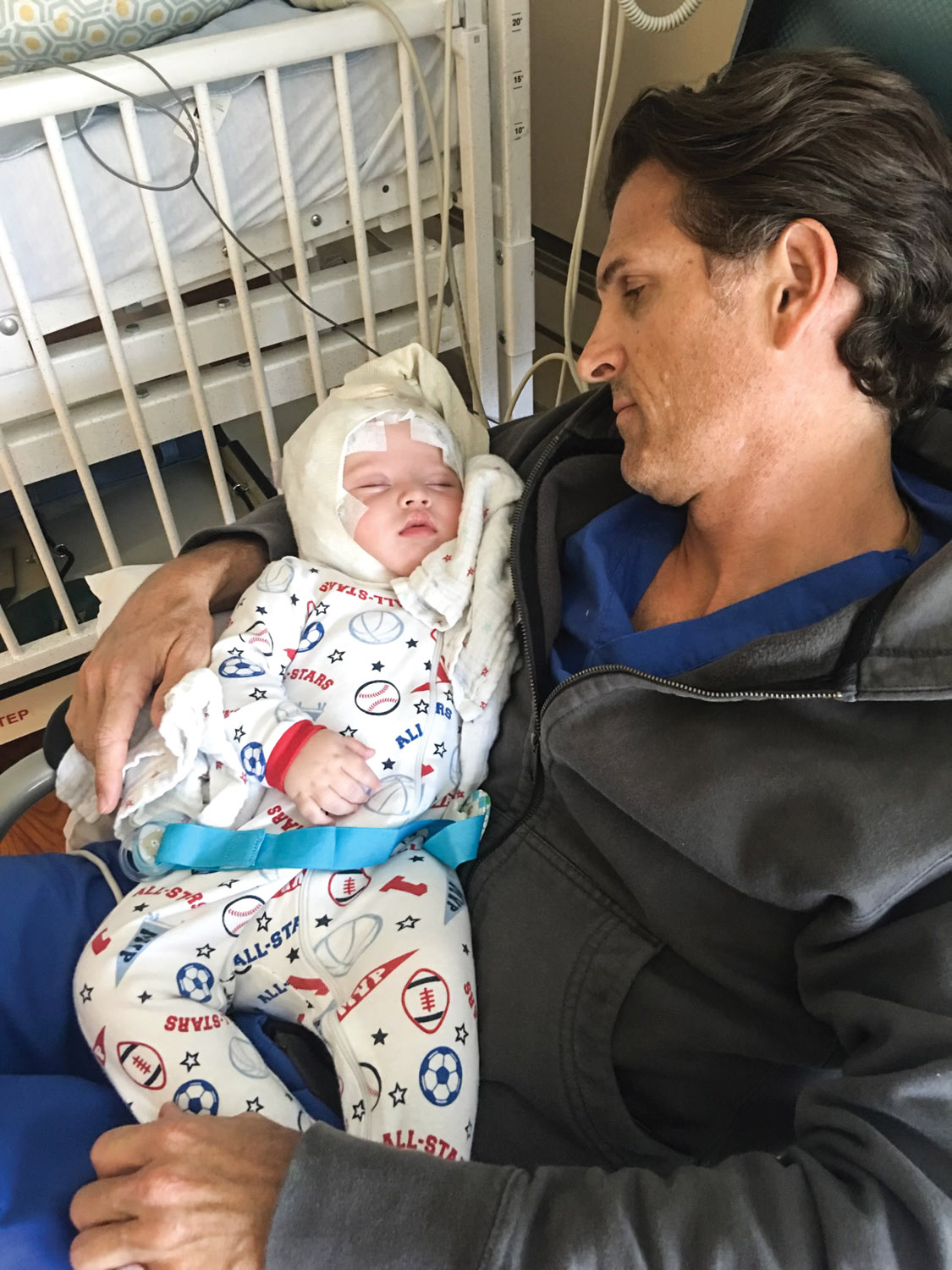
Justin West ’96 holds his son Andrew during one of Andrew’s many stays in the hospital as an infant.

Justin West ’96 holds his son Andrew during one of Andrew’s many stays in the hospital as an infant.

My wife and I are also both physicians. We met in medical school and did our residencies together at Georgetown. We delayed having children until we had the time and resources to care for them. Our third child, Andrew, was born when we were in our early 40s, a period with higher risks for both moms and babies.

Andrew’s first few months of life were like that of our first two children. Then, in a subtle flicker of his left foot, our lives changed forever. Over the course of a few weeks Andrew’s seizures became more dramatic. He went from a few a day to dozens. He spent over 100 days of his first year of life in hospitals across Southern California as we desperately raced to find a medication to make his seizures stop.

Andrew will be 6 years old in April. His seizures have slowed down, but his profound developmental stagnation persists. Andrew functions at the level of a 5-month-old. I have never heard his voice. I have never seen him walk. Without a dedicated treatment we will be caring for an ever-growing infant for the rest of his life and ours.

West plays with Andrew, left, Colin and Carolyn in 2019. His children are now 6, 7 and 9.

West plays with Andrew, left, Colin and Carolyn in 2019. His children are now 6, 7 and 9.

Like Zach and his wife, we are not willing to accept Andrew’s fate. Our KCNT1 Epilepsy Foundation is collaborating with more than a dozen teams around the world looking into drug repurposing, new small molecules and gene therapies to save Andrew’s life.

Along the way we have been fortunate to have received advice and assistance from Pomona alumni including Jeffrey Raskin ’03, M.D., Emil Kakkis ’82, M.D., Ph.D., and Jennifer Doudna ’85, Ph.D. We are also working on building a multidisciplinary team of Pomona students to help with our foundation initiatives.

The rare-disease pathway is beyond challenging. I am forever grateful to Pomona for preparing me to take on seemingly insurmountable challenges and for giving me the chance to be part of a community that comes together to help people in need.

—Justin E. West ’96
Newport Beach, California
Kcnt1epilepsy.org

Scholars and Fellows

This year’s list of recipients of prestigious awards to study or conduct research at home or abroad includes two young women with striking achievements. Vera Berger ’23 was selected as both a Churchill Scholar and a National Science Foundation Fellow. She also was Pomona’s student body president as a senior. Alexandra Turvey ’24 was selected as both a Beckman Scholar and Goldwater Scholar. In addition, she is a multiple-time All-American swimmer for Pomona-Pitzer and received the NCAA’s Elite 90 Award from women’s swimming. The Elite 90 is presented to the student-athlete with the highest cumulative grade-point average participating at the finals site for each of the NCAA’s 90 championships.

Beckman Scholars

Santiago Serrano ’25
Alexandra Turvey ’24

Churchill Scholar

Vera Berger ’23

Downing Scholars

Mohammed Ahmed ’23
Rya Jetha ’23

Fulbright Scholars

Maggie Allegar ’23
Sophia Chanin ’23
Brittany Chen ’20
Peter Chong ’23
Kelly Ho ’22
Kaitlyn Lee ’23
Kyu Lee ’23
Calla Li ’22
Jacob Ligorria ’23
Delmy Ruiz ’23
Oliver Spivey ’23
Zachary Wakefield ’22
Nathaniel Wire ’23

Goldwater Scholars

Zoë Batterman ’24
Alexandra Turvey ’24

National Science Foundation Fellows

Vera Berger ’23
Zoe Haggard ’21
Joe Hesse-Withbroe ’21
Kirby Lam ’23
Rohan Lopez ’23
Adele Myers ’21
Gabrielle Ohlson ’21
Cody Pham ’21
Marie Tano ’21
Gabe Udell ’21
Clayton Ziemke ’18

Schwarzman Scholars

Solomon Olshin ’23
Qingjie “Bob” Zeng ’18

Sagehens Still in the Spotlight

Ryan Long ’21 Strikes Out Mike Trout

Photo by Paul Stodart, British Baseball Federation/GB Baseball

Photo by Paul Stodart, British Baseball Federation/GB Baseball

The situation Ryan Long ’21 found himself in on March 11 was almost unfathomable. The 6-foot-6 former Sagehens pitcher was on the mound for Great Britain against Team USA in the World Baseball Classic in Phoenix when Mike Trout came to the plate. Long, a minor leaguer who was drafted 497th overall by the Baltimore Orioles in 2021, was facing Trout, the three-time American League MVP and 10-time All-Star.

And down went Trout after Long struck him out with a 94-mph fastball.

“It was just a really surreal experience. Something that I’ll definitely hold onto forever,” Long says of playing in the World Baseball Classic.

Long realized he was eligible to play for Great Britain because his mother, Liz, was born in England. He asked Pomona-Pitzer Coach Frank Pericolosi if he had connections to the British Baseball Federation and Pericolosi put him in touch with alumni who did.

Months later, Long was pitching at Chase Field in Great Britain’s opening game against Team USA.

“I think before this the biggest crowd I ever played in front of was about 7,000, maybe 8,000. This was 40,000,” Long says.

His early nerves settled after he went on in relief in the fourth inning.

“Once I got out there and got on the mound, my heartbeat started to slow down a little bit, which was cool,” Long says.

He gave up a home run, “one that I’m not too upset about because it’s a major league All-Star,” he says of the blast by Kyle Schwarber, who led the National League in homers last season.

The next inning, Trout came to the plate.

“First of all, he’s obviously an amazing hitter but their whole lineup was filled with All-Stars and future Hall of Famers,” says Long.

He got Trout to a 3-2 count and decided to stay with his best pitch, his fastball.

“He fouled the first two off,” Long says. “He didn’t seem like he was seeing it as well as he might normally be. I decided to throw it again and it got past him. That was a very, very exhilarating feeling—a lot to take in.”

Long moved up to the Orioles’ High-A team in Aberdeen, Maryland, this season and still has a goal of reaching the majors, but he won’t forget playing for Great Britain.

“I think that will go down as one of the best, if not the best, experiences I’ll ever have in this game.”


Melissa Barlow ’87 Officiates NCAA Tournament Game

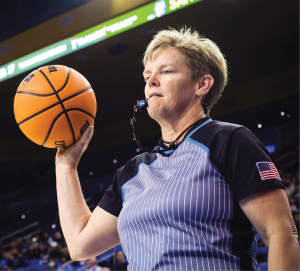
Melissa Barlow ’87 Officiates NCAA Tournament GamesIn a banner year for women’s college basketball, Melissa Barlow ’87 was in the middle of an NCAA tournament that garnered record ratings.

Decades after she played point guard on Pomona-Pitzer’s standout teams of the 1980s, Barlow still runs the floor as a top NCAA Division I women’s basketball official. She called three games during the 2023 tournament, including the Sweet 16 game in which Iowa star Caitlin Clark scored 31 points in a win over Colorado.

Barlow has officiated in 10 Final Fours and three NCAA championship games, assignments that are earned through round-by-round reviews by officiating supervisors. She also has been yelled at by some of the best in the business—the late Pat Summitt of Tennessee, Geno Auriemma of Connecticut, Kim Mulkey of Louisiana State—and can laugh it off later.

For years, officiating was a sidelight to a highly successful career in the pharmaceutical industry that enabled Barlow, a biology major at Pomona, to retire at 53 from her job as national sales director for the metabolic division of AbbVie.

She encourages other former women’s players to get into officiating, too.

“I try to tell them: You get the best seat in the house, you get a workout and they pay you to watch these great games.”

New Pitzer President a Sagehen from the Start

The bonds of The Claremont Colleges will become a bit tighter this summer, when consortium alumni take over as presidents of two of the colleges.

Strom C. Thacker ’88. Reprinted with permission of Pitzer College

Strom C. Thacker ’88.
Reprinted with permission of Pitzer College

Strom C. Thacker ’88, who graduated from Pomona with a degree in international relations, cum laude and Phi Beta Kappa, becomes president of Pitzer College on July 1. On the same day, Harriet B. Nembhard CMC ’90 becomes president of Harvey Mudd College.

Thanks to conveniently aligned athletic programs, neither one will have trouble knowing which side to sit on when Pomona-Pitzer plays Claremont-Mudd-Scripps in Sixth Street Rivalry games.

Thacker, who has been dean of the faculty and vice president for academic affairs at Union College in Schenectady, New York, grew up in Northern California and came to Pomona with the help of generous financial aid that included a federal Pell Grant. He went on to earn a Ph.D. in political science from the University of North Carolina at Chapel Hill and become an advocate for college equity, access and the value of a liberal arts education.

Among Thacker’s duties at Union College, by the way: Managing a budget of approximately $47 million. (Chirp.) Welcome home, President Thacker.

2023 Wig Awards

Each year, juniors and seniors vote for the Wig Distinguished Professor Awards for excellence in teaching—the highest honor bestowed on Pomona faculty—in recognition of exceptional teaching, concern for students and service to the College and the community. This year, William A. Johnson Professor of Government and Professor of Politics David Menefee-Libey was honored for the seventh time, tying the late Emerita Professor of English Martha Andresen Wilder for the most recognitions since the establishment of the award in 1955.

2023 Wig Award recipients, from left: Fred Krinsky Professor of Jewish Studies and Professor of Religious Studies Oona Eisenstadt, Assistant Professor of Chicana/o-Latina/o Studies Arely Zimmerman, William A. Johnson Professor of Government and Professor of Politics David Menefee-Libey, Professor of Mathematics and Statistics Jo Hardin ’95, Assistant Professor of Mathematics and Statistics Konrad Aguilar, Assistant Professor of Psychological Science Sara Masland. Not pictured: Henry G. Lee ’37 Professor of English Prageeta Sharma.

2023 Wig Award recipients, from left: Fred Krinsky Professor of Jewish Studies and Professor of Religious Studies Oona Eisenstadt, Assistant Professor of Chicana/o-Latina/o Studies Arely Zimmerman, William A. Johnson Professor of Government and Professor of Politics David Menefee-Libey, Professor of Mathematics and Statistics Jo Hardin ’95, Assistant Professor of Mathematics and Statistics Konrad Aguilar, Assistant Professor of Psychological Science Sara Masland. Not pictured: Henry G. Lee ’37 Professor of English Prageeta Sharma.

A Path to U.S. Colleges for Refugee Students

Among Pomona’s newly admitted students for 2023-24 are nine refugees with citizenships from Congo, Syria and Ukraine.

The admissions are a reflection of Pomona’s commitment to the recently launched Global Student Haven Initiative, a program founded by eight colleges and universities in response to the war in Ukraine and the humanitarian crisis in Afghanistan.

Along with Bowdoin, Caltech, Dartmouth, NYU, Smith, Trinity and Williams, Pomona is dedicated to providing a path for students affected by worldwide crises to apply to U.S.-based colleges and universities—and to receive scholarships and other support when they arrive. The initiative seeks to help students continue their education and later to return to their home nations.

“This is about opening doors and helping people through them,” says Pomona College President G. Gabrielle Starr. “The global disruptions of recent years have tested American higher education’s long commitment to reaching out to the world. We seek to reaffirm our global ties, starting with the urgent needs of students facing the devastation of war.”

Pomona’s effort is supported by an earlier $1.2 million gift from Florence and Paul Eckstein ’62 in honor of his immigrant parents, and a new $1 million gift from the Fletcher Jones Foundation.

2023 Commencement Speakers

Pomona’s 2023 Commencement speakers know about persistence, as do the new graduates they addressed in a May 14 ceremony.

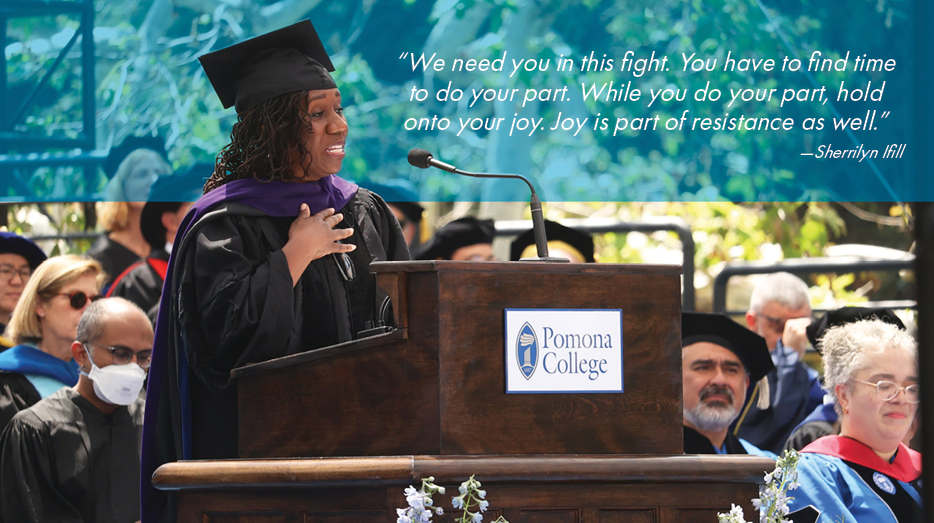
Sherrilyn Ifill is a distinguished civil rights lawyer, voting rights advocate and scholar. A senior fellow at the Ford Foundation, she previously spent a decade as president and director-counsel of the NAACP Legal Defense and Educational Fund, the nation’s premier civil rights law organization. She was chosen one of Time magazine’s 100 Most Influential People of 2021.

“We need you in this fight. You have to find time to do your part. While you do your part, hold onto your joy. Joy is part of resistance as well.” —Sherrilyn Ifill

“We need you in this fight. You have to find time to do your part. While you do your part, hold onto your joy. Joy is part of resistance as well.”
—Sherrilyn Ifill

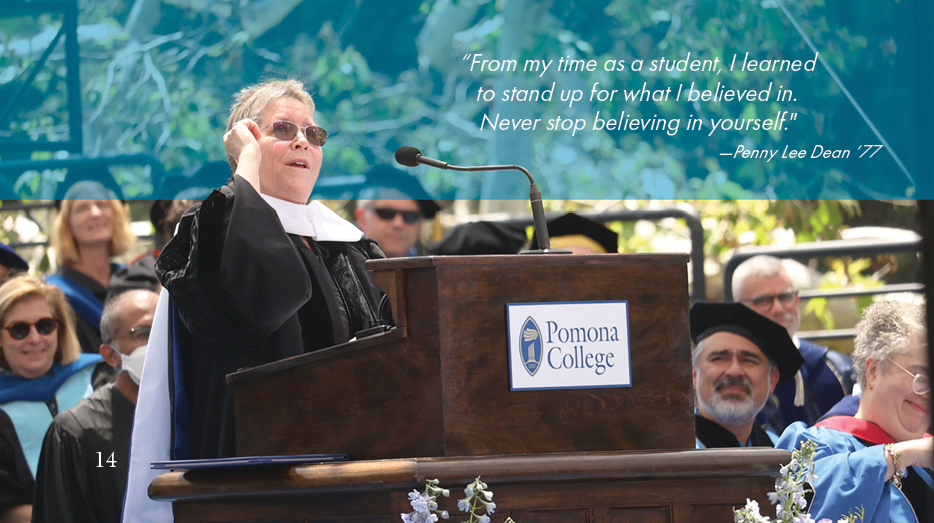
Penny Lee Dean ’77 set 13 world records as a marathon swimmer, including a 1978 crossing of the English Channel that shattered the men’s world record by more than an hour. She was inducted into the International Swimming Hall of Fame in 1996. A six-time All-American swimmer at Pomona, she returned to the College and coached and taught for 26 years, winning 17 SCIAC women’s swimming titles and guiding the women’s water polo team to a national championship in 1993.

“From my time as a student, I learned to stand up for what I believed in. Never stop believing in yourself." —Penny Lee Dean ’77

“From my time as a student, I learned to stand up for what I believed in. Never stop believing in yourself.”
—Penny Lee Dean ’77

In addition to conferring honorary degrees on Ifill and Dean, Pomona posthumously honored Trustee Emeritus George E. “Buddy” Moss ’52 with the Trustees’ Medal of Merit. A member of the Board of Trustees from 1995 to 2004, Moss made possible many programs for faculty and students. Among his many contributions, he made gifts to establish the George E. Moss Community Partnerships Fund, the George E. and Nancy O. Moss Professorship in Economics, the Henry G. Lee ’37 Professorship in Poetry, the Peter W. Stanley Chair of Linguistics and Cognitive Science and the Roscoe Moss Professorship in Chemistry.

Alumni Voices: A Friendship That Bridged 50 Years

Alumni Voices: A Friendship That Bridged 50 Years
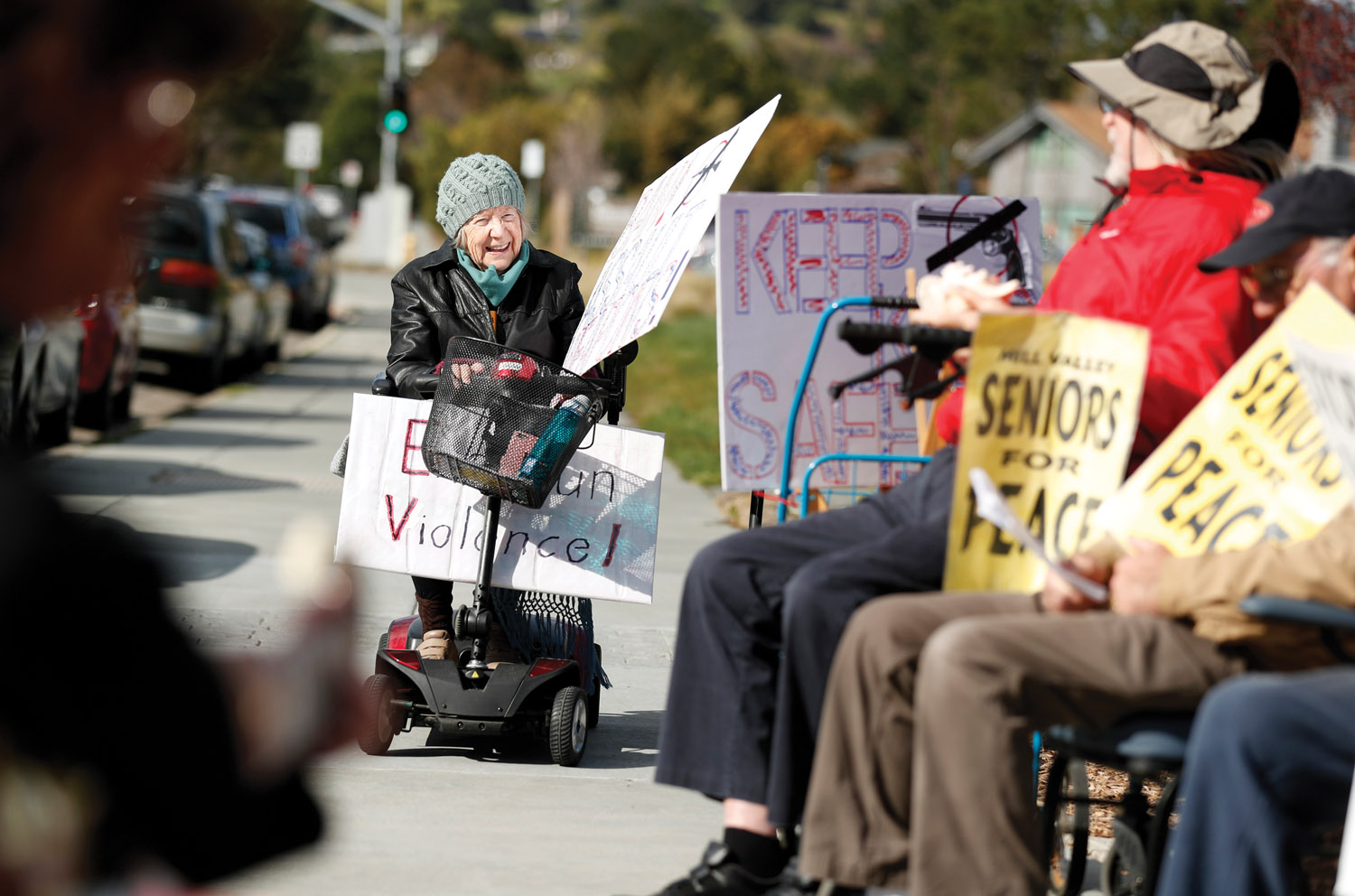
Helen Anderson ’47 took part in weekly demonstrations by seniors in Mill Valley, California, into her 90s, as seen here in 2018. Photo by Scott Strazzante / San Francisco Chronicle / Polaris

Helen Anderson ’47 took part in weekly demonstrations by seniors in Mill Valley, California, into her 90s, as seen here in 2018. Photo by Scott Strazzante / San Francisco Chronicle / Polaris

The road to my friend Helen Heyden Anderson ’47 was never long, and my heart always felt lighter crossing the Golden Gate Bridge. Her active senior community in Marin County reminded me of Blaisdell, where we lived 50 years apart.

Even at 97, Helen greeted me with bright eyes and a cheerful “Come in.” The scent of magnolia blossoms wafted through from the garden. “I was born in 1926. The flowers transport me to when I was 9, swinging from oak trees by the magnolias,” she said, remembering the San Fernando Valley ranch where she grew up. Helen entered Pomona College during World War II and was affectionately nicknamed Kanga by her suitemates, after the A.A. Milne character. In later years, she became “Great Helen” to her grandchildren and friends.

I met Helen more than 30 years ago, when I was applying to Pomona. She was leading a program addressing childhood hunger, and my friends and I raised a few thousand dollars toward her efforts. I recall visiting her ranch-style home in Tustin where Helen, surrounded by her watercolor canvases, talked about a service trip to Mexico with her husband Gordon. She was fascinated with the people she met, and I was taken with her life of service.

Her 10th decade of life found Helen leading a spirited social activist group called Seniors for Peace. With walkers and wheelchairs, Helen and some of her neighbors gathered to hold up poster board signs for various causes at a nearby intersection one afternoon a week. Her keen interest in restorative justice grew, and she worked with a group that successfully secured fair housing for low-income minorities in Marin.

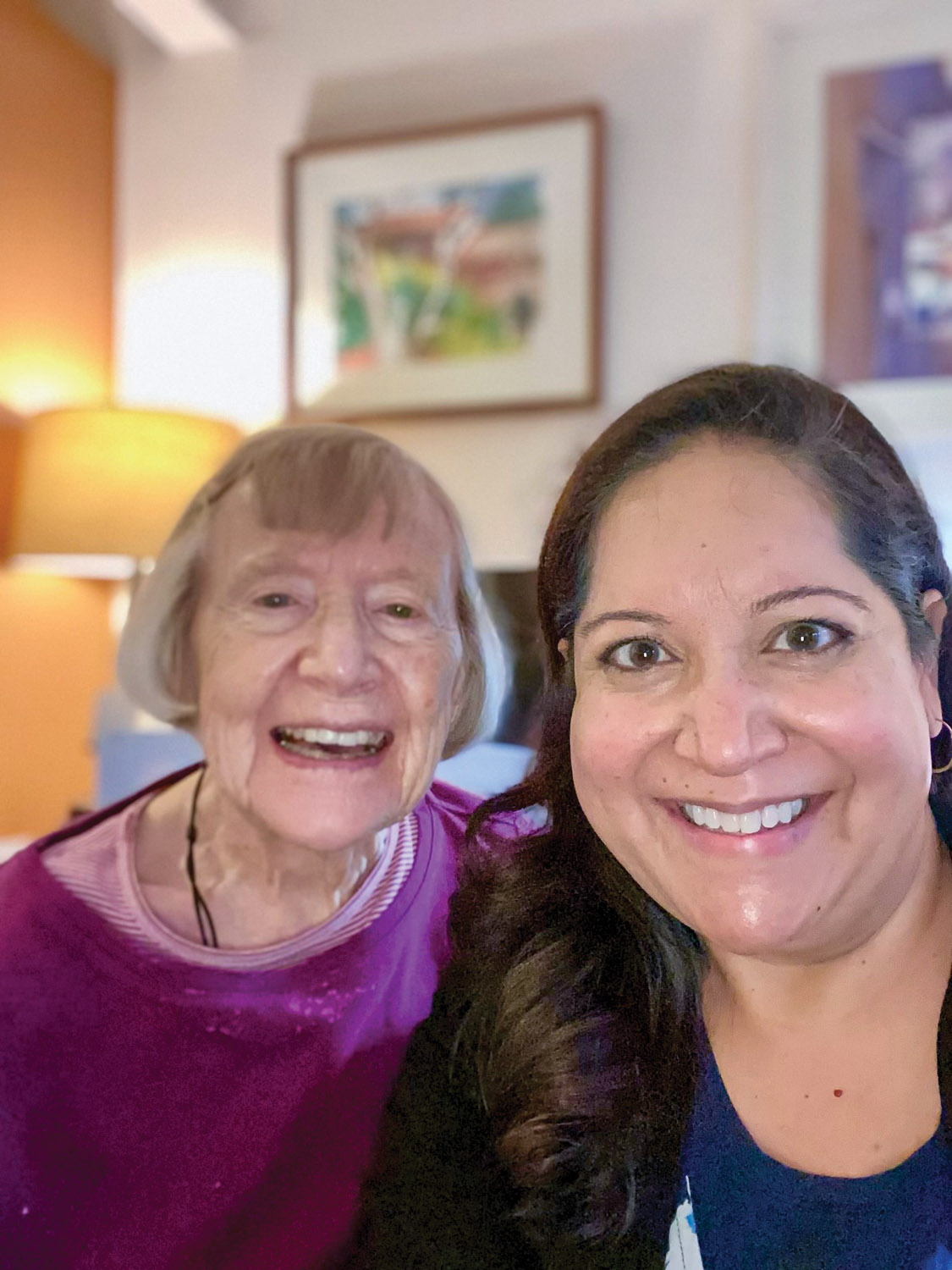
Helen Anderson ’47, left, with Leena Ved ’97.

Helen Anderson ’47, left, with Leena Ved ’97.

During my turn as a student at Pomona, I wrote about Helen for Professor Jill Grigsby’s class called the Life Course of Women. Helen encouraged my self-designed major in economic development. I visited schools for girls in South Asia with Professor Tahir Andrabi and, like Helen, I had my first career in K-12 education. Helen subtly counseled me on my life choices when I’d ask—career changes, having a second child and recently, on moving back to Tustin from the Bay Area with my little girls. We’ll do that this summer, coming full circle. One of her greatest gifts was how she listened with gentle presence. With her advice, I’m currently managing social impact investments, including housing with dignity for lower-income Americans.

The geographies of our lives intertwined. We moved from Orange County to the Bay Area at the same time, and Helen and Gordon guided me through the wilderness of my 20s and 30s as I wrestled with life’s big decisions. On Marston Quad during one of our common reunion years, Gordon advised me, “Marry for chemistry,” he said. “And shared values,” Helen said before Gordon added, “I met Helen when she was a spry 68, and we’ve had fun since.” Helen lost Gordon to complications from COVID-19 in 2021.

Helen lived through two pandemics. When she was a senior at Pomona, she contracted polio at a friend’s wedding. In her 70s, Helen experienced late effects of the disease, but continued moving forward with a leg brace, orthotics and undeterred optimism. She remembered the dramatic impact of Dr. Jonas Salk’s polio vaccine in 1955 and found it strange that COVID-19 vaccines were politicized. (She approached people she disagreed with politically with curiosity, not judgment.)

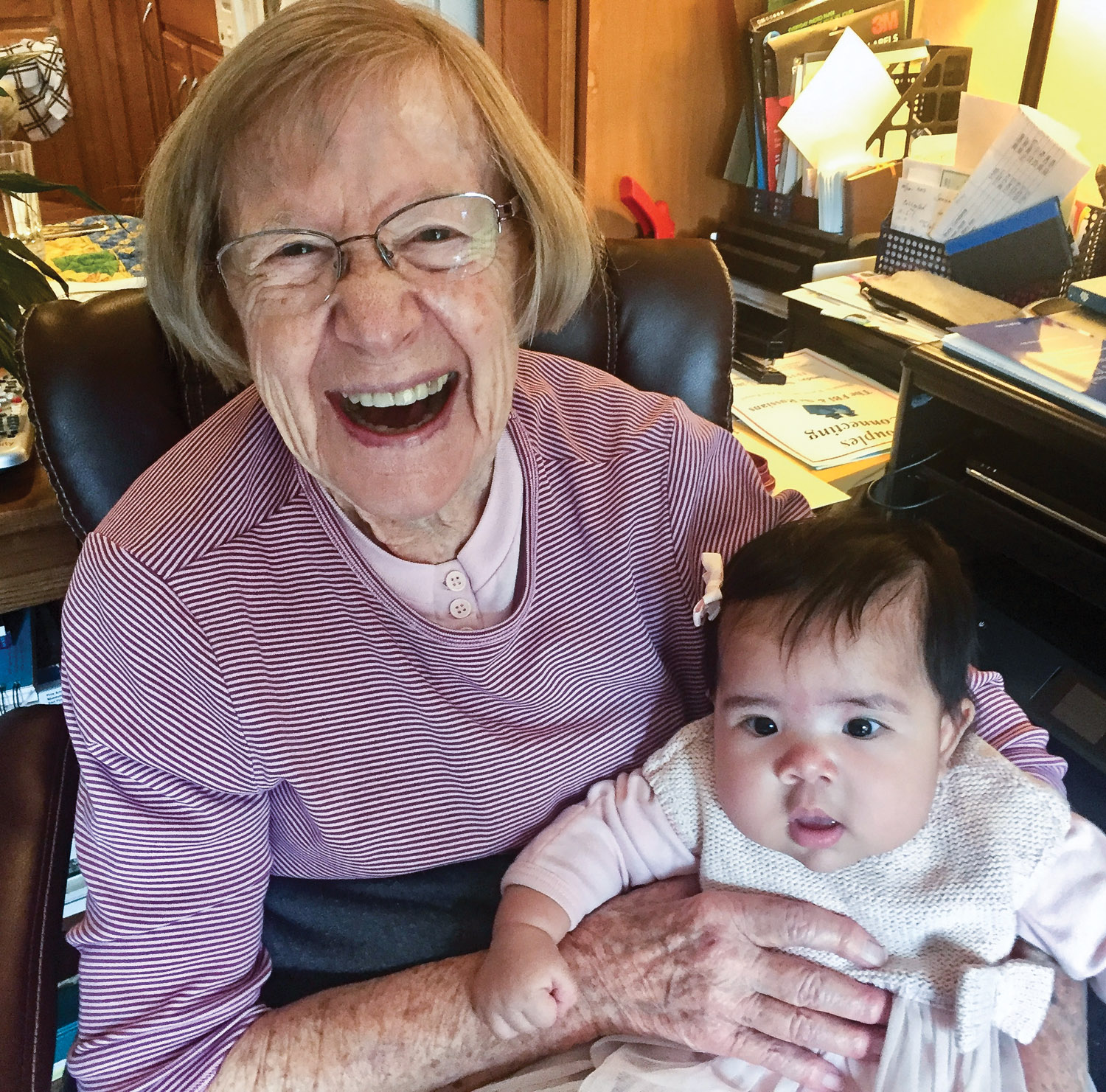
Anderson holding Ved’s first baby, Serena.

Anderson holding Ved’s first baby, Serena.

Last year, I met with Helen as a respite to juggling my preschooler, pregnancy and increased professional responsibilities. I asked how she managed years ago as a young mother to simultaneously raise young children alone (when her first husband left), earn a master’s degree and teach.

“We had four children,” she told me. “It was still the era where women could mostly become either a teacher or a nurse. So after Pomona I became a reading specialist. My mom watched the children, which kept me afloat. It made my family so much closer after that era when we were faced with sink or swim.”

That practical attitude pervaded all Helen did. When I asked how she kept up with the news, she grinned over her Jell-O. “I scan the biggest-sized headlines first. If I can take action on it, then I’ll read more.”

Helen was remarkably resilient despite three heart blockages in her last six months. On our final visit, I asked her how she maintained her optimism. “From this age, I see the tough times,” she said. “For me, it was after Gordon was gone. It comes down to gratitude. I always wanted a spiritual tie, so I had a church community. That helped me, as well as gaining a worldview, interacting with young adults, and traveling and seeing the hardships people have. Others lifted me in my life, so I did the same.”

Beyond Bruce’s Beach

Beyond Bruce's Beach

Beyond Bruce’s Beach

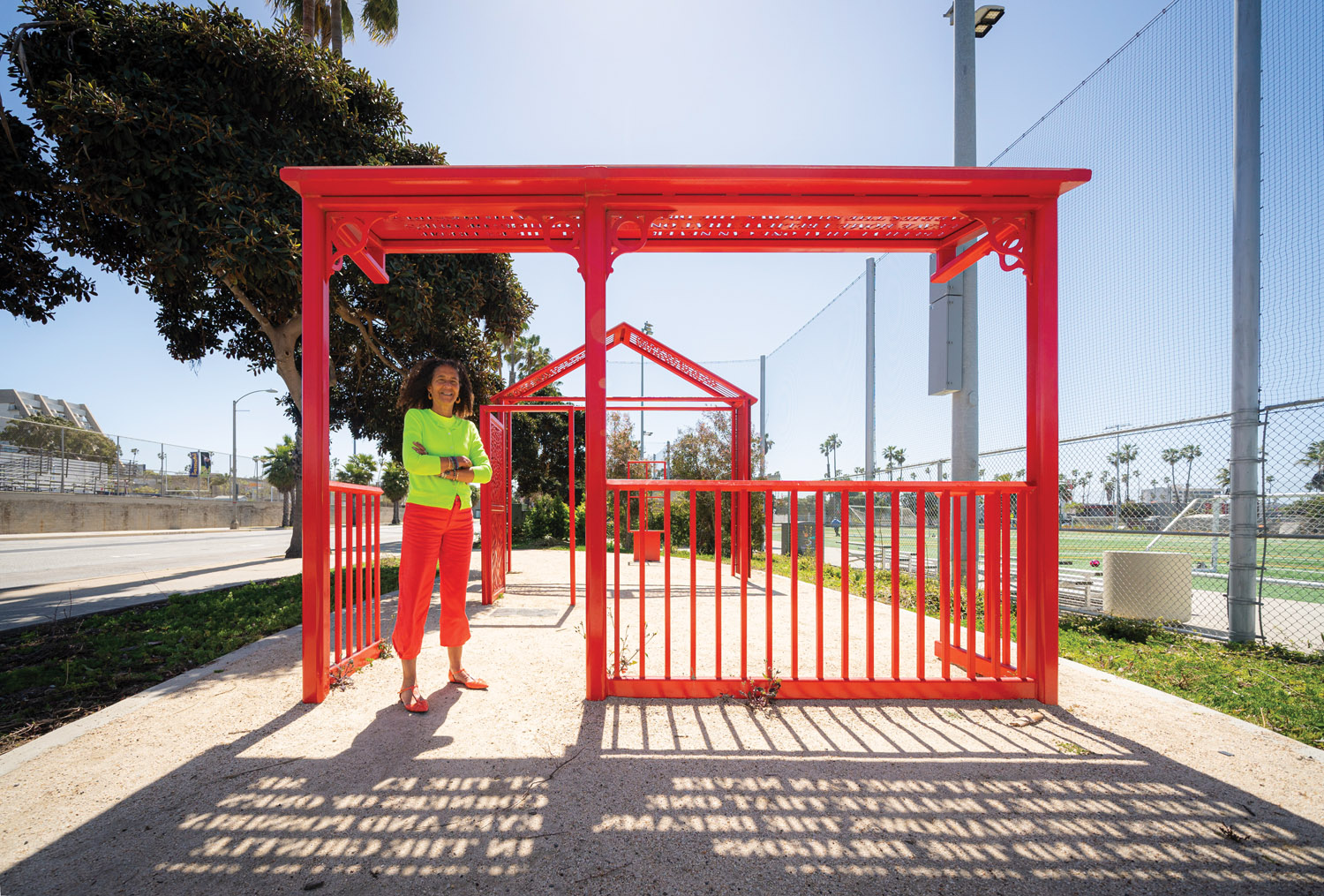
Alison Rose Jefferson ’80 stands in the permanent public art sculpture A Resurrection In Four Stanzas by artist April Banks in Historic Belmar Park in Santa Monica. Photo by Jeff Hing


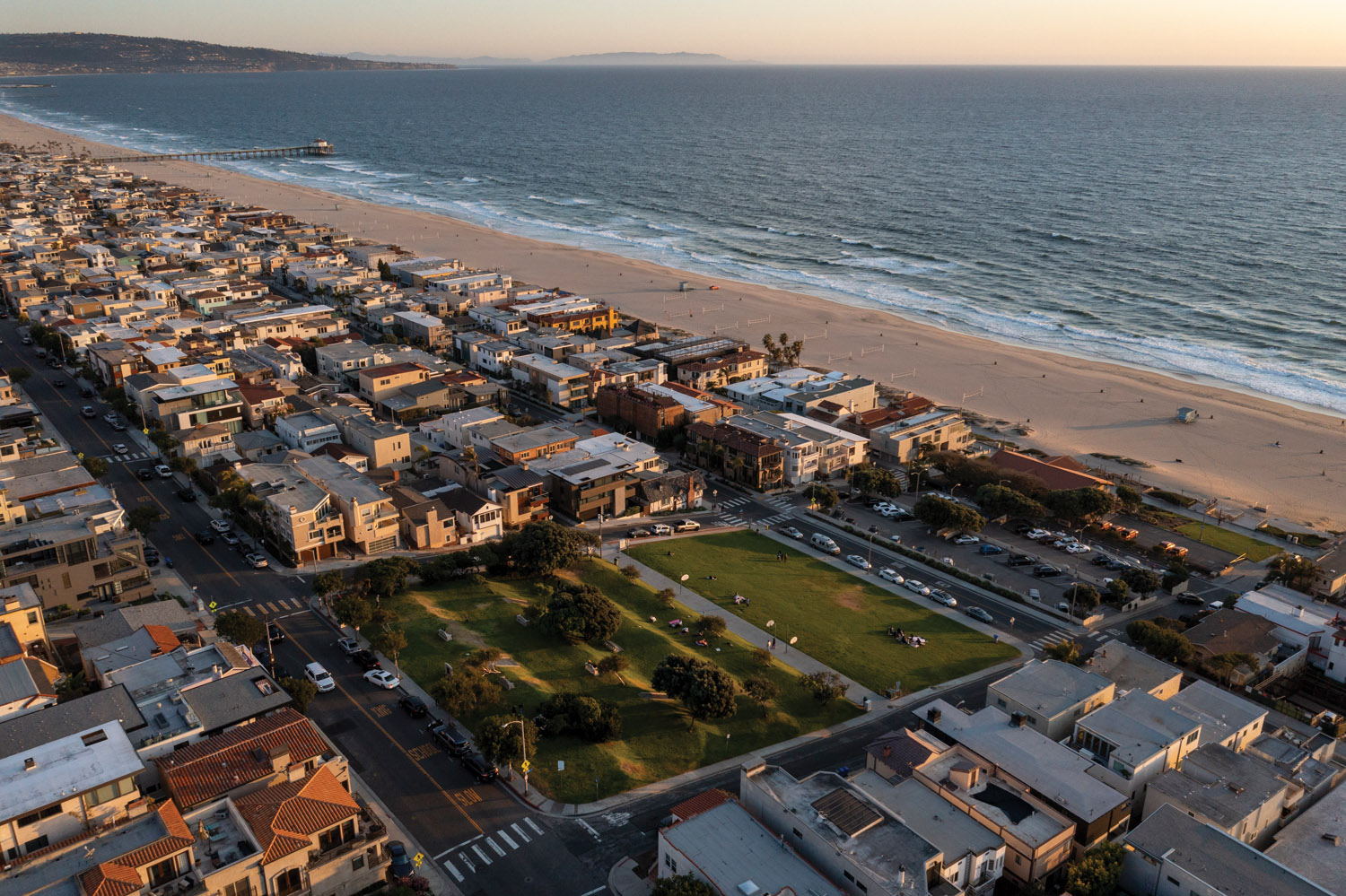
A grassy park known as Bruce’s Beach at the edge of the Pacific landed at the center of the national debate over reparations last year. Los Angeles County deeded the two oceanfront lots next to the park to descendants of Willa and Charles Bruce, the Black couple who lost their thriving resort there to a racist land grab a century ago.

Upcoming Exhibition

Black California Dreamin’
Curated by Alison Rose Jefferson
California African American Museum, Los Angeles
August 5, 2023–March 31, 2024

To historian and author Alison Rose Jefferson ’80, who chronicled the history of Bruce’s Beach in her 2020 book, Living the California Dream: African American Leisure Sites during the Jim Crow Era, what happened in Manhattan Beach is a significant example of how the concept of reparations in America has evolved, and of the power of reclaiming stories. But it is only one story. Many more can be found along Southern California’s famous coast, and Jefferson has played a key role in uncovering them.

A little more than 10 miles north of Bruce’s Beach is what remains of the historic Belmar neighborhood in the Ocean Park area of South Santa Monica.
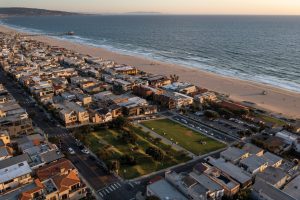
The two lots that formed the Bruce family's oceanside resort—now the site of an L.A. County lifeguard facility—lie just west of the grassy park that was renamed Bruce's Beach in 2007.

The two lots that formed the Bruce family’s oceanside resort—now the site of an L.A. County lifeguard facility—lie just west of the grassy park that was renamed Bruce’s Beach in 2007.

On a windy weekday, Jefferson walks the streets of present-day Ocean Park at Fourth and Pico, where a lively Black neighborhood stood from the early 1900s to the 1950s. The Belmar Triangle was one of three neighborhoods in South Santa Monica that made up this small community—only about 300 residents in 1920—but here Black families embraced the beach life, raised children, worked, danced, worshipped nearby and called the area theirs.

Today, nothing is left of the La Bonita Café and Apartments, the Dewdrop Inn and Cafe, the Arkansas Traveler Inn or Caldwell’s Dance Hall. In the 1950s, the city of Santa Monica wanted a new civic auditorium, courthouse and a 10 Freeway extension. Claiming eminent domain, the city tore down Black and other marginalized communities’ businesses and cited residents’ houses as unsafe in order to burn them down. Most of the population dispersed, finding more welcoming neighborhoods in areas such as a Black Santa Monica enclave 20 blocks inland, the Venice area and South Los Angeles.
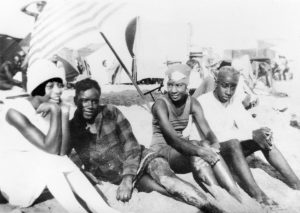
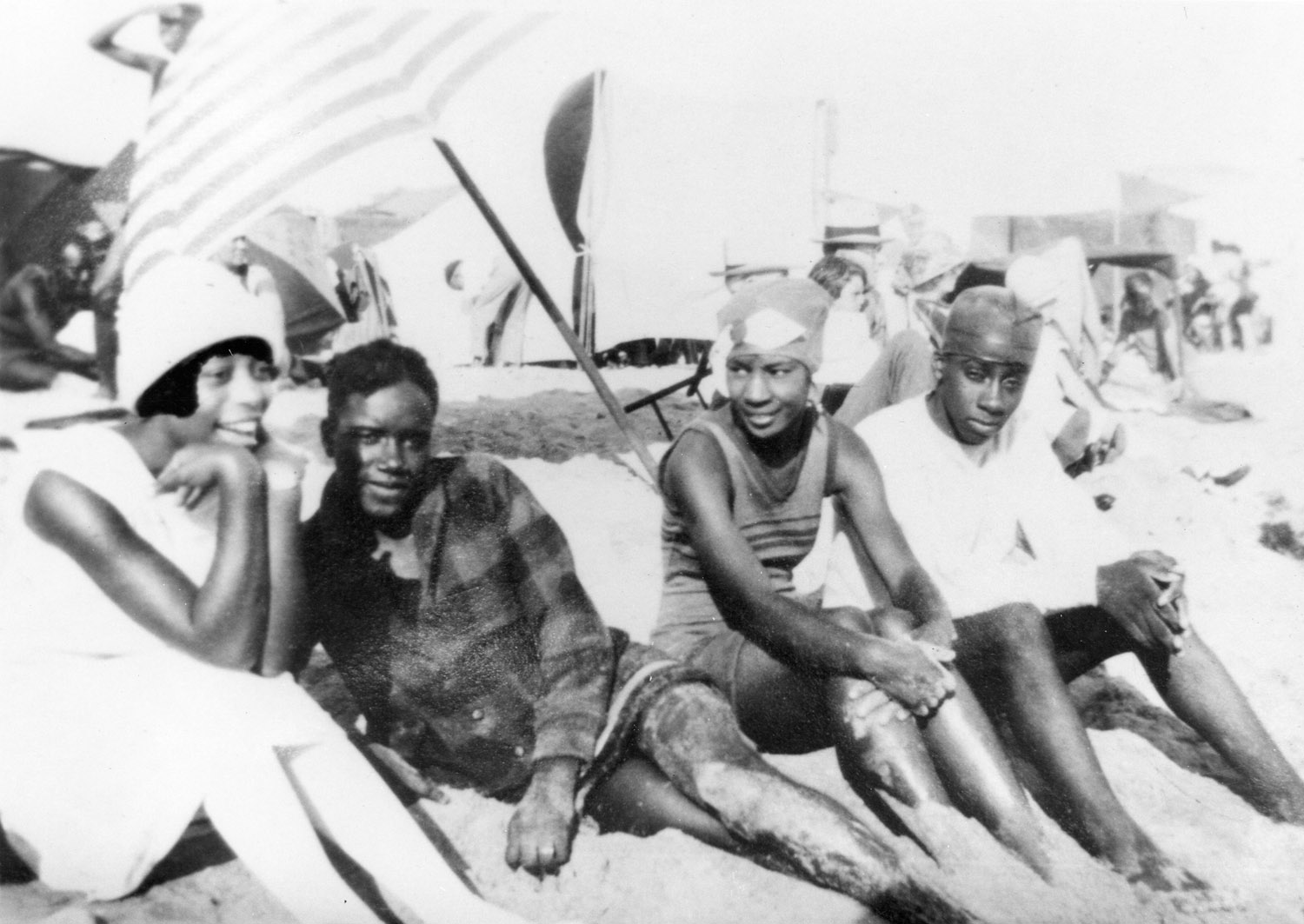
Bay Street Beach in Santa Monica, shown here in 1926, was a gathering place for Black friends and families from the 1920s to 1960s and was sometimes called "The Inkwell."/L.A. Public Library

Bay Street Beach in Santa Monica, shown here in 1926, was a gathering place for Black friends and families from the 1920s to 1960s and was sometimes called “The Inkwell.”/L.A. Public Library

In her book and in the upcoming exhibit Black California Dreamin’ at the California African American Museum in Los Angeles, Jefferson reveals the histories of Bruce’s Beach, South Santa Monica and other Black leisure communities in Southern California that have been erased. Lake Elsinore in Riverside County, a bucolic retreat from the city enjoyed by Black Angelenos, was described as the “best Negro vacation spot in the state” by Ebony magazine in 1948. The Parkridge Country Club in Corona was whites-only when it opened in 1925. But its white owner soon ran into financial trouble and controversially sold to a syndicate of Black owners in 1927, after which Parkridge was called L.A.’s first and only Black country club. In the Santa Clarita Valley north of Los Angeles, a resort community developed in the 1920s named Eureka Villa, later called Val Verde, became known as the “Black Palm Springs.”

There is so much forgotten history that the first step of reparations, Jefferson contends, is learning the stories and accepting the past, no matter how difficult that is.

“[In order to] incorporate these stories into our collective thinking, our perception, you first have to be exposed to them,” she says.

Repairing Injustices

A disastrous first attempt at reparations by the U.S. government came in 1865 as the Civil War neared its end, when freed slaves were promised what became known as “40 acres and a mule.” The government eventually reneged on the program and Southern white landowners, not Black families, received much of that “promised land.”

For much of the last 70 years, Jefferson says, one focus of reparations was on educating Americans young and old about the wide-ranging stories of Black Americans, though even that has come under fire recently, particularly in Florida.

“African American historians and people who have been African American allies had been pushing for a much broader narrative to be presented to the public through American history classes in college, high school and grade school and through public venues like museums,” Jefferson says, noting that the 2016 opening of the National Museum of African American History and Culture in Washington, D.C., “helped make people much more aware of stories that they didn’t know about.”

Reparation Terms

The big umbrella of reparations covers five main arrangements: compensation, restitution, rehabilitation, satisfaction and guarantees of non-repetition.

Compensation is cash payments given to recipients, whereas restitution is reversing a historic wrong such as returning land or housing.

Rehabilitative reparations include covering costs for mental health, medical, legal or social services.

Satisfaction and guarantees of non-repetition are about policy reform, such as removing legal slavery language from state constitutions, public apologies from officials, memorials and other public acknowledgments of specific historic wrongs.

Now there is a broader cry for reparations. Jefferson cites many factors: the 2020 social justice movement (driven by the murder of George Floyd, the killings in Ferguson, Missouri, and other racially motivated incidents), a pandemic that presented people with time to research their own history, and young Black Americans sharing personal stories via social media. “Don’t forget that Barack Obama was elected president,” she adds.

Across the country, government leaders are beginning, once again, to more seriously grapple with how to address the generations of injustices experienced by Black Americans. Reparations are complex, can take many forms (see box at right) and may be politically volatile. There is no “one size fits all,” experts agree.

In 2020, California became the first state to create a reparations task force, and the cities of San Francisco and Los Angeles soon followed by naming reparations advisory committees. Although California entered the Union as a free state in 1850, some people were brought to the state as slaves, and local and state governments continued to perpetuate systemic racism against Black Californians for generations through employment discrimination, displacement of communities and discriminatory educational funding, inhibiting their ability to develop wealth and social mobility.

Some economists initially estimated the potential cost to California for reparations at a staggering $800 billion, and one proposal in San Francisco called for $5 million payments to every eligible Black adult in the city. Ahead of a July 1 deadline to deliver recommendations to the legislature, the state reparations task force instead proposed cash “down payments” of varying amounts to eligible Black residents, which would have to be approved by the legislature and signed by the governor. Elsewhere, the city of Palm Springs, facing a claim for $2.3 billion in damages for the actions of city officials in the 1950s that uprooted Black and Latino families in an area known as Section 14, also is debating a reparations program.

Outside of California, other efforts to acknowledge the past and offer financial restitution are appearing. A program in Evanston, Illinois, is distributing payments to a number of Black residents who faced housing discrimination before 1969. In Asheville, North Carolina, where many Black people lost property during the urban renewal efforts of the mid-20th century, the city has designated more than $2 million toward “community reparations,” such as programs to increase homeownership and business opportunities for Black residents.

These are a handful of examples, Jefferson says. “But it’s a start. We are closer to the possibility of national reparations than in any time in history.”

Recovering History
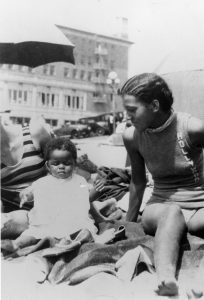
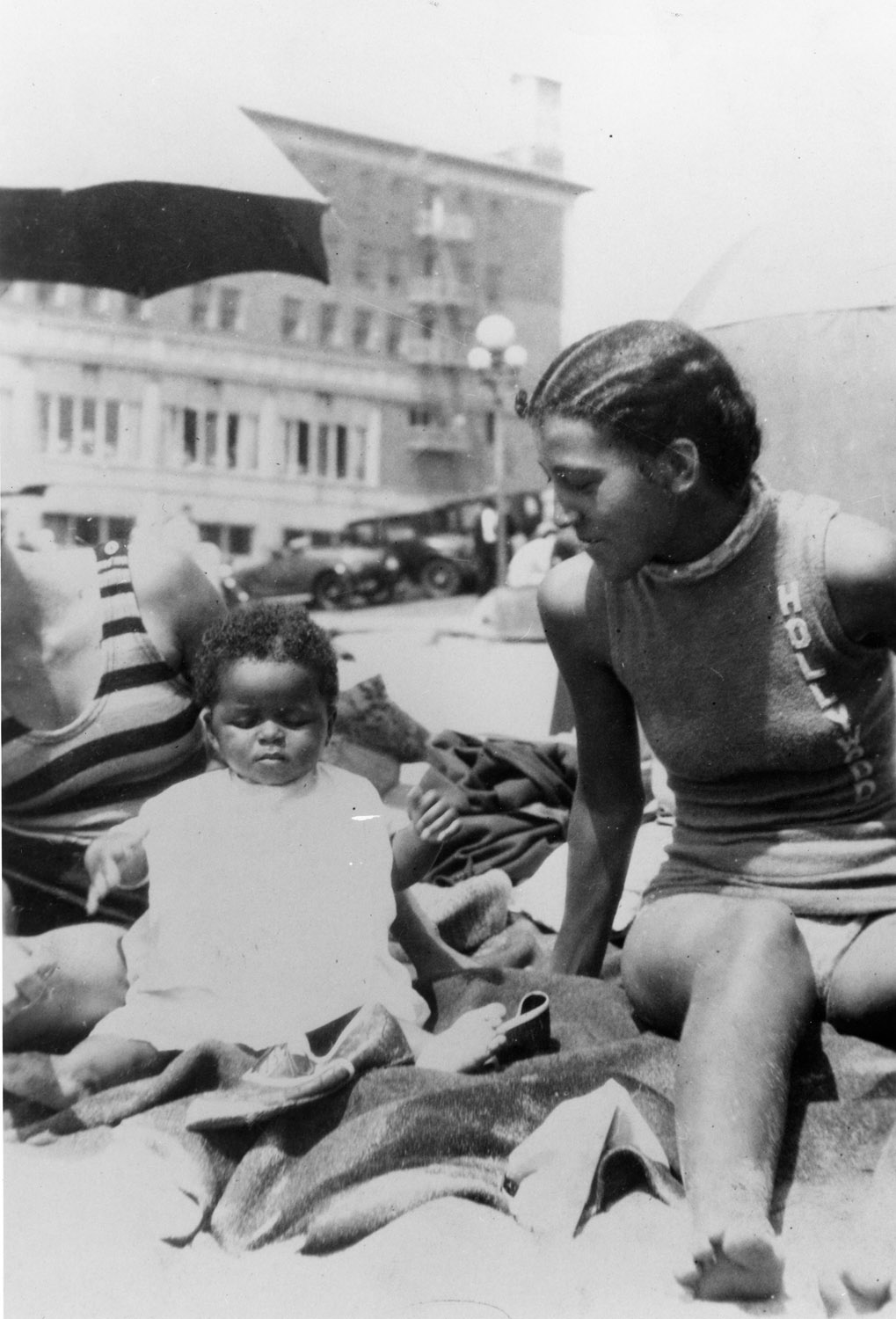
Woman and small child at Bay Street Beach in 1931./L.A. Public Library

Woman and small child at Bay Street Beach in 1931./L.A. Public Library

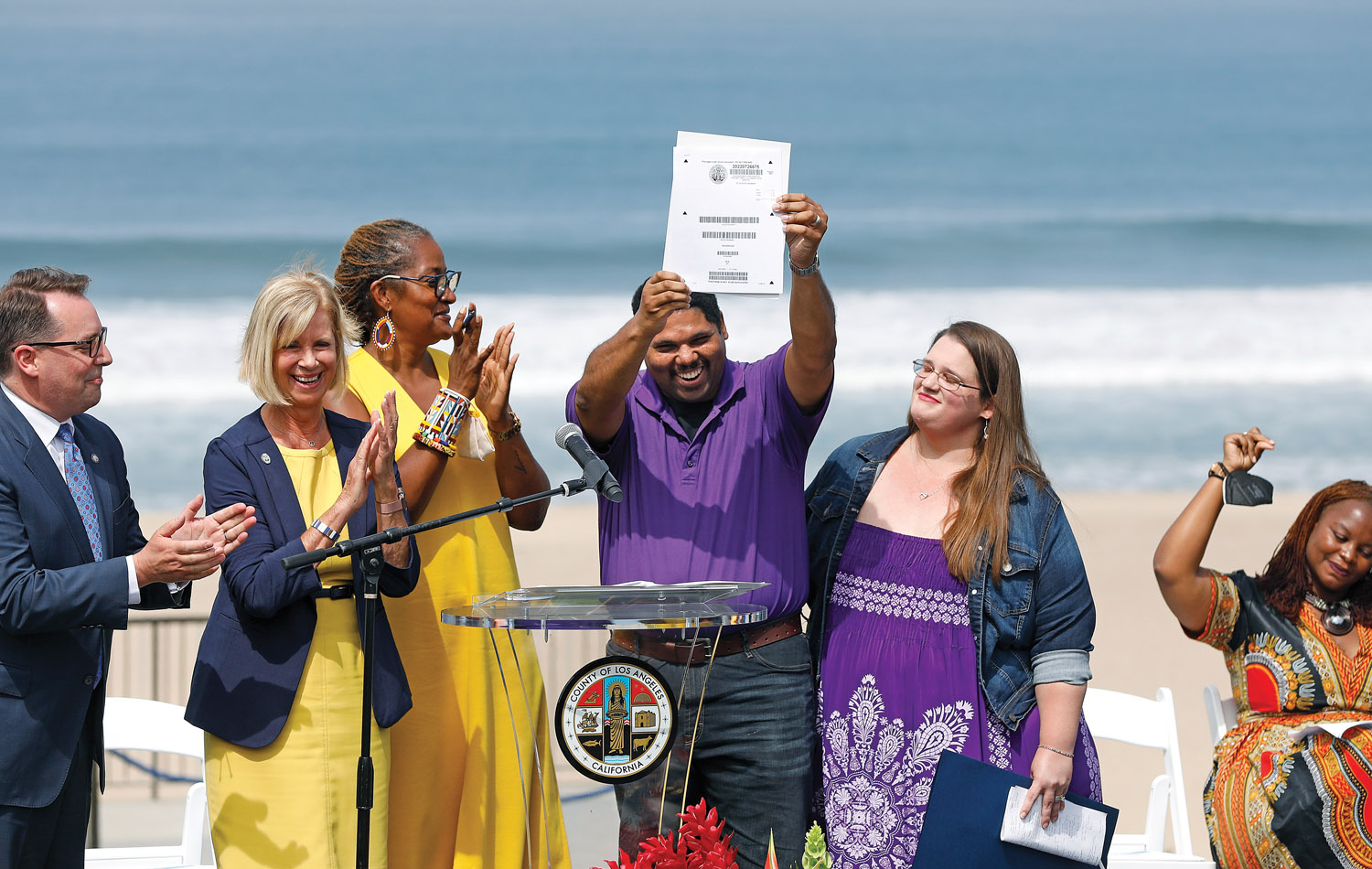
In Southern California, the return of the deed to the two lots that had formed the Bruce’s Beach resort to family descendants was a harbinger of other efforts, and it started with activists who heard the story and wanted justice for Willa and Charles Bruce. The Bruces migrated to Southern California from New Mexico in the early 20th century, and in 1912 Willa Bruce purchased the first of the family’s two lots in Manhattan Beach. Over the years they created a seaside resort for Black Americans complete with a restaurant, bathhouse and space for dancing. But the city council, influenced by the Ku Klux Klan and racist white community members, condemned the Bruce property and that of other African American property owners in the small enclave that had grown up around their business, citing eminent domain to build a community park. The Bruces’ and other Black property owners’ buildings were destroyed in 1927 for a park that did not appear for decades, and owners were paid a fraction of what the beachside property was worth.

Still, less than a year after widespread coverage of the July 2022 ceremony marking the return of the deed to the Bruce descendants, the family sold the property back to L.A. County in January 2023 for $20 million. The move was controversial, but the beachfront land—now used as a lifeguard training facility west of the grassy hill—is not zoned for private development and the descendants had been leasing it back to the county for $413,000 a year. What the family will do with the money is unknown, but Jefferson hopes some of that restitution will be used for community programs in Southern California to encourage young people to head to the beach and learn its history.

Today, the legacy of Bruce’s Beach clings more tightly to its past. “We have to keep telling the story,” Jefferson says. “This story is not over. There are still things we don’t know [about] what happened in Manhattan Beach. There are 35,000 people who live in Manhattan Beach and less than half a percent are of African American descent. So that tells you a legacy. But we also had the legacy of these Black pioneers, the Bruces and the other property owners and the visitors who were going down there who were striking out to enjoy what California had to offer, and to potentially develop their own dreams of property ownership or other things because they were inspired by going to this particular beach.”
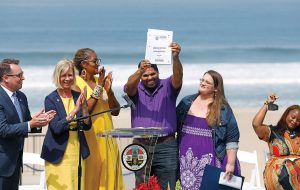
Anthony Bruce holds up a certificate of the deed as the family property taken by eminent domain in the 1920s is returned to descendants in 2022.

Anthony Bruce holds up a certificate of the deed as the family property taken by eminent domain in the 1920s is returned to descendants in 2022.

As she walks the breezy streets, Jefferson explains how the city of Santa Monica reached out to her in 2019 after the California Coastal Commission required an educational program to address the erased Black histories of South Santa Monica as a new park was being developed. She helped create interpretive signage there as part of what became the Belmar History + Art project in the new Historic Belmar Park, located where Black and other marginalized communities once resided. In 2020, the permanent outdoor exhibition was unveiled—colorful signs with historical narratives, along with a bright red sculpture in four pieces resembling the frame of a house. A Resurrection in Four Stanzas was created by Los Angeles artist April Banks, inspired by the people whose homes were destroyed due to urban redevelopment and by a photo of white city officials burning down a shotgun-style house in 1953.

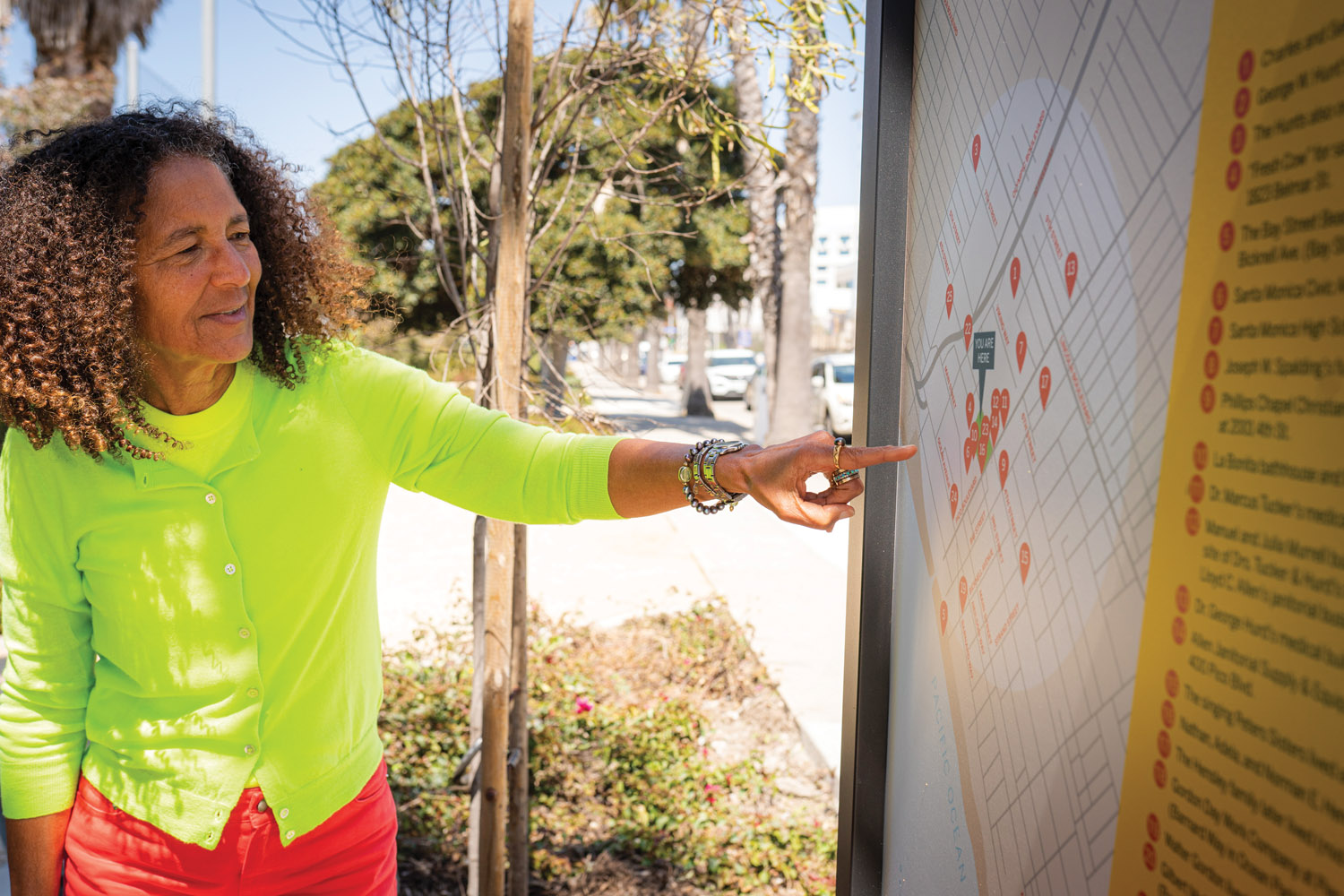
Surrounding the new sports field, the walking path features 16 panels that tell the history of notable individuals—business leaders, doctors, pastors and other Black community members—accompanied by black-and-white photos. A map notes important nearby sites and buildings that still stand, such as the 1905 Phillips Chapel Christian Methodist Episcopal Church and the Murrell Building, built by Santa Monica’s first Black mail carrier and also, for a time, the office of the first Black doctors in the area.

Jefferson knows all their stories by heart, many of them told to her through firsthand reflections. From the beach, she stops and points east to the big hill on Bay Street. “Look up at the top,” she instructs. Then she swings around for a straight view of the shimmering ocean before her. “Who could resist this?”
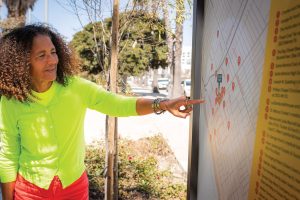
Alison Rose Jefferson ’80 points out local historic sites as shown on one of the panels she designed for the Belmar History + Art project.

Alison Rose Jefferson ’80 points out local historic sites as shown on one of the panels she designed for the Belmar History + Art project.

Walking down to the beachfront, Jefferson explains that the beach at the end of Bay Street—marked “COLORED USE” on one 1947 map of the era—was another hub for Black Angelenos in the early 20th century to enjoy the sun and sand. It was not without conflict. Casa del Mar, the nearby white-owned beach club, claimed only their members could use the beach in front of the club and built a fence in the sand.

“So [Black beachgoers] found a place where they were less likely to be harassed,” says Jefferson as she walks over to a bronze plaque that recognizes the beach in front of Crescent Bay Park as “The Inkwell,” a controversial name given to it by whites. For years, this destination offered Black residents access to the joys of living in Southern California.

As she looks to the ocean, Jefferson considers her role, doing what she can to “push forward the storytelling.” Among her many endeavors, she has been working with the Santa Monica Conservancy, Heal the Bay and other groups for the last 15 years, facilitating programs on the beach and introducing kids to the history of this area; sometimes they get a surfing lesson and learn about an early Black and Mexican American surfing legend named Nick Gabaldón.

“Education is so important,” says Jefferson. “I want young people to know that they have the opportunity to tell the stories themselves as well. You first need to have that education to build your knowledge base.”

Sometimes, that means heading down to the beach on a sunny Southern California day—Bruce’s Beach in Manhattan Beach, Bay Street in Santa Monica and others—to learn what history has been washed away with the sand.
 

Roots of Change

Roots of Change

Continuing a long tradition of organizing among Pomona students and alumni, Jacob Merkle ’18 and Niles Brooks ’20 created Rhizome to equip the next generation of leaders.

Roots of ChangeThe yearning to build a better world may be innate, but the skills to become an effective organizer often need to be learned.

Jacob Merkle ’18 believes in the potential of young people to create the world they want to live in: They just need structure, encouragement and clear paths to opportunity. To provide those things, he founded Rhizome, a grassroots nonprofit for emerging high school leaders to learn how to organize and create civic communities.

Jacob Merkle ’18

“So many young people, especially today, really genuinely want to take on high-impact work, want to make meaning with their time,” says Merkle.

An international relations and politics double major from Seattle, Merkle first became an organizer himself while at Pomona. He reveled in “the feeling when you’re shoulder to shoulder with folks that aren’t just talking about making the world a better place but are actually taking active steps toward making that happen.”

While Merkle says that the most meaningful parts of his time at Pomona were the conversations he had over meals at the dining hall, he also graduated with top accolades in both of his majors, winning the Fred Krinsky Prize in Comparative Politics and the John A. Vieg Prize in International Relations.

Professor of Politics Heather Williams says of Merkle, “He is one of those ‘immortals,’ or students whose presence, thought and writing rise above their peers. He’s one of the most likely politics alumni to become a major thought leader and public intellectual.”

After graduating, Merkle worked for Michelle Obama’s organization When We All Vote, where he helped register 38,000 students to vote. While doing that work, he realized the untapped potential of high school and college students. He enrolled at Cambridge University and earned a master’s degree in sociology, with his dissertation focused on the language used by history’s most persuasive nonviolent movements to motivate people into action.

“This research offered a personal, practical blueprint for how to organize sustainably over the course of my lifetime,” Merkle says.

Shortly after that, in 2021, he founded Rhizome (werhize.org). The impetus was “to be a part of building something that was authentically student-led, that was sustainable, that was collectively owned.”

He began calling people he had worked with in prior organizing efforts and eventually had 90 co-founders. These student organizers continue to vote to shape the goals, vision and work environment of Rhizome.

One of the people Merkle tapped was Niles Brooks ’20. Brooks, an international relations major from Memphis, Tennessee, headed Building Leaders on Campus (BLOC) at Pomona as well as Young Men’s Circle, a community outreach program. The two knew each other through playing together on the Pomona-Pitzer men’s soccer team. Merkle saw Brooks serving as a “spiritual center” for Rhizome, calling him “one of the most morally wonderful people” he has met.

Niles Brooks ’20Others at Pomona apparently agreed. Brooks won the Ted Gleason Award, given annually to the student who made a warm-hearted contribution to the community life of the College through traits such as sympathy, friendliness, good cheer, generosity and, particularly, perseverance and courage.

Brooks’ nonprofit work is partly inspired by his grandparents. “I learned from a young age what it meant to not have basic civil liberties in this country. My grandparents were folks who grew up in Jim Crow segregation,” he says. “Anytime I can leverage my experiences to help others, I will do that.”

Brooks believes in the work of Rhizome because “the younger we become civically engaged, the more likely we’ll treat civic engagement as a lifelong leadership activity.”

Through the support of Merkle, Brooks and other mentors, more than 600 students in organizing fellowships at 125 high schools have taken on campaigns such as advocating for safety policies in their cities, feminine hygiene products in their school bathrooms or spreading information about democracy vouchers—a recently developed finance method that allows voters to select recipients of public funding for political campaigns. Additionally, fellows helped more than 7,000 peers register to vote last year, and Merkle hopes to build on that number this year.

“Whatever it is that fellows care most about, we want to provide support for them to take action around those ideas,” says Merkle.

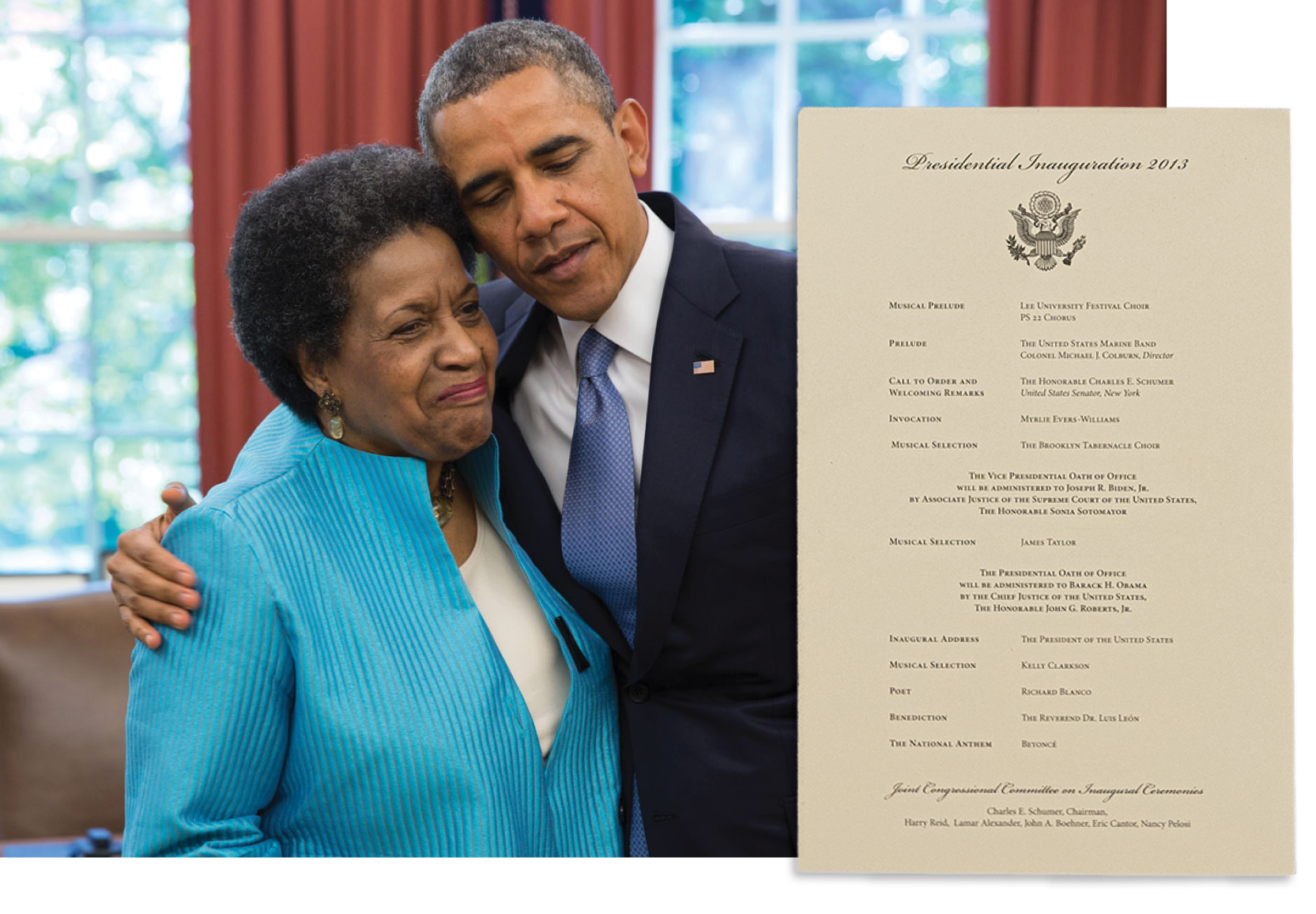
Merkle repeatedly strikes a spiritual tone as he speaks about his work. He and Brooks trained with the James Lawson Institute, a program for organizing movements and nonviolent action. (The Rev. Lawson, a contemporary of the Rev. Martin Luther King Jr. and a leading architect of the civil rights movement, spoke at Pomona along with Myrlie Evers-Williams ’68 in the inaugural Payton Distinguished Lectureship in 2018.)

“I think organizing is at some level always an act of faith,” Merkle says. “A belief in things unseen.”

This faith could be applied to Merkle’s long-term vision for Rhizome as well. In it for the long haul, he says, he hopes to make local chapters of the organizing fellowship accessible to students in every community across the country someday.

“We are in the nascent stages of building something that we think is going to get really big and beautiful,” says Merkle.

Rhizome (rai•zowm)

“Rhizomes are root systems that grow horizontally in unpredictable directions without beginning or end. Rhizomes are always in-process, always growing, always adapting to form symbiotic relationships with existing forms of life. We are a self-organizing system; deeper than grassroots.”

WeRhize.org Projects

Miami, FL: Advocating for access to free public transportation systems

Cary, NC: Organizing for feminine hygiene products in bathrooms

Newark, NJ: Meeting with the mayor on how to reduce peer-to-peer violence

Seattle, WA: Sharing information about how to use democracy vouchers

Nashville, TN: Joining James Lawson Institute for an intensive four-day training

Raleigh, NC: Running mutual aid campaigns to reduce youth food insecurity

Newark, NJ: Participating in a mental health forum with local city council