Blog Articles

National Youth Poet Laureate Finalist

Zoe Dorado ’27

Zoe Dorado ’27 traveled to the Kennedy Center in Washington, D.C., in April and performed as a finalist for National Youth Poet Laureate, a role once held by Amanda Gorman, who read her poem “The Hill We Climb” at the inauguration of President Joe Biden.

Dorado, representing the Western U.S., took the stage alongside three other finalists and was named the runner-up to 2024 honoree Stephanie Pacheco of New York.

Dorado began her writing journey in her hometown of Castro Valley, California. At Pomona, she plans on majoring in English and is exploring a possible double major. Asked how her poetry and social activism are related, Dorado says poetry is humanizing.

“Especially when there’s a lot of grief in the world, we go into direct action,” she says. “But we also need to take the time to grieve and sit with ourselves in order to fully show up for ourselves and for the people in and beyond our communities. Poetry gives us space to do that. I don’t think poetry will save the world. But it will help us reckon with it.”

The Sagehen and the Super Bowl

By day, Della Anjeh ’16 works as a software engineer at Google. On evenings and weekends during football season the past two years, she has moonlighted as a cheerleader for the San Francisco 49ers.

Her experiences at Pomona College helped launch both careers.

Della Anjeh ’16 software engineer at Google.

Della Anjeh ’16 software engineer at Google.

Anjeh knew she wanted to major in computer science when she arrived at Pomona from O’Fallon, Missouri, via the QuestBridge program. She credits her advisor, Professor Tzu-Yi Chen, with nurturing and guiding her. Her junior year, she landed an internship at a startup company through Code2040—a nonprofit that connects Black and Latino technologists with companies and mentors—when its recruiters visited Pomona’s campus. The internship opened doors, and since graduating, Anjeh has worked as a software engineer at Lyft, Amazon, Microsoft and now Google.

Despite growing up dancing, Anjeh didn’t imagine a career in professional dance. Her first year at Pomona, however, she signed up for a hip-hop dance physical education class. The instructor, Kristen Egusa, was a dancer for the Los Angeles Clippers and a choreographer for multiple professional sports teams. Attending a professional cheer workshop Egusa held in the Los Angeles area exposed Anjeh to the world of professional cheer for the first time. On campus, she also danced with the 5C Dance Company.

Della Anjeh ’16 seen in the center, cheerleading for the San Francisco 49ers.

Della Anjeh ’16 seen in the center, cheerleading for the San Francisco 49ers.

Now for the past two seasons and counting, Anjeh has donned red and gold as a 49ers cheerleader as a counterpoint to her time in front of a computer. In February, she capped her second season with a trip to the Super Bowl in Las Vegas, where the 49ers fell to the Kansas City Chiefs.

Besides the opportunity to perform on the world stage, other highlights included watching the halftime show from the field and encountering a wide swath of 49ers fans.

“Being involved in all the excitement was really fun,” she says. Did she see Taylor Swift in the stands? “We got to see just about everything you could see,” she answers.

Not bad for a side gig.

“It’s a flexible enough commitment for people to maintain pretty demanding full-time jobs,” Anjeh says. “I just love to perform.”

Ignacio López Day in the City of Pomona

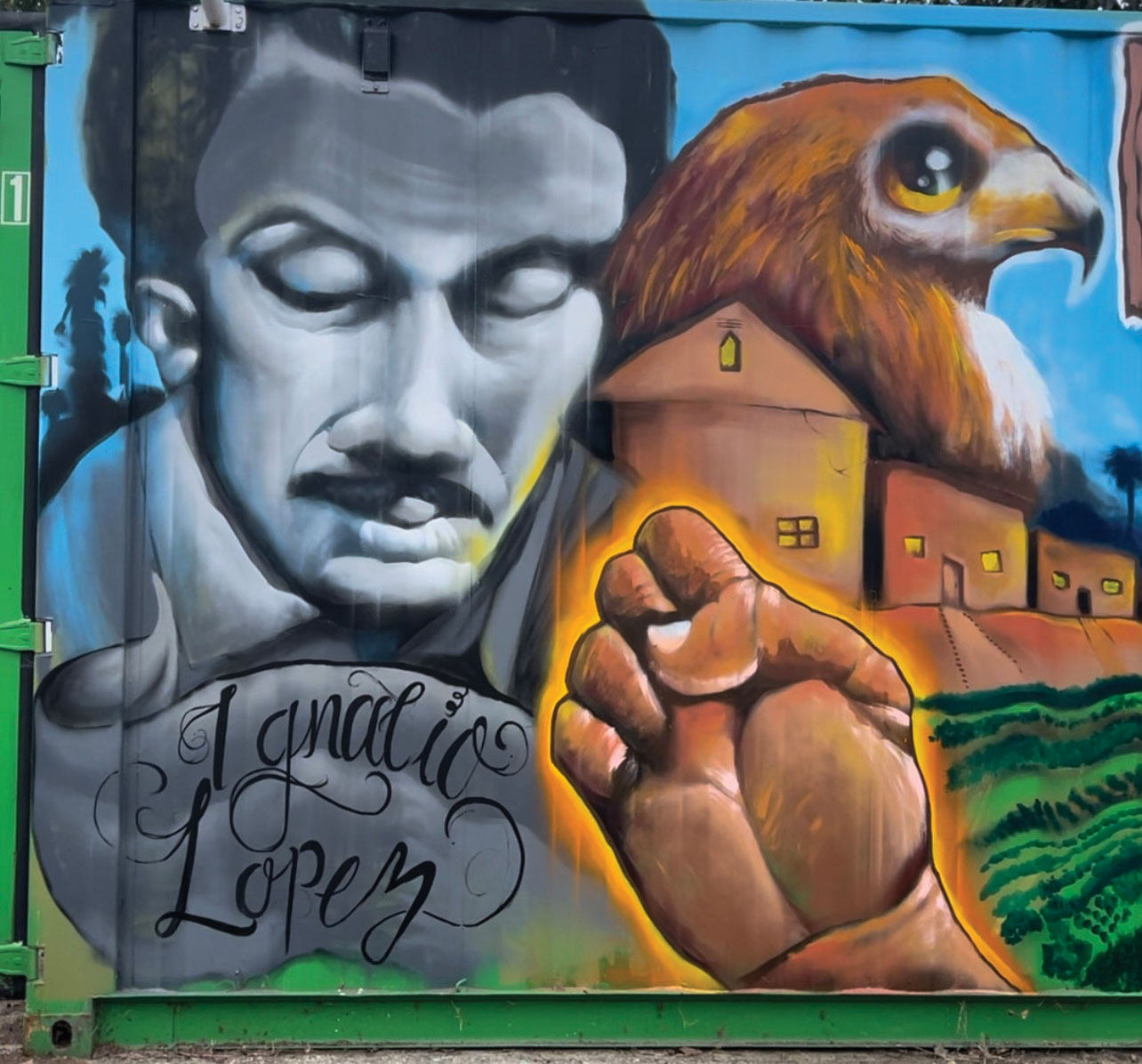
Mural by Thundr One. Photograph courtesy of López Urban Farm

Mural by Thundr One. Photograph courtesy of López Urban Farm

March 19 was Ignacio López Day in the city of Pomona by proclamation of the city council.

The date marked the 116th anniversary of the birth of the late journalist and civil rights champion Ignacio López ’31, who fought discrimination against Latinos in the region for decades, publishing his influential El Espectador newspaper in Pomona from 1933 to 1960.

His name lives on through both Pomona’s Ignacio López Elementary School and the López Urban Farm, a partnership between the local nonprofit Community Partners 4 Innovation and Pomona Unified School District. The farm provides people in the community with access to locally grown food and also educates youth on sustainable agriculture practices. Among the murals at the farm is one depicting López.

KSPC Radio Rocks On

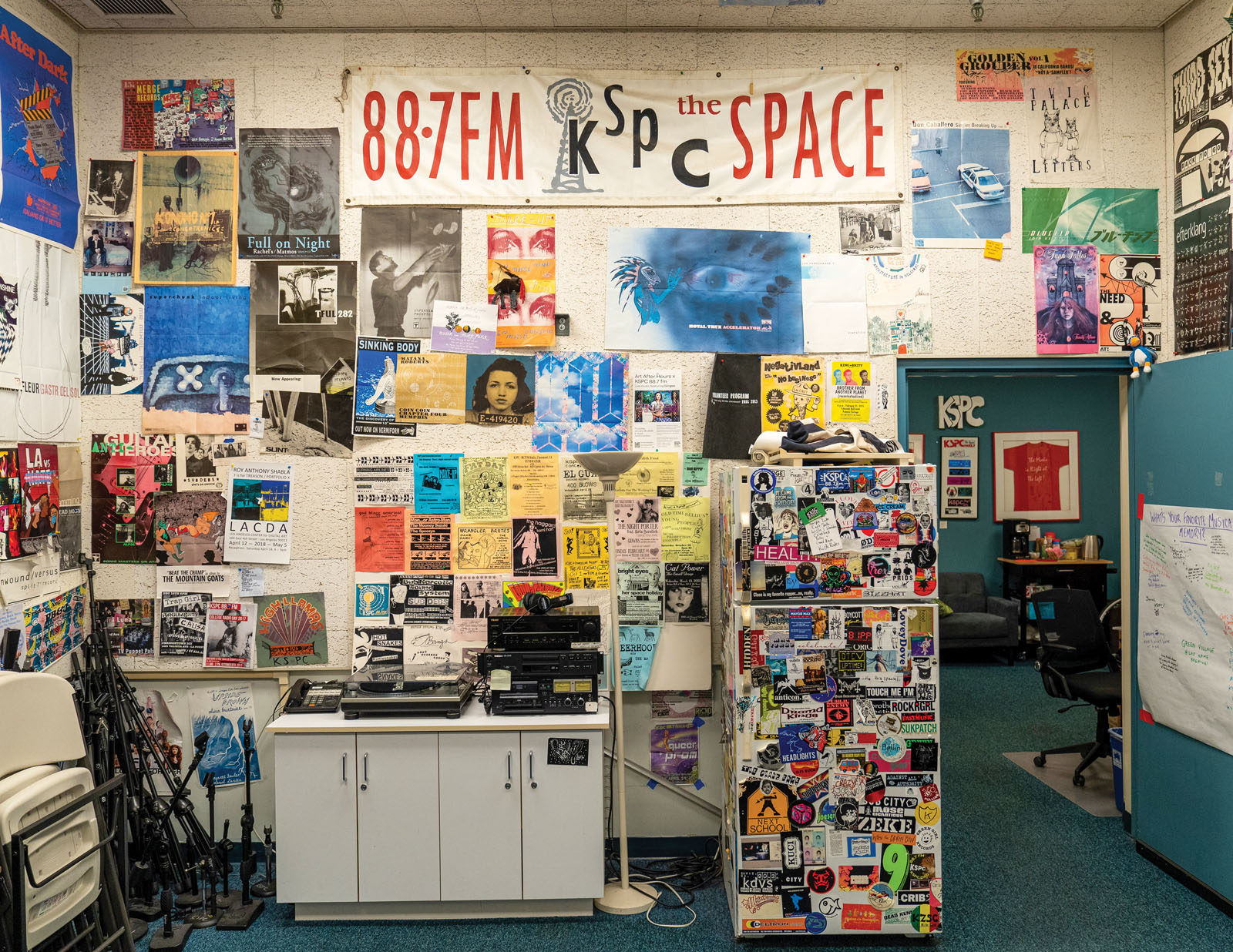
DJ Comet and DJ Moon were a natural fit for KSPC 88.7 FM, the station of The Claremont Colleges, which celebrated 68 years on the FM airwaves in February. (KSPC was preceded at Pomona by the AM station KPCR.)

DJ Comet was supposed to be a placeholder name until Anaelle Roc ’24 found another. But the moniker—a play on her last name and love of space—fit perfectly at the station often known as The Space. Pomona classmate Emily Gibbons ’24 christened herself DJ Moon on the same theme.

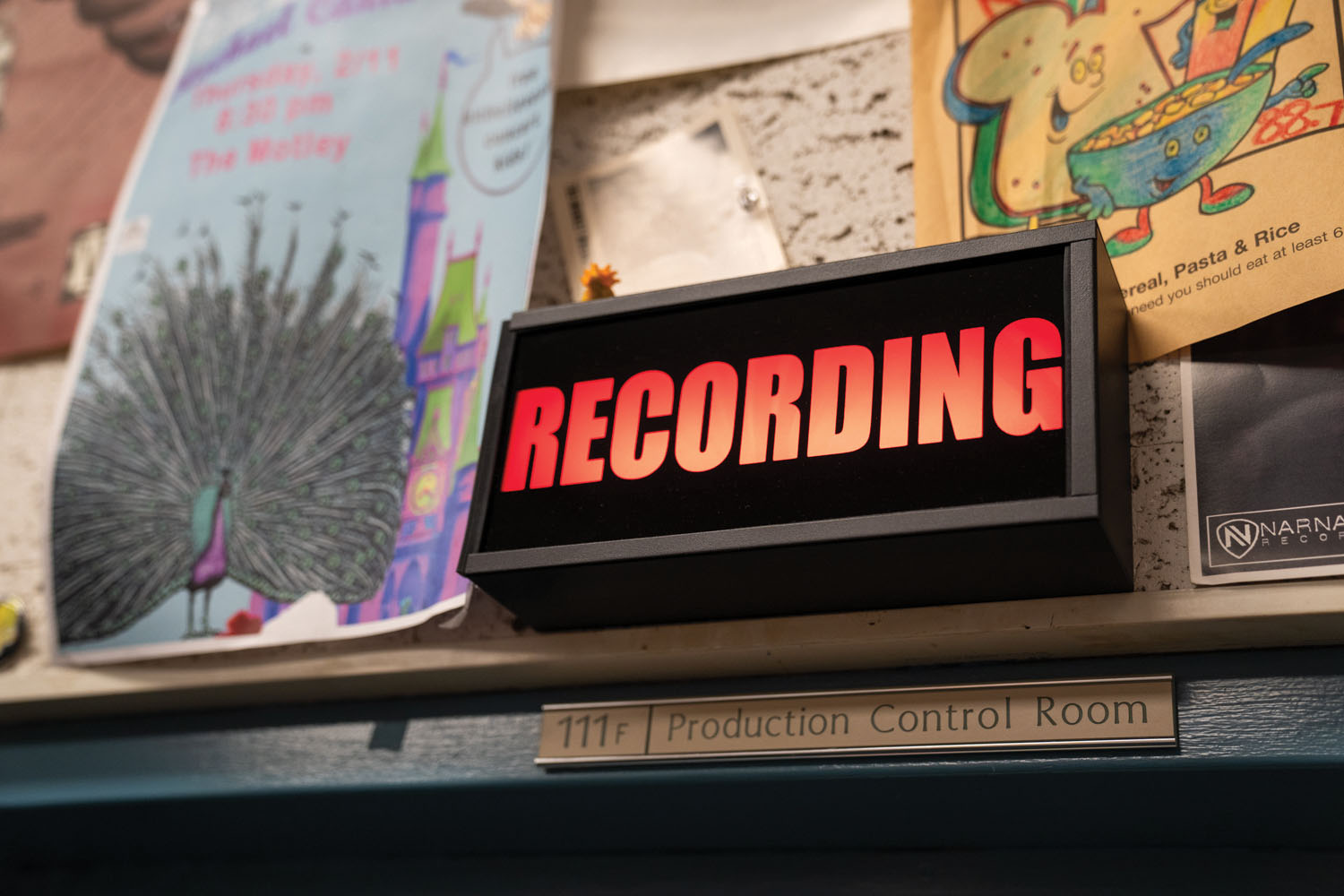
Roc and Gibbons represent a senior class whose introduction to college came via Zoom during the early months of the pandemic. While remote in 2020, Gibbons worked as a music director at KSPC, reviewing albums and music. Roc became a production director, learning how to edit shows and write promotions and community messages. Once they were on campus as sophomores, KSPC’s secluded headquarters awed them both.

“The Space is a time capsule,” Roc says. “There are posters there from the ’80s, photos there from the ’50s when it became an FM station. I was instantly hooked.

“People ask, ‘Why do radio? Radio is dead,’” Roc says. “We have Spotify, the internet, AI DJs who can find you the perfect song. But people are really attracted to The Space. It’s a beautiful space with all this history. We want to be part of that legacy.”

Gibbons, a philosophy major and host of In the Clouds with DJ Moon, plans to attend law school, with dreams of becoming an attorney for a band or music label.

“I would love to get involved in the radio station of whatever law school I go to if they would have me,” she says.

Roc, a physics major, is so invested in mastering the craft she says she only applied to astrophysics graduate programs with established radio programs either on campus or in the community.

“Live music is something I can’t live without,” the host of cathartic destruction says. “I’m tied on a soul level to radio now.”

Letter Box

The Liberal Arts for Life
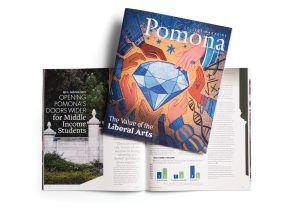
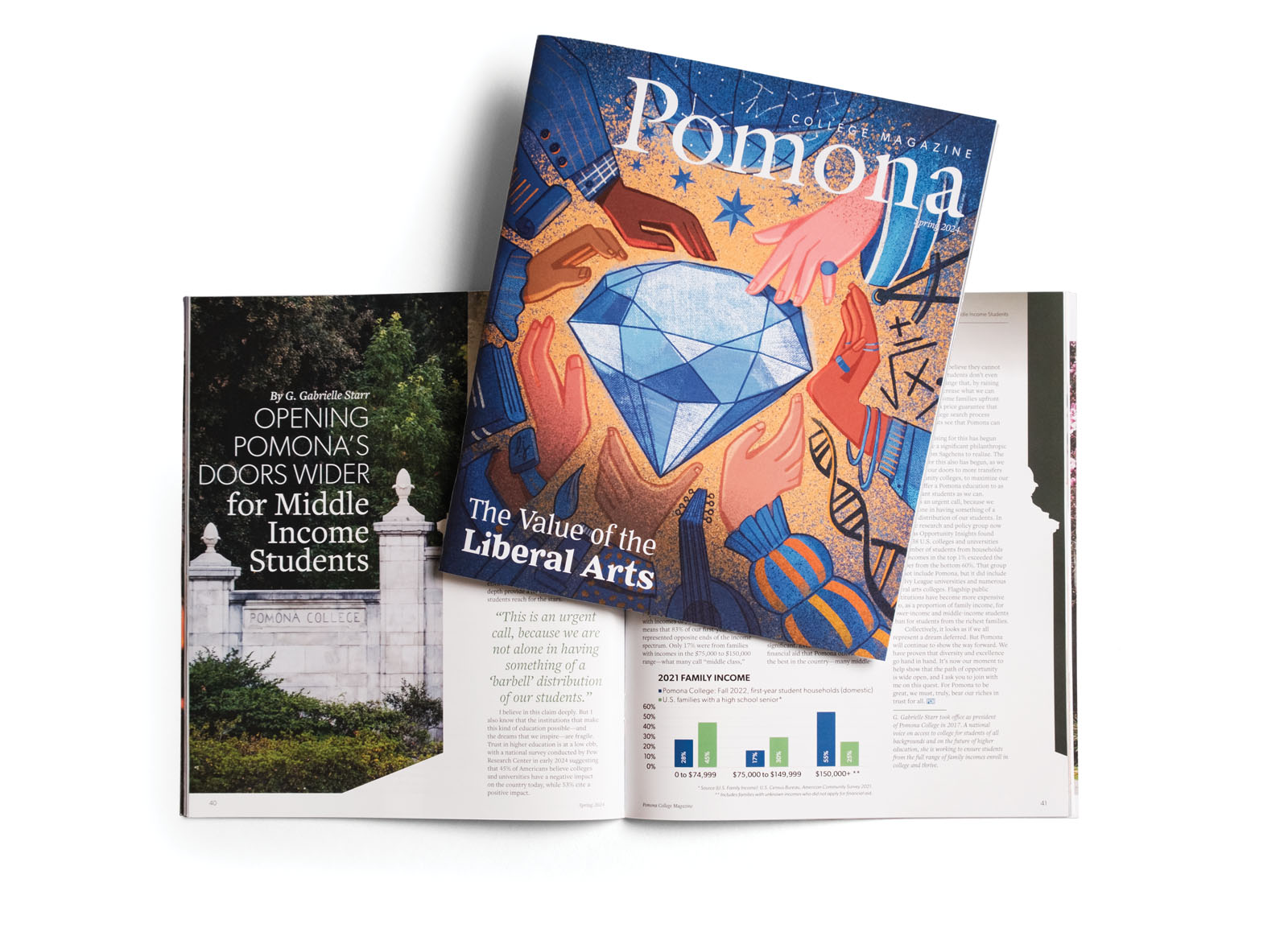
I was pleased to see your Pomona College Magazine article devoted to the value of liberal arts (Spring 2024). As one whose four years at Pomona included courses in over 20 departments, a semester in India, a history major, completion of pre-med requirements and evenings spent hanging around the music department, I loved the breadth of opportunities that Pomona provided. And, yes, some of those “non-career-prep” courses did help me in my work—for example, giving me tools to author successful textbooks and edit a scientific journal.

But the real value of my liberal arts education was that it made the non-work aspects of my life much fuller and more enjoyable. So I wish that your article had said more about this side of liberal arts.

I understand that our society these days tends to define return on investment in terms of dollars and cents, but the older I get the more I realize that it’s what makes you happy that matters, and Pomona’s contribution to that aspect of my life was squarely in the liberal arts opportunities it provided.

—Philip D. Sloane ’72
Professor of Family Medicine and Geriatrics
University of North Carolina at Chapel Hill


Praise for PCM, Aid for Middle-Income Students

Congrats on the “Value” issue (Spring 2024).

I think the cover is exceptional—eye catching, artistic, clever with math, musical and DNA symbols. The diamond representing “value” was quite creative.

The article about supporting the financially mid-level students is timely in my opinion.

Keep up the good work.

—Ron Smith ’63
Newport Beach, California


A ’60s Activist’s Take on Politicized Campuses

The subject of your piece is obviously of great interest, and I appreciate your effort to cover the waterfront in the limited space at hand. That said, I was disappointed that what strikes me as by far the most compelling issue driving the turn against liberal arts colleges—the politicization of the campus—is mentioned only briefly in your editor’s letter.

FYI, I was a political activist at Pomona in the 1960s, and having in the course of my career as a journalist moved to the right, I look back on the changes wrought by radicals like me at places like Pomona with regret and shame. It was a truly diverse intellectual campus when I arrived in 1966, far less so when I left in 1970; and on the basis of everything I see, a frighteningly narrow place today. And it’s a good guess a fair number of my fellow elderly grads feel the same. This is hardly unique to Pomona, of course, or even to colleges. My kids went to Fieldston in New York, and while it’s always defined itself as a progressive place, I’d be horrified if my grandkids were there today. And, alas, reading of the evident near-uniformity of thought in Claremont on issues of race, gender and now the Middle East, I feel very nearly the same way about Pomona.

Yours is an alumni magazine, and I understand you are not in the business of stirring the pot. Still, it’s unfortunate that as an interested alum I have to go to The Claremont Independent to find [other news coverage of campus].

—Harry Stein ’70
New York


Closer Look at Classroom Photo
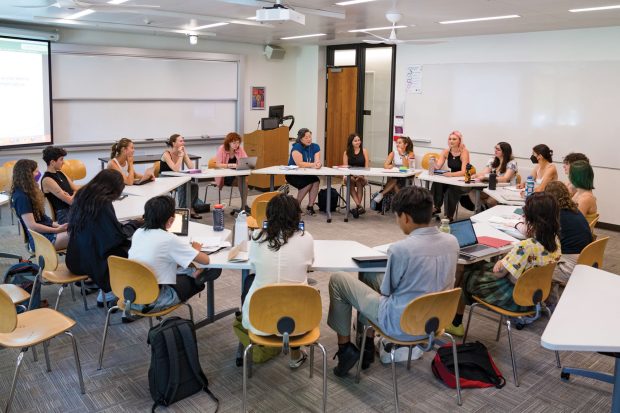
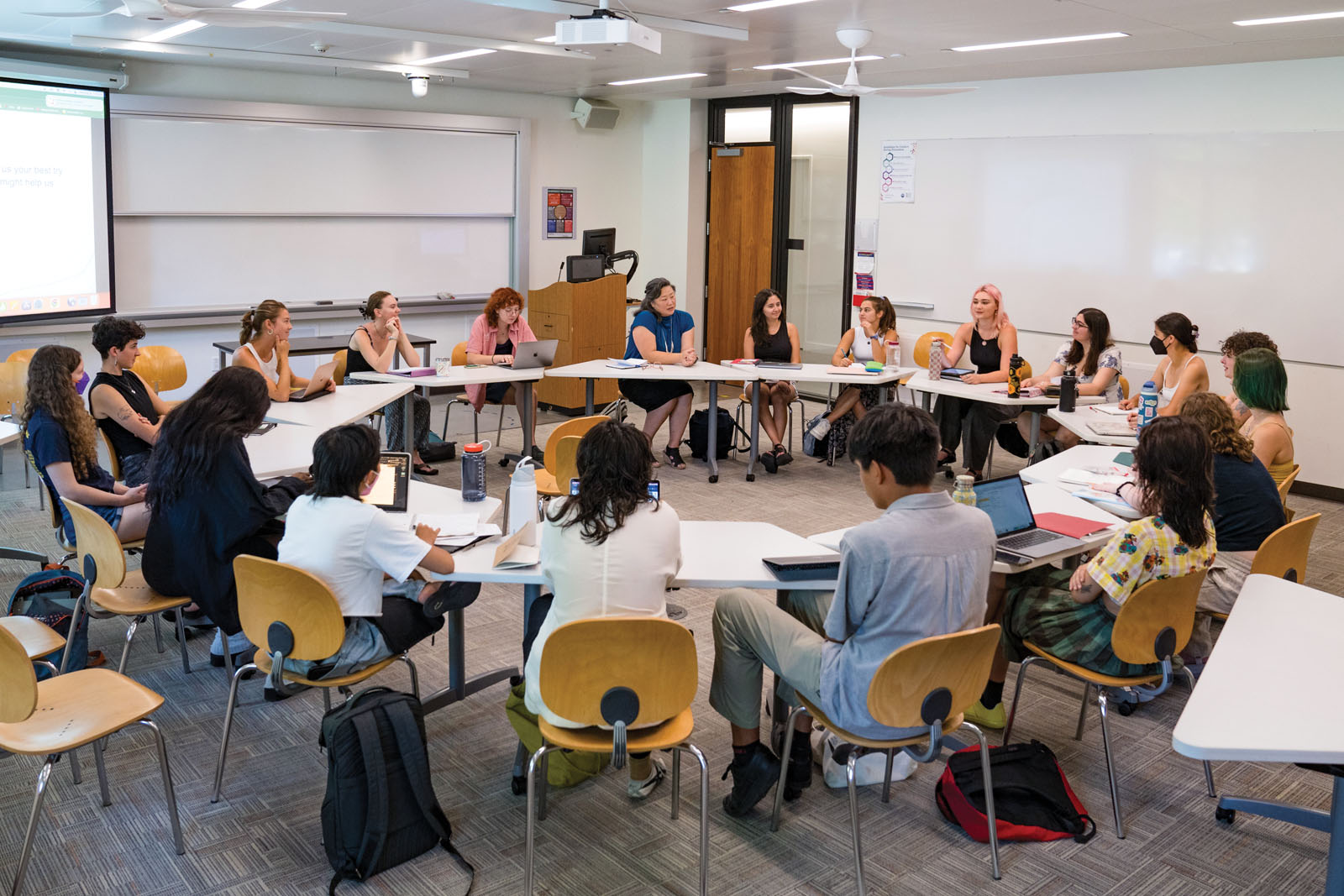
Associate Professor of Gender and Women’s Studies Aimee Bahng, right of the podium, leads a discussion in her Race, Gender and the Environment class.

Associate Professor of Gender and Women’s Studies Aimee Bahng, right of the podium, leads a discussion in her Race, Gender and the Environment class.

It was with great anticipation that I turned to your cover story on “The Value of the Liberal Arts.” Over a lifetime, Pomona’s liberal arts education has served me well both personally and professionally.

I was briefly thrown off by reference early in the story to “the gender and women’s studies class” since it is one of the newest and least established parts of the liberal arts curriculum. This mention felt a bit like the tyranny of political correctness (pc). But I continued to read until I took a close look at the photo of a class on gender studies, which covers the top of the right-hand page in this feature article’s two-page spread. Of the 19 people seated around the table, 17 or 18 are women and only one or two are men.

Those who seek to demonize gender studies charge them with being militant feminism, a.k.a. reverse sexism in disguise. Yet they have the potential to be of great value at a time when surveys show a larger divergence in life attitudes among young women and men than in the past. The big question is whether gender studies bridge this gap or widen it. The class photo is not encouraging in this regard. It suggests Pomona is not marketing gender studies to students in a way that is equally inviting to men and women, and thus is not inclusive.

That Pomona’s magazine could overlook the glaring implication of this photo suggests it is in the grip of an ideology regarding the need to promote gender studies as the new flagship of liberal arts. In this case, PC has fallen into the trap of being pc. Please take a closer look at such messaging.

—Glenn Pascall ’64
Dana Point, California


Arrest of Protesters on Campus

First, my bona fides. My great-grandfather, Edwin C. Norton, was Pomona’s first dean. My grandfather, Ralph Lyman, put Pomona on the map by introducing European classical music to Southern California and mentoring Robert Shaw, later mentored by Arturo Toscanini. Shaw was the greatest choral conductor of his time in America.

Now the war has come to us. No surprise that. The question faced all over our country is how do those in power deal with student unrest.

I am beyond appalled by how President G. Gabrielle Starr chose to militarize her response.

—David Lyman, ’66
South Pasadena, California

Editor’s note: Read more on the April 5 arrests of 20 people, including seven Pomona students, during a masked protest in Alexander Hall.


Correction

The article “A New Community Space in the City of Pomona” on page 8 of the Spring 2024 issue incorrectly referred to David Armstrong ’62 as deceased. Armstrong, founder of the American Museum of Ceramic Art on Garey Avenue in Pomona, still visits the museum almost daily as it undergoes a major remodel. At 51,000 square feet, it is the largest such ceramics museum in the United States. Pomona College Magazine regrets the error.


Write to Us at PCM

Pomona College Magazine welcomes brief letters to the editor about the magazine and issues related to the College from the extended Pomona community—alumni, parents, students, faculty, staff, donors and others with a strong connection to the College. Write to us at PCM or mail a letter to Pomona College Magazine, 550 N. College Ave., Claremont, CA 91711. Letters should include the writer’s name, city and state of residence, class year for alumni and contact information. With rare exceptions, letters should be no more than 400 words in length. Letters are selected for publication based on relevance and available space and are subject to being edited for brevity and clarity.

Stray Thoughts: Leaving Campus

Working on a college campus lends itself to looking back on your own college years.

With this issue of the magazine, I think again about how I never considered studying in another country while I was in school.

For one thing, I assumed it was too expensive because the only students I knew who did seemed to be alumni of New England boarding schools and I was from a public high school, one of four children in my family headed to college and already paying out-of-state tuition.

For another, this was the University of North Carolina at Chapel Hill, and Michael Jordan and Kenny Smith were my contemporaries. I didn’t want to miss any basketball games.

Only when I went to Europe the winter break before my final semester with a friend who was already working and generous with his frequent flyer miles did I see how much more actually using the language I had studied, seeing the art and architecture I had written about and standing in the places where history happened made me want to learn more.

After that—and once I was earning my own frequent flyer miles—I spent a lot of my 20s and 30s traveling to Latin America, various countries in Europe and later to Australia, each time coming back more interested in the literature, languages, history and current-day politics of those places than when I’d left.

Studying internationally already is much more part of the culture at Pomona than it was at UNC then, with about half of Pomona students studying away from campus, either internationally or in a domestic program.

One of the goals of the Global Pomona Project that inspired this issue is that every Pomona student will meaningfully engage with global learning, whether from abroad or here in the U.S.

What’s more, global education on campus is going to get a huge boost in coming years with the announcement of planning for the Pomona College Center for Global Engagement.

As for study away from campus: To ensure equal access for all students, financial aid transfers 100% for students participating in study away through Pomona College during the academic year. In addition, national and program-specific scholarships are available for fall, spring, academic year and summer study away from campus.

Think of that: A student reliant almost entirely on financial aid has as much chance to study internationally as one whose family goes to Europe on vacations.

Simply the awareness that it’s possible for any student to study in another country or another part of the U.S. means so much. I hope scanning the list of countries and cities on the list at the Office of International and Domestic Programs and its website will become as common as looking at the catalog to pick classes for upcoming semesters.

Thinking about all the opportunities Pomona students have starts to make me want to travel again after years of being worn out from traveling for work. Which brings me to personal news: My six-plus years at Pomona are coming to an end as I take early retirement to spend some vital years with people I love—and maybe do a little freelance study abroad, too.

I’m thankful for my time at the College and the privilege of working on these pages and getting to know so many alumni, students, professors and colleagues who have given me enjoyment, taught me things I didn’t know and kept me feeling younger than I am.

With gratitude,

—Robyn Norwood

In Memoriam: Jerome J. Rinkus

Jerome J. Rinkus

Emeritus Professor of Russian
1938-2023Jerome J. RinkusEmeritus Professor Jerry Rinkus, who taught Russian language and literature at Pomona for three decades, died on February 24, 2023. He was 84.

Rinkus arrived at Pomona in 1973 and remained at the College until his retirement in 2003, serving for a time as chair of the Department of German and Russian.

A specialist in 19th-century Russian literature—the era of Tolstoy, Turgenev, Dostoevsky and Chekhov—Rinkus came of age during the Cold War, studying Russian at a time of critical interest to the U.S. government.

“In a sense, politics has influenced the overall pattern of my life,” he told Pomona College Magazine in 2003. “But it is the love of literature that has kept me going.”

Rinkus was an undergraduate at Middlebury College when the former Soviet Union launched Sputnik, Earth’s first artificial satellite, igniting the space race between the U.S. and the USSR that led to the first moon landing in 1969.

After graduating cum laude from Middlebury in 1960, Rinkus was awarded a National Defense Education Fellowship to continue his study of Russian from 1960 to 1964, earning a master’s degree in Slavic languages and literatures from Brown University in 1962. His doctoral studies at Brown were interrupted when he was drafted during the Vietnam War, serving from 1966 to 1968, after which he returned to Brown and earned his Ph.D. in 1971. He completed his doctoral dissertation on the work of Sergey Aksakov after writing his master’s thesis on Maxim Gorky. Rinkus taught at Bucknell University from 1968 to 1973 before arriving at Pomona.

“If not for Jerry Rinkus, I would not have embarked on the career I’ve enjoyed for the past three decades,” said former student Thomas P. Hodge ’84, now a professor of Russian at Wellesley College. “He made a huge difference in my intellectual life and in the lives of the many other Russianists who passed through the department he lovingly nurtured at Pomona.”

Hodge also noted that in the early 1980s, before word-processing software, it was also difficult to find Russian typewriters. “I vividly recall the way he painstakingly handwrote and glossed entire stories and long poems, then handed out the photocopies to us. He was indefatigable,” Hodge said.

Rinkus also had a policy for students in his beginning Russian class who struggled to find the words in their limited vocabularies to accurately describe aspects of their personal lives in Russian.

“I don’t care if you tell the truth, as long as it’s grammatically correct,” Rinkus told his students. “Every student in the room broke out laughing,” Hodge recalled. “I announce an identical policy for my own students every time I teach Elementary Russian.”

During the early parts of his career, Rinkus told Pomona College Magazine, many of his students learned Russian in preparation for government jobs as translators, diplomats or to work for the CIA.

“If you studied Russian in the old days, you could either work for the government or teach,” he said in 2003. “When the Soviet Union collapsed, interest in Russian dropped 40 to 50 percent. It was almost as if they were studying it to understand our enemy.”

During his long career, Rinkus earned grants and fellowships from the National Endowment for the Humanities and the Mellon Foundation, among other organizations. He traveled to the Soviet Union numerous times during the Cold War when it was uncommon for Americans to do so, participating in teaching exchanges, leading tours and conducting research.

He led a Pomona College alumni tour group to Russia, Siberia and Central Asia in 1978. In 1990, during the era of glasnost under the Soviet leader Mikhail Gorbachev, Rinkus led a Pomona alumni tour group that visited Tallinn, Leningrad (now St. Petersburg), Moscow and cruised the Volga River the year before the 1991 dissolution of the Soviet Union.

Born in Baltimore, Maryland, Rinkus was the grandson of emigrants from Vilnius, Lithuania. In addition to John Tarin, his partner of more than 40 years and husband since 2015, Rinkus is survived by a niece, nephew and cousin.

In Memoriam: Robert E. Tranquada ’51

Robert E. Tranquada ’51

Robert E. Tranquada '51

Robert E. Tranquada ’51

Public Health Advocate and Trustee
1930—2022

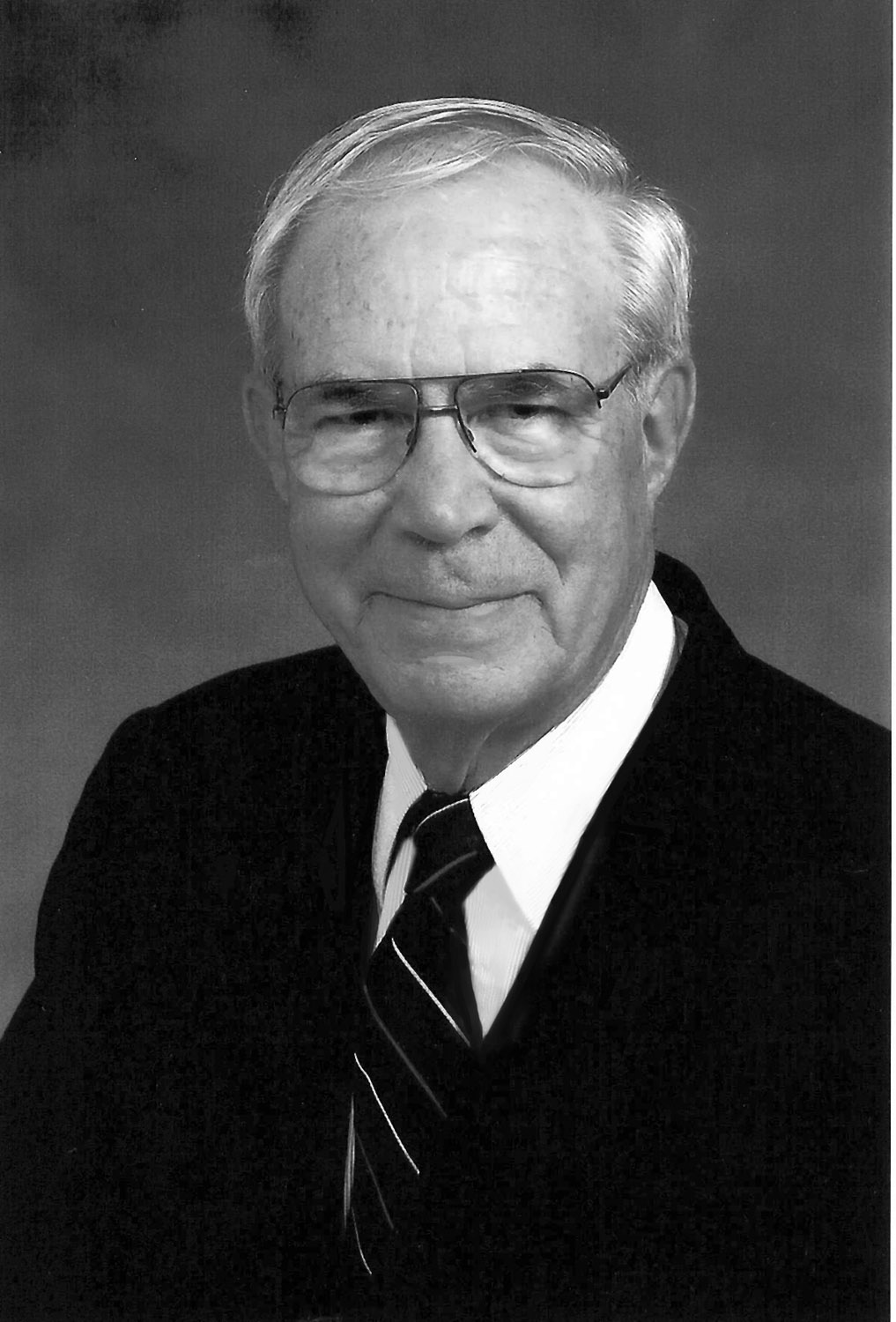
Bob Tranquada ’51, former chair of the Pomona College Board of Trustees and former dean of the medical school at USC, died on December 4, 2022, in Pomona. He was 92.

A diabetes researcher turned public health advocate, Tranquada was instrumental in increasing access to health care for underserved communities across Los Angeles County. He was a founding board member and chair of L.A. Care, today the country’s largest publicly operated health plan.

The son of two Pomona alumni and father and grandfather of others, Tranquada was a constant friend of the College. As a Commencement speaker and recipient of an honorary doctorate in 2007, he said, “I have been couched in the arms of Pomona College for a long time. It would be impossible to return more than a fraction of that I have received.” Awarded an Alumni Scholarship as a student, he returned much, both in service and financial support. The student health facility that serves The Claremont Colleges bears his name as the Robert E. Tranquada Student Services Center.

Tranquada’s path to medicine began early. Hospitalized with a broken leg at age 5, he was so impressed with the doctors who treated him he decided to become a physician. After graduating from Pomona College, summa cum laude and Phi Beta Kappa, he attended the Stanford University School of Medicine and joined the faculty of the USC medical school in 1959.

Tranquada’s career took a dramatic turn in 1965, when the California Army National Guard medical battalion he commanded was activated during the Watts Uprising to treat casualties of the violent confrontations between L.A. police and residents. Afterward, he was asked by then-USC Medical School Dean Roger Egeberg to head the new Department of Community and Preventative Medicine and to organize a public health clinic in Watts. Tranquada was one of the founders and the first director of the South Central Multipurpose Health Services Center in 1965 (now Watts Healthcare Corp.), one of the country’s first community health centers.

His experience in working to launch the health clinic, which opened its doors in 1967, led to a 40-year career in public health. Two years later, as associate dean of the medical school, Tranquada was appointed medical director of Los Angeles County-USC Medical Center. After five years as medical director, he became director of the Central Health Services Region of the L.A. County Department of Health Services.

Following other leadership positions, in 1986 Tranquada was recruited to become dean of what is now the Keck School of Medicine at USC with a mandate to develop a new private teaching hospital, today’s Keck Hospital of USC. It was while serving as dean that he was appointed to the Independent Commission on the Los Angeles Police Department, better known as the Christopher Commission, formed in the wake of the 1991 Rodney King beating. He also headed the Los Angeles County Task Force on Access to Health Care following the 1992 civil unrest, which led to the creation of Community Health Councils, a nonprofit that works to promote health and wellness in under-resourced communities.

After stepping down as USC medical school dean in 1991, Tranquada held an endowed chair in health policy before becoming professor emeritus upon his retirement in 1997. During his long and distinguished career, he was elected a member of the Institute of Medicine of the National Academy of Sciences and a fellow of the American Association for the Advancement of Science.

In addition to his service on the Pomona College Board of Trustees beginning in 1969, Tranquada was chair of the Claremont University Consortium board from 2000 to 2006. He served on numerous boards and was a particularly effective advocate for increasing the number of women and people of color in medicine, serving as a longtime board member of New York-based National Medical Fellowships, a member of the founding board of Charles R. Drew University of Medicine and Science and a board member of Martin Luther King Jr. Community Hospital.

Born in Los Angeles, Tranquada was the son of Ernest Tranquada ’27 and Katharine Jacobus Tranquada ’29. He married Janet Martin Tranquada ’51 after meeting at Pomona. In addition to his wife of 71 years, he is survived by children John ’77 (Lisa Sackett Tranquada ’77), Jim (Kristin) and Kate Tranquada; grandchildren Matt ’08, Jessica and Alex Tranquada; and his sister, Carolyn Prestwich ’54.

Civil Rights Press Photos at Benton Museum

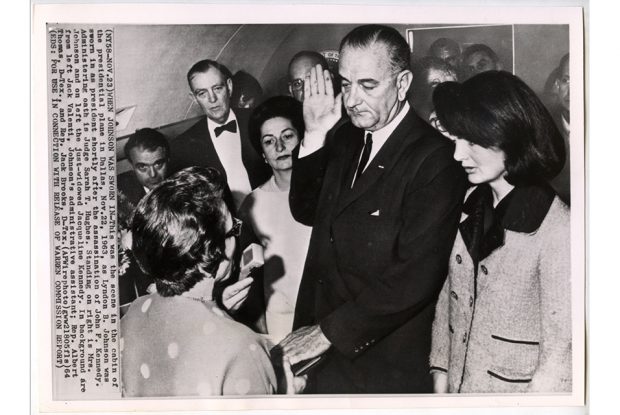
Cecil Stoughton, President Lyndon B. Johnson is sworn in by Judge Sarah T. Hughes as his wife and Mrs. John F. Kennedy flank him in the cabin of Air Force One, November 22, 1963 (printed 1964). Vintage wire photograph on paper. 6 9/16 x 8 in. (16.67 x 20.32 cm). Gift of Michael Mattis and Judy Hochberg in honor of Myrlie Evers-Williams. P2021.9.70Inspired by Myrlie Evers-Williams ’68 and the gift of her archives to the College, Michael Mattis and Judy Hochberg have donated their collection of more than 1,600 press photographs documenting the civil rights movement to the Benton Museum of Art at Pomona College in her honor. The Mattis-Hochberg photos include scenes of resistance, acts of civil disobedience and images of civil rights leaders including Martin Luther King Jr., Cesar Chavez, James H. Meredith as well as photos of Evers-Williams.

Coming to a Theatre Near You

Rose Portillo ’75, a longtime theatre lecturer at Pomona, has been cast in the upcoming Disney+ film adaptation of Alexander and the Terrible, Horrible, No Good, Very Bad Day. The latest screen version of the popular children’s book has a twist on the original: Alexander’s last name is Garcia, and the film will star Eva Longoria and Jesse Garcia with 9-year-old Thom Nemer as Alexander. Portillo plays Alexander’s grandmother, Lidia Garcia. In another recent Hollywood role, Portillo voiced the part of Señora Guzmán in Encanto, the 2022 Academy Award winner for best animated feature.