Blog Articles

A View Through the Bars

A View Through the Bars: With former Times editor Bill Keller ’70 on board, the Marshall Project is shining a light into the dark corners of America’s criminal justice system.

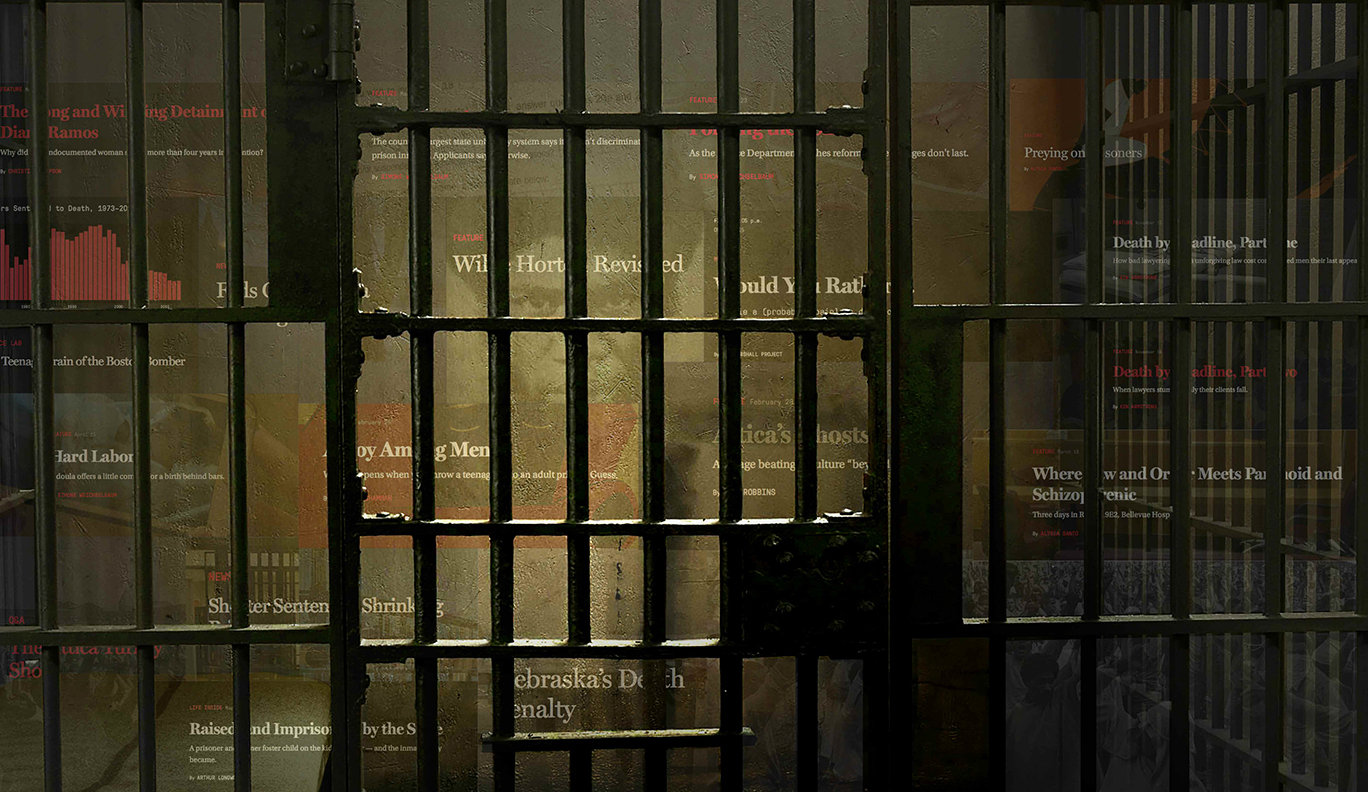
Photo illustration of prison bars with headlines from the Marshall Project websiteIT’S A CHILLY MARCH morning in Manhattan—the kind of grey, slushy Wednesday that can make even the most optimistic New Yorker wonder if winter will ever end. But for Bill Keller ’70, it might as well be spring.
The previous weekend, Keller’s former employer, The New York Times, ran a 7,500-word article about the brutal beating in 2011 of an inmate by guards at the Attica Correctional Facility in upstate New York. Three of the guards were scheduled to stand trial on Monday for multiple felonies, including first-degree gang assault. All had rejected plea bargains.

The story was reported by investigative journalist Tom Robbins for The Marshall Project, the nonprofit digital news outlet dedicated to criminal justice issues that Keller has edited since it launched in November of last year; and it was posted to the Times and Marshall Project websites before appearing on the front page of the newspaper’s Sunday print edition, complete with striking photos by Times photographers Chang Lee and Damon Winter. (Keller, who has been a trustee of the College since 2000, says he spent “a lot of time” dashing in and out of a board meeting in Claremont the previous Friday, shepherding the piece through publication.) On Tuesday, Robbins and Times reporter Lauren D’Avolio filed another story: all three guards had suddenly accepted a deal from prosecutors, pleading guilty to a single misdemeanor and quitting their jobs in order to avoid jail time.

From a purely journalistic perspective, the two articles packed quite a wallop, reverberating across the Internet and stimulating commentary in a variety of other media. And it’s not inconceivable that the first, lengthy story helped create the environment that made the second, shorter one come to pass; maybe, Keller mused in his Midtown office, a series of masks representing former Russian leaders gazing down at him from the wall, the guards decided to accept a plea deal because the weekend feature made it clear that prosecutors had a strong case against them.

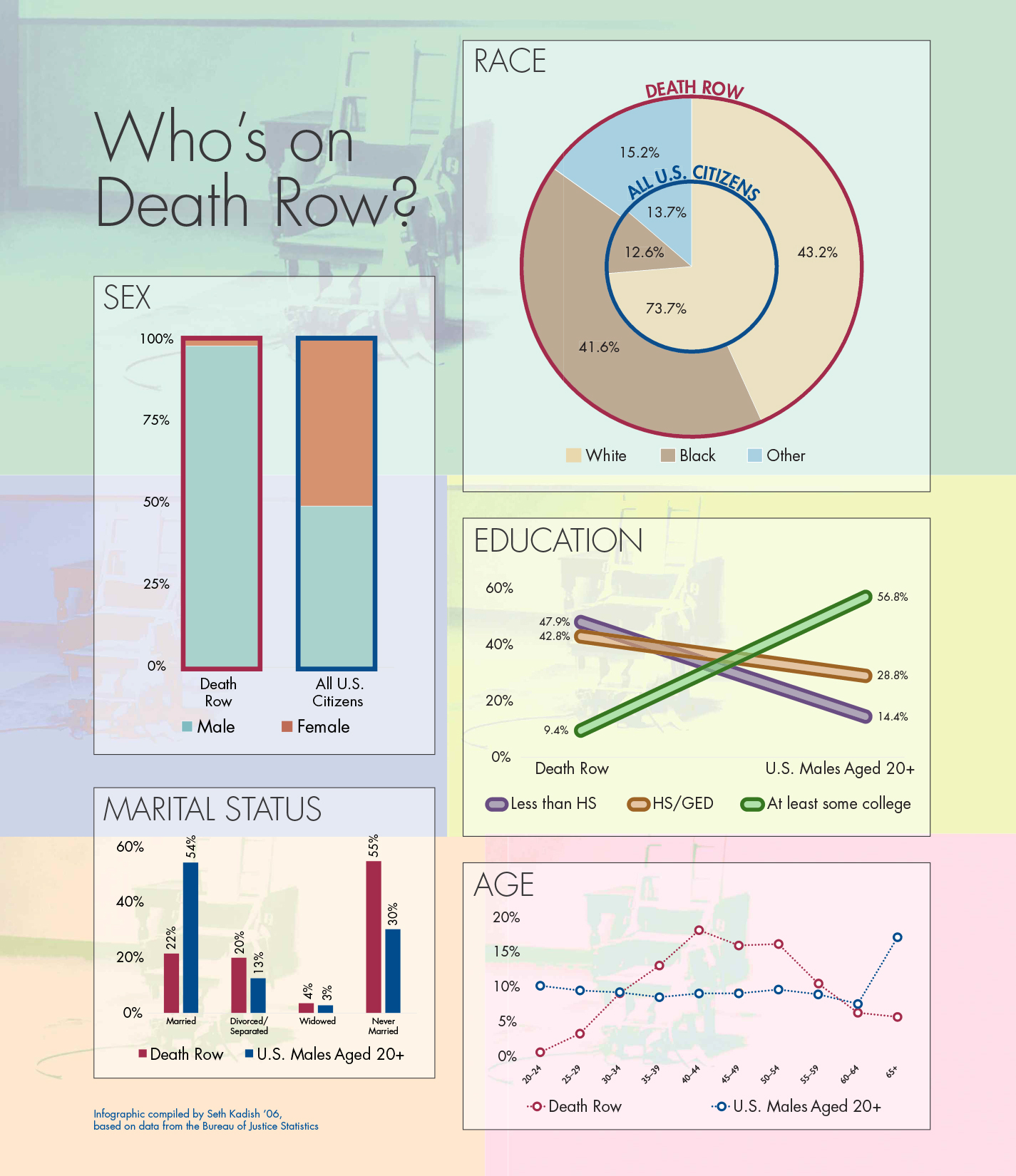
Who's on Death Row? Five charts comparing America's death row inmates to the larger U.S. population.

Click for a larger version.

The Marshall Project was founded by Neil Barsky, a former Wall Street Journal reporter, documentary filmmaker, and hedge-fund manager whose interest in criminal justice was piqued a couple of years ago by two books: Michelle Alexander’s The New Jim Crow, which examines the mass incarceration of African Americans; and Gilbert King’s Devil in the Grove, about Thurgood Marshall’s defense of four young black men who were falsely accused in 1949 of raping a white woman. (The Marshall Project was named for the late Supreme Court justice.) Barsky was raised in a politically active household—both parents were involved in the civil rights movement—and he retains a belief in the power of journalism to effect social change. He also feels that the American public has become inured to the fact that the nation’s criminal justice system is, as he says, “scandalously messed up.” So he decided to use digital journalism to lend the subject of criminal justice reform the urgency it deserves. “The status quo is not defensible,” Barsky says. “The country needs to see this issue like the house is on fire.”

Barsky didn’t know Keller personally, but in June 2014, he shot him an email to see if he might be interested in signing on as editor-in-chief. The two met for breakfast; Keller agreed; and then, as Barsky puts it, “all hell broke loose.”

“Bill’s hiring put us on the map right away with funders and with other reporters and editors who wanted to work with us,” Barsky says. It also stirred up a great deal of media attention, with articles about Keller, Barsky and The Marshall Project appearing long before the site actually launched.

This should come as no surprise. Keller is one of the most familiar and respected figures in American print journalism: Over the course of his 30 years at the Times, he won a Pulitzer for his coverage of the fall of the Soviet Union; served as bureau chief in South Africa during the end of apartheid; held the position of executive editor for eight years; and ended his run at the paper as a columnist. His decision to move to a nonprofit digital enterprise evoked comparisons with Paul Steiger, who left his job as managing editor of the Wall Street Journal to found ProPublica, now the largest and best-known nonprofit digital newsroom in the country; and it generated a commensurate amount of buzz.

For Keller, running an editorial staff of 20 after several years of solitary column writing represented a welcome return to what he calls the “adrenaline and collegiality” of chasing news. Just as importantly, it meant working in an area where there was a real opportunity to effect change—there is broad bipartisan support for criminal justice reform these days—and to practice accountability journalism, probing public institutions to see if they are fulfilling their responsibilities. This, he adds, is distinct from advocacy: The Marshall Project does not promote specific legislative reforms, nor does it take a moral stand on issues like drug policy or capital punishment. (He does admit, however, that walking the line between advocacy and accountability can sometimes be uncomfortable, and says that he must occasionally keep his staff from crossing it; but as Supreme Court Justice Potter Stewart once memorably said of pornography, Keller claims to know advocacy when he sees it.)

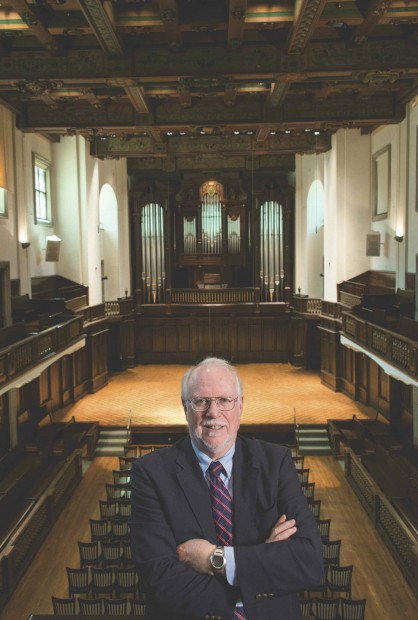
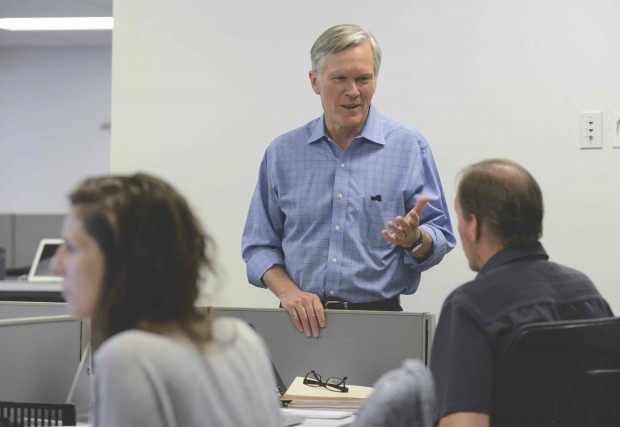
Photo of Bill Keller ’70 at the New York office of the Marshall Project

Bill Keller ’70 at the New York office of the Marshall Project

There was also, Keller says, a certain appeal to building an organization from scratch, without the ample safety net afforded by The New York Times, and in managing a relatively small operation. “I can talk to pretty much everyone on my staff if I want to, which is nice,” Keller says—and presumably quite different from the Times, where he edited a staff of 1,250.

In fact, Keller had just come from The Marshall Project’s weekly editorial meeting. A clutch of reporters and editors crowded into Barsky’s office in his absence, some sitting on the floor, others taking up positions on top of a low-slung filing cabinet. Keller presided with genial authority, asking questions, soliciting opinions, and sifting the criminal justice news of the day for potential stories.

That news, as anyone with eyes to see or ears to hear can attest, has been coming thick and fast of late. The Marshall Project was conceived before Eric Garner died while being subdued by police officers in New York City; before Michael Brown and Walter Scott were fatally shot by police officers in Ferguson, Mo., and North Charleston, S.C.; and before Freddie Gray died of injuries sustained while in police custody in Baltimore. And it came into being as those and similar events sparked what has been described as the most significant American civil rights movement of the 21st century, inspiring a concomitant deluge of stories about crime, punishment and America’s failure to manage either one particularly well.

But criminal justice has always represented an unusually rich vein of material for investigative journalists, and that, too, appealed to Keller. The sheer scope of the topic was evident at the Wednesday meeting: Andrew Cohen, who edits “Opening Statement,” the site’s morning e-newsletter, talked about the release of a report by the President’s Task Force on 21st Century Policing; news editor Raha Naddaf described a possible collaboration with a highly regarded print magazine on deteriorating conditions at New York City’s Rikers Island jail complex; and Keller brought up the case of the Kettles Fall Five, a group of medical marijuana growers in Washington State who face federal drug charges. There was talk of immigration law, of data-driven reporting, and of recent revelations regarding just what kinds of information federal prosecutors are obliged to share with defense attorneys.

Several of those stories would make their way onto the site over the next month or so, as would a dizzying array of others. Indeed, in a single week in late April, The Marshall Project ran pieces that dissected the career of Baltimore police commissioner Anthony Batts; examined the treatment of transgender inmates and investigated standards of care for diabetic ones; considered the miserable record of the FBI’s forensics labs and the long-term efficacy of reforms imposed on local police forces by the Department of Justice; and invited readers to take a quiz to find out which are killed more humanely: pets or prisoners. (Answer: pets.) “For a niche subject, this is a very big niche,” says Keller, who together with staff writer Beth Schwartzapfel filed a story in mid-May about Willie Horton, the convicted murderer and rapist whom George H.W. Bush used to pummel Michael Dukakis in the 1988 presidential election.

Much of the site’s original reporting covers topics that remain underreported elsewhere, or provides added context to ones that are already trending. There’s no denying that the latter have proliferated wildly over the past year or so: “Opening Statement” typically includes links to pieces produced not only by other criminal justice outlets like The Crime Report and The Juvenile Justice Information Exchange, but also by publications such as The New Yorker, The Atlantic, The Guardian; a host of independent blogs and progressive news sites; and just about every major newspaper in the United States.

The attention currently being paid to criminal justice represents a sharp reversal following years of declining coverage. That decline, says Stephen Handelman, who edits The Crime Report and directs the Center on Media, Crime and Justice at John Jay College of Criminal Justice, resulted from two principal phenomena: falling crime rates, which made the topic a “spectator sport” for many middle-class Americans; and turmoil in the news business, which led to a reduction in resources, including the number of reporters with the knowledge and experience required to tackle complex criminal justice stories. Despite the proliferation of digital tools for gathering and distributing news and information, solid investigative reporting still requires old-fashioned shoe-leather, which in turn requires both time and its correlate, money. And investigative reporting that focuses on criminal justice stories that may unfold over weeks or months or even years—stories that require reporters to scrutinize sprawling institutions like the federal court system or state correctional facilities and that involve untangling the complex web of legal, social and political factors at play in issues like the mass incarceration of black men, the detention of undocumented immigrants, the war on drugs and the use of prisons as holding pens for the mentally ill—requires a lot of both.

FROM THE ARCHIVES:

A Time for Experiments

This excerpt is lifted from an essay on the future of journalism by Bill Keller ’70 in the Spring 2009 PCM titled “Not With A Bang.”


… Where does this end?

An NYU professor named Clay Shirky writes about this subject with considerable common sense, although he is more pessimistic than I am about newspapers. His analogy for the disruptive power of the Web is the Gutenberg printing press, invented in the 15th century. Gutenberg’s press is credited with being an important factor in the spread of literacy that produced the Renaissance. But in the years immediately after the invention, Shirky points out, there was chaos. All the accepted philosophers, faiths and accounts of history were open to challenge, and nobody quite knew whom to trust.

“As novelty spread,” Shirky writes, “old institutions seemed exhausted while new ones seemed untrustworthy; as a result, people almost literally didn’t know what to think. … This is what real revolutions are like. The old stuff gets broken faster than the new stuff is put in its place.”

So how will things work when the Internet finishes shaking our world?

“I don’t know,” Shirky replies. “Nobody knows.” Now is the time for experiments, “lots of experiments, each of which will seem as minor at launch as Craigslist did, as Wikipedia did. … For the next few decades, journalism will be made up of overlapping special cases …No one experiment is going to replace what we are now losing with the demise of news on paper, but over time the collection of new experiments that do work might give us the journalism we need.”

On that uncomfortable truth, I agree.

Which brings us, inevitably, to the “nonprofit” part of “nonprofit digital news outlet.” The word is by no means a synonym for impoverished; some of the most robust news organizations in the country (NPR, The Associated Press) are nonprofits. Nonetheless, there are concerns about the long-term prospects of the smaller digital nonprofits that sprouted like mushrooms in the wake of the Great Recession, when the short-term prospects of traditional news media appeared to be particularly dismal. A 2013 study of 172 nonprofit digital news outlets by the Pew Research Center suggested a guardedly optimistic attitude, with most reporting that they were in the black. But the study also found that many of those same outlets were reliant on one-time seed grants from foundations, and lacked sufficient resources to pursue the marketing and fundraising activities that could help them become more financially stable. “Nonprofit journalism isn’t going away any time soon,” says Jesse Holcomb, a senior researcher at the center who worked on the report. “But that doesn’t mean there’s been a tipping point in terms of achieving a sustainable approach.”

Research by the Knight Foundation indicates that the most successful nonprofit news organizations seek to diversify their funding; invest in marketing, business development and fundraising; and build partnerships with other organizations to expand their audiences and bolster their brands. Judging by those criteria, The Marshall Project appears to be on solid footing. The site has a long list of donors, some of whom have committed funds for two or three years, and a dedicated business staff. Keller and Barsky are considering a wide range of alternative revenue sources, including memberships, conferences, and sponsorships—though advertising might be a tougher row to hoe. (“Advertisers aren’t dying to advertise their products next to stories about prison rape,” Keller says.) And thanks no doubt in part to the Keller Effect, the site is not hurting for partners.

In addition to the Attica piece, The Marshall Project has published stories in conjunction with The Washington Post, The Chronicle of Higher Education, and Vice, which Keller describes as “a direct pipeline to a younger audience.” It also has projects in the works with 60 Minutes and This American Life, and is in talks with several other outlets, including Stars and Stripes, The Weather Channel, and the statistics-driven news site 538.org.

In some ways, Keller says, it’s easier to do everything yourself. But collaborations with other outlets help build the site’s credibility, and allow it to leverage the resources of different organizations. (The Times, for example, contributed photography to the Attica piece, which can be costly, while other partners might provide legal services or help cover travel expenses.) Most importantly, such partnerships ensure that The Marshall Project’s reporting, which Keller describes as “journalism with a purpose,” will reach the largest possible audience.

“The aim,” says Keller, “is to get these issues onto the larger stage. And for that, you need a megaphone.”

Buckley completes term as Chair of Pomona College Board

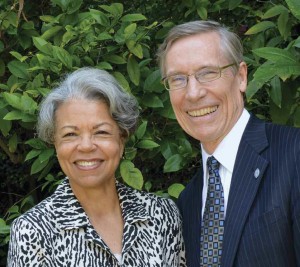
Photo of Outgoing Board Chair Jeanne Buckley ’65 with President David Oxtoby

Outgoing Board Chair Jeanne Buckley ’65 with President David Oxtoby

OUTGOING CHAIR OF the Pomona College Board of Trustees Jeanne Martin Buckley ’65 received the Pomona College’s Alumni Distinguished Service Award at an Alumni Weekend program in Little Bridges on May 2, in honor of her many years of service to the College. Buckley, who completed her three-year term as board chair in June, has been a member of the board since 1999 and is the first woman and the first person of color to lead the board since the College’s founding in 1887.

“I have really appreciated the opportunity to work closely with Jeanne Buckley during her term as board chair over the last three years,” President David Oxtoby said. “She has provided steady and thoughtful leadership during a period of considerable change for Pomona College. I have been able to turn to her for helpful advice on many occasions.”

As an undergrad at Pomona in the early 1960s, Buckley took a range of leadership roles, participating in student government, choir and glee club, and helping to put on a jazz festival. For much of the time, she was the only Black woman attending Pomona, but she had been in the same situation in high school in Pelham, N.Y. “It was not a shock in a cultural sense,” she said in an interview a few years ago. “I could navigate it.”
After Pomona, she found her way into social work and was involved in the early days of Head Start. She also trained as an actress, landing a seven-episode stint on the popular primetime soap opera Peyton Place. In the end, a decade after graduating from Pomona, she decided to continue her education in law school, earning her J.D. from Empire College School of Law in 1979.

During a distinguished legal career, Buckley has specialized mainly in juvenile and family law and then served as a Sonoma County Superior Court Commissioner for more than a decade. In 1995, she was honored as Juvenile Court Judge of the Year by the California Judges Association and Woman of the Year by the Sonoma County Bar Association’s Women in Law group. Since 2003, she has been a professional panel member for Resolution Remedies, a firm specializing in mediation, arbitration and other forms of alternative dispute resolution. In 2004, she was recognized with the Bar Association’s Career of Distinction Award.
Prior to assuming the role of board chair, Buckley chaired both the Student Affairs Committee and the Academic Affairs Committee for four years and served on a number of other committees including the Executive Committee, Facilities and Environment Committee, Strategic Planning and Trusteeship.

Prince of LEGOs

Colin Walle ’91

PCM-summer2015-web3_Page_26_Image_0001
ON THE MORNING of July 10, Colin Walle ’91 needed only 1,997 more votes to see his dream come true—or at least, to take a very big step in that direction.

No, he wasn’t running for office. This was something more personal. His prize creation—based on a happy confluence of a children’s toy that he had never given up and a favorite book about never losing your inner child—was hanging in the balance.

Based on Antoine de Saint-Exupéry’s Le Petit Prince, Walle’s proposed Little Prince LEGO project had accumulated 8,003 votes on the LEGO Ideas website. He now had 78 days left to hit 10,000. Reaching that threshold by the Sept. 27 deadline would mean that his pet project would move from a LEGO-lover’s fantasy to actual consideration for development and marketing as an official LEGO set.

Walle says he doesn’t remember a time when he didn’t play with LEGOs. “We had LEGO sets when I was a kid that predated my birth,” he recalls. But unlike most adults, Walle never put away his favorite toy. As a self-described “LEGO enthusiast,” he visits lots of aficionado websites, and one day he happened across one called LEGO CUUSOO, based on a Japanese word for “fantasy.” The site would later morph into LEGO Ideas.

“Basically, they have these different projects that anybody can submit,” he explains, “and then if they get enough votes, the LEGO Corporation will put them into a review stage and then consider making a real set based on your proposal.”

At the time, Walle happened to be reading The Little Prince to his son for the second time. He had first read the book in high school, but it was at Pomona that he really fell in love with Saint-Exupéry’s gentle fable. He even quoted some of the book’s most famous lines in his senior yearbook. (“‘Goodbye,’ said the fox. ‘And now here is my secret, a very simple secret: It is only with the heart that one can see rightly; what is essential is invisible to the eye.’”)

So maybe it was inevitable that two of Walle’s fascinations would come together in a brainstorm. “The book was sitting on the banister upstairs, and I had this little LEGO Death Star sitting in close proximity to that,” he explains, “and it was sort of a eureka moment. ‘Wait a minute—this is a project I need to do.’ I had been such a big fan of the book for so many years, and the book prizes a child’s imagination and the emphasis on adults not forgetting what it’s like to be a child. And so I thought, ‘Well, wait a minute—here I am, 46 years old and into LEGOs.’ And it’s the perfect story to be made out of LEGOs.”

Before he could start building his prototype, however, he had to decide what to include. “My thought was, in the books you spend so much time on the asteroid, so I had to have the asteroid in the prototype. Originally, I came up with more of a two dimensional asteroid. And then talking to a friend of mine, he was telling me about how to make a three-dimensional, six-sided box that looks like a ball made of LEGOs. It’s a technique they call S.N.O.T, which sounds gross but it stands for ‘Studs Not on Top.’”

Walle also spent a lot of time building the airplane that crash lands in the desert, where the book’s narrator meets its title character. Other parts include a baobab tree, the main characters and the Little Prince’s rose under her glass dome.

Of course, even if Walle gets his 10,000 votes, there’s no guarantee that an actual Little Prince LEGO set willever hit the market. Winning prototypes for sets based on the TV comedy “The Big Bang Theory” and the movie “Wall-E” are now in production, he says, but others winning projects didn’t make the cut. Three projects based on the video game “The Legend of Zelda” hit the 10,000 mark, but no set has emerged, possibly because of licensing difficulties.

If the LEGO Corporation were to decide that the idea was marketable, they would engineer their own set, which might or might not resemble Walle’s admittedly rough prototype. “Frankly, they would build something better than what I did,” he says with a laugh. “Let’s be blunt about it. I’m just doing my best efforts, but they’re the professional designers.”

If it came to that, the Saint-Exupéry Estate would also have to sign off on the deal. That isn’t a sure thing either, but Walle has spoken with them and was thrilled to find that they were “nuts about the project. I can’t say that they will approve the license, but they definitely want this set made.”

Maybe that’s because the very idea of a man on a quest to create a toy based on a book that idealizes the wisdom and innocence of childhood is the kind of thing Saint-Exupéry himself would have appreciated. “Even when I was in college, I knew I wanted to have a family someday,” Walle says, “and now that I’m thinking about it maybe that’s part of what draws me to the book—in the sense that the story is also about protecting and valuing innocence: the way that the aviator tries to look out for the Little Prince, and the way that the prince cares for his rose.”

At the end of the day on July 10, the vote total had risen by three more votes—8,006 down, only 1,994 to go.

If you’d like to support Walle’s dream before the Sept. 27 deadline, you can cast your vote at ideas.lego.com/projects/50323

Celebrate!

SAGEHENS ARE COMING together in record numbers—both in person and online—to learn, mingle and make a difference.

PCM-summer2015-web3_Page_25_Image_0002

Alumni Weekend 2015 

This year’s Alumni Weekend brought together more than 1,600 alumni and guests for a weekend of for a weekend of fun, celebration and hundreds of campus activities, including performances, open houses and lectures. Highlights included the Daring Minds Speakers Series, featuring Blaisdell Award winners James Turrell ’65, Bill Keller ’70 and Mary Schmich ’75, the first-ever 47th Reunion, held by the Class of 1968 (see story on page 47), and a Claremont in Entertainment and Media panel featuring Richard Chamberlain ’56. At the gathering in Little Bridges preceding the Parade of Classes, Alumni Distinguished Service Award winners Jeanne Buckley ’65 P’92 and Stan Hales ’64 were recognized, class volunteers were celebrated and over $3 million in reunion class gifts were announced. (For more photos, see Last Word, page 64.)


Winter Break Parties

In January, Sagehens around the world flocked together in growing numbers to take part in a favorite community tradition. Winter Break Parties brought nearly 1,000 Pomona alumni, parents, students and friends together in 15 cities from Kansas City to Shanghai for laughter and libations, stories and Sagehen spirit. Interested in hosting a Winter Break Party in your city this season? Contact Kara Everin in the Office of Alumni & Parent Engagement at kara.everin@pomona.edu for more information.


Daring Minds Events

Pomona’s yearlong celebration to wrap up Campaign Pomona: Daring Minds kicked off last spring with a series of events designed to help Sagehens learn, mingle and make a difference. Highlights this spring included:

  • Daring Minds Lectures: On campus (including nationally noted poet Professor Claudia Rankine in April) and across the nation (including the East Coast lecture series in March, featuring Professors Amanda Hollis-Brusky and Char Miller).
  • 4/7: A Celebration of Sagehen Impact: This social media-driven effort celebrated the good work and good will of a community full of “everyday Daring Minds.” More than 150 civic-minded Sagehens and friends posted about their good deeds, and the good deeds of Pomona friends, while hundreds more chirped their encouragement through “likes” and comments. Community members also pledged and performed service as part of the celebration, including 16 Seattle Sagehens who came together on a rainy Saturday to plant 447 trees at a local nature preserve. It’s not too early to start planning: What will you do to make a difference by next 4/7?
  • Senior Send-Off: For 47 hours leading up to Class Day and Commencement, hundreds of alumni, parents, faculty, staff, students and friends rallied for the College’s first Senior Send-Off, a mini-campaign to honor the graduating Class of 2015 and support Pomona education for all current students. Nearly 500 donors gave more than $80,000, and dozens more alumni, students, faculty and friends took to social media and the campaign web site to offer their “sage advice” to graduates as they make their life-changing transition.
  • Daring Minds Videos: Watch for your invitation to tune in for a series of Daring Minds videos to be made available starting in September. On the playlist are Professor Claudia Rankine and alumni James Turrell ’65, Bill Keller ’70 and Mary Schmich ’75.


Career Networking Events

Alumni volunteers across the country organized and hosted a series of career networking events this spring and summer. From Los Angeles to Chicago and New York, more than 100 members of the Pomona community came together to connect with fellow Sagehens and share industry-specific and general career stories and advice, and the program continues to grow! Interested in hosting a career networking event in your region? Contact the Alumni and Parent Engagement team at alumni@pomona.edu.

To make sure you hear about exciting events and opportunities yet to come, update your contact information by emailing alumni@pomona.edu or calling 1-888-SAGEHEN.


Travel/Study

Hawaiian Seascapes 

(Big Island to Molokai)

With Professor Emeritus Rick Hazlett

Dec. 5–12, 2015

Board the Safari Explorer for a seven-day cruise from the Big Island of Hawaii to Molokai, with stops on West Maui and the “private island” of Lanai. Enjoy dramatic volcanic backdrops and marine life sightings. (NOTE: At publication, there was only one cabin left on this cruise.)


From Angles to Angels:PCM-summer2015-web3_Page_25_Image_0001

The Christianization of Barbarian England

With History Professor Ken Wolf

May 18–29, 2016

The eighth in a series of alumni walking trips with a medieval theme, this is the first involving the United Kingdom. Its purpose is to appreciate the fascinating history (captured by the Venerable Bede) of the conversion of the barbarian conquerors of England, starring the Irish and Roman missionaries. In Scotland, you will visit Kilmartin, Dumbarton and Loch Lomond; in England, Lindisfarne, Hadrian’s Wall and Durham Cathedral.


Inner Reaches of Alaska

June 4–11, 2016

Join Pitzer Professor of Environmental Analysis Paul Faulstich on an “un-cruise” through the stunning Inner Reaches Coves of Alaska. Aboard a small vessel serving 74 passengers, adventurers will travel from Juneau to Ketchikan, encountering stunning glacial landscapes, old-growth forests and incredible wildlife.


For more information, contact the Office of Alumni and Parent Engagement at

1-888-SAGEHEN or alumni@pomona.edu.

Retiring But Not Shy

cartoon of Rick Hazlett rappeling to his interview, suspended over a pit of molten lava

PCM-summer2015-web3_Page_18_Image_0001

Rick Hazlett

WHEN ASKED IF PCM could interview him about his retirement, Professor Rick Hazlett suggested that the writer would “have to rappel in to my interview, suspended over a pit of molten lava in a bat cave (or something like that!), where of course I’ll be doing research just for the ‘hell-uvit.’”

He was joking—sort of.

Hazlett is starting his retirement in style: He’s moving to Hawaii. A geology professor at Pomona since 1987, he’s trading Claremont for the Big Island, giving him a prime spot from which to pursue one of his greatest passions: volcano research.  u

Hazlett calls the move a “bittersweet denouement” because of his deep affection for Pomona College and its students. But he has a long-running connection to Hawaii, having done many research projects there over the past 40 years, stretching back to the time he was a student.

“In a sense, I’m not really moving to a new landscape or an entirely new social circle,” he says. “It’s a bit of going home, in a way.”

A four-time winner of the Wig Distinguished Professor award, Hazlett chaired Pomona’s Geology Department for nine years. He helped establish the school’s Environmental Analysis Program and became its pioneer coordinator.

Hazlett is moving into a historic house in north Hilo, 30 miles away from the Hawaiian Volcano Observatory. His research will likely involve “looking at a prominent fault zone near the summit of the [Kilauea] volcano.”

“That sounds like work, but honest to God, it’s recreation for me,” he says with a laugh.

In addition, Hazlett will be working on two book projects. One is a new edition of a popular textbook, Volcanoes: Global Perspectives, that he co-wrote in 2010. He was also appointed senior editor for a research encyclopedia of environmental science, to be published by Oxford University Press. His focus will be the impact of agriculture on the environment.

“I’m really quite concerned about, and deeply committed to, solving environmental issues that I can impact. I figured this was a great way for me to pursue that mission while moving into retirement.”


Jud Emerick

Illustration of Professor Emeritus Jud Emerick

AFTER TEACHING ART history at Pomona for 42 years, Jud Emerick says he still has as much interest in the field as ever.

“I’ll be doing art history for the foreseeable future,” Emerick writes in an email from Rome, where he’s spending the summer. The current focus of his research, he says, is “how architecture from early Christian and early medieval times in the Euro-Mediterranean world set stages for worship.”

Emerick’s areas of expertise are wide-ranging. As a professor, he taught courses on subjects such as prehistoric and ancient Mesopotamian, Egyptian, Green and Roman art; classical art in the Mediterranean; and painting in Italy during the 14th century.

Emerick and his wife have made Rome “a kind of second home” for the last 46 years. You can sense his passion for the place as he describes attending lectures at landmark sites, eating in local restaurants with friends, and talking art. After all these years, he says, he and his wife “still find that being in Rome is tantamount to being at the center of our art historical world.”

Emerick is also a music buff and says one of his greatest joys is his home music center. (His eclectic musical interests range from American blues to European chamber music to Seattle grunge.) In an age of digital recordings, the self-described audiophile says he hopes to do some online reviewing of new recording formats and equipment.

Honing his language skills is another goal. Emerick says he plans to “learn modern Italian verb tenses (how does one use the subjunctive?), get better at deciphering medieval Latin and even start the study of ancient/medieval Greek.”


Sidney J. Lemelle

PCM-summer2015-web3_Page_19_Image_0002
AS SIDNEY LEMELLE heads into the future, he’s also revisiting his past. Specifically, Lemelle, a professor of history and black studies, is delving back into his 1986 Ph.D. thesis to expand it into a new manuscript.

His thesis chronicled the history of the gold-mining industry in colonial Tanzania, from 1890 to 1942. Now he’s exploring the post-colonial period, taking the subject up to the present. “I originally looked at gold, for the most part; now I’m looking at gold, diamonds and gemstones,” says Lemelle.

He adds that it’s difficult at times to re-examine his earlier work. “You’re going back to something you’ve written many years ago, and your ideas have changed since then. It takes a little humility.”

Lemelle joined Pomona’s faculty in 1986. A four-time winner of the Wig Distinguished Professor award, he chaired the Intercollegiate Department of Black Studies from 1996 to 1998 and the History Department from 2002 to 2004. His areas of expertise include Africa and the African Diaspora in North America, Latin America and the Caribbean.

Lemelle says he’s also looking forward to teaming up with his son, Salim Lemelle, a 2009 graduate of Pomona College, who is a screenwriter and writing intern at NBC/ Universal. The two plan to collaborate on screenplays.

“I hope we can write historical dramas and that sort of thing,” says the senior Lemelle. “We’ve been tossing ideas back and forth for a long time. Now I’ve got the time where I can actually do it. I’m excited about it, and so is he.”


Laura Mays Hoopes

PCM-summer2015-web3_Page_19_Image_0003
LAURA MAYS HOOPES is writing a second act to her long career in science: She’s transitioning from biology professor to novelist.

In her retirement, Hoopes plans to put the finishing touches on a novel she penned while earning her MFA at San Diego State University in 2013. The book’s working title is The Secret Life of Fish, and it’s about a girl growing up in North Carolina who develops an interest in science and environmental issues.

“It’s not really autobiographical but it has certain things in common with my life, because I grew up in North Carolina, and I love the beauty of the state,” says Hoopes. “And I know a lot of strange stories about North Carolina history that I was able to weave in.”

Besides exploring the topic of women in science, she tackles issues of ethnicity and Native American identity in the book. There’s also a love story.

Hoopes came to Pomona College in 1993 and served as vice president for academic affairs and dean of the college until 1998, when she moved full time to the faculty. She taught both biology and molecular biology. In 2010 Hoopes wrote a memoir, Breaking Through the Spiral Ceiling: An American Woman Becomes a DNA Scientist.

Hoopes is also working on a nonfiction book. It’s a biography of two major female figures in science: Joan Steitz, a professor at the Yale School of Medicine, and Pomona graduate Jennifer Doudna ’85, a professor at the University of California, Berkeley.

“The two entered science about 20 years apart—Joan when there was a lot of discrimination against woman, and Jennifer when pretty much all the doors were open and everyone was just enchanted with her,” says Hoopes. “The whole idea is to look at key stages in their careers. It’s kind of a fun project.”


Ralph Bolton ’61

PCM-summer2015-web3_Page_19_Image_0004
JUST AS HE DID 53 years ago in the Peace Corps, Ralph Bolton ’61 will be spending his post-Pomona years helping impoverished people in Peru.

The anthropology professor, who began teaching at Pomona in 1972, is president of the Chijnaya Foundation, which aids people in poor, rural communities in southern Peru. Created by Bolton in 2005, the organization designs and builds self-sustaining projects in health, education and economic development. Bolton does the work entirely on a volunteer basis.

“It’s extremely gratifying,” he says. “The people are very grateful. Many of these communities where we work are totally abandoned by any other nonprofit organizations or by the government agencies, and it’s one of the poorest areas of South America.”

His powerful connection to Peru first took root when he was a 22-year-old in the Peace Corps. In the small highland village of Chijnaya, he brought agrarian reform to the farming families, improving their lives dramatically. Hands-on service has always been part of Bolton’s approach as an applied anthropologist, whether he’s helping the destitute or advocating for HIV prevention.

His very popular Human Sexuality class at Pomona pioneered undergraduate discussions on AIDS and HIV when he began teaching it in the late 1980s. In 2010, he was honored with the Franz Boas Award for Exemplary Service to Anthropology, considered the most prestigious award in his profession.

Bolton says he’ll be spending about half the year in Peru, where he’s also working with fellow anthropologists and helping develop anthropology programs in universities.

“I can barely sign in to Facebook without having a Peruvian student or colleague begin to chat with me. So while I regret the loss of my Pomona students, the slack has certainly been taken up by other students of anthropology elsewhere who are very eager to continue to benefit from whatever I have to offer.”


James Likens

PCM-summer2015-web3_Page_19_Image_0005

JAMES LIKENS SPENT 46 years teaching economics at Pomona. In his retirement, he’ll focus more on family than finance.

“I’m very big into family history. I have more than 17,000 names in my file,” he says. “Genealogy is fun for me perhaps because it’s so different from economics. Economics is driven by numbers and theory; genealogy is driven by documents and stories.”

Likens also served as president and CEO of the Western CUNA (Credit Union National Association) Management School, a three-year program spread over two weeks each July on the Pomona College campus. Since he joined the school in 1972, its annual enrollment has more than tripled from less than 100 to more than 300.

Likens, a winner of the Wig Distinguished Professor award, chaired Pomona’s Economics Department from 1998 to 2001. He also directed the yearlong celebration of Pomona’s Centennial. Likens has long been involved in community service—he has served on nonprofit boards and task forces—and says that will continue. “I will always be involved with service. I don’t know what it will be, but I will do something. It could be a board, or it could be a soup kitchen.”

He also plans to pursue his many interests, which include traveling, golfing, painting and spending time with his family, especially his four granddaughters. In addition, he’ll be working on a memoir.

“I have mixed feelings, of course, about retiring,” says Likens. “I have been at Pomona a long time, and it’s very much a part of my life. On the other hand, I now have the opportunity to do new things, and I look forward to that.”

Helping Out With Speaking Up

Helping Out With Speaking Up: Jessica Ladd ’08 is destigmatizing the reporting of sexual violence—and her new app may even help stop it.

PCM-summer2015-web3_Page_17_Image_0001

GET HER GOING, and Jessica Ladd ’08 will talk effusively about her many positive Pomona memories, from late-night sponsor-group discussions about free will to sunny study sessions on Walker Beach.

In many ways, Pomona directly inspired her career path. She created her own major in public policy and human sexuality, writing her thesis on condom distribution in California prisons and jails. She turned The Student Life’s often-lewd sex column into a thoughtful exploration of topics such as virginity, safe sex and consent.

Perhaps most pivotally, and certainly most traumatically, Pomona was also the place where she was sexually assaulted.

The incident itself was harrowing, but its aftermath was in some respects even more traumatizing. Ladd found herself unsure of how to go about doing basic things like finding emergency contraception and confidentially getting tested for STDs. Worse still, in reporting the assault she felt like a passive and helpless participant, from the tone of campus security’s questioning to uncertainty about how her answers would be used.

“Instead of feeling empowered, I left the situation on the verge of tears,” she says. “It made me realize that many of the tools for improving the process didn’t exist, and sowed the seeds for wanting to create a better way.”

As founder and CEO of Sexual Health Innovations (SHI), Ladd has developed a tool called Callisto that is aimed at making survivors feel more comfortable reporting their experiences. This fall, two institutions will adopt the technology, including the very place where Ladd’s frustrating but illuminating journey first started.

Sexual assault is consistently one of our country’s most under-reported crimes, with upwards of 80 to 90 percent of incidents going undocumented. The reasons range from logistical, to social, to psychological. Victims may be afraid people will think they are lying or exaggerating; they may worry that accusing their acquaintances will ostracize them from social circles; and they may be scared to publicly re-live the experience in a trial where their credibility and character are continuously questioned.

“Because survivors have had their agency stripped in such a severe way, they often feel hesitant to give information to authorities if they think they might lose that agency all over again,” says Ladd, who herself took over a year to report. “We’re trying to create a trauma-informed system that gives them total control over the process.”

Photo of cell phone with Callisto, a tool to help with reporting sexual assault

Callisto- a tool to help with reporting sexual assault

Callisto lets users file an incident report that can be sent directly to authorities or archived for later. Users can also choose a third option: saving the report such that it only gets filed if their attacker is separately reported by another user.

It’s a clever feature, and not a trivial one. Ladd often cites a 2002 study which found that 90 percent of campus assaults are committed by repeat perpetrators; she’s confident that Callisto has the potential not only to improve the reporting process, but perhaps even to reduce the number of assaults that happen in the first place.

“If authorities could stop perpetrators after their second assault, 60 percent of assaults could be prevented,” Ladd says. “Callisto isn’t the complete answer, but I think it can be a valuable piece in the puzzle.”

One reason to bet on Callisto is that it was developed with direct input from more than 100 college sexual-assault survivors and advocates, in the form of several months’ worth of surveys, focus groups and interviews.

Among the participants was Zoe Ridolfi-Starr, who last year organized a Title IX federal complaint against Columbia University arguing that the institution treats survivors and alleged assailants unequally. She says that, with Callisto, it was clear from the start that SHI truly understood its audience’s needs.

“Survivors can find it overwhelming enough to try to maneuver through all that red-tape before you even add things like PTSD and depression into the mix,” she says. “SHI has shown that they want to go about the process in a way that’s inclusive, intuitive and intentional.”

Callisto’s sleek interface is designed to make it easy to wade through the murky waters of bureaucracy. Questions have explanatory “help text” to clarify why they are being asked and how answers will be used, while the language is chosen with care and sensitivity. For instance, a question about how much the victim had been drinking is couched in reassurances that such answers do not put her or him at fault and will not, say, get her or him in trouble with the school for violating its alcohol policy.

The system’s development has coincided with sexual assault emerging as perhaps the most-discussed issue in all of higher education, from President Obama’s recent “It’s On Us” initiative to the Columbia University student who carried a mattress all year to protest the school’s handling of her assault allegations.

“As far back as 2013, we realized that if there ever was a time for schools to change their programs, it’s now,” Ladd says. “In the past, adopting this might have seemed like an admission that assault is prevalent on campus. Today, it’s seen as forward-thinking.”

The issue has gained prominence even beyond academia, particularly with the many allegations against comedian Bill Cosby. Ladd says that, while such visibility can be valuable, the growing list of women who have spoken out only further highlights the importance of systems like Callisto for survivors who don’t want to go public, or whose assailants aren’t famous entertainers.

“People shouldn’t have to out themselves to the world to get justice,” she says. “Callisto is a service that we’d eventually like to make available to anyone who needs it.”

Ladd’s interest in sexual health evolved from her upbringing on San Francisco’s Castro Street, where she says that it “always seemed like the city around me was dying of AIDS.” An early clouds-parting moment happened in a high school production of “The Vagina Monologues,” when she first learned that there was such a thing as a clitoris.

“It felt as though the world had been conspiring to not let me know about it,” she says. “It made me wonder, ‘what else are they hiding from me?’”

Since then she has dipped her toes into several different sexual-health-related sectors—as an educator, an academic, a policy advocate and even a White House intern—but says that she became disenchanted with all of these approaches as means to actually effect change.

Instead, she looked at companies like Facebook and Google, and realized that a key way to influence people was through technology.

“The Internet allows people to do things that they would normally find socially awkward, from looking at porn and buying sex toys to propositioning threesomes on Craigslist,” she says. “We’ve harnessed that power to make ourselves happier, but why not use it to make ourselves safer and healthier, too?”

Callisto is the flagship initiative for SHI, which Ladd founded while enrolled full-time in Johns Hopkins’ public-health MPH program. SHI has grown from a makeshift website coded by volunteers to a full-fledged 501(c)(3) nonprofit with bi-coastal offices and more than a quarter-million dollars in funding from Google.

This fall, in efforts that are more than a year in the making, Ladd will launch Callisto at two “Founding Institutions”—Pomona and the University of San Francisco.

“We want to make sure that students feel comfortable reporting sexual assaults when they happen,” says Pomona Associate Dean and Title IX Coordinator Daren Mooko. “Callisto is a very creative mechanism for doing so, in a way that puts a lot of control in the survivor’s hands.”

Ladd says she didn’t come into SHI with particularly entrepreneurial intentions, but simply with a problem that she wanted to solve.

“This is something that I have long believed should exist in the world,” she says. “At a certain point I realized that, while I can’t change what happened to me, what I can do is build something that will hopefully help the next person who’s in that same situation.”

Food as Story

Food as Story: Eric Wolfinger '04 Brings Together the Arts of Food and Photography.
Untitled photo from <em>Manresa</em>, by David Kinch with Christine Muhlke (Ten Speed Press 2013, 336 pages, $50.00)

Untitled, from Manresa, by David Kinch with Christine Muhlke (Ten Speed Press 2013, 336 pages, $50.00)

THE TWO SIDES of Eric Wolfinger’s profession, photography and food, took years to converge, but when they did, something very special happened, like flour and water morphing into bread—an apt metaphor for a man who once spent years learning to bake a perfect loaf.

A political science major at Pomona, Wolfinger ’04 traces the first step in his journey to becoming one of the world’s leading photographers of fine cuisine to his work as a food columnist for the student newspaper, The Student Life.

“When I wrote that food column,” he recalls, “I had my first vision of what I actually could see myself doing post-college. Up until then, I had no clue what direction I was going. I was like, oh my God, food writing—that’s something that people do and get paid for.”

By that time, many of his classmates had already punched their tickets into graduate school or had jobs lined up. Wolfinger had nothing waiting for him and liked it that way. He dreamed vaguely of buying a pickup truck and driving around Mexico working on a cookbook. Moving to the Bay area, he ran into a high school friend who was working at a restaurant, having already worked her way up from kitchen apprentice to sous chef.
“I realized right then and there—I don’t want to write any more, for now,” he says. “I want to cook. If I ever do write I want to write from the perspective of somebody that I would respect. I don’t want to just have an opinion. I want to have a skill and an expertise in this field.”

Starting as an apprentice at an Italian restaurant, Wolfinger quickly discovered what it felt like to be clueless. “I came from Pomona where adults treated me like I was smart and like I had something to say, and it was worthwhile. I started working in a kitchen, where I was the village idiot.”

Untitled photo from Flour+Water: Pasta, by Thomas McNaughton (Ten Speed Press 2014, 288 pages, $35.00)

Untitled, from Flour+Water: Pasta, by Thomas McNaughton (Ten Speed Press 2014, 288 pages, $35.00)

He learned fast, but after a couple of years, he was convinced the life of a chef wasn’t for him. Writing still beckoned, but there was one more thing he wanted to accomplish before moving on. “Before I leave San Francisco and leave cooking,” he told himself, “I want to learn how to make the Tartine croissant, which was the most amazing thing I’d ever tasted and the most amazing thing I could afford, working on a cook’s salary of $8.25 an hour.”

So in 2005, Wolfinger took a job at Tartine Bakery, a place where bread sells out within an hour of opening. In master baker Chad Robertson, he found both a mentor and a surfing buddy, and he quickly fell in love with the deceptive simplicity of baking. If restaurant cooking is a science of efficiencies—“How do you set up your station so that when an order comes in, you can bang out that salad in 25 seconds instead of 30?”—baking, he says, is an art—“What is my dough doing today, how is it behaving, and what small tweaks to my process do I need to do to bring this amorphous dough to the bread that I have in the back of my head, that I know is the ideal loaf?”

At Tartine, he practiced the art of baking for five years. But the memory of his original plan—driving around Mexico seeking recipes for a cookbook—occasionally made him restless. All through college, he’d spent his summers traveling in Latin America, exploring cultures and polishing his Spanish. But working life had left him with little time or money for travel. He told his mentor he needed some time off. Robertson agreed, and Wolfinger made plans to head for South America, where his brother was living at the time.
“Days before leaving, it occurred to me that nobody was going to give me my dream job of a travelling food journalist,” he says. “I was going to have to give it to myself first and kind of prove that I could do it.”

So he bought a digital camera and started a traveling food blog.

 Photo of Thousand-year-old quail egg, potage and ginger, from Benu, by Cory Lee (Phaidon Press 2015, 256 pages, $59.95)

Thou-sand-year-old quail egg, potage, ginger, from Benu, by Cory Lee (Phaidon Press 2015, 256 pages, $59.95)

“I was like, I’m just going to do a blog and tell stories of the people that I meet, the recipes that I find, and the experiences that I have,” he says. “Obviously, I wasn’t trained as a photographer at all. I knew that to tell a decent story, you needed pictures. So I got a digital camera, and I thought, ‘I’ll teach myself along the way, and I’ll figure it out.’”

He followed his taste buds from Chile to Columbia to Peru to Bolivia, taking pictures of the food he found and posting them in his blog. As time went on, however, his blog didn’t seem to be opening any doors. “Gourmet magazine did not call me and tell me they wanted me to write a feature for them.” But when he got back to the States, the opportunity he’d been waiting for came from an unexpected source.

It seemed that his mentor and surfing buddy at Tartine Bakery had followed his blog with interest. Impressed by his food photography, Robertson, who was preparing to write a cookbook of his own, had an epiphany. “Coming off of an experience of a previous cookbook that he did with his wife,” Wolfinger recalls, “he realized that rather than having a professional photographer come in and shoot for two weeks, why not have his buddy—who takes beautiful pictures, who knows his bread better than anybody else in the world—do the pictures while we’re baking?”

Photo of wild bamboo fungi and shoots, from Benu

Wild bamboo fungi and shoots, from Benu

Before that, Wolfinger had never allowed himself to take photography seriously, but after two years of shooting at the bakery and “making every mistake in the book,” he began to think of himself as a real photographer. “Just the process of making this book from start to finish really gave me a clear sense of how publishing works, how you tell a visual story, how to be really ruthless with yourself and with your own work so that you are putting your best foot forward,” he says. “While I was doing that book, I was doing little side projects. The next thing I knew, I was working as a photographer.”

But it wasn’t until the book came out that his career really took off. “The photography u in that book was nominated for a James Beard Award, which is kind of like the Oscars of food,” he says. “It was a huge deal. Since that first year, things have gone gangbusters, really—beyond my wildest dreams.”

Since then, he’s worked with celebrity chefs like Hubert Keller and David Kinch. He’s done mass-market cookbooks, like Williams-Sonoma’s Home Baked Comfort, and classy, one-restaurant books like Corey Lee’s Benu. He and his camera have circled the globe, from Vietnam to Uruguay, from Italy—where he spent 12 days with chef Thomas McNaughton, taking pictures of pasta—to Thailand, where he ate some of the most interesting food of his life, including a delicacy called ant’s egg salad. (“Ant eggs taste like lemongrass, and ants themselves taste like fresh lime. So we ate this salad, and it only had ant eggs, salt and mint, but it tasted as if there were lime juice and lemongrass in the salad. It was surprisingly delicious.”)

Untitled photo from Mallmann on Fire, by Francis Mallmann (Artisan, 2014, $40.00)

Untitled, from Mallmann on Fire, by Francis Mallmann (Artisan, 2014, $40.00)

He attributes his meteoric success not only to his hard-earned skills behind a lens, but also to the fact that he understands the dynamics of the kitchen as only an experienced cook and baker can. “For me, food has a feeling,” he explains. “There’s a story behind it. There’s a person who made it. I see food a little differently—not as an object to be photographed but as a story to be told. Chefs call me because they’ve cooked something and they want a pretty photo of it. I think they sense in me an understanding of where they’ve come from and what they’ve put into it.”

Photo of Eric Wolfinger ’04

Eric Wolfinger ’04

Looking back, he also believes Pomona played a huge role in preparing him for the unique challenges of his chosen profession. “I wouldn’t be doing what I’m doing and it wouldn’t be going as well if I hadn’t had that rigorous, yet very open-ended education at Pomona. You learn not to put anything out but your best. Even if that means I’m shy a few photos, I’m not interested in putting out anything but my best.”

But when he remembers his college years, what he thinks back to most often isn’t the classroom—it’s his three years as a member of the improvisational comedy group, Without a Box, which he spent, he says, in a constant state of terror.

“What you learn in improvisation is not necessarily how to be funny on the spot but how to think creatively under enormous amounts of pressure. And how to trust that instinct of where you think a scene should go. So many times I’m on set and a problem arises, and if you listen for that inner voice—what if I did this?—it’s helped countless times as I’ve moved forward as a photographer. I’m always improvising in this business.”


Tech vs. Stress

bandu1

A few months after graduating from Pomona, Joel Fishbein ’12 entered the Boston startup world. As a research engineer at Neumitra, founded by a neuroscientist and engineers in the neurotechnology class at MIT, Fishbein is helping to develop a wrist-based biosensor called bandu that will help to measure and manage stress levels.

PURSUING HIS INTERESTS

Fishbein headed for Boston hoping to find something he really wanted to do. “People say a lot of really nice things about Silicon Valley, but I’ve found that Boston has a really thriving start up scene too, especially in a lot of the fields I care about like healthcare.”

Once there, he started networking. He helped bring together a technology “Meetup” group in Boston, run through the online service that helps people organize themselves around common interests. At one of the meetings, Neumitra founder Robert Goldberg, a neuroscientist by training, came to give a talk. “He was speaking about the technology he was developing and it seemed like such a perfect marriage of the types of things I had been working on at Pomona in linguistics and cognitive science and psychology,” says Fishbein.

So Fishbein contacted Goldberg after the meeting. “One of the things I’ve learned since graduating is that, especially in the startup world, it is acceptable and even encouraged that when you think that you have something to offer someone, just email or talk to people and make the connection yourself.” He landed the job.

THE BIOWATCH

Fishbein hopes that the biowatch can make a substantial positive impact, especially for people who suffer from anxiety disorders or posttraumatic stress disorder. “It works by monitoring and managing stress by recording physiological indicators of stress such as skin conductance,” Fishbein says. Then, personalized stress management help can be delivered over devices like the iPhone.

For example, if the biowatch senses stress levels, it may advise its owner to listen to music or participate in some other activity that has been shown to reduce the owner’s stress.

Fishbein says that when asked what he does, he explains to people that he is working on a technology to reduce stress. “About 75 percent of the time, the response I get is ‘I could really use that!’”

POMONA IN PRACTICE

At Neumitra, Fishbein researches how best to apply the company’s stress-reducing technology to such groups as veterans. Then, he works to develop some of the capabilities that will make the treatment more effective. “I really do think about the types of things I learned at Pomona every day here,” he says.

A linguistics and cognitive science major, Fishbein found his path after taking an intro psychology course his freshman year. He credits Pomona professors such as Deborah Burke and the late Bill Banks with encouraging him to continue cognitive science, linguistics and psychology coursework. Fishbein’s studies culminated in a thesis on language processing under the guidance of professors Jesse Harris and Meredith Landman.

“His thesis was exemplary and showed me that he would hit the ground running and with minimal need for traditional management,” says Goldberg, Neumitra’s founder.

Adds Fishbein: “A lot of what I do here is scientific writing—reading journal articles and synthesizing them and presenting them—so it was important to show that I was able to work on a project like the thesis where I was doing creative thinking and the hard work of the writing and research, too.”

—Emma Paine ’14

Foul Job

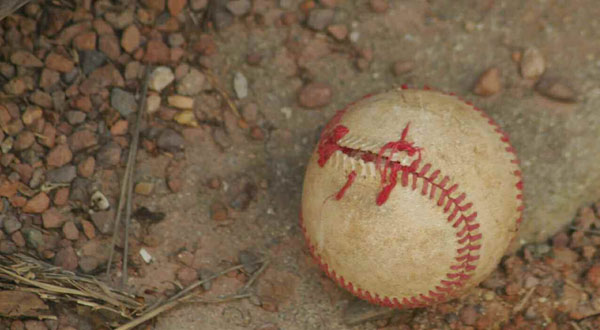
foulball1We freshmen on the Pomona-Pitzer baseball team have a new position to add to our baseball cards: designated foul ball retriever. Every year, the new guys assume the job, as a collective unit, of making sure every single ball that leaves Alumni Field gets back safely into the umpire’s pocket.

 Our task sounds simple until you consider all the distances and directions a foul ball can travel off of a bat. This game-within-a-game comes down to location, location, location. Foul balls out of play down the third base side are a freshman’s best friend, as they usually land on the football field. There have been games where I’ve spent more time there than on the baseball field. Luckily, the white of the ball against the level green grass makes for a quick and easy retrieval.

Fouls straight back behind the backstop sometimes find the few problematic clumps of bushes, but even in this unlucky scenario, there are usually plenty of fans who saw the ball land and can point you in the right direction. The first base side is where things can get ugly. The bushes are sharp, thick and an excellent hiding spot for naughty baseballs. See you in three innings.

Most of the time, though, foul balls are returned to the umpire in an impressively timely manner. Our mastery of the “foul ball science of deduction” allows us to retrace the flight of the ball and consider the spin to help us locate fouls that present a worthy challenge. And then organization and communication make the big difference.

There are nine freshmen on the team, but the number of people retrieving foul balls at any given moment can fall anywhere from two to seven, as some of us are playing in the game or assigned to other jobs. For those of us available, we have created a line-up based on jersey number. So the freshman with the lowest number leads off with the first foul, while whoever has the next lowest number waits on deck.

A turn is not over until we tell the person after us that it’s now theirs. Because foul balls can pile up in a hurry, it is important that everyone knows where they fall in the order as well as who is and isn’t participating at any given moment.

Sometimes, two foul balls are hit in the same general area, but only one is clearly visible. You should never commit the evil act of stealing your friend’s more findable foul ball before he gets to it and making him dig around for ages to find yours.

As soon as the ball leaves the bat and heads for foul territory, you should be outside of the dugout and headed towards the stairs at a jog. Not only does any delay give the impression that you aren’t on top of your responsibilities, it gives the ball even more time to roll into nearly undetectable hiding spots.\

Hearing the crowd erupt as you’re digging around for a ball is a very lonely feeling. Foul balls in the ninth inning are especially bad because there is a fear of missing the final out. Everyone wants to be in the dugout to cheer on the team during the final out of a win or to help try to spur a comeback if we are trailing. In the end, it’s all about being a good teammate.

Each player on the team has responsibilities and jobs that lend to our success. Even the best players to don a Pomona-Pitzer uniform spent their freshman year chasing fouls around the field en route to playing professionally. Truthfully, I’m happy to go hunt down other people’s foul balls because I know that when I hit mine, there’ll be someone else going after them.

Letters to the editor

Sad Chapter in Pomona Life

I have been inspired to write you on the subject of gays at Pomona College by the request of Paul David Wadler ’83 to save Pomona’s LGBT history (Letterbox, Spring 2013 issue) as well as by the article in Harvard Magazine, March-April 2013, on “Litigating Gay Rights.”

I graduated from Pomona College in 1951. I was one of the first Fulbright scholars from Pomona. Pomona had a deeply homophobic culture. I was rejected for membership in the fraternities because I am gay, even though I had had no sexual activity to that point. Their rejection stigmatized me throughout the remainder of my time at Pomona. I was then a fervent Catholic, and I internalized their rejection. I felt that I had an illness which the fraternity men were right in not wanting to have around them. My reaction was that it was up to me to find a cure for my homosexuality.

(At the time I was president of the Newman Club for Catholic students. When I told the chaplain that I was gay, even though still without sexual activity, he insisted I resign.)

I found it impossible to find a cure and concluded I could not go into college teaching because I felt the homophobia I had experienced at Pomona would be hellish to endure on a college faculty.

I felt it was impossible to come “out” at Harvard in 1956, and so I stopped studying for my qualifiers and left with a master’s degree. I could not think of a better solution.

I am deeply concerned with the welfare of gay students at Pomona. Do all the fraternities admit gay men? Or is there still a “gentlemen’s agreement” to exclude them from some?

I would appreciate seeing Pomona College Magazine publish an article or more on gay Pomona men and women as rightfully belonging to the Pomona family.

 —Lino Zambrano ’51

 What Became of Zeta Chi Sigma?

I was accepted by the fraternity Zeta Chi Sigma second semester of my freshman year (that would be 1984). I remained a member throughout my Pomona career. We were coed; for most of my time in said institution women comprised 60 percent or more of our membership.

I also shared the statistic with my best friend as one of the two heterosexual males. In 1986 we changed the designations from fraternity to community and from brothers to siblings. My predecessor as president, a wonderful man named Michael Butterworth ’86, proposed this and we joyously embraced the idea. After his graduation I became president and continued the tradition.

Zeta Chi had history. It started in the early ’60s as the frat for those who couldn’t get into any other frat. Then it was the theatre frat. Then it was the drug frat. Then it was the gay frat (my era).

In my time, it was a collection of wonderful people. We proudly proclaimed ourselves as “siblings.” And we encouraged other students to join our all-inclusive community. Sadly, Zeta Chi no longer exists. I sincerely hope the spirit continues.

—Dan Nimmo ’87

Agonizing Decision

Bill Keller’s [’70] New York Times March 27, 2013, blog on the topic of abortion, titled “It’s Personal,” demonstrates the value of the liberal arts education that Pomona offers (keller.blogs.nytimes.com/2013/03/27/its-personal/?hp). It matters not if one agrees with Keller’s position, only that one recognizes and admires his ability to think hard, and then to express his thoughts with clarity and passion.

He acknowledges that his remarks are not “likely to satisfy anyone who can reduce abortion to a slogan,” and then he uses his own and his wife’s personal experience, as well as the experience of hundreds of readers who have written to him, to reach the conclusion that abortion, as a matter of law and politics, is a personal decision, “not a decision I would entrust to courts and legislatures, even given that some parents will make choices I would find repugnant.”

Pomona helped Keller learn to think hard. Pomona taught a lot of us to think hard. It continues to do so. Thank you, Pomona.

—Tom Markus ’56

New Ways in the U.K.

President Oxtoby’s reflections on Cambridge (“Autumn in Cambridge,” spring issue) were illuminating, but I do not agree there is less staff-student interaction than at Pomona—just not in the middle of a lecture.

He may also have observed that social class is no longer uniquely rigid in England, as the haute bourgeoisie find when trying to place their child in Eton or Cambridge. Old connections no longer work and the likes of Eton choose the bright offspring of Shanghai textile magnates rather than the “nice-but-dim” sons of aristocratic alumni.

The same is true of our leading universities and Cambridge would not dare show the kind of bias towards “legacy” students that is routine in American Ivies, hidden or otherwise.

—John Cameron ’64

Musical Memories

The Class of 1953 gathered for its 60th reunion on Alumni Weekend and reveled in nostalgia. At our Saturday dinner, Don Shearn and I served as emcees. When Don approached the mic wearing a measuring tape around his neck, he was heckled.

The evening included a video about classmate Frank Wells. Made by Disney colleague Jeff Katzenberg, the video was shown at Frank’s memorial following his death in a helicopter accident in 1994; it illustrated his remarkable achievements, from surviving an airplane crash at the foot of Mount Kilimanjaro during his Rhodes Scholar years to his attempt to climb the highest peak on each of the seven continents.

I shared more nostalgia from Hail, Pomona!, an original musical which was presented by alumni, students and staff during Pomona’s Centennial celebration in 1987-88. I read the lyrics of two songs, composed by Dan Downer ’41. Here is a sample:

On the Alluvial Fan

When we came to Pomona,

our mission was clear,

We had only one thing on our minds.

To become educated and quite liberated

With knowledge to help us to find… a man.


I partied up on Baldy at the cabins of frats,

And attended sneak previews at the Fox.

I danced at the Mish and had dates at the Coop

And had long philosophical talks.

I cut classes and went swimming

at the beach in Laguna,

But I only found out how to get a tan.

And then suddenly it happened

And I learned about love, out on the alluvial fan.


When he asked me if I’d like

to go out to the Wash,

I finally began to have hope.

I could tell by the way that he asked me this

That I wasn’t supposed to bring soap.

He said we would look at the stars out at Brackett

And he knew that I would know

what that would mean.

But if a girl’s going to learn

about love any place,

At least in the Wash it is clean.


On the alluvial fan with a Pomona man

You must remember one thing,

That senior or frosh, just a trip to the wash,

Might make those wedding bells ring.

Now I have what I came to Pomona to get,

A degree in fine arts and a man.

But I didn’t get either from my courses at Seaver,

I learned on the alluvial fan

In the Wash as a Frosh I learned about love

Out on the alluvial fan.


The lyrics of the second song resonated with a class that graduated 60 years ago.


Look Where I am in the Book!

As I looked through my mail one morning,

Something hit me without any warning.

Wasn’t something I read that hit me,

But where it was that quite undid me.

Look where I am in the book!


I’m nearing the front of alumni news notes,

In the back of Pomona Today.

I don’t know how it happened, it just couldn’t be,

I’ve moved up three pages since May.

Every issue ages me nine or ten years.

I’m face to face with one of my fears.

It’s an unhappy fact in each issue,


The classes ahead get much fewer.

While just behind there’s a long growing line,

Let’s sing one more chorus of Auld Lang Syne.

But the news of my friends is a comfort to see,

I can watch them getting older with me.

Look where I am in the book!

—Cathie Moon Brown ’53

Editor’s Note: Hail, Pomona!, The Show of the Century was produced by Cathie Brown and Don Pattison, former editor of Pomona Today.]

I had been looking forward to joining the Class of ’78 for our 35th Reunion, but, unfortunately, I was unable to attend. The celebration, however, has given me cause to reflect upon my Claremont days.

I am eternally grateful for the outstanding music education that Pomona provided, a foundation that has served me well in my career as a performer, conductor and educator. Equally important and influential was the schooling I received as a result of interaction with amazingly talented classmates.

The early departure of David Murray in 1974 might have left a tremendous void in Claremont’s music scene were it not for a group of remarkably accomplished singers and players whose eclectic interests and ardent collaborations contributed to a vibrant and supportive atmosphere for music and musicians.

Not to diminish the training I received from such gifted teachers as Kohn, Kubik, Russell, Ritter and Reifsnyder, but I will always be indebted to the brilliant and passionate student musicians I encountered during my years in Claremont. I am thankful for having had the opportunity to share music-making with the likes of Dean Stevens ’76, Bart Scott ’75, Richard Apfel ’77, Carlos Rodriguez, Julie Simon, Bruce Bond ’76, Anne McMillan ’78, Mary Hart ’77 and Joel Harrison ’79, as well as Dana Brayton ’77 and Tim DeYoung, who left us too soon. I hold fond memories of these good people.

Gratias multas to them and to those I may have forgotten. Little Bridges, the Smudgepot and the Motley still resonate with their great music and generous spirits.

—Jim Lunsford ’78

 Spelling (Sea) Bee

I have just finished reading the Fall 2012 issue of your excellent magazine. I enjoyed it, but am pained by an error. In the obituary of a classmate of mine, Armand Sarinana on page 59, he is listed as having been a Navy “See” Bee.

Actually, these men belonged to a Construction Battalion, hence the name, based on the initial letters, C.B., so they were known as “Seabees.” Their symbol was a very angry bee, in a sailor hat, holding a hammer and a wrench in two of his “hands” and a machine gun in his other “hands.” One of their many exploits was constructing aircraft landing strips on newly-captured islands.

Obviously, I’m a nit-picker. Must be the English classes I had at Pomona!

—David S. Marsh ’50