Blog Articles

Celebrating the Class of 2015 

PCM-summer2015-web3_Page_07_Image_0003
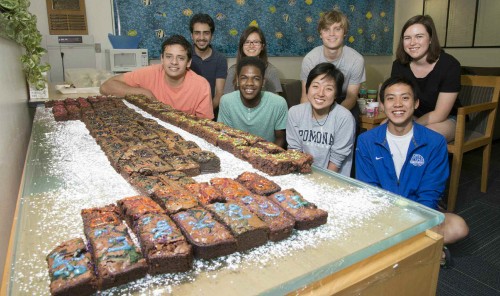
Members of the Class of 2015 show support for a classmate who just received a diploma during Pomona’s 122nd Commencement in May. During the ceremony, Michael Dickerson ’01, Andrew Hoyem ’57, Judge Stephen Reinhardt ’51, and France Córdova spoke and received honorary degrees from the College. Videos of the speakers are available at www.pomona.edu/events/commencement/archive/2015.aspx.

Prince of LEGOs

Colin Walle ’91

PCM-summer2015-web3_Page_26_Image_0001
ON THE MORNING of July 10, Colin Walle ’91 needed only 1,997 more votes to see his dream come true—or at least, to take a very big step in that direction.

No, he wasn’t running for office. This was something more personal. His prize creation—based on a happy confluence of a children’s toy that he had never given up and a favorite book about never losing your inner child—was hanging in the balance.

Based on Antoine de Saint-Exupéry’s Le Petit Prince, Walle’s proposed Little Prince LEGO project had accumulated 8,003 votes on the LEGO Ideas website. He now had 78 days left to hit 10,000. Reaching that threshold by the Sept. 27 deadline would mean that his pet project would move from a LEGO-lover’s fantasy to actual consideration for development and marketing as an official LEGO set.

Walle says he doesn’t remember a time when he didn’t play with LEGOs. “We had LEGO sets when I was a kid that predated my birth,” he recalls. But unlike most adults, Walle never put away his favorite toy. As a self-described “LEGO enthusiast,” he visits lots of aficionado websites, and one day he happened across one called LEGO CUUSOO, based on a Japanese word for “fantasy.” The site would later morph into LEGO Ideas.

“Basically, they have these different projects that anybody can submit,” he explains, “and then if they get enough votes, the LEGO Corporation will put them into a review stage and then consider making a real set based on your proposal.”

At the time, Walle happened to be reading The Little Prince to his son for the second time. He had first read the book in high school, but it was at Pomona that he really fell in love with Saint-Exupéry’s gentle fable. He even quoted some of the book’s most famous lines in his senior yearbook. (“‘Goodbye,’ said the fox. ‘And now here is my secret, a very simple secret: It is only with the heart that one can see rightly; what is essential is invisible to the eye.’”)

So maybe it was inevitable that two of Walle’s fascinations would come together in a brainstorm. “The book was sitting on the banister upstairs, and I had this little LEGO Death Star sitting in close proximity to that,” he explains, “and it was sort of a eureka moment. ‘Wait a minute—this is a project I need to do.’ I had been such a big fan of the book for so many years, and the book prizes a child’s imagination and the emphasis on adults not forgetting what it’s like to be a child. And so I thought, ‘Well, wait a minute—here I am, 46 years old and into LEGOs.’ And it’s the perfect story to be made out of LEGOs.”

Before he could start building his prototype, however, he had to decide what to include. “My thought was, in the books you spend so much time on the asteroid, so I had to have the asteroid in the prototype. Originally, I came up with more of a two dimensional asteroid. And then talking to a friend of mine, he was telling me about how to make a three-dimensional, six-sided box that looks like a ball made of LEGOs. It’s a technique they call S.N.O.T, which sounds gross but it stands for ‘Studs Not on Top.’”

Walle also spent a lot of time building the airplane that crash lands in the desert, where the book’s narrator meets its title character. Other parts include a baobab tree, the main characters and the Little Prince’s rose under her glass dome.

Of course, even if Walle gets his 10,000 votes, there’s no guarantee that an actual Little Prince LEGO set willever hit the market. Winning prototypes for sets based on the TV comedy “The Big Bang Theory” and the movie “Wall-E” are now in production, he says, but others winning projects didn’t make the cut. Three projects based on the video game “The Legend of Zelda” hit the 10,000 mark, but no set has emerged, possibly because of licensing difficulties.

If the LEGO Corporation were to decide that the idea was marketable, they would engineer their own set, which might or might not resemble Walle’s admittedly rough prototype. “Frankly, they would build something better than what I did,” he says with a laugh. “Let’s be blunt about it. I’m just doing my best efforts, but they’re the professional designers.”

If it came to that, the Saint-Exupéry Estate would also have to sign off on the deal. That isn’t a sure thing either, but Walle has spoken with them and was thrilled to find that they were “nuts about the project. I can’t say that they will approve the license, but they definitely want this set made.”

Maybe that’s because the very idea of a man on a quest to create a toy based on a book that idealizes the wisdom and innocence of childhood is the kind of thing Saint-Exupéry himself would have appreciated. “Even when I was in college, I knew I wanted to have a family someday,” Walle says, “and now that I’m thinking about it maybe that’s part of what draws me to the book—in the sense that the story is also about protecting and valuing innocence: the way that the aviator tries to look out for the Little Prince, and the way that the prince cares for his rose.”

At the end of the day on July 10, the vote total had risen by three more votes—8,006 down, only 1,994 to go.

If you’d like to support Walle’s dream before the Sept. 27 deadline, you can cast your vote at ideas.lego.com/projects/50323

Celebrate!

SAGEHENS ARE COMING together in record numbers—both in person and online—to learn, mingle and make a difference.

PCM-summer2015-web3_Page_25_Image_0002

Alumni Weekend 2015 

This year’s Alumni Weekend brought together more than 1,600 alumni and guests for a weekend of for a weekend of fun, celebration and hundreds of campus activities, including performances, open houses and lectures. Highlights included the Daring Minds Speakers Series, featuring Blaisdell Award winners James Turrell ’65, Bill Keller ’70 and Mary Schmich ’75, the first-ever 47th Reunion, held by the Class of 1968 (see story on page 47), and a Claremont in Entertainment and Media panel featuring Richard Chamberlain ’56. At the gathering in Little Bridges preceding the Parade of Classes, Alumni Distinguished Service Award winners Jeanne Buckley ’65 P’92 and Stan Hales ’64 were recognized, class volunteers were celebrated and over $3 million in reunion class gifts were announced. (For more photos, see Last Word, page 64.)


Winter Break Parties

In January, Sagehens around the world flocked together in growing numbers to take part in a favorite community tradition. Winter Break Parties brought nearly 1,000 Pomona alumni, parents, students and friends together in 15 cities from Kansas City to Shanghai for laughter and libations, stories and Sagehen spirit. Interested in hosting a Winter Break Party in your city this season? Contact Kara Everin in the Office of Alumni & Parent Engagement at kara.everin@pomona.edu for more information.


Daring Minds Events

Pomona’s yearlong celebration to wrap up Campaign Pomona: Daring Minds kicked off last spring with a series of events designed to help Sagehens learn, mingle and make a difference. Highlights this spring included:

  • Daring Minds Lectures: On campus (including nationally noted poet Professor Claudia Rankine in April) and across the nation (including the East Coast lecture series in March, featuring Professors Amanda Hollis-Brusky and Char Miller).
  • 4/7: A Celebration of Sagehen Impact: This social media-driven effort celebrated the good work and good will of a community full of “everyday Daring Minds.” More than 150 civic-minded Sagehens and friends posted about their good deeds, and the good deeds of Pomona friends, while hundreds more chirped their encouragement through “likes” and comments. Community members also pledged and performed service as part of the celebration, including 16 Seattle Sagehens who came together on a rainy Saturday to plant 447 trees at a local nature preserve. It’s not too early to start planning: What will you do to make a difference by next 4/7?
  • Senior Send-Off: For 47 hours leading up to Class Day and Commencement, hundreds of alumni, parents, faculty, staff, students and friends rallied for the College’s first Senior Send-Off, a mini-campaign to honor the graduating Class of 2015 and support Pomona education for all current students. Nearly 500 donors gave more than $80,000, and dozens more alumni, students, faculty and friends took to social media and the campaign web site to offer their “sage advice” to graduates as they make their life-changing transition.
  • Daring Minds Videos: Watch for your invitation to tune in for a series of Daring Minds videos to be made available starting in September. On the playlist are Professor Claudia Rankine and alumni James Turrell ’65, Bill Keller ’70 and Mary Schmich ’75.


Career Networking Events

Alumni volunteers across the country organized and hosted a series of career networking events this spring and summer. From Los Angeles to Chicago and New York, more than 100 members of the Pomona community came together to connect with fellow Sagehens and share industry-specific and general career stories and advice, and the program continues to grow! Interested in hosting a career networking event in your region? Contact the Alumni and Parent Engagement team at alumni@pomona.edu.

To make sure you hear about exciting events and opportunities yet to come, update your contact information by emailing alumni@pomona.edu or calling 1-888-SAGEHEN.


Travel/Study

Hawaiian Seascapes 

(Big Island to Molokai)

With Professor Emeritus Rick Hazlett

Dec. 5–12, 2015

Board the Safari Explorer for a seven-day cruise from the Big Island of Hawaii to Molokai, with stops on West Maui and the “private island” of Lanai. Enjoy dramatic volcanic backdrops and marine life sightings. (NOTE: At publication, there was only one cabin left on this cruise.)


From Angles to Angels:PCM-summer2015-web3_Page_25_Image_0001

The Christianization of Barbarian England

With History Professor Ken Wolf

May 18–29, 2016

The eighth in a series of alumni walking trips with a medieval theme, this is the first involving the United Kingdom. Its purpose is to appreciate the fascinating history (captured by the Venerable Bede) of the conversion of the barbarian conquerors of England, starring the Irish and Roman missionaries. In Scotland, you will visit Kilmartin, Dumbarton and Loch Lomond; in England, Lindisfarne, Hadrian’s Wall and Durham Cathedral.


Inner Reaches of Alaska

June 4–11, 2016

Join Pitzer Professor of Environmental Analysis Paul Faulstich on an “un-cruise” through the stunning Inner Reaches Coves of Alaska. Aboard a small vessel serving 74 passengers, adventurers will travel from Juneau to Ketchikan, encountering stunning glacial landscapes, old-growth forests and incredible wildlife.


For more information, contact the Office of Alumni and Parent Engagement at

1-888-SAGEHEN or alumni@pomona.edu.

Retiring But Not Shy

cartoon of Rick Hazlett rappeling to his interview, suspended over a pit of molten lava

PCM-summer2015-web3_Page_18_Image_0001

Rick Hazlett

WHEN ASKED IF PCM could interview him about his retirement, Professor Rick Hazlett suggested that the writer would “have to rappel in to my interview, suspended over a pit of molten lava in a bat cave (or something like that!), where of course I’ll be doing research just for the ‘hell-uvit.’”

He was joking—sort of.

Hazlett is starting his retirement in style: He’s moving to Hawaii. A geology professor at Pomona since 1987, he’s trading Claremont for the Big Island, giving him a prime spot from which to pursue one of his greatest passions: volcano research.  u

Hazlett calls the move a “bittersweet denouement” because of his deep affection for Pomona College and its students. But he has a long-running connection to Hawaii, having done many research projects there over the past 40 years, stretching back to the time he was a student.

“In a sense, I’m not really moving to a new landscape or an entirely new social circle,” he says. “It’s a bit of going home, in a way.”

A four-time winner of the Wig Distinguished Professor award, Hazlett chaired Pomona’s Geology Department for nine years. He helped establish the school’s Environmental Analysis Program and became its pioneer coordinator.

Hazlett is moving into a historic house in north Hilo, 30 miles away from the Hawaiian Volcano Observatory. His research will likely involve “looking at a prominent fault zone near the summit of the [Kilauea] volcano.”

“That sounds like work, but honest to God, it’s recreation for me,” he says with a laugh.

In addition, Hazlett will be working on two book projects. One is a new edition of a popular textbook, Volcanoes: Global Perspectives, that he co-wrote in 2010. He was also appointed senior editor for a research encyclopedia of environmental science, to be published by Oxford University Press. His focus will be the impact of agriculture on the environment.

“I’m really quite concerned about, and deeply committed to, solving environmental issues that I can impact. I figured this was a great way for me to pursue that mission while moving into retirement.”


Jud Emerick

Illustration of Professor Emeritus Jud Emerick

AFTER TEACHING ART history at Pomona for 42 years, Jud Emerick says he still has as much interest in the field as ever.

“I’ll be doing art history for the foreseeable future,” Emerick writes in an email from Rome, where he’s spending the summer. The current focus of his research, he says, is “how architecture from early Christian and early medieval times in the Euro-Mediterranean world set stages for worship.”

Emerick’s areas of expertise are wide-ranging. As a professor, he taught courses on subjects such as prehistoric and ancient Mesopotamian, Egyptian, Green and Roman art; classical art in the Mediterranean; and painting in Italy during the 14th century.

Emerick and his wife have made Rome “a kind of second home” for the last 46 years. You can sense his passion for the place as he describes attending lectures at landmark sites, eating in local restaurants with friends, and talking art. After all these years, he says, he and his wife “still find that being in Rome is tantamount to being at the center of our art historical world.”

Emerick is also a music buff and says one of his greatest joys is his home music center. (His eclectic musical interests range from American blues to European chamber music to Seattle grunge.) In an age of digital recordings, the self-described audiophile says he hopes to do some online reviewing of new recording formats and equipment.

Honing his language skills is another goal. Emerick says he plans to “learn modern Italian verb tenses (how does one use the subjunctive?), get better at deciphering medieval Latin and even start the study of ancient/medieval Greek.”


Sidney J. Lemelle

PCM-summer2015-web3_Page_19_Image_0002
AS SIDNEY LEMELLE heads into the future, he’s also revisiting his past. Specifically, Lemelle, a professor of history and black studies, is delving back into his 1986 Ph.D. thesis to expand it into a new manuscript.

His thesis chronicled the history of the gold-mining industry in colonial Tanzania, from 1890 to 1942. Now he’s exploring the post-colonial period, taking the subject up to the present. “I originally looked at gold, for the most part; now I’m looking at gold, diamonds and gemstones,” says Lemelle.

He adds that it’s difficult at times to re-examine his earlier work. “You’re going back to something you’ve written many years ago, and your ideas have changed since then. It takes a little humility.”

Lemelle joined Pomona’s faculty in 1986. A four-time winner of the Wig Distinguished Professor award, he chaired the Intercollegiate Department of Black Studies from 1996 to 1998 and the History Department from 2002 to 2004. His areas of expertise include Africa and the African Diaspora in North America, Latin America and the Caribbean.

Lemelle says he’s also looking forward to teaming up with his son, Salim Lemelle, a 2009 graduate of Pomona College, who is a screenwriter and writing intern at NBC/ Universal. The two plan to collaborate on screenplays.

“I hope we can write historical dramas and that sort of thing,” says the senior Lemelle. “We’ve been tossing ideas back and forth for a long time. Now I’ve got the time where I can actually do it. I’m excited about it, and so is he.”


Laura Mays Hoopes

PCM-summer2015-web3_Page_19_Image_0003
LAURA MAYS HOOPES is writing a second act to her long career in science: She’s transitioning from biology professor to novelist.

In her retirement, Hoopes plans to put the finishing touches on a novel she penned while earning her MFA at San Diego State University in 2013. The book’s working title is The Secret Life of Fish, and it’s about a girl growing up in North Carolina who develops an interest in science and environmental issues.

“It’s not really autobiographical but it has certain things in common with my life, because I grew up in North Carolina, and I love the beauty of the state,” says Hoopes. “And I know a lot of strange stories about North Carolina history that I was able to weave in.”

Besides exploring the topic of women in science, she tackles issues of ethnicity and Native American identity in the book. There’s also a love story.

Hoopes came to Pomona College in 1993 and served as vice president for academic affairs and dean of the college until 1998, when she moved full time to the faculty. She taught both biology and molecular biology. In 2010 Hoopes wrote a memoir, Breaking Through the Spiral Ceiling: An American Woman Becomes a DNA Scientist.

Hoopes is also working on a nonfiction book. It’s a biography of two major female figures in science: Joan Steitz, a professor at the Yale School of Medicine, and Pomona graduate Jennifer Doudna ’85, a professor at the University of California, Berkeley.

“The two entered science about 20 years apart—Joan when there was a lot of discrimination against woman, and Jennifer when pretty much all the doors were open and everyone was just enchanted with her,” says Hoopes. “The whole idea is to look at key stages in their careers. It’s kind of a fun project.”


Ralph Bolton ’61

PCM-summer2015-web3_Page_19_Image_0004
JUST AS HE DID 53 years ago in the Peace Corps, Ralph Bolton ’61 will be spending his post-Pomona years helping impoverished people in Peru.

The anthropology professor, who began teaching at Pomona in 1972, is president of the Chijnaya Foundation, which aids people in poor, rural communities in southern Peru. Created by Bolton in 2005, the organization designs and builds self-sustaining projects in health, education and economic development. Bolton does the work entirely on a volunteer basis.

“It’s extremely gratifying,” he says. “The people are very grateful. Many of these communities where we work are totally abandoned by any other nonprofit organizations or by the government agencies, and it’s one of the poorest areas of South America.”

His powerful connection to Peru first took root when he was a 22-year-old in the Peace Corps. In the small highland village of Chijnaya, he brought agrarian reform to the farming families, improving their lives dramatically. Hands-on service has always been part of Bolton’s approach as an applied anthropologist, whether he’s helping the destitute or advocating for HIV prevention.

His very popular Human Sexuality class at Pomona pioneered undergraduate discussions on AIDS and HIV when he began teaching it in the late 1980s. In 2010, he was honored with the Franz Boas Award for Exemplary Service to Anthropology, considered the most prestigious award in his profession.

Bolton says he’ll be spending about half the year in Peru, where he’s also working with fellow anthropologists and helping develop anthropology programs in universities.

“I can barely sign in to Facebook without having a Peruvian student or colleague begin to chat with me. So while I regret the loss of my Pomona students, the slack has certainly been taken up by other students of anthropology elsewhere who are very eager to continue to benefit from whatever I have to offer.”


James Likens

PCM-summer2015-web3_Page_19_Image_0005

JAMES LIKENS SPENT 46 years teaching economics at Pomona. In his retirement, he’ll focus more on family than finance.

“I’m very big into family history. I have more than 17,000 names in my file,” he says. “Genealogy is fun for me perhaps because it’s so different from economics. Economics is driven by numbers and theory; genealogy is driven by documents and stories.”

Likens also served as president and CEO of the Western CUNA (Credit Union National Association) Management School, a three-year program spread over two weeks each July on the Pomona College campus. Since he joined the school in 1972, its annual enrollment has more than tripled from less than 100 to more than 300.

Likens, a winner of the Wig Distinguished Professor award, chaired Pomona’s Economics Department from 1998 to 2001. He also directed the yearlong celebration of Pomona’s Centennial. Likens has long been involved in community service—he has served on nonprofit boards and task forces—and says that will continue. “I will always be involved with service. I don’t know what it will be, but I will do something. It could be a board, or it could be a soup kitchen.”

He also plans to pursue his many interests, which include traveling, golfing, painting and spending time with his family, especially his four granddaughters. In addition, he’ll be working on a memoir.

“I have mixed feelings, of course, about retiring,” says Likens. “I have been at Pomona a long time, and it’s very much a part of my life. On the other hand, I now have the opportunity to do new things, and I look forward to that.”

Helping Out With Speaking Up

Helping Out With Speaking Up: Jessica Ladd ’08 is destigmatizing the reporting of sexual violence—and her new app may even help stop it.

PCM-summer2015-web3_Page_17_Image_0001

GET HER GOING, and Jessica Ladd ’08 will talk effusively about her many positive Pomona memories, from late-night sponsor-group discussions about free will to sunny study sessions on Walker Beach.

In many ways, Pomona directly inspired her career path. She created her own major in public policy and human sexuality, writing her thesis on condom distribution in California prisons and jails. She turned The Student Life’s often-lewd sex column into a thoughtful exploration of topics such as virginity, safe sex and consent.

Perhaps most pivotally, and certainly most traumatically, Pomona was also the place where she was sexually assaulted.

The incident itself was harrowing, but its aftermath was in some respects even more traumatizing. Ladd found herself unsure of how to go about doing basic things like finding emergency contraception and confidentially getting tested for STDs. Worse still, in reporting the assault she felt like a passive and helpless participant, from the tone of campus security’s questioning to uncertainty about how her answers would be used.

“Instead of feeling empowered, I left the situation on the verge of tears,” she says. “It made me realize that many of the tools for improving the process didn’t exist, and sowed the seeds for wanting to create a better way.”

As founder and CEO of Sexual Health Innovations (SHI), Ladd has developed a tool called Callisto that is aimed at making survivors feel more comfortable reporting their experiences. This fall, two institutions will adopt the technology, including the very place where Ladd’s frustrating but illuminating journey first started.

Sexual assault is consistently one of our country’s most under-reported crimes, with upwards of 80 to 90 percent of incidents going undocumented. The reasons range from logistical, to social, to psychological. Victims may be afraid people will think they are lying or exaggerating; they may worry that accusing their acquaintances will ostracize them from social circles; and they may be scared to publicly re-live the experience in a trial where their credibility and character are continuously questioned.

“Because survivors have had their agency stripped in such a severe way, they often feel hesitant to give information to authorities if they think they might lose that agency all over again,” says Ladd, who herself took over a year to report. “We’re trying to create a trauma-informed system that gives them total control over the process.”

Photo of cell phone with Callisto, a tool to help with reporting sexual assault

Callisto- a tool to help with reporting sexual assault

Callisto lets users file an incident report that can be sent directly to authorities or archived for later. Users can also choose a third option: saving the report such that it only gets filed if their attacker is separately reported by another user.

It’s a clever feature, and not a trivial one. Ladd often cites a 2002 study which found that 90 percent of campus assaults are committed by repeat perpetrators; she’s confident that Callisto has the potential not only to improve the reporting process, but perhaps even to reduce the number of assaults that happen in the first place.

“If authorities could stop perpetrators after their second assault, 60 percent of assaults could be prevented,” Ladd says. “Callisto isn’t the complete answer, but I think it can be a valuable piece in the puzzle.”

One reason to bet on Callisto is that it was developed with direct input from more than 100 college sexual-assault survivors and advocates, in the form of several months’ worth of surveys, focus groups and interviews.

Among the participants was Zoe Ridolfi-Starr, who last year organized a Title IX federal complaint against Columbia University arguing that the institution treats survivors and alleged assailants unequally. She says that, with Callisto, it was clear from the start that SHI truly understood its audience’s needs.

“Survivors can find it overwhelming enough to try to maneuver through all that red-tape before you even add things like PTSD and depression into the mix,” she says. “SHI has shown that they want to go about the process in a way that’s inclusive, intuitive and intentional.”

Callisto’s sleek interface is designed to make it easy to wade through the murky waters of bureaucracy. Questions have explanatory “help text” to clarify why they are being asked and how answers will be used, while the language is chosen with care and sensitivity. For instance, a question about how much the victim had been drinking is couched in reassurances that such answers do not put her or him at fault and will not, say, get her or him in trouble with the school for violating its alcohol policy.

The system’s development has coincided with sexual assault emerging as perhaps the most-discussed issue in all of higher education, from President Obama’s recent “It’s On Us” initiative to the Columbia University student who carried a mattress all year to protest the school’s handling of her assault allegations.

“As far back as 2013, we realized that if there ever was a time for schools to change their programs, it’s now,” Ladd says. “In the past, adopting this might have seemed like an admission that assault is prevalent on campus. Today, it’s seen as forward-thinking.”

The issue has gained prominence even beyond academia, particularly with the many allegations against comedian Bill Cosby. Ladd says that, while such visibility can be valuable, the growing list of women who have spoken out only further highlights the importance of systems like Callisto for survivors who don’t want to go public, or whose assailants aren’t famous entertainers.

“People shouldn’t have to out themselves to the world to get justice,” she says. “Callisto is a service that we’d eventually like to make available to anyone who needs it.”

Ladd’s interest in sexual health evolved from her upbringing on San Francisco’s Castro Street, where she says that it “always seemed like the city around me was dying of AIDS.” An early clouds-parting moment happened in a high school production of “The Vagina Monologues,” when she first learned that there was such a thing as a clitoris.

“It felt as though the world had been conspiring to not let me know about it,” she says. “It made me wonder, ‘what else are they hiding from me?’”

Since then she has dipped her toes into several different sexual-health-related sectors—as an educator, an academic, a policy advocate and even a White House intern—but says that she became disenchanted with all of these approaches as means to actually effect change.

Instead, she looked at companies like Facebook and Google, and realized that a key way to influence people was through technology.

“The Internet allows people to do things that they would normally find socially awkward, from looking at porn and buying sex toys to propositioning threesomes on Craigslist,” she says. “We’ve harnessed that power to make ourselves happier, but why not use it to make ourselves safer and healthier, too?”

Callisto is the flagship initiative for SHI, which Ladd founded while enrolled full-time in Johns Hopkins’ public-health MPH program. SHI has grown from a makeshift website coded by volunteers to a full-fledged 501(c)(3) nonprofit with bi-coastal offices and more than a quarter-million dollars in funding from Google.

This fall, in efforts that are more than a year in the making, Ladd will launch Callisto at two “Founding Institutions”—Pomona and the University of San Francisco.

“We want to make sure that students feel comfortable reporting sexual assaults when they happen,” says Pomona Associate Dean and Title IX Coordinator Daren Mooko. “Callisto is a very creative mechanism for doing so, in a way that puts a lot of control in the survivor’s hands.”

Ladd says she didn’t come into SHI with particularly entrepreneurial intentions, but simply with a problem that she wanted to solve.

“This is something that I have long believed should exist in the world,” she says. “At a certain point I realized that, while I can’t change what happened to me, what I can do is build something that will hopefully help the next person who’s in that same situation.”

The Tetrasept Reunion

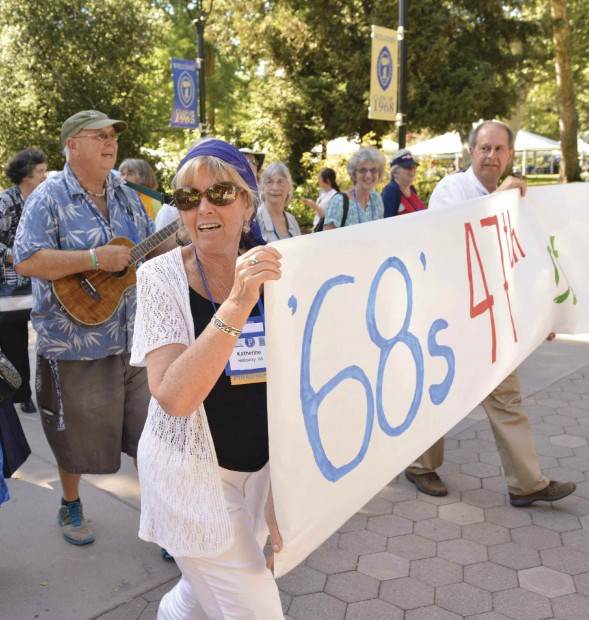
Photo of members of the Class of 1968 marching in the Alumni Weekend parade

THE CLASS OF 1968, which launched the College’s ongoing fascination with the number 47 years ago, has now given birth to a new tradition—the 47-year reunion. During Alumni Weekend, members of the class flocked back to Pomona for the first such gathering, and in honor of the occasion, they even created a new genre of poetry, which they dubbed the “tetrasept.”

At the center of it all was Bruce Elgin ’68, who—as a student in class with Professor Donald Bentley back in 1964—was one of originators of Pomona’s ongoing 47 search (along with Laurie Mets ’68). Elgin defines a tetrasept as a poetic form with “either four lines of seven syllables or seven lines of four syllables,” adding: “There are no rhyme or meter restrictions.”

During the build-up to the reunion, members of the class submitted tetrasepts about the reunion itself, the Class of ’68 or the cult of 47, for publication in a 32-page booklet. The submissions ranged from nostalgic to acerbic to esoteric, but they had one thing (in addition to their unique form) in common—they’re characteristic of the extraordinary inventiveness of one of Pomona’s most innovative classes.

Below are a few examples lifted from the booklet titled “Tetrasepts.”


From “Tetrasepts” 

We call four score and seven

Oratory from heaven.

But other way ’round … not close:

Seven score and four—just gross!

—Bruce Elgin ’68


Greetings dear friends,

the deadline nears.

Words elude me.

What did I learn

at Pomona?

Procrastinate,

and words will come.

—Karen Porter MacQueen ’68


Why wait ‘til number fifty?

Let’s meet now, and let’s meet then.

Twice the fun! (Like letters here

Are two times forty-seven).

—Ruth Massaro (Henry) ’68


Forty-seven

Since sixty-four

Has proved to be

Unlikely lore;

So now ’hens fete

What shall endure

Forever more.

—Mary Jane Gibson ’68


Forty-seven

Have come and gone

My liberal

Education

Still a solid

Deep foundation

For a good life.

—Jill Kelly ¸’68


Where art thou forty-seven

Our class seeks you everywhere

In proofs, in ads, or even

A silly verse—on a dare.

—Diane Erwin ’68


They only are loyal to

this college who, departing,

bear their added riches in

trust for mankind. James Blaisdell

—Kathleen Wilson Selvidge ’68


Bentley proved all

Numbers equal

Forty-seven;

Hence Pomona

Class reunions

Always are the

Forty-seventh.

—Brian Holmes ’68

Inspired

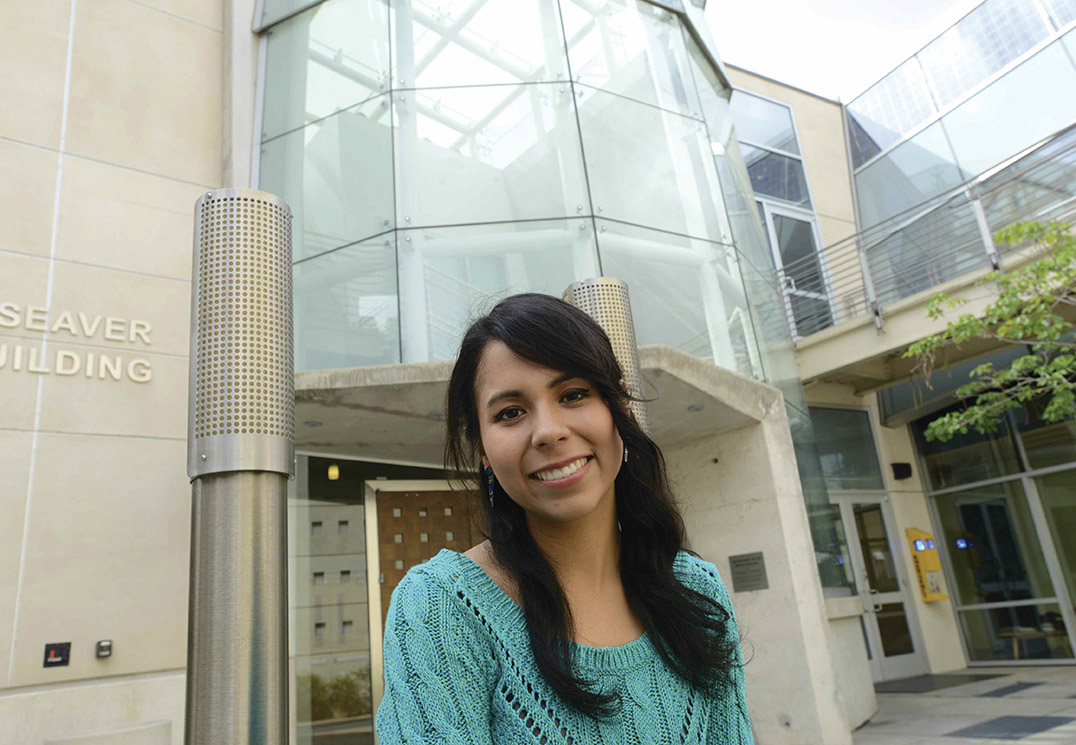
ANDREA DIAZ ’15 HAS found inspiring role models throughout her life, starting with her parents and continuing with the professors at Pomona College. The daughter of two pediatricians, she came to Pomona with an interest in the sciences and began doing research in Professor Mal Johal’s lab as a first-year student. She also became a mentor herself, working with international students, Pomona Science Scholars, Students of Color Alliance and as a pre-health liaison. Last spring, Andrea received two extraordinary awards—a Fulbright Fellowship to conduct research in Paris and the David Geffen Medical Scholarship to attend the David Geffen School of Medicine at UCLA.

Photo of Andrea Diaz '15

“Looking back, I see that Pomona has molded me, but that I’ve helped to mold it as well. That’s one of the great things about the College. You can’t be a passive bystander.” -Andrea Diaz ’15


Parents, Role Models and Inspiration

“My parents are the superstars. They were both first-generation students, first-generation Americans and the first physicians in our family. By witnessing their work serving as two of the only three pediatricians in our county, a small, under-served rural area, I’ve been able to see the influence they’ve had on the health of our community. Whenever they go out, people approach them, giving them updates about their children and thanking them; they taught me that being a physician in that kind of area is not a 9-to-5 job, but a social responsibility. It’s what has inspired me to go to medical school.”


The Fight Against Drug-Resistant Bacteria

“As more and more bacteria become resistant to antibiotics, scientists and doctors are concerned that we’re headed toward a post-antibiotic era, where simple infections can once again become deadly. The research I’ve worked on at Pomona involves antimicrobial peptides, which latch onto the inner membranes of bacteria and essentially tear them apart. It’s a molecule that works to fight bacteria and is a promising alternative to traditional antibiotics.”


Three Professors Who Made a Difference 

“Professor Johal has been my strongest supporter and was very influential during my time at Pomona. He sparks something that makes you take responsibility and ownership over your research and work as a collaborator with him in the lab. That is very empowering. Professor Selassie is a wonderful, strong role model of what a woman of color in science should be like. I hope one day I can be that for someone who wants to enter the medical field. And Professor Sandoval, who taught my Intro to Chicano/Latino history class, is inspirational and challenges students to re-think traditional narratives. After his last class, I honestly just wanted to stand up and applaud because he’s an incredible lecturer and really calls you to action.”


Recognition for Pomona as a Fair Trade College 

“In high school, I became interested in fair trade as a practical way to fight modern-day slavery, to provide just wages to producers and growers. At Pomona, I became part of a three-person committee to gain recognition for the great strides the College was making to bring fair trade products to campus and to create some form of accountability. Pomona was recognized as the 11th Fair Trade College nationally and the second in California, which speaks to our commitment to sustainability and fair wages. Whenever I went to campus events and saw fair trade coffee or tea, it made me happy to think that I played a small role in that.”


Language, Humanities and a Year in Paris 

“I’m spending a year at the National Museum of Natural History in Paris on a Fulbright Fellowship, working under Dr. Sylvie Rebuffat, who is one of the world’s leading researchers in antimicrobial peptides, specifically lasso peptides. It’s a dream come true. I know my experience doing research in an international setting is going to be different than my experience at Pomona.

“What the humanities taught me is that I can’t go into a different environment blindfolded. I’m grateful that my classes at Pomona, especially my French classes, have given me a wider cultural awareness and appreciation. They have strengthened my ability to communicate and work with others and have helped me understand the impact that science has on society, as well as the impact that society has on science.”


UCLA and Beyond 

“I’m very honored and humbled by the David Geffen Medical Scholarship and by the freedom it will give me to shape my future. Many people coming out of medical school have the burden of debt, but this opportunity will give me the liberty to use my medical degree where I see the greatest need, to go to underserved communities and specialize in primary care, or to become more involved with research or with academic medicine.”


The Greater Good 

“Most students at Pomona are really passionate about something and can find the support they need here to act on those ideas and that passion. We’re incredibly fortunate to have all these resources and opportunities, amazing professors and outlets for expression. Looking back, I see that Pomona has molded me, but that I’ve helped to mold it as well. That’s one of the great things about the College. You can’t be a passive bystander. The question for me now is: ‘How am I going take all these things that I’ve acquired here and use them for the greater good?’”


Click for larger view

Click for larger view

88 Years Ago

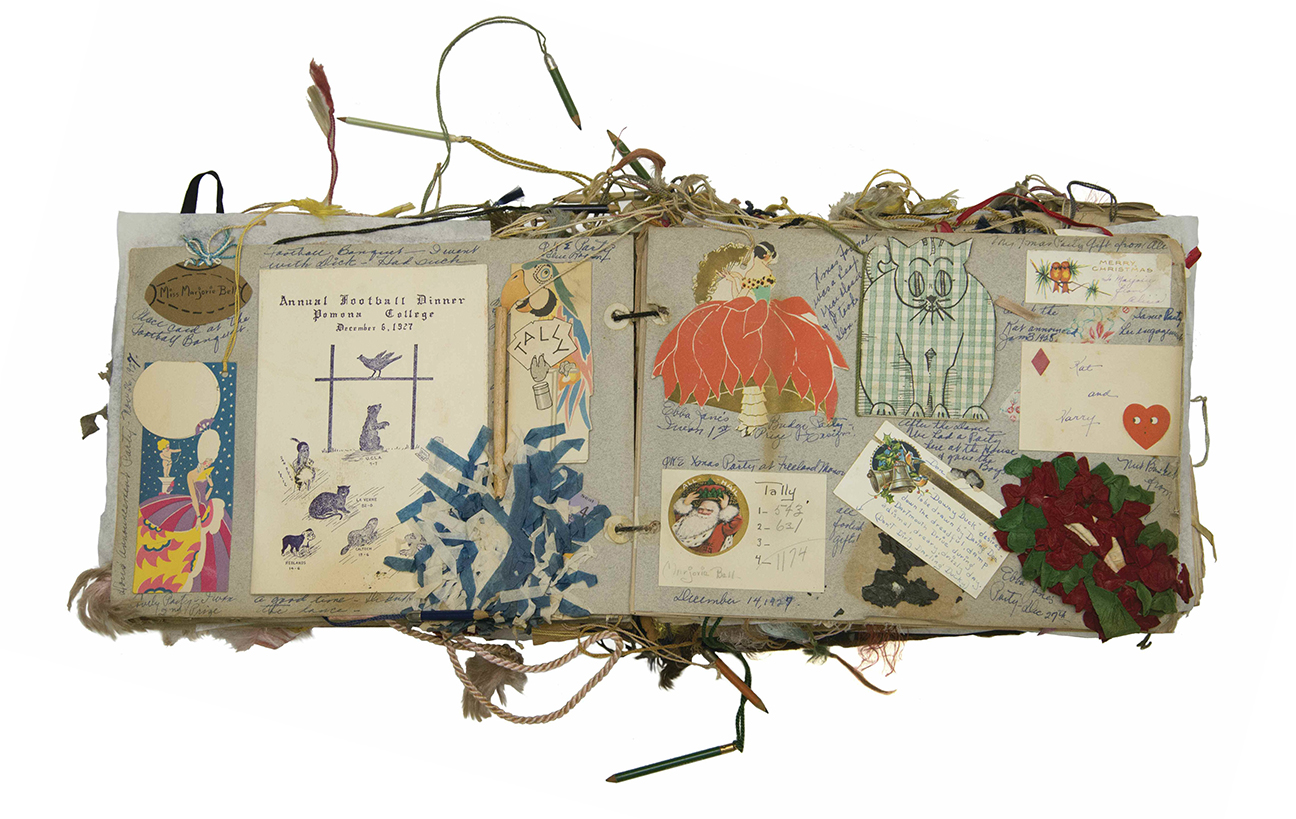
Photo of the Marjorie Maude Bell ’28 Scrapbook from the Pomona College Archives

Click for larger version

ITEMThe Marjorie Maude Bell ’28 Scrapbook
DATE1924–1928
COLLECTIONOne of 37 scrapbooks currently in the Pomona College Archives collection, ranging from the Class of 1901 to the Class of 1972.
DESCRIPTION240-page scrapbook (12” X 9” X 6”), jammed with pasted-in invitations, dance cards with attached pencils, tickets, programs, clippings and other memorabilia from Southern California college life in the 1920s.
ORIGINThe scrapbook was donated by Karen McDaniel, Ms.Bell’s niece, who explained: “She graduated in 1928, and her brother Gilbert Clyde Bell, (my grandfather) graduatedin 1927. She was a very involved student: secretary of her senior class, president of Phi Kappa Sigma literary society,sorority sister of Alpha Chi Omega, among other positions.”
If you have an item from Pomona’s history that you’d like tosee preserved in the Archives, please call 909-621-8138.

Not Your Ordinary Help Desk

Photo of Melanie Sisneros ’94 at her workstation

IF YOU WANT a sneak peek into the personality of Pomona’s Desktop Support Specialist Melanie Sisneros ’94, you might start by visiting her workstation.

Clustered in rows that fan out across every surface are dolls, toys and figurines—a stuffed Fix-It-Felix Jr. plush can be spotted alongside Cruella DeVille. Harry Potter posters paper the walls above her wildly colorful desk.

“I had to downsize when I moved from my old office,” says Sisneros. She points out several well-dressed Bratzillas and explains their rivalry with Monster High dolls.

Also surrounding her work area are boxes and boxes of the latest Apple computers, waiting to be opened and tested. Sisneros is as serious about her work as she is about staying true to herself. A member of the Class of 1994, Sisneros has been working for ITS since she first began work study at Pomona.

“The first job application somebody handed me was for the computer center,” she recalls. “I didn’t know anything about computers, but I needed to fulfill my work study, and it was a job application.”

If you had asked that younger Sisneros whether she thought her career would involve computers, she’d have laughed. “I hated computers when I was little!” she exclaims. “We had this horrible Tandy 1000 RadioShack-brand piece of junk that I could never get to work right. When I got to college, I was quite surprised that I ended up liking computers.” She attributes this interest in part to the late Professor of Psychology William Banks, who was responsible for the acquisition of Sisneros’s first computer of her own, an all-in-one black-and-white Mac with a power supply problem. “That’s when I really started to play and discover,” she recalls.

Sisneros’s method of discovery was entirely her own. “My high school job was working at Long John Silver’s, a fish shop, where I started drawing a comic strip about these little cartoon fish,” she explains. “So once I discovered SuperPaint, an illustration software on my Mac, I started making it on the computer instead. I would print it out and tape it on the door of my dorm room, and people would walk by and read the latest installment.”

Sisneros took to working with computers like one of her cartoon fish to cartoon water. She worked for ITS for four years as an undergraduate before accepting a post-graduation internship, which she held for several years before being hired full-time.

Now, she works as part of ITS’s six-person Client Services team, where her job includes providing desktop support for several academic departments. One of these is the Department of Classics, in which Sisneros was a major. “I’ve always felt that at liberal arts colleges, you learn how to think,” she says. “Regardless of what you study, you learn how to look at things critically. I use that training every day in doing IT support.”

Sisneros spends a big part of her day answering the phone at the ITS service desk, taking walk-ins and responding to help requests submitted through the College website. Much of her job consists of configuring computers, which can either mean connecting remotely or taking time to visit the offices of professors and administrators across campus.

In Sisneros’s eyes, technology is just a tool. One of the joys of her job, she says, is helping users understand the tools at their disposal and match them to their needs. She recalls a brief stint at Computer City in the mid-’90s, where customers would come to her for help “learning computers.”

“What does that mean?” she laughs. “You don’t ‘learn computers;’ you use them for something. I don’t want to learn vacuum cleaners. I want to clean my floor.”

However, what keeps Sisneros excited about her job isn’t just her love of technology and of helping others fit it to their individual needs. “People have jobs where they’re in a rut, day in and day out,” she says. “For me, every phone call is something new. Every person that walks up to the desk brings a new challenge, a new problem to solve. There are new versions of software, new viruses to fix, new everything.”

Pomona-Pitzer Cracks Top 50 in Director’s Cup Rankings

For the first time in almost 20 years, Pomona-Pitzer Athletics reclaimed its spot in the top 50 nationally in the 2014–15 Learfield Sports Director’s Cup.

Directors' Cup Logo

The Sagehens ranked 49th nationally (out of 332 NCAA Division III institutions) jumping from 63rd last year and 117th in 2012-13 and placing them second among SCIAC institutions. It is the highest finish for Pomona-Pitzer Athletics in the Director’s Cup standings since a 33rd-place finish in 1996–97.

Sponsored by the National Association of Collegiate Directors of Athletics (NACDA), the Director’s Cup is a program that honors institutions maintaining a broad-based program and achieving success in many sports, both men’s and women’s. The standings are calculated via a points system based on how teams finish in their national tournaments.

Pomona-Pitzer had a successful academic year from start to finish, with five teams, as well as numerous individuals, qualifying for the NCAA Championships.

In the fall, men’s soccer won the SCIAC Postseason Tournament to advance to the NCAA Division III Championship for the first time since 1980. Men’s cross country earned a team qualification to the nationals for the third year in a row, by taking a second-place finish in the NCAA West Regionals, and ended in 17th place, the team’s highest finish since 1982. Maya Weigel ’17, meanwhile, earned All-America honors for the women’s cross country team with a 22nd place finish, after claiming first place at the West Regionals.

The winter saw a strong season from the men’s and women’s swimming and diving teams, which both finished second in the SCIAC and had national qualifiers. In his first year, Mark Hallman ’18 earned All-America honors by qualifying for the finals in the 200-yard freestyle. For the women’s swimming and diving team, the 800-yard freestyle relay team of Vicky Gyorffy ’15, Maki Tohmon ’17, Kelsey Thomas ’18 and Victoria Vanderpoel ’18 earned All-America honors as well.

The Sagehens made their biggest leap in Director’s Cup standings during the spring semester, thanks to three teams that advanced to the round of 16 in the NCAA Division III tournaments.

Women’s lacrosse reached the round of 16 with its first-ever NCAA tournament win, defeating SCIAC rival Occidental at home after winning its first-ever SCIAC title by four games. Men’s and women’s tennis both moved on to the NCAA Regional Finals in May after earning top-10 rankings in the regular season, with the men reaching as high as third and the women as high as seventh. Men’s tennis defeated Texas-Tyler in the regional semifinals to reach the round of 16, while women’s tennis earned a win over Whitman. In addition, Connor Hudson ’15 qualified for the NCAA Division III Championships both in singles and in doubles after he and doubles partner Kalyan Chadalavada ‘18 reached the finals of the ITA Small College nationals in the fall, earning All-America honors. On the women’s side, Lea Lynn Yen ’16 and Grace Hruska ’18 qualified for the NCAA Championships in doubles.

Women’s water polo, which is not calculated in the Director’s Cup standings due to the small number of participating teams, added to the spring success for Pomona-Pitzer by tying for the SCIAC title with a 10-1 league record, the fourth year in a row that it has earned at least a share of the conference crown.

In addition to team successes in the spring, Weigel completed a fall-spring All-America sweep by finishing in seventh place nationally in the 800 meters for the women’s track and field team, while John Fowler ‘16 earned a top-10 finish (ninth) in the 5,000 meters. Tiffany Gu ’16 also earned a national qualification for the women’s golf team, finishing 30th out of 110 at the NCAA Division III Championships.

The late push in the spring enabled the Sagehens to pass Redlands (56th place) among SCIAC schools.