Features

What We Gave the Game

what we gave the game: sagehens have left their tracks on the national pastime in all sorts of surprising ways, racking up win after win for the liberal arts

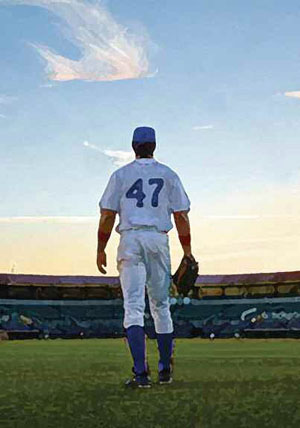
So what if a century has passed since Pomona College sent a player to the majors? Sagehens have left their tracks on the national pastime in all sorts of surprising ways, racking up win after win for the liberal arts.


47playerimage

baseballsmall

1) Computer baseball: The first interactive baseball computer game was born in Mudd-Blaisdell. Here’s how a would-be playwright and a ballet dancer became video game pioneers.

2) The Ultimate Baseball Roadtrip: Over 16 years, Mike Luery ’77 and his son visited ever Major League ballpark in North America, somehow surviving those tense teen years.

3) The Nation’s Smartest Stadium Restaurant: With his acclaimed restaurant in the shadow of Boston’s Fenway Park, Garrett Harker ’89 offers a brainy beacon amid a sea of beer-soaked sports bars.

4) Reassuring Research: The big leagues owe a debt of gratitute to Professor Gary Smith for such scholarly papers as “The Baseball Hall of Fame is Not the Kiss of Death.”

5) Big-League Books: Sagehen wordsmiths such as Professor Jonathan Lethem contribute more than their share to the ever-growing trove of baseball literature.

6) Baseball Worldwide: From Brussels to Tel Avis to Taipei, Sagehens play an outside role in helping to spread baseball fever beyond the bounds of North America.

7) Goofball Classic: A quarter century after its release, the movie Major League by David Ward ’67 has only grown in its appeal as baseball fans’ favorite funny flick.


Lost Worlds

Lost Worlds: Sometimes the map itself is the treasure. Here, four cartographical curiosities unfold, revealing hidden realms and long-forgotten locales.
PHANTOM OF THE FOOTHILLS

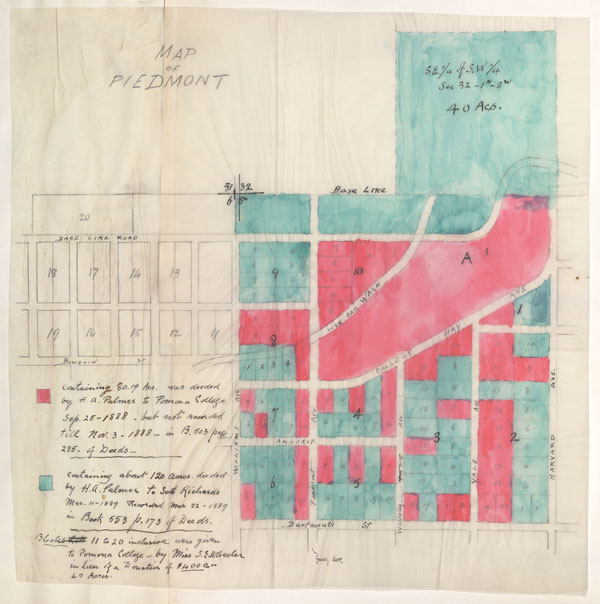
Planned as the original building site for Pomona College, Piedmont  is the college town that never was.

 For a place that never really existed, Piedmont turned out to be surprisingly easy to find.

The would-be burg dreamed up long ago as the permanent site for Pomona College couldn’t even be called a ghost town: Little more than a cornerstone was ever put in place, and even that was eventually moved away. Still, all the historical hubbub surrounding the College’s 125th anniversary piqued my curiosity about the location the Pomona Progress all those years ago declared was just right for the future college: “No sightlier spot could have been selected. The tract is … the very perfection of Southern California.”

 Then came a real estate crash, and, soon after, an offer from the nearby struggling settlement of Claremont, which had an empty hotel to offer the College. After some tussling, the Piedmont plan was dropped for good, and the never-built town became just one of many SoCal settlements that didn’t make it past maps.

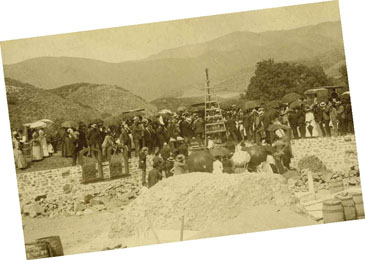
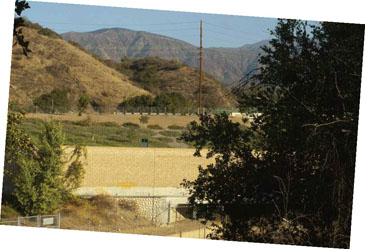
  There remained, however, a photo from the September day in 1888 when hundreds of people gathered at the base of the foothills north of Pomona for the cornerstone ceremony. That old black and white helped lead me back to the spot known as Piedmont Mesa and its faint traces of the College’s beginnings.

 Next I turned to the tomes. The histories of the College—particularly Frank Brackett’s Granite and Sagebrush—were quite clear in placing the Piedmont Mesa at the mouth of Live Oak Canyon, a locationI know well having driven through it at least a hundred times.

 So my editorial co-conspirator Mark Wood and I set off to do a little legwork and pinpoint Piedmont more precisely. Once there, we called up that old photo of the cornerstone ceremony on his iPhone.

 Even on the little screen, it was easy to line up the old view with the present one, since the hills had changed so little in 125 years. Comparing the two views, it looked to us like the site of the original cornerstone—later relocated—might just lie beneath the 210 Freeway, which today slices through the site.

 The street names bore witness to history as well. We were standing near the intersection of Piedmont Mesa Road and College Way. And then came the twist: Looking closely at the markings on those street signs, and later checking with the map, I couldn’t help but notice that even the original site dedicated to become a permanent home for Pomona College wound up within the city limits of … Claremont.

NEW TRACKS, OLD PATHS

When Dan Hickstein ’06 set out on an adventurous quest to chart the mountain-bike trails of Colorado, he ran smack dab into the state’s wild mining past.

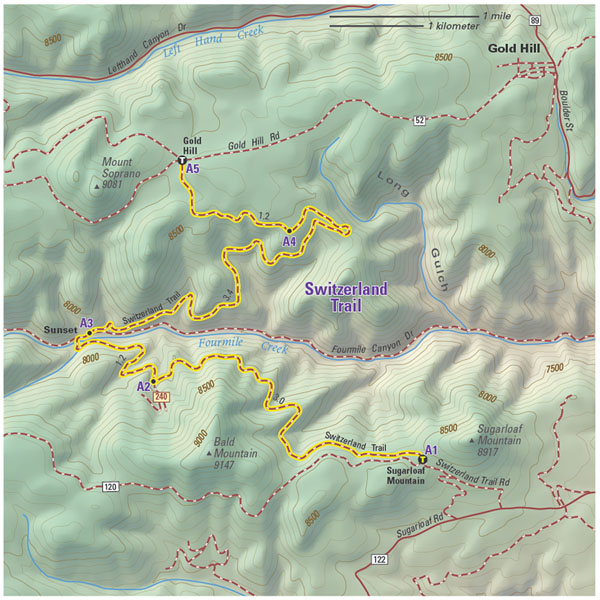
Map by Mike Boruta / Fixed Pin Publishing

 Dan Hickstein ’06 recently took a year-long “sabbatical” from the chemical physics Ph.D. program at the University of Colorado at Boulder to ride the trails and write the definitive guidebook to mountain biking in the rustic realm he now calls home.

 Good maps were key to his quest. The outdoors adventurer, who earlier studied x-ray crystallography on a Churchill Scholarship to Cambridge, was unsatisfied with other Colorado biking guidebooks that contained hand-drawn maps that would leave him and his friends lost in the woods. Equipped with GPS, he set out to gather all the raw data that the book’s cartographer needed to get the maps just right.

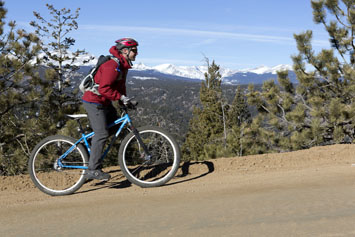
Dan Hickstein ’06 in the Gold Hill, Colo., area. (Photo by Craig Hoffman.)

Naturally, he also had to ride every single trail, and that’s when he ran into something he didn’t expect. Many of those awesome, high-altitude rides led him smack dab into Colorado’s colorful past. You might think of mountain biking in the Rockies as a series of rugged trails, breathtaking views and run-ins with the weather—and it was all those things. But on the trails Hickstein also encountered closed-off mine shafts, “creepy, abandoned mining buildings” and once-bustling towns that had all but disappeared.

Over and over, he kept running across the remnants of the state’s mining rush in the late 1800s, later waves of mining, and the remains of various “crazy schemes,” including railroad tunnels blasted through 12,000-foot-high ridgelines and opulent summer resorts that are now long abandoned.

This convergence of mountain biking and history makes sense. Years ago, miners and engineers forged new paths through the mountains, and given the difficulty and danger involved in making them, those trails would remain of use long after. On the Switzerland Trail, pictured here, near what Hickstein calls the “quasi-ghost town” of Gold Hill, the mountain biking trail follows a path created over 150 years ago for a narrow-gauge railroad that once served mining towns. “So, when you ride the trail, you’re following the same path as the prospectors who rode the train up into the mountains with the hopes of striking it rich,” writes Hickstein.

Hickstein does concede that his brushes with history sometimes slowed the book project down. He’d ride past rustic ruins and later look them up to discover the settlement once had been filled with hotels, bars and brothels. He’d get lost in reading about some little town and how silver prices had shot up and then crashed after the Sherman Silver Purchase Act and … then he’d notice three hours had passed by and “Oh, man, I’ve got nothing done.”

Fortunately, he was able to include some of the historical tidbits—along with 118 maps—in his recently published book, The Mountain Biker’s Guide to Colorado (Fixed Pin Publishing). Hickstein is now a fourth-year grad student at University of Colorado, where he studies how ultrafast lasers can be used to make super-slow-motion movies of chemical reactions. But after a long day in the lab, Hickstein still finds time to ride the trails, sometimes even bringing along his own tome and its trusty maps.

THE COMMON-SENSE CARTOGRAPHER

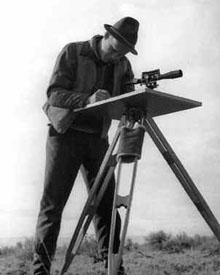
At the dawn of the Jet Age, Hal Shelton ’38 shook up the crusty world of cartography by making maps in which the colors matched the landscape.

Hal Shelton’38 changed the way we see the world, at least on paper. He brought artistry, color and a dash of common sense to the crusty field of cartography at the dawn of the Jet Age. Today, his maps are considered cartographic masterpieces.

An art major at Pomona, Shelton was introduced to cartography just after graduating when he went to work for the U.S. Geological Survey creating topographical maps in the field. Perplexed by some of the conventions of mapmaking, he became interested in the idea of “natural color”—making the area mapped look like it does to the eye.

“Up until Shelton came onto the scene, when you made maps, the color would represent, say, political areas [or] elevation …,” notes Tom Patterson, a National Park Service cartographer who has written extensively on Shelton’s career. “He really revolted against that idea because he felt that when people see these colors, they don’t think of elevation, they think of land cover and vegetation.”

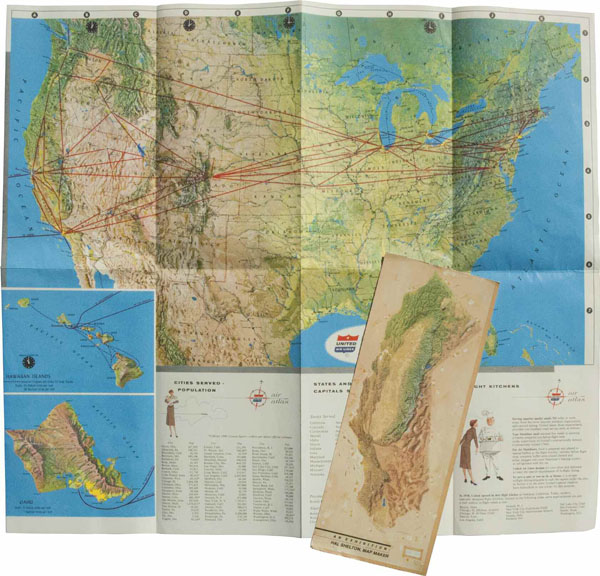
The U.S.G.S. wasn’t interested at first, but soon enough the military was, and Shelton did some work for the Air Force during World War II. According to Shelton’s son Stony, his father’s big break came after the war when he met Elrey Jeppesen, a pilot who had started an aeronautical mapping business. Jeppesen saw the potential in Shelton’s approach, and soon the artist was making airline maps for the traveling public. The idea was that air travelers could look at maps that matched the terrain they saw out the window. “This was at the beginning of the jet era,” says Patterson. “People would get dressed up to go on an airline.”

 If the natural color concept seems straightforward—forests are green, deserts are brown— the execution required patience, skill and considerable expense. Decades before satellite imagery was widely available, Jeppesen hired academic geographers to gather the data, which was etched into zinc plates about two to three feet in diameter. Working on an inch at a time, Shelton then painstakingly painted on the landscape features along with shaded relief to show elevation. His artistry yielded “realistic picture maps that astound the cartographic world,” as The New York Times gushed in 1954.

The series of maps Shelton painted for Jeppesen came to be used not only by airlines but also in classrooms and by NASA. Even today, the work of Shelton, who died in 2004, remains relevant for cartographers. Raw satellite images hold too much “noise” and distraction, says Patterson, while Shelton’s less-literal technique brings out the most important features of the landscape to create an image that a casual reader can make sense of.

“He painted the entire world, he liked to say sometimes,” recalls Stony, who notes his father went on to create a series of well-known maps of Colorado ski areas and then left the cartographic work behind for a prolific career painting landscape scenes. “He created these, beautiful, beautiful maps that were just the landforms as they looked from space.”

And what became of those maps? The originals—valued at the time at more than $1 million—were donated to the Library of Congress in 1985 and exhibited with fanfare in 1997, when Shelton was flown to D.C. to take part in a showing timed to the maps division’s 100th anniversary. Years later, though, when Patterson came to see them at the maps division’s vast storage facility, Shelton’s creations led a more down-to-earth existence, tucked away among the “cabinets that just go on and on in the basement of the place.”

JEST OF THE WEST

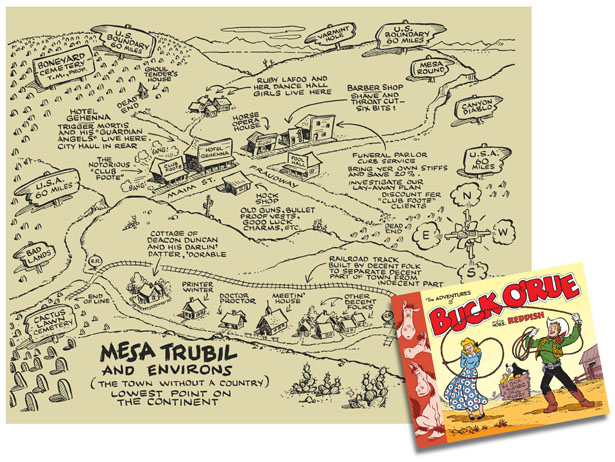
Pulling together his father’s long-forgotten cowboy comic strips, Richard Huemer ’54 delved into an imaginary western world — and his dad’s psyche.

Just as Richard Huemer ’54 was settling into his first semester on Pomona’s leafy and idyllic campus, his father was bringing to life a very different realm in the newspaper comics.

Mesa Trubil, a weedy Western outpost so vile that the government wouldn’t claim it as part of the U.S.A., had only one hope in the form of hero on horseback Buck O’Rue. The noble and naïve cowboy tangled with malevolent Mayor Trigger Mortis and his henchmen, all the while dazzling love interest Dorable Duncan with his bravery.

The satirical strip was born of a career setback for Richard’s dad. Dick Huemer had been laid off from his job as a Disney writer, and that allowed him to pursue the project he had talked about for years. “He desperately needed something to do,” recalls Richard.

With Disney colleague Paul Murry on board to do the drawing, Dick Huemer got a small syndicate in Cleveland to promote the strip. But perhaps due to the syndicate’s limited reach, the strip didn’t go over big. And just as Buck hit the papers, Dick was back in the saddle at Disney, where his career later included co-writing Dumbo. By late 1952, the strip was kaput.

Dick Huemer died in 1979, but it wasn’t until Richard’s mother passed on 20 years later that the old comic came back into view as Richard sorted through his mother’s possessions. “The Buck O’Rue proofs were among the things she had saved all these years,” he says.

Next, Richard was contacted by a Swedish graduate student, Germund von Wowern, who was interested in the work of illustrator Murry (later one of the best-known illustrators of Mickey Mouse). The Swede wanted to know if Richard had any proofs of a strip called Buck O’Rue. Did he? Richard had nearly all of them.

Out of that came a 10-year collaboration through which Richard and von Wowern unearthed and filled in the missing pieces of the story of Buck O’Rue. Their efforts culminated with the publication last year of a 300-page book of old O’Rue strips accompanied by commentary.

Along the way, Richard gained insight into the era—and his own father. The strapping cowboy hero, in Richard’s eyes, epitomizes the America of the time. “There was a great deal of optimism,” he says. “And a feeling that we could do anything.”

Still, Richard’s adult eyes couldn’t ignore some things he missed in his youth. As Richard notes in the tome, Buck confronted a relentlessly foul cast of characters in Mesa Trubil, where political corruption was rife. Some of the strips featured a crazy old miner who carelessly tosses around his “schmatum bomb” that could destroy the world. All in all, the comic strip was rather bleak in its worldview, which Richard says seemed to reflect his father’s own outlook.

“He covered it with his jocularity. He liked humor and wordplay,” recalls Richard. “Inevitably, when you delve into the work of someone you know, you understand more about them.” So from those long-forgotten funnies, Richard wound up with a more rounded and complex picture of his dad. “That was a voyage of discovery for me, too,” he says.

The Football Wars

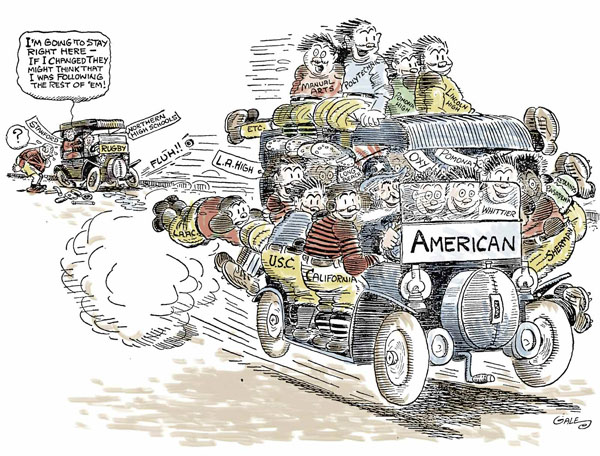
The Football Wars: The football wars raged on until the strange Christmas Day game in which the Sagehens helped put rugby to rest.

In those bleaker moments, with a player writhing on the field—again—it seems as if there’s no fixing football. The sheer force of the sport’s intrinsic and inextricable violence overwhelms one well-meaning new rule after another. There is some wringing of hands by authority figures—even the President, an ardent sports fan, expresses some grave concerns about the game and its costs—and a sense that Something Must Be Done, if notably less sense of what that might be. That was the state of football in 1906.

It’s the state of football in 2013, too. The same managed, choreographed violence that drives the game’s popularity can’t be managed or choreographed into un-violence. That reality, football’s defining conflict and central contradiction, would be recognizable to a fan from 1906. The game itself, though, would not be. Contemporary football’s intricate passing-driven offenses, as well as the speed, strength, skill and sheer tonnage of the players involved, make today’s game seem even more than a century removed from the version played around the turn of the 20th Century.

Take, for instance, the game played between Pomona and Stanford on Oct. 27, 1906, at Fiesta Park in Los Angeles. The players on those two teams averaged a little under 160 pounds. (If you were wondering: There is no player on this year’s Stanford roster who weighs less than 170 pounds, and a dozen listed at 298 pounds or more.) This wasn’t just a time in which Pomona College had a football rivalry with the 2012 Rose Bowl Champions, it was a time in which those two football teams were roughly equivalent in size and skill. But the strangest thing about that 1906 game was that these two teams of football players were squaring off in a game of rugby. How and why they were doing that is something of a long story, but it comes back to football’s old—and still contemporary—crisis of violence.

COLLEGE FOOTBALL IN THE EARLY part of the 20th century was, by and large, an East Coast pursuit. While Pomona and Occidental had rivalries with present-day Pac-12 powerhouses such as USC, Cal Berkeley and Stanford, those games and the teams playing them weren’t held in especially high regard nationally. But if California football was considered, in the words of a 1905 article in Outing Magazine, “slow and second class,” the game was no less violent west of the Rockies.

The game’s roughness was then, as it is now, both a part of the game’s appeal and its distinctive mythos. No less a fan than Theodore Roosevelt wrote, in an 1893 response to concerns about football violence in Harper’s, that, “the sports especially dear to a vigorous and manly nation are always those in which there is a certain slight element of risk. Every effort should be made to minimize this risk, but it is mere unmanly folly to do away with the sport because the risk exists.” But injuries and even deaths continued to occur on the field, and the sporting press of the period happily hyped the violence. The presence of bought-and-paid-for players on bigger and more ethically flexible teams—a problem big-time college football is still working on, actually—added to the appearance of chaos. A round of rule changes in 1905 legalized the forward pass, opening up the game and diminishing the importance of the dull, grunt-y, straight-ahead brutality that the football writer Caspar Whitney dubbed “the beef trust.” The changes also led to the creation of the Intercollegiate Athletic Association, the predecessor of the NCAA. On the East Coast, university presidents further responded to the rising tide of injuries and on-field deaths with a series of “debrutalization” measures designed to make the game safer.

Unsurprisingly, they didn’t quite work. “The season of ‘debrutalized’ football ended … with a record of eleven deaths and ninety-eight players more or less seriously injured,” The New York Times reported in November of 1907. This was only a slight reduction in casualties and no reduction at all in the number of fatalities, although the Times did note, hopefully, that “not a single serious injury has been sustained by Yale, Harvard or Princeton.” On the West Coast, at Cal and Stanford, university presidents were notably more proactive. They dumped football entirely for the 1906 season, and replaced it with rugby.

This was not necessarily a popular decision at the time. In June of 1907, Berkeley high school students (naturally) staged demonstrations against the imposition of what the newspapers of the time called “the English game.” But the shift to rugby was one that Pomona reluctantly made as well. They had to play against someone, after all.

 THE GREAT RUGBY EXPERIMENT didn’t last long at Pomona. Pomona was shut out by Cal, and while the Sagehens did win a tune-up game against Pomona High School in early October—“The game was not a particularly brilliant one,” the Los Angeles Times sniffed—they didn’t fare nearly as well against collegiate competition. Pomona was shut out again, 26-0, by Stanford shortly after that win against the local high school. “Pomona made a game fight to the end, and came very close to being enti-tled to a score,” the Los Angeles Times reported, quite possibly sarcastically. The headline in the Times, three days after that game, read “Pomona Drops Rugby Games.”

This was not the end of California’s football war. It was the end of intercollegiate rugby’s attempt at supplanting football at Pomona; the football team was back at practice by Halloween. It took Occidental and Whittier several years to follow suit, but within a few years a schism had emerged: Cal, Stanford and other Northern California schools played rugby, while by 1910, Pomona, Whittier and Occidental were playing football again, albeit against each other and teams from Colorado and Oregon instead of their larger and more geographically proximate rivals. “The two northern universities have adopted rugby for all time,” the Los Angeles Times columnist Owen Bird wrote in 1912. “The University of Southern California saw the way the tide was setting last year and took up the new game. Now it looks to be only a matter of time until the [Occidental] Tigers and the Sage Hens are forced to take up the game or lose standing with the athletic students of Southern California.

“This was not necessarily sportswriterly hyperbole on Bird’s part. “Rugby and American football are about on a par here,” Bird wrote, later in 1912. “This season will tell the tale as to which will survive.”

The answer, for a while, was both. Stanford, Cal and USC stuck with rugby, playing each other and teams from Canada and Australia for (very-far-) away games; the New Zealand All-Blacks, then as now one of the premier rugby sides in the world, swung through for an exhibition in 1913. But if rugby was an improvement on the brutal, dull, two-yards-and-a-cloud-of-ugh version of football that existed prior to the “debrutalization” rules and later reforms, the game that had emerged in the intervening years was a different thing—something slightly less bruising, a good deal more open, and notably more like the sport that’s currently the most popular in the United States by a wide margin. With the more pass-friendly and marginally less vicious game catching on in the rest of the nation—and booming in Southern California—the rugby schools were increasingly isolated. And then, in 1913, Pat Higgins initiated USC’s proud tradition of high-confidence, high-volume football coaches by injecting some trash-talk into the dispute.

“It will be remembered that Pat Higgins stated recently that he could get up a football team of rugby players, who could show the American players a few tricks at their own trade,” Bird wrote in the Times on Dec. 12, 1913. “Said speech caused a river of wild argument to be loosed upon our devoted heads.” Less metaphorically, it also led to a heavily-hyped exhibition American-style football game on Christmas Day, at Washington Park in Los Angeles. Higgins put together a team of elite rugby players from Cal, Stanford, Santa Clara and USC; coach Jack d’Aule built a team of his own, with Pomona (four players) and Whittier (five) represented heavily. “This squad of local intercollegiate men are fast, in condition, veterans of the game, and, best of all, are fired by a mighty impulse to defend the game they love,” Bird wrote. The opposing side, Bird noted, “[ran] to beef”—they outweighed the football players by 23 pounds per player, on average. They were, for the most part, the best rugby players in the United States.

It is, admittedly, something of a stretch to say that the resounding and lopsided 24-2 win that the team of smaller players from smaller schools rolled up that day saved college football in California. The game was not necessarily going anywhere; there is, for better or worse, something in the American psyche and populace that loves football. It was still several years before the rugby schools—Stanford was the last—dropped the sport in favor of football, although it’s safe to say that their programs have recovered from the blow. But while football still has a great many problems of its own to sort out, that Pomona-powered win a little over a century ago did at least ensure that rugby isn’t one of them.


Hologram or Bust

Hologram or Bust: Visiting (the papers of) David Foster Wallace at the Harry Ransom Center

I.
I Fly to Austin to Visit an Archive of the Entire Works and Life Papers of My Writing Mentor and Once Professor

The great thing about being a writer is that you send out vague emails like the one I sent asking the editor of this magazine if he had any work for me, and sometimes something wonderful, and completely beyond the value of money comes back. That was what happened when the editor of this magazine asked me if I might want to go to Austin to spend some time with the papers of David Foster Wallace who, despite my complicated feelings around his death, remains the most influential writer and perhaps more importantly, teacher, in my life.

A few weeks later, I was flying to Austin on-schedule through sheets of unbroken blue spotted with perfect clouds reminiscent of the original cover of Infinite Jest.

II.
The First Time I Encountered David Foster Wallace, the Writer

I found that blue-sky book in my father’s office in our house in 1996, opened it and didn’t leave my bed for five days. I was 15. I can’t remember whether I was actually sick or just decided to stay home “sick” from school for a week so I could do nothing but read Infinite Jest from morning until night.

All I know is that absorbing those words for the first time, for me, was a kind of transport as real as the flight I took from JFK to Austin. It was more than half my life ago, but I still have a very visceral memory of the days I shared with that book in my bed in my sophomore year of high school. I remember those days reading Infinite Jest in flashes, as if they were sections of a scary and wonderful trip I took by myself away from the teenage high school place I was stuck in at that time and so longed to escape, and into a terrain far more sophisticated and complicated. It was the kind of journey that, even though it had to end, when I got back I was permanently changed, and I knew it. Another way to say this would be that in adolescence, before I stumbled upon Infinite Jest, I was sad, but I thought the sadness I felt was unique to me, and that made me sadder. After reading Infinite Jest, I realized that there was a vast, great, adult sadness in the world that I was only likely experiencing the very tip of at that particular adolescent moment, and that made me feel significantly less sad.

I know now that many people feel that sense of both change and of having their specific sadness understood and put to words for the first time when they first read the work of David Foster Wallace. I didn’t know it then. I just knew that despite being an insatiable reader since I could put letters together, I finally had a favorite author.

III.
The First Time I Encountered David Wallace, the Professor

By the time I arrived at Pomona in 1999, I had read all of David Foster Wallace’s books that he had published up to that time except one and loved and was likely changed by them all. (The one book I hadn’t read was Signifying Rappers: Rap and Race in the Urban Present, because it was harder to get, and still is. I should probably still get it.)

I met David Wallace the person and professor in 2002, in the fall semester of my senior year. I had just returned from taking the previous semester off. During my semester off, I hiked the Appalachian Trail. I walked from Georgia to Maine, over 2,000 miles. I was struggling with a lot of things that now, as a professor, I understand are not uncommon for college students to struggle with. At the time, however, I thought my struggles meant I might not come back to Pomona in the fall when and if I finished my epic hike. I felt like maybe I wasn’t in the right place to be in college, or that college maybe wasn’t the right place for me to be.

I met with my advisor at the time, a professor in the English Department whom I also still admire. I told him that even though I was leaving college to live in the wilderness for six months to walk until I (I hoped) became unrecognizable to myself, I needed all the information he had available so that I could apply to the workshop I’d heard rumors that David Foster Wallace was coming to teach at Pomona in the fall. My advisor then said what many writers I respect have said to me about the writing of David Foster Wallace since. He said he didn’t know what everyone was so excited about, because he thought David Foster Wallace was sophomoric. I told my advisor that I was only a junior, and that when I had fallen in love with the writing of David Foster Wallace I had actually been a sophomore in high school, so that made perfect sense.

A few months later, I mailed in my story to apply to be in Professor Wallace’s Advanced Fiction Writing Workshop from a small outpost in rural Tennessee on the Appalachian Trail. It was the first story I had ever written from beginning to end, and it was about opening my father’s stacks of forbidden journals to find that they were not full of racy life experiences but instead of lists and lists of the books he had read when he was younger. I don’t know if I got into the workshop because the story was any good or if Wallace was just impressed with how battered the envelope was from being lugged around in my pack in the woods. I just know that I wasn’t a writer when I went into his workshop, and I was when I came out.

IV.
I Find Enough Wallace Files to Build a Fort Out of File Folders, No Make That A Whole Empire of Forts, So I Make Some Ground Rules and Start Sifting

There are five “collections” of papers at the Harry Ransom Center that come up if you do a search for David Foster Wallace. Each collection has an average of one to 10 “series,” which are groups of containers. From there, the numbers get complicated. The number of containers in each series varies greatly. The number of boxes in each container also varies greatly. The number of folders in each box—you get the idea.

One way to think of the categorical branching off of the material remnants of Wallace’s life would be like being surrounded by the folds and memory files of a giant, sterile, academic brain. I’m not a neuroscientist, so forgive me for the crudeness of this metaphor when it comes to its scientific roots. But at certain moments, going through those carefully ordered compartments of paper—being in the reading room at the Ransom Center did feel like being inside a brain in the best kind of way. A brain where everything had finally been sorted and smoothed and was organized once and for all to be shared, something I guessed Wallace might have appreciated, at least based on the lamentations about how hard it was to communicate the chaos in one’s head in an orderly way on paper that I was reading over and over as I sifted through those concrete-colored cardboard boxes of correspondence.

Confronted with so much paper, I had to determine what not to write about. After significant deliberation, I decided:

1. I would not write about manuscripts, various versions of manuscripts, or Wallace’s marginalia on manuscripts. I knew this was the kind of undertaking that would require far more time than I had at the University of Texas at Austin. Also, after having Wallace as a professor, I really respect him as a reviser, so I was not that interested in mining earlier drafts.

2. I would not write about Wallace’s correspondence that had to do with pitching his books and other writing. It seemed to me to be the most business part of the files, and I was interested in the opposite.

3. I would not write about his personal correspondence. It was just too sad. Exposing it without permission would feel like a violation. I will say that there were some fun postcards. I left the archive with the resolution to send more postcards, especially when not traveling. Favorites included pulp book covers such as A Woman Must Love: She Thought She Could Live Without Men, a photo of Truman Capote luxuriating at home in a bathrobe and Stetson, and a photo of an old geezer that Wallace had drawn a voice bubble for with the words, “Kein kluger Streiter hält den Feind gering.” I put the line into Google and learned it was a quote by Goethe. Translated, it reads, “No prudent antagonist thinks light of his adversary.”

4. I would not present the reader with just lists—lists of the words Wallace looked up and wrote his own definitions of, lists of the readings he assigned his students. I couldn’t fit those amazing lists into this brief article even if I wanted to. There were too many and they were too long! One folder I scanned of words Wallace wrote the definitions of is 100 pages long. Most of the pages are filled with lists of words in small print and they are on both sides. I hope someone someday publishes a book of his lists: lists of words, lists of recommended readings … I have a feeling someone will … In the meantime, here are a few gems that Wallace looked up the definitions of: vituperations, littoral, oneiric copralalia, tenesmus, gomphosis, coruscate, felo de se, votary, sapropel, nonceword, polyandry, logorrhea, facula, stellify, comether, rimple, hypolimnion and adumbrate. I leave it to you to take to the dictionary to unearth their meanings. One thing is certain about the David Wallace I knew as a student at Pomona, he would want you to work for it.

V.
The Single Most Joyful Thing I Found While Sifting Through the Papers of My Dead Professor

As I returned various boxes to the reference librarian, I slowly realized that what I was most interested in, and what fellow Sagehens were likely to be most interested in, was David Wallace the professor and David Wallace the person. That was how we knew him best after all. I decided to leave David Foster Wallace, fascinating and heartbreaking as he was in the pages I sifted through, to the people who knew him as a writer, in that way while he was still alive—to leave it up to them to decide when and what to
share from that aspect of the archive.

My favorite folder was the folder of the photocopies of the American Heritage Dictionary ballots. Wallace was a member of the company’s board that governed decisions on usage, spelling and pronunciation. The ballots show the feedback he gave to the American Heritage Dictionary over the years on items they sent him to review.

I think I was especially delighted to find Wallace’s dictionary ballots after reading his personal letters to the writer Don DeLillo, many of which seemed tortured or fraught with insecurity and self-doubt, because when Wallace is commenting on the dictionary ballots there is not a shred of that self-consciousness in his obvious joy in interacting so directly with pure language in its most naked state. Whether he is appalled at the way most people don’t understand the meaning of “to beg the question,” or enthusiastically approving the many acceptable different ethnic pronunciations of the words “bayou” or “calzone,” it is clear that there is no terror or stress for him on these pages, only an incredibly exuberant love of the words, stripped down to their barest selves.

Though Wallace may have wrestled with his role as a writer, his role as a grammarian and expert on words was clearly pleasing to him, and carried with it none of the burden of assemblage that creating novels and other texts did. I like looking at these dictionary ballots because, even in this quiet room that I can’t help feeling is a tomb of some kind, his joy and the thrill he got from his expert manipulation of the English language shines through.

When I reach the end of the folder of dictionary usage ballots dated 11-04-05, I get a pang seeing that he has listed a permanent change of address to Claremont, California, after he had already lived there three years. The address snaps me out of the paper and back to thinking about how difficult it is to reflect, on the one hand, about your friend whom you admired, who died, and on the other, about the intersection of your somewhat normal life with the life of someone whose papers end up in an archive … it’s difficult and disorienting to try to reconcile the two.

I only knew one very specific and cordoned-off part of David Wallace. Being confronted so closely with the other parts, having access to so many of them, felt reckless and unnatural, almost as if I was traveling through time. At points, I had to remind myself that Don DeLillo is still alive—that the dictionary ballots I was looking through were filled out by Wallace two years after I graduated from Pomona, only eight years ago. Retrieving them from those files in the archive where the papers of other great thinkers, long dead, were kept changed them somehow. It made him feel less like a person or friend, and more like a dead great writer.

VI.
There are More Than 40 Bronze Busts of (Predominantly White Male) Authors in the Harry Ransom Center, and a Bust of David Foster Wallace is Not Yet Among Them

There is an epigraph printed on the wall as you enter the reading room where you go to request the files. It is cited only as coming from the Hebrew Union Prayer Book. It reads, “So long as we live, they too shall live, for they are now a part of us, as we remember them.”

There are also the busts of great dead authors everywhere, immortalized in bronze inside the reading room, on the halls leading up to it and on the floor below where you enter the building that is designed to protect the delicate remembrances of great men from excesses of heat or light. Unfortunately, the busts are mostly old white men, which makes me start to wonder about the obvious question.

Who decides who gets a bust?

I walk around photographing all the bronze busts, metal, immortal monuments to other “great” authors (photographing is a way of looking when you are in an archive trying to absorb as much as possible). It is only when I get to the last one that I realize I had been hoping to find a bust of Wallace. There isn’t one. At least not yet.

Some of the authors get more than one bust inside the Ransom Center. There are three James Joyces, two Hemingways, two George Bernard Shaws. Steinbeck’s mustache is sculpted in a way that makes him look like a bullfighter, Tom Stoppard’s bust looks an awful lot like Mick Jagger, the two women who have been chosen above all the rest seem to be somewhat randomly Edith Sitwell and Edna St. Vincent Millay. Sitwell’s bust is also the only one that isn’t at least somewhat realistic. The rendering of her head as a giant, balloon-ish, moonlike white marble sphere with enlarged, alien eyes is eerily out of place, as if, in the afterlife, only her soul out of them all is not shaped like a person.

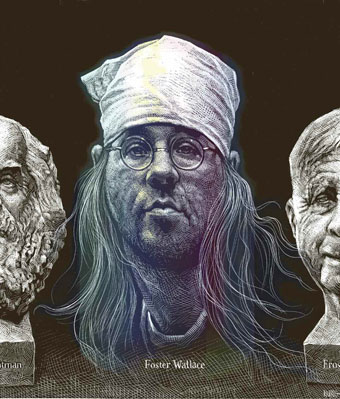
Perhaps someday there will be many busts to represent the many David Wallaces. The wacky young Wallace, eternally bandana-ed. The junior tennis pro. The fat, sweaty Wallace I saw read as a sort of audition for the post he came to fill the following year, significantly more svelte. The drug-addicted atheist and the sober Christian. It’s possible bronze is too ancient a material to capture a personality with so many genuine permutations. The future is long. Maybe someone will commission a hologram. Then, perhaps, the next time I come to visit these papers (I suspect there will be a next time), between the busts of Whitman and Frost, there will be a simulacrum of my old professor, made of light, chewing tobacco and spitting it into an old, dirty peanut butter jar, just as he used to do in class.

Myrlie in the Mirror

Myrlie in the Mirror: Reflecting on life 50 years after her husband's assassination, Myrlie Evers-Williams '68 is carrying on a long-held role -- and finding new ones.

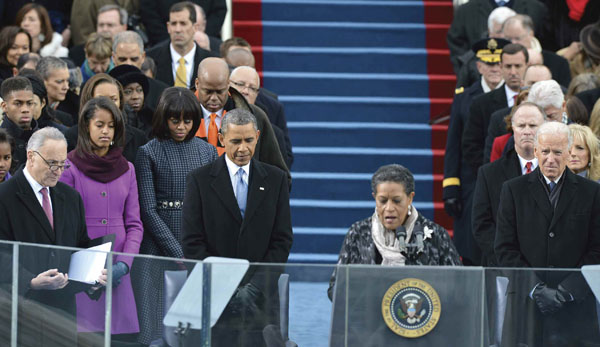
photo by Jewel Samad / AFP / Getty Images


The widow of.

The phrase travels with her through life, as if it were part of her name.

“Widow of Medgar Evers to Deliver Inaugural Invocation,” said a recent headline in The New York Times.

“Widow of Medgar Evers to Deliver Invocation at Obama Inauguration,” said the Washington Post.

“Medgar Evers Widow Gives Inaugural Invocation,” says the YouTube video.

Fifty years have passed since the hot June night in Jackson, Miss., that she heard the crack of a gun then bolted out of her bedroom, followed by her three children, and fell to her knees next to her husband, who lay near the doorstep in a pool of blood.

Within an hour, she was the widow of.

Myrlie Evers-Williams ’68 has tried to be the very best widow Medgar Evers could have hoped for. She has devoted herself to bringing his killer to justice, to keeping the cause of civil rights alive. But in the past half century, she also has maintained another struggleto become fully realized and recognized as herself. Just Myrlie.

“I made a decision,” she said one balmy winter day when I went to visit her at her apartment in a senior community just outside of Claremont.

The decision she was announcing wasn’t on par with others she had made recently, like selling her big house in Bend, Ore., or squeezing into a tight red dress to play piano at Carnegie Hall with Pink Martini, or agreeing to stand next to the black president of the United States and deliver the inauguration prayer.

This was a smaller act of liberation.

“I’m going to keep my hair natural,” she said, with a deep laugh. “I don’t have time for blow drying and curling and styling. I prefer to let the personality of yours truly emerge.”

On that day in early January, Evers-Williams, a tall woman with a rich voice whose friendliness carries a dash of tartness, felt under siege. She was recovering from the flu. Her sunny one-bedroom apartment was stuffed with boxes and her days were packed with chores.

The inaugural staff kept calling, and she had preparations to make for a 50th anniversary commemoration of Medgar Evers’ assassination.

“I am juggling a life that is not mine,” she said. “You know, as I approach 80, I ask myself why, why are you doing this?”

OK, why?

She plunged her hands into the pockets of her jeans.

“It’s just me,” she said. “It’s the nature of Myrlie.”

A few days earlier, trying to get organized for her upcoming appearances, she had fished some old documents out of the boxes in her living room. She sat down, in one of her orange wing chairs, and began to read about the funeral of the man she had married at 18 and lost at 30.

She was freshly struck by what he meant, to American history and to her. It had been a long time since she wept over Medgar, but sitting there, alone in the clutter of the past, she cried.
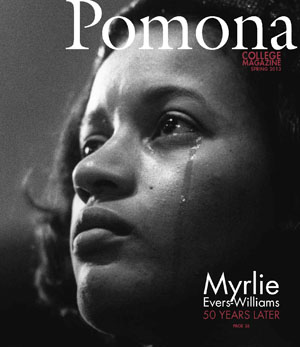
 

This powerful photo of Myrlie Evers-Williams ’68 (by Flip Schulke/Corbis) taken at a memorial service after her husbands assassination in June 1963 appears on the cover of our spring issue.

TO GRASP the improbable sweep of Myrlie Evers-Williams’ life, you have to understand the place she came from.

Mississippi in 1933 was poor, even by the standards of the Great Depression. In its small towns and out on the sharecroppers’ fields where blacks and whites alike struggled to eke a living from the land, the myth of white supremacy flourished as hardily as Delta cotton.

Like the rest of the Deep South, Mississippi abided by Jim Crow, a set of laws and customs that segregated blacks and whites in public places. Black people were shunted into separate schools and corralled in the backs of buses.They drank from water fountains marked “colored.” When they were allowed in “white” movie theaters, it was through a side door, then on up to “the buzzard’s roost” in the balcony far from the white patrons and the screen.

In that era, in the Mississippi River town of Vicksburg, lived a schoolteacher named Annie Beasley.

Beasley was one of the lucky few, a black woman who had gone to college for a while, and she believed that education was salvation. Shortly after her son and a 16-year-old girl gave birth to a child, she knew what she had to do.

She brought the baby, Myrlie, home.

Beasley owned her own house, a whitewashed place up the hill from the shacks where the poorest blacks lived. In her clean rooms, with the vegetable garden and fruit trees out back, she kept books. She listened to classical music and on Sundays wore white gloves to church.

Myrlie, named after an aunt who also helped raise her, called her grandmother “Mama.”

“Open your mouth and speak distinctly,” Mama instructed Myrlie.

“Baby,” Mama told her, “you may not have the money to travel, but as long as you can read, and books are accessible to you, you can travel anywhere in the world.”

“Baby, baby, get back here,” Mama would call if Myrlie left her nightly prayers too early. “You didn’t ask God to make you a blessing.”

Myrlie Beasley didn’t grow up feeling inferior or poor, and not until she was ready for college did she register how high and hard the wall of segregation was. When she applied for a state scholarship, hoping to study music at a college outside Mississippi, she was told that she could find everything she needed at a black school right there at home.

In 1950, she enrolled at Alcorn A&M College out in the woods of tiny Lorman, Miss.

“Stay away from the servicemen,” Mama and Aunt Myrlie warned.

On her first day at Alcorn, as she leaned against a lamppost, a football player approached. He was a few years older, one of the black Army veterans who had come home to Mississippi after World War II, having tasted the possibilities of the wider world. He was from the little Delta town of Decatur. His name was Medgar Evers.

They married the next year. She was 18.

Medgar Evers got a job selling insurance, and as he drove the Delta peddling his policies, he witnessed daily, in growing dismay, the black sharecroppers who lived barely better than slaves. He loved Mississippi, but in the nascent civil rights movement, he saw a chance to change it.

In 1954, the National Association for the Advancement of Colored People hired Evers as its first Mississippi field secretary. He roamed the state, documenting lynchings and other brutalities against black people, helping blacks register to vote, organizing boycotts and sit-ins. At one point, he handed out bumper stickers that read, “Don’t buy gas where you can’t use the restroom.”

Myrlie Evers worked as his secretary while she raised the children. They both grew tired, and scared. They argued, about money and safety. Civil rights was risky business.

In 1957, the Evers family moved up in the world, and into a small new house, with a mortgage, in a stable black neighborhood in Jackson. Some of their neighbors didn’t want them. Medgar Evers was stirring up trouble. Trouble was bound to follow him home.

On June 12, 1963, just past midnight, a few hours after President John F. Kennedy gave a televised speech in support of civil rights, Evers pulled into his driveway. He stepped out of the car, carrying T-shirts that said “Jim Crow Must Go.” From a honeysuckle thicket across the street came a bullet. It pierced him in the back.

“His murder was eerie and providential, so flushed with history as to seem perversely proper—shot in the back on the very night President Kennedy embraced racial democracy as a moral cause,” the historian Taylor Branch wrote in his Pulitzer-Prize-winning book Parting the Waters.

“. . .White people who had never heard of Medgar Evers spoke his name over and over, as though the words themselves had the ring of legend.”

Not all white people.

A proudly racist and cockily unrepentant fertilizer salesman named Byron De La Beckwith was soon arrested, tried twice in 1964, and both times let go after the juries, composed entirely of white men, deadlocked.

 THAT SUMMER Myrlie Evers packed up her life and headed for Claremont, Calif., about as far from Mississippi as a car and her imagination could take her.

“The kindness of people in Claremont was beyond belief,” Evers-Williams said, sitting in her apartment all these years later. “That was not what I wanted. I wanted the nastiness, the hatred. I wanted a fight. God, I wanted a fight so bad.”

Medgar had always told her that if they ever left Mississippi, he’d like to go to California, and in Kiplinger’s Magazine, she read a story on the country’s best small colleges. A name caught her eye: Pomona.

Then there she was, the famous widow of the newly famous Medgar Evers, living a continent away from friends and family, in a pruned and placid college town where blacks were almost as rare as snow.

She hadn’t comprehended how white her new hometown was. She had imagined it was more like the neighboring city of Pomona, and some of the black people there were miffed that she’d chosen insular, collegiate Claremont. Did she think she was too good for them?

Not only was she black in a land of whites, but as a 32-year-old student, she was old in the kingdom of youth.

She remembers her first day on campus, some professor addressing the freshmen about what an important time in life this was.

“Why am I sitting here?” she fumed to herself, “when I have three kids at home and I have no idea what they’re doing?”
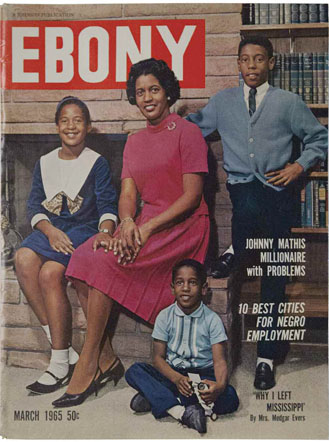
Her arrival in Claremont made news. Look Magazine photographed her poring over her books. Ebony Magazine put her and the three kids on its cover, posed next to their big stone fireplace, all smiles, dressed like the era’s perfect white sitcom families, only without the dad. Inside is a story: “Why I Left Mississippi,” by Mrs. Medgar Evers.

 Little by little, she softened to the kindness around her. Masago Armstrong, the Pomona College registrar, was among those who took a special interest.

“She and others were so powerful,” Evers-Williams said. “So powerful in their excellence, making me think about what I wanted to do.”

But the work was hard. Her grades weren’t good. She walked into a professor’s office one day“Alvin?

Was that his name?”and announced, “I quit.”

Go home, he said. Put your books away. Come back in a week. She came back in a week, ready to keep going.

When the Pomona College class of 1968 paraded across a stage to collect their diplomas, Myrlie Evers, sociology major, was there. The audience rose and cheered.

“Why did they stand up to applaud you?” her older son, Darrell, asked afterward. “You didn’t do anything different from the other graduates.”

“IS THAT the pool?” she said.

We were standing in front of Sumner Hall, out for a tour of the Pomona campus, where Evers-Williams rarely comes these days. She peered toward the blue shimmer in the distance. Pendleton Pool. She remembers that. Shivering in the water, clinging to the side, afraid, listening to the swimming instructor, Anne Bages, who finally, one day, said, “Myrlie, you must do this. Come on. If your child were on the other side drowning, what would you do? Envision it.”

She envisioned it and swam across the pool. “Her patience, her strength and determination to see I did what I had to do,” Evers-Williams said, “that speaks to my entire experience here.”

It was a sunny, warm day, and as we walked past Little Bridges, she remembered that old, elegant, mission-style building, too. She and her second husband, a longshoreman and union organizer named Walter Williams, were married there in 1975, before they set off for a life in Oregon.

“He was my dearest best friend,” she said. Williams died in 1995. “He was so good to me and my children.”

She walked on, slowly, wishing she’d brought her cane.

“God,” she said, “I’ve lived through so many changes. It’s amazing to walk on this campus and think of it. Mind if we sit?”

We sat on a bench on Marston Quad, looking toward Mount Baldy, past the trees that never seem to change. She thought back. Her eight years as an executive at Atlantic Richfield Company. Her run for Congress, unsuccessful but a decent showing. Her three years in the mid-1990s as head of the NAACP; she has some untold stories she’d love to tell about that. The writing, the speaking. The three children brought successfully to adulthood. “When I look at my bio,” she said. “I say, ‘wow.’”

Through it all, she never forgot that she was the widow of. She kept her eye on that cocky fertilizer salesman, Byron De La Beckwith. Her pressure helped persuade the state of Mississippi to retry him, and in 1994, a racially mixed jury of Mississippians declared him guilty of Medgar Evers’ murder.

There were many times after Medgar Evers died that his widow cursed and cried and wanted to dwell in hatred. She built a different life instead.

“And now?” she said. “Back in Mississippi after 50 years.”

Last February, while keeping her apartment near Claremont, she returned to Alcorn State University as a visiting scholar. “Come home,” she says the president of the college told her. “Come home and let us take care of you.”

So she went, and flew into Jackson-Medgar Wylie Evers International Airport.

In this half century, Evers-Williams has never ceased to be surprised.

Another surprise arrived after she gave a TEDx talk in Oregon a while back. She told the audience about how as a girl in Vicksburg, she sang and played the piano, and how her grandmother and aunt dreamed she would make it to Carnegie Hall. Out in the crowd that day sat Thomas Lauderdale, the founder of the pop orchestra Pink Martini. Afterward, he made her a proposition: Come perform with us. At Carnegie Hall. Crazy, she thought. Not with her arthritic fingers, and besides, she didn’t play much anymore. And, really, she was shy.

Then she thought of how Medgar used to say, “Trust yourself.”

She said “yes.”

One night last December, at the age of 79, she swept onto the New York stage in a form-fitting red dress“long trumpet sleeves, just a little bit of cleavage and this gorgeous train”tailored for her by the designer Ikram.

She sat down at the baby grand, so unlike the cold, out-of-tune piano at Alcorn that she’d been practicing on.

She played “Claire de Lune,” her grandmother’s favorite, followed by “The Man I Love.”

The audience gave her a standing ovation.

“As ‘the widow of,’” she said later, “I kept Medgar’s memory alive, and that’s what I was determined to do. But there is the Myrlie who at times finds herself saying, ‘Hey, wait a minute, I’ve done these things too, on my own.’ That’s one reason I got such a kick out of Carnegie Hall.”

Soon after her Carnegie debut, she would be at the inauguration, standing next to the first black president of the United States, praying aloud for the nation, the personification of its past, its progress, its hope.

“People choose, I think, what they want to be,” she said that day in Claremont, closing her eyes for a moment, soaking up the sun. “I don’t believe in self pity forever.”

Her mind flitted back to her old friends, Coretta Scott King, widow of Martin, and Betty Shabazz, widow of Malcolm X. She recalled a newspaper story a young woman once wrote about the three of them.

“The article was: these are just widows living off their husbands’ reputations,” she said. “Betty, Coretta and I talked, furious. Coretta said, in her calm, understanding way, ‘Oh, she’ll learn, she’ll learn.’”

Evers-Williams sighed.

“I miss those two ladies so much.”

At 80, there are many people for her to miss. Mama, Medgar, Walter, Aunt Myrlie, her mother and father, her son Darrell, who died nine years ago of cancer. She feels their absence but looks for the blessings.

Every morning when she gets up, she walks into the bathroom and before brushing her teeth or washing her face, she performs a ritual that shapes the day.

“Hi, beautiful,” she says to the mirror, and she smiles.


A Carefully Calculated Caper

A Carefully Calculated Caper

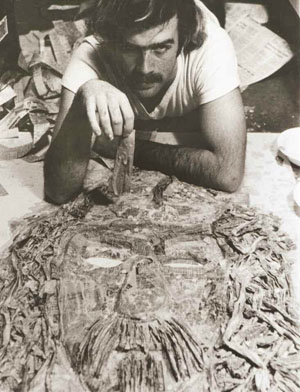
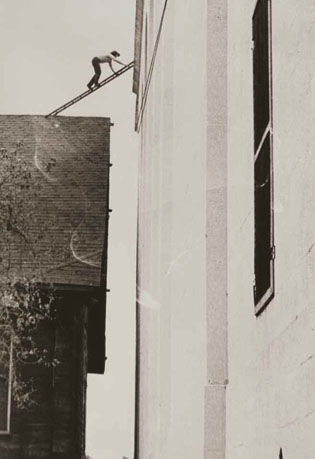
John Irvine ’76 hoists the finished Zappa frieze from atop Bridges Auditorium in 1975.

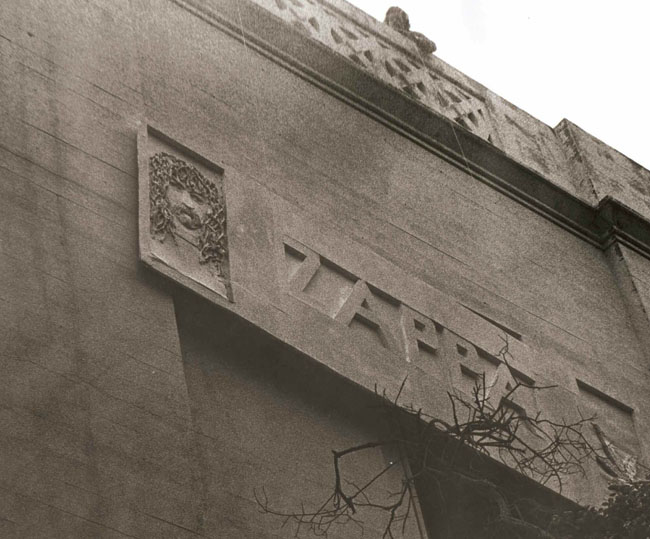
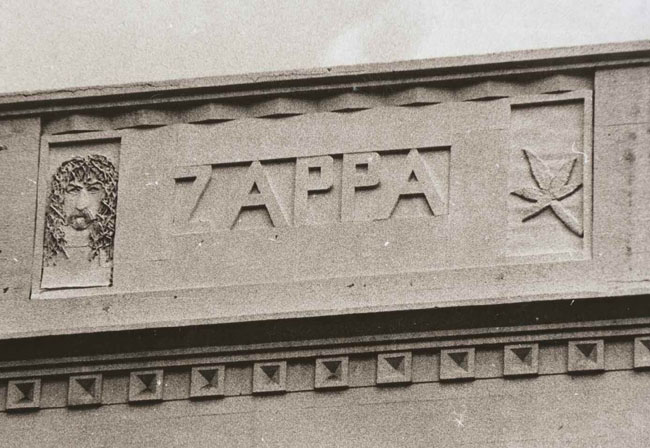
Set in Styrofoam, not stone, Frank Zappa’s name and likeness appeared, seemingly overnight, high upon the face of Bridges Auditorium back in the carefree spring of 1975.

Snugly hung between Wagner and Beethoven, the phony frieze only remained in place for a few days. But the identities of the students who pulled off this high-profile prank—and the tale of how they did it—have stayed under wraps to all but a few Sagehens for nearly four decades. Now the original pranksters finally have come forward with the story of a caper that required a precarious climb, careful calculations and a touch of artistic flair.

Strange as this may seem, it was a Commencement speech given in May by the then-U.S. ambassador to Pakistan that finally shook loose their secret.
Speaking on Marston Quad with Big Bridges looming in the background, Cameron Munter, a veteran diplomat who served in Serbia and Iraq before the Pakistan post, recalled the last time he spoke here, some 40 years ago, as valedictorian of Claremont High School. That led into an anecdote about the epic prank that briefly placed Zappa amongst the iconic composers honored on the front of the auditorium. Munter’s memory, though, was a bit misty—the ambassador just may have had weightier matters on his mind—and he dated the Zappa caper to 1972, crediting high school students “who shall remain nameless” for carrying it out.
Next, Inland Valley Daily Bulletin columnist David Allen dug deeper into the matter, pegging the date to three years later and straightening out a few other details. Still, the notion that the stunt was pulled off by local high-schoolers remained the operative story until a digital dossier laden with black and white photos and a complete account of the caper reached PCM via back channels. The material was pulled together by John Irvine and Greg Johnson, both math majors from Pomona’s class of 1976. After learning of Munter’s speech, the pair decided it was time to spill the beans.

They did it.

Irvine works on the Zappa frieze.

Irvine and Johnson weren’t huge Zappa fans at the time, even though the rocker lived in Claremont for part of his youth. The prank came to mind when Irvine and Johnson learned Zappa was coming to play Bridges in April of 1975. “We were looking up at the front of Big Bridges and said, ‘Well, gosh, he should have his name up there,’” recalls Irvine, who went on to get his Ph.D. and now works at a research laboratory in Cambridge, Mass.

This casual thought launched an intensive, two-week effort. The first big obstacle: How would they scale the imposing auditorium? It was Johnson, another future Ph.D., who figured out that they could get onto the roof of the adjacent old Renwick Gym (long since gone) to extend a ladder across a four-foot gap that separated the two structures, and climb onto the roof of Bridges. “Being young college students, we were stupid enough to do that,” says Irvine of the dangerous move. “I would never do that today.”

Once on the roof of Bridges, they lay down, reached down and measured the dimensions of the frieze, which, they note, was a surprisingly sizeable 15 feet by 5 feet.

Next: Security breach! While they were still atop Bridges, some friends passing by spotted them and asked the guys what they were doing. Irvine and Johnson waved them off, and lucky for them, their rooftop hijinx didn’t draw campus authorities.

The pair had decided it was Chopin whom they would cover up amongst the five composers commemorated on the face of Bridges. “I’m not big on the Romantics,” explains Irvine. “I would never cover up Beethoven or Bach.”

Onward to the design phase: phony frieze would have to be lightweight enough to hoist onto the roof, but sturdy enough to stay in place. Johnson settled on Styrofoam set on an aluminum frame. Irvine, meanwhile got to work on the two end pieces of the frieze, a papier mache bust of Zappa for one end and  a marijuana leaf for the other. (The pair has gotten some blowback for the pot image, since Zappa was opposed to drugs. Their response boils down to: “Hey, we know, but it was the ’70s.”) The end pieces were small enough to work on in a dorm room, but to assemble the entire frieze, they set out for the Wash, where they had room to lay everything out.

After a late night that crept into early morning, they were just about done. Then it started to rain on their newly painted masterpiece. They rushed their work of art into the Mudd-Blaisdell trash room. More bad luck: trash pickup arrived that next morning, and Irvine was rousted by an early morning call to retrieve his “art project” which was blocking access to the garbage.

Greg Johnson ’76 makes the dangerous climb from the gym to the roof of Big Bridges.

The guys covered up the frieze and stashed it behind Big Bridges in preparation for the final stage. With the risk of getting caught by Campus Security patrols, the rooftop operation would require some assistance from their friends in the “Statpack,” a group of math and statistics students studying under Professor Donald Bentley. As Johnson and Irvine write in a summary of their caper provided in the dossier given to PCM:

“So, using the expertise in statistical analysis that they were developing under the tutelage of Professor Don Bentley, they modeled the frequency and regularity of the passage of Campus Security in the early hours of the morning. At between 2 and 3 in the morning, the frieze was surreptitiously installed on the front of the building.”

As Johnson recalls it, the Styrofoam had enough give to easily wedge into the notched, recessed space for Chopin’s frieze. They secured the replacement with heavy fishing line tied to various rooftop fixtures just in case it fell—even with the lightweight materials, the frieze’s sheer size meant it weighed 60 to 70 lbs.

Frank Zappa was now shoulder to shoulder with Beethoven and Bach on the campus’s most imposing edifice. Chopin had been shown up, and the two math majors had succeeded in pulling off a highly-visible prank.

The pair climbed down from Bridges, and kept their involvement on the lowdown. They couldn’t resist, however, showing off the stunt to their mentor, Professor Bentley. They got him to take a walk with them, making sure he noticed their handiwork, without explicitly claiming credit. Bentley, to the best of their knowledge, was the only campus official who knew they did it. While the professor didn’t know about the plan in advance, Johnson says Bentley indirectly played a key role in the caper by creating “the camaraderie, the closeness and the culture out of which this whole endeavor arose.”

Campus officials were quick to remove the faux frieze, and the pair never saw their creation again. That helps explain the alternative story from the Commencement speech. Former Ambassador Munter (since hired to teach in Pomona’s International Relations Program) told PCM that he had visited some Claremont High classmates back at the time of the prank, and in the garage of their home was the Zappa frieze. He asked them about it, and they then took the credit for the caper. Irvine and Johnson, meanwhile, largely kept mum over the years, hoping to maintain a mystique around the prank.

And even though the Zappa frieze only stayed up for a few days back in 1975, the Statpack relationships were built to last. “We are friends to this day,” says Johnson.

Postscript: The math guys’ mission did suffer from one miscalculation. Irvine and  Johnson didn’t manage to get the phony frieze up until a week after the Zappa concert that had inspired the prank in the first place. “We kind of got an incomplete,” says  Johnson. “We weren’t quite ready in time.”

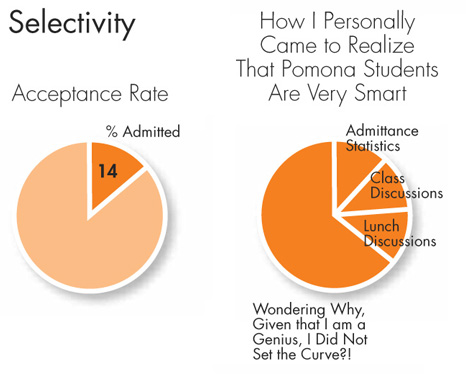
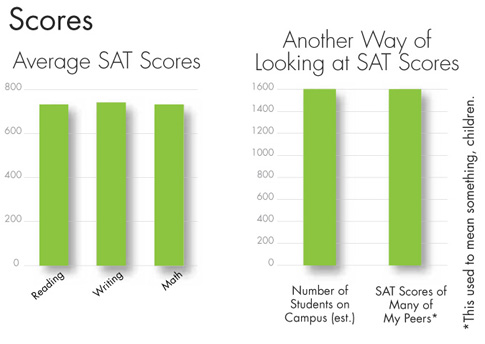
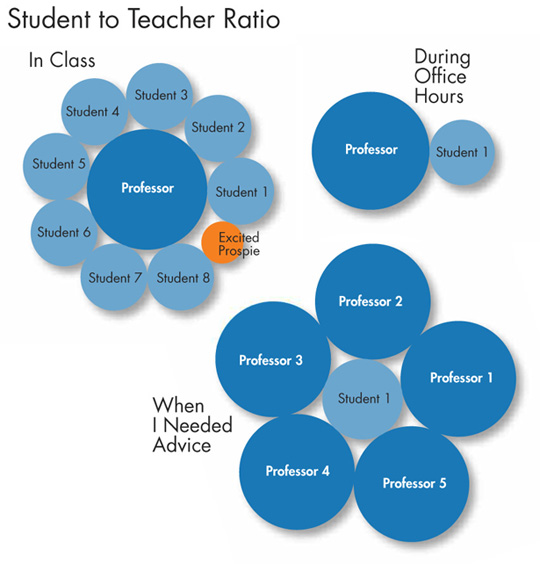
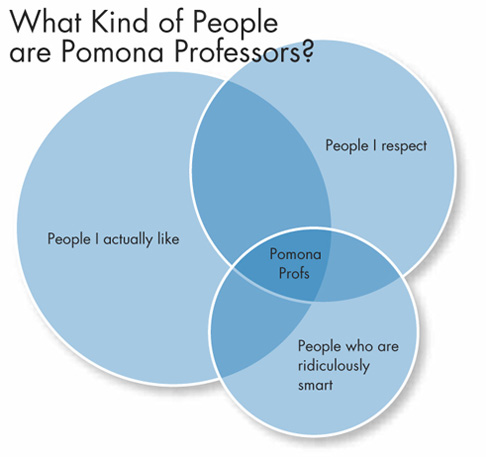
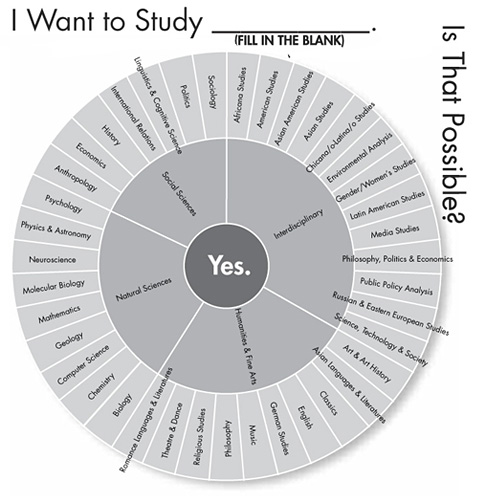
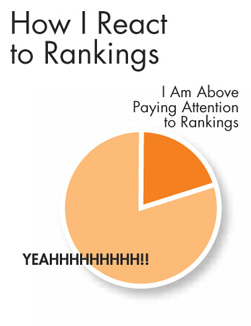
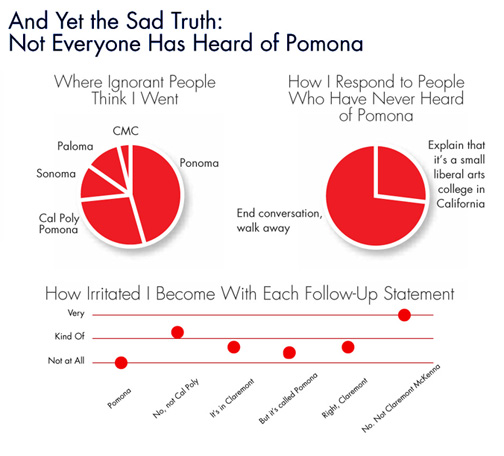
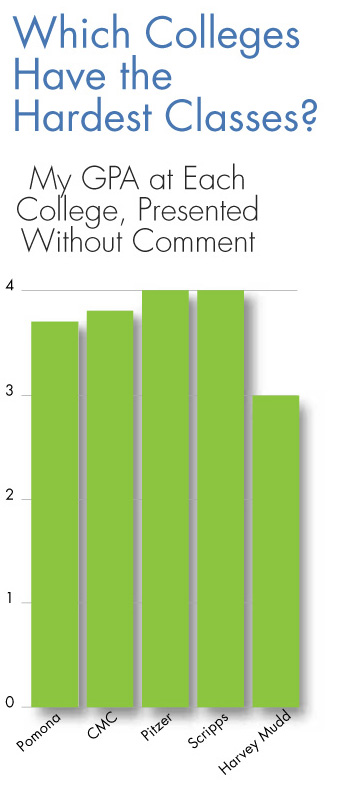
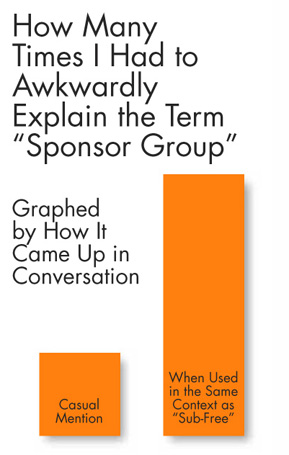
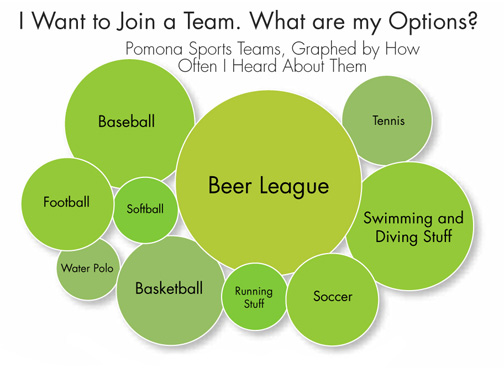
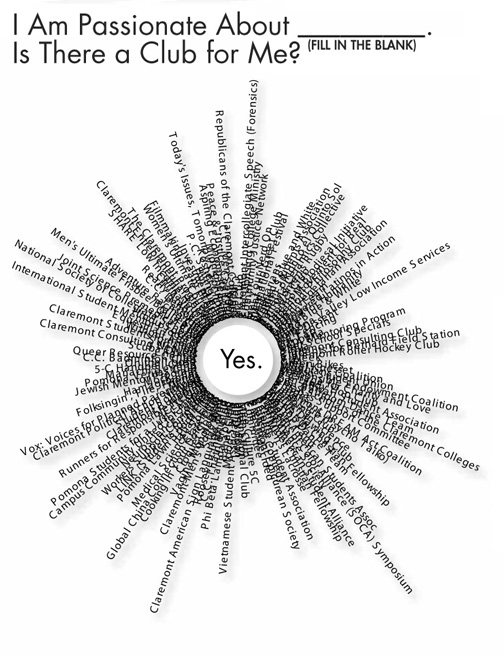
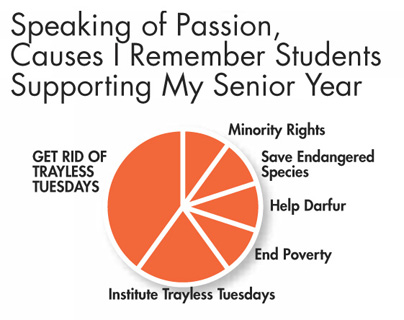
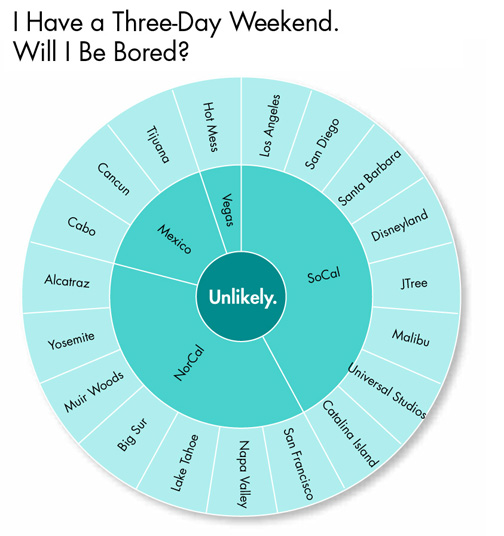
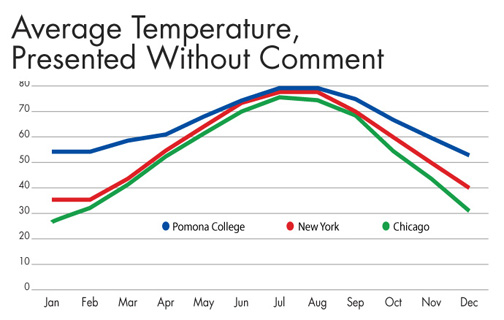
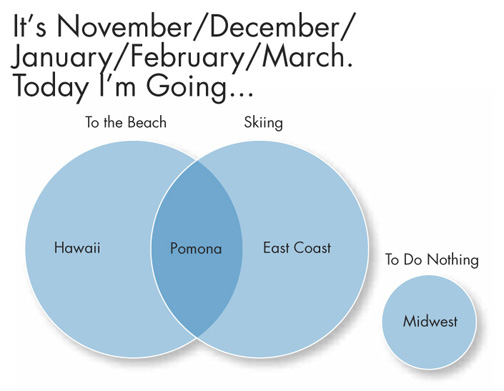
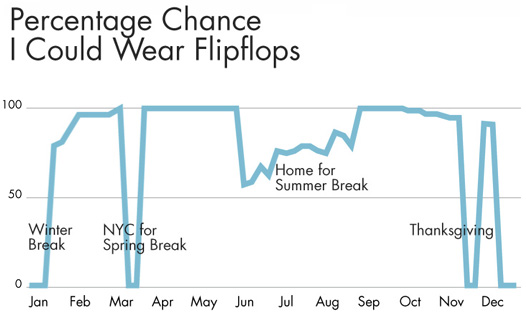
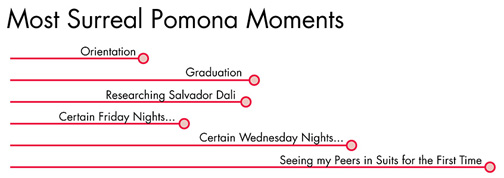
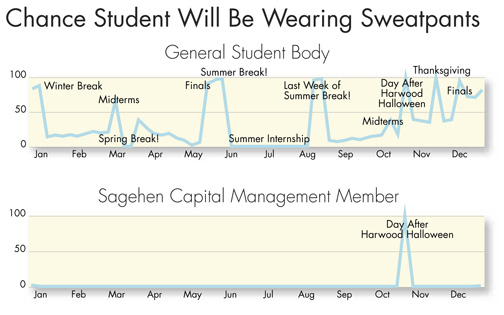
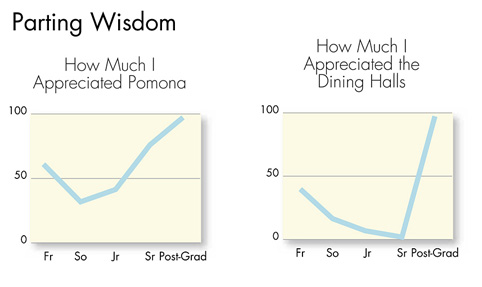
Pomona in 47 Charts

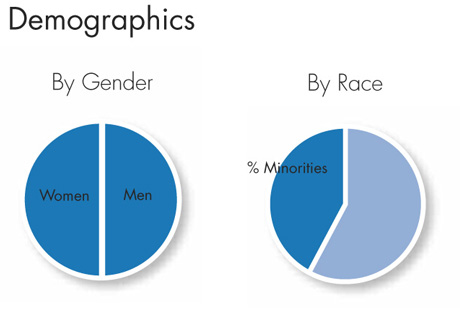
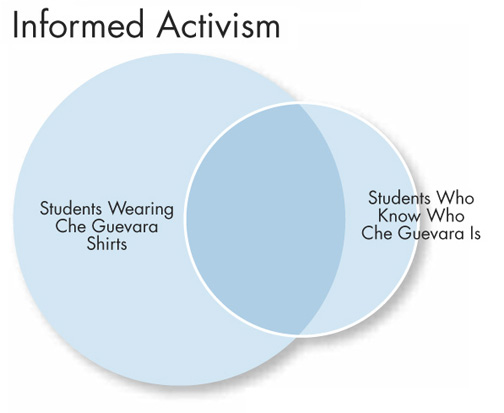
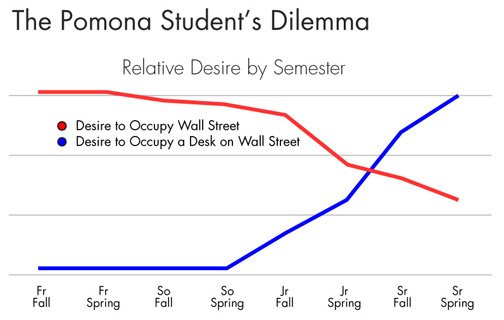
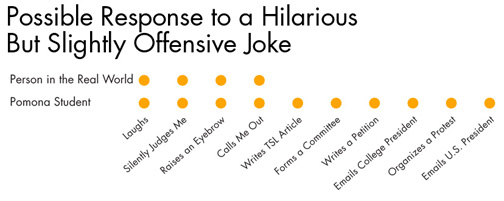
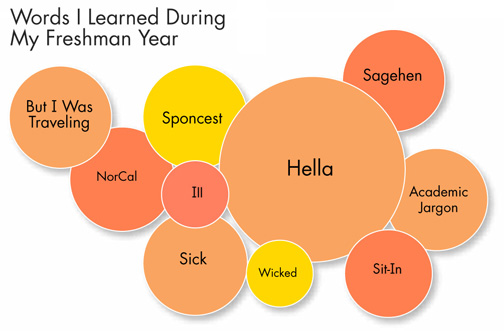
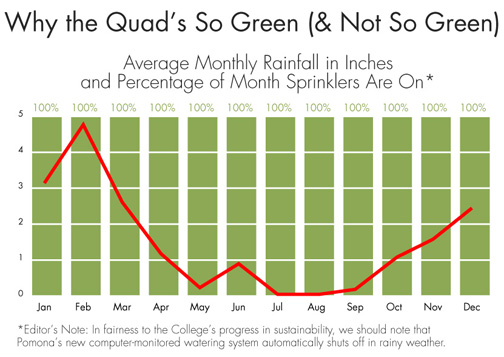
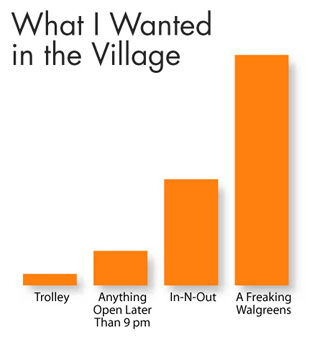
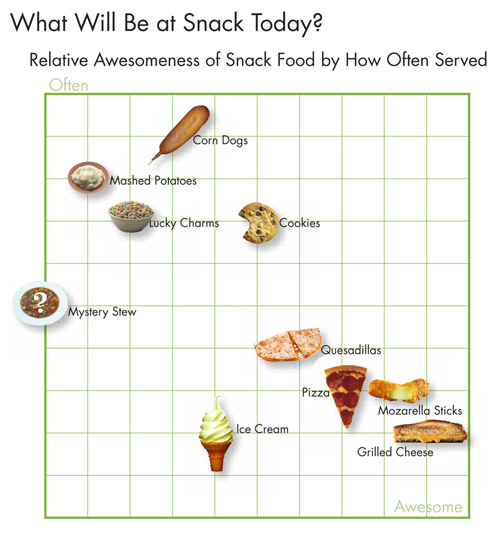
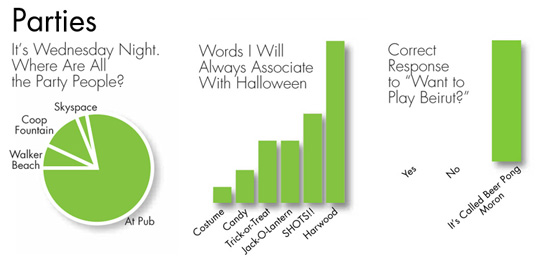
Pomona in 47 Charts: Elisabeth Fosslien '09 Shows her Humor in Histograms and Reveals her Heart in Bubble Charts

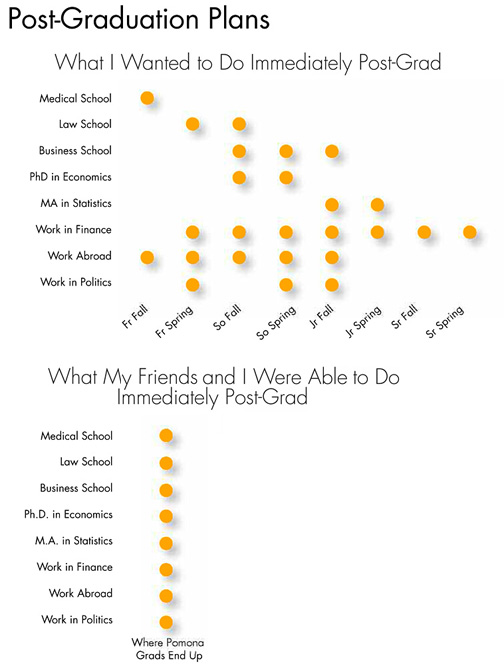
A mathematical economics major at Pomona and ad-agency analytics whiz in the real world, Elisabeth Fosslien ’09 spends her free time cooking up tart little pie charts on topics ranging from Chicago crime to getting a job to “14 ways an economist says I love you,” which drew praise from The Economist magazine, one of many nods she has earned for her minimalist musings. To no surprise, it was her online ode to her alma mater, “Pomona in 47 Charts,” that caught our eye. The facts, figures and feelings behind them are her own, derived from her perceptions of Pomona, but even if your data set is different, we think you’ll still find some laughs in her graphs.


The Man with a Plan

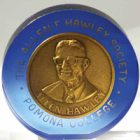
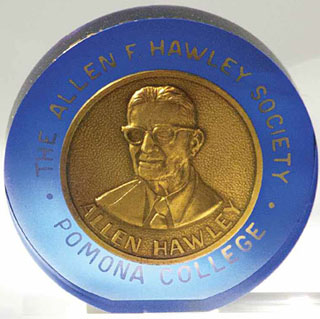
flat bronze plate. It reads: “Allen F. Hawley, 1893-1978.”

In 1949, when Allen Hawley, Class of 1916, was a fundraising administrator at Pomona College, he answered a local group’s request for biographical information on himself. In a letter, Hawley highlighted the pertinent details of his youth and his career.

“It’s not much of a life story,” he summarized, “but it’s a thrilling life to me.”

Not much of a life story? Consider: The man grew up on a turn-of-the-century California ranch, was expelled at least once from high school, graduated Phi Beta Kappa from Pomona, then attended the Harvard Graduate School of Business until dropping out to volunteer as an ambulance driver in France serving the wounded during World War I. After the war he worked in Hollywood as an assistant director at the Fox movie studio.

And we haven’t even covered the best part. Hawley returned to his alma mater in 1938, and his contributions over the next 24 years played a key role in the College’s rise. Launching what would later come to be known as the Pomona Plan, Hawley pioneered a game-changing vehicle in the world of educational fundraising. At the heart of what he hatched was this: a new kind of charitable-giving program in which the College, in essence, manages a donor’s money in return for a financial gift released to Pomona after the donor dies; the contributor earns a tax break and regular payments for the rest of his or her life.


So years later, when it came time to put Pomona’s new fundraising plan out into the world, Hawley knew from experience the best way to spread the message—especially to those outside the Pomona family. (He had been instructed by the College not to solicit alumni or parents for such financial gifts for fear of simply diverting away more traditional annual donations.)

How Hawley marketed the fundraising plan is another unique part of his legacy. He turned to newspaper advertising—something viewed at the time as almost sacrilegious in academia.

Consider Hawley’s life story in this context: When he toiled in Tinseltown, working on Western serials, he helped craft fictional vehicles—but the Pomona College story is a real one, and Hawley is a central figure in its telling.

Scholarly and Stylish

Those who knew Allen Hawley described him as a quiet and modest man. He had a distinguished manner and enjoyed col- lecting first-edition books. He also liked to look good. The fundraising whiz wore a natty suit and tie to work, and donned a hat—indeed, a Borsalino, the stylish Italian brand.

However, Hawley, who died in 1978 at the age of 85, didn’t fit a predictable profile. The dignified, scholarly man had a weakness for tobacco and a salty sense of humor. He was shy and intensely private (almost nothing is known of his personal relationships beyond the fact that he married a woman in 1922 and the union apparently ended in divorce), yet he thrived on cold calls to potential donors and reached out so attentively to members of the Pomona community that a good friend referred to him as the “Mother Hen” to students and alumni.

“As with many unusual men, different people could see different sides to him,” the late Pomona Philosophy Professor Fred Sontag once said of Hawley, whose last 10 years at Pomona (1952 to 1962) coincided with Sontag’s first 10.

A Pioneer’s Roots

The Pomona Plan pioneer grew up on a ranch in rural El Cajon near San Diego. He graduated from San Diego High School, but “not without an expulsion or two,” as he later recalled (though he never gave a reason for such disciplinary actions). After high school came an education of another kind: Hawley’s father required him to work on the family ranch, performing grueling tasks at the discretion of the ranch foreman. The experience provided great motivation, Hawley wrote nearly 40 years later:

“After a year of this fate I decided anything would be better than ranching, and certainly the offer of going away to college was inviting.”

So the young man enrolled at Pomona. (“Fortunately, the entrance requirements were not very high in those days.”) Though shy, Hawley was a leader, elected as Pomona’s student body president his senior year. After his war service and three-year stint in Hollywood, he went into the newspaper business, joining the advertising staff of William Randolph Hearst’s Los Angeles Examiner. The career move would prove critical to his later success at Pomona.

The Ad Man Flourishes

Hawley’s life story was chronicled by William B. Dunseth, who came to Pomona in 1959 to work for the fundraising maven. When Hawley retired in 1962, Dunseth became director of the Annuity and Life Income Program. For his 1994 book on his former boss, Dunseth interviewed many people who knew and worked with Hawley, including a former colleague at the Los Angeles Examiner. The man said Hawley had a real talent for the newspaper ad work, describing him as “a dynamic salesman” who wrote clever ads and had a knack for selling advertising space and nabbing new clients.

So years later, when it came time to put Pomona’s new fundraising plan out into the world, Hawley knew from experience the best way to spread the message—especially to those outside the Pomona family. (He had been instructed by the College not to solicit alumni or parents for such financial gifts for fear of simply diverting away more traditional annual donations.)

“I couldn’t resist using some of the [same] principles of advertising here as I did in the newspaper world,” Hawley said, according to Dunseth’s book.

It wouldn’t be easy, though. The idea of higher learning institutions advertising for financial contributions was viewed as unseemly. Thus, Hawley’s marketing method raised the hackles of the academic community, especially East Coast universities. (Dunseth wrote that a former fundraiser for just such a school told him, “It is uncouth for this little college out West to advertise for money.”)

Even Pomona’s “academicians resisted heartily” when Hawley initiated the newspaper concept, he recalled. Yet when the strategy proved lucrative, those objections suddenly didn’t seem so important.

“They melted when we started getting results,” Hawley said.

The Pomona Plan Emerges

Hawley came to Pomona in 1938 as the school’s new public relations director. In the mid-’40s, uncertain about student enrollment in the war’s aftermath, Pomona intensified fundraising efforts to cover potential deficits in the next few years. Hawley became its go-to guy.

For years, friends and neighbors had been asking Hawley investment questions. “Allen was well known in the little town of Claremont not only as a man of great financial acumen but of great financial integrity,” says Kent Warner ’66, former director of Pomona’s Annuity and Trust Office (now called Trusts and Estates). Warner worked for many years with Howard C. Metzler, who preceded Warner as director of Annuities and Trusts. Warner says Metzler passed on many affectionate stories about Hawley, including one recounting a time Hawley was walking down the streets of Claremont and two widows approached him. Turns out they wanted him to manage the inheritances their late husbands had left them.

With the new fundraising plan Hawley conceived in the mid-’40s, the College would in effect provide free money management for individuals in exchange for their philanthropic contribution. The beneficiaries received income for the rest of their lives, and then upon their deaths the financial gift was re- leased to the College. This kind of agreement provides donors with sizable tax deductions while allowing them to feel good about contributing money toward the future of young people.

These elements represented the core concept of the much-imitated Pomona Plan. (Dunseth points out that Hawley actually developed the program with three other men who worked at or with Pomona, including prominent Los Angeles attorney William B. Himrod, Class of 1908; however, Hawley was the day-to-day driving force behind the plan’s emergence.) In 1946, the College received approval of its financing concept from the Internal Revenue Service. The IRS ruled the plan was acceptable—and Hawley was off and running, free now to start offering the “Life Income Plan” to prospective donors.

Frank Minton, a national expert on charitable giving, says Pomona was the first college to develop this kind of plan, where the school acts as a trustee and the donor gains tax benefits and life income.

“They were the first out the door,” says Minton, who established the planned-giving program at the University of Washington and co-authored what is widely regarded as the bible in his field, Charitable Gift Annuities: The Complete Resource Manual.

Advertising in the Wall Street Journal and elsewhere, Hawley played up the tax benefits, knowing that would be a key appeal to the Journal’s financially-savvy readers. Drawing these people into the plan expanded the College’s donor base. As the Chronicle of Philanthropy put it in 1989: “Throughout its life, the so-called Pomona Plan has followed a highly unusual marketing strategy: trying, through newspaper advertisements, to turn wealthy strangers into friends of the college. The logic has been that Pomona can offer older people the chance to support a good cause and to get paid for doing so.”

The promotional campaign, as Professor Sontag noted, “reached people this little college in the orange belt of the California desert would otherwise never have touched.”

(By the early ’50s, Pomona was hearing from colleges requesting brochures and tips, and a 1953 Time Magazine article on the topic mentioned the College.)

Hawley felt very strongly about the writing of the ads. He wouldn’t let anyone else pen them and was meticulous about all manner of details, including grammar and punctuation, according to Dunseth’s book. His exacting standards could make him an intimidating colleague, added the author—apparently drawing on firsthand experience.

“A visit to his office to explain an action of which he didn’t approve or to be handed a letter for re-writing was not to be anticipated with enthusiasm. He was exceptionally polite and seldom displayed anger, but his ‘righteous coolness’ on those occasions didn’t make the experience a happy one.”

Pomona’s Prosperity

Ultimately, Hawley’s efforts led to many millions of dollars coming Pomona’s way over the years, money that helped erect campus buildings and pay for world-class teachers, among other benefits to the College.

The Pomona Plan became a model for deferred-giving programs, which are now the norm at most institutions of higher education. Not only colleges benefitted: Many different charitable organizations use a form of what Hawley started.

“In the 1980s, many other charities adopted Allen Hawley’s outline, and now every charity you hear advertising or soliciting is benefitting from his inspiration,” says Robin Trozpek, the current director of the Pomona Plan.

Adds Minton: “Pomona had a lot of influence beyond its campus.”

 Just how much has the Pomona Plan meant to Pomona? Financial figures tell part of the story. Since the fundraising plan was kicked off in the ’40s, Pomona has amassed a whopping $216 million in life-income agreements, and more than $172 million of those deferred funds have been released to the College, according to statistics from the Trusts and Estates Office. There’s another factor in the equation as well: the amount Pomona currently manages on behalf of beneficiaries.It’s about $140 million, which is significantly higher than the sum of $216 million minus $172 million; the number reflects how the assets on hand have appreciated.

Of course, the Pomona Plan has grown more sophisticated and elaborate since Hawley’s time. A Forbes magazine article this summer touted Pomona’s offerings: “Its payouts are so generous that half of the annuities it sells are to non-alumni.” The plan now has a number of different variations, and Howard Metzler, longtime director who died in 2012, is credited with playing a big role in its progress.

Still, Hawley’s lessons and methods carried on with his successors. At the top of the list: “The personal visit was the heart and soul of Hawley’s marketing program,” according to Kent Warner.

Hawley, who was Pomona’s vice president of development his last eight years working at the school, knew the best way to reach a potential donor was through conversation, in person. One reason is that it played to his strong suit—Hawley was a very persuasive salesman, say those who knew him. But selling Pomona was never about pitching product for him. He genuinely loved the school. In fact, Hawley maintained the primary goal of his ads was getting readers to visit the Pomona campus because he knew the school would sell itself.

After his death—in a nursing home in Hemet, Calif.—Allen Hawley was buried in Oak Park Cemetery in Claremont. The only marker at the gravesite, according to Dunseth, is a simple, flat bronze plate. It reads: “Allen F. Hawley, 1893-1978.” The bare-bones wording is in stark contrast to the streams of praise uttered about Hawley over the years. His influence on the enduring success of Pomona is profound.

Leave it to Fred Sontag, the longest-serving faculty member in Pomona’s history, to put Hawley’s achievements in the proper philosophical perspective. After Hawley died, Sontag paid tribute to his former colleague at a meeting of the Pomona faculty.

“As a teacher, I am bound to affirm that good colleges are made of teachers and talented students,” said Sontag, who taught in Pomona’s Philosophy Department from 1952 to 2009. “As a human being, I know in fact that all great colleges are built on the quantities of money needed to support what is exceptional.

“In that sense, Allen Hawley had as much or more to do with what Pomona is today as any faculty member. It is hard to exaggerate what he did to secure the college we currently enjoy.”


The Book Budget Bind

save our library

For the past several years, veteran Pomona City Councilwoman Paula Lantz ’67 has found herself acquiescing to constant cutbacks to her hometown library, where she had spent so much of her youth. As city coffers shrank, library budgets were sliced, hours were slashed, staffing and special programs were squeezed.

Yet, as the library slouched toward insolvency, Lantz was surprised by the silence. No citizens storming the council chambers. No emails or phone calls. Not even a tap on the councilwoman’s shoulder from a fellow library lover in line at the grocery store.

It wasn’t until earlier this year, when the city announced that it would be forced to close the library for a full year, that supporters came forward in strength. They held rallies on the library steps, protested at council meetings, organized fundraisers and revived a dormant foundation for raising private funds to help keep the library afloat. That burst of activism, says Lantz, is the only silver lining in a budget crisis that threatened to give Pomona, the College’s birthplace and namesake city, the distinction of becoming one the largest municipalities in the country without a public library.

Under public pressure, the city found funds to keep the library open another year, albeit on a skeleton staff and a miserly annual budget of $400,000, less than 15 percent of its peak funding in 2007. The city council has also approved a ballot measure calling for a library tax of $38 per year on all Pomona properties. The tax, which requires two-thirds approval in November, is considered a long shot, but it may be the library’s only shot considering the city’s dismal long-term fiscal forecast.

Next year, without a new source of funds or a miracle, the library may be broke again. For now, the protesters succeeded in delaying the doomsday decision.

“It makes it a whole lot easier to make cuts if it’s just numbers on a page, rather than looking into people’s eyes,” says Lantz, who launched a community task force to save the library. “It took the drastic measure of closing the library to get everyone’s attention. But I wish it had happened four years ago.”

POMONA HAS PLENTY OF COMPANY in its biblio-budget battles. For more than a decade, libraries across the country, including the Library of Congress, have been forced to tighten their belts and cut back on service. And, as it turns out, the public’s reaction to the Pomona library’s plight—chronic unconcern before last-minute mobilizations—is also part of the national trend.

Budget cuts have crippled libraries from New York to Newport Beach, Calif., where a plan last year called for replacing librarians with videophones for patrons to call in their reference questions. Three years ago, only state intervention averted a radical plan that would have closed all 54 branches of the Free Library of Philadelphia. The following year in Brooklyn, protestors staged a 24-hour read-in to stop the imminent closure of 40 library branches. Their slogan: “We will not be shushed.”

The library cutbacks are so widespread that the Huffington Post created a special section titled, “Libraries in Crisis.” Just perusing the headlines underscores the extent of the threat to these temples of knowledge:

–Children’s Laureate Warns ‘Society Will Pay’ For Library Closures
–Can a Protest Save a Library?
–After Branches Close, Students Set Up Outdoor Libraries

In his introduction to the series, HuffPo Books Editor Andrew Losowsky calls for a “national conversation” about the evolving nature and future of libraries. “If information is power,” he writes, “then libraries are the essence of democracy and freedom.”

NOBODY KNOWS THE budget ups and downs of the Pomona Public Library better than Greg Shapton ’71, the former director who retired last year after almost half a century as a library employee. Shapton started there as a part-time page, working with the library’s collection of 16-mm movies. It was 1967, the same year he enrolled as a freshman at Pomona College. Though he graduated with a degree in psychology, his major for a while was math. That training would come in handy as an administrator, juggling budgets and allocating ever-diminishing resources.

Now 63, Shapton looks back at his first decade as a golden era for the library, a modern architectural centerpiece of the civic center on Garey Avenue. But with the passage 34 years ago of Proposition 13, the state’s sweeping anti-tax measure, “the library was really gutted,” says Shapton, who was head of the reference desk at the time. “That began the downward slide, not just for the Pomona Library but for cities in general.”

In the immediate aftermath of the 1978 tax revolt, the library lost half its budget and half its staff, recalls Shapton. Exactly 30 years later, the library would be buffeted by yet another historic force, this time the worldwide financial collapse of 2008. Since then, the city’s general fund budget—which pays for essential services such as police and fire protection, as well as the library—has plunged by $20 million, or 22 percent of its high of almost $90 million. Pomona went from budget surpluses to annual deficits.

In fiscal 2007-08, the library budget had peaked at just over $3 million with 56 hours of operation. Three years later when Shapton finally retired, it was down to a tight but survivable $1.6 million and 26 hours.

Just when it seemed things couldn’t get any worse, they did. The budget was trimmed even further in the current fiscal year, down to $1.1 million and 20 positions. Then, the real calamity struck. Suddenly, there was a gaping new hole in the city’s operating fund.

This year, the city faced an unanticipated shortfall, due in part to the loss of $1.1 million in tax revenue tied up in a messy, drawn-out legal battle. The funds vanished in May as a result of a surprise appellate court ruling in a case involving the state Board of Equalization and several Southern California cities. The city was caught flat-footed when the court shot down a deal that cities had hammered out over how to share the disputed tax revenue.

In its scramble to make up for the loss, the city almost immediately announced it would be forced to close the library for a full year and lay off the entire library staff. In their defense, city administrators argue that Pomona has been hit disproportionately by hard times, leaving them with only painful options for cutting the budget. The city’s tax base, already weak in comparison to some wealthier neighbors, was crippled in recent years by the flight of major retailers. Car dealerships shut down. Big-box stores like Toys “R” Us left town. The result: Pomona’s sales tax per capita was $87 in fiscal 2010-11, compared to $316 for the nearby city of Ontario.

The paradox in this municipal numbers game is that the deeper the economic crisis, the more people need their free library. That is especially true, supporters say, in a poor, predominantly Latino city like Pomona where people may not have Internet access at home and rely on the library for school research, job searches and even adult literacy lessons.

“It’s tragic,” says Religious Studies Professor Erin Runions, who has lived in Pomona for four years. “The cities are being cut by the state, the state is being cut by the federal government. And who ends up paying for that? It’s people who can’t afford to buy books or computers. People who rely on the library as a source of education, a source of information, as a source of transformation. Those are the people who lose out.”

POMONA’S FIRST LIBRARY was founded in 1887, the year before the city itself was incorporated, by a small group of women who were members of a garden club. By 1890, the city officially took over library operations, promising under contract to keep it in good condition and add new books every year. Soon, the library was seeking a permanent building and turned to philanthropist Andrew Carnegie, who saw free public libraries as essential to the development of communities and supported their construction throughout the country.

In a letter to Carnegie dated Dec. 3, 1901, a Pomona library board member made a pitch for funds. His letter included an appeal on behalf of students attending a fledgling college that had been established in the city the very same year as the library. “Pomona College, a young but growing institution of some 300 students, relies largely on the facilities offered by the Pomona Public Library,” the trustee wrote, “and greatly needs more assistance than we can now afford with the resources at our command.”

By then, the College had already moved to its new location in Claremont, which at first was considered temporary. But the letter to Carnegie underscores how closely intertwined were these two institutions at the start.

To mark its own 125th anniversary, Pomona College has established a theme of “community,” pledging to connect the campus with its neighbors, including the city of its birth. A handful of faculty members and students are looking for ways to put that theme into action by connecting with the Pomona Library in its time of need. They have met informally to discuss the issue, explored ways for the College to get involved, posted appeals for action on their Facebook pages and privately alerted college officials of their concern.

“We’ve been talking a lot recently about our interactions with the local community,” says History Professor April J. Mayes ’94. “To me, this is a perfect opportunity to bring Pomona College back into Pomona again.”

Mayes feels so strongly about the issue because, like many supporters, her whole life has been memorably intertwined with the library. As a child she spent hours in the Laura Ingalls Wilder Children’s Room, fascinated by the collection of memorabilia from the author of Little House on the Prairie. Later, while attending Pomona Catholic Girls High School, Mayes worked as a library page. And finally, while researching her senior thesis on local history at Pomona College, Mayes returned to her hometown library to make use of its special collections, consulting newspaper microfiche and first edition books written in the late 19th century.

“The special collections is pretty amazing,” she says. “It’s a pretty extensive gathering of great materials on the history of, not just the city of Pomona, but the entire region.” Professor Runions, the biblical scholar, moved to Pomona four years ago, looking for more diversity than Claremont had to offer. This summer, Runions got involved in the library task force and joined the opposition in another messy issue, the battle over a proposed new trash transfer facility she considers an example of “environmental racism.” She also is helping to campaign for passage of the library parcel tax.

As a transplant from British Columbia in 2005, Runions felt “somewhat like an outsider trying to make a home here.” She settled on Pomona and has not regretted it.

“We love it here,” says Runions, who lives in the city’s historic Lincoln Park area. “There’s a real sense of community in Pomona, and I think that’s what the library task force really shows, that there are citizens who are concerned about the well-being of this city. Deeply concerned. They’ve been here many years and they’re really willing to put in the time and the work. But they need some leadership.”

POLITICAL LEADERSHIP is precisely what’s lacking in Pomona, says Gwen Robinson ’60, head of Friends of Pomona Public Library, a volunteer group founded in 1955. Robinson, a retired school teacher, assails city leaders for consistently short-changing the library in favor of other city services. She fears if the tax plan doesn’t pass, the library will shut down for sure next year, and she blames the city council for letting it happen. “They don’t have a plan and they don’t want to look for any other cuts,” said Robinson, who attended Pomona College for two years as an undergraduate. “They just don’t want to deal with it any more.”

Robinson and other library supporters bristle at the suggestion that civic apathy permitted the library to become an easy target for the budget axe. Yet, a study by Public Agenda, a public opinion firm in New York, found a pattern of what it calls “benign neglect” has undermined libraries nationwide. Libraries enjoy broad public support, the 2006 study found, but even the most ardent library lovers are not aware of budget problems until there is a full-blown crisis. And cities don’t act until the public mobilizes.

Civic leaders surveyed echoed Councilwoman Lantz’ concerns about the public’s “impassive advocacy” in the face of repeated library cutbacks. But she adds that what appears to be apathy may be a matter of generational values instead.

Lantz, who majored in sociology and earned a master’s in education from Claremont Graduate School, uses her own four adult children as examples. They all have moved away, settling in cities from Nashville, Tenn., to Oakland, Calif. But they have one thing in common. Their 30-something generation has grown detached from civic life at a local level, even as they engage on a global level with communities on the web. They can’t name their mayor, don’t read a local paper, don’t know about redevelopment and, she adds, “they don’t care.”

Things were different in her day, says Lantz, now 66. She was born in Pomona, like her dad before her. His was a generation that put down roots in one place for a lifetime. Her mother, who’s 97, still lives in the home the family built when Lantz was attending Pomona High School. Her folks didn’t have money to buy books, so they took her as a child to the library, then in the old Carnegie building. That turn-of-the-century structure was torn down for a bank parking lot and replaced in 1965 by the current building. But no matter where the books are housed, Lantz’ mother still visits the library to this day.

Lantz is encouraged to see young people join the library task force. And she concedes the city shares the blame for failing to find a way to reach them, until it was almost too late.

“We don’t communicate with them in the way they communicate,” Lantz says.

LIKE LANTZ, Carla Maria Guerrero ’06 was also born and raised in Pomona. She hasn’t volunteered on the task force, but she’s following the library issue on Facebook. She says the threatened closure has “galvanized” library supporters on the Internet.

“It’s a little unfair to say the newer generations don’t care,” asserts Guerrero, 28. “In activist circles online, I would dare say people are upset. Many people might not be able to come out (for meetings), but we’re all still avidly following it.”

Guerrero is the daughter of immigrants who came from Mexico with limited schooling. But they always stressed education. Her father, Homero Guerrero, was a factory worker who, on his time off, was “always on the hunt for good Spanish books.” He built a respectable collection by scooping up the tomes discarded by libraries from Los Angeles to Riverside.

Even after earning her bachelors degree in Latin American studies and her masters in print journalism from USC, Carla still lived in Pomona, sharing the family home with her parents and her two younger sisters. She also still used her hometown library, but now to check out audio books for her three-hour daily commute to Los Angeles where she works. That’s how she discovered the library hours had been cut back. Then, after moving to L.A. last year, she found out about the planned shutdown from her sister, who saw it posted on Facebook.

“If the closure ever happens, it would be really sad,” she says. “The library is one of the few public institutions that stands for knowledge, not for profit. It’s something so pure, it’s actually there for the good of the people. It’s something that a city like Pomona, that is already pretty impoverished, cannot afford to lose.”

Update: The library parcel tax, Measure X, failed in the Nov. 6 election, receiving just over 60 percent approval, short of the two-thirds required.

Life in My ($135) Bargain Shorts

Life in my $135 (Bargain) Shorts: Our Writer Test-Rides a Pair of Fancy-Fabric Action Pants Created by Urban Innovator Abe Burmeister '97


One drizzly afternoon in July, Abe Burmeister ’97 stood in a makeshift fitting room at the Brooklyn headquarters of Outlier, the apparel company he co-founded four years ago, holding a pair of Three Way Shorts in his hands.

Meant for summertime use as both active and leisure wear—“Run, swim or just straight up look good. Our Three Way Shorts can do all three,” reads the online marketing copy—the shorts were the second item that Burmeister and his partner, Tyler Clemens, designed when they formed the company. (The first was a pair of trousers that were meant to look like business- casual slacks but behave like cycling pants.)

The pair that Burmeister handed me, and which I intended to field test, were brick red. They were size 32. And they sold for $135—more than I had paid for my last suit. More, in fact, than I would consider spending on almost any item of clothing, given my penny-pinching ways.

“I’ll take good care of them,” I said, suddenly intimidated by the cash value of the merchandise I’d just received.

“No,” said Burmeister. “You should beat the hell out of them.”

Burmeister’s response might lack the poetic concision of his company’s motto (“tailored performance”) or the high-mindedness of its official philosophy (“we want to build the future of clothing”). But it gets at the essence of what Outlier does: construct hip, all-purpose clothing from the kind of high-tech fabrics normally reserved for outdoor apparel and sportswear.

In response to Burmeister’s injunction, I wore my new Three Way Shorts on a series of summer adventures, bicycling through the mean streets of NYC and swimming, sans undergarments, in the occasionally toxic waters of Lake Michigan while staying with my wife’s parents in Chicago. And while I hesitate to use underworld metaphors when describing a visit to my in-laws, I feel confident that, short of falling off a mountain or diving off a cliff, I gave those shorts as much of a workout as they’ll ever receive.

More of one, than perhaps even Burmeister had in mind when he first toyed with the idea of starting a clothing business back in the early aughts. At the time, Burmeister was partner in an animation studio in San Francisco, and spent much of his time flying back and forth between California and his native New York. Living out of a carry-on bag, he came to wonder if there might be money in making better clothes for business travelers.

That particular idea went nowhere. But several years later, after joining the ranks of New York City’s bicycle commuters, Burmeister was once again drawn to the needle trade. Crossing the Williamsburg Bridge between Brooklyn and Manhattan by bike on a regular basis, he became frustrated by his inability to buy a pair of pants that would hold up to the abuse of hard cycling and inclement weather while looking nice enough to wear into a meeting. So he decided to create them himself.

A trip to the Fashion Center Information Kiosk at the corner of Seventh Avenue and 39th Street—essentially a fashion industry help desk with an enormous button sculpture positioned on top—yielded a list of factories in the garment district. And so it was that, with the help of a local patternmaker, Burmeister made his first pair of slacks using a durable, water repellent, stretchy material from Schoeller, a Swiss textile mill that produces a line of what garmentologists refer to as technical fabrics.

After wearing the pants for a year, Burmeister decided that he could use another pair. He also decided that it was time to start making more than one at a time.

Burmeister’s resume already was impressive in its variety: An anthropology major at Pomona, he worked briefly on the bond floor at Morgan Stanley; ran the aforementioned animation studio and web design firm; acquired a masters degree from the Interactive Telecommunications Program at NYU; toiled as a freelance graphic designer; and developed data visualization tools for a Wall Street firm run by a couple of nuclear physicists. Along the way, he wrote a book, Economies of Design and Other Adventures in Nomad Economics, that explored alternative approaches to the “dismal science.”

Still, Burmeister knew he would need help jump-starting an apparel company.

Then one day, the barista at his neighborhood coffee shop introduced him to Clemens, a fellow urban cyclist who worked at a men’s shirt company and who was, in his spare time, trying to do for shirts what Burmeister was trying to do for pants. Within months, the two had founded Outlier.

(In statistics, an outlier is a data point that lies beyond the norm; the company logo, a black swan inside a black ring, alludes to the rare but catastrophic “black swan events” that roil financial markets. But the term was also once applied to those who lived in outlying regions, apart from their places of work: “the original commuters,” as Burmeister says.)

Burmeister and Clemens initially set up shop in Clemens’ living room. They have since moved into a former wedding dress studio on the third floor of an old Brooklyn sewing factory; a pile of bicycles belonging to Outlier staff lies just outside the door, paying silent homage to the company’s roots.

Their offices comprise an open workspace limned by Apple computers; a small development room crammed with sewing machines, fabric swatches and a rack of reference garments (a Burberry trench coat, an early Gore-Tex jacket); and the fitting room where I tried on my shorts. Outlier’s public face, though, is almost entirely virtual, and the firm uses social media to reach the young, active urbanites who represent its target market.

The partners now employ a professional designer who previously worked at the upscale menswear company Thom Browne, and they have expanded their offerings to include a variety of pants, shorts, shirts and accessories. They continue, however, to seek the same grail: to produce clothing that acts like rugged outdoor gear but looks (and feels) like premium lifestyle apparel.

“They have a nice little niche, which I think will prove to be a very good business for them,” says David Parkes, a tex- tile developer and marketer whose New Jersey-based firm, Concept III, does business with Outlier.

Burmeister and Clemens are forever looking for technical fabrics that might be adapted to other uses, whether that means attending events like the biannual Outdoor Retailer tradeshow, which attracts major outdoor brands like Patagonia and Timberland, or investigating the materials used to make protective clothing for firefighters.

They have cultivated relationships with contract cutting and sewing factories in Manhattan’s garment district, giving them access to skilled workers who are willing to learn how to handle difficult materials.

And they have kept their sticker prices relatively low by selling almost exclusively online through their own website, thereby eliminating the traditional retailer’s mark-up that would miraculously transform my $135 pair of shorts into a $270 pair without improving them in any way.

“Our stuff is certainly not cheap, but it’s half the price it would be otherwise,” says Burmeister, who likens that particular achievement to going from an “incredibly niche price point” to a “semi-niche price point.”

Burmeister and Clemens have reached that point even though their business model diverges from the industry standard. Outlier does not follow the typical seasonal model. Instead, the pair experiment constantly with new designs. “It’s a very development-intensive process. Everything goes through multiple iterations,” Burmeister says.

That costs money: after testing an item in-house, Burmeister and Clemens typically produce a small run for initial release, like a bespoke beta version. “It’s more expensive to make a small amount like that, but it’s worth it to figure out if an item is successful. You don’t get the full range of feedback until you have customers in the wild putting it through all kinds of crazy situations,” says Burmeister.

EAGER TO OBLIGE, and initially skeptical about the technical specs of the clothing I’d been handed, I wore my Three Way Shorts for five days before washing them, bicycling through the steamy summer streets of Queens and subjecting them to the kind of abuse that only animals and small children can dole out: Within hours, my 3-year-old had turned them into a napkin, wiping the remains of dinner (steak marinated in red wine) off his face and onto my lap. Yet Schoeller’s Nanosphere finish, which binds to individual fibers and repels water, dirt and oil, kept them surprisingly clean.

Testing began in earnest the following week, when I lived in the shorts during the two-day drive from New York to Chicago; drenched them in sweat along the bike paths of Illinois and Wisconsin during a scorching Midwestern drought; and finally rinsed them off by diving into Lake Michigan just days after the authorities had posted a swim advisory due to the troublingly high E. coli count.

The internal drawstring—a second-iteration feature that replaced an earlier, and less effective, set of pull-tabs—kept me from accidentally mooning the attractive young female lifeguard, a face-saving feature that was probably worth a few bucks in and of itself. And as I waded back out onto the beach, the lake water drained rapidly from the mesh in the flow-through pockets. When I mounted my bike a few minutes later, the shorts were still moist, but they were already dry enough for me to cycle home without any awkward squishiness.

And marketing hype aside, the nylon-polyester-elastane blend did indeed prove to be both stretchy and durable. Just as important, the double-weave technique employed during milling pushed the tough, Cordura-grade nylon towards the outer surface while keeping the softer polyester threads on the inside. That comfortable inner surface also had a waffle-like texture that Burmeister claimed would prevent the fabric from sticking to my skin, rendering it more breathable and al- lowing moisture to escape.

I won’t argue with him, any more than I will argue with the steady stream of compliments I received on the appearance of the garment. Indeed, after a month of steady use, the shorts had become my go-to clothes—the ones that I found myself slipping into almost every morning. The $135 price tag still triggered my cheapskate reflex, but I don’t exactly belong to the company’s target demographic (i.e., people who have money and are willing to spend it). And as Mary Ann Ferro of the Fashion Institute of Technology pointed out, any fabric that repels dirt and therefore requires less laundering should save water and electricity in the long run. “So maybe,” she ventured, “it’s not so expensive when you think about it.”

Maybe. Maybe not. But even if I might still balk at buying a pair with my own money, I have come to appreciate the advantages of clothing that looks good, feels good—and is literally tougher than dirt.

BEHIND THE PRICE

Performance wear—a category that includes everything from bike shorts to mountaineering pants—is one of the fastest growing sectors in the textile industry. According to a 2011 report by the market research firm Global Industry Analysts, the worldwide market for sports and fitness clothing will exceed $126 billion by 2015.

That growth is helping to drive the development of technical fabrics that have been engineered to possess magical properties: some stretch, others repel water, a few can even kill the germs that make your sweatpants smell not-so-fresh after a workout.

Originating in the first water-repellant fabrics of the 19th century, today’s technical fabrics include synthetics like the finely spun polyester called microfiber; natural materials such as cotton and wool that have been treated with special finishes; and complex concoctions that incorporate a bit of this and a dash of that—perhaps a nylon-cotton blend for durability and comfort, with a bit of polyurethane-based elastane added for stretch and a water-repellent finish to protect against the rain.

Yet adapting technical fabrics designed for spe- cific performance contexts to more fashionable ends can be tricky. The people who design and assem- ble men’s and women’s wear are often unfamiliar with the materials, which do not behave like ordi- nary ones. “It takes skill to sew stretch fabric,” notes Mary Ann Ferro, an assistant professor at the Fash- ion Institute of Technology who formerly designed outdoor wear for London Fog.

And the fabrics themselves—often synthetic, often treated with special finishes—can be shiny, or noisy, or otherwise ill suited to places of work or leisure. “You don’t want to be that guy swishing through the office,” says Outlier’s Abe Burmeister ’97, musing on the loud crinkliness of nylon.

Finally, all of that performance comes at a cost. “The price,” Ferro says, “is a problem.”

Burmeister agrees. Fabric alone accounts for ap- proximately 60 percent of the expenditure involved in manufacturing a pair of Three Way Shorts—a figure that includes the 25 percent bump accruing from tariffs and shipping fees. (Most fabrics used in American garments, including ones that are assembled here in the United States, are made abroad.)

“The materials that The Gap uses cost nothing compared to what we use,” he says.