Blog Articles

Milestones

Pomona’s new Chief Operating Officer and Treasurer Brings Extensive Track Record

Robert Goldberg

Robert Goldberg

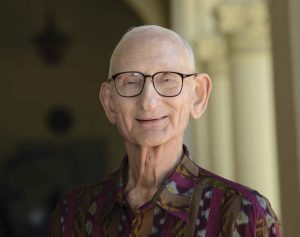
ROBERT GOLDBERG, formerly chief operating officer of Barnard College, became vice president, chief operating officer (COO) and treasurer of Pomona College on Jan. 1, succeeding Karen Sisson ’79, who served in the role for 11 years.

President G. Gabrielle Starr said Goldberg “will bring to Pomona vast experience, a strong sense of mission and a true commitment to people. I am looking forward to working with Rob as the College moves ahead in completing our strategic plan and creating a community in which everyone can flourish.”

Goldberg arrived at Barnard College in 2014, after a 25-year career in the federal government. At Barnard, he quickly made his mark by effectively managing a $220 million budget, leading a staff of more than 500 in areas ranging from finance to dining to human resources and information technology (IT) and working in a thoughtful and open manner with faculty, staff and students.

He oversaw the design and construction of the Milstein Center for Teaching and Learning, Barnard’s award-winning $150 million library and academic building, which opened on time and on budget last year. And just this past year he led a process to acquire a new residence hall to expand the inventory of Barnard’s student housing in New York City. He worked side-by-side with faculty committees on budgets and resources, partnering with the provost to support academic endeavors. In 2017, Barnard turned to Goldberg to serve as its interim president, a role in which he guided the College during a period of transition and oversaw the creation of Barnard’s Council on Diversity and Inclusion.

In his time as Barnard’s COO, he worked with students to help reduce out-of-pocket expenses for low-income and first-generation students. He also increased the transparency of the College’s budgeting process through regular briefings and discussions with the faculty Budget and Planning Committee, faculty meetings and student government.

“It’s important to note that with the majority of our staff members working in this division, the vice president, COO and treasurer role is a particularly important one at Pomona,” adds Starr. “Rob has a strong track record: At Barnard, he created a year-long professional development training program for new managers and worked with staff to create the Barnard Staff Advisory Council.”

Before Barnard, during his government service, Goldberg served as a senior budget official for the U.S. State Department, where he was responsible for the formulation, management and implementation of a foreign assistance budget of more than $32 billion,. He received the Department of State’s Distinguished Honor Award in 2013.

Earlier, working for the U.S. Office of Management and Budget (OMB), he was the senior career executive responsible for management of the U.S. government’s $52 billion international affairs budget, leading OMB’s work in crafting the president’s annual budget requests as well as legislative proposals for international affairs programs.

He earned both his B.A. and M.A. in international affairs from The George Washington University.

New Advancement VP Seeks to Strengthen Pomona’s Culture of Support

Maria Watson

Maria Watson

MARIA WATSON joined Pomona’s executive team on Jan. 6 as vice president for advancement, succeeding Pamela Besnard, who led Pomona’s advancement staff for six years.

With more than 25 years of nonprofit leadership experience, Watson has followed a career path that has taken her from cultural institutions such as Lincoln Center and the New World Symphony to Fordham University and, most recently, the University of Southern California, where she served as associate vice president of development.

In her eight years at USC, she conceptualized and launched that institution’s first New York City/Northeast advancement office, led major gift and regional teams and played a key role in the success of USC’s $7 billion campaign.

In Pomona, Watson says she sees a highly successful institution with true intellectual purpose, strong values and an enduring commitment to access and opportunity—what she calls the “perfect combination.”

“In meeting students, faculty members, staff, trustees and alumni, I was struck by how deeply people care about Pomona and how deeply the College has affected their lives,” says Watson. “There is such strong sentiment for the College—we are going to work together to build a culture of philanthropic support for the world-changing work here and strengthen our ties to one another along the way. I am honored to now be part of this community of scholars, leaders, creators and innovators.”

Watson’s own interest in the liberal arts began during her undergraduate days at the University of Michigan, where she earned her B.M.A. in clarinet performance with a minor in political science. She went on to lead marketing for The Chamber Music Society of Lincoln Center, the New World Symphony in Miami Beach and the Brooklyn Philharmonic. From there, she became chief development director for Fordham University’s WFUV, designing and launching the first capital campaign for the beloved public radio station.

After opening USC’s New York office in 2011, she later moved to Southern California and joined the senior leadership team responsible for organizing, planning and executing the Campaign for USC. She has led the strategic integration and growth of USC’s central major gifts and regional teams and the securing of principal gifts for USC. Watson also has shown a deep belief in and commitment to diversity in building her teams at USC.

As vice president for advancement at Pomona, Watson will lead philanthropic initiatives and oversee key programs—including major gifts, alumni and parent engagement and planned giving—while serving on President G. Gabrielle Starr’s executive team.

“Maria truly understands the liberal arts and will be an energetic and effective advocate for providing the resources that allow Pomona to be Pomona, offering the best undergraduate education anywhere,” says Starr.

Benton Museum Has New Director

Victoria Sancho Lobis

Victoria Sancho Lobis

VICTORIA SANCHO LOBIS, a talented art historian, curator and administrator whose most recent curatorial appointment was at The Art Institute of Chicago, became the director of the new Benton Museum of Art at Pomona College, starting Jan. 6.

Since 2013, Lobis has served in a range of curatorial and administrative roles at The Art Institute of Chicago, and she was interim chair of the Department of Prints and Drawings in 2016-–17. She recently completed a multi-year project related to the Art Institute’s holdings of Dutch and Flemish drawings, culminating in a scholarly catalogue and exhibition: Rubens, Rembrandt and Drawing in the Golden Age.

Lobis was instrumental in developing the Art Institute’s permanent collection in the field of Dutch and Flemish prints and drawings, and she also contributed to an institution-wide effort to enhance the representation of Viceregal Latin American art.

Her curatorial experience reaches across a broad range of subject areas, including projects treating medieval manuscript illuminations, early modern prints and drawings, Viceregal Latin American painting, Whistler and his influence, modern and contemporary Latin American works on paper and contemporary American drawings. She has also published in the fields of contemporary artists’ books and contemporary American photography.

In addition to her role as the Sarah Rempel and Herbert S. Rempel ’23 Director of Pomona’s museum, Lobis will hold a co-terminous appointment in the Art History Department.

She received her B.A. from Yale University, her M.A. from Williams College and her M.Phil. and Ph.D. from Columbia University.

Baseball by the Numbers

Rapsodo device provides pitching data that includes velocity, spin rate and vertical and horizontal breakGATHERED ON THE pitcher’s mound during class, Pomona College students feed balls into a pitching machine, then quickly glance down at an iPad.

On the ground between them and home plate is a boxlike device called a Rapsodo, a $4,000 radar-based system that provides data not only on pitch velocity, but also spin rate, spin axis, horizontal and vertical break, 3D trajectory and a strike zone analysis.

The Rapsodo device provides pitching data that includes velocity, spin rate and vertical and horizontal break.

Welcome to PE 086: Baseball Analytics, a new course taught by Frank Pericolosi, a professor of physical education and coach of the Pomona-Pitzer baseball team.

The class formalizes what has emerged as a notable career path for Pomona alumni: More than a dozen graduates or current students have put backgrounds in mathematics and computer science to work for Major League Baseball teams analyzing the game-changing explosion of data in baseball.

They’re following a trail blazed by Guy Stevens ’13, a former Sagehens pitcher and math major who has risen to senior director of research and development/strategy for the Kansas City Royals. He was on staff for a World Series championship in 2015, less than three years after working with Math Professor Gabe Chandler to publish a statistical analysis of minor league data.

“Talking to Guy [Stevens] over the years, I ask, ‘What do we need to be doing on campus to make these kids better candidates for these internships and for these jobs?’” Pericolosi says. “He gave some suggestions in terms of, ‘They need to be doing creative, innovative projects on their own.’ The driving force for getting this technology on campus was initially to help our kids who want to go into analytics. Also, we’re in a heavy-data era of baseball even more so than before, and it’s going to give us good data to evaluate our players as well.”

Five of the 15 students in the class play baseball for the Sagehens. One of them, catcher and math major Jack Hanley ’20, worked for the Oakland Athletics two summers ago and spent last summer as an associate in quantitative analysis with the New York Yankees. This October, he watched his former colleagues advance to the American League Championship Series.

“It’s definitely very rewarding to know that whatever small role I played this summer in making the team better, it paid dividends,” says Hanley, whose description of his research for the Yankees is vague. That’s because he had to sign a non-disclosure agreement to protect what amount to industry secrets.

Not all the alumni putting data analysis to work for major league teams are former baseball players. Jake Coleman ’13 played Ultimate Frisbee at Pomona but completed a Ph.D. in statistics at Duke University in May and joined the Los Angeles Dodgers in August as a senior quantitative analyst. Nor are they all men: Christina Williamson ’17, a former water polo player and swimmer who majored in math, was featured by The Athletic as one of 35 people under 35 shaping the game of baseball for her work with the Yankees using biomechanical data to aid player development and reduce injuries.

Pomona, Stevens is confident, is gaining a reputation in the game.

“If you think about how small the sport is, with only 30 teams, and how well-connected it is, there’s a pretty good chance if you’re in baseball, you know someone who knows someone who went to Pomona,” he says. “A lot of these jobs in baseball, it’s the same set of skills that translate anywhere: If you’re working with data, it’s curiosity and creativity and thinking outside the box. And Pomona trains you for that 100%, whether it’s baseball or finance or whatever else.”

Baseball analytics once was based on information available in a box score, but has evolved rapidly in the era since it was popularized by the 2003 book Moneyball and the movie that followed. It is now decidedly high-tech, requiring expensive equipment that Pericolosi was able to purchase for the course through Pomona’s Hahn Teaching with Technology Grants. He’s in the process of acquiring a second Rapsodo that gathers hitting data, measuring such things such as exit velocity—the speed of the ball off the bat—launch angle, 3D ball flight and expected landing location. Blast Motion swing sensors that attach to the knob of a bat are yet another tool in an array of devices that are used in training to aid the development of players and to help shape strategies.

Though some of the students in the class chose the course as an intriguing elective—Noah Sasaki ’20 thinks it could help him in a planned sports media career—those who play baseball are earnestly using the data to improve their skills and approaches. Analyzing spin data has helped catcher Jake Lialios ’20 and pitchers Luka Green ’20 and Simon Heck ’22 determine a particular pitcher on the staff should throw higher in the strike zone because the spin rate makes his fastball appear higher than it is. Green suggests data also could be used to recognize injuries.

“If your slider spin rate gets cut in half, your elbow probably hurts—and sometimes people don’t tell anyone,” he says.

Hanley plans to use bat sensor data to study swing paths in a senior thesis supervised by Chandler, the math professor and former assistant baseball coach whose mentorship helped launch Stevens’ career. After Stevens showed Chandler a trove of minor league data he was struggling to shape into a project, the pair joined forces and published an article in the Journal of Quantitative Analysis in Sports in 2012. That, plus an introduction from Chandler to an East Coast statistics professor who also worked with the New York Mets, helped Stevens break into Major League Baseball.

“At that point, people at Pomona realized this is something that one can do,” Chandler says. “I don’t know if people were thinking this before they decided to enroll here, but all of a sudden we went from having almost no math major baseball players to having two or three a year.”

Hanley, who communicated with Stevens even before arriving at Pomona, would love to follow the same sort of path. For his thesis, he is building on research he began with the A’s to study swing mechanics through functional data analysis, a statistical method Chandler calls “cutting-edge stuff.”

“What I’m really interested in is the function of position or acceleration over time—not just to reduce the entire function down to one point, but to use the entire function in data analysis,” Hanley says. “Generally, the project is to look at these swings and see how much information we can really glean. Let’s not limit ourselves in terms of format or data structure. Let’s see what we can really do with this stuff.”

After graduation, Hanley hopes to land a position with a baseball team, but he notes that more and more baseball analytics researchers have graduate school training and he might also go that route after a couple of years. Peter Xenopoulos ’18, who has worked for the Philadelphia Phillies as a quantitative analyst associate, is now a Ph.D. student in computer science at NYU, and Mike Dairyko ’13 earned a Ph.D. in applied math at Iowa State and works as a data scientist for the Milwaukee Brewers, though he is on the business side. “I do think this is something where Pomona is getting a reputation,” Hanley says. “It’s really a great breeding ground, a great incubator for baseball analytics in college.”

Pomona’s Baseball Analysts

The following is a list of recent Pomona alumni who have worked for MLB teams in roles related to data and analytics:

Drew Hedman ’09
Run Production Coordinator
Arizona Diamondbacks

Guy Stevens ’13
Senior Director, Research & Development/Strategy
Kansas City Royals

Jake Coleman ’13
Senior Quantitative Analyst
Los Angeles Dodgers

Mike Dairyko ’13
Senior Manager, Data Science, Business Analytics
Milwaukee Brewers

Jake Bruml ’15
Pro Scouting Intern
Boston Red Sox

Kevin Brice ’16
Quantitative Analysis Assistant
Los Angeles Angels

Simon Rosenbaum ’16
Assistant, Baseball Development
Tampa Bay Rays

Dylan Quantz ’16
Player Development Assistant
Atlanta Braves

Christina Williamson ’17
Research Analyst, Performance Science
New York Yankees

Peter Xenopolous ’18
Former Quantitative Analyst Associate
Philadelphia Phillies

Bryce Rogan ’18
Quantitative Analysis Assistant
Los Angeles Angels

Andrew Brown ’19
Apprentice, Baseball Analytics
Texas Rangers

Jack Hanley ’20
Former Summer Associate
New York Yankees

Nolan McCafferty ’20
Former Quantitative Analyst Intern
Baltimore Orioles

Outsmarting the Market

Stocks with clever ticker symbols CASH. BABY. BOOM. Stocks with clever ticker symbols such as these continue to outperform the market as a whole, a new study has confirmed.

The study’s authors, Professor of Economics Gary Smith, along with recent Pomona graduates Naomi Baer ’19 and Erica Barry ’19 studied the performance of a portfolio of 82 stocks and found that companies with clever tickers outperformed the market from 2006 to 2018.

This new study is a follow up to a 2009 study in which Professor Smith and his co-authors Alex Head ’05 and Julia Wilson ’05 found that a portfolio of stocks with clever ticker symbols beat the market by a substantial margin during the years 1984–2005. Smith and his co-authors re-examined the 2009 study’s surprising conclusion by updating the analysis for the subsequent years 2006 through 2018. They pursued the new study to demonstrate the resiliency of this phenomenon with respect to both the original clever-ticker stocks and a more recent set of clever-ticker NASDAQ stocks, a phenomenon that strongly contradicts the efficient market hypothesis.

The authors replicated the earlier methodology with a new list, focusing on NASDAQ stocks, which historically use four-digit ticker symbols, in contrast to the NYSE and AMEX, which use three or fewer characters. Examples include PZZA for a pizza company, BDAY for online party supply retailer and BOOM for an explosives company, among others.

“For example, WOOF, the ticker for VCA Antech, which operates a network of animal hospitals and diagnostic laboratories, is a lot more amusing and memorable than something boring like VCAA or VCAN,” says Smith.

A possible explanation to this stock overperformance is that memory involves the acquisition, storage, retention and retrieval of information and the understanding of human memory suggests that clever tickers may heighten investors’ recall of companies, according to Smith and his co-authors.

We Are Scientists’ Megaplex

The Brooklyn, New York, based indie rock band We Are ScientistsThe Brooklyn, New York, based indie rock band We Are Scientists—the creation of bassist Chris Cain ’99 and guitarist Keith Murray ’00, who’ve now been performing together for almost 20 years—released the group’s sixth full-length album last April from 100% Records—a new collection of original pop songs, including “One In, One Out” and “Heart Is a Weapon.”
Bookmarks Winter 2019

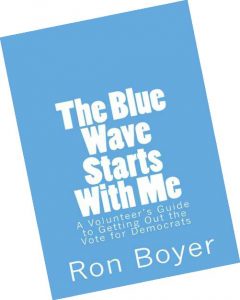
The Blue Wave Starts with MeThe Blue Wave Starts with Me:
A Volunteer’s Guide to Getting Out the Vote for Democrats
Ron Boyer ’76 penned a book for people asking themselves, What can I do to help elect Democrats?


Business ChemistryBusiness Chemistry:
Practical Magic for Crafting
Powerful Work Relationships
Kim Christfort ’96 and Suzanne Vickberg offer a guide to putting cognitive diversity to work.


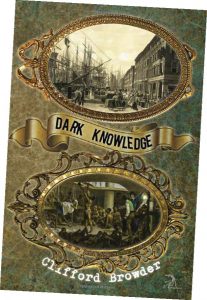
Dark KnowledgeDark Knowledge
In his historical novel, Clifford Browder ’50 writes about a young man in New York in the late 1860s investigating the illegal pre–Civil War slave trade.


Sea ChangeSea Change:
The Unfinished Agenda of the 1960s
Dorothy May Emerson ’65 pens personal stories about a young life lived on the edge of hope, change and possibility in California in the 1960s.


Searching for My HeartSearching for My Heart:
Essays About Love
This book by Dawn Downey ’73 contains stories with themes of alienation, shame and the self-awareness that leads to love.


No Hard FeelingsNo Hard Feelings
Emotions at Work (and How They Help Us Succeed)
Liz Fosslien ’09 and Mollie West Duffy take a look at emotions in the workplace and how to navigate them.


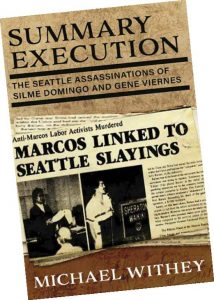
Summary ExecutionSummary Execution:
The Seattle Assassinations of Silme Domingo and Gene Viernes
Michael Withey ’68, P’91 tells a true story that could be a crime thriller: a double murder replete with assassins, FBI informants, murdered witnesses and a foreign dictator.


The Power of the ImpossibleThe Power of the Impossible:
On Community and the Creative Life
Erik S. Roraback ’89 surveys cultural figures and icons like Spinoza and Ivan Ledi and examines global community formation and creativity.


PeregrinationsPeregrinations:
Walking in American Literature
Amy T. Hamilton ’98 explores physical bodies and movement in American stories and history.


Sara When She ChoosesSara When She Chooses
Deedra Cooper ’76, who writes under the name Cat Jenkins, takes the fictional character Sara on a trip to her grandmother’s house—a primitive home that she hates to visit.


The American Road Trip and AmericanThe American Road Trip and American
Political Thought
Professor of Politics Susan McWilliams Barndt shows how Americans have long used road trips not only as escapism but also as a vehicle to explore questions about American politics.


San AntonioSan Antonio:
A Tricentennial History
W.M. Keck Professor of Environmental Analysis and History Char Miller has written the first general history of San Antonio, Texas, the nation’s seventh-largest city and one shaped by environmental, social, political and cultural pressures.

Oxtoby and the Academy

Former Pomona College President David W. Oxtoby has been named the new president of the American Academy of Arts and Sciences. A chemist by training, Oxtoby was elected a member of the academy in 2012. Founded in 1780, the academy honors and brings together members from across a wide range of disciplines to pursue nonpartisan research and provide critical insight on issues of importance to the nation and the world. The list of Oxtoby’s predecessors at the helm of the academy includes former U.S. presidents John Adams and John Quincy Adams; the first American to receive the Nobel Prize in Chemistry, Theodore William Richards; and the co-founder of the Polaroid Company, Edwin Herbert Land.

Math Award

Professor of Mathematics Stephan Garcia has been awarded the inaugural Mary P. Dolciani Prize for Excellence in Research from the American Mathematical Society. He was recognized for his outstanding record of research in operator theory, complex analysis, matrix theory and number theory, for high-quality scholarship with a diverse set of undergraduates and for his service to the profession. The award recognizes a mathematician from a department that does not grant a Ph.D. who has an active research program in mathematics and a distinguished record of scholarship.

Pomona Votes

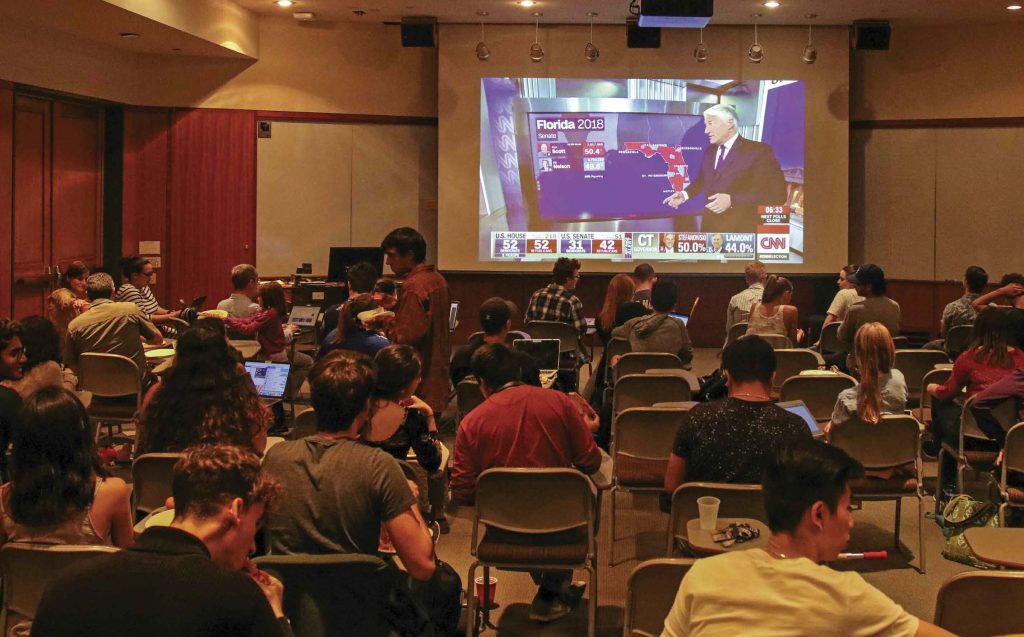
students gathering to watch the midterm 2018 election returns

In the midterm elections of 2014, according to a Tufts University survey, only 17 percent of Pomona College students cast a vote. Four years later, a group of concerned Pomona students turned to an online voting support site to give those numbers a boost.

Student leaders Michaela Shelton ’21 and Lucas Carmel ’19 led the outreach effort, encouraging their fellow students to sign up with TurboVote, an online tool that helps users take the first steps to register to vote or to request an absentee ballot.

“A recent Pew study revealed that about 75 percent of nonvoters are not voting due to logistical concerns, confusion,” says Carmel. “Where to get a stamp? How to request an absentee ballot? Where’s their polling place? The same thing is true for college kids—but if you’re concrete with people and help them with the process, you can eliminate many of those barriers.”

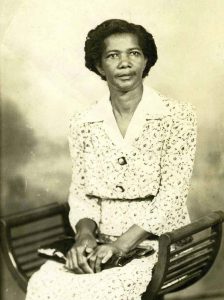
Ethel Starr

A portrait of President Starr’s grandmother, Ethel Starr, whose dedication to voting was featured in an op-ed in the Washington Post.

President G. Gabrielle Starr joined in encouraging students to get out and vote, not only on our own campus but across the nation. In an op-ed titled “Dear College Students: My grandmother waited 70 years for the right to vote. Don’t ignore this chance,” published in The Washington Post in late October, Starr told the story of her grandmother, Ethel Starr, who was nearly 70 when the Voting Rights Act was passed in 1965. “As a child in the 1970s and ’80s, I always knew when it was Election Day,” she wrote. “My grandma got dressed in her Sunday best, put on her black shoes, hoisted her hard, black pocketbook, adjusted her hat and waited by the door for my father to drive her to the polls. She never missed an election. …”

“Do something no one else can do for you,” Starr concluded. “The students I’ve worked with know I love a good dare. And I send one back. I dare you.”

The efforts at Pomona seem to have succeeded in stimulating greater interest in voting, as TurboVote reports that about 40 percent of all Pomona students—703 to be exact—signed up for the service prior to Election Day.

Tech for Sleepy Drivers

Tech for Sleepy DriversDriving back to campus from L.A. late one night, computer science major Eberto Andre Ruiz ’19 felt himself drifting off at the wheel. Worried, he grasped for a solution.
“I’m like, ‘Man, this is not safe,’ so I told Siri to set a timer for every five minutes,” he says. “I woke up the next morning and thought, ‘I’ve got to make an app for this.’”

Enter the 5C Hackathon—a one-night coding competition. In early November, Ruiz joined classmates Peter Nyberg ’19, Thomas Kelleher ’19 and Brook Solomon ’19 to built a prototype called Olert, with the O reminiscent of a steering wheel.

“Basically we were interested in doing something that was ‘Tech for Good,’ an idea in some way applicable to the real world,” Nyberg says. “This is something that takes lives.”

Using a camera and eye-tracking software, they built a system that would vibrate the steering wheel if the program detected signs of drowsiness in the driver’s eyes.

One after another, checking out some of the 20 projects submitted after the Hackathon, students from the 5Cs sat down and gripped the makeshift steering wheel the team fashioned with the leather cover from the steering wheel of Ruiz’s Nissan Altima. Sure enough, they felt it vibrate when their eyes closed.

As a result, Olert took the Hackathon’s top prize for the best “Tech for Good” project.

Accessible Geology

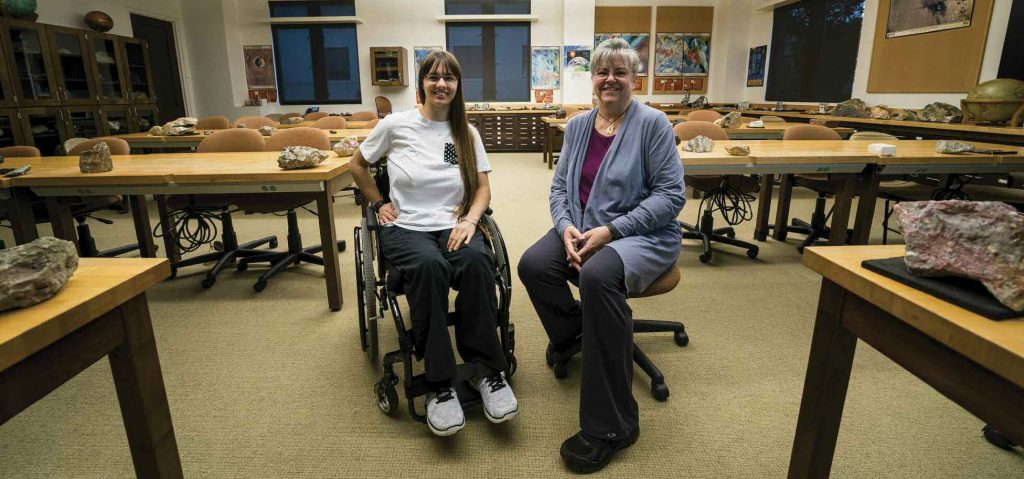
Alida Schefers ’21 Alida Schefers ’21 usually makes the first contact with her professors to let them know she uses a wheelchair and may need accommodations. Last year, however, it was Professor of Geology Linda Reinen who contacted Schefers, inviting her to visit the classroom where Reinen’s Intro to Geohazards class would take place and talk over plans for the class field trip. Since then, the bond between Schefers and Reinen has strengthened, and the classroom experience has changed for the better—for all of Reinen’s students.

In her revamped classroom, the most important rock samples now sit at the end of narrow tables with spacious and cleared aisles that ensure a wheelchair user can move with ease. A stream table (a tall table that demonstrates stream erosion) has a camera with a bird’s-eye view. The video is played back on a large screen for all students to see the action without having to crowd around.

Reinen’s changes may seem minor, but they make the classroom accessible in a major way. It was these changes that the International Association for Geoscience Diversity (IAGD) took note of when the group honored Reinen with the 2018 Inclusive Geoscience Education and Research (IGER) Award, given to instructors who promote or implement inclusive instruction and research that supports active engagement by students with disabilities.

“If everyone were mindful of a missed opportunity for a disabled student and took the time to advocate on their behalf, then the changes would be immense,” Schefers says. “One of my favorite sayings is: ‘If everyone did a little, no one would have to do a lot.’”