Blog Articles

100 Years of the 7 Colleges

The year was 1925, and Pomona College had a problem: too many students wanted to enroll. The solution it kick-started a century ago this fall set the stage for The Claremont Colleges, an educational system unmatched in American higher education—and it all began with then-President James Blaisdell’s audacious idea.

In the “roaring ’20s,” Southern California’s population was exploding. Within a 60-mile radius of Claremont, the population doubled in just six years. The attractiveness of Pomona was so strong that by 1926, only one in four applicants gained admission. Clearly, the college needed to expand. But how to do so without becoming, as 1907 alumnus and Rhodes Scholar E.H. Kennard warned in a 1925 article in The Pomona College Quarterly Magazine, “one more drab university”?

In Oxford, a university eight centuries older than Pomona, President Blaisdell saw a possible model for the future: a collection of small colleges that share some common facilities while each maintains its own independence and identity. “I should hope to preserve the inestimable personal values of the small college while securing the facilities of the great university,” he wrote.

1925 illustration of the Group Plan

1925 illustration of the Group Plan

By 1925, what became known as the Group Plan was quickly taking shape in the minds of Blaisdell and other leaders—some of whose names are now etched in stone across campus. Among them were George Marston, Ellen Browning Scripps and William L. Honnold. In March 1925 Blaisdell gave a trustee-appointed committee his summary of the Group Plan. His right-hand man, Robert J. Bernard, took an all-night train to Sacramento to file articles of incorporation for the new educational enterprise on October 14, 1925, exactly 38 years to the day after Pomona itself was incorporated.

The new entity, says Brenda Barham Hill, who served as CEO of The Claremont Colleges consortium from 2000 to 2006, had three main functions. It would provide common services, hold land on behalf of the group and offer graduate education.

Aerial shot of the campuses taken in 1930

With tuition set at $150 per semester and seminars offered in 14 fields, including geology, Latin, psychology and zoology, classes began in 1926 at the clunkily named Graduate School of Claremont Colleges, known since 2000 as Claremont Graduate University (CGU). That same year the inaugural class of first-years was admitted to a new Claremont college named after Scripps, a philanthropist and supporter of education and women’s rights whose fortune was tied to the E.W. Scripps newspaper publishing empire. An ardent advocate of Blaisdell’s vision, she made multiple real estate purchases that became a significant part of the footprint for Scripps, CGU and three additional new colleges.

The end of World War II saw a flood of returning GIs ready to continue their education, and The Claremont Colleges were poised to admit them. The next 20 years saw the launch of three more colleges, including Claremont Men’s College (1946, later renamed Claremont McKenna College), Harvey Mudd (1957) and Pitzer (1963).

Thanks to Ms. Scripps’ foresight and real estate prowess, the colleges are almost entirely contiguous, minus Keck Graduate Institute located west of Indian Hill Boulevard. One easily walkable square mile—these days often biked, scootered or skateboarded—is now home to roughly 9,000 students, 3,000 faculty and staff, and nearly 3.2 million square feet of building space. The central library is the third largest among private institutions in California, behind only Stanford and USC.

Blending the vision and needs of seven distinct institutions that are at once partners and competitors has required informal collaboration and formal agreements hammered out over many decades. Sharing services, from an early steam-heating plant to sophisticated modern cloud-computing clusters, has occasionally required challenging negotiation and a recognition of the importance of “group over the individual.” As Blaisdell put it, “The whole project depends upon whether the participants are primarily interested in their separate organizations or, first of all, concerned in the creation at Claremont of a common and efficient center….”

And yet, a century in, the experiment shoulders on. The consortium has been modified over the years: graduate education, once the purview of all the colleges, is now housed in two distinct consortium members, and individual schools can choose to participate in some shared services but not others, with procedural guidelines and formulas in place to promote fairness. “Part of the genius of the model from day one was that they saw the benefit of sharing, and that it’s not static,” says Barham Hill.

Blaisdell would no doubt marvel at how his idea has flourished in what’s now called the “City of Trees and Ph.D.s.” When he became Pomona’s president in 1910, Claremont had no paved streets and Marston Quad was still a rye field. Now the colleges have collectively graduated about 100,000 alumni, and all five of the colleges are among the most highly ranked liberal arts schools in the country.

Yet Blaisdell would likely not be surprised. As he wrote to Scripps in 1923, “all I can hope to do is to draw the outlines of a project so fine and yet so sane that the generations will not suffer it to fail.”

The Central Pacific Railroad passenger depot in Sacramento

The Central Pacific Railroad passenger depot in Sacramento, where Robert J. Bernard filed the articles of incorporation for Claremont Colleges. [Credit California State Railroad Museum Library]

Celebrating 20 Years of QuestBridge

This year Pomona is celebrating 20 years of partnership with QuestBridge, a national nonprofit that connects exceptional, low-income youth with leading colleges. Through the QuestBridge National College Match college and scholarship application process, Pomona offers a number of College Match scholarships annually that cover the full cost of tuition, room and board and are loan-free.

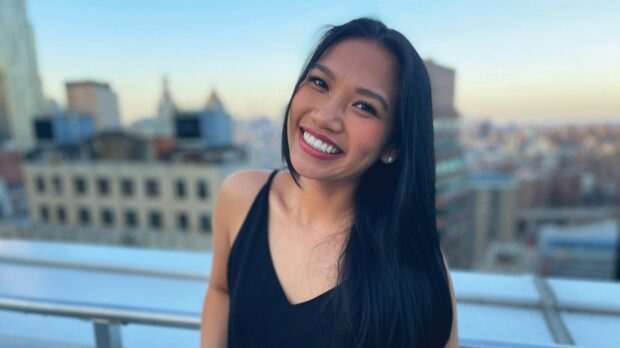
Bayarmaa Bat-Erdene ’26

Bayarmaa Bat-Erdene ’26

“The access to college that QuestBridge provides is closely aligned with our mission statement at Pomona College to gather individuals, regardless of financial circumstances,” says Edward Pickett III, senior associate dean of admissions and director of recruitment.

Pomona has also hosted QuestBridge-related events such as the National College Admissions Conference, where QuestBridge participants can learn about the college admissions process and meet with admissions staff from partner colleges. This year there are 25 QuestBridge scholars at Pomona. Here’s a snapshot of a couple of them!

Illinois native Bayarmaa Bat-Erdene ’26 credits QuestBridge for making her college experience. She says that her parents, who emigrated from Mongolia, worked really hard to get her to Pomona, and wants to make sure that her parents’ “contributions and efforts were worth it.” Bat-Erdene is studying sociology and public policy analysis, thinking closely about issues like income and immigration. Reading the book The Maid’s Daughter for a class, she was able to compare it to her own experience as her mom worked as a housekeeper for a time.

Peter Schwammlein ’26

Peter Schwammlein ’26

Peter Schwammlein ’26 was drawn to Pomona for the Claremont Colleges consortium, the liberal arts education, and students he had met through the QuestBridge network. Raised in Fayetteville, Arkansas, Schwammlein is majoring in linguistics and considering double majoring in German Studies. Schwammlein has especially enjoyed the students at Pomona. “People are willing to listen to other perspectives,” he says. “The school pulls deep-thinking people that can see multiple sides and are not fully set on their ideology.”

Stray Thoughts

It’s a familiar refrain heard across dinner tables, holiday gatherings and comment threads: “Back in my day…” Every generation seems to carry a version of this lament—the notion that they had it tougher or that life was more demanding. Whether it’s holding down a job at 16 or walking to school uphill both ways, the past tends to wear a nostalgia filter, painted in hues of grit and resilience.

While there’s some truth to the idea that the challenges of youth are universal, in 2025 it’s safe to say that there are some pretty unique complexities ahead for folks born in the last 30 years (i.e. the elder “Gen Z” Zoomers, and the younger “Alphas”). The next generation is in the midst of navigating a thorny landscape littered with issues like loneliness, climate anxiety, skyrocketing housing costs, an AI-disrupted job market and political polarization.

This issue aims to explore the realities, hopes and hurdles of those coming into adulthood today, with a particular focus on the three topics of work-life, parenting and mental health. We delve into the future of office work and how young professionals are questioning hustle culture and demanding purpose alongside their paychecks; we talk to experts about how financial stress and shifting cultural expectations have made younger generations less likely to have kids; and we confront the ongoing mental health reckoning that has involved evolving conversations around self-care and seeking therapeutic support.

Adam Conner-Simons ’08

Adam Conner-Simons ’08

As we turn the page of this issue, we invite you to set aside the nostalgia and listen to the stories of those growing into adulthood at a time unlike any other. While every generation thinks they had it hardest, it just might be true that this one has it different—and is rising to meet it in extraordinary ways.

—Adam Conner-Simons ’08
editor-in-chief

Letter Box

Come Sail Away

Perhaps it was because three of my grandparents were born in England, the fourth, an eighth great grandfather, born there quite long ago, or due to my dad and his father being in the Navy, I became interested in ancestry and boats. Over the last 25 years I’ve built several small wooden boats, and through that made several friends and organized many ‘Messabouts’.

Over the past decade I’ve been watching lots of YouTube videos on wooden boats and those that sail them, which led in time to videos of couples sailing wooden and fiberglass boats all over the globe for years at a time.

It was thus with great excitement that I read about “Project Atticus” in the Spring 2025 Pomona College Magazine. I’d not heard of this channel before, but I will now enjoy binge-watching the past decade of these videos, and any upcoming videos as well!

—Steve Lansdowne ’71

Desiree and Jordan Wicht overlooking the ocean

Prompts of Fond Memories

As a former editor of Pomona College Magazine, I read each issue with interest. The Spring 2025 obituaries have prompted some special memories of four people:

Perdita Sheirich was an unsung hero of the College; her myriad notes regarding births, professional and personal achievements, and obituaries captured, preserved and celebrated the fabric of the campus community for decades.

Gordon Hazlitt ’54 was a legendary editor of PCM when I arrived in 1984. He was one of several editors with whom I had the pleasure of working (Christine Kopitzke ’75, Dennis Rodkin ’83, Tom Wood, Mark Wood).

And finally, let’s remember parents and grandparents who are often unappreciated. The late Peter and Winky Hussey (parents of Duncan Hussey ’13) helped support athletics at Pomona, funding facilities and nearly single-handedly organizing tailgate parties before and after football games. They were tireless advocates and supporters of the College.

All four, in different ways, contributed mightily.

—Don Pattison
Pomona, California

Remembrances from the Golden Age

I was alarmed to find nothing in the Spring issue from my ’56 classmates. I miss knowing who is still around and what they are about. At 90, I would enjoy any bits about fellow aged lives. I have memories of the ’50s that are laughable now—Stinky’s hamburgers! May Queen! Gracious Living! I waited on tables at dinners. Are there still served dinners? My life is limited now, of course, to reading, writing a column for a local paper here in small-town Arizona, and musing about the meaning of life. I’m shorter and fatter and am married to my third husband. I don’t miss my teaching or my ministry, but I do miss my departed friends, like Ann Williams ’56 with whom I had wonderful trips and many laughs.

—Elaine Stoppel Jordan ’56

Correction

Friends, on page 8 of the Spring 2025 PCM, you identify 1982 commencement speaker Bill Bradley as a New York senator. Although “Dollar Bill” starred for the New York Knicks, he represented New Jersey in the Senate.

—Steve Johnson ’82

Write to Us at PCM

Pomona College Magazine welcomes brief letters to the editor about the magazine and issues related to the College from the extended Pomona community—alumni, parents, students, faculty, staff, donors and others with a strong connection to the College. Write to us at pcm@pomona.edu or mail a letter to Pomona College Magazine, 550 N. College Ave., Claremont, CA 91711. Letters should include the writer’s name, city and state of residence, class year for alumni and contact information. With rare exceptions, letters should be no more than 400 words in length. Letters are selected for publication based on relevance and available space and are subject to being edited for brevity and clarity.

Introducing Pomona’s new Chief Communications Officer

Dear Pomona community,

I’m very excited to have joined Pomona as its new Chief Communications Officer (CCO) this July.

I bring over two decades of strategic communications leadership to the College, and most recently served as Assistant Vice President of Executive and Community Communications at the University of Southern California (USC). I know Pomona to be a remarkable institution whose faculty and administration put student belonging, experience and success at the heart of every endeavor. I feel very fortunate for this opportunity to lead our talented Communications team and help tell Pomona’s story.

More than anything, I’m looking forward to collaborating with our gifted academic community on a host of important initiatives and showing the enduring value of the liberal arts in shaping the next generation of leaders, scholars, artists and engaged citizens.

Eric Abelev, Chief Communications Officer

As a newcomer to the Pomona community, I know that your support and input will be an invaluable ingredient to my team’s success. Your ideas and feedback will always be welcome and I hope you won’t hesitate to reach out!

—Eric Abelev
chief communications officer

‘Through the Gates’ with President Starr

G. Gabrielle Starr and students walk through the gates of Pomona CollegeThis fall I have come back to campus after an energizing and much appreciated sabbatical. I’m looking forward to working with the entire community as we begin this new academic year together.

Sabbatical leave is one of the important ways Pomona encourages great scholarship and, in turn, the exceptional teaching for which we are renowned. It is a gift of time to study intensively and keep the light of learning glowing brightly.

During my sabbatical I had the opportunity to work on my next book, which is about why human beings need beauty. I don’t think that beauty is icing on the cake of human experience; it is part of who we are and how we learn.

Beauty leads us on in our explorations of the world around us. The products of our creativity—from paintings and poems to buildings and even tools—are records of what we have learned about the world and how we have learned it. Our symphonies are explorations of the world of sound; they are products of feeling, too, but they are also markers of collective yearning, loving and living.

It is easy, as a college president, to be fully caught up in pressing day-to-day issues, and I truly love serving the College and our community. I’m glad to be back on campus, living and loving our collective life. But, having an opportunity to focus for a time on my intellectual curiosity connected me closely once again with the heart of Pomona—our commitment to lifelong learning.

Students choose Pomona because they, too, are curious. So many elect to double major because it’s simply too hard to narrow their attention to just one discipline. And our faculty come here because there is no place better to discover, create, imagine and learn alongside each other and our incredible students.

I am grateful to the Board of Trustees and to Bob Gaines, who stepped in as Acting President, for this period of time to once again experience the life of scholarship and strengthen my kinship with our learning community. Bob’s steady, thoughtful and optimistic leadership was wonderful to see. I appreciate so much his willingness to take on the role and the expert way in which he guided the College toward the fulfillment of our mission.

Now, as we begin a new academic year, it is important that we as a community find ways to be a place of calm amidst the winds of discord and division that are currently buffeting our nation and our world. Pomona brings together people with different backgrounds, cultures, worldviews and passions. We have so much to learn from each other, ideas and imaginings that can enrich each of our lives. The key is learning to listen, not just with our ears, but with our hearts and our full attention.

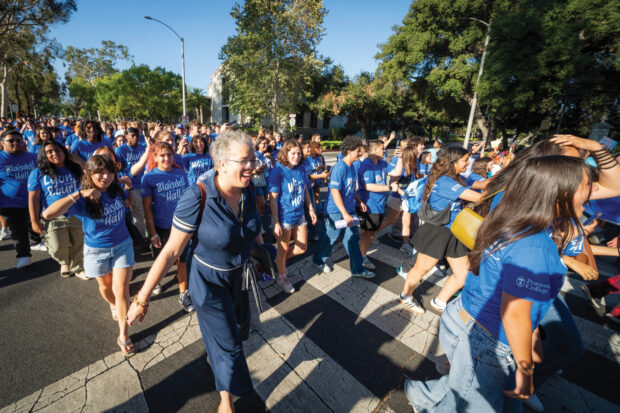
On the first day of orientation I walked, as is tradition, through the gates with our newest students. When I met with them later in our beautiful Center for Athletics, Recreation and Wellness, I encouraged them to look around at their classmates. These are the people, I reminded them, who will become their teammates and friends, not just for now, but perhaps for life. I encouraged them to pay attention to and care for each other on the journey they will share at Pomona. I ended with a quote from Apollo astronaut Rusty Schweickart that I think is apt for us all: “We’re not passengers on Spaceship Earth,” he said. “We’re the crew.” (And then, of course, I said it again in Klingon.) Whatever languages we speak, whatever creeds we hold dear, and wherever we go, we Sagehens will shape our future together, and that makes me very proud.

Pomona College has been making an outsized contribution to Spaceship Earth for more than 100 years because of the strength of our community. I eagerly anticipate building on that in the year ahead.

—G. Gabrielle Starr
President

Is Gen Z Getting Off the Corporate Ladder?

Is Gen Z Getting Off the Corporate Ladder?


Is Gen Z Getting Off the Corporate Ladder?

The old career advice isn’t relevant anymore.

Start in the mailroom. Get your foot in the door. Grab a rung on the ladder and start climbing.

But what if there’s no actual office door, because your colleagues work remotely?

What if that mailroom is merely a metaphor in an age of electronic communications and AI-written emails?

Julianna Pillemer ’09

Julianna Pillemer ’09, an assistant professor of management and organizations at NYU’s Stern School of Business

And as for the ladder, who among us actually still stays at one company for decades, waiting for a gold watch and a pension?

“It’s a totally different landscape,” says Julianna Pillemer ’09, an assistant professor of management and organizations at NYU’s Stern School of Business.

A New Generation of Workers

Young workers inhabit a changed work world, and they bring very different attitudes than previous generations. The last of the baby boomers who dominated workplace culture for decades turned 60 last year and are moving toward retirement. A decade ago millennials became the largest generation in the U.S. workforce, surpassing Gen X. Just two years ago, the boomers were eclipsed by Gen Z, those born from 1997 to 2010.

What do young workers want? Among the key values identified in a 2023 survey directed by Georgetown University’s McDonough School of Business was that workers ages 24 to 35 prioritized flexibility and work-life balance.

That rings true to Hazel Raja, senior director of Pomona’s Career Development Office (CDO)—a Gen Xer who encouraged the office book club to read millennial author Lindsey Pollak’s The Remix: How to Lead and Succeed in the Multigenerational Workplace, so that the CDO team could better understand both the job seekers they counsel and their own colleagues.

The Remote Work Revolution

The pandemic ushered in the era of telecommuting, but many young people who experienced the isolation of the COVID shutdown have come to crave in-person collaboration, while also appreciating the versatility of hybrid work options.

“I think there’s this feeling of wanting the best of both worlds, to have days in the office where you can connect with the community but also the flexibility to say, ‘I’m working from home today,’” Raja says.

Even after return-to-work calls following the pandemic, remote work is entrenched in many organizations. Folks with bachelor’s degrees have benefited most: 52 percent of college graduates now work remotely some or all of the time, compared to 35 percent of the overall workforce.

Hybrid jobs offer potential gains for work-life balance. Yet NYU’s Pillemer—who earned a Ph.D. in organizational behavior from the University of Pennsylvania’s Wharton School and studies workplace relationships—says friendships can be key sources of motivation and support at work when managed effectively.

“I think this is often what leads to work feeling like a community, a place where you don’t have to hide who you are,” she says, noting her research on the concept of “strategic authenticity,” which involves finding the right balance between self-disclosure and professionalism at work. “I think there might be a disconnect between how little this younger generation is thinking these relationships matter and how much they actually do matter to their workplace happiness.”

Gen Z workers say they yearn for more in-person connection, but that it doesn’t have to be with colleagues. Now trending: meetup activities such as book clubs and hiking groups, and even platonic matchmaking apps like Bumble BFF.

Cohen ‘81 spoke in her TED talk about how to transition back into the workforce after career breaks.

Still, remote workers may miss out not only on networking and friendships but also on mentoring, says Carol Fishman Cohen ’81, a regular contributor to Harvard Business Review and co-founder and CEO of iRelaunch, a career re-entry company.

“To be in the office side-by-side with more seasoned professionals and have informal interactions with people is part of how you learn,” Cohen says. “You stop by someone’s office or walk out together from a meeting, and that’s where relationships are built and knowledge is transferred. If early-stage professionals don’t get to have that experience, it’s going to be much more difficult for them to learn what they need to know.”

Next-Gen Feelings

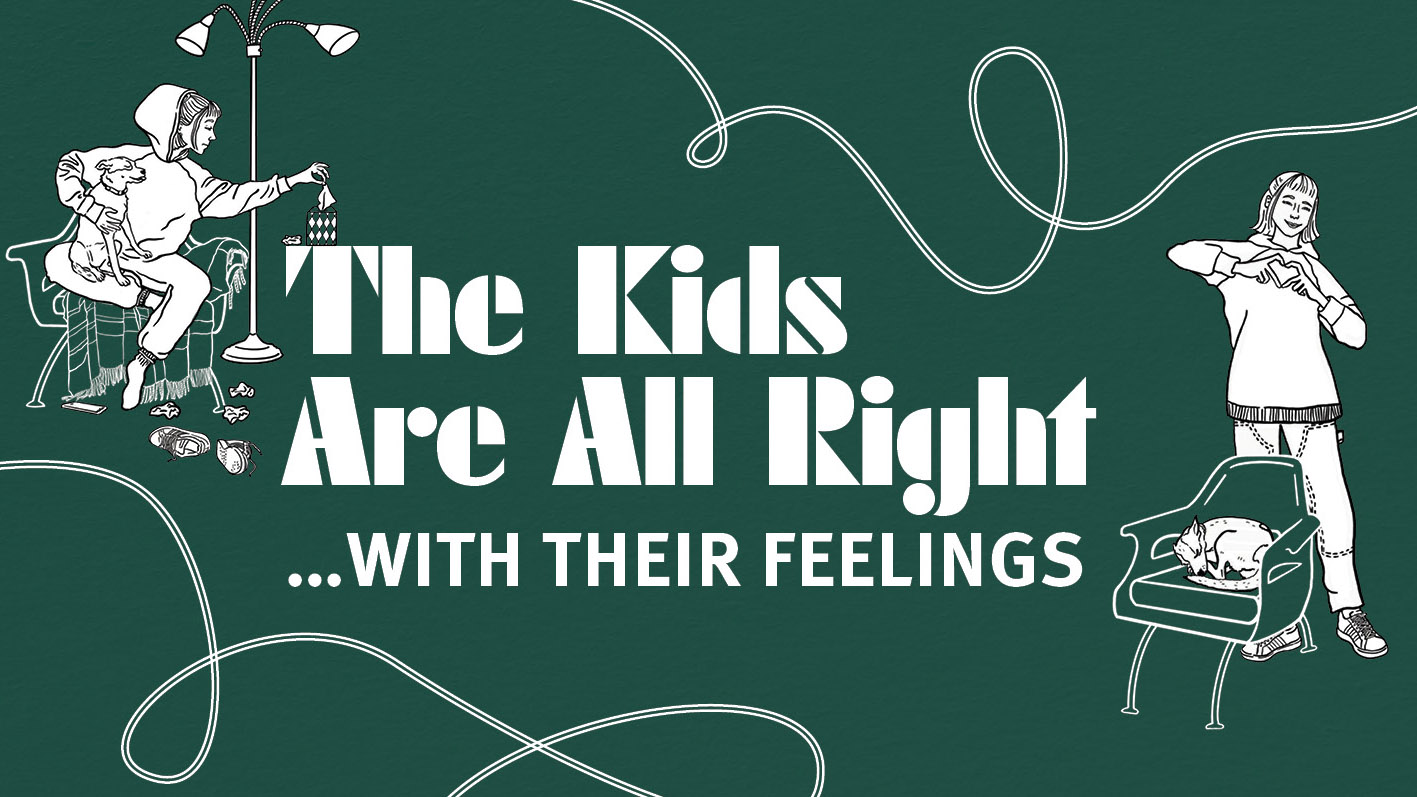
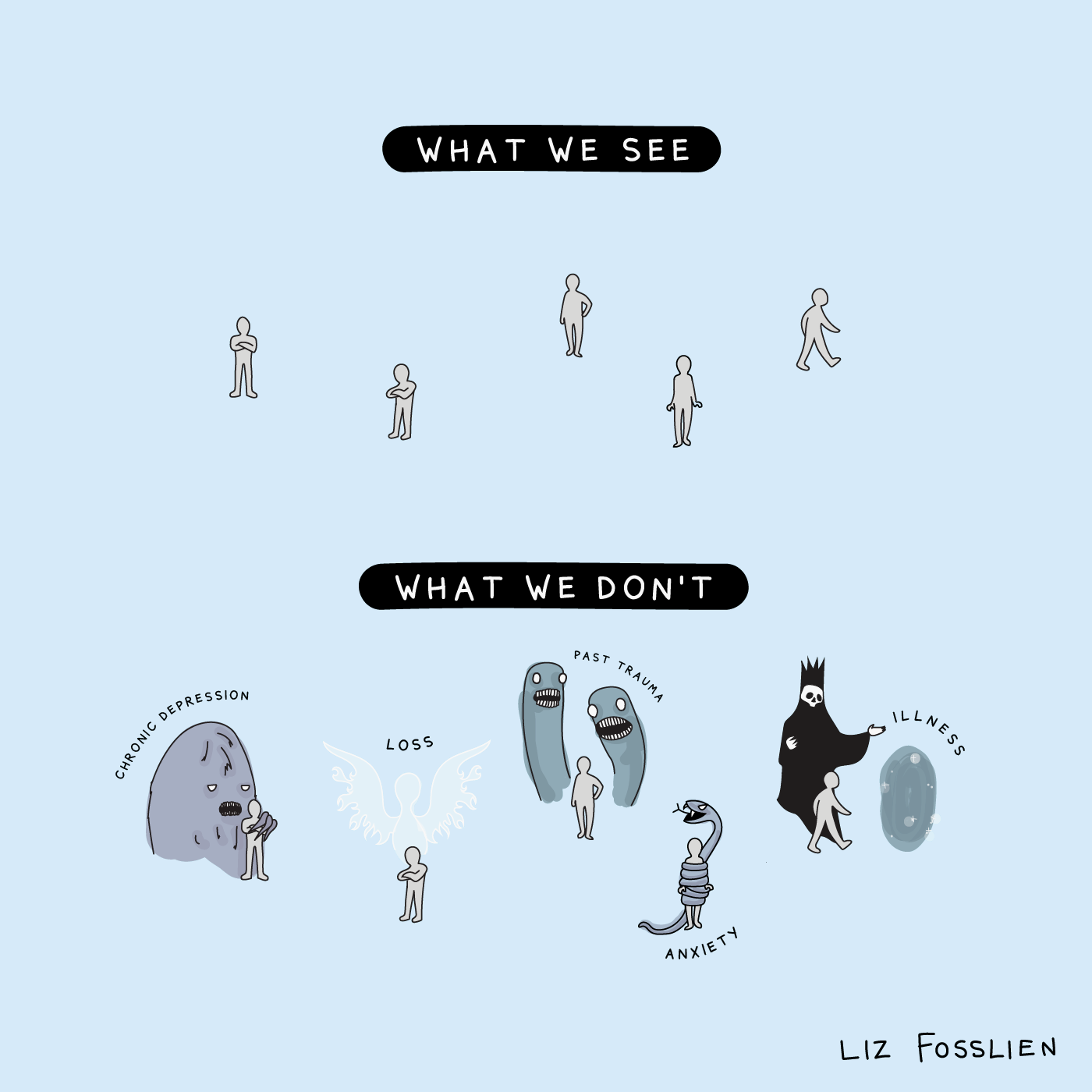
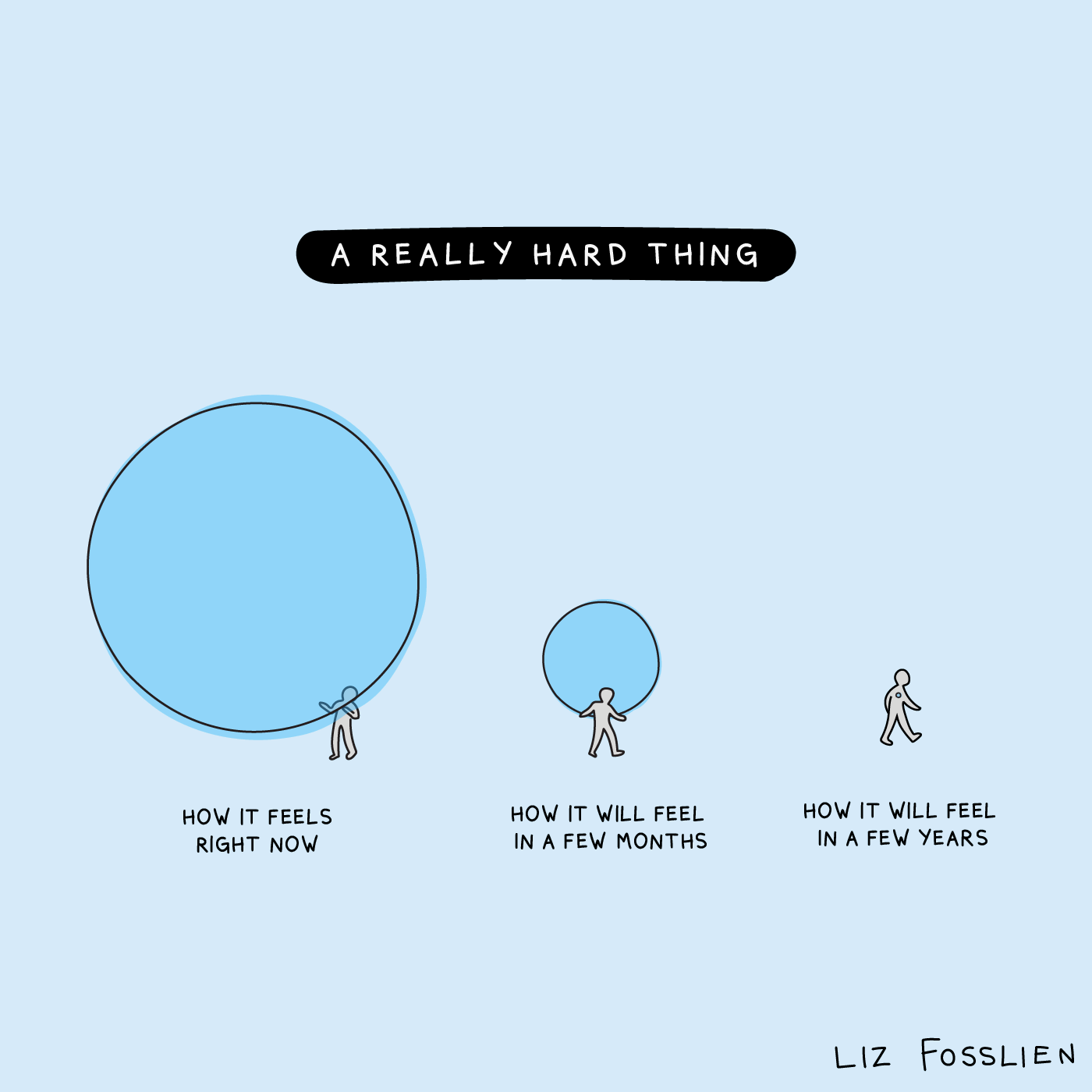
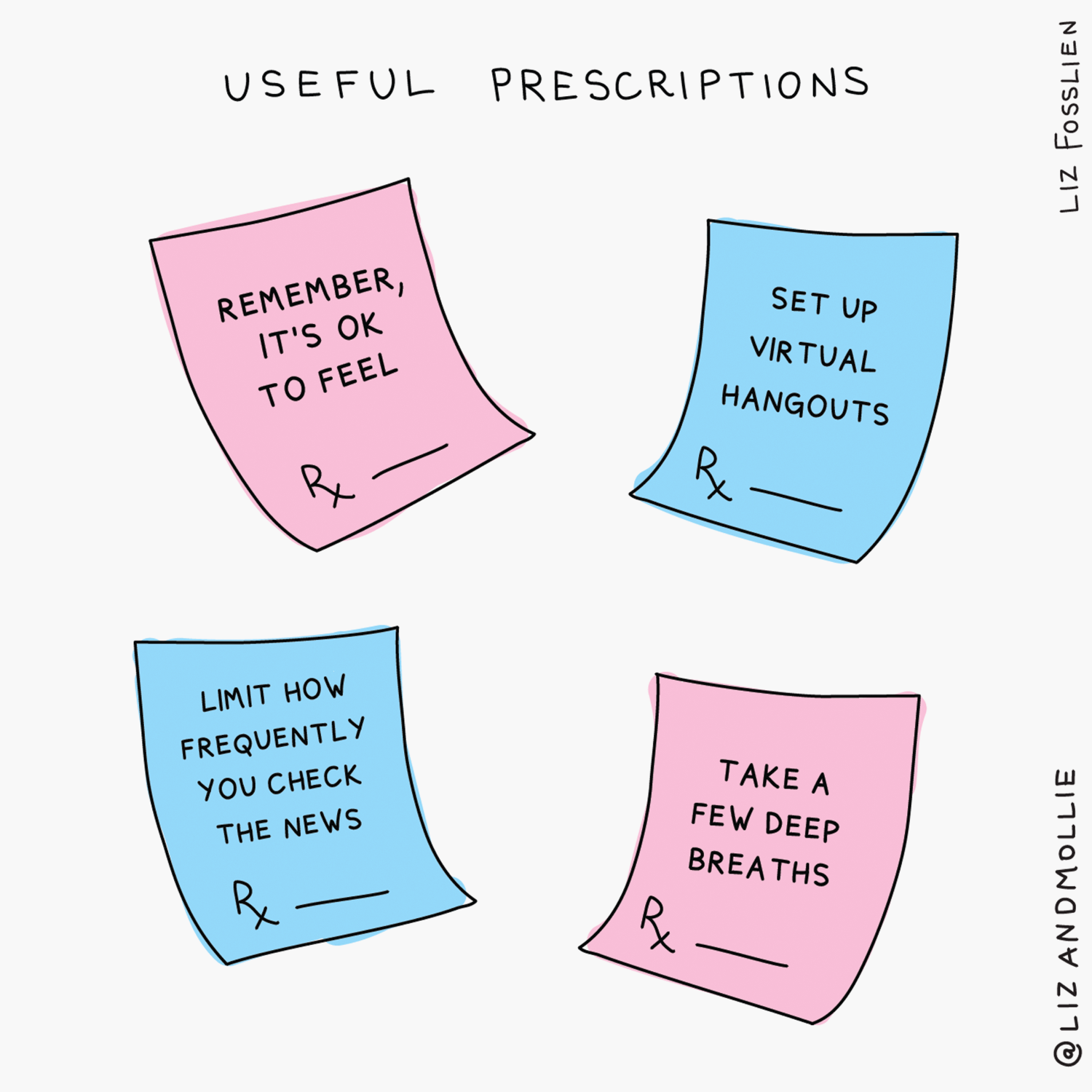
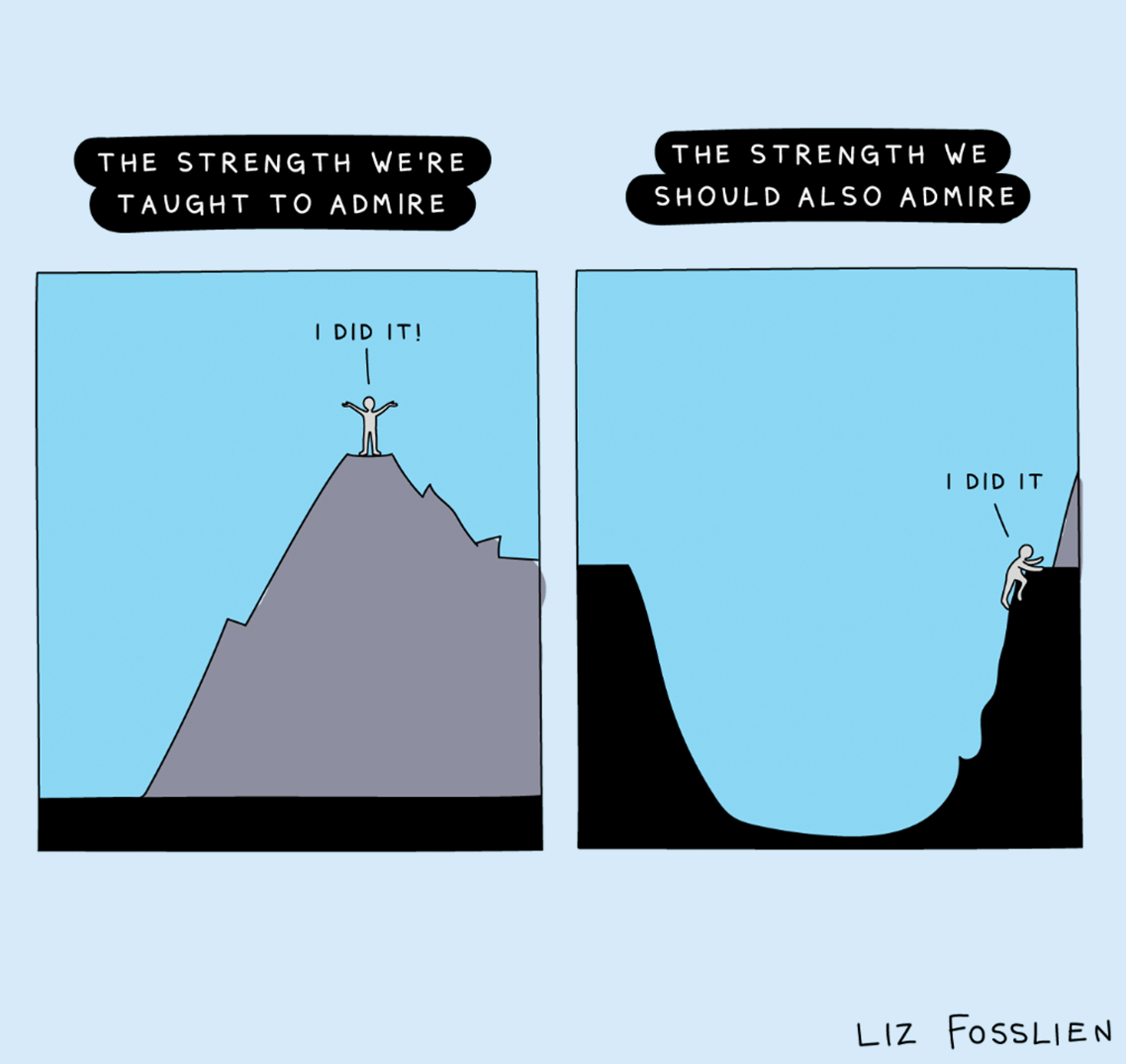
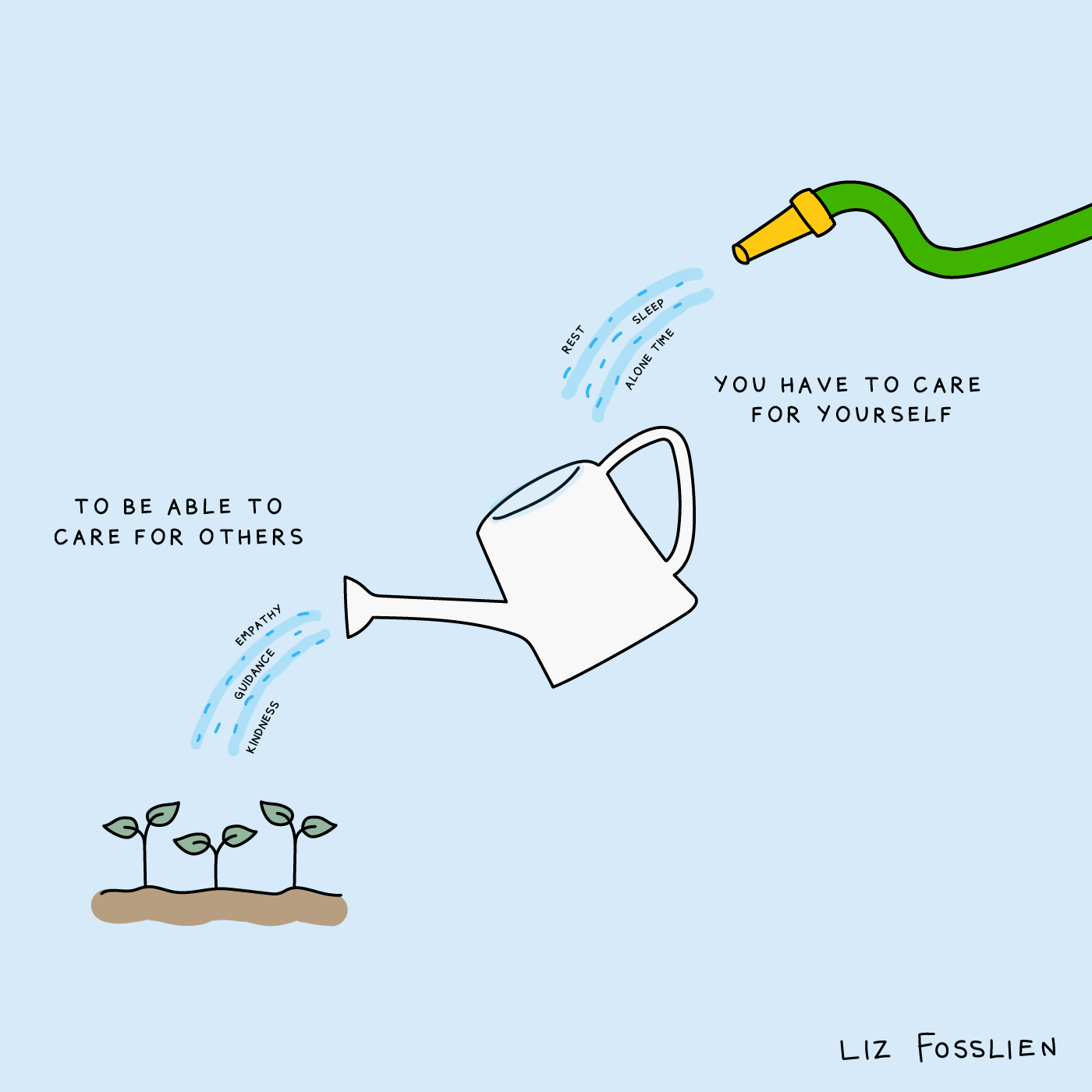
Liz Fosslien ’09 has spent nearly 20 years creating thoughtful, whimsical illustrations for publications such as The Economist, The New York Times and TIME. Often focusing on the topic of emotions as they apply to professional paths and workplace environments, she co-authored and illustrated the national best-seller Big Feelings and its follow-up No Hard Feelings, as well as helping illustrate Adam Grant’s New York Times bestseller Hidden Potential. Throughout this issue we’ll be featuring some of her illustrations that have resonated most strongly with younger generations, particularly those revolving around “the concept of giving yourself grace during hard times.”

A Sense of Purpose

Work-life balance is no longer something people focus on only once they have kids and a household to run. Many Pomona students are thinking ahead, evaluating career choices by considering their personal priorities—sometimes choosing a city and then finding a job instead of finding a job and moving to that city—as well as by seeking more meaning in their work.

Raja says many students these days are often much more driven by things they’re passionate about, though she notes some students from less-advantaged backgrounds may still feel the need to maximize the financial return on their education.

“Generally, there’s not this aim for a ‘35 years of service’ pin,” she says. “More students are anchored by their values being met and doing work that is personally fulfilling.”

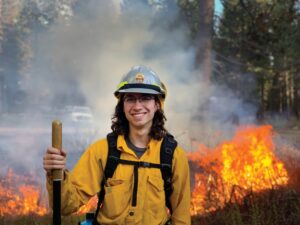
Nate Dailey ’23

Nate Dailey ’23, a high school senior when his family fled Paradise, California, in the early morning hours of the November 2018 “Camp Fire,” is one example of melding professional skills with personally meaningful work. He arrived on campus less than a year after his family’s home was one of nearly 19,000 structures destroyed in the deadliest wildfire in California history.

After majoring in computer science, Dailey embarked on a career in wildfire science as a research analyst for Deer Creek Resources, which helps communities and landowners prepare for wildfire. There he developed a computer model to detect overgrown parcels from roadside imagery that aids in both vegetation management and evacuation planning.

“I was really inspired to pursue something that was connected to the Camp Fire, and also my interest in computers and maps,” Dailey recently told Professor Char Miller in a Sagecast podcast. “Now I’ve been able to put it all together, and I think my Pomona education really helped me with that.”

Another key differentiator for the next generation of workers is that if a job isn’t right for whatever reason, today’s young people are not afraid to move on. While job-hopping once was a resume red flag, Raja and others say that applicants are now more likely to raise eyebrows if they stay too long, potentially suggesting that they don’t have other opportunities.

According to U.S. Labor Department statistics, in early 2024 the median time workers had been with current employers was only 3.9 years—the shortest tenure recorded since 2002. While the average job-stay for older workers was almost 10 years, for workers ages 25-34 it was a mere 2.7 years.

Camille Molas ’21, co-president of the New York City Alumni Chapter with her husband, Diego Vergara ’20, sees that phenomenon around her.

“A lot of people are on their third job already,” she says. “A friend of Diego’s already is on his fourth. Younger people are just more willing to say, ‘I’m out. This is not working for me.’” (See page 27 for more on Molas.)

Seeking Balance Beyond Wall Street

Camille Molas ’21Camille Molas ’21 landed a coveted Wall Street investment banking job before she graduated from Pomona. The entry-level role with JPMorganChase paid her in the low six figures with the potential for five-figure bonuses and a big future.

She left after only a year, jumping to Knowde, a startup focused on building software for the chemical industry.

The reason wasn’t only the famously grueling hours that Wall Street firms expect from young graduates.

“I was learning a lot and it was super interesting, but I felt like I was missing a certain something of actually building stuff,” says Molas, who completed the astrophysics track in the physics major at Pomona and spent her time with JPMorgan covering companies in industries such as aerospace, defense and chemicals. “These are already massive corporations that are no longer thinking about things like how you go from zero to one. I was really drawn to learning, ‘How do you even get things off the ground?’”

As part of the new Gen Z workforce, she also had expectations about balance, flexibility and personally meaningful work.

“I think what moved the needle for me to leave investment banking was that work-life balance,” she says. “It just kind of consumes your life.”

Working 80 or more hours a week is routine, and despite pledges by Wall Street firms to limit demands after the 2024 death of a junior investment banker at Bank of America who had been putting in 100-hour weeks, a Wall Street Journal investigation found some managers continued to pressure junior bankers to hide excessive hours.

“It’s not necessarily that you are working nonstop, [but] that you’re required to be ‘on’ all the time, which is almost worse,” Molas says. “It could be 14 hours one day, then eight, then 12 on the weekend. You’re not able to anticipate when you can be free.”

Don’t mistake her decision to leave Wall Street as a lack of ambition. Her ultimate goal:

“I would like to start a company.”

While working full time, she also has enrolled in a part-time remote master’s program in computer science at Georgia Tech to be able to better translate between the business and engineering sides of a company.

“I’m very big on understanding and being able to communicate, and think it’s important to know the language,” Molas says. “I want to make sure that I have at least the framework of where the tech people are coming from. There are always going to be the businesspeople and the engineers. You really need someone who can talk to both.”

Uncertain Outlook

While younger generations are being given more grace for job-hopping, their prospects aren’t uniformally positive. This year there were many headlines lamenting the job market for the Class of 2025 and, for the first time in decades, unemployment rates for college graduates under 27 have surpassed the overall average. Even the typically staid Economist chimed in with “Why Today’s Graduates Are Screwed.”

Factors include everything from federal spending cuts to the explosive rise of artificial intelligence, which experts say will affect entry-level jobs most because of more replicable tasks such as coding, number-crunching and summary writing. Despite that, Raja says she has seen such admirable adaptability for Sagehen job seekers.

“While it’s nice to be able to get a job at Amazon or Apple or Google, I think students like ours are versatile enough to say, ‘Well, I have these tech skills I could apply to another industry,’” she says. “‘Maybe a lot of the values I have are still being met because I’m not only working in an area that I’m actually interested in, but I’m making the same salary or I’m still building my network.’”

Ultimately, it may be the massive uncertainty in academia brought on by new federal policies that will have the largest impact on Pomona alumni, considering that one in four respondents from Pomona’s Class of 2024 First Destinations Report said they were headed straight to graduate school. In addition, many alumni who enter the workforce right out of college pursue a graduate degree within five years, Raja says.

Federal research grant cuts and wrangling over student visas and policies such as DEI mean some jobs and graduate school opportunities that used to be stable have evaporated, particularly in STEM fields and for international alumni. Proposals to limit federal loans for graduate students could also have a chilling effect, particularly on those seeking expensive medical degrees.

The impact on academia is likely to be felt by more than just graduate students: In Pomona’s 2023 Alumni and Family Attitude Survey, higher education was the number one job sector reported by alumni, ahead of science and medicine (36 vs. 27 percent).

Pillemer says most of her undergraduate business students at NYU remain focused on finance, consulting and tech, though they also are keenly aware of the potential to pursue more independent career paths such as internet content creation, entrepreneurship and gig work.

“As a scholar I’m reckoning with things like how we think about work and how organizations are structured, especially in a future when ‘employees’ could be bots and people are striking out on their own as entrepreneurs or influencers,” Pillemer says. “As students grapple with an uncertain job market and these sweeping changes in the way we work, they’re asking themselves, ‘What do I value?’ ‘What’s meaningful to me?’ And ‘How am I going to get paid to do it?’”

When the Baby Boom Went Bust

When the Baby Boom Went Bust

When the Baby Boom Went Bust

After a long, slow slide that began in the era of petticoats and suffragettes, the American fertility rate recently reached a new nadir. In 2023 U.S. moms birthed 3.6 million babies—about 76,000 fewer than the year before and one of the lowest totals since 1979.
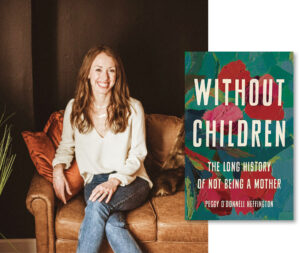
A University of Chicago professor, Heffington ‘09 has written about motherhood and women’s movements for TIME, The New York Times, and The Washington Post.

A University of Chicago professor,
Heffington ‘09 has written about motherhood and women’s movements for TIME, The New York Times, and The Washington Post.

It was a low-water mark that hinted at a bigger sea change. According to a 2024 Pew Research Center study, between 2018 and 2023 the share of adults under 50 who have no children and say they are unlikely to ever do so rose from 37 to (what else?) 47 percent. Fertility is falling in “basically every county: rich and poor, rural and urban,” says University of Chicago historian Peggy Heffington ’09, who studies contemporary and historical motherhood and reproduction. In 1970, the American fertility rate was about 2.5, above the replacement rate of 2. Today, it sits around 1.6.

Academics and parents themselves agree: this is a remarkably arduous moment to raise a child in the United States. But women opting not to have children is nothing new. In her book Without Children: The Long History of Not Being a Mother, Heffington traces the history of non-motherhood from ancient Roman women who used lemons as ad-hoc diaphragms, through abstinent medieval nuns, and all the way to the present. “It felt important to me as a historian to establish that there is significant evidence of women limiting fertility for a very long time,” she says. “As long as people have been trying to have babies, they have been trying not to have babies.”

Still, many factors make parenting feel particularly difficult in 2025, including economic struggles, gender inequities, climate anxiety, mental health concerns and shifting expectations of community support. These accumulating challenges have been central to an increasingly common choice for young people of parenting age: not to parent at all.

Factor 1: Money talks

More than one-third of respondents to the 2024 Pew survey cited money concerns as a major reason for deciding against parenthood. The financial landscape for young people is tough, to say the least: a 2016 study from the Center for Household Financial Stability found that median millennial savings were 34 percent below what historic trends would predict; in a recent survey by the financial platform Step, more than one-third of Gen Z respondents reported running out of money every month.

Shadiah Sigala ’06

Among the many costs of raising a new human, child care has emerged as especially exorbitant. According to the U.S. Department of Labor, American families pay upward of one-sixth of their median income on care for just one child—as much or more than what most pay for rent or mortgage. As tech entrepreneur Shadiah Sigala ’06 puts it, “You can see how with two or three children the calculus becomes absolutely untenable.”

On top of the cost of child care is its availability: over half of Americans live in “child care deserts,” with low-income rural and communities of color disproportionately impacted. This issue inspired Sigala to found Kinside, which provides a marketplace connecting families to caregivers in their area, helps companies build child care into their employee benefits, and works with local governments to improve larger care ecosystems.

But more accessible child care doesn’t help those who struggle to get pregnant in the first place. Fertility issues afflict many aspiring mothers, and while technologies like in-vitro fertilization (IVF) have opened up many new possibilities, they don’t come cheap, with a single round of IVF costing some $20,000. Heffington argues that, for some, such technologies actually “increase the pain of infertility in offering a promise where previously there was nothing you could do.”

Empathy Across Generations With Prof. Jessica Stern ‘12

By Lorraine Wu Harry ’97
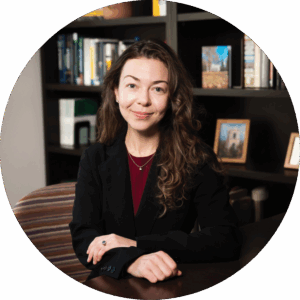
Jessica Stern ’12

This spring a child development paper from assistant professor Jessica Stern ’12 was selected by University of California at Berkeley’s Greater Good Science Center as one of 2024’s “most provocative and influential findings on the science of a meaningful life.” We talked to Stern to learn more about her paper “Empathy across three generations.”

What is your study’s central research question?

Adolescents get a bad rap. The misconception goes something like this: Teens are self-focused, easily pressured to do bad things by their peers, and lacking mature social skills like empathy. But does the evidence bear this out?

Not really. In our observations, teens are deeply engaged in supporting others, particularly their friends, and peer interactions often encourage them to be prosocial. Our research team wanted to understand: How do teens learn empathy? How is empathy transmitted across generations? And what’s the role of teenage friendships?

How did you collect the data?

The KLIFF VIDA longitudinal study, led by the University of Virginia, began in 1998. We tracked 184 teens from age 13 into their mid-30s, and every year invited teens to the lab with their parents and closest friend, and recorded videos of their interactions. When teens were 13 we observed them talking to their moms about a problem they could use help on, and tracked how much empathy moms showed during that conversation. We looked for things like how emotionally engaged the mom was, whether she had an accurate understanding of the teen’s problem, and how much help and emotional support she provided.

Then, every year for seven years, we observed teens talking to their closest friend about a problem their friend needed help with. We looked for those same types of empathic behaviors in how the teen treated their friends. When some of those same teens were starting to have kids of their own about a decade later, we sent them surveys asking about their parenting behavior and their children’s empathy.

What were your key findings?

We found that teens who experienced more empathy from their mothers at age 13 were more likely to “pay it forward” by showing empathy for their friends in adolescence. For the teens who later had children, practicing empathy with close friends in late adolescence predicted more supportive parenting behavior a decade later. We were able to see how empathy is transmitted across three generations.

Our message is this: if we want to raise empathic teens, we need to give them firsthand experiences of receiving empathy from adults at home. More than lectures or pressure, teens need to feel what it’s like to be understood and supported. This gives them a model of empathy in action.

We also hope [to] give parents peace of mind, knowing that teens’ desire to hang out with friends is a boon for their social development (and perhaps their future success as caregivers). Supporting teens to cultivate close friendships may be important for them to hone their social skills by practicing caregiving for their friends.

Factor 2: Balancing the load

As she discusses the current state of non-parenthood, Heffington cites a Pew survey statistic she finds telling: 45 percent of women said they wanted kids in the future, compared to 57 percent of men. “What we’re seeing is not that women like babies less than they did,” she says. “It’s that they’re very aware of who’s going to be doing the work, whose career is going to take the hit, and who will do the vast majority of mental labor.”

LOW FERTILITY RATES

While the share of millennials who will never be parents is likely to climb to the highest in history, for now the generation with the lowest fertility rates in U.S. history is still those born between 1900 and 1910 who reached their childbearing years during the Great Depression. Amidst deep economic upheaval, a world war and a flu pandemic that killed millions, many women decided that now was not the time to create new life.

In fact, Heffington says that one-half to one-third of Depression-era pregnancies were aborted. “It’s only reasonable that people were looking around and thinking, ‘I can’t feed the kids I have; it doesn’t make sense to bring a child into this situation,’” she says.

That dynamic is familiar to Karen Magoon Pearson ’05, who adopted four children with her husband. As a couple, they seek to be egalitarian in their sharing of household chores, and mostly succeed. But, like many mothers, Magoon Pearson has been tasked with nearly all the intangibles: keeping track of the kids’ schedules and school workloads, planning outings, problem-solving and managing the logistics of a six-person family. “Emotional labor, the mental load; the code hasn’t fully been cracked there, even when both people want it to be,” she says.

Sigala, who now has two children, has also struggled in that arena. She experienced deep postpartum depression after her first child, exacerbated by a lack of support from her then-husband. “Mothers are the nucleus and the electrons; they’re keeping everything together,” she says. “They’re called to be many, many elements in the atom. And they’re just breaking.”

Although the twin concepts of mental load and emotional labor have finally entered the collective conversation, Heffington argues that that awareness is not enough to counter the deeply ingrained expectations that befall mothers. “Women have become more aware of the effect [parenting] will have on their lives, their marriages, their careers,” Heffington says, “and are increasingly thinking that it’s not a good trade-off.”

Factor 3: A hostile climate

The changing climate has also had profound effects on people’s parenting proclivities. In the 2024 Pew study, one in four respondents said their choice to not have children was primarily for “environmental reasons,” while 38 percent cited a slightly broader “state of the world.” (Cue meme of “gesturing broadly at everything.”)
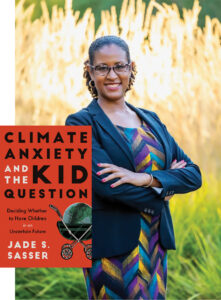
Jade S. Sasser ’97 (Photo by Matthew Reiter Photography)

These choices are not evenly distributed among young people, notes Jade Sasser ’97, an associate professor of gender and sexuality studies at University of California, Riverside. Surveys by the Yale Center for Climate Communications consistently find that people of color experience more emotional distress—and suffer from more clinically diagnosable mental health issues—due to climate change. Their fertility decisions are also more likely to reflect that experience. In a 2020 survey, 41 percent of Latino respondents and 30 percent of Black respondents cited climate change as a factor in why they did not have children, compared to 21 percent of white respondents.

This trend was compelling enough to inspire Sasser to write a book about it. Climate Anxiety and the Kid Question explores younger generations’ fear and grief around the climate emergency, the ways that people of color are disproportionately impacted, and the reproductive decisions that result.

One of Sasser’s more surprising findings was that young people are less fixated on the negative impacts their hypothetical children will have on the planet, than on the negative impacts the planet will have on their children. That is, in previous decades people who cited environmental factors in their fertility decisions were usually considering issues like overpopulation and pollution—how bringing a new human into the world would damage their surroundings. Now, the feeling is that the damage has been done, and the fears focus more on how the consequences will affect quality of life for a new generation.

Many people Sasser interviewed wanted children but felt that subjecting new humans to the potential horrors of climate change felt unethical. “If I had kids amidst a catastrophe like a hurricane, I would be worried every day,” one woman told Sasser. Would she be able to keep them safe?

MORE ‘HUMANE’
To Not Create
MORE HUMANS?

In 1969 Mills College valedictorian Stephanie Mills gave a speech eulogizing the children she felt ethically bound not to have: “I’m terribly saddened by the fact that the most humane thing for me to do is have no children at all,” she told onlookers.

In contrast to many of today’s parental-environmental concerns, women like Mills were concerned about the polluting impact and resource-intensiveness of new babies—the impact their children would have on the environment, rather than the impact the environment would have on their children.

The year before, author Paul Ehrlich had published The Population Bomb, predicting dire effects for a runaway population: pollution, starvation, widespread destruction. The book contributed to widespread anxiety among women like Mills, who felt the best choice they could make was to opt out of motherhood and not add to the problem.

Although climate anxiety and grief are common across race and socioeconomic strata, people of color experience them more strongly due to structural inequities, Sasser says. (In her book, she points to one potent example; a report analyzing FEMA records from 1999 to 2013, which found that 85 percent of post-disaster buyouts went to white families.) “Climate change seems to be a threat multiplier,” she explains, “meaning that the other reasons people have for either not wanting children or being ambivalent are compounded by emotional responses to climate change—and that’s worse for young people from marginalized communities.”

Factor 4: The parenting happiness gap

One hot take you won’t hear on Oprah: American parents seem to consistently report feeling less happy than people without children. (Specifically, 12.7 percent less happy, according to a 2016 meta-analysis of adults across 22 countries.) Heffington says that, in the U.S. at least, there is no kind of parent—new parents in the thick of it, empty nesters, step-parents—that is, on average, happier than people without children.

The so-called “happiness gap” is particularly acute for women, which Sigala and others attribute to the true emotional weight of motherhood and the opportunities young women give up by having children. Since full-time child care can often cost as much as a professional woman earns, Sigala says that women around her often feel the “pernicious, intractable” pressure to step away from work and care for their children or families. “You can see how it starts to pile up, and before you know it, women are hugely disadvantaged in their professional lives and their ability to have strength and freedom,” she says.

Still, data from Europe suggests that, while raising children is challenging everywhere, the kids themselves are not the problem. In a meta-analysis, researchers found that in countries such as France, Finland, Norway and Sweden, the gap disappears or is even reversed, with parents reporting that they are happier than non-parents by up to 8 percent. Their results showed that a few simple factors make this paradigm possible: vacation time, parental leave, sick leave, and affordable or free child care. “It doesn’t require massive infrastructure,” Heffington says. “Just dialing down some of the pressure American parents experience could make a huge difference.”

GET THEE TO A NUNNERY

In 1869 Arabella Mansfield was the first woman to pass the bar to become a lawyer. This milestone was a sign of a larger trend: women gaining better access to education and entering the workforce in increasing numbers.

In response, starting around 1900, both private companies and government entities began instituting “marriage bars” that banned married women from the workplace. These bans, which stemmed in part from racist fears around a plunging white birth rate, were common in industries such as insurance, publishing and banking, but in some cases were implemented statewide. A 1935 Wisconsin resolution called working married women “a calling card for disintegration of family life.”
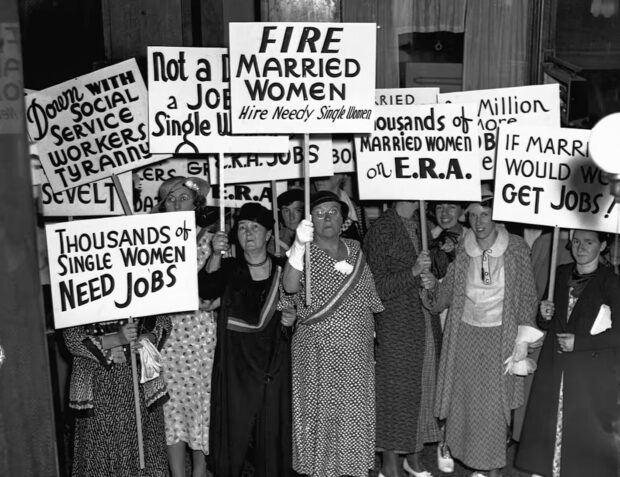
Single women picketing a relief headquarters in Boston, 1935 (Bettmann Archive)

Heffington says that marriage bars were intended to force women to go back to domestic spaces after they got married, which is “often exactly what they did.” But a growing number chose instead to delay marriage or opt out of family life altogether—either to pursue their professional priorities or because they could not afford the economic costs of ceasing work.


Factor 5: Losing the village

In writing her history of non-parenthood, Heffington found that she was actually writing a story about the transformation of the American home, a transition “from something deeply embedded in community structures offering support to the isolated nuclear family.” Although the familiar single-biological-unit structure might seem inevitable from our perspective, work from Pomona professor emerita Helena Wall shows that alternative configurations were flourishing in North America as recently as 400 years ago. “Colonial Americans understood the family only in context of community, with women from throughout a community taking active part in raising children,” Heffington explains. “They spent their whole lives passing in and out of each other’s houses.”

But during the 19th century, a major demographic shift found young people flocking from rural to urban areas for factory jobs—away from those support systems and toward the smaller, suburbanized nuclear family so typical today. Heffington sees today’s millennial experience as an extension of that shift. “We’ve replaced community support structures with ones you have to pay for, with relatively predictable results in terms of fertility,” she says.

Indeed, the loss of the proverbial “village” it once took to raise a child is significantly impacting younger generations’ parental reluctance. For example, while a network of relatives and neighbors watched over Sigala during her childhood, as a young adult she lived in a succession of different cities, each time starting anew and alone. “When my friends have grandparents around to take the kids, even one day per week, I’m very envious,” she says. And babysitting neighbors? As extinct as the dinos and the dodos.

Magoon Pearson also struggled with a lack of support after her oldest child’s academic troubles led her to homeschooling; not long after, the pandemic found her at home teaching all four children. “By the end of that year, I just couldn’t do it anymore,’” she remembers. Continued changes to parenting norms only intensified the difficulty. During her own childhood, she often spent time independently at friends’ houses or birthday parties. “It wasn’t like parents were expected to be everywhere all the time, doing everything their kids were doing,” she says. “Now, you kind of are, so you never get a break.”

Missing Community

One of Heffington’s favorite historical examples of non-motherhood comes from French Colonial Canada. Birth records from the 16th and 17th centuries tell a powerful story about the importance of community support in parenting. Demographers studying the era noticed that the farther a woman moved from her mother, the fewer children she was likely to have—up to four fewer children if she lived more than 200 miles away. Those children were also more likely to die early in their lives, while children whose mothers stayed closer to home had better odds of surviving until adulthood.

Heffington sees this pattern as proof of how much impact a woman’s community had on her parenting capacity. “It’s not just about where her mother was but about the community, about how important support networks are for people having kids and for those kids being able to thrive.”

Next steps: should we (population) panic?

Since President Trump started his second term, his administration has taken a staunchly pronatalist approach. Vice President JD Vance has spoken disdainfully of “childless cat ladies” while Trump touts $5,000 “baby bonuses” for mothers-to-be.

Sasser interprets it all as part of a larger, politics-driven “population panic”—and one that she treats with a heavy dose of skepticism.

Indeed, while Magoon Pearson feels some anxiety when she considers a future with fewer children—what will happen to Social Security? Will there be enough young people to keep the gears of society moving?—she rejects the idea that the childfree are inherently selfish, citing family and friends who instead spend their time on other meaningful endeavors. With four children’s lives to manage, and so many places where the world needs help or healing, “I’m bogged down with this anxiety that I’m not doing enough, stuck at home,” she says. “Thank goodness there’s people out there with the time and energy I don’t have!”

Sasser, Heffington and others argue that any supposed population crisis is at best overblown, and at worst manufactured. While some East Asian countries are indeed seeing small towns depopulating and villages with no children, the U.S. has “the privilege of being a place where people want to come to raise their families,” Heffington says.

Zooming out, the larger context is that fertility rates tend to reliably settle under 2 across time and cultures as women get more access to education, contraception and professional opportunities.

Heffington suggests that policymakers could look to the European countries with happier parents for a model of how to make parenting healthier. France and Sweden, for example, have built infrastructures conducive to parenting that include paid and extended maternity leave, prenatal care, free child health care and subsidized daycare. “If you’re forcing women to choose—whether it’s because of professional ambition or economic survival—some are going to choose not to have kids,” Heffington says. “If you make it easier for them to have both, they’re going to have both.”

Alternative Paths

Although they might not have explained their choices in so many words, medieval nuns have their own unique role in the history of non-motherhood. Heffington says that medieval biographies of saints showed these women to be “very clear from a very young age that they do not want to be wives or mothers, and [that] the path they choose is the only other option available to them.”

At that time, girls from good families would have been married off in their teens or younger, with the expectation that they begin birthing heirs soon after. But the convent offered an alternative, respectable path, where teaching and serving God was just as valuable as marriage and family. Many engaged in scholarship and mentorship, and became advisors to kings or emperors.

Their biographies portray this as a valid choice to “spend their time doing other things,” Heffington says. “Some of these women built lives that were clearly very rewarding—and didn’t include motherhood.”

The Kids Are All Right … With Their Feelings

The Kids Are All Right … With Their Feelings

The Kids Are All Right … With Their Feelings

The numbers tell a sobering story. According to the Centers for Disease Control and Prevention, for 10- to 24-year-olds—a hefty chunk of Gen Z— suicide is the second leading cause of death and has increased more than 50 percent since 2000. Across a range of psychological surveys Gen Z often is found to be the loneliest, most anxious, depressed and heavily medicated generation ever.

Many mental health professionals call it a crisis—but perhaps there is also a crisis of perception.

Gen Z folks—and, to some extent, their millennial elders—have often been slapped with disparaging labels like “the Anxious Generation,” “the Therapist Generation” or even “the Snowflake Generation.” While no one can contest the heartbreaking stats on suicide, loneliness and depression, another thing that can’t be dismissed is Gen Z’s ability to adapt to adversity. They report being sadder, but—based on conversations with several mental health professionals in the field—in many ways they are also braver.

We recently spoke to three experts on the topic:

  • Pomona College Assistant Vice President for Student Affairs and Dean of Students for Academic and Personal Success Tracy Arwari
  • Crisis Systems Medical Director at King County, Washington Dr. Matthew L. Goldman ’08
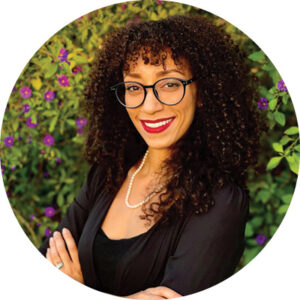
  • Licensed Clinical Social Worker and Clinical Director Jasmine Lamitte ’08 (below), author of The Black Mental Health Workbook: Break the Stigma, Find Space for Reflection, and Reclaim Self-Care

Today’s young adults have had more than their fair share of battle wounds. They were a key casualty of COVID-19, both in actual deaths—approximately 15 million worldwide—and in the wrap-around effects of the pandemic on their mental health. When some of your most formative years are spent communicating via screens, the consequences are sharply felt.

“Psychosocial development was basically stalled for a period of time for a lot of kids,” says Goldman. “The increased use of services, and increased suicidality among youth, suggests that COVID was absolutely a catalyst for worsening the youth mental health crisis.”

Jasmine Lamitte ’08

Jasmine Lamitte ’08, author of The Black Mental Health Workbook: Break the Stigma, Find Space for Reflection, and Reclaim Self-Care

Lamitte agrees, pointing specifically to something she noticed when schools reopened: Young people who had isolated at home had missed key developmental milestones, leading to behavioral challenges and a huge uptick in both social and generalized anxiety.

The social isolation may be exacerbated by increased digital connection. Social media and digital connectivity certainly have their benefits in increasing awareness of challenges that other young people might be going through.

Although Lamitte is encouraged by Gen Z’s growing comfort talking about mental health, she says that platforms such as TikTok have rampant misinformation that can lead users to self-diagnose and feel like they can handle things on their own without therapy.

Tracy Arwari

Pomona College Assistant Vice President for Student Affairs and Dean of Students for Academic and Personal Success Tracy Arwari

Arwari says that help-seeking behavior has become much more ubiquitous on campus in recent years, which she attributes to Pomona’s own proactive efforts toward outreach and prevention, as well as a larger societal trend toward being open around mental health and self-care.

“Ten or 15 years ago, you did your best to tread water on your own and you had to have quiet faith that this, too, would pass,” she says.

Experts see a greater willingness among Gen Z to seek therapy earlier and more consistently, versus waiting until things get intensely challenging.

“With my generation, the process started in college or after,” says Lamitte. “Now kids are coming out in high school and exploring trauma they’ve experienced, to not necessarily carry that burden by themselves.”

While some label Gen Z as “the Therapist Generation” with disdain, Goldman considers it a net positive that there’s been such a banishment of stigma, which translates to prioritization of funding for mental health services, not to mention greater receptivity to treatment and more engagement in the healing process.

Lamitte adds that younger generations are increasingly open to exploring different modalities that they may have first encountered on social media, including mindfulness meditation and “Eye Movement Desensitization and Reprocessing.”

Illustration by Liz Fosslien ’09

The experts argue that Gen Z has gotten increasingly comfortable being vulnerable about everything from anxiety to past trauma.

New Models of Care: What Systems Need to Catch Up

If the youth have caught up with the times, the systems unfortunately have not. Goldman says that the greatest barriers to care are the lack of services plus access. It’s a bind: there aren’t enough youth mental health services in general, much less ones that insurance will pay for. Complicating an already knotty situation is that pediatricians are often the ones prescribing medications for youth, without extra training in mental health or psychiatry.

“They’re doing their best and want to help, but often end up using the tools that they have at their disposal, like medications,” says Goldman. “There is plenty of data showing overprescription of psychiatric meds among kids.”

While many kids absolutely need the meds, data suggests widespread overprescription of antipsychotic medication that’s especially acute for children who are Black, Indigenous and People of Color (BIPOC), including boys who are involved in a juvenile justice or foster care system. Goldman says that this form of “diagnostic overshadowing”—in which BIPOC folks are more likely to be diagnosed with a psychotic disorder or more serious mental illness—often can mask other diagnoses such as trauma or complex trauma.

Concern regarding mental health among youth in general is appropriately high. In King County, where Goldman serves as medical director for its crisis systems, there will soon be a 24-7 youth crisis facility with both urgent care and higher acuity units.

Given that dedicated behavioral health facilities tend to be much more effective at crisis care than in emergency departments or general hospitals, Goldman hopes that policymakers nationwide see the need to cover the gaps in care and support these crisis stabilization services. He cites Washington state’s requirement for commercial payment, which creates alternatives to sitting in an emergency room for hours or days waiting to be seen, or getting involved in a criminal legal system where people end up unnecessarily incarcerated.

Goldman says it’s also critical to have an outpatient system that can receive people in the aftermath of a crisis. Post-crisis follow-up resources tend to be quite limited. Someone may receive good care during the crisis, but then face a lot of post-discharge barriers to being able to access ongoing support to prevent future relapse.

“There’s a risk of them falling through the cracks again,” says Goldman.

To mitigate that risk, King County is investing in post-crisis follow-up services that are dedicated to the aftermath of a crisis, so that anyone who comes through the crisis centers has access to ongoing care. It’s based on one of the leading national models for youth crisis response, Mobile Response and Stabilization Services, or MRSS, a youth-specific model that comes from Connecticut; it is a field-based, community-based crisis response.

“Your anxiety or despair may sometimes be so overwhelming that you can’t see anything else. But it won’t be like that forever. There can still be lighter times ahead.” —Liz

If a young person or a parent calls into a crisis hotline like 988 or other local hotlines or a teen-specific hotline, and the call taker is concerned that the level of the crisis is more acute or severe than what can be handled on the phone, then they might dispatch a mobile response-type resource. While a lot of places have a general mobile crisis response that serves both adults and youth, the gold standard model is to have dedicated youth-specialized mobile teams, Goldman says.

“They’ll do the initial mobile response, but then they’ll also continue to support that child for six to eight to even up to 12 weeks after the initial mobile response,” he says. “And the idea is that it’s the team that does the initial mobile response that makes that initial bond with both the child and their family and then can continue to support them for that extended period.”

Sometimes that’s all that you need, Goldman says. Long-term outpatient or any other kind of community support isn’t always necessary because if it’s a crisis that’s related to something situational or circumstantial—bereavement, some event that happens—then youth can eventually do really well.

What Gives Us Hope

Gen Z’s crisis overwhelms, but there is hope rising nonetheless. For Lamitte, it’s their early pursuit of healing. For Goldman, it’s young people’s openness and receptivity. And for Arwari, it’s Gen Z’s commitment to kindness, camaraderie and advocacy.

“There is a lot in this world that can feel like doom and gloom at every turn,” she says. “But the thing that gives me hope is witnessing the way that students will hold each other up [and make] a rooted good faith effort to be kind to one another. The kids are all right.”

“It’s easy to equate success with visible achievements like a promotion or a new job. But it’s important to acknowledge and celebrate all growth, especially when it comes to mental health and well-being.” —Liz

SageChat Across Generations

SageChat Across Generations thumbnail

We asked the same set of questions to 3 individual alums from 55, 30 and 5 years ago, as well as 4 couples across multiple generations. Ahead, our super-scientific results.


How did you meet?
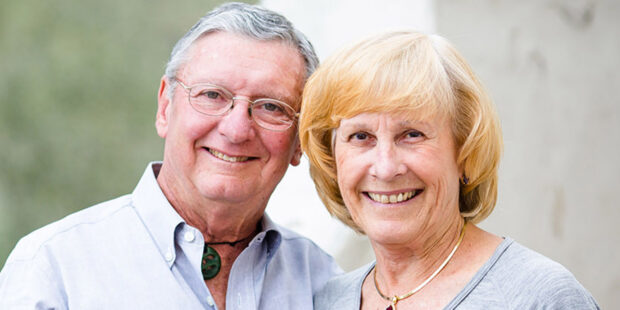
Larry Hauser ’64 and Barbara Hauser ’65: We met in 1962-1963 at a “Served Dinner” at Frary Dining Hall, where a vigorous courtship ensued with lots of coffee dates that had to be completed by the 10 p.m. curfew.

Classes of 1964 & 1965

Larry Hauser ’64 and Barbara Hauser ’65 Larry Hauser ’64 and Barbara Hauser ’65
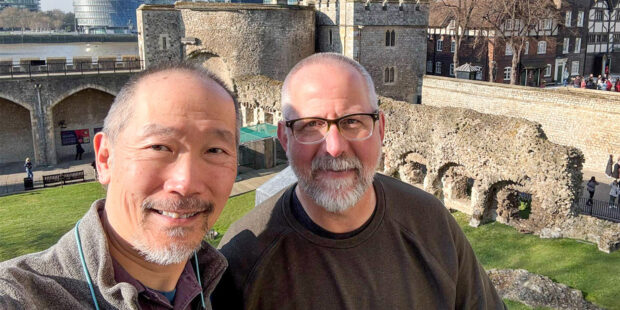
Richard Bookwaiter ’82 and Galen Leung ’82:
We met as first-years when we were both elected to the Freshman Dorm Council representing Oldenborg and Walker, respectively.
Rob Ricketts ’97 and Karla Romero ’97:
We met in January 1996 in Harwood Basement. Rob was a transfer student, and Karla was his assigned sponsor.
Kai Fukutaki ’17 and Sameen Boparai ’17:
While we first met during Orientation Adventure in Sequoia, we didn’t start hanging out until we crossed paths in the social dance clubs, including ballroom dance.


What is your favorite Pomona College
memory together?

Hauser and Hauser: Our “Pinning Ceremony”—the entire Zeta Chi Sigma Fraternity marched down to South Campus and sang a romantic serenade at Mudd-Blaisdell, marking the start of our lifelong journey together.
Bookwaiter and Leung: After the “Survivors’ Party” for students who had made it through the fall, we were the only two who showed up on the cleaning committee.

Class of 1982

Richard Bookwaiter ’82 and Galen Leung ’82 Richard Bookwaiter ’82 and Galen Leung ’82
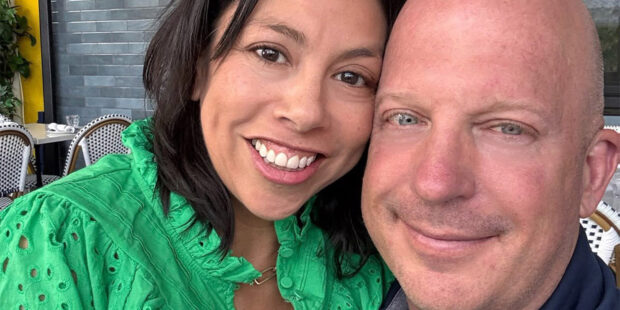
Ricketts and Romero: Harwood Halloween, where we saw a relevantly unknown opening act called the Black Eyed Peas.
Fukutaki and Boparai: During senior week in San Diego, we put our liberal arts degrees to good use: we won pub trivia, sang karaoke and had our ecology friends help us identify tide pool creatures!


How long have you been together?

Hauser and Hauser: Married 60 years! We just attended Barbara’s 60th Pomona reunion and are forever bonded to this beautiful campus with all of its memories.

Bookwaiter and Leung: 34 years! By the end of our senior year we knew we wanted to be together. We married in August 2008.

Ricketts and Romero: We’ve been together since May 1996, with one brief intermission in 1998-99. We found our way back to each other, and have been inseparable ever since.

Class of 1997

Karla Romero ’97 and Rob Ricketts ’97 Karla Romero ’97 and Rob Ricketts ’97

Fukutaki and Boparai: 9 years! We immediately had to do two years of long-distance after college but fortunately both ended up in Seattle for graduate school.


What is your secret to a successful relationship?

Hauser and Hauser: Patience, optimism and a sense of firm commitment. Per philosopher Brian Andreas: “I’m deciding everything is falling into place perfectly, as long as you don’t get too picky about what you mean by ‘place’. Or ‘perfectly.’”

Bookwaiter and Leung: Our relationship has lasted over 34 years because we are able to communicate with each other.

Ricketts and Romero: Relationships aren’t about being right—they’re about growing together. Also, we laugh a lot. Humor keeps things light even when things get heavy. We don’t agree on everything or spend every waking moment together, but we consistently show up for one another.

Fukutaki and Boparai: Cultivating healthy communities has helped us feel fulfilled and supported so that we don’t depend solely on each other. Staying curious and always learning new things, together and apart, keeps us excited about the world—and each other.

Class of 2017

Kai Fukutaki ’17 and Sameen Boparai ’17 Kai Fukutaki ’17 and Sameen Boparai ’17

What is your fondest memory of Pomona?
Blair: Groups of us would get tickets to classical concerts in Big Bridges, where we’d see Arthur Rubinstein, Van Cliburn, Christopher Parkening and the Romeros, among many others.
Trupin: I think a lot about the freshman seminar, the intramural sports and, of course, both the good friends and the meaningful conversations I had all the time there.

Addo-Ashong: I don’t think I could truly narrow down to just one memory—I look back at dozens of moments spent with my friends and laugh all the time.


Where did you and your friends hang out?

Blair: I developed some of my longer-lasting friendships when I lived in Oldenborg for two years. We hung out in the language lounge for the Russian and Chinese students. I was studying Russian. We studied, we partied and had a great time there.

Class of 1970

Tina Blair ’70 Tina Blair ’70

Trupin: We attempted to study at pools, a lot. Somehow I still passed my classes. We ate a lot of fried food and shakes at the Coop. And we ventured to parties on whatever campus was hosting one.
Addo-Ashong: I could guarantee that you’d see me and my friends in Frary at some point, especially for Snack. My Sontag suite was also a glorified community center my senior year with the number of people that were in and out every day.


The career path you first envisioned in college—is that what you’re doing now?

Blair: I fell in love with the fields of anthropology and education. As a result, I studied at Stanford and received an MA in Education. Although later I studied theology, was ordained a Presbyterian minister and received a Ph.D. from the Claremont School of Theology, I was always using what I had learned at Pomona.

Trupin: I majored in American Studies, so I wouldn’t say I had a planned career path. But I did get to spend a lot of time focusing on youth homelessness at Pomona, including a Watson Fellowship in Latin America. I still work on that today, so the answer, I guess, is yes!

Class of 1995

Casey Trupin ’95 Casey Trupin ’95

Addo-Ashong: I didn’t have one career path clearly laid out, but my current job working in data analysis and research for litigation is a good mix of my public policy analysis and math background. My next steps are to apply for a master’s in similar fields, so in that sense, I think I’m following what I set out to do!


What do you wish you’d known before you came to Pomona?

Blair: I felt instantly at home at Pomona because of the many new students who, like me, had lived outside the United States. I was embarrassed, however, that I had not yet heard of Jefferson Airplane and their music.

Trupin: This is a rare four-year opportunity that you’ll never get again, and you should take advantage of all it has to offer during your time there. A lot of us would come back for another year if we could.

Addo-Ashong: I wish I’d known that the pluses and minuses on grades do in fact affect your GPA, because that was a very rude awakening my freshman fall!

Class of 2020

Victoria Marie Addo-Ashong ’20 Victoria Marie Addo-Ashong ’20


What was your favorite dining-hall food?

Blair: I have little memories of the food. It was better in Oldenborg than elsewhere.

Trupin: Fried mozzarella sticks at the Coop. In the dining hall, maybe the omelet bar—how nice it would be to have that in my house now!

Addo-Ashong: My usual breakfast omelet and avocado toast, maybe the tomato/burrata, and balsamic sandwiches and the oatmeal craisin cookies!


What was the best book you read during your Pomona years?

Blair: A book that over the long term shaped me the most was Mysticism, by Evelyn Underhill. I read it for a course I took at Pitzer; we also read Tillich and William James.

Trupin: In the Name of Eugenics by Daniel Kevles stuck with me and stays relevant today as a frightening and helpful exploration of using science to justify racism and every type of discrimination.

Addo-Ashong: I don’t know how many books I read for fun , but I really enjoyed American Hookup by Lisa Wade!


What was your favorite band while you were in college?

Blair: The Beatles, then Jefferson Airplane and the Doors.

Trupin: I have fond memories of seeing No Doubt perform in my dorm. They weren’t my favorite band, and I think my glasses fell into the mosh pit and got crushed, but it still stands out.

Addo-Ashong: I’d say favorite actual band was Glass Animals, and individuals were SZA and Childish Gambino.


What was the first electronic device you ever owned?

Blair: I got my first computer in 1986, when I was working on my Ph.D. dissertation.

Trupin: My roommate and I had a combo tape/record/CD player that I think was the size of half of one of our walls.

Addo-Ashong: My Game Boy Advance.