Blog Articles

Sea Chanties

Professor of Music Gibb Schreffler (right) and class aboard the Exy Johnson. Photo by Lushia Anson ’19

Professor of Music Gibb Schreffler (right) and class aboard the Exy Johnson. Photo by Lushia Anson ’19

TO HELP HIS students get on board with one of his chief research interests, Music Professor Gibb Schreffler got them out of the classroom and out to sea.

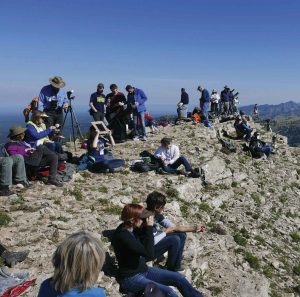
On a breezy spring afternoon, aboard the two-masted sailing vessel Exy Johnson in Los Angeles’ San Pedro Bay, Ranzo—Schreffler’s chantyman alter ego—led a group of Pomona and Claremont Colleges students in singing “Goodbye, My Riley” and “Tom’s Gone a Hilo,” traditional work songs known as “sea chanties.” Adding the physical labor and rhythm of pulling halyard lines gave the students a sense of how chanty singing once fit into the work of the crew on a traditional sailing vessel. As the hoists grew more difficult toward the end of the lines, the chanty leader shifted to a “short drag” chanty such as “Haul Away, Joe” and “Haul the Bowline” to reflect the cadence of a more demanding physical effort.

The half-day sailing field trip was part of Schreffler’s special topics course, American Maritime Musical Worlds, where his class explored America’s musical development from the perspective of those who have lived or worked near the water. The goal was to better understand the context and function of the shipboard work songs prevalent in the 19th century.

According to Schreffler, the topic of American maritime music is not well-documented or researched. His scholarship focuses on the musical experiences of African Americans, and his findings place the tradition of sea chanties within the larger umbrella of African American work songs. The epicenter of the chanty genre, he explains, was not Great Britain but America—or, more precisely, the western side of the “Black Atlantic,” rimmed by Southern U.S. ports and the Caribbean.

Schreffler’s research also found that chanty singing by sailors at sea represented just one branch of a larger network of work-singing practices, most of which were performed on terra firma. In fact, far more chanties were sung by stevedores—the workers loading ships—than were ever sung by sailors. Sailors’ labor tended to be associated with white workers, and stevedores’ labor was associated with Black workers—which partly explains the neglect of the latter’s story in ethnocentric narratives told by English and Anglo-American authors of the last century.

Schreffler’s research has been challenging, in part, because much of what has been presented in the last century has created a strong bias against recognizing African Americans as creators of the sea chanty genre. His published work on the subject includes the article “Twentieth Century Editors and the Re-envisioning of Chanties,” in the maritime studies journal The Nautilus.

His research takes him to archives and ports in cities around the country that were centers of maritime commerce, such as Mobile, Alabama, and Galveston, Texas. He also has traveled internationally in a traditional sailing ship from the Azores, in the middle of the Atlantic, to the coast of France, to study applied seamanship in order to better understand the historical texts he studies.

Since the maritime work songs Schreffler studies are not used in today’s sailing, recreating their performance helps him imagine them and find answers, despite the lack of detailed information available. Since 2008 he has been working on posting online his renditions of every documented chanty song he has encountered. His purpose for the recordings is to simulate psychologically the process of acquiring a repertoire and learning the genre’s method and style.

“Scholars in my field, ethnomusicology, traditionally employ fieldwork to interpret living culture as ‘text,’” he explains. “In order to study culture of the past in this fashion, I try to convert history into a sort of living text in the present.”

Last spring was his first time teaching the course, but Schreffler previously brought chanties to Pomona College and The Claremont Colleges through the Maritime Music Ensemble he founded and directed in 2013. In the ensemble, all songs were taught orally to simulate a realistic way of acquiring the tradition. Students needed no prior formal training and took part in engaging sessions of rehearsals or jam sessions as well as performances.

Experiencing music in order to understand it is at the core of Schreffler’s teaching and research. Also a scholar of the vernacular music of South Asia’s Punjab region, he learned to play the large drum known as the dhol. “Without my doing this, many of my interlocutors would have had no idea how to relate to what I was doing in studying Punjabi music,” he says.

Schreffler has plans to return to his Punjabi research and work on a forthcoming book during his upcoming sabbatical year. In addition, he headed to the Caribbean during the past summer to get reacquainted with the Jamaican music scene in order to prepare his next spring course. Among the topics he will explore in that class, he says, is the connection of Jamaican music to the beginnings of hip hop and electronic music.

“Some of my students are very interested in producing or becoming DJs, so this course could be of special interest to them, given the connection to the origin of hip hop and dance music.

“My goal with this class, as in all of my classes, is to give them information and lively discussion that will challenge them about something that is related to a topic they’re interested in to begin with. I don’t necessarily tell them that it is related, but I drive them to make the connection. Once they see the connection, it transforms their learning about the original topic of the class.”

How I Spent My Summer Vacation

AS SUMMER CAME to a close, many Pomona students returned to campus with new career experiences, thanks to internships across the country and around the globe. Through the Pomona College Internship Program (PCIP), 68 students received funding to participate in work opportunities that would otherwise be unpaid, while others found paid internships that also allowed them to live in new cities and gain new experiences. Here are six of their stories.


Marisol Diaz ’18Marisol Diaz ’18

Major: American Studies

Internship: Legislative intern with California Assemblywoman Cristina Garcia ’99

Location: Sacramento, California

“Interacting with staffers in Assemblymember Cristina Garcia’s office has been great. She has such a wonderful team of people; specifically, in her office, there are a lot of women and women of color. It’s very encouraging to me, and it’s very important in shaping my experience to be surrounded by women.”


Jacob Feord ’18Jacob Feord ’18

Double Major: Economics and Japanese Language and Literature

Internship: Intern with the United States Department of State at U.S. Embassy Tokyo-Akasaka

Location: Tokyo, Japan

“A U.S. government institution managed by Americans, located in Tokyo and staffed largely by Japanese local staff makes for a very unique workplace culture. The mixture of languages and business ideologies is a concoction absolutely unique to the U.S. Embassy in Tokyo. At first it seemed difficult to navigate, but I ended up having a lot of fun getting to know the quirks of the embassy system.”


Pablo Ordoñez ’18Pablo Ordoñez ’18

Major: Public Policy Analysis

Internship: Policy intern with the United States

Department of Commerce Census Bureau

Location: Washington, D.C.

“Everyone has this big misconception about the government: It’s a very slow, monotonous, perfunctory place. But like any company, it has a CEO and high-level executives, meetings, people very connected to the mission of the bureau—and that’s helpful to me for any industry I’ll go into. Government could be slow and inefficient, but there are people there who are very committed to the work they are doing who have extremely innovative ideas.”


Carly Grimes ’18Carly Grimes ’18

Double Major: Cognitive Science and Politics

Internship: Intern with the Yale University Canine Cognition Center

Location: New Haven, Conn.

“My favorite part of this internship was interacting with the dog’s owners, since I love communicating science research to the general public. The owners were always very interested and would ask great questions that sharpened my ability to make complex scientific theories more easily digestible for people with vastly varying scientific backgrounds.”


Carly Grimes ’18Sylvia Gitonga ’20

Major: Economics

Internship: Investment analyst intern with the East African Reinsurance Company

Location: Nairobi, Kenya

“I learned how to establish and maintain relationships not only with clients but also with the company’s employees. I also became more vocal and confident in terms of presenting ideas to people. Although I secured this internship by myself, the one-on-one meetings with Wanda Gibson in the Career Development Office, with regard to my career path, really played a huge role in acquiring the internship. The PCIP funding, however, is what really enabled me to carry out this internship. If not for that, my career growth would be stagnant. ”


Samuel Kelly ’18Samuel Kelly ’18

Major: Media Studies

Internship: Intern with The Daily Show with Trevor Noah

Location: New York City

“I’d say one of the biggest things I’ve learned at this internship is the level of professionalism necessary to make a massive production like The Daily Show operate smoothly and at a high level. It takes a lot of people to get The Daily Show on the air every night, and I’m always impressed at how everyone in the office knows exactly what they need to do to make it successful.”


Roads Less Traveled

Bryan Kevan ’14 at the Mirador Cuesta del Diablo, just off the Portezuelo Ibañez, the highest pass on the Carretera, in 2014.

Bryan Kevan ’14 at the Mirador Cuesta del Diablo, just off the Portezuelo Ibañez, the highest pass on the Carretera, in 2014.

IF A ROAD can be a political statement, then the Carretera Austral—stretching 1,200 kilometers, the majority of the length of Chilean Patagonia—is just that. Started under the dictatorship of Augusto Pinochet in the 1970s, it checked all the boxes for a military dictator seeking to exert political and economic control over the country’s most remote and inaccessible territory.

Many of the towns along the road had previously been connected to the outside world only through towns across the border in Argentina, a dependence that Pinochet sought to eliminate. Snaking around narrow fjords, over high mountain passes and through dense, seemingly impenetrable forests, the road was a symbolic statement that not even nature could stop Chile from policing its borders. The road unofficially carried Pinochet’s name for years, an indication of its strategic military importance in the historically poor relationship between Chile and its neighbor to the east.

As Pinochet’s reign continued, so did construction of the Carretera Austral. Over decades, the road inched farther and farther into the Patagonian wilderness. Signs along the road still carry a Ministry of Public Works slogan harkening back to the road’s original political significance: “Obras que Unen Chilenos” (“Works That Unite Chileans”).

The spirit of the Carretera Austral remains, embedded in a thin ribbon of gravel road connecting Chilean Patagonia to the rest of the country. In 2000, workers finally reached their limit, a dead end at the town of Villa O’Higgins. The terrain was just too rough after that point, and the territory too remote. With no more towns, the Carretera Austral had reached its terminus. Two small border crossings into Argentina, complete with posts and military barracks, were constructed at the end of the road, neither passable by car.

When I graduated from Pomona in 2014, my mom told me to go out and take a new risk. Confined to the Pomona bubble for four years, and to the bubble of small Eugene, Oregon, for my life before that, I was hungry for something different. Something new, challenging and, most importantly, something not academic. I didn’t, and still deep down don’t, consider myself particularly athletic or adven- turous. I ran cross-country in high school, but not particularly well. I enjoyed hiking and camping, but it was clear at least to me that I didn’t share the single-minded passion for it that many of my classmates had. I replied to my mom over text with a picture of a motorcycle, and she responded with a picture of a bicycle. It was decided.

So I packed up the things I thought I would need for a few weeks on the road, never having camped for more than a handful of nights in a row, and set off to Patagonia. Everyone on the Internet’s various bike-touring forums raved about this gravel road in Chile, and I felt like I just had to do it. I didn’t expect to make it far. Maybe go out for a week or two, have a fun experience and then come back.

I quickly realized upon my arrival that I had timed it all wrong. It was September, very early spring in Patagonia, and most towns, campsites, hostels and even some border crossings into Argentina were still closed. It rained pretty much constantly for the first two weeks of my trip, and the state of the road left my body broken and bruised every night from hour upon hour of riding on rocky, muddy gravel.

My tent was hardly waterproof, my rain jacket even less so. For a road that was supposed to be so popular with touring cyclists, it was surprisingly little-traveled; I finally saw another cyclist after a month. It was a struggle. I learned to live with myself, camped alone for weeks in the middle of nowhere. But it was exciting, it was new, and I loved every second of it.

Kevan sitting on a marker identifying the peak of the Tizi n’Isli Pass while riding along the spine of the Atlas Mountains in Morocco in 2017.

Kevan sitting on a marker identifying the peak of the Tizi n’Isli Pass while riding along the spine of the Atlas Mountains in Morocco in 2017.

At Villa O’Higgins, a month into my trip, I reached the dead end, and the two roadless border crossings, only one of which was open during that season. The Chilean post was unassuming, to say the least—just two small buildings and a helipad at the dead end of a rough gravel road. Three policemen manned the post, sitting around a fireplace stamping passports and making snide remarks about the Argentines 15 kilometers away. I stayed the night in the barracks next to a nice, warm fire and stamped out of Chile the next morning. Between passport stamps, it took 14 hours of navigating the roadless swamp of backwoods Patagonia to reach Argentina. I cursed and yelled my way through dense forests, over swinging sheep bridges, through bogs and through glacial streams, all on the very imprecise directions received from a very inebriated gaucho living on the border.

I eventually found a road that led to the Argentine border post. As I stumbled out of the wilderness, a policeman came out to meet me, clearly concerned for my safety. I was quickly stamped into the country and shown where to set up camp.

In a poetic turn, I experienced the same thing at the Argentine border as I had at the Chilean one, but in reverse—just three policemen stamping passports and making snide remarks about Chileans. After the decades of antagonistic relations and political symbolism that surrounded the road’s construction, all that remained at road’s end was a remote border crossing, a few half-rotted military barracks and a handful of policemen taking half-hearted verbal shots at one another across the border.

I was sold. These were the genuine travel experiences I wanted in my life. I continued my trip, eventually ending up in Tierra del Fuego, at the tip of South America. More trips soon followed—Southeast Asia, the Pacific Northwest, Iceland, and Morocco, all since graduation.

I am now in the planning stages for a trip spanning the entirety of the Silk Road across Central Asia, starting in 2018. I encourage interested readers to follow along at my blog starting next March at venturesadventures.wordpress.com.”

Life and Death in the D-Pod

Kare Toles '07
Kara Toles ’07 makes her morning rounds in the D-Pod.

Kara Toles ’07 makes her morning rounds in the D-Pod.

6 a.m.

At this hour, as at every hour, the D-Pod bustles beneath the round-the-clock glow of the hallway strip-lights. Attending physician Kara Toles ’07 has just begun her shift in the Emergency Department of the UC Davis Medical Center (UCDMC), and for the moment, both the outgoing and incoming teams are jammed together inside the tiny, walk-through office known as the “Doc Box,” a space about the size of a janitor’s closet. As they work their way through the customary hand-off, their terse exchanges are studded with terms like “angioedema” and “metabolic encephalopathy.” Toles quickly takes charge, quizzing the three young residents and one visiting medical student who will make up her team for the day.

Toles observes preparations in a trauma room.

Toles observes preparations in a trauma room.

Once the hand-off is complete, Toles loses no time in setting out for her first tour of the surrounding hallways. As she speed-walks, print-out in hand, she pokes her head through each set of curtains to introduce herself, greeting each patient by name. The important thing, she explains, is to get a firsthand sense of which patients can wait and which need immediate care. “The first thing we’re trained to do with a patient is say, ‘What do I see, hear and smell? In medicine, and especially in emergency medicine, we have to use all of our senses, picking up cues. Just standing outside of a room, you can tell a lot about a person’s airway, breathing and circulation—the ABCs—just from looking at them.”

Today, most of the cases seem to be fairly routine, but one catches her eye—a man suffering from a severely swollen lip and chin. She speaks with him for a few minutes before moving on. “That can go downhill really fast,” she remarks as she hurries back to the Doc Box. “We need to take it very seriously.”

Welcome to the D-Pod. That’s D as in disease, disaster and death. It’s what they call the section of the ER that handles the patients Toles describes as “really sick”—that is, dealing with potentially life-threatening conditions. Today, their immediate welfare and, possibly, their ultimate survival will depend on how well Toles and her team do their jobs.


THERE’S A CERTAIN irony in Toles’s decision to specialize in emergency medicine. Back in 2005, as a junior at Pomona, struggling with the academic workload of a premed student and trying to decide what major to pursue as she followed her childhood dream of becoming a doctor, she was featured in an article in this magazine titled “Stressed,” in which she opened up about the difficulty of dealing with the unrelenting demands of college life. Her first year was so stressful, she said at the time, that “I’m sure I would have transferred if it were not for the support that I got through my sponsors and other peers in my sponsor group.”

Fast-forward—past graduation, past a year off to regroup, past four years of medical school at UC Davis and various rotations as a resident—to her choice of arguably the most stressful of all medical specialties.

Toles makes a teaching point with medical student Samantha Kerns.

Toles makes a teaching point with medical student Samantha Kerns.

“I know,” Toles says with a laugh when reminded of that history. “What does that tell me about myself? I guess I thrive in stressful environments? I feel alive in stressful environments? It’s that degree of stress that makes you get up and do, and not feel paralyzed. And I think that I need some degree of that to feel alive. But then, my baseline is to back off and say, ‘Hoo, all right. I’m going to chill now.’ But every once in a while, I need it to remind myself that I’m alive.”

That balancing act seems to be a lifelong pattern. At Pomona, for instance, she solved her early battle with stress, in part, by choosing a less traditional path into medical school, switching her major from neuroscience to Black Studies because it allowed her to break away from the sciences and spend more time exploring her identity as a Black, queer woman and how to incorporate social justice into her practice as a physician.

“I was able to tap into those other sorts of courses—psychology and art history and music and dance, West African dance, and history of jazz with Bobby Bradford and all these super-cool classes that I wouldn’t have had the opportunity to take if I were doing neuroscience. It was really fun to learn about that stuff, and it kind of helped me have a better understanding of who I was as an African American woman, so it was a pretty awesome experience.”

Today, the pattern continues with Toles’s decision to work part time instead of committing to a full-time position in a hospital ER. “Residency was a lot of people telling me where to go, what to do, and when to do it,” she says. “I’m a very headstrong, independent woman, and so I needed that part of my life back after training. I’m taking a little bit of a pay cut because I’m not signing on somewhere and getting, you know, that salary and benefits package. But I only work around eight to 10 shifts a month, so I have a lot of free time to decompress and tap into things that give me life and make me happy and make me feel fulfilled.”

9 a.m.

Toles checks in again on the patient with the swollen lip and is delighted to learn that the swelling is going down. After counseling him on his daily medications, she returns to the Doc Box and wolfs down a beef stick, a few walnuts and some trail mix to keep her energy level up. “You never know when something’s going to go down, so I just snack and then have a full meal after I get off,” she says.

Toles awaits the arrival of a trauma patient with chief resident Taylor Stayton.

Toles awaits the arrival of a trauma patient with chief resident Taylor Stayton.

With her whole team momentarily present, Toles offers to demonstrate a new technique for resolving a dislocated jaw without having to put fingers inside the patient’s mouth, but as if on cue, events begin to speed up, postponing the demonstration and sending residents scrambling.

First, there’s a new analysis of imaging for a patient suffering from an uncontrollable tic, identifying a potentially deadly subdural hematoma—blood pooling between the skull and the brain. Then a new patient arrives with a badly broken wrist, the result of a skateboard accident. That’s followed by another patient showing troubling signs of gastrointestinal bleeding, and another suffering from weakness in one arm and leg following a traffic accident, and another suffering from a bizarre condition called subcutaneous emphysema, in which air escapes from the lungs into the surrounding tissues, causing strange, crinkly swellings of the chest, throat and face.

In the midst of all that hectic activity, the loudspeaker announces a 911 emergency arriving in five minutes, and Toles and the chief resident drop everything to head for one of the trauma rooms, where they join a growing crowd of attendings, residents, nurses, technicians and students. Pulling disposable plastic gowns over their scrubs and donning gloves and face shields, they join their colleagues inside the red line on the floor that separates participants from observers—and they wait.

A little before 10 a.m., the patient arrives, strapped to a gurney. She’s a disoriented homeless woman with stab wounds to the neck, reportedly self-inflicted. As someone closes the glass doors to the room, she can be heard shouting threats and obscenities at the doctors as they close in to care for her.


IN ADDITION TO broadening her education, Toles’s choice of Black Studies as a major had a significant impact on the kind of doctor she wanted to be. For her major thesis, she studied the relationship between the nation’s medical system and social justice, and the inequities that she saw gave her a new mission in life—caring for people on the margins. That was still on her mind a few years later as she neared the end of her medical training and began to explore specialties.

“At first, I was thinking, ‘How do I marry this idea of social justice and using medicine as a vehicle for social justice?’ And to me, that meant preventive care, and the essence of that is pediatrics, like having conversations with folks about healthy behaviors before they get chronically ill. But then, when I did my peds rotation, I was like, ‘Theoretically, that makes sense, but in practice, I don’t feel engaged, you know? Kids are cute and whatever, but at the end of the day, I’m not excited.’ It just didn’t speak to me. So it was like, ‘Oh bummer. What else am I going to do?’”

The answer came to her, strangely enough, while working up a sweat on a climbing wall.

Toles gets hands-on with a patient in the D-Pod.

Toles gets hands-on with a patient in the D-Pod.

“I met an emergency medicine doctor in the climbing gym,” she says with a laugh. “And he was a really cool guy, really nice guy, an awesome climber, and I knew that he was associated with UC Davis but I wasn’t sure how. We ended up kind of being in the same friend group at the gym, and he told me he was an ER doctor, and I was like, ‘You? You are really cool. You’re out there doing things that I want to do, and I want to be like you.’ And he’s like, ‘You totally should check out emergency medicine.’ And I did, and I fell in love with it.”

Part of that love, she says, has to do with the people she sees in the ER. Many are precisely the kind of people on the margins to whom Toles pledged to devote her career.

“That’s what we do in emergency medicine,” she says. “Whoever walks in the door—it doesn’t matter your race, sexual orientation, gender identity, age, whether or not you have a home—we treat everyone, and that’s one of the powerful things that drove me to emergency medicine and that keeps me there.”

Then too, it appealed to her because it reminded her of what she loved most about college.

“Of all the specialties, emergency medicine is the one that has kind of a liberal arts flavor to it because of the breadth of knowledge that’s required to do this practice,” she says. “I love the fact that I get to see such a breadth of pathology. I think it’s incredibly engaging in one minute to be taking care of a patient who has angioedema, which is the swelling of the lips or the mouth that can be life-threatening, and then I walk out of the room and take care of a critically ill, injured trauma patient. So that switching and the dynamic nature of my job, I just love. It keeps me excited. It’s like stuff that you see on TV.”

12 noon

A crackly voice on the public address system announces, “911 in three minutes,” and as the inhabitants of the Doc Box turn to their computer screens for details, the mood abruptly shifts from laid-back to tense. “This sounds real,” the chief resident says.

As Toles and the chief resident head for the trauma room, all they know for sure is that the patient has suffered a traumatic amputation of his lower left arm in a motor vehicle accident, but they know that an accident of such severity is likely to produce other kinds of trauma as well. As they gown up, they discuss their role in the coming procedure, which will be to establish an airway, if needed.

Despite the three-minute warning, they’re still waiting 20 minutes later, as a crowd of observers gathers around the red line in the room and overflows into the hallway.

Toles makes a point in the Doc Box.

Toles makes a point in the Doc Box.

Finally, EMTs steer a gurney down the long corridor to the trauma room. On it is a male patient in obvious pain. Word spreads that he was driving with his arm outside the window when a guard rail struck him just below the elbow. A few minutes later, two highway patrol officers arrive carrying a cooler. A member of the team removes the severed arm and begins to clean it in hopes of a possible reattachment—an effort that will prove to be in vain.

Later, back in the Doc Box, Toles turns to the residents and asks, for maybe the fourth or fifth time that day, “Okay, what are the learning points from that case?”


“WE CALL IT dropping pearls,” Toles says of the teaching aspect of her job. “Dropping little pearls of knowledge along the way.”

After all, UCDMC is a teaching hospital, and the ER is in many respects a big, high-stakes classroom. The residents and fourth-year students are there to care for patients, but they’re also there to learn through observation and firsthand experience.

“And if they ever get stuck,” Toles adds, “then they know that the attending is there to help them push through that part.”

The chance to gain experience in teaching, she says, is one of her own principal reasons for working here. However, this part-time job at UC Davis is not the only iron Toles has in the fire. She’s also taking shifts back in her hometown of Angleton, Texas, in the ER of the small community hospital where she was born, as well as working in the much tamer environs of an urgent-care center near her home in Oakland.

“‘I have issues with commitment,’ is what I tell the residents,” she says with a laugh. “I don’t like to commit until I know what I’m getting myself into because I like to give 110 percent when I do commit, and I don’t like to give less than that.”

Each setting provides her with a very different taste of life as an emergency physician. “I’m getting a feel for these different settings,” she explains. “So I picked jobs that are in communities that mean a lot to me, that I haven’t been able to engage in the way that I want to because I’ve been in residency. Working here at UC Davis, I get to engage in this community with my friends and learn how to be a teacher at this academic institution. And then, my job down in Texas is in a small community hospital where it’s single coverage, and I’m the only emergency medicine doctor in the Emergency Department, which is a completely different experience.”

Eventually, she expects to make a more permanent career choice, but for now, she’s content with the freedom her unconventional lifestyle provides. “I wanted to get a feel for what it’s like to be a doctor in those many different settings,” she says, “but I’m also tapping into these people in my life that I had to neglect while I was in residency and put energy, love and time back into those relationships, which feels great.”

1:45 p.m.

Toles and chief resident Taylor Stayton gown up for a trauma case.

Toles and chief resident Taylor Stayton gown up for a trauma case.

As her shift winds down, Toles goes out for her final rounds. “I want to visualize everyone one more time,” she explains. Then it’s back to the Doc Box for the hand-off to the next crew. Though her shift ends, theoretically, at 2, she hangs around another hour or more to make sure that the transition goes smoothly and, finally, to give her long-delayed demonstration of the new technique for resolving a dislocated jaw.

It’s been a good day by her standards—she’s taken care of some “really sick” patients, but the D-Pod wasn’t so swamped that she had no time to teach. Most importantly, no one died on her watch. That’s one experience in the ER that she prefers not to talk about. When asked about it later on, away from the ER, she quickly changes the subject, but a few minutes after, as she is discussing something else, a tear rolls unexpectedly down her cheek in response to some unspoken memory.

“I try not to have that happen at work,” she says as she swipes it away, “but you’re human. Accidents in young people—those are the worst. But you do what you can medically to try to save them, and if you’re not able to, then it’s heartbreaking. But you honor the life that has passed, and you try to figure out what ways you have to deal with that and cope with that.” She dabs away another stray tear. “If I ever get to the point where I’m not crying when a baby dies, then I need to stop doing my job.”

Bulletin Board

Welcome, 2017–18 Alumni Board

Pomona Board Members 2017

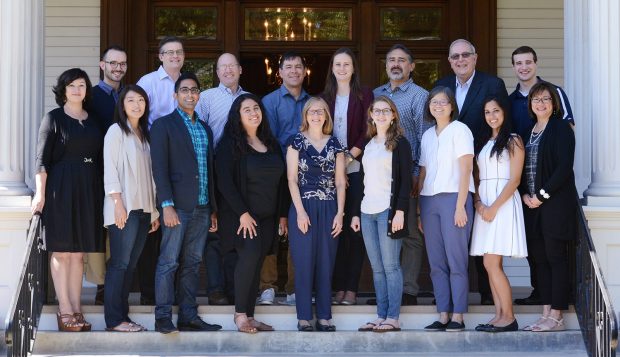
Attendees of the 2017–18 Alumni Board Kick-Off Meeting: (top row, left to right) Lazaros Chalkias ’16, Craig Arteaga-Johnson ’96, Jon Siegel ’84, Matt Thompson ’96, Kayla McCulley ’09, Alfredo Romero ’91, Harvey Alpern ’60, Don Swan ’15; (bottom row, left to right) Rocio Gandara ’97, LJ Kwak ’05, Jumal Qazi ’02, Maria Vides ’18, Jan Fukushima ’72, Stacey Abrams ’16, Diane Ung ’85, Jahan Boulden PZ ’07, Belinda Rabano ’88

THE ALUMNI BOARD welcomed President Starr to its first meeting of the year with a basket of gifts sent by alumni authors, filmmakers, poets, musicians and vintners. President Starr and members discussed priorities for the year and topics important to on- and off-campus Sagehens, including free speech and alumni-student mentorship. During lunch, the board heard from Elvis Kahoro ’20, who was featured in the recent New York Times article “When Affirmative Action Isn’t Enough.” Working committees met, including Alumni Engagement, chaired by Don Swan ’15, which focuses on learning and career programs for alumni; Athletic Affinity, chaired by Mercedes Fitchett ’91, which supports events such as Rivalry Weekend and promotes the Champions of Sagehen Athletics fundraising initiative; Current Matters, chaired by Rocio Gandara ’97, which responds to time-sensitive issues within the Pomona alumni community as they arise; and 4/7, chaired by president-elect Diane Ung ’85, which organizes community service events around Pomona’s “special day” in April. The Alumni Association president for 2017–18 is Matt Thompson ’96. A complete list of members and a nomination form.

Fall/Winter Book Club Selection: The Immortal Life of Henrietta Lacks

The Immortal Life of Henrietta LacksGRAB A BLANKET (or, if you’re in Claremont, maybe a fan) and cozy up with The Immortal Life of Henrietta Lacks by Rebecca Skloot, the Pomona College Book Club selection for fall. This New York Times bestseller was adapted earlier in the year into an Emmy-nominated HBO television film, directed by Tony Award–winning playwright and director George C. Wolfe ’76. In a September 2017 interview for the website Shadow and Act, Wolfe spoke about the project: “I think it is a phenomenal story. Henrietta Lacks, a woman who, with limited education and a vibrant and colorful personality, transformed modern medicine. When she died, her cells gave birth to the biotech industry. I found it so fascinating that someone who on paper had limited power, in death had tremendous power and that her family knew nothing about it.”

To join the Book Club, learn more about in-person discussions in your area, and access exclusive discussion questions, faculty notes and video content, visit pomona.edu/bookclub.

Mentor Current Students with Sagepost 47

Sagepost 47DO YOU REMEMBER feeling unsure about your path after Pomona? Are you interested in ways that you can give back to the student community? Sagepost 47 is Pomona’s alumni-student mentorship program, founded by a team of students and alumni in 2014. The program connects alumni mentors with students, provides support for career and graduate school exploration and allows students to participate in mock interviews in a variety of fields. Visit sagepost47.com to learn more or sign up to become a mentor.
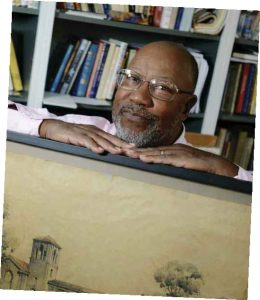
Sagehens Bid a Fond Farewell to Prof. Lorn Foster

Lorn Foster, Pomona’s Charles and Henrietta Johnson Detoy Professor of American Government and Professor of PoliticsLORN FOSTER, Pomona’s Charles and Henrietta Johnson Detoy Professor of American Government and Professor of Politics, has announced his retirement at the end of this academic year—his 40th at the College. A special fund supporting student internships and Pomona’s golf program has been established in his honor. Foster fans who wish to honor his legacy with a gift should visit pomona.edu/give and select the “Lorn S. and Gloria F. Foster Fund” from the gift designation menu. To hear about events celebrating Professor Foster, make sure your information is up to date.
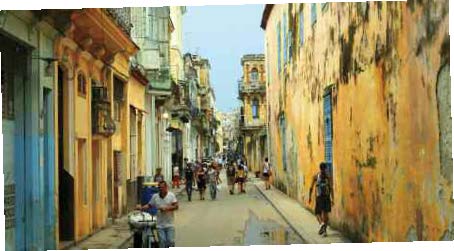
 

Show Your Sagehen Pride with New Pomona-Pitzer Athletics Gear

BIG NEWS FOR Sagehen fans: Announcing the launch of a new online Nike store for Pomona-Pitzer Athletics! Get in the game with your favorite gear at sagehens.com—just click the “Nike Store” tab on the navigation bar. Your order will be shipped directly to your door. And don’t forget to support your favorite team with a gift to Champions of Sagehen Athletics!

New Pomona-Pitzer Athletics Filter in the Mobile Alumni Directory

SAGEHEN CONNECT—a free app featuring an alumni directory and mapping resource to connect you with Sagehens in your area—has been bringing alumni together since 2013. Now, a new filter allows users to search by athletic participation from the Directory search tool. Visit pomona.edu/sagehenconnect to find out how to download the app to your iOS or Android device.

Alumni Travel/Study

Alumni Travel/Study

April 4–11, 2018
Explore Cuba with the Claremont Colleges
Join CMC and Pitzer alumni on this three-college tour as we cross a cultural divide, exploring the art, history and culture of the Cuban people.

May 25–June 4, 2018
The Camino de Santiago: A Pilgrimage into the Past
Join John Sutton Miner Professor of History and Professor of Classics Ken Wolf on one of the great journeys of the world, the Camino de Santiago, done in the way it was meant to be traveled: on foot.

For complete tour information, please visit pomona.edu/alumni/lifelong-learning/alumni-travel-program or email alumni@pomona.edu.

Tributes

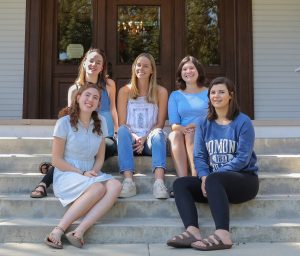
Pictured are: (top row, left to right) Frannie Sutton, Maia Pauley, Martha Castro, (bottom row, left to right) Claire Goldman and Lianna Semonsen.

Pictured are: (top row, left to right) Frannie Sutton, Maia Pauley, Martha Castro, (bottom row, left to right) Claire Goldman and Lianna Semonsen.


FIRST-YEAR STUDENTS whose parents are alumni were invited to swing by Seaver House to say hello and snap a photo. Thanks to those who took part, and welcome to the Pomona family.

From Taliban Bombs to Coconut Palms

Steven Gutkin ’86
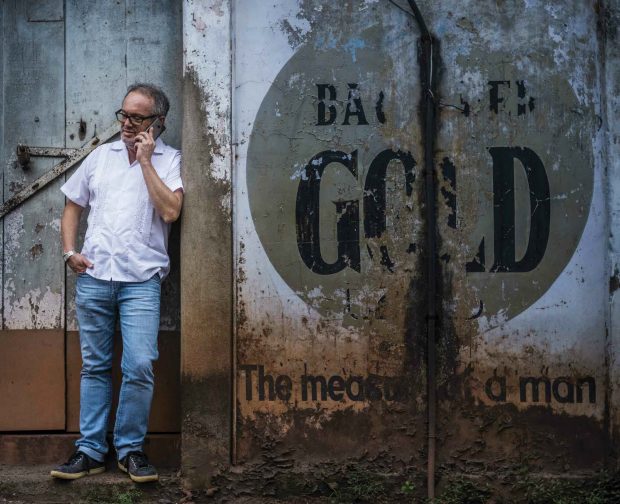
Steven Gutkin ’86 in Goa

Steven Gutkin ’86 in Goa

IMAGINE FOR A moment that this is your life. Interviewing the likes of Fidel Castro, Gabriel Garcia Marquez, Lee Kuan Yew, Jimmy Carter and Shimon Peres. Getting shot at, shelled, detained or banned in Iraq, Afghanistan, Pakistan and Cuba.  Bearing witness to global events such as the rise and fall of the Medellín and Cali cocaine cartels, the Israeli withdrawal from Gaza, upheavals in Venezuela and Indonesia, a coup in Fiji and the defeat of the Taliban.

And now imagine that, as a reward for your efforts, you are “promoted” to a management position, where conference calls, performance reviews and bureaucratic jockeying have taken the place of covering palaces, presidents and the outbreak of war and peace.

What do you do then?  Why, you quit your job and move to India with your wife and two sons to start your own weekly newspaper, of course.

At least that’s what you do if you’re former Associated Press (AP) bureau chief Steven Gutkin ’86.

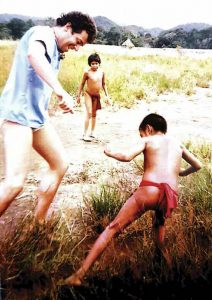
Gutkin playing with Yanomami children in the Amazon jungle

Gutkin playing with Yanomami children in the Amazon jungle

Whether fleeing Colombia because of death threats from the Cali cartel, or ducking and covering during a Taliban shell attack on a battlefield north of Kabul, or witnessing the independence celebrations of the long-suffering people of East Timor, Gutkin has always equated work with adventure and the pursuit of truth. And when he talks about his long career as a foreign correspondent, his war stories unfurl like a tightly wrapped, multicolored Sikh turban.

For instance, early in his career, he and another journalist were left stranded in the Amazon jungle with Yanomami tribespeople by a pilot who took off from a grassy field promising to return in a few hours but came back instead 10 days later. Gutkin and the other reporter were forced to trade their clothes with the tribesmen in exchange for plantains to eat, and he recalls watching dozens of Yanomami click their tongues—their word for “wow”—upon seeing their first magazine.

At the time he was angry about the pilot’s antics, but looking back, he says, “I was afforded a great privilege to spend time deep in the Amazon jungle with an intact hunter-gatherer society completely untouched by Western influence. I don’t think it would be possible to find such people today.”

And then there’s the story he tells about the day Colombian drug lord Pablo Escobar was killed. Gutkin had submitted questions to the drug lord’s son, Juan Pablo Escobar, and asked him to get answers from his dad over the phone. While the two lingered on the phone, the police traced their call. Gutkin says, “Father and son spoke about a number of things that day, but among them was going through the answers to a journalist’s questions—that would be me.”

Gutkin soon arrived at the Medellín home where Escobar had been gunned down with a pistol in each hand. He saw blood, shattered glass and Escobar’s half-eaten hot dog. He recalls, “I used the same phone that Escobar had used when his call was traced, partly because he was answering my questions, to call in my reports to the AP.”


AFTER EARNING HIS master’s degree from the Columbia University School of Journalism, Gutkin moved to Venezuela in 1987 and got his first byline in Time magazine during 1989’s violent price riots in Caracas. “You could say this was my first major break in journalism,” he says, “because the Time magazine correspondent was out of station when the riots broke out, and the magazine hired me to cover them instead.”

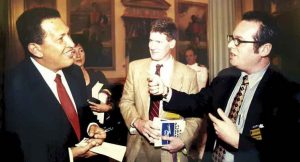
Gutkin interviewing Venezuelan President Hugo Chavez

Gutkin interviewing Venezuelan President Hugo Chavez

He then began his long relationship with the Associated Press, covering a coup attempt in 1992 by a young Venezuelan army officer named Hugo Chavez and reporting on the drug wars of Colombia. (He hasn’t seen the Netflix series Narcos but says he did “live it.”) He then became an editor on AP’s international desk in New York.

In 1997 at the unusually tender age of 32, Gutkin returned to Caracas as the AP’s bureau chief in Venezuela, where he covered Chavez’s rise to the presidency and came to know the late leader well, along with the policies that he says led to Venezuela’s implosion. “I’m absolutely sick about what is happening in Venezuela today,” he adds. “One of the most delightful countries on the planet has been driven into the ground by stupid ideology-driven policy. People are going hungry, and misery abounds.”

After the AP set up its first bureau in Havana since the Cuban revolution, he covered the story of Elián González, the 6-year-old boy who was the subject of an international custody battle in 2000 after surviving a boat wreck at sea that killed his mother and her boyfriend. Gutkin spent a week in the mother’s hometown of Cárdenas and wrote a story revealing how the Cuban authorities had lied about her motivations for leaving the island. The AP brass got wind of the piece and, fearing closure of the newly opened Havana bureau, ordered a rewrite. By then it was too late, however, as the original story had already run on the AP’s Spanish wire. In the ensuing fallout, the bureau was allowed to remain in Cuba, but Gutkin was not.

“In some ways, I have always considered being banned from Cuba as something of a badge of honor, but the truth is I love the country and very much would like to return there. I hope enough time has passed now that I will be able to do so.”

In the years that followed, Gutkin always seemed to find himself where the action was.

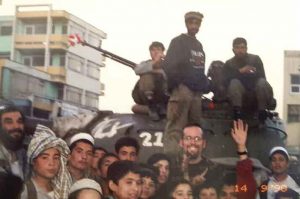
Gutkin in Kabul after the fall of the Taliban

Gutkin in Kabul after the fall of the Taliban

He was appointed AP’s chief of Southeast Asia services in Singapore and then Jakarta. He became the AP’s first print journalist to enter Afghanistan after 9/11 and rode into Kabul with a triumphant Northern Alliance. He helped lead AP’s coverage of the Iraq War and covered the kidnapping and killing of fellow journalist Daniel Pearl in Pakistan (Gutkin, like Pearl, is Jewish, and they had both been seeking to interview the militants who subsequently killed Pearl after forcing him to say, “I am Jewish”).

As bureau chief in Jerusalem from 2004 to 2010, he led one of the AP’s largest international operations and directed coverage of wars in Lebanon and Gaza and the death of Palestinian leader Yasser Arafat.

Then a big story broke on the other side of the world that would change his life forever.

In the spring of 2010, a blowout at the Deepwater Horizon platform sent some 210 million gallons of oil gushing into the Gulf of Mexico over a period of five months, making it the largest spill in the history of the petroleum industry.

At the time, Gutkin had been hoping to take up a new position in Mexico City, but the AP convinced him to move to Atlanta to lead the AP’s multitiered coverage of the spill, involving scores of reporters, photographers, videographers, graphic artists and others.

Eventually, however, the story died down, and Gutkin found himself living in Atlanta with no permanent assignment.  “The kids were settled in school,” he says, “and we were hoping to buy a home and stay there for a while.”

So, after decades of pursuing big stories and dodging bullets, he accepted a job as deputy regional editor for the U.S. South—“a good gig,” he says, but still “a far cry from the life I had come to love.”

So at the age of 47, with the support of his wife, Marisha Dutt, he decided to leave his AP career behind and start over.


Gutkin with his wife, Marisha Dutt, on their wedding day in India

Gutkin with his wife, Marisha Dutt, on their wedding day in India

“I HAD ALWAYS thought about the possibility of doing something on my own, and in the back of my mind I told myself that I’d stay with the AP as long as I loved it, and would leave as soon as I didn’t,” Gutkin explains. “That happened in 2011, when I decided to start a new chapter completely.”

The couple had been traveling to Dutt’s native country of India every year since their marriage in 2002, and in 2008, they had purchased a home in the tiny western state of Goa. “If the idea was to start something on our own,” he says, “Goa seemed the place to do it.”

The first edition of their new weekly newspaper, called Goa Streets, was published on Nov. 8, 2012.

“We started out with a bang, to say the least,” Gutkin says. “Our Goa Streets Flash Mob, days before our launch, attracted about 160,000 views on YouTube, and we arranged hop-on, hop-off party buses around the state, with traditional Goan brass bands aboard, to ferry people to hot spots” around Goa.

For the next four years, Gutkin and his wife, along with a devoted staff, published a weekly newspaper, informing readers about things to see, do and eat in Goa while providing cutting-edge articles on a wide range of topics, including politics, art, literature, the environment and finance.

“Our idea was to bring the idea of an ‘alt-weekly’ to India,” Gutkin says. “We worked very hard and had a wonderful time.”

Looking back, Gutkin says the price for achieving profitability at Goa Streets was too high, however. He gives the example of Goan casinos, whose advertising was essential for financial survival but who would not countenance negative coverage despite a scandalous presence in the state.

“I do not want to choose between my principles and my pocketbook,” he says of his eye-opening introduction to media entrepreneurship in India.

About a year ago, the couple decided to quit printing their weekly and publish online only. Currently, they are in the process of turning Goa Streets into a probono publication that promotes art, culture and responsible citizenship in the state and beyond—with any hopes for further monetization postponed to a later date.
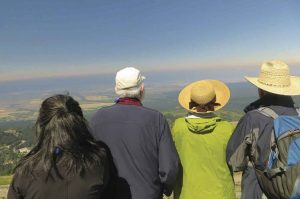
“We have a great brand,” says Gutkin. “Goa Streets will live on.”

At the same time, they have ventured into a brand new arena—constructing sustainable luxury villas in Goa, an enterprise that has opened what Gutkin calls “a completely novel and entirely welcome new path in life.”

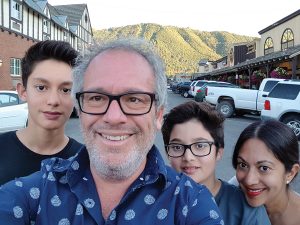
A selfie with Gutkin, his two sons and his wife Marisha Dutt

A selfie with Gutkin, his two sons and his wife Marisha Dutt

Their main project at the moment is a villa in the serene village of Sangolda. It is designed by award-winning architect Alan Abraham, who built one of the most famous homes in India—a seaside penthouse in Mumbai for his brother, Bollywood actor John Abraham, called Villa in the Sky. The new villa is nestled beside a flowing stream on a property filled with coconut palms.

“When Alan came to check out the property and saw the towering coconut trees, the first thing he said was, ‘We’re keeping them,’” Gutkin remembers. “So instead of cutting the trees to build the house, we built the house around the trees. We’re calling it Villa in the Palms, kind of like the sequel to Villa in the Sky.”

It’s a long way from his old globe-trotting life on the cutting edge of the news, but Gutkin says he has no regrets. And he promises he’s not done with journalism yet.

“My next big goal in life is to write more for Indian and international publications,” he says. “I’ve lived in a lot of places, seen a lot of things, and feel I have much to say.”

Of Record Books and Lab Books

Birir sets the all-time Sagehen career rushing record in the 2017 season opener.

Birir sets the all-time Sagehen career rushing record in the 2017 season opener.

AS AN ATHLETE, Aseal Birir ’18 has made his mark as the leading running back in Pomona-Pitzer history. At the same time, as a senior chemistry major working on his last research project, he is also leaving his mark in the laboratory.

On the athletic side, Birir was named Rookie of the Year in the Southern California Intercollegiate Athletic Conference (SCIAC) during his first year of college. Since then, he has validated that award by going on to claim team records both for career rushing and for single-game rushing.

He became the football program’s all-time leading rusher during the team’s home opener this fall against Lewis & Clark, surpassing the previous record of 3,004 yards set by Luke Sweeney ’13 and becoming only the second Sagehen ever to eclipse the 3,000-rushing-yards mark.

“The all-time rushing record was a satisfying record to break,” says Birir. “I think it is a great reflection of what our whole team has accomplished over the past four years. Football truly is a team sport, and I have received a lot of help from teammates along the way to get to the record.”

Then, for good measure, on Oct. 7, Birir also set the record for most rushing yards in a single game, with 275 yards against Cal Lutheran. His achievement was recognized by the conference, which named him SCIAC’s Athlete of the Week.

“The single-game record is somewhat bittersweet for me,” says Birir. “I am very proud of my individual effort, but it stings to know that I broke the record in a game that we lost in the last minute. However, it will probably be the game that I remember the most 10 years from now when I reflect back on my football career at Pomona.”

Voted captain by his peers as a junior, Birir also serves as captain during his senior season.

“Aseal’s athletic abilities and his leadership on and off the field have been instrumental in the improvement of our entire football program,” says Sagehen Head Football Coach John Walsh, who recruited him in 2013.

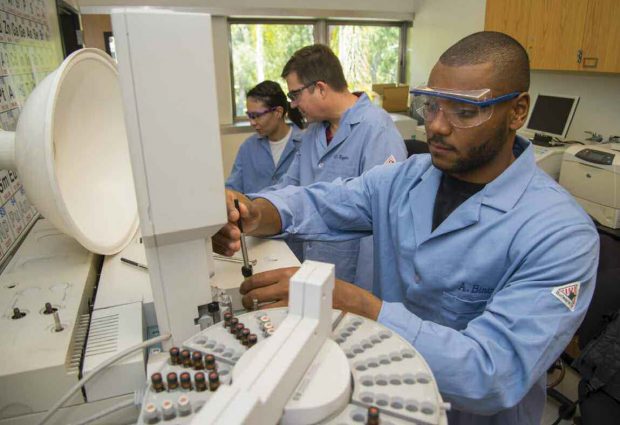
Birir works in the biochemistry lab on a medical research project with Professor Charles Taylor.

Birir works in the biochemistry lab on a medical research project with Professor Charles Taylor.

On the academic side, under the guidance of Chemistry Professor Chuck Taylor, Birir, who hopes to become a doctor in the future, is focusing his research on reducing the risk of bacterial infections in hospitalized patients. The goal is to understand the types of volatile organic compounds (VOCs) released by bacteria that are known infectious agents for many hospital-acquired infections. Working with Soleil Worthy ’18 in an ongoing project led by Professor Taylor, Birir aims to use the VOCs as biomarkers in a breath test, offering a quicker way to test patients for infectious disease.
Birir’s scientific journey started early at Pomona after his senior year at Tamalpais High School in Mill Valley, Calif. As an incoming first-year student, he participated in the summer High Achieving Program (HAP) for minority students interested in pursuing a career in the STEM fields.

The HAP experience in Professor EJ Crane’s biochemistry lab provided him with an eye-opening introduction to scientific research. It also laid the foundation for the academic support that would be key to balance his rigorous curriculum and a full athletic schedule with the Sagehen football team.

Professor Taylor points to Birir’s perseverance in the lab and on the field.

“When experiments don’t go as planned, extra work is needed reviewing the data and conditions to determine why the experiment didn’t work out as expected,” says Taylor who has worked with Birir since he entered Pomona. “Some students would throw up their hands and say ‘I’m done,’ but Aseal would come back and we’d work through the problem together.”

“You can’t teach a person to have this kind of drive, but by getting to know them, you may be able to learn what gets them excited and tap into that,” adds Taylor. “Ultimately, the drive comes from within and is a combination of intellectual curiosity and willingness to learn from one’s mistakes. This is probably the trait that makes Aseal a great football player and what will make him an excellent physician.”

On top of his athletic and academic commitments, the Novato, Calif., native finds time to mentor young men at a local high school. On Fridays, he volunteers for the program Young Men’s Circle at Pomona High School through the Pomona College student group BLOC (Building Leaders On Campus). The program involves college volunteers meeting with high school students and encouraging them to pursue their goals through either workshops or conversation.

“We try to use what we have learned about our own paths to college to help these students purse whatever goals they have—may that be college or something else,” says Birir. “Young Men’s Circle works to bridge that opportunity gap by providing the kids access to volunteers who were in similar situations to theirs not too long ago.”

Another factor in Birir’s success is the ability to forge relationships with his mentors. Two high school coaches greatly influenced him to pursue a college football career and to follow his dream of becoming a doctor. Coach Mark Ridley put him in contact with college coaches, while Mick O’Mera was his coach and his AP chemistry teacher—and one of the reasons why Birir is a chemistry major today.

“Without him [Ridley], I probably would not have even realized that I could play football in college or even how to go about pursuing it,” says Birir. “He still keeps in contact with me and is planning on coming to Claremont this year to see me play.”

What does Birir want to accomplish in his final year as a Sagehen?

“I guarantee if you ask Aseal what is more important—his personal record or for the team to win games—he will always want team success,” says Walsh.

“Win SCIAC and beat CMS [Claremont-Mudd-Scripps],” Birir responded.

Sagehen Now Part of Rock History

ben-murphy-sagehen-formationSagehen Pride is now part of the very landscape of California.

Four years ago, while still at Pomona, geology-physics double-major Benjamin Murphy ’13did his senior thesis on a geologic formation in Eastern California near Mammoth Lakes. Thanks to a serendipitously-located road, Murphy and his mentors, geology professors Jade Star Lackey and Robert Gaines, came up with the idea of naming it the Sagehen Formation. 

A few years and some revisions later, their paper was recently published in the Journal of Sedimentary Research, making it all official.

Geologically speaking, the Sagehen Formation is a package of coarse-grained sedimentary rocks (sandstones and conglomerates) that were deposited within a lake in the Long Valley Caldera in California between 500,000 and 100,000 years ago, according to Murphy, now in his third year in a Ph.D. program at Oregon State University’s College of Earth, Ocean and Atmospheric Sciences.

How did they manage to name it after our mascot? A newly discovered formation must be named after some local landmark that is as near as possible to the “type section”– the place where the formation is best exposed and representative, says Gaines.

It turned out that Sagehen Road was one of the only named features anywhere near the type section. “Once we realized that, there was no need for discussion! It was obvious that it was both scientifically appropriate and awfully fun,” says Gaines.  

For those new to Pomona, nobody is quite sure how the sage hen, also known as the sage grouse, became our mascot a century or so ago. A sizeable bird with spiky tail feathers, the sage grouse ranges over much of the West, but is not found in the Claremont area. In fact, the region where the Sagehen Formation stands is one of the only places in California where these birds roam, making the name a rock-solid choice.

Book Talk: Migrants in the Crossfire of Love and Law

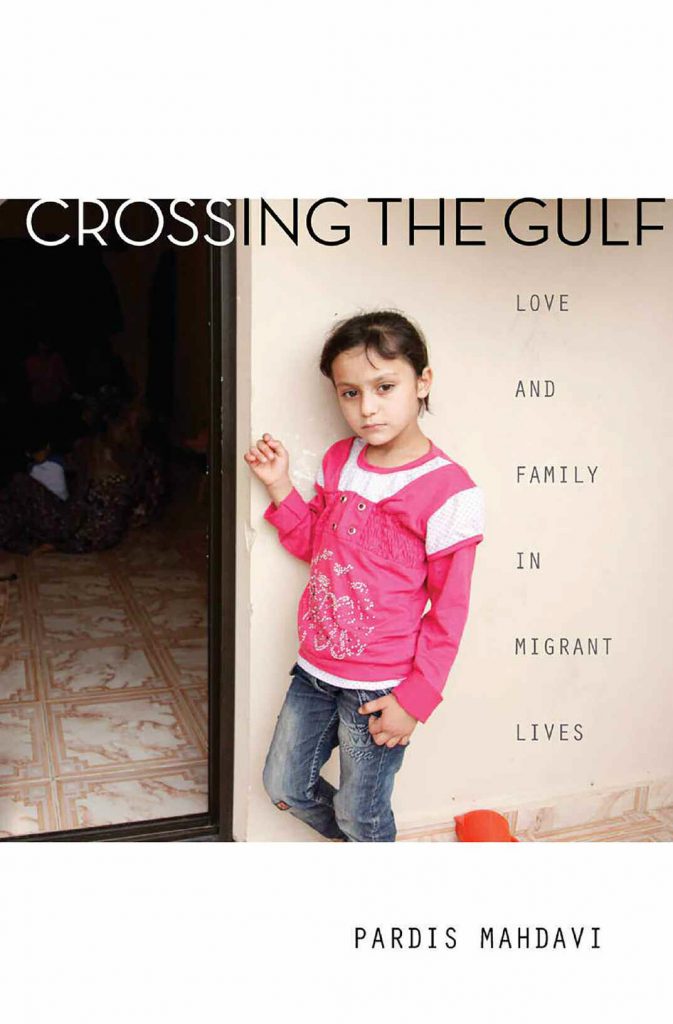
01-crossing-the-gulf-mahdavi-bookIn her new book, Crossing the Gulf: Love and Family in Migrant Lives, Associate Professor of Anthropology Pardis Mahdavi tells heartbreaking stories about migrants and trafficked mothers and their children in the Persian Gulf and talks to state officials, looking at how bonds of love get entangled with the law. Mahdavi talked to PCM’s Sneha Abraham about her book and the questions it poses about migration and families. This interview has been edited and condensed.
PCM: Talk about the relationship between family and migration.

MAHDAVI: Our concept of family has been reconceptualized and reconfigured in and through migration. People are separated from their blood-based kin; they’re forming new kinds of fictive kinship in the labor camps or abroad. Some people migrate out of a sense of familial duty, to honor their families. Sometimes they get stuck in situations which they feel they can’t get out of because of their family and familial obligations. Other people migrate to get away from their families, to get away from the watchful eyes of their families and communities. Families are not able to necessarily migrate together, and children are not able to migrate with their parents; they’re in a more tenuous relationship now than we would recognize when we look at migrants really just as laborers.

Laws complicate those relationships. Laws on migration, citizenship and human trafficking create a category of people caught in the crossfire of policies—and those people are often women and their children, and often they are trapped in situations of illegality.

PCM: Would you tease out the question of migration versus trafficking? That is something you’re exploring in your book.

MAHDAVI: I think it’s a real tension that needs to be teased out in the larger discourse. That’s the central question. What constitutes migration? What constitutes trafficking? It’s very difficult and that space is much more gray than we think. We’ve tended to assume that women in industries like the sex industry are all trafficked. We assume if there’s a woman involved, it’s the sex industry; if it’s a minor, it is trafficking; if it’s a male, if they’re in construction work, that’s migration. But that’s just not true. Trafficking really boils down to forced fraud or coercion within migration. It’s kind of a gray area, a much larger area than we think. The utility of the word “trafficking” really is questioned in the book. How useful is that word? The very definitions of migration and human trafficking are extremely politicized and depend on who you ask and when. Some people might strategically leverage the term, whereas other people strategically dodge it.

Some interpretations have positively elevated the importance of issues that migrants face; other people might say that the framework is used to demonize migrants or further restrict their movement.

PCM: What’s an example of a policy that affects these issues of migration and trafficking?

MAHDAVI: The United States Trafficking in Persons Report (TIP) is one policy, kind of a large one, to the extent that the report ranks all the countries into tiers and then makes recommendations based on their rankings. And sometimes the recommendations that the TIP report makes actually exacerbate the situation instead of making it better.

For instance, the United Arab Emirates is frequently ranked Tier 2, or Tier 2 Watchlist [countries that do not comply with minimum standards for protecting victims of trafficking but are making efforts], and the recommendation is that there should be more prosecutions and there should be more police. Now, the police in the U.A.E. are imported oftentimes, and from my interviews with migrant workers, it’s often the police who are raping sex workers and domestic workers. So you double up your cops, you double up your perpetrators of rape. So that is a policy that’s not helping anyone.

Other policies are more tethered to citizenship. They don’t have soil-based or birthright citizenship in the Gulf. Citizenship passes through the father in the U.A.E. and Kuwait. Citizenship also passes through the father in some of the sending countries, for instance, up until recently Nepal and India. So that means a domestic worker from India or Nepal, five years ago, who goes to the U.A.E., perhaps is raped by her employer or has a boyfriend and gets pregnant and has a baby, that woman is first incarcerated and then deported because as a guest worker she is contractually sterilized, and that baby is stateless because of citizenship laws that are incongruent.

There is a whole generation of people that have been born into this really problematic situation.

PCM: You write about “children of the Emir.” Who are they? 

MAHDAVI: So, “children of the Emir” is kind of the colloquial nomenclature given to a lot of the stateless children. They could be children of migrant workers, children who oftentimes were born in jail; maybe they were left in the Gulf when their mothers were deported. They may have been left there intentionally. It’s not clear, but they’re stateless children who were born in the Gulf. And some of them are growing up in orphanages; others are growing up in the palaces. There was a lot of tacit knowledge about these children and rumors that the Emir or members of the royal family are raising them. But nobody could find the kids. Nobody knew where they were or if it was actually true that they were being raised in the palaces or not. That was rumor until I conducted my research and I was able to confirm that by interviewing these children. And it is true that some are raised in various palaces, given a lot of opportunities, and treated very well.

So now many of them are adults, living and working in the Gulf but still stateless. Recently there’s been a slew of articles that have indicated that some of the Gulf countries, the U.A.E. and Kuwait included, are engaging in deals with the Comoros Islands where, in exchange for money to build roads and bridges, they are getting passports from the Comoros Islands. Initially it was thought that they would just get passports to give to these stateless individuals, but the individuals had to remain in the Gulf. However, a closer look at some of the contracts indicates that some of these stateless individuals who are being given Comoros citizenship actually will have to go to the Comoros Islands, which is a very disconcerting prospect for many stateless individuals in the Gulf. And for people who are from the Comoros Islands, they are now thinking, “Oh, our citizenship is for sale,” to stateless individuals who are suddenly told that they are citizens of a country they’ve never even heard of.

PCM:  You write about something you call “intimate mobility.” What is that?

MAHDAVI: Intimate mobility is kind of a trope that I’m putting forward in the book. Basically, it’s the idea that people do migrate in search of economic mobility and social mobility—which is obvious to a lot of people—but people also migrate in search of intimate mobility, or a way to mobilize their intimate selves. For example, they migrate to get away from their families in search of a way or space to explore their sexualities. Some form new intimate ties through migration. For others, their intimate subjectivities are challenged when one or more members of the family leave. My book is asking us to think about how intimacy can be both activated and challenged in migration.

PCM: What does it mean to mobilize one’s intimate self?

MAHDAVI: There was a young woman who migrated, who left India because her parents wanted her to get married in an arranged marriage. But she left because she saw herself as somebody who would not want to marry a man. She identifies as a lesbian, and so she migrated to Dubai so that she could explore that sexual side of herself. So that’s some of the intimate mobility I’m talking about.

On the flip side, I talk about intimate immobility and I talk about how people’s intimate lives, as in their intimate connections with their children back home or their partners back home, become immobilized when they are in the host country. Their intimate selves are immobilized because they can’t fully express their love for their children or for their partners. And also women who are guest workers or low-skilled workers legally cannot engage in sexual relations so they can’t as easily engage in a relationship.

Pardis Mahdavi is associate professor of anthropology, chair of the Pomona College Anthropology Department and director of the Pacific Basin Institute. Crossing the Gulf is her fourth book.

Flightless to the Bone

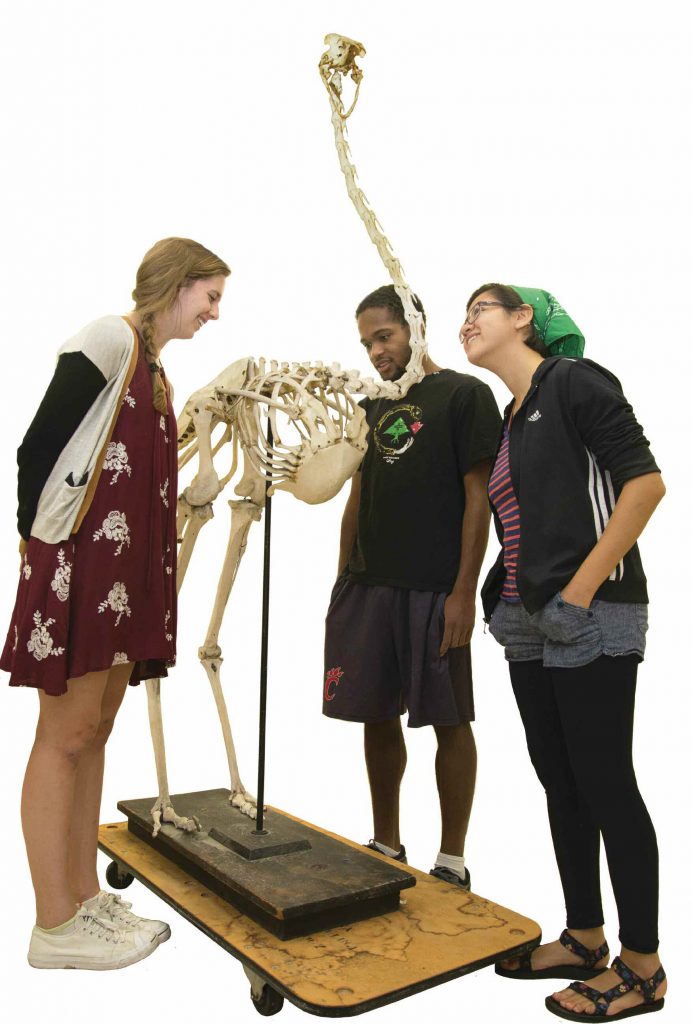
pcm-fall2016text39_page_07_image_0001Jeffrey Allen ’17 (center), a teaching assistant in Professor of Biology Nina Karnovsky’s Avian Ecology class, joins Ellie Harris ’18 (left) and Vanessa Machuca ’18, students in the class, to examine the skeleton of an ostrich, part of the vertebrate specimens collection housed in the Biology Department. “From one look at the breastbone you can tell that this bird can’t fly,” Karnovsky notes. “There is no keel for flight muscles—it is totally smooth—plus the wings are tiny. It dramatically shows adaptations for running—lots of area for attaching leg muscles. I use this in my Vertebrate Biology class as well. I have no idea where it came from or how long we have had it. I just love it.”