Pomona is No. 3 on The Princeton Review’s 2022 list for Best Financial Aid among private colleges. Pomona is one of a handful of institutions committed to need-blind admissions and to meeting the full demonstrated financial need of all students who enroll.
Pomoniana
And the Oscar Goes To …
 At the moment when Encanto won the Oscar, Rose Portillo ’75—the voice of Señora Guzmán in the 2022 Academy Award winner for best animated feature—was on her way home after performing in a play.
“It happened as I was driving in. Friends were texting me and saying ‘You won! Congratulations!’” Portillo says. “It still feels odd to realize that I actually am a part of this. I still look at it and think: Isn’t that wonderful? My friends won. This is a lovely moment and, I feel, a deserving moment. And then I have another moment of oh, it’s kind of me, too.”
An accomplished actor, writer, director and visual artist as well as a Pomona College theatre lecturer, Portillo was too busy to enjoy the Oscars until after her afternoon performance in the nearly monthlong run of the Pulitzer Prize-winning play Anna in the Tropics at Pasadena’s A Noise Within theatre.
“By the time I got home, there was a watch party next door,” Portillo says. “When I walked in, they were all, ‘Congratulations, congratulations,’ which was very sweet and lovely.”

Besides voicing Sra. Guzmán, mother of the hunky Mariano, Portillo spent two years developing the character of Abuela Alma Madrigal, matriarch of the warm Colombian family whose magical powers not only help them to survive after fleeing a junta but also help to sustain their community.
Portillo calls participating in the production “joyful” and is particularly proud of the animation’s realistic depiction of varied skin tones within a family. She also talks about the invisible effects of unspoken trauma reverberating through generations and the potential for healing.
She wasn’t the only Sagehen involved in Encanto. Jasmine Reed ’12 was an editorial production supervisor for Walt Disney Animation Studios. Encanto is being celebrated throughout the world. “It is proof that the better we come to truly know each other, the better we can embrace each other. That’s the kind of project I’m always looking for,” Portillo says.
Watson Fellows ’22
For sheer armchair traveling pleasure, we present this year’s Thomas J. Watson Fellowship winners:
Xiao Jiang ’22 and Mark Diaz ’22 are among 42 students selected from 41 private college and university partners to receive $40,000 grants to pursue research projects during 12 months of international travel.
Jiang found care and acceptance in New York City’s Chinatown at the age of 5 when she and her mother came to the U.S. from China. After arriving at Pomona as a Questbridge Match Recipient with a full four-year scholarship, Jiang was worried about returning to her Chinatown for fear of seeing it changed—gentrified —into a place she would no longer recognize as home. As a sophomore, she took an anthropology course and studied the effects of gentrification on Los Angeles’ Chinatown. For her senior project in anthropology, she created a short documentary on how COVID-19 has affected Chinatowns in New York and Los Angeles.
Jiang will spend her Watson year traveling to China, Malaysia, Singapore, Vietnam, the United Kingdom, France and Belgium to learn how immigrants and Chinese residents engage with Chinatowns to develop a sense of self within a community of like-minded people.
Diaz was a junior in high school when he was first introduced to kabuki, a traditional form of Japanese theatre that incorporates dance, music and mime. At Pomona, he drew Emeritus Professor Leonard Pronko out of retirement to study under him and to have Pronko teach a masterclass on kabuki. They staged Narukami Thunder God at Pomona’s Alumni Weekend in 2019 before Pronko’s death later that year.
Thinking about his own ancestors, the Maya and the Basque, Diaz wondered what type of theatre they developed and how it is also under-staged or recognized in the U.S. Diaz will travel to Japan, Spain, Belize and Guatemala to explore traditional dramatic forms: kabuki in Japan, religious dance ceremony in Guatemala and Belize, and pastorale in Spain.
This is Jeopardy!
 Some 26,000 students from more than 4,000 colleges auditioned for the chance to be among the 36 competitors in the Jeopardy! National College Championship, televised in February.
Lauren Rodriguez ’22 made the cut and then some, taking home $20,000 after reaching the tournament semifinals.
“I had such a blast competing on the show,” says Rodriguez, a public policy analysis and sociology major whose first post-graduation job is in management consulting. “Being part of the College Championship as opposed to regular Jeopardy! made it so rewarding, because I was able to meet 35 other college kids from all across the country and form friendships with them. We all embraced our inner nerd together and had a lot of fun.”
The tournament champion, University of Texas senior Jaskaran Singh, won $250,000.
Besides cash, Rodriguez took home memories for a lifetime.
As she posted on Instagram to promote the show, “I’ll take Bucket List for 2022, Mayim 🤪”
Legacies
Dr. Martin Hyung-Il Lee
 Lee, the father of Pomona College Trustee Bobby Lee ’02 and Jenny Lee ’07, immigrated to the U.S. from South Korea in 1974, becoming the first in his family to graduate college before going on to medical school with the help of scholarships supplemented by student loans.
As a doctor, Lee for decades served immigrants in Los Angeles’ Koreatown, sometimes even accepting copayments in windowsill chili peppers from elderly widows with limited incomes.
Now students on Lee’s same path to the American dream will benefit from a $1 million gift to Pomona College devoted entirely to scholarships. The Dr. Martin Hyung-Il Lee Scholarship Fund is for students facing financial hardships who come from immigrant families, are first-generation college students and/or are pursuing careers in science or medicine.
Lee’s son Bobby and daughter-in-law Sophia Whang established the fund to honor Dr. Lee, who died in 2021 at the age of 64.
“My father lived the American dream, and this is a way to carry on his memory and ideals,” says Bobby Lee, president and COO of Los Angeles-based JRK Property Holdings.
Barbara Barnard Smith ’42
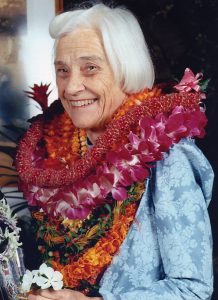 Smith’s remarkable support for the College and non-Western music continued at her passing last year at the age of 101. She left more than $3.5 million to the Music Department through a planned gift, bringing her support to the College over the years to $5.7 million.
Half of her final gift will support the future renovation of Music Department facilities and the naming of a space in honor of the late Professor of Music Katherine J. Hagedorn. The other half will further endow the existing Barbara B. Smith ’42 Fund for Non-Western Music to support ethnomusicology curriculum and other instruction, programming, equipment and performances of non-Western music at the College. Smith’s support made possible Pomona’s non-Western music ensembles, including the Balinese gamelan, West African and Afro-Cuban ensembles.
After graduating from Pomona, Smith studied at the Eastman School of Music at the University of Rochester before embarking on a career teaching at the University of Hawaii at Mānoa from 1949 to 1982. Noting the university’s diverse student body, Smith introduced classes in hula and Hawaiian chant, Korean dance, Chinese dulcimer and Japanese gagaku (court music). She founded UH Mānoa’s ethnomusicology program and established its master’s and Ph.D. ethnomusicology degree programs.
The Highest Beam
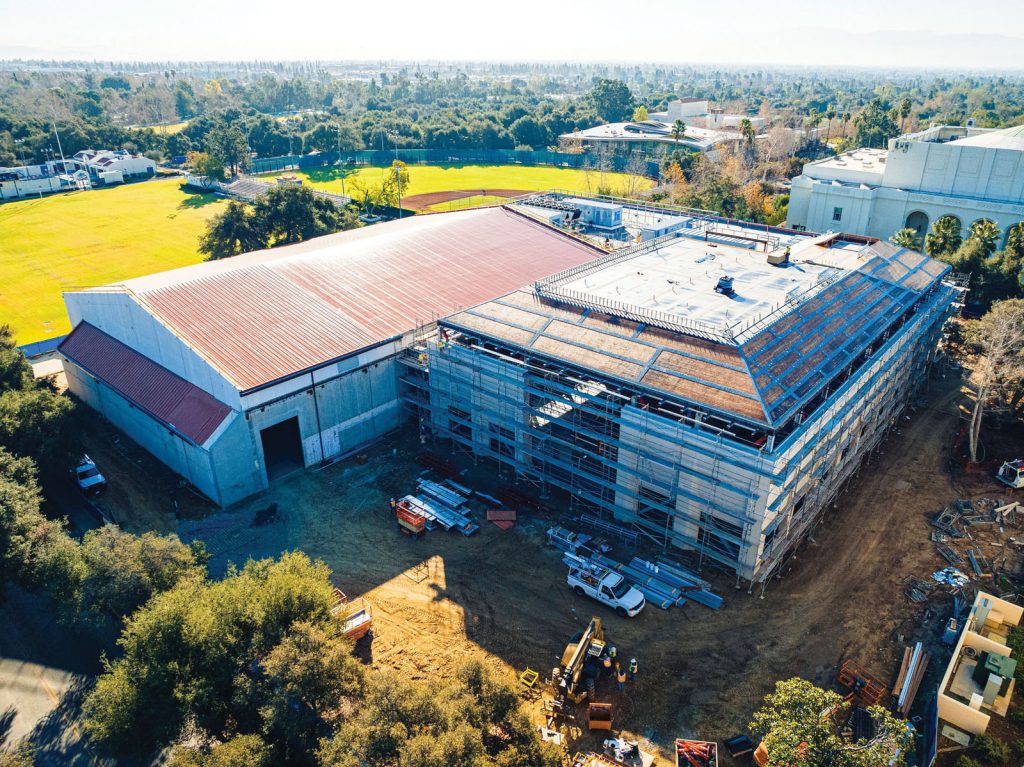 The new athletics, recreation and wellness center adjacent to Bridges Auditorium topped out with the raising of the highest beam in November.
Scheduled to open this fall, the 99,925 square-foot building will feature not only facilities for Pomona-Pitzer Athletics but also a vastly expanded fitness area, plentiful locker rooms, three classrooms, two weight rooms and two large studios for activities such as yoga or spinning.
“This is part of how we reinvent wellness on our campus,” says Miriam Merrill, director of athletics and professor of physical education, noting that wellness is a component of the College’s 2020 Strategic Vision.
Once it opens, visitors to the athletics center may notice a small detail that gives Project Manager Brian Faber pride. The room number of the first-floor studio is a nod to Pomona lore: Studio 147.
OA, Local Version
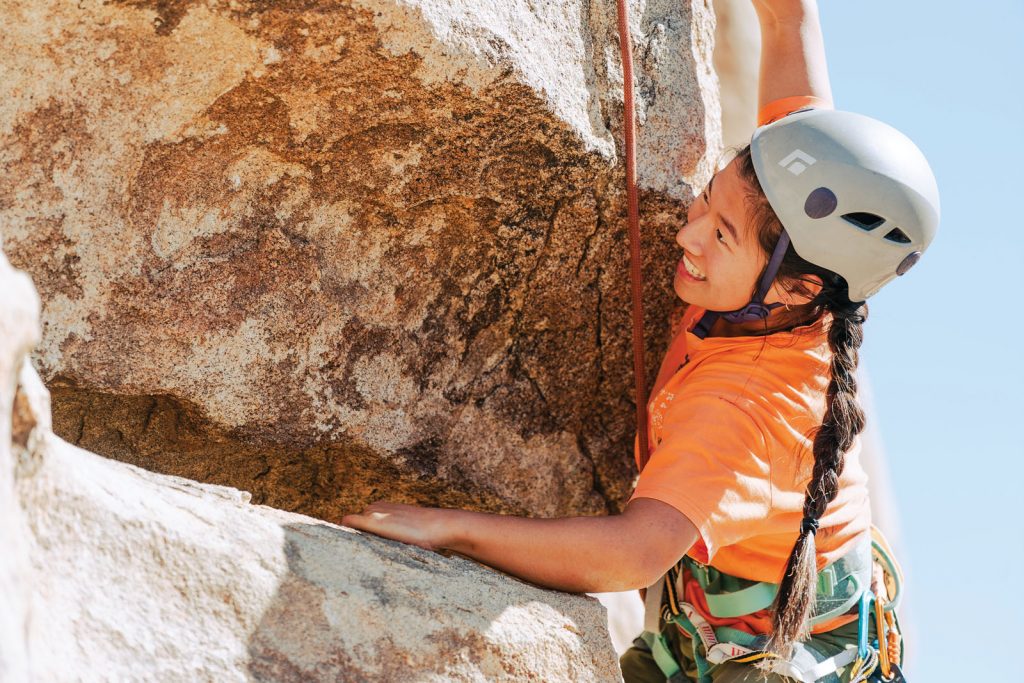
Eli Li ’25 tries rock climbing at Joshua Tree National Park.
The traditional multi-day Orientation Adventures to such classic California destinations as Yosemite National Park and various coastal spots for camping, surfing or kayaking have been on a pandemic hiatus. But students arriving on campus for the first time had opportunities to go on more local orientation experiences last fall, including a rock-climbing day trip to Joshua Tree National Park, a dog-walking outing with four-legged friends from the Priceless Pets rescue group in Chino Hills and a trip to Long Beach.

Ella Novy-Marx ’25, left, and Brody Eggert ’25 playing with a dog.
Protesting is part of the college experience—even perhaps an essential element of a well-rounded education.
But the small protest that materialized outside of Frary Dining Hall one November morning was unexpected to say the least. Several students, armed with camp stoves and spatulas, were whipping up made-to-order omelets for yawning students before class.
Their cause? Weekday morning omelet service had been suspended because of pandemic-related staffing issues. The students published a “Das Omelettistich Manifesto” with an apropos slogan: “You can’t make an omelette without breaking a few eggs.”
Campus administrators said the omelet stations would resume as staffing allowed—and they did, with daily made-to-order omelets returning to Frary and Frank as indoor dining resumed for the spring semester.
‘The Capacity to Ask Questions’
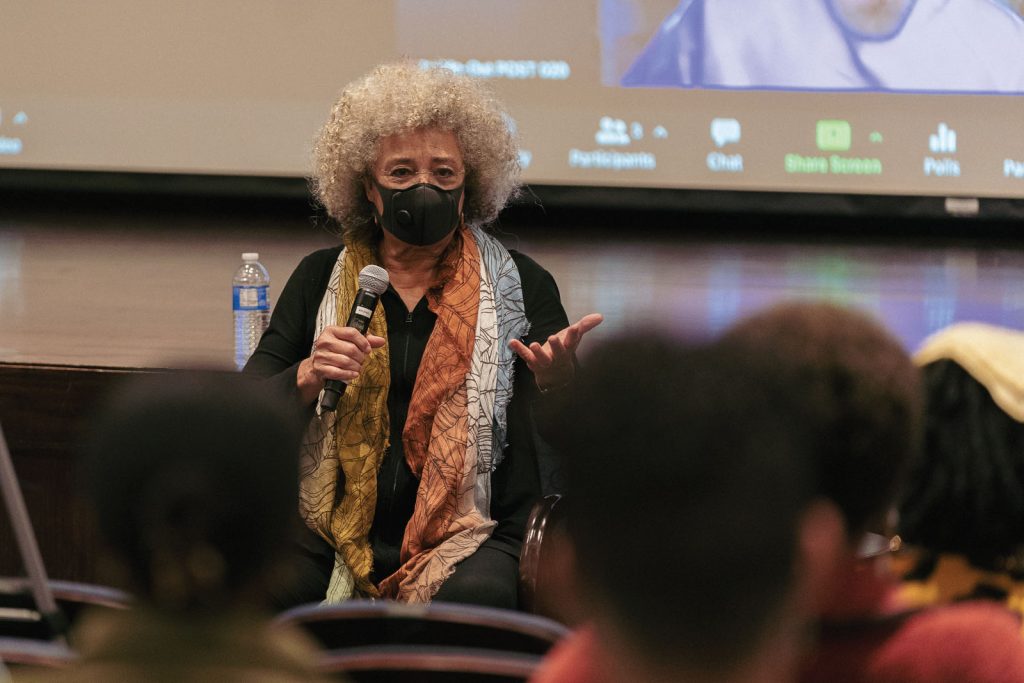
Angela Davis at The Claremont Colleges during her October visit
Angela Davis, considered a radical in the 1970s and now Distinguished Professor Emerita at UC Santa Cruz, returned to the Pomona campus as the Ena H. Thompson Distinguished Lecturer for two events in October. In 1975, Davis was appointed to teach in The Claremont Colleges’ Black Studies Center only to be forced out after two semesters by resistance from administrators, trustees and donors who objected to her activism and notoriety as a former prisoner on charges for which she was later acquitted.
In a Q and A with The Student Life, Davis addressed the role of education in activism.
“The challenge, I think, is to guarantee that students acquire the capacity to raise questions. And as far as I’m concerned, that is the very heart of education, not only teaching students how to conduct research and acquire information, but what we do with it. So it seems to me that the most crucial aspect of education is teaching and encouraging students how to constantly engage in that process of questioning. And that involves also questioning those things we take for granted.”
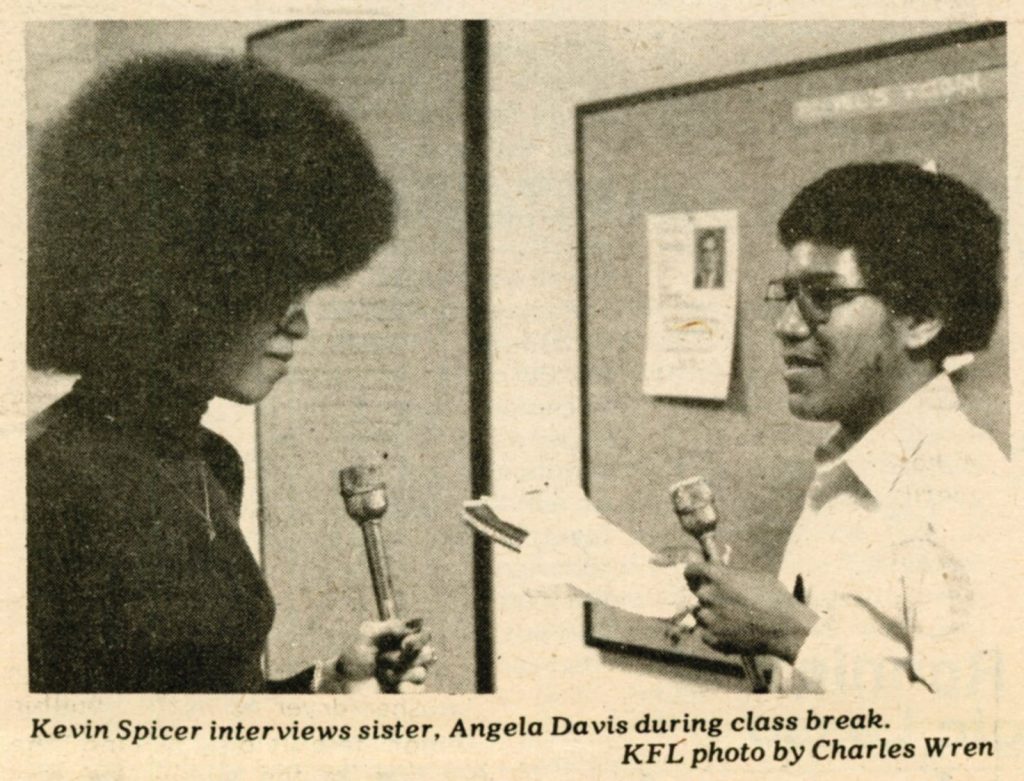
Angela Davis at The Claremont Colleges in 1975-76. Kevin Spicer interviews Angela Davis during class break
Portrait of the Artist as a Young Grad
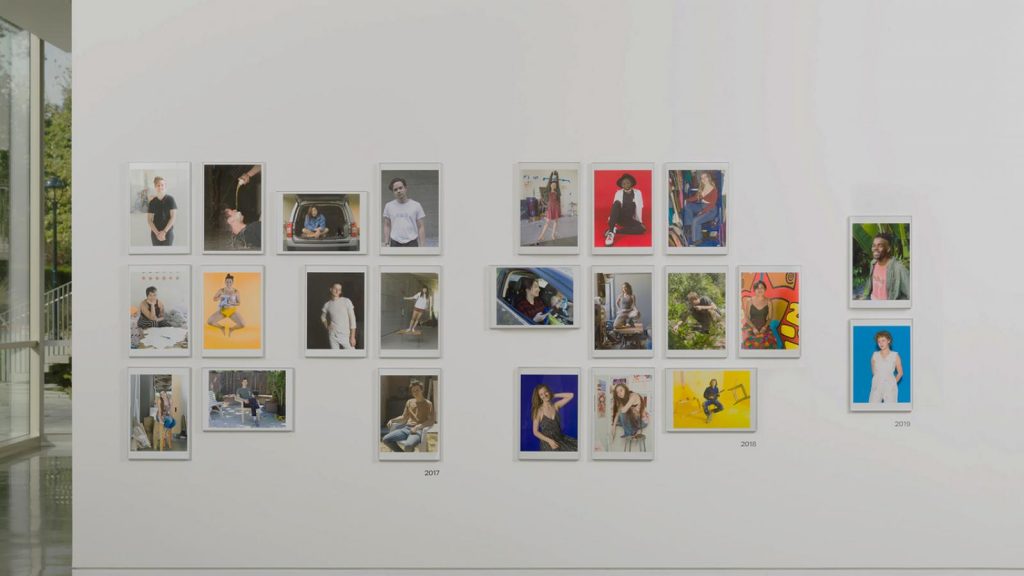
Each year, Art Professor Lisa Anne Auerbach gives graduating art majors something to take with them as they leave Pomona.
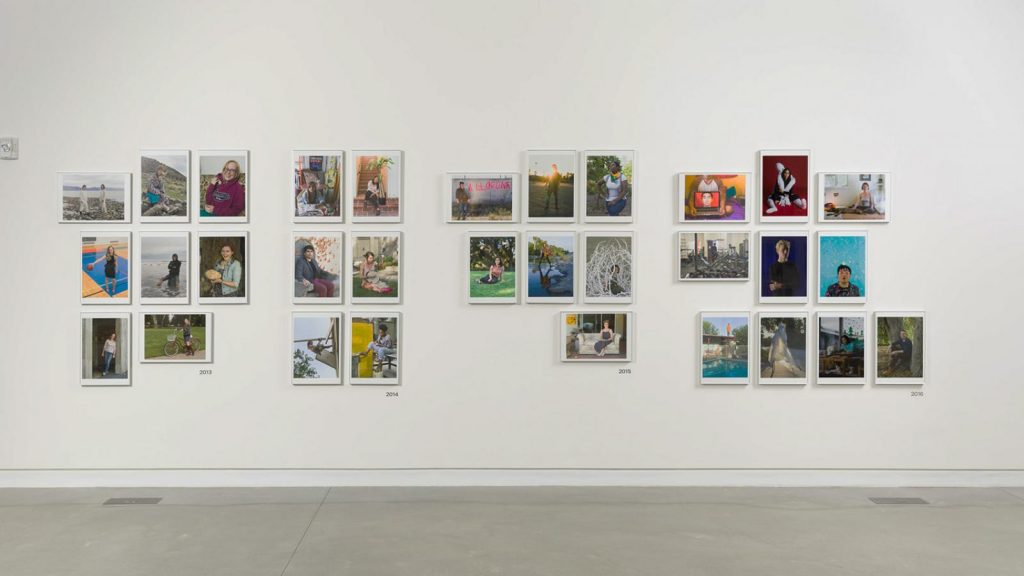
For more than a decade, she has photographed the department’s seniors in individual portraits, capturing them in a setting they choose themselves on campus or nearby. The resulting portraits are colorful and sometimes playful, often capturing the students’ artistic sensibilities.
“It’s an interesting time to make a portrait when most of our students are on the precipice of this new time in their lives,” says Auerbach, who started the project in 2010 during her first year at Pomona. “The images reflect who they are at the moment and maybe a bit of who they aspire to be, going forward.”
Last fall, her work resulted in an exhibit in the Chan Gallery on campus: Senior Portraits—The First Decade. Grouped by class year, the individual portraits created a moving history of the department and subtle changes in student styles.
Auerbach persisted with the project through the pandemic graduations of 2020 and 2021, driving as far as Ojai to photograph a student, taking another photo via Zoom and creating one with a photograph of a photograph. With any luck, Senior Portraits—The Second Decade, is ahead.
“It has a very positive effect on the relationship that I’m able to build with these students going forward,” Auerbach says. “We’re relating as people in the way that one relates to their professors after they graduate, sowing the groundwork for a future relationship when we can be just people in the world together—collaborators or friends.”
Sumner’s Century
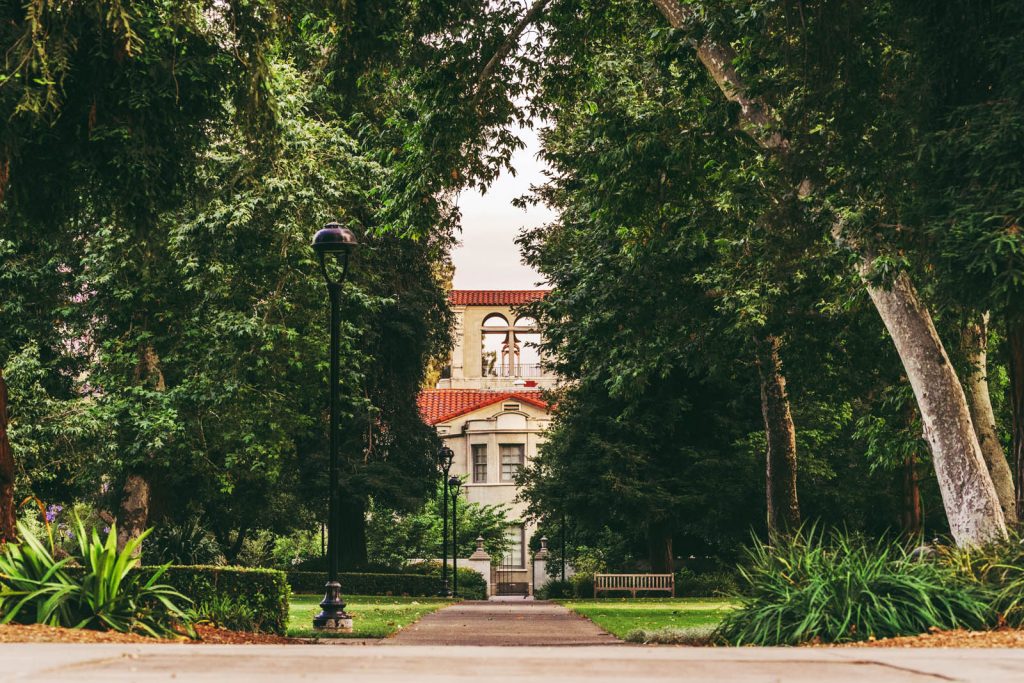 During 1921-1922, Pomona relocated its early administration building, Sumner Hall, from what is now Marston Quad to its current location east of Bridges Hall of Music. Today, Sumner houses the financial aid and admissions offices, drawing thousands of visitors every year from around the world as the starting place for campus tours. After more than a year with Sumner closed in the pandemic (and tours online only), visitors are now returning to campus and Sumner is sure to resume its role as one of the busiest spots at Pomona.