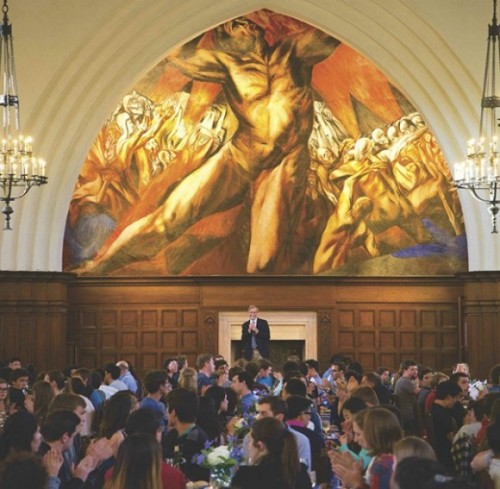
President David Oxtoby welcomes the members of the Class of 2015 to a Senior Dinner on April 7 beneath José Clemente Orozco’s fresco of Prometheus in Frary Hall.
Pomoniana
Under Prometheus
Have a Jolly Holi
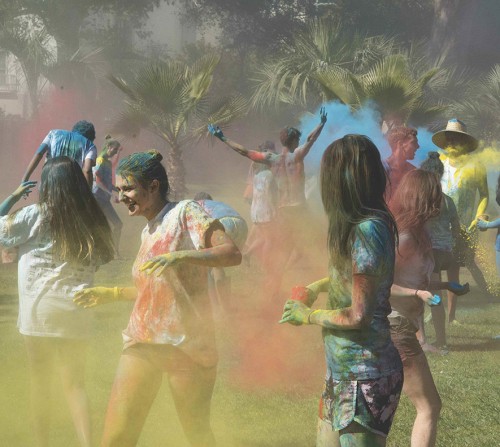
Since 2000, Walker Beach has been the site of The Claremont Colleges’ increasingly popular celebration of Holi, the springtime festival of colors and love that originated in India. Organized by the Claremont Hindu Society, with the support of the Office of Chaplains, the festival is celebrated as a carnival of bright colors, with participants throwing dry colored powder or colored water at each other until both crowd and surroundings appear to have been tie-dyed. Last March, more than 400 students from across the campuses took part in the 2015 festivities.
Mountainous Monument

THE MAJESTIC San Gabriel Mountains, Pomona College’s ever-present backdrop, are now a national monument encompassing 350,000 acres of scenic, rugged terrain. President Barack Obama visited nearby Bonelli Regional Park in October to sign the proclamation, saying, “We are blessed to have the most beautiful landscapes in the world.” For Pomona students, the nearby mountains have always been a favorite spot for recreation, but they also serve as a key site for field trips and student research in geology and other fields. The College’s shared one-meter telescope at Table Mountain Observatory is located high in the mountains near the resort town of Wrightwood.
Do You Speak Sagehen?
POMONA HAS ITS own ever-evolving set of unique words that only have meaning on the Pomona campus. Here are a few special words and phrases that are vital to understanding life at Pomona today.
Spo-gro — Short for “sponsor group,” this is a word students are likely to hear frequently during their first year at Pomona, and possibly for the rest of their lives. Designed to help students make a smooth transition to college, the Sponsor Program clusters first-year students into sponsor groups of about 15 students who live together in a residence hall, along with older students who help them settle into the Pomona community.
OA — OA stands for Orientation Adventure, the three-day trip that all first-years go on before they start class. There are various derivations of this word, such as “OA-by,” which is what you may be introduced as if you encounter your OA leader at a party.
Table Manners, Pub, Bloc, Tap — At Pomona, the term “Table Manners” doesn’t refer to a set of polite social behaviors every student should learn. For today’s Sagehens, it’s the name of a party thrown in Doms Lounge of the Smith Campus Center every Tuesday night. Other parties that take place on campus weekly have equally cryptic names, such as Pub, Bloc and Tap.
Sustainable Numbers
 The number of gallons of water the College expects to save each year due to new pH controllers installed on its 10 water-cooling towers. Purchased last March, the new controllers reduce the number of water replacement cycles in building air conditioning systems.
 The number of pounds of used appliances, furnishings, books and other items (including 100+ couches) saved from the landfill last May in the College’s Clean Sweep, which picks up items left behind in residence halls for resale the next fall. This year’s sale raised more than $9,500 for sustainability programs.
 The number of new low-flow faucets and showerheads installed as part of the College’s Drought Action Plan. The College also reduced irrigation to landscaped areas by at least 20%, timed watering schedules for night-time and prohibited washing of outside walkways.
 The number of bicycles available to students last year through the College’s Green Bikes program, in which students check out bikes for the entire semester and learn how to repair and maintain them.
 The percentage of produce served in Pomona’s dining halls last year that came from local sources
How Classes Are Born
POMONA OFFERS MORE than 600 classes in 47 majors, and each year new courses are born. Here’s a look at the origins of seven of the newest:
1) Behaviorial Economics (Professor of Economics John Clithero ’05) was added by popular student demand. It explores a growing subfield that attempts to incorporate more psychologically plausible assumptions into the traditional economic model of “unbounded rationality.”
 2) Laughing Matters (Professor of Romance Languages and Literatures Jose Cartagena-Calderón) grew out of the professor’s research into the meaning and value of humor in Hispanic literature and art.
3) Anthropology of Food (Professor of Anthropology Drew Gladney) explores food and culture with special attention to food taboos and security issues. The course was born out of a discussion of California’s ban on foie gras in an Introduction to Anthropology class.
4) Genes and Behavior (Professor of Neuroscience Elizabeth Glater) originated in a conference the professor attended that focused on the gap between what the public believes and what studies have shown about the dominant influence of genes on behavior. The class examines the science behind the fundamental question of “nature vs. nurture.”
5) The Science of Empire (Professor Pey-Yi Chu) explores the history of science in connection with the expansion of European empires. The class grew out of a book Chu is writing on the history of frozen earth and permafrost research in Russia and the Soviet Union.
6) Surveillance and the Media (Professor of Media Studies Mark Andrejevic) was created in the wake of recent revelations about the NSA and increasingly intrusive technologies of surveillance. Originating in the professor’s writings, it examines “how the media in which we are immersed double as tools for monitoring and surveillance.”
7) Disability Studies (Hentyle Yapp, Mellon Chau Post-Doctoral Fellow in Gender and Women’s Studies) was formed to examine the changing definitions and approaches to the concept of disability and related areas of activism as part of Pomona’s emphasis on Dynamics of Difference and Power.
Rocking Studio Art
A SELECTION OF interesting rocks placed in the courtyard of the new Studio Art Hall will serve as instructional tools, artistic inspiration—and occasional outdoor seating.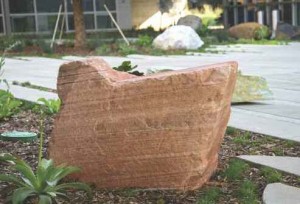
The idea came from Art Professor Michael O’Malley and Geology Professors Bob Gaines and Jade Star Lackey. Original plans calling for the placement of some generic granite stones were replaced by a more eclectic arrangement of rocks as a way to enliven the building’s stark open spaces, inspire young artists and bring in other disciplines. The Geology Department plans to use the rocks as teaching tools in introductory courses.
“Artists draw inspiration and knowledge from all sources,” says O’Malley. “As a sculptor, I love learning about stones and the fascinating stories behind them. The art faculty hopes that the building draws students from across the campus, and we saw the stones as a device to create a more complex community.”
Standouts among the stones include a brilliant sheet of green quartzite from Utah and a dazzling marble boulderin its raw, unpolished form. One rock, a checkered block of granite, even has a strong connection to the L.A. art world, having been discovered in the same Riverside quarry as Michael Heizer’s Levitated Mass installation at LACMA.
The Mystery of 47
“To the uninitiated, 47 is a mystery. To knowledgeable Pomona Sagehens, 47 is dogma. To sociologists, 47 is a prime example of a minor piece of whimsy that somehow developed into a legend of mythical proportions…”
—Pomona Student Handbook, 1985-86
In 1964, a tongue-in-cheek student project to determine whether the number 47 appeared more often in nature than other random numbers turned into a wholesale 47 hunt that has continued to this day and is even celebrated at Pomona on April 7.
After all, you can’t deny the evidence:
- Pomona College is located at Exit 47 of the San Bernardino Freeway.
- There are 47 pipes in the top row of the Lyman Hall organ.
- At the time of Pomona’s first graduating class in 1894, there were 47 students enrolled.
- The Bible credits Jesus with 47 miracles.
- The Declaration of Independence has 47 sentences.
- There are 47 strings on a concert harp.
- In the freshman class that entered Pomona College in the year 2000, there were 47 valedictorians.
- The tropics of Cancer and Capricorn are located 47 degrees apart.
Even Hollywood has gotten in on the act. From art films to sci-fi to Will Ferrell vehicles, Pomona’s enduring in-joke has slipped past countless millions of movie-goers and tube-watchers in recent years. On TV’s Lost, 47 people survive the plane crash. In The 40-Year-Old Virgin, Steve Carell keeps a collection of 47 G.I. Joes. Watch Monsters Inc. closely and you’ll spot an “Accident Free for 47 Days” sign on the Scare Factory floor. The 2009 blockbuster reboot of Star Trek alludes to 47 Klingon vessels being destroyed. There is even a much-viewed YouTube spoof of Jim Carrey’s The Number 23, substituting—you guessed it–the No. 47.
It goes as far back as the The Absent-minded Professor (1961). The Disney comedy features a basketball game filmed at Pomona’s old Renwick Gym. The final score? 47-46.
The recent spate of number-dropping started in the ’90s in earlier incarnations of Star Trek. Joe Menosky ’79 was a writer for The Next Generation (and later Voyager and Deep Space Nine) when he started slipping 47s into the shows. A producer eventually got wind and shut down the underground effort. But 47 keeps popping up in all sorts of shows.
If Menosky has moved on, how come our secret number keeps landing bit parts time and again? Is our 47 tradition at risk of overexposure? There’s no getting a straight answer out of Tinseltown on this sort of stuff, so—in a playful spirit—we turned to graphic novel artist Andrew Mitchell ’89 in our Fall 2009 issue of Pomona College Magazine for a creative take on the mystery (page 22 of the PDF).
Top 5: Campus Creatures
Animal sightings on campus are certainly not rare, (although being one of few to witness a hawk scooping up an unsuspecting squirrel may be). Grounds Manager Ronald Nemo shared this list of Pomona’s most common animal visitors, noting that recent conservation efforts have brought much wildlife back to the 40-acre Wash. Close runner-ups include rabbits, which are hunted by coyotes living in the Wash, and opossums.
However, the rustic east side of campus isn’t the only place frequented by wildlife. According to Nemo, Red-tailed hawks nest in the pine trees between Harwood and Wig residence halls, barn owls can be found living near Bridges Auditorium, and raccoon families hunker down in the storm drains. And of course, there’s nowhere on campus where friendly-tree squirrels—gray or red—can’t be found.
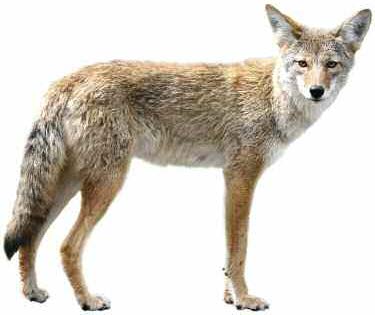 Top 5:
1) Western Gray and American Red Tree Squirrels
2) Raccoons
3) Red-tailed Hawks
4) Barn Owls
5) Coyotes
The Atomic Art of Millikan Hall
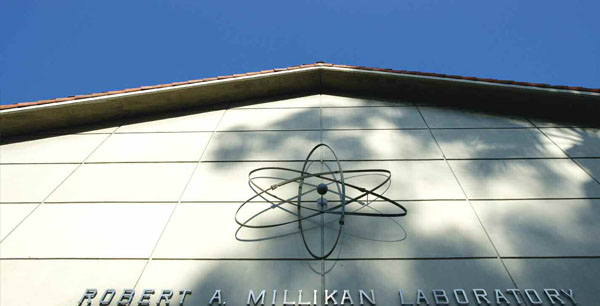
Aging Millikan Hall, built at the dawn of the Space Age, is being torn down and rebuilt to state-of-the-art standards over the next two years. But the iconic atomic artwork on the west facade of the building will be preserved and prominently displayed on the new building.
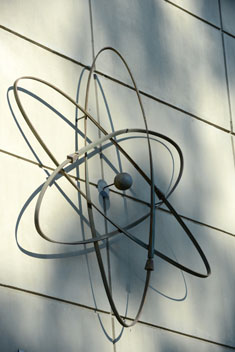 Commissioned for Pomona College’s new math, physics and astronomy lab back in 1958, the bronze atom sculpture facing College Avenue was designed by noted sculptor Albert Stewart, whose work adorns civic buildings nationwide, including the U.S. Mint in San Francisco. Before his death in 1965, Stewart created counterparts for the atom for the facades of Seaver North and South, with an image of cell division for biology and an array of particles for chemistry.
Stewart got his start in the 1930s as an artist for the Depression-era Works Progress Administration. In 1939, he was named a professor of fine arts at Scripps College, and he soon figured in a group of prominent regional artists that included Sam Maloof and Millard Sheets. Stewart also designed and donated the Pegasus relief on Stover Walk, (though Steve Comba, associate director of the Pomona College Museum of Art, points out that the current piece is a recast from the original, apparently stolen back in the ’70s).
Today the atom sculpture on Millikan holds up better as art than as science. Professor of Physics and Astronomy Alma Zook ’72 calls it a “not-very-accurate representation of a lithium atom.” With our present understanding of the atomic and subatomic worlds, the three electrons circling on the atom’s fringes would be more properly depicted as a dispersed cloud, rather than the classical image of a series of orbits, like planets rotating around a sun.
Nonetheless, as Zook herself notes, the design makes for a “nice threefold symmetry.” And once the new Millikan is built, the atom artwork will be returned to its rightful place over Millikan’s doorway to College Avenue as a “historical nod to the original construction,” says Andrea Ramella, project manager for the new building.
Read more here about the Millikan project.