Features

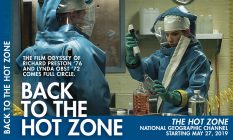
Back to the Hot Zone

Back to the Hot Zone pane
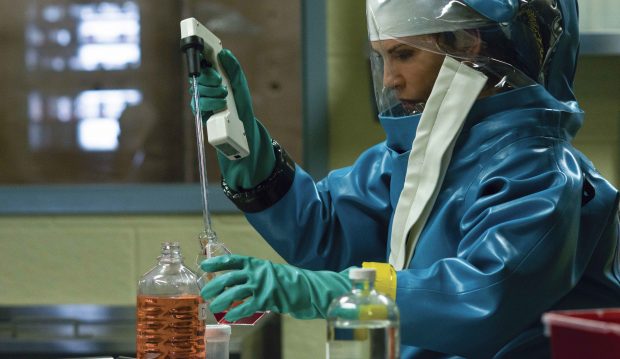
Julianna Margulies stars as Nancy Jaax in the National Geographic Channel miniseries The Hot Zone

Julianna Margulies stars as Nancy Jaax in the National Geographic Channel miniseries The Hot Zone, to air beginning May 27.

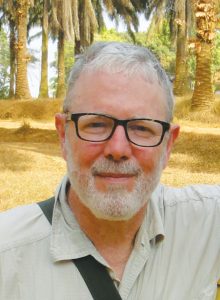
Richard Preston ’76

Richard Preston ’76

JODIE FOSTER WAS SET TO STAR. Robert Redford was on board. Ridley Scott would direct. And then it all fell apart. It was the 1995 blockbuster that never was, and it has bound together two Pomona College alumni for more than 25 years, even though Hollywood producer Lynda Obst ’72 and author Richard Preston ’76 had never met before Obst read the 1992 story in The New Yorker that became the basis of Preston’s nonfiction bestseller The Hot Zone.

Their twisting journey reaches its destination on Memorial Day, when the six-episode limited series The Hot Zone, starring Julianna Margulies, premieres on the National Geographic Channel. A quest that began when Preston was 38 and Obst was 42 is ending in triumph with both old enough to draw Social Security.

Lynda Obst ’72

Lynda Obst ’72

“The article set the town on fire from the moment it was published,” Obst says of Preston’s New Yorker story, while sitting in the office of her hillside home in the Silver Lake neighborhood of Los Angeles. “Everyone went insane and had to have it. And I was one of those people.”

By early 1993, Obst had won the rights to Preston’s terrifying true tale about the threat of Ebola and other deadly viruses on U.S. soil. But she lost the agonizing war after Foster pulled out over script differences and rival producer Arnold Kopelson raced into filming a blatant knockoff, the 1995 movie Outbreak, despite failing to secure the rights from Preston.

It was a defeat so painful, so public for Obst—who already had Sleepless in Seattle to her credit and later added Contact and Interstellar—that she made its lessons the first chapter of her 1996 memoir about navigating Hollywood, Hello, He Lied.

“The pressure can crush you or turn you into the diamond version of yourself: hard and brilliant,” she wrote about the necessity of moving on. Yet in the midst of the chapter “Next!” about the ephemeral nature of both defeat and success, she slipped in a caveat: “Reinvention remains an option.”

Reinvention it would be: Last September, The Hot Zone began filming in Toronto, followed by a December shoot in South Africa, a stand-in for 1970s Zaire.


MONTHS EARLIER, AS OBST was busy with preproduction, her satisfaction was palpable. “Somebody called me ‘Tenacious L,’ which is my favorite name I’ve ever been called,” she says with a laugh. “So you know, it feels pretty gratifying. Pretty damn gratifying.”

Within arm’s reach in her office was the final version of the contract with Preston from decades ago.

“I keep it on my bulletin board,” she says. “There are many colleagues I still work with who went through the original crisis of ‘Crisis in the Hot Zone’ with me who are still around now as my peers and allies and friends. And they are having a big laugh.”

Preston says he harbored little hope.

“I had given up,” he says by phone from the East Coast, where he lives near Princeton University. “I really thought it was never going to see the light of day. However, I was aware of one thing—it kind of lingered in the back of my mind—which was Lynda Obst’s vow in her autobiography that if it was the last thing she ever did, she was going to make The Hot Zone. I know Lynda well enough to know that was a blood oath.

“I said to Lynda that this could be described as an odyssey, except Odysseus wandered for 20 years,” Preston says. “Lynda wandered for 25 years. She beat Odysseus.”

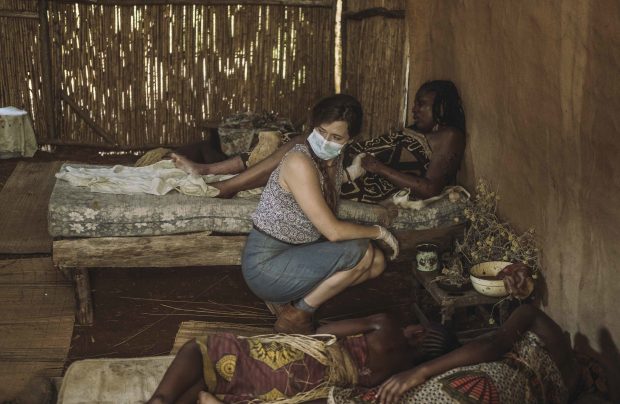
In an episode of The Hot Zone, a character played by Grace Gummer (center) tends to a hut of Ebola victims, including a pregnant woman. —Photo by National Geographic/Casey Crafford

In an episode of The Hot Zone, a character played by Grace Gummer (center) tends to a hut of Ebola victims, including a pregnant woman. —Photo by National Geographic/Casey Crafford


THOUGH THEY CAME WITHIN months of passing each other on Marston Quad—Obst graduated in the spring of 1972, and Preston arrived that fall—the two did not know each other. They also had overlapping circles in New York, where Preston was a contributor to The New Yorker and Obst had been an editor for The New York Times Magazine before moving west, fixing her eye for a story on the film industry and emerging as a powerful Hollywood producer. Obst even knew Preston’s brother, author Douglas Preston ’78, but didn’t make the connection.

Their memories differ as to when they first realized they were two Sagehens trying to make a movie. Obst remembered it as riding in a car to meet Nancy and Jerry Jaax, central figures in the book, but after hearing Preston’s recollection, “I think he’s right and my memory stinks,” she says. As Preston remembers it, Obst mentioned Pomona in their first conversations on the phone.

“My recollection is that she made a real point of that, that she had researched me,” Preston says. “I liked that. Pomona people have a lot of low-key credibility in the world. Pomona people are extremely smart, by and large. So I immediately knew that Lynda was very well educated in the humanities, and that counts for a lot with me, because I have a doctorate in the humanities, in English, but I write about science.

“Those first phone calls, I found myself admiring her, and I really like to work with people I admire,” Preston says. “I admired her because she already had a fantastic track record as a producer. I admired her because she had succeeded as an editor at The New York Times Magazine and then had seemed to shift effortlessly to the West Coast to becoming a producer. And I admired her for her grittiness, for her willingness to get into a major fight with a huge producer like Arnold Kopelson. And I really didn’t like Arnold Kopelson at all.”

Kopelson. the Academy Award–winning producer of Platoon, died last year at 83, but Obst had long studiously avoided mentioning his name, even in her book. Preston says his conversation with Kopelson wasn’t much of a courtship.

“Kopelson had me on the phone, just a typical, unbelievably typical, cigar-smoking Hollywood producer,” Preston says. “And he goes, ‘Richard, you really only have one question you need to ask of yourself. I am going to make this movie, and the only question you need to answer is whether you want to play with me or not.’”

Kopelson later told The New York Times he made no threats but simply stated his intentions: The result was Outbreak, a movie about a fictional deadly monkey virus called Motaba, minus most of the science and transplanted from labs in suburban Washington, D.C., to small-town California, with a military bomber ordered to obliterate the town of dead and dying before the carrier monkey is found and a cure is created from its blood.


THE OFFERS FROM KOPELSON AND OBST, bidding for what was then 20th Century Fox, had been about the same—$100,000 up front and $400,000 if the movie was made. But when Obst and Preston got on the phone, the two Pomona graduates with backgrounds in nonfiction journalism and a passion for science quickly connected.

Obst studied the philosophy of science at Pomona and during a stint in graduate school at Columbia University, and her goal with The Hot Zone as well as in projects involving the late Carl Sagan and Nobel Prize–winning physicist Kip Thorne, both friends, has always been to get the science right. The truth is sometimes scarier than any fiction.

Dr. Nancy Jaax, played by Julianna Margulies, works with a pipette in the pathology lab

In an episode of The Hot Zone, Dr. Nancy Jaax, played by Julianna Margulies, works with a pipette in the pathology lab. —Photo by National Geographic/Amanda Matlovich

“A lot of other producers talk hype. I talk story,” says Obst, who zeroed in on the central figure of Nancy Jaax in her proposal to Preston. “To me, the vital, amazing thing wasn’t the blood and gore in the piece that attracted some producers. It was that there was a woman Army colonel at the core of this who was a heroine, who exposed herself to danger unwittingly by making a salad for her family, oh my God, on the way to work, where she worked in a [Biosafety] Level 4 containment zone on a regular basis, between visiting her kids at gym and soccer. She was my kind of girl. So I saw a movie star. I saw a great part for women. And I’ve pretty much devoted my career to great parts for women, without sort of consciously being aware of it.”

Kopelson never had a chance.

“I didn’t like the way he had treated me or handled me,” Preston says. “And I found Lynda to be like—this is an odd thing to say, but I felt like she was a kind of samurai, and that she was an expert in martial arts with regard to film production, and that it was just very, very good to have someone like that behind the project.

“I felt like we were two Pomona people going into battle together. And I loved the idea it was a woman warrior. I just loved that.”

But The Hot Zone, the movie, was not to be.

Foster and Redford are both directors as well as actors, and both had strong ideas about the script. Preston thought the original script needed only a little work, and he favored the sensibilities of Foster, who has a degree in literature from Yale. He says Redford wanted to enhance his role by adding an affair with Foster’s married character, Nancy Jaax, and ordered his own rewrite. Foster pulled out of the project over script issues first, and after Meryl Streep considered it before signing on to The Bridges of Madison County, Redford pulled out too. Cameras were rolling for Outbreak. There would be no room in theatres for two monkey virus thrillers at the same time. It was over.

Preston saw Outbreak and calls it “a ridiculous, idiotic film, through no fault of the actors.” (The cast included Dustin Hoffman, Rene Russo, Morgan Freeman, Donald Sutherland, Kevin Spacey and Cuba Gooding Jr.)

Preston says Hoffman called Peter Jahrling, the scientist who discovered the Ebola-Reston virus, in the middle of the night while the film was shooting. “This is a true story,” Preston says. “It goes like this, ‘Ah, is this Dr. Peter Jahrling? Ah, this is Dustin Hoffman. Listen, I’m sorry to bother you, Dr. Jahrling. I’ve got Rene Russo, she’s dying of Ebola, very attractive lady I will say, and we need to cure her in five minutes of screen running time. What do I do, Dr. Jahrling?’”

Jahrling explained a possible cure, Preston says, and at the end of Outbreak, Russo is given an IV bag “of something that looks like Tang breakfast drink, and it cures her in five minutes,” Preston says. “So Jahrling says, ‘I gave them their ending, and they never paid me a dime.’”

Obst, however, refused to watch Outbreak.

“It made me too angry,” she says.

The Hot Zone had come to a painful end, or so it seemed.

“People involved in the project were calling me up and basically weeping over the telephone,” Preston says. But in the end, he adds, “the screenplay was so wretched that it was a relief just to see it put out of its misery.”


BY 2014, THE LANDSCAPE HAD CHANGED. Ebola emerged again in West Africa in an epidemic that ultimately killed more than 11,000 from 2013 to 2016, and health officials are currently battling a new outbreak in the Democratic Republic of Congo.

What’s more, Ebola arrived in U.S. hospitals in 2014, borne by international flights. Two men who traveled from West Africa after contracting the virus, one of them a doctor, died of Ebola. Two nurses treating a dying patient in Dallas also contracted the virus but survived, as did seven other patients treated in the U.S. The Ebola threat was no longer far away in Africa.

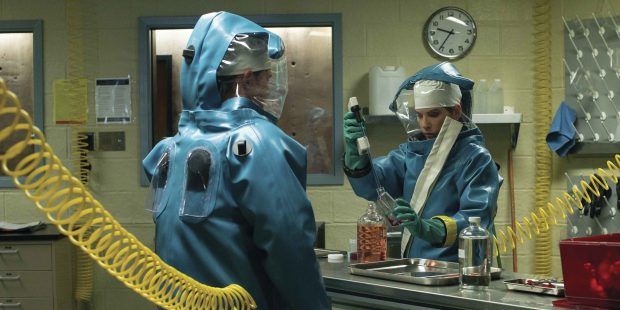
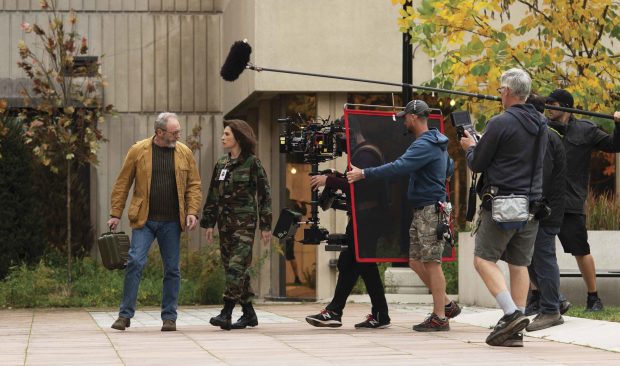
Liam Cunningham as Wade Carter and Julianna Margulies as Dr. Nancy Jaax during production of The Hot Zone in Toronto

Liam Cunningham as Wade Carter and Julianna Margulies as Dr. Nancy Jaax during production of The Hot Zone in Toronto —Photo by National Geographic/Amanda Matlovich

But something else had changed, Obst says: Television entered a golden age. Even Jerry and Nancy Jaax, central figures in Preston’s book, were amazed when the production came together after all this time. “They’d given up on it,” Obst says. “They all think I’m a miracle worker. But the truth is that I’m not a miracle worker: Media has changed. Television grew up, became great, and we were able to take advantage of that.”

Though she says the outbreaks are only a coincidence, they make the series resonate.

“Unfortunately, Ebola did not go away, but Ebola showed its ugliest head in Sierra Leone, became the outbreak that was warned about in Richard Preston’s book, and then simultaneously, this venue developed called ‘Nat Geo,’ in which you could do these things called limited series, which we used to call miniseries, but they were shorter,” she says. “These are at least double the length. And in this venue, you can do the real science.”

Because Fox—now part of Disney after the Hollywood megadeal—owned the intellectual property as well as the National Geographic Channel, Obst saw a way to do the series under the Fox umbrella, and with Ridley Scott’s television production company, Scott Free. “It got to be a better show than it would have been as a movie,” she says.

Preston agrees. “There’s been a sea change in how television series are made and produced and distributed. It’s the Netflix phenomenon,” he says. “The whole story of The Hot Zone has always lent itself to television far better than to a two-hour feature film. You just can’t get the story into a two-hour feature film and preserve the muscularity and the drama of the story.”

Far from the familiar Hollywood scenario in which writers sign away the rights to their work and watch helplessly as it takes a form they never imagined, Preston became deeply involved in the National Geographic series.

“He’s a very important part of the brain trust,” Obst says.

As a co-executive producer and consultant, Preston not only served as a liaison between the production and the real-life characters;he also was a fact-checker on the science, working closely with showrunners Kelly Souders and Brian Peterson on the scripts.

He went through the episodes line by line with them, “getting down to the nitty-gritty of the science,” Preston says. “The end result is that the audience is going to see something that really feels authentic. It’s like you go onto a car lot, you want to buy a car, and you slam the door and nothing rattles.”

Preston also made suggestions to make the series more realistic or dramatic. In one scene where Jaax puts on a protective biohazard space suit as she and a soldier prepare to go into Biosafety Level 4—the extraordinarily dangerous containment area for lethal viruses for which there is no vaccine and no cure—Preston flashed back to his own experience.

“I’m not going to tell you what it is, but it’s what they did to me the first time I went in with a space suit on,” he says. “I told Kelly and Brian about that. I said, ‘This is what Nancy Jaax is going to do to this soldier,’ and they go, ‘Oh my God, yes.’”

With the Hot Zone television series likely to boost sales of the original book, Preston went to work on a revised edition, with scientific updates reflecting what is now understood about Ebola and related viruses that wasn’t available when he wrote the book, including exactly what killed the Danish boy known by the pseudonym of Peter Cardinal, who became ill after entering Kenya’s Kitum Cave.

Slight additional revisions refine the gruesome descriptions of victims’ bleed-outs, a part of the book Stephen King called “one of the most horrifying things I’ve ever read in my whole life.”

And although Preston has written other books in the interim, his next book, Crisis in the Red Zone, is a successor to The Hot Zone and will be published by Random House in July.

“I don’t want to give away too much, but it’s about emerging viruses—viruses coming out of natural ecosystems and invading the human species,” he says.

The original Hot Zone will come to life not on the silver screen but on the small screen, opening May 27 with a three-night run. Like the lethal virus itself, the project retreated and re-emerged, perhaps a stronger version of itself.

The final words of Preston’s book The Hot Zone now seem doubly prophetic:

“It will be back.”

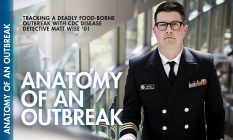
Anatomy of an Outbreak

Anatomy of an Outbreak pane
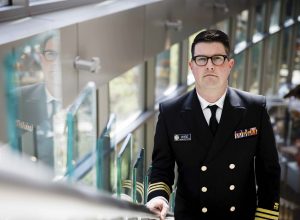
Matt Wise ’01

Photos by Dustin Chambers

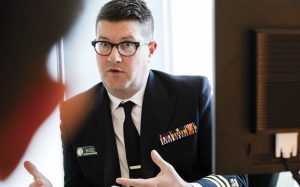
ON A SWELTERING Monday afternoon last September, a few minutes before 3 o’clock, Matthew Wise ’01 hustled down the hall from his office to a windowless conference room at Atlanta’s Centers for Disease Control and Prevention (CDC) headquarters. Nearly three dozen scientists had crammed in there for the weekly meeting. At the head of the table, Wise slid into his swiveling chair, trying his best not to wrinkle his neatly pressed commander’s uniform.

His team of epidemiologists soon fired off one-minute updates of roughly 30 different food-borne illness outbreaks. He stared at a giant flat-screen filled with bar charts, hoping to triage minor threats from the major ones. Cyclospora outbreak caused by vegetable trays? Fully contained. Listeria linked to deli ham? Under control. Then came the details of a cluster that demanded his full attention: more than 60 infections caused by Salmonella Newport across the western U.S. He could see that the bacteria strain had slowly spread across the country and was sending dozens of people to the hospital.

A member of the U.S. Public Health Service Commissioned Corps, Wise had climbed the ranks of the CDC thanks to his skill as a disease detective. Now a senior official with the federal agency’s Outbreak Response and Prevention Branch, he had the power to act swiftly and decisively. If he made the right choice, he might prevent thousands more from falling ill or even dying. But act too slowly or too fast—particularly by lobbying for a recall—and his team might expose the CDC to the ire of industry and the public at large.

Weighing his options, Wise figured this Salmonella strain was trickier than most. That’s because a new wave of food-borne illnesses had swept the nation in recent years. Unlike traditional outbreaks—which ended nearly as fast as they began—cases were unfolding over longer periods and wider distances. Wise also sensed that these Salmonella infections were the tip of the iceberg. As a general rule of thumb, only one in every 30 people affected by a food-borne illness typically reported being sick. The well-being of thousands of people was likely at stake.

Identifying the outbreak pattern was the easy part. The hard part—discovering the source of the Salmonella—came next. To do so would require a small army of nearly 250 people from more than three dozen agencies. Investigators would ask fathers who’d just left the hospital to recall what they’d recently ordered for dinner. They’d also persuade mothers to search their purses for grocery store receipts. Instead of charging full speed ahead with an investigation, Wise wondered if the agency’s best shot at solving this mystery was to look back to a previous investigation the year before that had gone unsolved. Perhaps an older clue—a fingerprint—might crack open this case.


 Matt Wise ’01NINETY-SEVEN PERCENT of America’s food-borne outbreaks are confined to a single source in a single state. Wise says these kinds of outbreaks can be caused by anything from chicken at a church supper left uncovered for too long to a fast-food restaurant kitchen forgetting to wash lettuce. When a food outbreak occurs, he said, local and state health inspectors are usually the ones handling the response.
The other 3 percent of outbreaks are the ones that wreak havoc on America’s health systems. Of the food-borne outbreaks reported to the CDC, they’re responsible for a 10th of the reported sicknesses, a third of the hospitalizations, and more than half of the deaths.

It’s the job of the Outbreak Response and Prevention Branch to spot an outbreak that crosses state lines and, once it does, to help guide the national investigation. Officials of the branch are sort of like agents of the Federal Bureau of Investigation. Except, instead of tracking serial killers, they’re tracking killer lettuce.

To understand food investigations, according to Wise, you need to know how food production has changed in recent decades. Not only is food being produced by fewer companies—thanks to increased consolidation—it is also traveling longer distances to reach consumers. Because of that, Wise says parts of his branch’s job have grown increasingly tough, with outbreaks now spanning the entire nation. But the challenges have also bred opportunity: The CDC is helping reshape how state and federal agencies respond to pathogens such as Salmonella, E. coli and Listeria.

In a given year, Wise’s epidemiologists will have 200 potential cluster outbreaks. Before one crosses his desk, several steps must be taken. First, when a person gets seriously ill from a potential food-borne illness, a doctor collects a stool sample for testing at that hospital’s clinical lab. A technician will then isolate the bacteria and ship the sample to a laboratory that’s part of PulseNet, a network of more than 80 labs, to create a DNA fingerprint. That fingerprint is sent off to a CDC lab in Atlanta. It will eventually make its way up to Wise’s team, who will analyze patterns of illnesses, connecting each like a detective uses yarn on an evidence board.

“If we see there are people in California and Texas and Illinois that all got sick around the same time, from the same fingerprint, that says to me that people have maybe gotten sick from the same thing,” Wise says. “This lets you pull needles from a haystack and see what they have in common.”


THE OLD CLUE WISE thought might be helpful came from a previously unsolved Salmonella Newport outbreak that he had first learned about in late January 2017. By then, roughly four dozen cases with a similar bacterial strain had been identified in California, Arizona and Texas. In just weeks, five times as many states had reported similar strains. Soon, local investigators were dispatched to ask sick people hundreds of questions about their recent food consumption and purchasing patterns. The best Wise could tell, ground beef was the likely culprit.

With a decent hypothesis, Wise’s team sought more data to lead the team toward the contamination’s original source. So they advised local investigators to learn more specifics about how the ground beef had been cooked and consumed. Wise’s team also urged the U.S. Department of Agriculture (USDA), which regulates ground beef, to collect further evidence about whether people had purchased a certain brand of ground beef from a grocery store. By compiling those answers, Wise says, they hoped to be able to trace back the Salmonella. That might lead the USDA to recall a product, close production facilities or persuade a manufacturer to voluntarily take its product off the shelf.

That strategy, it turned out, led to a minor breakthrough. Sick people had been purchasing five-pound chubs of ground beef. One Colorado public health official even collected leftover ground beef from a patient’s home—and it tested positive. Wise and his colleagues eventually realized that the Salmonella outbreak was not just linked to those chubs but also to some dairy cows in New Mexico. At that point, however, they hit a snag: The strain found in cattle couldn’t be connected back to a single slaughterhouse. Questions ran through Wise’s mind: Was the problem with one farm’s cows? Or was there a widespread strain in cattle?

“If it came from 10 states and 10 slaughterhouses, maybe it’s connected, but we’ll do more research,” Wise said. “A lot of the time, we’re looking to see if the same facility produced all of it—if the people who got sick all ate the same thing from the same line, produced in the same hour and at the same facility.”

Wise hoped a new kind of technology would crack open the case. For years, scientists in the PulseNet network had used a technique known as pulsed-field gel electrophoresis (PFGE) to create a fingerprint for a bacteria’s DNA. But PFGE wasn’t precise enough to parse out Salmonella strains that were extremely similar to one another. So epidemiologists struggled with statistical “noise” that made it hard to spot which cases were directly linked to ground beef.

The CDC had recently begun shifting toward a more advanced tool—whole-genome sequencing—which allowed them to reconstruct the genome of each bacteria’s DNA, putting each nucleotide together like the pieces of a jigsaw puzzle. But the CDC hadn’t yet fully rolled out the tool for Salmonella cases in real time. The delayed use of the technology, along with the complexity of the ground beef outbreak, stopped the investigators in their tracks. Of the 106 cases ultimately reported, one person died and 42 people were hospitalized.

Matt Wise ’01“We never figured it out,” Wise said.
 

TWO DECADES AGO when Wise arrived at Pomona College, he was more interested in treating illness than tracing its cause. As a high school student, the Sacramento native grew interested in health care after hearing a talk about San Francisco’s needle exchange. But by his sophomore year, he no longer wanted to pursue a medical degree. “The chemistry classes were disconnected from actual health and medicine,” he said. “And, frankly, I was shitty at organic chemistry.” So his coursework shifted toward social sciences—anthropology, psychology and sociology.

During his sociology of health and medicine course, he was first introduced to the CDC’s Epidemic Intelligence Service, a two-year program for postgraduate fellows who are among the first to respond to public health emergencies. After graduating from Pomona, he was hired as an epidemiologist at Los Angeles County’s public health department. Simultaneously, he worked toward his Ph.D. at the University of California, Los Angeles, which later helped him get accepted into the U.S. Public Health Service Commissioned Corps. He moved to Atlanta but traveled coast to coast, helping to investigate outbreaks in hospitals.

“Investigating outbreaks is like the emergency room of public health,” he said. “You don’t have the luxury to pontificate. In academia, you can obsess over little details for a really long time to get a perfect analysis. I was working in environments where you make real decisions in real time.”

During one of his earliest multistate cases at the CDC—a fatal outbreak of fungal meningitis—Wise was assigned to work with employees from the Outbreak Response and Prevention Branch. Their job seemed fascinating. So in 2013, Wise shifted to that team, where he guided epidemiologists through investigations into food-borne illnesses related to frozen pizza snacks and tahini sesame paste. Last year, he was again promoted—this time to the role of deputy chief of his branch.

Beyond overseeing investigations, he was tasked with speaking to the press and, at times, taming the public’s outrage toward the CDC. He explained the basic functions of the agency, like the fact that it doesn’t usually order recalls, or that outbreak investigations take longer than just a few days. While Wise’s work with food-borne illnesses hasn’t changed his diet—he still eats most things, except for raw sprouts—it has changed the way he sees food systems.

“There’s a huge amount of machinery,” Wise said. “I view food more as a product of these complex and massive systems where, if just a couple of little things go wrong, you can have bad results.”


IN LATE SEPTEMBER 2018, weeks after that initial 3 p.m. meeting, Wise finally got to see more data. A familiar suspect—ground beef—was causing more problems.

His epidemiologists had already worked with state health departments to obtain sick patients’ shopper records. But the CDC was once again seeing a “noisy” PFGE pattern, complicating the process of finding a single Salmonella source. This time, however, they could use whole-genome sequencing in real time. The results allowed Wise’s team to see that a third of the initial cases weren’t relevant to this investigation at all. Of the remaining ones, they managed to interview 22 people about their ground beef purchases. Twenty-one said they had consumed ground beef.

“It pulled a signal from the noise,” Wise said. “And it allowed us to definitively say that the [unsolved] outbreak was connected to this one.”

With that information, USDA investigators tracked down more shopper cards and beef grinding logs, which showed that a disproportionate number of cases linked back to several Sam’s Club stores located in Wyoming, Utah and South Dakota. Then, another breakthrough: A beef sample purchased by state officials at a California discount grocery store also contained the same strain. That packaging contained an establishment number—EST. 267—which helped trace back the Salmonella source to a beef plant just outside Phoenix.

In late September, Wise’s team sent over their findings to USDA officials, who then approached the plant’s owners: JBS Tolleson. Faced with the evidence, JBS Tolleson agreed to cooperate with the federal government. Between Oct. 4 and Dec. 4, JBS Tolleson voluntarily recalled more than 12 million pounds of beef products. The recall, one of the largest of its kind ever, impacted hundreds of grocery stores from Florida to Washington.

This past March, Wise returned to the windowless conference room and stared at the TV screen full of charts. When the Salmonella outbreak came up, he could finally see the full damage it had caused. Over a six-month period, more than 400 people had gotten sick in 30 different states. Nearly a quarter had been hospitalized. This time, though, no one died.

Wise breathed easily—but only for a moment. Another outbreak, he knew, would soon be on its way.

The Face of a Pandemic

The Face of a Pandemic pane

Adolfo Sartini

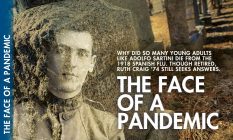
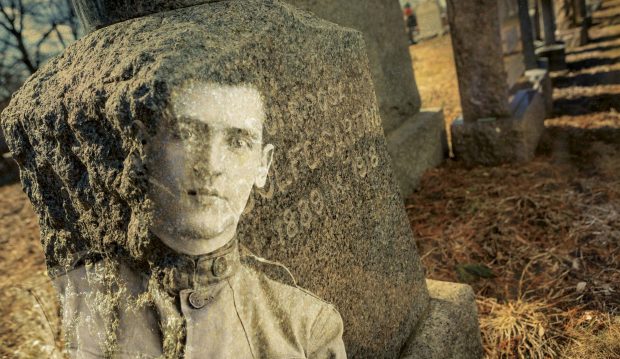
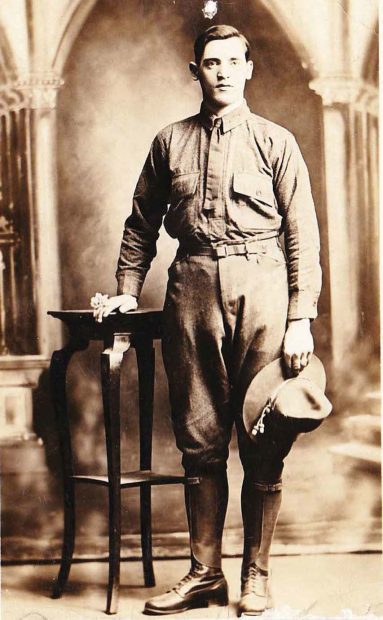
ADOLFO SARTINI WASN’T SUPPOSED TO DIE from the flu. He was 29 years old, healthy and strong; he had answered the draft in 1917 and was picked to work as an Army engineer. And yet, the things that should have protected Sartini actually made him an utterly typical victim of the virus that killed him: the notorious 1918 “Spanish” flu.

Adolfo Sartini

Adolfo Sartini in uniform

Extending over the world in three deadly waves, the 1918 flu infected some 500 million people and killed at least 50 million—as much as 5 percent of the world’s population, though it is hard to pin down a precise figure—placing it among the deadliest pandemics ever recorded. So many died so quickly that cities ran out of coffins. Extra gravediggers were called up by the hundreds, and when there weren’t enough gravediggers, steam shovels came in to dig mass graves for the bodies that were piling up in morgues and on roadsides.

The virus piggybacked on World War I troop movements and was sustained by soldiers’ close quarters, yet it also spread to people and places far removed from the war. And the world was all but defenseless against it: without vaccines, antibiotics or antivirals, patients made do with rest, fluids, fresh air and prayer.

The 1918 flu was a killer, and it was also a puzzle. Unlike most flu strains, which are deadly mostly to the very young and the very old, the 1918 flu disproportionately struck down young adults. Graph typical seasonal flu deaths according to age, and you get a “U” shape, with high mortality among babies on the left and the elderly on the right, and a strong, healthy trough in the middle. But when you plot out deaths from the 1918 flu, you get a “W” instead, with the peak centered near age 28—almost exactly Adolfo’s age when he died.

For decades, researchers have been trying to understand what made young adults like Sartini so vulnerable to this particular flu. Maybe people over 40 had already been exposed to similar strains and built up some immunity, while younger ones were immuno­logically unprepared. Maybe soldiers like Sartini were already weak from other infections, like tuberculosis. Maybe young, healthy people suffered from an overactive immune response—a so-called cytokine storm, named for proteins that help direct the body’s immune response—that damaged their lung tissue and allowed fatal infections to establish themselves. Or maybe it was all of those things at once.

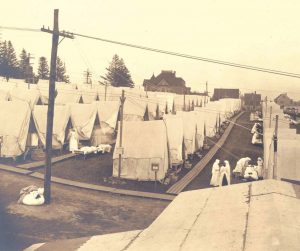
Rows of tents at Emery Hill in Lawrence, Massachusetts, where victims of the 1918 influenza pandemic were treated. —Photo courtesy of the National Archives

Rows of tents at Emery Hill in Lawrence, Massachusetts, where victims of the 1918 influenza pandemic were treated. —Photo courtesy of the National Archives

It’s a puzzle that fascinates Ruth Craig ’74. That’s because Sartini’s story embodies her two life’s passions: molecular biology, which she researched and taught for more than 20 years from her labs at Johns Hopkins University School of Medicine and the Geisel School of Medicine at Dartmouth, and genealogy, which she discovered later on and took up as a second career when she moved from active to emeritus professorship. “The two tracks seem very different but actually intersect,” says Craig, “and that intersection is the flu.”


IN 1987, AS A BRAND NEW FACULTY MEMBER at Johns Hopkins University School of Medicine, Craig led a research team that discovered a gene that helps control whether cells live or die. The gene, called myeloid cell leukemia-1, or MCL1, is a member of a family of genes with similar jobs, and their involvement in leukemia surprised cancer researchers—it suggested that cancer isn’t just about runaway cell growth, but also about cells that fail to die when their time is up.

But MCL1’s influence goes beyond cancer, as Craig discovered over the course of many years examining the gene. In 2005, Craig was part of a team led by David Dockrell, an infectious disease researcher at the University of Sheffield, that looked at how MCL1 helps immune cells fight infection. They found that MCL1 makes a protein that helps signal immune cells called macrophages to attack bacteria. The macrophages swallow up the invaders, and they also recruit other immune cells to join their offensive. When levels of the MCL1 protein drop, macrophages get the signal to stand down and die off, taking their infectious “prisoners” with them and calling off the immune attack. The response is exquisitely tunable and can be turned on and off in different kinds of cells with laser precision and speed. But what would happen if, for some reason, it failed to turn off on time?

Craig and Dockrell tried to answer that question. Their team started with mice with an MCL1 gene that caused them to overproduce the MCL1 protein. Then, the researchers gave those mice bacterial lung infections. Mice with the modified gene could not clear the infection. Moreover, their lungs were overwhelmed with inflammatory cells. The macrophages, it seemed, didn’t know when to die—so while the immune system kept up its attack, the bacteria went on multiplying, and the mice got sicker and sicker.

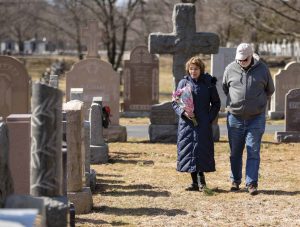
Ruth Craig ’74 and Bob Sartini visit St. Michael Cemetery in Boston, where Spanish flu victim Adolfo Sartini is buried.

Ruth Craig ’74 and Bob Sartini visit St. Michael Cemetery in Boston, where Spanish flu victim Adolfo Sartini is buried.

This is where Craig’s gene intersects with Sartini’s story. That’s because if he was like most flu victims, Sartini didn’t actually die from the flu, but from a bacterial lung infection that set in afterward. Craig wondered: Could he have died—too young, too early—in part because some cells in his body died too late?


BOB SARTINI KEEPS HIS GREAT-UNCLE Adolfo’s Army chest in his living room in Vermont; on the wall of his Boston apartment, he hung oval-framed pictures of his grandparents and a memorial certificate from the U.S. Army commemorating Adolfo’s supreme sacrifice in World War I. When his grandfather died, Bob says, the certificate “was basically on the trash heap,” Bob became friends with Craig in the late 1970s, when they worked down the hall from each other at Boston University School of Medicine (Bob, who is now retired, spent his career there), and she had the certificate framed for him as a birthday present. “From then on, it’s been on the wall in my house.”

Bob imagined filling up Adolfo’s old Army chest with “period things,” artifacts that would tell the story of Adolfo’s life, but the family lore was meager. Bob knew Adolfo had followed his brother Eugenio, Bob’s grandfather, from Italy to America. He knew that he had spent time working at a country club in Newton, Massachusetts, before enlisting in the Army, and he knew that Adolfo had died young, of the flu. But he wondered: Why did Adolfo enlist? Did Adolfo know that because he was not a U.S. citizen and had not  w  declared an intention to become one, he was not required to answer the draft? Did he deliberately pass up this exemption so that he could step forward to defend his chosen home? And how to make sense of the irony of a healthy soldier being struck down not by shells or machine guns but by something as mundane and typically benign as the flu?

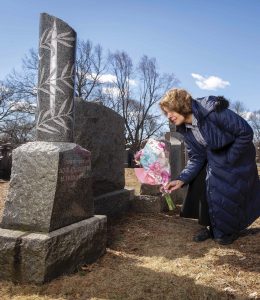
Ruth Craig ’74 places flowers on the grave of Adolfo Sartini, who died of the Spanish flu in 1918.

Ruth Craig ’74 places flowers on the grave of Adolfo Sartini, who died of the Spanish flu in 1918.

Bob wondered about this off and on over the years, going so far as to contact the National Military Personnel Records Center, but they could offer no help: Adolfo’s records had burned up in a 1973 fire that destroyed more than 16 million Army and Air Force personnel files.

Then, around 2013, Craig mentioned that she was working on becoming a certified genealogist and needed a project—something specific and preferably something in Massachusetts, where, unlike New Hampshire, birth and death records weren’t kept sealed. Adolfo seemed perfect.

Craig began by tracking down the register for the ship that brought Adolfo to America. The register listed his birthplace in a farming region of Italy. Then, from her desk at Dartmouth, she pored over digitized images of 19th-century Italian record books. Finally, she found Adolfo’s birth record and birthdate: Feb. 8, 1889.

But what Craig really wanted to find was his death certificate. Not sure where to look next, she posted to an online military history forum, where an expert in World War I history pointed her to a military base that trained engineers, Camp A.A. Humphreys, in Virginia. A search of Virginia death records confirmed it: Adolfo died at the Virginia training camp, far from home and far from the front lines, of a sickness that was one thing that the broken world had in common.

While Craig was searching genealogical records, she was also poring over the scientific literature on the flu, hoping to answer the question that was rising up in her mind: Why did it kill someone like Adolfo?

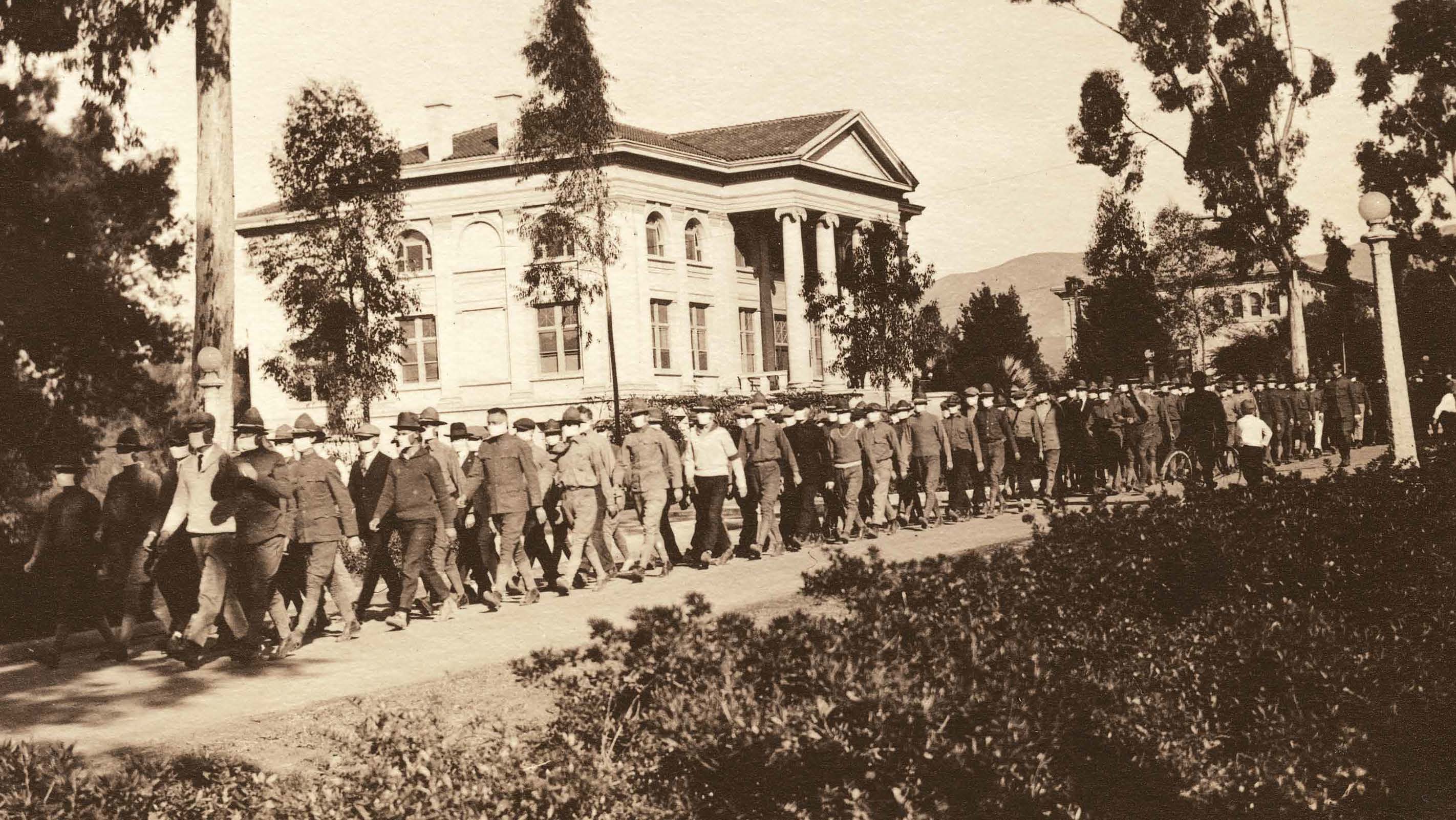
Soldiers parade in front of the Carnegie Building on Armistice Day, Nov. 11, 1918, wearing surgical masks to protect themselves from the Spanish flu.

Soldiers parade in front of the Carnegie Building on Armistice Day, Nov. 11, 1918, wearing surgical masks to protect themselves from the Spanish flu.

The Spanish Flu at Pomona

It was Nov. 11, 1918—Armistice Day. The global catastrophe that was World War I was finally over, and people everywhere were celebrating. But as soldiers paraded down College Avenue in Claremont, it wasn’t hard to see that the celebration was tempered by worry and caution. Every man in the parade was wearing a white surgical mask to protect himself from the scourge that was striking down the young and fit across the country.
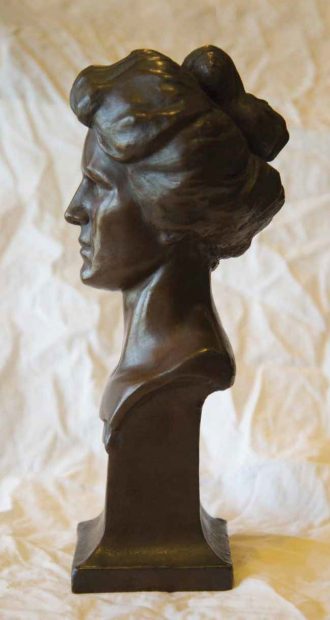
But whether through luck or caution, the pandemic claimed only one life on the Pomona campus. A previously healthy young woman named Viola Minor Westergaard, the wife of Pomona faculty member Waldemar Westergaard, succumbed during the final throes of the epidemic, on Jan. 7, 1919. Viola’s parents later donated a collection of books and other items to Honnold-Mudd Library in her honor, including a bust of her face by artist Burt Johnson.
—Mark Wood

Bust of Viola Westergaard, the only victim of the Spanish flu on the Pomona campus

Bust of Viola Westergaard, the only victim of the Spanish flu on the Pomona campus

Flu viruses are always changing, accumulating small genetic mutations and, once in a while, making more radical shifts that constitute entirely new flu subtypes—not just variations on a theme but fresh, unfamiliar melodies. This year-to-year change explains why getting the flu this year doesn’t mean you’ll be protected against it next year. It also helps explain why older people are sometimes spared the worst of a flu that seriously sickens younger ones: Their immune systems remember similar strains that circulated decades ago and can mount some defense, even if it is an imperfect one.

For instance, some 80 percent of those who died from the 2009 “swine flu” pandemic were under 65—turning the expected mortality statistics for seasonal flus on their head. Why were younger people  w  likelier to get sick and die of swine flu? Researchers think that older people had been exposed to similar flus, including the 1918 flu, in the early 20th century, and therefore had some protection against the 2009 version.

Yet that can’t completely account for the 1918 flu’s W-shaped curve and the peculiar vulnerability of those who were born around 1889, like Adolfo. Craig’s search brought her to mathematician David Earn, who studies mathematical biology at McMaster University in Canada. Earn and his colleagues have explored the possibility that a person’s very first flu—the one he or she encounters as a baby—makes a more powerful impression on the immune system than any other. This hypothesis, called “antigenic imprinting,” goes back to the 1950s and offers an appealingly parsimonious explanation for the W-shaped curve. If it is correct, Earn wrote, it means that your risk of dying from the flu has everything to do with the biological “distance” between your first flu and the one you happen to be sick with right now.


IN THE FALL OF 1889, a new flu broke out in St. Petersburg, Russia. Quickly, the flu spread west. (It may have actually already made its way through India and Central Asia before being reported in Russia.) Though it wasn’t as deadly as the 1918 flu, the flu of 1889 and 1890 is recognized as the first pandemic of the connected world. Extensive railroads linked the countries of Europe, and the United States was less than a week away by boat. In just four months, the “Russian flu” had gone full circle around the world. Little Adolfo was probably exposed when the flu hit Italy in 1890; he was not yet one year old.

“If the hypothesis is correct, Adolfo’s immune system was imprinted by the pandemic of ’89–90,” says Craig. When the 1918 flu, which was presumably a different subtype, came along, his body tried to fight it off, but brought the wrong weapons: “His body was responding, but it was primed to respond to the other flu. It didn’t deal well with the flu that he encountered in 1918.”

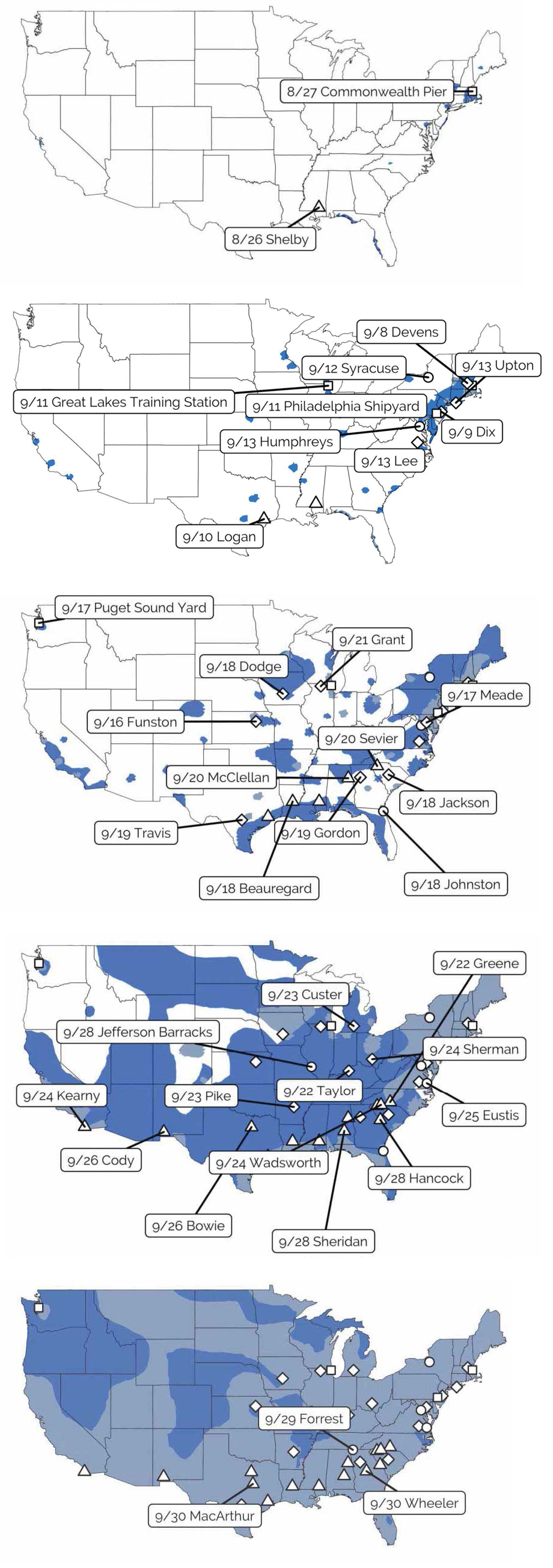
Pandemic’s Progress

Maps prepared by Ruth Craig ’74 and colleagues James Adams and Stephen Gaughan show how the Spanish flu hopscotched through military bases to blanket the country in barely a month, from late August to the end of September.

To test this hypothesis, Alain Gagnon, a professor of demography at the University of Montreal, along with Earn and other colleagues, looked for similar mortality patterns in other flu pandemics. Their results suggest that the 1918 flu was not unique: People born near the time of the 1918 pandemic were likelier to die during a 1957 “Asian flu” pandemic, and people born during that outbreak, in turn, were at greater risk during the 2009 swine flu pandemic.

A study published in Science in 2016 gave new support to the imprinting hypothesis. In that study, researchers looked at flu infection data from China, Egypt, Cambodia, Indonesia, Thailand and Vietnam. They figured out the “first flus” for every birth year between 1918 and 2015 and then compared that data against flu illnesses and deaths for two different flu types. Just as the imprinting hypothesis predicted, people were more likely to get seriously ill or die from flu subtypes that were very different from their first flu.

These correlations are suggestive, but they aren’t conclusive, points out immunologist Matthew Miller, who collaborates with Gagnon and Earn at McMaster. “We see it in epidemiological data, but there’s still not a biological explanation of what’s causing that to happen.” And the epidemiological data still leave key questions open: Perhaps the critical flu exposure happens before a baby is even born, says Miller, when a pregnant woman is infected with flu, sapping her body of resources that would normally be directed to the developing fetus. Or perhaps being exposed to any virulent disease as a baby imparts a lifelong fragility, normally invisible, that makes a person more vulnerable to future illness of any kind. Miller and his colleagues are currently working on testing these ideas.

Yet Miller can sketch out a rough story of what might have happened to Adolfo and other young-adult victims of the 1918 flu, if the “first flu” imprinting hypothesis is correct. “People who were exposed to the 1890 virus would have made antibodies against that virus and T-cells against that virus,” says Miller, describing proteins and immune cells that fight off infections. When the 1918 flu came around, their bodies could have responded with a rush of antibodies and T-cells that “remembered” the earlier flu. But the defensive assault might backfire: The mismatched antibodies would be ineffective, and the T-cells could run riot, making the victim sicker and sicker.

There may be no single explanation for what made young people like Adolfo Sartini so vulnerable in 1918; imprinting probably combined with other factors to create a particularly deadly risk profile. After all, most people who got the 1918 flu, even those born around 1889 and 1890, recovered just fine.

But in Adolfo’s story, Craig sees the shadow of MCL1 and wonders: Did MCL1 help his immune cells “remember” the Russian flu, and did that memory make it harder for him to clear the lung infection that took his life? Did it help unleash a deadly cytokine storm?

To Dockrell, it’s plausible that, at a minimum, Adolfo’s childhood infection with Russian flu may have made him more susceptible to complications of Spanish flu. In fact, in still-unpublished research, Dockrell and his colleagues have found that the flu virus can dial up MCL1 in lung cells, possibly making them more vulnerable to bacterial infections like pneumonia.

“This is total speculation, but in my mind the immune imprinting hypothesis and the cytokine storm hypothesis are not mutually exclusive,” Craig says. “They could both have been at work in 1918.”

Whatever made the 1918 pandemic so deadly, one thing is clear: There will be a next time. And the more researchers know about what happened in 1918, the better prepared we will be to protect ourselves from future pandemics.

AFTER ADOLFO DIED IN VIRGINIA, his body was brought back to Boston, and he was buried at St. Michael Cemetery, a largely Italian cemetery about five miles south of downtown Boston and a few miles west of the Atlantic shoreline. On a chilly day in March, Craig and Bob met there and found Adolfo’s grave, which is packed close with others dated 1918: young children, elderly people, and many in the prime of life, like Adolfo.

A century later, memories of the 1918 flu are mostly like this—gravestones, fading certificates, old Army trunks. But among the headstones at St. Michael, Adolfo’s stands out. It is a granite cylinder carved with winding vines. At the top, it is cut rough. To Craig, it looks like a toppled column: a monument to a life built up and struck down. But the granite is surprisingly smooth, and the flowers she lays are fresh.

The story could begin again tomorrow.

Creating Answers

Creating Answers pane

Most of the research projects undertaken by students at Pomona, with the support of or in collaboration with faculty members, are of the kind known as “pure research”—that is, their aim is to add new knowledge to a field of study, not to pursue a specific application. Occasionally, however, those projects cross over into “applied research,” aimed at solving a specific problem in the real world. The following are illustrations of three such projects, all aimed at finding new solutions to problems in medicine or mental health.

Diagnosis by Breath

View the full, two-page Diagnosis by Breath infographic as it appeared in the print edition.

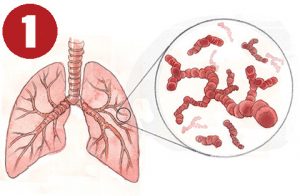
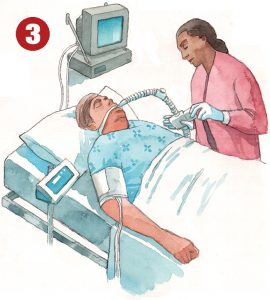
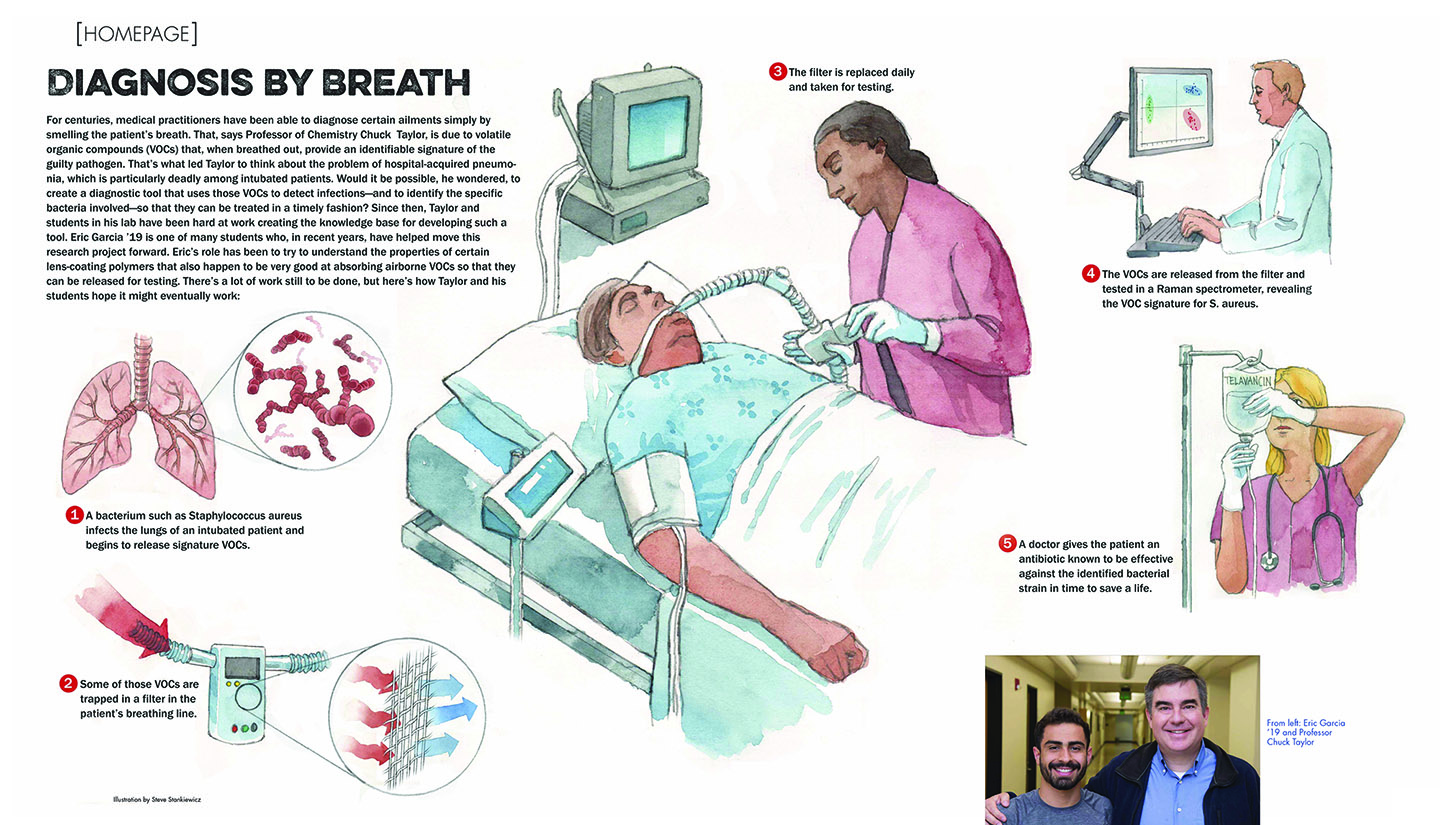
For centuries, medical practitioners have been able to diagnose certain ailments simply by smelling the patient’s breath. That, says Professor of Chemistry Chuck Taylor, is due to volatile organic compounds (VOCs) that, when breathed out, provide an identifiable signature of the guilty pathogen. That’s what led Taylor to think about the problem of hospital-acquired pneumonia, which is particularly deadly among intubated patients. Would it be possible, he wondered, to create a diagnostic tool that uses those VOCs to detect infections—and to identify the specific bacteria involved—so that they can be treated in a timely fashion? Since then, Taylor and students in his lab have been hard at work creating the knowledge base for developing such a tool. Eric Garcia ’19 is one of the many students who, in recent years, have helped move this research project forward. Eric’s role has been to try to understand the properties of certain lens-coating polymers that also happen to be very good at absorbing airborne VOCs so that they can be released for testing. There’s a lot of work still to be done, but here’s how Taylor and his students hope it might eventually work:

A bacterium such as Staphylococcus aureus infects the lungs of an intubated patient and begins to release signature VOCs.A bacterium such as Staphylococcus aureus infects the lungs of an intubated patient and begins to release signature VOCs.
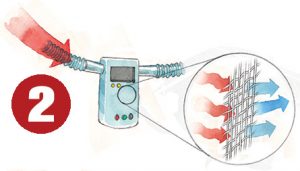
Some of those VOCs are trapped in a filter in the patient’s breathing line.

The filter is replaced daily and taken for testing.The filter is replaced daily and taken for testing.
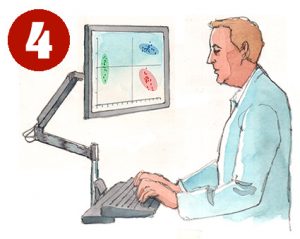
The VOCs are released from the filter and tested in a Raman spectrometer, revealing the VOC signature for S. aureus.The VOCs are released from the filter and tested in a Raman spectrometer, revealing the VOC signature for S. aureus.
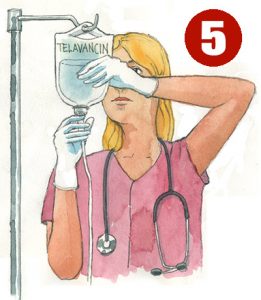
A doctor gives the patient an antibiotic known to be effective against the identified bacterial strain in time to save a life.A doctor gives the patient an antibiotic known to be effective against the identified bacterial strain in time to save a life.
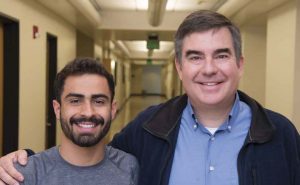
Eric Garcia ’19 and Professor Chuck TaylorFrom left: Eric Garcia ’19 and Professor Chuck Taylor


Autism and Virtual Reality

View the full, two-page Autism and Virtual Reality infographic as it appeared in the print edition.

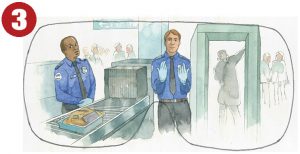
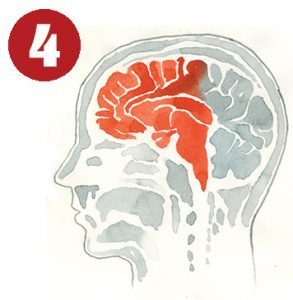
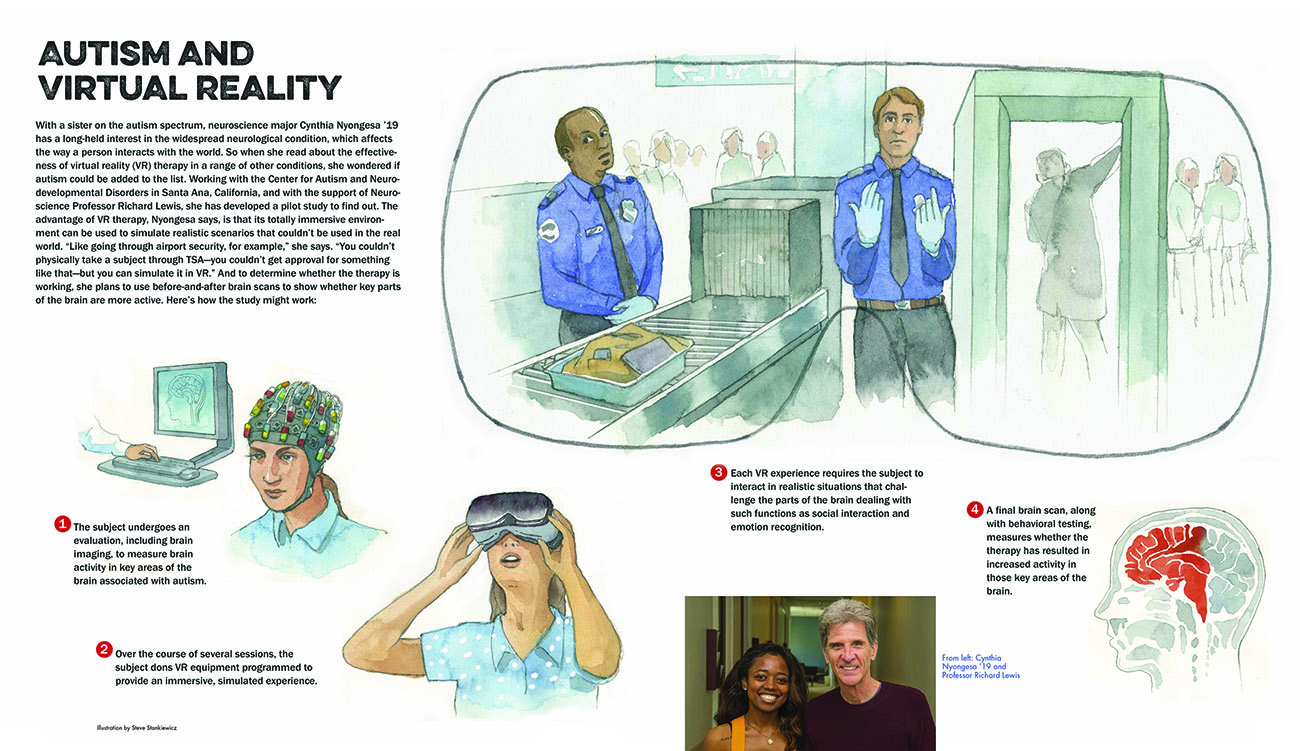
With a sister on the autism spectrum, neuroscience major Cynthia Nyongesa ’19 has a long-held interest in the widespread neurological condition, which affects the way a person interacts with the world. So when she read about the effectiveness of virtual reality (VR) therapy in a range of other conditions, she wondered if autism could be added to the list. Working with the Center for Autism and Neurodevelopmental Disorders in Santa Ana, California, and with the support of Neuroscience Professor Richard Lewis, she has developed a pilot study to find out. The advantage of VR therapy, Nyongesa says, is that its totally immersive environment can be used to simulate realistic scenarios that couldn’t be used in the real world. “Like going through airport security, for example,” she says. “You couldn’t physically take a subject through TSA—you couldn’t get approval for something like that—but you can simulate it in VR.” And to determine whether the therapy is working, she plans to use before-and-after brain scans to show whether key parts of the brain are more active. Here’s how the study might work:

The subject undergoes an evaluation, including brain imaging, to measure brain activity in key areas of the brain associated with autism.

The subject undergoes an evaluation, including brain imaging, to measure brain activity in key areas of the brain associated with autism.

Over the course of several sessions, the subject dons VR equipment programmed to provide an immersive, simulated experience.

Over the course of several sessions, the subject dons VR equipment programmed to provide an immersive, simulated experience.

Each VR experience requires the subject to interact in realistic situations that challenge the parts of the brain dealing with such functions as social interaction and emotion recognition.

Each VR experience requires the subject to interact in realistic situations that challenge the parts of the brain dealing with such functions as social interaction and emotion recognition.

A final brain scan, along with behavioral testing, measures whether the therapy has resulted in increased activity in those key areas of the brain.

A final brain scan, along with behavioral testing, measures whether the therapy has resulted in increased activity in those key areas of the brain.

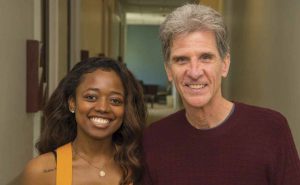
Cynthia Nyongesa ’19 and Professor Richard LewisFrom Left: Cynthia Nyongesa ’19 and Professor Richard Lewis
Depression and Social Media

View the full, two-page Depression and Social Media infographic as it appeared in the print edition.

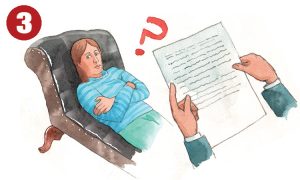
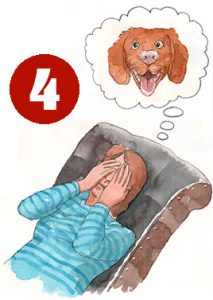
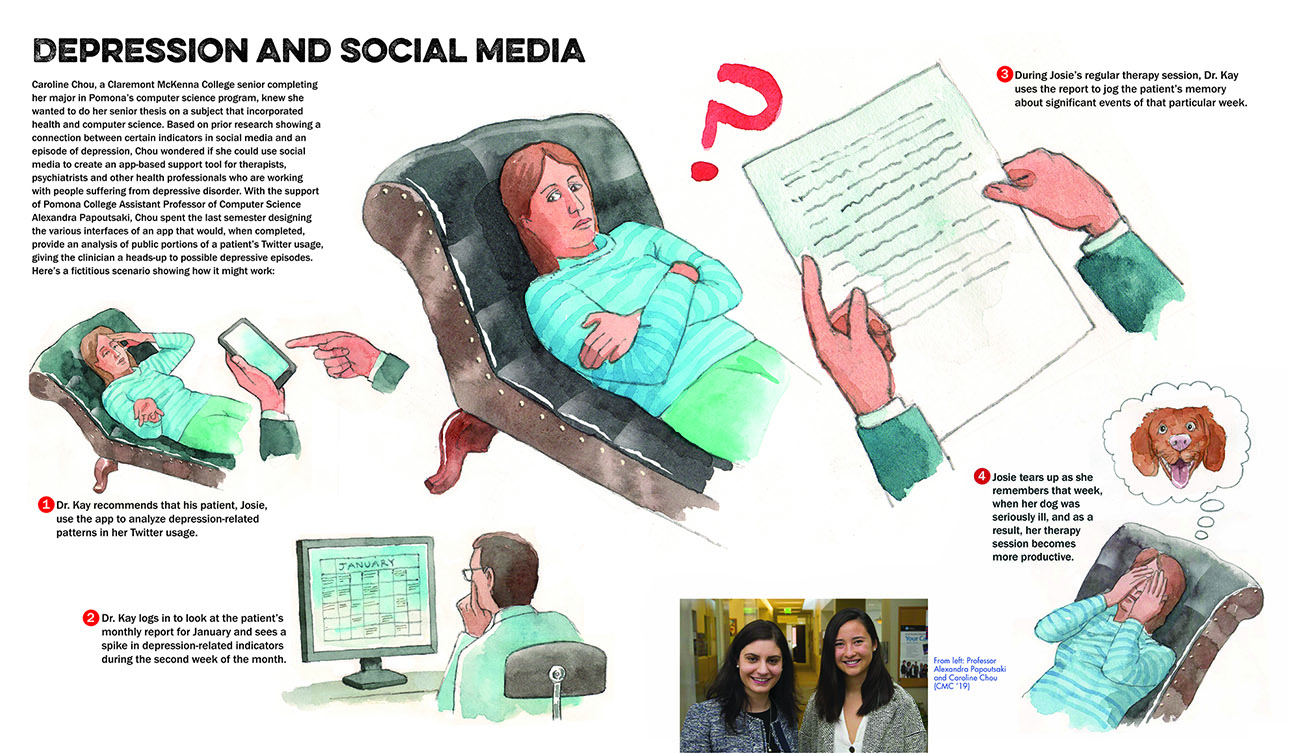
Caroline Chou, a Claremont McKenna College senior completing her major in Pomona’s computer science program, knew she wanted to do her senior thesis on a subject that incorporated health and computer science. Based on prior research showing a connection between certain indicators in social media and an episode of depression, Chou wondered if she could use social media to create an app-based support tool for therapists, psychiatrists and other health professionals who are working with people suffering from depressive disorder. With the support of Pomona College Assistant Professor of Computer Science Alexandra Papoutsaki, Chou spent the last semester designing the various interfaces of an app that would, when completed, provide an analysis of public portions of a patient’s Twitter usage, giving the clinician a heads-up to possible depressive episodes. Here’s a fictitious scenario showing how it might work:

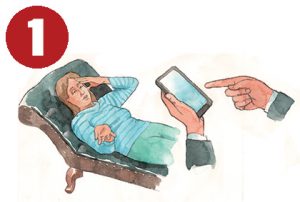
Dr. Kay recommends that his patient, Josie, use the app to analyze depression-related patterns in her Twitter usage.

Dr. Kay recommends that his patient, Josie, use the app to analyze depression-related patterns in her Twitter usage.

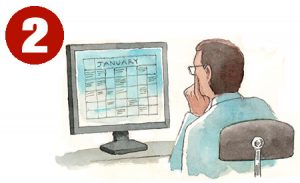
Dr. Kay logs in to look at the patient’s monthly report for January and sees a spike in depression-related indicators during the second week of the month.

Dr. Kay logs in to look at the patient’s monthly report for January and sees a spike in depression-related indicators during the second week of the month.

During Josie’s regular therapy session, Dr. Kay uses the report to jog the patient’s memory about significant events of that particular week.

During Josie’s regular therapy session, Dr. Kay uses the report to jog the patient’s memory about significant events of that particular week.

Josie tears up as she remembers that week, when her dog was seriously ill, and as a result, her therapy session becomes more productive.

Josie tears up as she remembers that week, when her dog was seriously ill, and as a result, her therapy session becomes more productive.

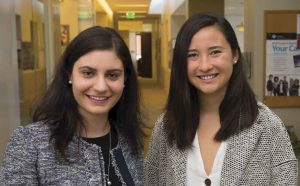
Professor Alexandra Papoutsaki and Caroline Chou (CMC ’19)From left: Professor Alexandra Papoutsaki and Caroline Chou (CMC ’19)
Where Claremont Meets Hollywood

Where Claremont Meets Hollywood

Where Claremont Meets HollywoodWANTED Lead Camera and Lights for a documentary-style film.”

“Congrats to Maximilian Zarou (PO ’99) on his upcoming TV appearance!”

“If anyone has a short or feature film they’d like to get into a festival, PM me.”

With nearly 2,000 members, the Claremont Entertainment & Media networking group’s Facebook page is a lively community of alumni of The Claremont Colleges who mostly either work in Hollywood or aspire to.

Founded in 2007 by a group that included actor Kelly Perine ’91, the network offers a clearinghouse for job openings, freelance gigs, congratulations and queries from alumni and current students of the seven Claremont campuses.

“I was on the ground floor of getting this puppy up and running, and after 10 years we’re on the brink of turning The Claremont Colleges into forces to be reckoned with, just like other universities that seem to have a stronghold on Tinseltown,” says Perine, who is currently appearing in Nickelodeon’s Knight Squad.

The Claremont Colleges have some Hollywood heavyweights in their corner, including Interstellar producer Lynda Obst ’72 and The Martian producer Aditya Sood ’97, who is also a Pomona trustee.

“What they’re doing is fantastic,” Sood says of the group, also known as CEM.

Before the last decade or so, students and alumni often discovered Claremont entertainment industry contacts either by digging hard or by accident, which is how Sood met his first show business contact, Greg McKnight ’90, now a partner at United Talent Agency. “I was a sophomore sitting in Honnold reading weekly Variety, the print paper,” Sood remembers. “All of a sudden this guy came up to me and said, ‘Oh, how long have they had that here?’ And I said, ‘Ever since I’ve been a student.’ And he said, ‘When I was a student here, I used to write letters to get [the library] to subscribe.’ Then he said, ‘Do you want to get lunch?’ and we did. We became really good friends and have crossed paths many, many times in business over the years.”

At the offices of Lynda Obst Productions on the Sony Pictures studio lot in Culver City, Obst’s right-hand woman is Katarina Hicks ’10, who reached out to Obst because of their Pomona connection and was hired as Obst’s creative executive. She since has been promoted to development executive. There are “tons of people my age in the ‘trenches’ making moves up the ladder,” says Hicks.

Obst proudly notes that one of her former Pomona interns, Justin Huang ’09, is now the head of development at Pearl Studio, the Shanghai-based animation studio formerly known as Oriental DreamWorks. Obst says the CEM group has grown “very strong,” and she continues to speak on the Claremont campuses and offer guidance to students and recent graduates.

“I have always responded to anyone from Pomona, and they’ve come to my office, and I’ve given them advice—but not when I’m in production,” Obst says. “Also, they’ve tended to be my smartest interns, because you know when you get a Pomona person, they can write English sentences; they can analyze scripts; they can speak well; they can think on their feet. I mean there’s just been a very consistently high quality.”

It is a competitive field, and a shared alma mater isn’t enough on its own. But Sood emphasizes the value of the preparation students receive at the 5Cs, as the Claremont undergraduate schools are known. “There’s a real literary component to what we do,” he says. “You’re reading books; you’re analyzing material; you have to have critical thinking and a lot of problem-solving in novel situations. I really think the liberal arts background is a perfect steppingstone for this kind of work.

“The advice I give every time I talk to students is something I didn’t really have but I think would have been great to have: Try to find the other people on campus who also want to do this, and get to know them now. Get to know them as students, because they will form the nucleus of your network that will last you throughout your entire career.”

Storytelling for Kids

Storytelling for Kids thumbnail

The Ethan I Was BeforeA storyteller from childhood and now an all-grown-up author, Ali Standish ’10 is writing children’s and middle-grade books that are being noticed by children and critics alike.

Her first book, The Ethan I Was Before, received a coveted starred review from Publishers Weekly: “Readers will be riveted.” Her debut was an award-winner, racking up accolades like the Children’s Book Review Best Book of the Year and the North Carolina Young People’s Literature Award, and landed on a slew of long-lists, including being named a Carnegie Medal Longlist Title.

August Isle, Standish’s second book published by HarperCollins, was released in April and is a work with themes of secrets and lies. A Junior Library Guild Selection, it was praised by Kirkus Reviews as “a beautifully written story. An emotional journey of family, friendship, loss, and healing.”

August IslePomona College Magazine’s Sneha Abraham talked to Standish about inspiration, imagination, what’s an absolute must in children’s literature and more.

PCM: So, why writing? What led you down this path?

Standish: You know, it’s hard to say that I chose writing. This sounds very cliché, but I think writing more so chose me, or at least storytelling did. A lot of my earliest memories are of making up stories about things. And from when I was really little, my mom and I would play storytelling games. So it’s always been something that I needed to do as a creative outlet. I wrote my first manuscript when I was in the sixth grade and have been writing ever since. When I was at Pomona, I was fortunate to be able to take some creative writing classes with [poet and former Pomona College Professor of English] Claudia Rankine, and it was wonderful. I also was able to do creative writing as part of my study-abroad curriculum in Cambridge.

Bad BellaI’ve just been doing it for really as long as I can remember. Then one of my really good friends, an important person in my life, passed away in fall of my senior year. And a big part of coping with that for me was writing my first children’s lit manuscript. I wrote a manuscript that was a very boilerplate, poorly written fantasy novel. And I was able to submit that as my final project for Children’s Literature 101. So senior year was when I really edged over into writing children’s literature.

PCM: Talk about why you moved into children’s literature.

Standish: Astrid Lindgren, who is the author of the Pippi Longstocking series, has this great quote about how she only wants to write for children because children are the only ones who can perform miracles when they read. That quote really resonates with me because I just have such powerful memories of being a reader as a child. And what a sacred experience that was for me and a formative experience. To be a part of creating that for another generation of children, I think, is probably the most rewarding thing that I can imagine doing.

PCM: Where do you get your ideas from?

Standish: I think every book that I’ve written so far has started with a kernel from my own life experience. With The Ethan I was Before, that book really started with the grief that I felt after losing the best friend that I mentioned earlier. With August Isle, it started with a trip to Indiana for a family funeral where I was reminded of a family secret that stoked some curiosity for me, and that I thought could potentially make a good book. Then with Bad Bella, that book is actually based on my own dog, Bella. The one I have coming out in the winter, called How to Disappear Completely, is actually about a girl who gets vitiligo, which is a condition that my husband was diagnosed with a couple of years ago.

It always starts with something from my life experience. Then it becomes a process of finding enough other inspiration in the world around me to take that seed of truth and turn it into a story that is not my story, that is something new and exciting. I was just working on my launch-party speech for August Isle, and I was comparing it to being a kid hunting for Easter eggs. It’s always that hunt of keeping your eyes out wherever you go and waiting for those interesting people to cross your path, or a news article that has something in it that you are  drawn to.

And then once you have those different kinds of sources of inspiration, it’s pulling them together and trying to find the connections between them. Because I think how you make the connections between the  different elements of your story is how you make your story unique. There’s no subject that hasn’t been written about; it’s how you write about it and what you connect it to that makes it interesting. So that’s the part  of the process that really is my favorite part, that gets my neurons really firing—thinking about how to bring things together in a  new way.

PCM: How do you feed your imagination? You’re looking for new ways of telling things. What do you do to stoke that fire?

Standish: I read—that’s the main thing. And then I have an overactive imagination. The positive manifestation of that is that I am quite easily able to take someone passing me on the street and create a story around them. The downside is that I have a lot of anxiety in things, and I think that is also a product of imagining different scenarios. Let’s see. I travel whenever I can. That is really helpful. In August Isle, there’s a character who is an old and wizened seafarer who has just come back from a long journey around the world. Being able to rely on what I’ve learned from being in different places is really helpful in that, and it’s cool to be able to introduce those places and different concepts to young readers.

PCM: What’s your favorite book or books from your childhood?

Standish: The two that I always go back to are Bridge to Terabithia by Katherine Paterson and The Lion, the Witch and the Wardrobe by C. S. Lewis. I read both of those books in fifth grade, which was a really transformative and transitional year for me. They are interesting counterparts to one another because they’re both about children who find magic worlds. And in one they stumble into Narnia. But in Bridge to  Terabithia they create that world for themselves. That idea really intrigued me. I lived in kind of a rural place that had a little forest in the backyard, and I just decided that my backyard was going to be my magical kingdom and called it “Nabithia,” because I hadn’t learned a lot about originality at that point. I just took Narnia and Terabithia and stuck them together, and I brought that into our playing make-believe. I kept a diary in the hollow of a tree, where I would write down these different episodes that I created for myself. And that was a really foundational experience for me in learning how far I could stretch my imagination and what I could do with it.

PCM: Nature plays a big role in your writing. Can you talk a little bit about that?

Standish: Yes. I wrote The Ethan I Was  Before after my husband and I moved to England. I didn’t know anybody. I had no job prospects. I was very isolated. And I was really homesick and particularly homesick for the American South. So writing the  setting for The Ethan I Was Before—writing that town of Pam Knot, Georgia—was a  way for me to reconnect with a place that  I really missed.

Nature played a huge part in my imaginative journey. And I think we continue to learn about how important nature is in terms of development, in terms of mental health. I was just reading an article in The New York Times yesterday written by Oliver Sacks about the importance of gardens in helping patients that have neurological issues. Unfortunately, because of the way that society has moved, it’s harder and harder for kids to have meaningful interactions with nature on their own. So I think it’s more important that they get that through books. If they’re not getting it anywhere else, at least they can have it on a page.

PCM: Narnia is outdoors. You’ve been inspired by that.

Standish: Yeah. You think about spaces like the Forbidden Forest in Harry Potter and how alluring that is. And even going back to fairy tales, we have a fascination with forests and the secrets that can be found there. Een in an age where children don’t play outside as much, I think that fascination is very much in our DNA.

PCM: Something primal about it.

Standish: Yes, yes. And I also think it’s important for kids to develop a healthy appreciation of our Earth and to know how important it is to safeguard it. This is kind of off-topic, but I think we’re coming to a point where we know that this generation is going to be the one who’s either going to really create change and be able to be the ones who are going to force everybody else to save the planet, or they’re not. I think having that emphasis there and that exposure early on is vitally important.

PCM: What elements do you think a  children’s or middle-grade book has to  have to tell a story successfully?

Standish: I think the biggest thing is honesty. Kids that age are … they’re coming into themselves. They’re already looking back on their childhood with the sense of nostalgia but also suspicion. Because for most of them, if they’ve had healthy upbringings, they have been isolated and insulated from a lot of the harsher realities of life. And they’re really curious about those things. So my books tend to have heavier subject matter in them. Adults come up to me all the time and say, “Do you really think an eight-year-old or 10-year-old wants to read about this?” And my answer is emphatically, “Yes, they do,” because books are a safe place to learn about those kinds of topics, so what better place to introduce them.

Adventure is always going to be key for middle graders because as much as they may be growing up socially, I think a lot of them are still holding on to that quest kind of structure that they have probably read in The Lion, the Witch and the Wardrobe and Harry Potter and books like that. So I always try to mix issues that can be hard to talk about with a sense of adventure and humor and sometimes a little bit of magic that helps to lighten up that heavier stuff.

PCM: Kids can deal with more than we give them credit for.

Standish: Exactly. And, you know, they do with the internet and social media, the way they are; they’re always dealing with more than we know that they are.

PCM: How do you think your Pomona  education contributed to your taking this  literary path?

Standish: Pomona gave me everything that I needed to be able to take this path. Part of it was just being around so many people who were passionate about whatever it was they were doing. Even if it was something that didn’t seem like it could translate easily into a lucrative career path. And people who were unashamed about what they were passionate about. That made me feel like it was a safe place to explore my passions and to not put myself down for having an idea that I might one day be able to write professionally. I got a lot of encouragement from the faculty there in terms of my writing. I also got an occasional kick in the pants that I really needed.

My advisor was [Professor] Toni Clark, who passed away a couple of years ago. I will never forget the first class I took with her; I wrote an essay on Virginia Woolf’s To the Lighthouse, where I looked at bird imagery. I typed it up and sent it off to her, and she gave me a C-minus. I was devastated and horrified. That was early on in my career at Pomona. I had a sense that it was confirming everything that my impostor syndrome had told me about—not being worthy of a Pomona education.

When I went in to see her to ask her what I could do better and to plead the case for extra credit, she told me that she had given me that grade because she knew from my contributions in class that I could do much better. And if I were another student, she might have given me a different grade, but she knew that I had it in me to do  more and she wanted to pull that out of  me. I am so thankful that she did that, because even though it was just a little paper and a small moment, it really made the difference in how I—I’m about to cry about it—it really made a difference in how I saw myself and my potential. That was a message that I didn’t get a lot in high school. Pomona gave me a lot of emotional and intellectual tools to be able to pursue this career path.

PCM: It’s touching to have someone see more in you than you see in yourself.

Standish: Exactly. And for a girl who came from Greensboro, North Carolina, to Pomona—my guidance counselor cried when I told her I got into Pomona. She said, “I don’t believe it.” So, when I came, I really was not sure if it was something that I could handle or a place that I belong. So especially for me to have that reassurance was really powerful.

PCM: What are you reading right now?

Standish: I am reading … nothing that’s going to look good, in fact. I would love to say I’m reading Tall Story. But no, I am reading an audio book by an Australian author I love called Liane Moriarty. She did Big Little Lies, which got turned into that HBO series. And then I’m reading a British mystery.

But I will say that’s not my usual fare. Usually my bedside table is stacked high with 10, 12-odd children’s books that I’m reading.

PCM: Do you alternate between children’s books and adult books? Or do you have a method of how you choose your books?

Standish: I try to. It’s important for me to see what’s out there in children’s books. Every time I open a book, I treat it as a learning experience. I always feel like I come away having learned something new about the craft of writing, whether it’s what to do or what not to do. Then when I need a break from children’s books, generally I tend toward hedonistic pleasures in the adult books. I go straight for the mysteries and The New York Times bestsellers.

PCM: Great. No shame in that.

Standish: Yeah, thank you.

PCM: No, no.

Standish: The English major in me does die a little inside.

How to Become Pomona’s Dean of Students

How to Become Pomona’s Dean of Students thumbnail

Avis HinksonWhile Avis Hinkson was growing up in a Barbadian immigrant household in Brooklyn, she imagined a career in health care. Instead, her life’s work has been guiding college students, first as an admission officer, later as a director of advising and now as Pomona College’s dean of students. “I didn’t go to college thinking I would stay in college,” she says with a laugh. She tells students that “as a college student, you want to chart a career path, and I encourage you to do that. But I also encourage you to be open to the right and left turns that sometimes take place, because they can lead you to wonderful career spots that you couldn’t have possibly imagined.”

1Absorb the lesson while growing up in a culturally rich neighborhood that education is the path to a better life. Watch your mother, a seamstress, graduate from college in her 50s after going to work as a teacher assistant.

2Go along with a high school friend to meet a recruiter from Barnard College. Be impressed that the recruiter is African American, and with the help of financial aid (Barnard costs more than your father makes in a year’s work as a mason), become one of about 25 Black students in a class of 500.

3Bump into Barnard student Vernā Myers on your way to the career center to pick a work-study job as a first-year student. Heed the advice of the future Netflix vice president when she suggests a job in the admissions office. Create Barnard’s first overnight-visit program for prospective students of color.

4Listen to Barnard senior Marcia Sells (a future dean of students at Harvard Law School) when she encourages you to run for the student seat on the Board of Trustees. Take part in the decision that Barnard will remain a women’s college instead of merging with Columbia.

5After graduation, become an admissions counselor at Bowdoin, establishing minority recruitment programs there. Decide on a career in higher ed instead of health care, later earning an M.A. in student personnel administration from Columbia University’s Teachers College and an Ed.D. from Penn.

6Establish minority recruitment programs at Cornell before coming to Pomona in 1990 as asso­ciate dean of admissions. Contribute to Pomona’s minority recruitment plan before moving on to become director of minority recruitment at the University of Southern California.

7As director of advising for more than 18,000 undergraduates in the College of Letters and Sciences of the University of California, Berkeley, get an eye-opening look at the bureaucracy of a large public university. While furloughed amid a California budget crisis, remember the allure of small liberal arts colleges.

8Go home again and call your 96-year-old father to tell him you’ve been named as Barnard’s first African American dean of the college. Feel grateful that a man who felt most comfortable talking with the public safety officers and janitors when visiting campus lived to see it.

9Go home again (again). Leave behind your newly renovated childhood home in Brooklyn and return to Pomona as you are drawn back to the campus where G. Gabrielle Starr has recently become Pomona’s 10th president, the first woman and first African American to lead the campus.

10Discover that April Mayes ’94 is now a professor of history at Pomona, and Nate Kirtman III ’92 is on the Board of Trustees. (Both were student workers in admissions when you worked at the College before.) Know that the seeds you planted have helped make Pomona one of the most diverse private residential liberal arts colleges in the country.

How to Outsmart the Next Wildfire

How to Outsmart the Next Wildfire pane

When Sia ’65 and Aim ’64 Morhardt decided to build their new home in the hills above Santa Barbara, California—on a site where a previous home (not theirs) had burned to the ground—they knew they had to do more than simply cross their fingers and hope for a wildfire-free future. So they decided to outsmart the fire before it starts. Completed in 2011, the house incorporates every available and cost-efficient measure they could find to minimize the prospect of another disaster, plus a few that they invented themselves. “We haven’t been tested by fire,” Sia says. But the Morhardts sleep better at night, knowing that they’ve made their house as fire-resistant as they could possibly make it.

Sia ’65 and Aim ’64 Morhardt

Consider the Feral

Consider the Feral

Pomona College Professor Jonathan LethemThe motif of feral children was in critically acclaimed novelist Pomona College Professor Jonathan Lethem’s index of writing ideas for many years. There was the concept of urban feral children in New York City. Archetypal fictional characters like Tarzan and Mowgli. Real-life stories of feral children. A Pomona College course he designed on animals in literature had a portion devoted to the idea of the feral. All things feral fascinated him. So, a feral child of a different kind was born: the book The Feral Detective. This wild detective-book child was local-born, with the story set in the surrounding Inland Empire, the mountains and the desert region (what Lethem calls “the scruffier east”). He took the feral even farther, exploring desert-dwelling communes and creating two off-the-grid communes, the Rabbits and the Bears, that he writes about in his book.

Pomona College Magazine’s Sneha Abraham sat down with Lethem, the College’s Roy Edward Disney ’51 Professor of Creative Writing and Professor of English, to talk about the conception, birth and growth of the book and more.

PCM: Where did this idea of a feral detective come from?

LETHEM: I’d been sort of creeping around this idea of “the feral,” thinking there might be something there for me to write about, but it was hard for me to get a handle on it. Then I had this idea which, like a lot of my best ideas, sounds ridiculous at first. “Oh, a feral detective? What would that be? What would that consist of?” It was just a phrase at first. But I thought, “I’ve written before about strange figures who occupy the detective’s role in a story. What would it mean if someone who’d grown up as a feral child became a detective?” Even that wasn’t quite a plan yet, more an inkling. It took thinking about the protagonist, Phoebe, a New Yorker who gets involved with this detective and hires him and is the reader’s surrogate for meeting this character—only then did I realize I did have a book that would work. It took coming up with the narrator for it to click into place. As well as my growing interest in this local terrain that I’ve come to live in.

I’ve been in Claremont now not quite a decade, but it feels increasingly vivid to me. I’ve begun traveling east, into the desert areas, and puzzling over the way life occupies that landscape. One day I felt I knew enough; I’d been stirred enough by the local environment to write about it in a way that would be meaningful. I believed I knew how to make the setting click into place with the characters. The final part of the book’s genesis was a strange and in many ways unhappy circumstance, but it became crucial as well. Just as I was planning to start writing—I’d been assembling my materials—Trump was elected. I felt disarranged—a sensation many people felt, I think. For a moment, my work appeared quite useless. Again, I suspect other people might identify with the sensation: “Why do I do the things I do? This is more or less a joke.” And then I realized that this book could be a pretty good vehicle for describing some of those feelings, that Phoebe herself could give voice to that kind of anxiety.

PCM: Do you go to the desert often?

LETHEM: More and more. As a New Yorker the whole West was mysterious to me. California was a fantasy and an image that I knew from the movies, and desert spaces seemed very imaginary. I knew them from looking at Western movies, set in Monument Valley or perhaps Pioneertown. It wasn’t until I was in my early 20s that I even crossed the Mississippi River. At that point I moved to Berkeley, where I lived for 10 years, and began to have a relationship to the actual Western space. It’s not just a fantasy, but the fantasies pervade it. California and the West are places of myth. They’re implicated in the ideology of westward expansion, the frontier. I started traveling sporadically, in my 20s, to Arizona and some of the Utah Canyonlands. I suspect Claremont is a disguised desert. It’s all dressed up with these trees, but all you have to do is cross Claremont Boulevard and look at the Wash, and look at the way Upland is more yellow and scraped, to imagine how Claremont ought to look.

Increasingly, I was curious to get a sense of Rancho Cucamonga and Riverside and places farther east. I became interested in the Mojave and Joshua Tree in the last few years and started to realize that it was speaking to me. I was beginning to peel away my mythic response to the desert spaces—which has to do with the movies and American history—and just the weird planetary intensity of figures in open space and start to see that it was also a social or a cultural space, that in weird scrappy ways people had made lives out there. There were intimate histories that I could perceive. So I started spending time less in the Joshua Tree National Park than in the town of Joshua Tree and the other towns around there, Landers and Yucca Valley. And finding it really compelling for what it did to my head, but also for what I was beginning to observe—the way other people occupy that space. It attracts artists and weirdos—like myself—because there are certain automatic libertarian freedoms. Nobody’s going to bother you. People go there to just be whoever they want to be.

PCM: Live their lives on their terms.

LETHEM: Yeah.

PCM: Do you remember your first trip to the desert?

LETHEM: Well, my first real trip to the desert was with my then-wife, in the early ’80’s. Her grandparents lived in Globe, Arizona, an old mining town. We drove with her family—this is a long time ago—and on the way did some Canyonlands, visited Zion and Bryce and Coral Pink Sand Dunes. It was extraordinary for me. All I’d done before was drive Route 80 and drive across Wyoming and Utah, across the salt flats. But that was to get across it. This was to go to it, and that was different. And then staying in Arizona for a week or so and taking walks in the desert, meeting a scorpion on the patio.

PCM: Are these desert-dwelling groups that you describe in the book, the Rabbits and the Bears, real kinds of groups?

LETHEM: The Rabbits and the Bears are kind of a distillation. I’m quite interested in the history of intentional communities and communes in American life, and I think it’s an underappreciated, under-described part of the history of the West. Many people did come and create and make attempts to live in some different kind of configuration. Just under the surface of the history of a lot of localities is some group that came to make a new world, to found a small utopia. And there are some communes that are loosely comparable to the back-story that I gave the Rabbits and Bears. They’re not necessarily in the Mojave Desert. The desert is actually a fairly unlikely place to try and live the way they’re living—in that sense it’s fantastical. More typically, groups set up somewhere where there’s a little more arable land and shade available. The Black Bear Ranch was a point of reference. Its history intrigued me because there were such utopian aspirations, as well as such comically disappointing results. But people did also persist; they kept trying to live that way even when things went disastrously badly.

This circles back to the idea of the feral child. One of the forms of ferality that interests me—and that people are writing about in the form of memoirs and fiction now—is the children of, basically, hippies, or seekers from the Aquarian generation who went into wild spaces, rural spaces, and tried to live off the grid or to homeschool or non-school their kids. Some of those children from the ’60s and ’70s have begun testifying about the weirdness and wildness of their upbringing. So I was thinking about Detective Heist, one of my main characters, as being a product of that very real legacy. But my specific commune—and where I located it—is my own invention.

PCM: This is a return for you to the detective novel. Why the return and what was it like to come back to it?

LETHEM: Well, it’s a replenishing source for me. When I discovered my appetite for reading and then my ambition to become a writer, I really loved a lot of the hard-boiled writers—that first-person, private-detective style that you associate most strongly with Raymond Chandler and Ross Macdonald and Dashiell Hammett. I read many different things, but this was one of the key sources for me. I recognize now, when I look at my earliest writing, how things began to coalesce for me best when I used that voice as a template. Even if I didn’t have a detective in the story, I used that hard-boiled style. That romantic but also cynical first-person voice was incredibly versatile for me; it helped me learn to tell stories. I came back to it in the middle of my writing life with Motherless Brooklyn very satisfyingly. It became a vehicle for transforming my writing at that point; I used it to write about growing up in Brooklyn for the first time.

So it was a talismanic approach for me. In some ways, as I set out to write about Southern California, a subject that was increasingly rich and meaningful to me, but also overwhelming, and then to try to capitalize on this notion of the feral child—these were intimidating prospects for me. I didn’t know how to handle them. But just as writing about growing up in Brooklyn was intimidating to me, and writing about the neurology of Tourette’s syndrome was intimidating to me—difficult things to get onto the page—the detective story had given me a way to do it. It carved out an approach that was familiar and that I could handle. There’s a formal quality to writing a detective story that’s quite sturdy. It’s almost like you’re a poet reaching for the sonnet form. You always know where you are in this kind of story. So I thought that if I used this sturdy generic apparatus, maybe then I can handle all this crazy material that I’m thinking about and pour it into this nice strong vehicle.

PCM: How does one situate oneself in the perspective of the opposite gender? How does that work? What’s that process like?

LETHEM: If I approached it on the terms that your question suggests, as a kind of categorical task—“I am a man; I’m going to try to write as a woman”—I’d flinch immediately. It would seem forbidding, and impossible. Instead, I don’t think of Phoebe as representative or categorical, I think of her as an individual. My job isn’t to figure out a gender other than my own; my job is to figure out who Phoebe is. She’s my character, particular and distinct, and I need to believe in her before I can write the first word. And I was lucky in this. Phoebe made sense to me relatively quickly. I don’t know how that luck comes to you—certainly sometimes it doesn’t. In this case, when I wondered “Who is this person?” I had answers. I felt her. Obviously she was made up of pieces of myself and of people I know, including women I know, and made up partly also of other people’s fictional characters. There are those recognizable ingredients, but the ingredients coalesced into someone I had unique access to. When that happens, you realize that if you didn’t have the courage to write her down, write her thoughts down, Phoebe wasn’t going to exist. So I was now obliged to make her live on the page. By making this individual connection, you overcome the intimidating prospect of writing across difference.

PCM: Do you ever dream your plots or characters?

LETHEM: Oh, yeah. My dream life is frequently implicated in generating the raw imagery, the baseline ideas for a novel or story. Sometimes I’ll also dream about books as I’m writing them, and that will shape or transform the project. But, in many ways, once the books are in progress, they’ve become lucid dreams. They’re waking dreams. So they don’t need to be in my sleep life anymore. The dreams are most useful before I’ve produced any evidence of the book, and in them I feel the reality of a new book insisting itself upon me.

PCM: What’s your emotion when you know your work is complete?

LETHEM: There’s an initial exultation. But the question’s tricky because the meaning of “complete” is tricky. With each book, there are several finishings. There’s the day you write the words “The End.” And you think, “There it is. It’s done.” And then there’s the day you get over your infatuation with having written the last page, and you go back and you look at the beginning, and you’re like, “Oh, there’s a lot of work to be done here.” So there’s revision. Then there’s another finishing that comes when you’ve revised it to your initial satisfaction. And then you hand it over to early readers and to your editor, and you’re humbled—all sorts of questions are raised. And then you think, “Oh wait. I wasn’t done.” And so there’s yet another finishing. Beyond that, in a kind of diminishing but important way, in the production process first you’re given copyedits, and there you find things you want to change. And then you’re given proofreading, and you panic and you find things that still need correcting.

And so, finishing is a kind of … what is it? Zeno’s paradox. You’re always half-finished. And then you half-again finish. But still, there’s that day that you write the words ‘The End,’ when you write the last page. Because I’m superstitious, I think, “Oh, God. OK. I won’t die with this book as an unfinished project. It won’t be a Kafka book. It won’t have no ending.” So, no matter how many errors are still in it, at least if someone reads it, they’ll get to an end. I feel like I’ve delivered the goods. And I’m also just excited and, usually, very in love with the book in that initial feeling of finishing, before anyone else’s assessment can get between me and the thing.

Invariably there follows, shortly after, a kind of postpartum confusion. It’s not really a deep depression, but there’s a sort of “lost” feeling of “Oh, wait. I had this organizing principle. Every day I woke up knowing I have to advance this cause.” The way soldiers can be nostalgic for war because after they come back, life is no longer simple. They’re no longer clear on what they’re supposed to do every day. So I’m often surprisingly distressed or unmoored by finishing, and then the only answer to that is to find something else to work on.

PCM: You dedicate the book in part to the late Professor of English Arden Reed? Why Arden?

LETHEM: Arden was important to me even before I was hired, on my first visit. He made an impression on me. He reached out. He was such a defining presence in our department. He quickly became one of the people in my life that I wrote to impress. And he also showed me a portion of the desert, because I got to stay with him and his partner in New Mexico, where they had an extraordinary home, their second home, a kind of a desert compound that they had built themselves. And so there was also a material resonance, because his love of that desert space spoke to my interest in it. He passed away as I was writing the book, so the dedication just seemed a natural result.

PCM: What advice would you give to an aspiring writer?

LETHEM: Well, the simplest advice, which everyone gives, is this: You must just read and write inordinate amounts and allow yourself to be consumed by those tasks without being in a rush to publish or to see results. It’s typical to write for 10 years before you’re getting results that would matter to readers. Being patient with that is very challenging, but it’s important. And reading constantly, to fill up the well with different sources and different structural models for how it’s done.

But the other thing I advise is to remember to play with different forms. Do different things. Don’t lock down into one idea, thinking “Oh, I’m meant to be this sort of writer. I’m going to just bear down on this one style, or premise, or genre of work, until I break through.” In the apprentice phase when you’re beginning, you have an uncommon freedom. You need to make use of it and try things that don’t seem typical to you, or even seem funny or awkward. Just experiment a lot with forms and styles and tones.

Try to surprise yourself a lot. Diversify. Because you might find what you really want to do in that mode of play. Many people—and this was true for me—don’t end up exactly the sort of writer that they first visualized they’d be. Their writing teaches them that they have other strengths or other tendencies or other desires which are shrouded, initially. But it’s only by being polymorphous and playing in the realm of writing that you’ll uncover these things.

Eric Cooper ’18: How to Win the “Heisman of Physics”

Eric Cooper ’18: How to Win the “Heisman of Physics”

Eric Cooper ’18

A few months after moving on to graduate school at Stanford University, physics major Eric Cooper ’18 learned that he’d won what Associate Professor of Physics and Astronomy Dwight Whitaker describes as “the Heisman Trophy of physics.” Cooper won the American Physical Society’s LeRoy Apker Award for his work as part of Whitaker’s lab team, using high-speed video to measure the extraordinary seed dispersal rotation rates of certain plants. Reaching rates as high as 1,660 rotations per second, they are among the fastest in nature. Mathematical modeling of the seeds’ flight showed that rotation rate, vertical orientation, low drag and tight spin combine to launch those seeds at distances of 20 feet and more. The Apker Award—conferred each year upon two undergraduate students, one from a Ph.D-granting institution and the other from a non-Ph.D.-granting institution—is the highest national collegiate honor a physics student can receive. To understand the path Cooper followed on his way to this achievement, put yourself in his shoes.

1Grow up in Seattle, Washington, the son of two science professors, and get your first electricity set at the age of 5. Become fascinated with building little robots (including a mini Mars rover) with Lego Mindstorms from the age of 8 on.


2Start playing the cello at age 10 and keep playing through middle school and high school. Do so in part for the same reason you’re attracted to research—because it allows you to work alongside others while pursuing long-term goals and building incremental skills.


3In middle school, attend a summer program on rockets and robotics, where you become intrigued by the mathematics of energy and momentum. Take a particular interest in air resistance and decide you want to do something about it for your next science project.


4Join the Frisbee team at school and become fascinated with the physics of flying disks. Teach yourself to use video tracking techniques in order to win the eighth-grade science fair with a project examining the aerodynamics of a spinning Frisbee.


5In high school, branch out into nonscientific disciplines with classes in philosophy, comparative government and politics. Realize you want to go to a college where you can do science while also exploring other interests.


6Pick Pomona because it checks all your boxes, including a broad curriculum, strong programs in math and physics and the chance to do research. An opening for a cellist in the orchestra and appealing food options seal the deal.


7As a first-year, get your first taste of college physics in Whitaker’s Spacetime, Quanta and Entropy class. Get an invitation to work in Whitaker’s lab, in part because of your experience with video tracking and the aerodynamics of rotating bodies from your Frisbee project.


8After your first year, do a summer research project at the University of Maryland, College Park, in which you use computer code to track the location of sand grains in three dimensions. Bring that code back to Pomona to track flying, spinning seeds.


9As part of Whitaker’s lab team, gather a lot of data during your sophomore year and spend your junior year analyzing it for a paper of which you’re listed as an author, published in the Journal of the Royal Society Interface. Expand upon this for your senior thesis.


10Learn that you are one of three finalists in your category for the Apker Award. Give a nerve-wracking 30-minute presentation before the selection committee in Washington, D.C. Learn after starting at Stanford that you won.