
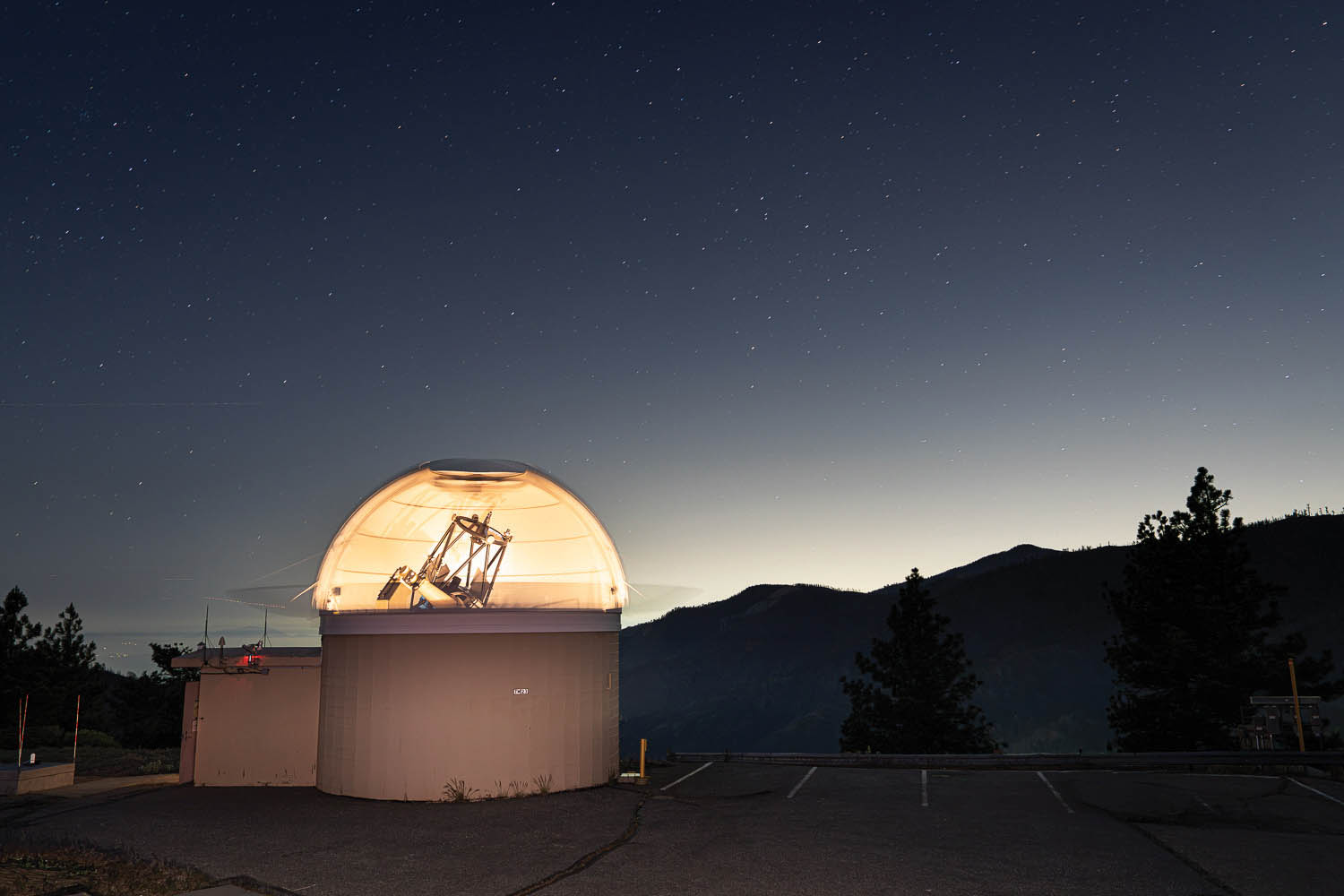
It’s 10 p.m., and three Pomona College students are just getting their night started.
Huddled in a closet-sized room alongside Associate Professor of Physics and Astronomy Phil Choi, they’re searching a computer screen for their next celestial target. The click of a button triggers the mechanical sound of metal and gears groaning through the walls.
Just outside, a massive telescope carefully pivots into position across the night sky.
These stargazing Sagehens are not on campus. They’re perched atop a 7,000-foot peak in the San Gabriel Mountains at Pomona College’s Table Mountain Observatory (TMO), scanning the sky for Near Earth Asteroids.
“These are potential impactors,” Choi says of the asteroids. “We’ve been working for years trying to discover these things, determine their orbits and decide whether they’re potentially hazardous.”
“If they are,” he adds, “we follow them up.”
Designed and constructed in the 1980s, the observatory’s research capabilities were limited during its first few decades. But in the past five years, TMO has exploded onto the astronomy scene as a productive science machine.
“We’re active every clear night,” Choi says, “so we’re involved in a very serious way in two or three big collaborations where we’re churning out data on a night-to-night basis.”
TMO provides an advanced learning opportunity that many young astrophysicists don’t receive until grad school. It’s also been a boon for recruiting high-caliber students to the College.
“I did not think coming in that I would have the level of hands-on experience, the level of interaction with senior researchers at NASA’s Jet Propulsion Laboratory [and] the level of interaction with collaborators around the world,” Sage Santomenna ’26 says.
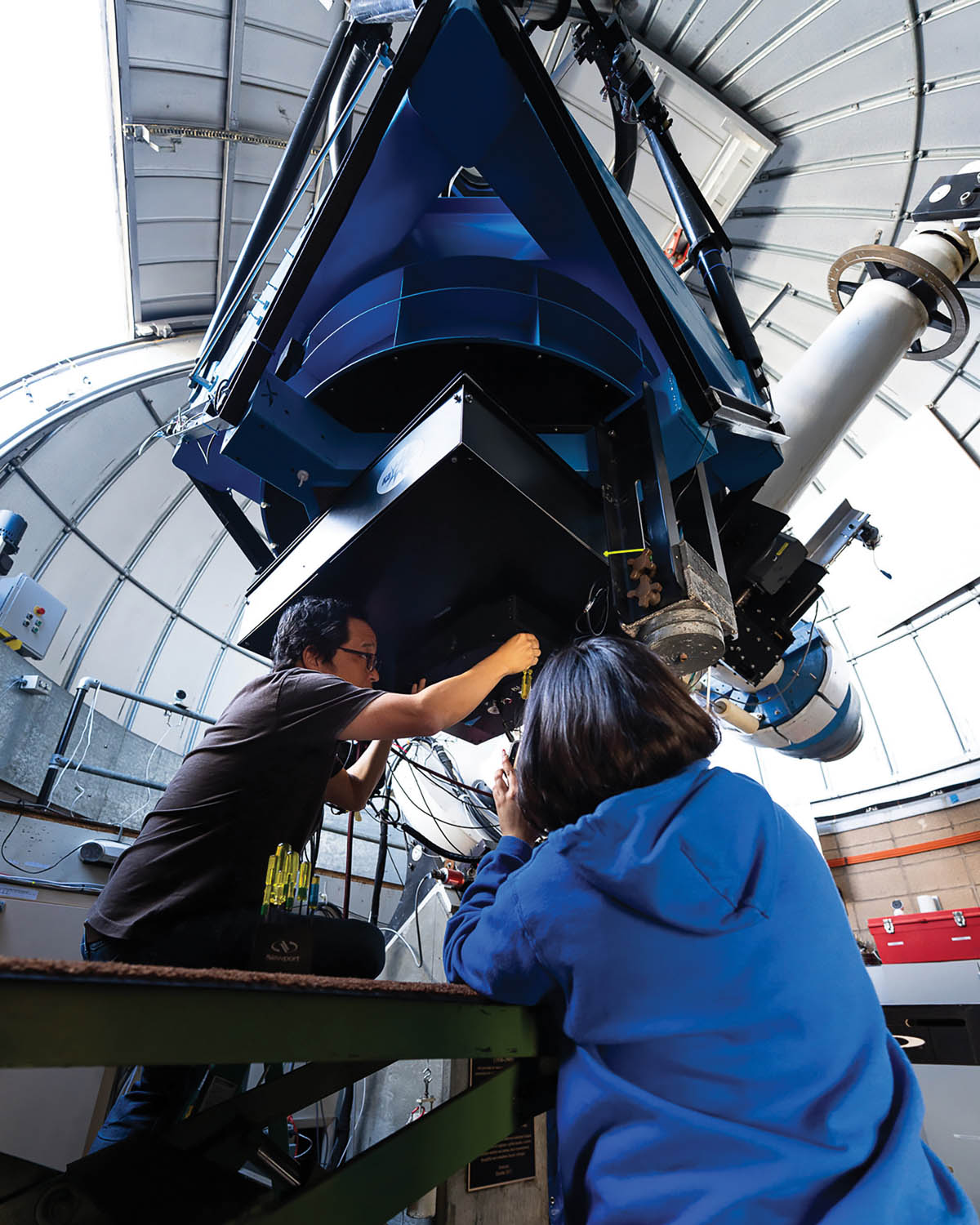
Tala Istanbouli ̓28 and
Professor Phil Choi tinker with
the hardware underneath
the one-meter telescope.
Santomenna turned down multiple R1 university offers in favor of attending Pomona College for its astrophysics program. Their work at TMO was the foundation of a prestigious Goldwater Scholarship awarded for the 2025-26 academic year.
Santomenna exemplifies the important roles students have played in bolstering the telescope through its history, Choi says.
“I’d say there’s been a factor of 10 increase in the efficiency of our telescope based on a lot of the software tools that Sage has been able to build for us,” Choi says.
On more than one occasion, Choi has been asked why he doesn’t roboticize and automate the observatory to pump out nonstop research for collaborators.
His answer is always the same: It’s important that TMO remains accessible to Pomona students.
Since taking over as the facility’s point-person 18 years ago, Choi has worked with students to secure multiple National Science Foundation and NASA grants to build up the million-dollar instrumentation and high-tech software that are the bedrock of the now modernized telescope.
As TMO continues to evolve in leaps and bounds, the astrophysics world has taken notice.
The combination of advanced instrumentation and year-round, immediate access enables TMO to occupy a unique niche in high-spatial and temporal-resolution imaging of fast-moving objects. For the Near Earth Asteroid study, the TMO facility achieves astrometric performance better than all but a handful of competing systems in the world.
“It’s a humble one-meter telescope,” Choi says, “so compared to a lot of other instruments doing this research, it’s small. But the thing that makes it special is the hardware on the back end is doing something that very few facilities do.”
“People are sometimes skeptical of our technique, but our results speak for themselves.”