
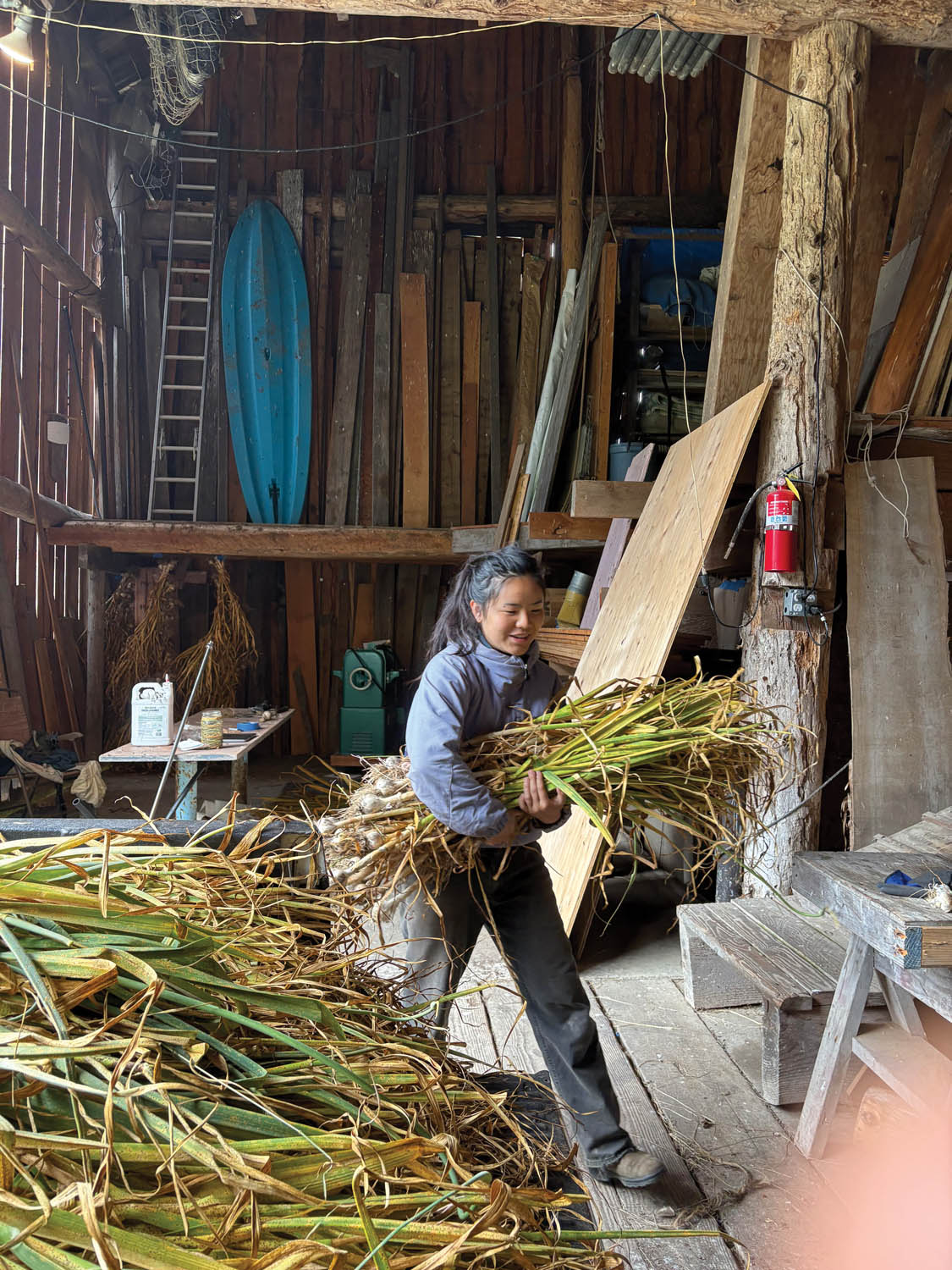
 On a typical afternoon this past July, a visitor to Midnight’s Farm on Lopez Island off the coast of Washington state might have spotted Lina McRoberts ’27 harvesting rhubarb, trellising Swiss chard or sticking a temperature probe into a steaming pile of compost.
A physics and gender and women’s studies double major, McRoberts spent 10 weeks living and working at the farm for her Summer Undergraduate Research Program (SURP) project, through an internship with the Lopez Community Land Trust. Alongside daily hands-on farmwork, McRoberts drew on her physics knowledge to understand and improve the farm’s community composting system.
Composting is fascinating, says McRoberts, because while it is a biological, chemical and physical process, it also is a stewardship practice that transforms waste—brought to the farm by Lopez Island residents—into a shared community resource that is sold back to local farms, restaurants, gardens and community members. “Nutrients circulate, quite literally, through the island,” she says.
On the technical side, McRoberts wanted to know how airflow, temperature, moisture and microbial activity interact within large compost piles. Because the microbial activity driving decomposition occurs largely out of sight within piles that can reach 8 feet in height, temperature serves as one of the most important indicators of what is happening inside.
One of McRoberts’ first tasks was to re-establish Midnight’s Farm’s wireless temperature monitoring system (separate from the farm’s regular wired setup), which was used for past experiments and had been offline for six months. After identifying and testing damaged probes, troubleshooting communication failures and reconnecting hardware, McRoberts brought the system back online. This was essential for her own research, she says, because “without reliable temperature measurements, it would be nearly impossible to assess whether the compost is receiving adequate oxygen, how actively decomposition is occurring, or how different management strategies influence the composting process.”
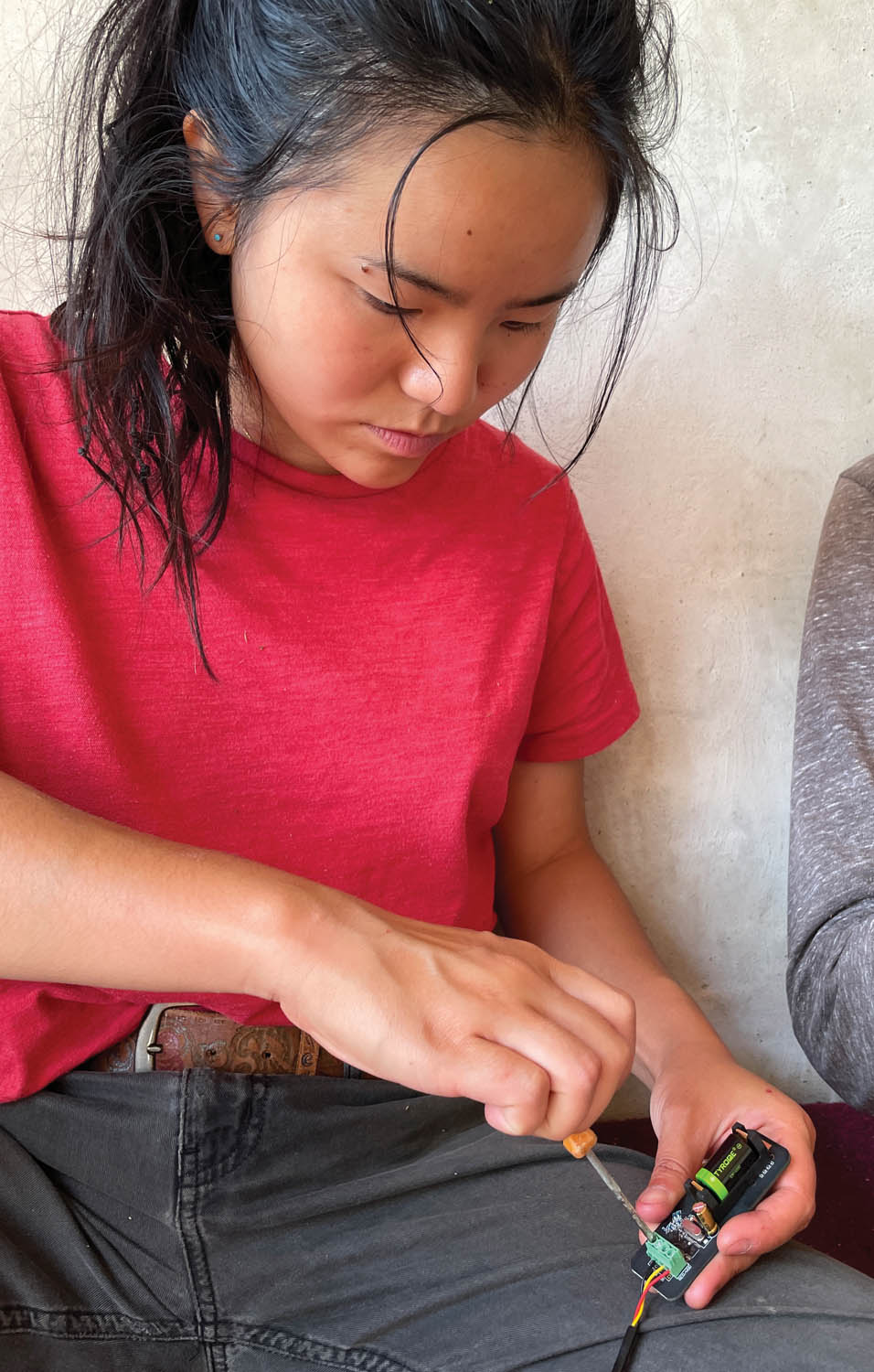
Lina McRoberts
fixing a compost
temperature probe.
The composting project has led McRoberts to think about the broader systems and people that make community-scale sustainability possible, especially on a small island like Lopez.
“Living on Lopez Island has given me a deeper appreciation for both the possibilities and the challenges of community life,” she says. “The island is extraordinarily beautiful, but it also faces many of the pressures affecting rural communities across the country—housing affordability, rising land values, an aging population and economic inequality.”
During her time at Pomona, McRoberts has been increasingly involved in political organizing. In her sophomore year, with her friend Claudio Castillo ’26, she co-founded Critical Mass, a student organization that encourages STEM students to consider who their work serves and what kind of world it is helping to create. They have explored such topics as surveillance technology, the political economy of scientific research and growing attacks on public education and intellectual life.
That social justice lens led her to seek out opportunities where she could use her scientific training in ways that felt directly connected to community needs. The Lopez Island composting project, she says, allowed her to apply physics in a context with tangible and immediate benefits.
“I am constantly reminded that technical knowledge is not neutral,” she says. “It matters deeply how we choose to use it, and I have found it remarkably rewarding to apply it in service of a community working to sustain itself.”
McRoberts found digging into manual farm labor equally satisfying. Biking to the grocery store on Lopez Island, she says, “I would see the mixed greens we harvested, washed, dried and bagged that very morning, or the raspberries that we woke up an hour and a half early to harvest so as to avoid the sun.”
There was a moment, she says, echoing German philosopher Karl Marx, where she caught a glimpse of herself in her work. “Meaningful labor,” she says, “allows us to encounter ourselves in the world we have and continue to make.”