Blog Articles

Exploring the Neuroscience of Beauty: G. Gabrielle Starr Discusses Her Book, Feeling Beauty

G. Gabrielle starr discusses her book feeling beauty And her search for the neural footprint of aesthetics.

What does the phrase “feeling beauty” mean?

Starr: “Beauty” is probably the oldest and most inclusive term for the vast set of responses we have both to works of art and to powerfully compelling parts of the natural world; “beauty” is also an important term in that, unlike many other words we use to describe aesthetic experience (like “divine,” “thrilling,” “sublime,” “awesome,” “delightful,” “awful,” or even “nice”), it has a primarily aesthetic and broadly employed range of reference. “Feeling beauty,” however, emphasizes not just the value of terms like “beauty” and its kin, but “feeling”— the principle that all aesthetic responses call on feeling, and they link feeling to knowledge in surprising, dynamic ways. Aesthetic responses in this sense that matters in my book are not any responses to a work of art, but a subset of such responses—the felt engagement with art and with other objects we might approach because they move us.

How does understanding the neural underpinnings of aesthetic experience reshape our conceptions of aesthetics and the arts?

Starr: Aesthetic experience restructures our ways of knowing the world by changing the ways that we assign value to the world. By exploring the neural underpinnings of aesthetics, we can begin to see how this happens and to understand why aesthetic experiences may call on our most powerful kinds of mental representation, as well as how they become foci for linking the internal and external worlds.

How do works that address different senses using different means seem to produce the same set of feelings?

Starr: Perception is not even the beginning when it comes to aesthetic experience—not only is what we perceive conditioned by our past experience and the limits of our bodies, but aesthetic experience brings a range of internal perceptions and processes into close relation with external sensory experience. So the perceptual differences that shape works of art are not the most central key. Powerful aesthetic experience means in part that we are accessing the systems we use for understanding internal life, as well as those for engaging the outer world. Thus, the arts may affect us not primarily by the senses, but by speaking to a core set of human neural systems, chief among them our systems for emotion, memory, semantic processing, imagery and inwardly directed thought.

What lessons can we draw about the embodied nature of aesthetic experience and the hidden unity of seemingly disparate arts?

Starr: Some theorists of the aesthetic would like our response to art to be purely immaterial, or if they grant that there is a material underpinning to our experience, they do so only to dismiss the possibility of learning anything about the aesthetic by studying this material foundation, or they claim that this foundation is no more than trivially important.

On some level I find this puzzling. Human beings have a material existence that shapes and enables every breath we take, every thought we entertain, every moment of bliss or disbelief.

Aesthetic experience is in fact embodied. Seeking to understand the aesthetic, then, means that we ought to seek to understand how that experience is shaped by the bodies in which we live. Learning about the human body is a worthy undertaking in itself. The brain is only one part of this equation, but it is a crucial part. The question then is whether we learn anything about aesthetics when we use the tools of neuroscience to do so.

One major critique of neuroaesthetics relies on the idea that what we want to know about art primarily is how to interpret it. But the study of art and how it affects us is not only a hermeneutic problem, it is an epistemic problem, an affective problem, a moral problem, an historical, economic, social and even an evolutionary one. No single discipline carries all the answers that we might want to pose about art and aesthetic experience.

Cognitive and behavioral neuroscience contributes something particular to the study, in my view, not so much of art objects as of our responses to them, and our responses to the broader world that calls to us in terms of beauty and its kin. Neuroscience can help us understand part of the story of emotions, of memory, and even of how we relate domains of experience together.

Neuroscience doesn’t have all the answers, but it has given us many new things to ponder about how we live in the bodies that help make us human. The road is long, but we can have a lot of fun on the way.

Reprinted with permission from MIT Press

Story Folded Up Like a Fist

Story Folded Up Like a Fist: "Word Collector" Ray Young Bear '73 writes poetry and novels in a language he mistrusts in order to preserve the culture that he loves.

Ray Young Bear ’73

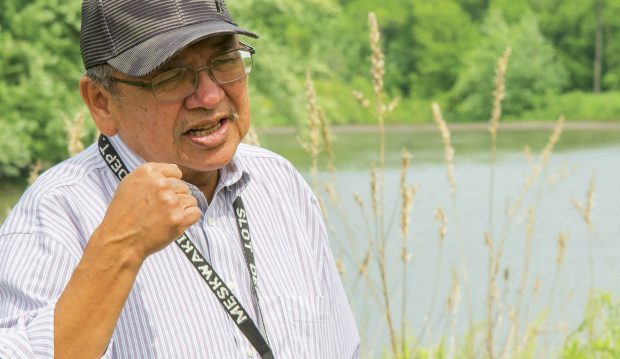
IN THE MESKWAKI LANGUAGE, There is no word for poem. So poet and novelist Ray Young Bear ’73 made up his own: pekwimoni, a word that translates roughly as “story folded up like a fist.”

It’s a word that seems perfectly suited to the interwoven cultural imagery that fills his work. “My poems are therefore origami,” he explains, “large stories that have been compressed with multiple layers of images and messages. They can be complicated or simple, but they’re replete, once the key is turned, with Algonquian-based history.”

Algonquian is the group of Native American languages—and cultures—to which Meskwaki belongs. The Meskwaki, or “People of the Red Earth,” originated in the Great Lakes region of what is now New York and have a long, tragic history of being driven westward, all the way to Kansas. Finally, in the 1800s, they doubled back to central Iowa, bought a chunk of prairie beside the Iowa River and took root there in what is now the Meskwaki Settlement.
Ray Young Bear ’73Meskwaki language is spoken today by only a few hundred people, and Young Bear is grateful to be among them. Since his formal education took place entirely in English, however, he didn’t learn to read and write Meskwaki until much later, in adulthood. Today he takes pride in being one of the few Native American authors with literary mastery of their native tongue. “I’ve got contemporaries who are very famous who may not be well versed in their language, but I happen to be halfway proficient. That’s a rarity, in my opinion.”

In his early days of writing poetry, he recalls, he usually thought his verses out first in Meskwaki and then rewrote them in English. “But as I started growing up, getting mature, I realized that oftentimes it was just the opposite. It eventually got to the point where, you know, I was writing far too much English; then I sometimes had to go back and start redoing stuff in Meskwaki again.”

Indeed, the two languages flow together in many of his recent poems. Lines of Meskwaki appear here and there among his verses, and his newest volume—Manifestation Wolverine: The Collected Poetry of Ray Young Bear, a compilation of his earlier collections plus a slate of new poems—includes works like “Three Translated Poems for October,” originally composed in Meskwaki and then translated into English, as well as a series of old Meskwaki peyote and social songs.

GRANDMOTHER


if I were to see
her shape from a mile away
i’d know so quickly
that it would be her.
the purple scarf
and the plastic
shopping bag.
if i felt
hands on my head
i’d know that those
were her hands
warm and damp
with the smell
of roots.
if i heard
a voice
coming from
a rock
i’d know
and her words
would flow inside me
like the light
of someone
stirring ashes
from a sleeping fire
at night.

But though he uses English with poetic skill and depends upon it to bring his work to a wide range of readers, he still regards it as an alien tongue, part of a culture that subjugated, displaced and nearly wiped out his own. “Sometimes I wonder how much I should accept the English language, because it is, after all, colonialism in progress,” he muses. “Maybe I don’t want to accept the English language because it would mean that we’re defeated. You know, you don’t want to succumb to the civilization that almost killed you.”

Old Bear, Young Bear

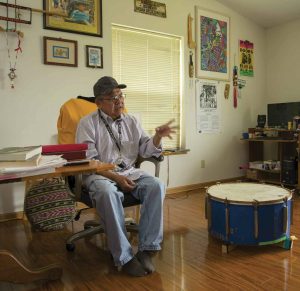
The slightly worn La-Z-Boy recliner in Young Bear’s living room appears in some of his poems as a place of visions. It’s where he sits when he’s seeking spiritual guidance, and a number of his poems originated in scenes dreamt there.

Today, however, he has ceded that place of honor to his guest and retreated to a desk chair against the wall, where he sits gazing out at the riot of springtime greenery as he talks about his life and the culture and religion that inspire much of his poetry. On the wall behind him are framed photos of his six adopted children, along with concert posters, Meskwaki artifacts and memorabilia from poetry readings across the country. To his left is a big ceremonial drum, on which he occasionally taps out a rhythm to illustrate a story.

“Most of what I know with regard to language, religion and culture comes from my grandmother and my father,” he says. “Both of them were quite religious, other than the fact that they had different, you know, political beliefs.”

By “different” he means bitterly opposed. His parents were members of powerful clans that represented opposite poles of tribal politics—the traditional and the progressive. “My parents were star-crossed lovers like the Capulets and the Montagues,” he says. “My mother is an Old Bear from the conservative, traditional chief-in-absentia line of beliefs. My father came from the progressive Young Bear faction that believed in working with outside society and getting ahead. And so the Old Bears and the Young Bears were against each other, and then my parents fell in love and had me.”

Ray Young Bear ’73

With his parents separated by political feuding, Young Bear lived until the age of 10 with his grandmother, Ada K. Old Bear, a seminal figure in his life and work. Indeed, the very first poem in his first published collection, Winter of the Salamander, is titled “Grandmother” and begins with the words: “if I were to see / her shape from a mile away / i’d know so quickly / that it would be her.”

“My grandmother didn’t speak any English,” he says, “so I’d converse with her in Meskwaki. She was the one who basically began outlining the world order for me to understand just exactly why we are here.”

Those traditional beliefs still profoundly color his view of the world. “Animism is probably the best way I can describe my beliefs,” he says. “When I go into an elementary school, or even graduate school level, the analogy I give them is: If you see a tree outside, for you and me, we can look at it scientifically and also for aesthetic reasons. But for Meskwakis, they look upon the tree as a protector, as a remnant of the gods that were left here after the first time the world was obliterated.”

The Accidental Poet

Starting in the seventh grade, Young Bear entered the public schools of Tama, Iowa. “That was the first time I had Caucasians for classmates,” he recalls, “and that was when I realized that I was behind in my academics.”

THIS HOUSE


i begin with the hills
lying outside the walls
of this house.
the snow and the houses
in the snow begin somewhere.
the dogs curled against each
other must feel that they own
the houses, the people
in each house must feel
they own the dogs
but the snow is by itself
piling itself over everything.

i keep thinking of comfort
such as a badger stretched over
a house with its guts pulled
out. its legs over each corner.
it is truly a dream to tie down
a skinned badger like a tent over
a house, watching it shift
as the wind changes direction
like the cylinders of pistols,
the holes of magnums turning
people inside out.

my young wife turns under
the yellow blanket in her sleep.
she wishes to be left alone,
closes herself within the dark
of her stomach, cups her hands
and sees what is ahead of us.
she senses i will die long before
the two of them, leaving her
without a house, without roomlight.

the yellow blanket, the house
and its people cover her.
the clothes she wears cover her.
the skin of her body covers her.
the bones cover her womb.
the badger feels it owns the womb,
protects the unborn child,
encircles itself to a star
and dies in our place.

He recalls an essay assignment in particular—one he thought he’d aced. “The teacher came up to me and said, ‘Ray.’ She kind of whispered it and said, ‘Do you know what you did?’ And I said, ‘What?’ And I thought, ‘Uh-oh.’ She said, ‘You’ve written a poem, not an essay.’ I said, ‘Okay.’ And she walked away. But I didn’t know what that meant. What’s a poem?”

The answer would come to him through popular songs sung by the Beatles and Simon and Garfunkel. He recalls becoming so fascinated by the lyrics of “The Sound of Silence” that he wrote them down on a piece of paper and carried them around in his billfold. Soon Young Bear would begin to write more intentionally, and poetry would shape his life in surprising ways.

For example, it was a poem that brought him halfway across the continent to Pomona College.

The poem, he says, “was basically a proclamation of my native identity or something like that, a very awkward, very raw poem that I had written in the ninth or 10th grade.” But when he was a high school senior, it was printed in a magazine published by the Upward Bound program, and soon thereafter, he received a surprising letter. “It said, ‘I read your poem, and I was wondering if you’d like to come to school at Pomona College in California. We can offer you a $30-a-month stipend and travel to and from home whenever necessary,’ and so forth.”

It sounded too good to pass up, so he took the ticket the College sent him, and with $25 in his pocket and a paper bag full of snacks, he boarded the train for a two-day trip out West.

At Pomona, he soon found himself in over his head academically—some classes he thrived in; others he found utterly incomprehensible. Today he suspects that he underestimated his own academic abilities and sabotaged his own college career. In any case, after two years of focusing on the classes he loved and ignoring the others, he dropped out and returned home. But he still remembers those two years as some of the most influential on his poetry, mainly because of the poets he encountered on the Pomona campus.

“I attended every poetry reading that I could,” he says. “And they had lots of great poets—nontypical poets like Charles Bukowski. He was the one that really got me interested in bluntness and being, you know, rude.” He also remembers meeting classmates and fellow budding poets Brenda Hillman ’73 and Garrett Hongo ’73 and spending an increasing amount of time alone, writing poetry. “In Manifestation Wolverine, the first 60 or 70 pages are all from Pomona,” he says. “So that was really a prolific time.”

After Pomona, he became a college hopper, spending time at the University of Iowa, Grinnell College, Northern Iowa University and Iowa State University, taking what he wanted from each while resisting requirements that would have led to a degree.

THE SIGNIFICANCE OF A WATER ANIMAL


Since then I was
the North.
Since then I was
the Northwind.
Since then I was nobody.
Since then I was alone.

The color of my black eyes
inside the color of King-
fisher’s hunting eye
weakens me, but sunlight
glancing off the rocks
and vegetation strengthens me.
As my hands and fingertips
extend and meet,
they frame the serene
beauty of bubbles and grain—
once a summer rainpool.

A certain voice of Reassurance
tells me a story of a water animal
diving to make land available.
Next, from the Creator’s
own heart and flesh
O ki ma was made:
the progeny of divine
leaders. And then
from the Red Earth
came the rest of us.

“To believe otherwise,”
as my grandmother tells me,
“or to simply be ignorant,
Belief and what we were given
to take care of,
is on the verge
of ending…”

Through it all, he continued to write, though he still refused to think of himself as a poet. In fact, when the University of Dakota Press, which had printed a couple of his poems, offered to publish his chapbook, “that scared me silly,” he recalls. “I only had 30 or 40 poems, and I thought, ‘I’m just a young man trying to write poetry, and it’s imitation. It’s not real.’”

Ironically, it was his traditional grandmother who encouraged him to continue to develop his burgeoning talent with the English language.

“By the time I got to 30 years of age, she began to say, ‘You should use your abilities to write about the history of your uncles and your grandfather, and how he purchased this land in 1856. And the only way you can communicate that is to write in English.’ Which floored me because, at first, she was the one saying, ‘Don’t learn anything, grandson, from the school,’ when she sent me to school, ‘because the whites are always trying to steal our language.’”

Vision Quests

Even today, despite his success as a writer, with four books of poetry and two novels under his belt, Young Bear shies away from referring to himself as a poet. He prefers to call himself a “word collector.”

“A word collector is primarily someone like myself who is bilingual,” he explains, “who is interested in the artistic communication process with the English language but doesn’t use it on an everyday basis. So it’s necessary for me to investigate these words and to see how I can implement them within my work.”

Much like a scrap metal artist, he says, he collects verbal scraps and reassembles them into art.

Even beneath the words, he refuses to take full credit for the images and ideas that make up his poetry. Many of them, he explains, come to him in dreams. “I tend to view myself a lot more these days as somebody who is basically channeling information,” he says. “My grandmother would always say, ‘You and I are protected by spirits invisible to us. They are always around us,’ And so I believe that part of the reason I am able to write these things without any academic foundation is the fact that I’m simply channeling those energies that have been here before.”

To some, that may sound metaphorical, but Young Bear couldn’t be more literal. Indeed, in recent years, he has become more and more involved in trying to use his ability to channel those spiritual connections for more mundane purposes, like solving crimes.

THREE TRANSLATED POEMS FOR OCTOBER


Old woman, I hope that at least
you will watch me in the future
when I am an elderly man—
so my baggy clothes
do not catch fire
when I socialize
with the young people
as they stand around
the campfire intoxicated.
Of course, I will tell them
worldly things.

/ / /

Now that the autumn season
has started, one suddenly
realizes the act of living
goes fast.
Sometimes the spring
is that way too:
the green so quick.
Thirty-two years of age I am.
Box elder leaves are being shaken
by the cold rain and wind.
In the tree’s nakedness
there stands a man,
visible.

/ / /

Although there is yet
a lot of things to do,
surprisingly, I have this urge
to go fishing.
They say the whites
in town will pay
one hundred dollars
to whoever catches
the largest channel catfish
or flathead.
You know I like to fish.
We could invite and feed
lots of friends.
Plus, purchase
a cast iron woodstove
since the business committee
has ignored our weatherization
application, but Bingo
is on the agenda.

It began with the murder of his brother in 1992, an unsolved crime he would fictionalize in his first novel, Black Eagle Child. “We contacted a psychic then in Dallas, Texas, who had some insights into Meskwaki clan names and some teenage suspects,” he recalls. “Over the years, my parents always believed these suspects would slowly kill themselves with drugs and alcohol. They got away, but perhaps not really.”

A few years later, after watching the news about three missing campers in Yosemite Park, he fell asleep in his La-Z-Boy and dreamt that he was one of the women, talking to a mysterious character through a car window. He took note of the license plate on a nearby car, but forgot it upon waking. The next day, he returned to his La-Z-Boy for a vision quest. “I was able to pin the license down and forward the info to the Sacramento FBI,” he recalls, though he has no idea if anyone ever took him seriously.

But the experience also served his poetry, inspiring a poem called “Three Brothers.”

The vision quests and the “word-collecting” poetry are all part of what Young Bear terms his experimental approach to life and to literature. “There’s no mold; there’s no pattern that I have,” he says. “It’s just an experiment. Everything that I do, almost, is an experiment. That’s what I like about poetry, because, you know, you can go back to something and rewrite it and change it over and over again. I’ve been working on some of my poems for 10 years.”

First Language

Maybe it was inevitable that Young Bear, caught from an early age in the tug-of-war between the traditional and the progressive, would be conflicted about the role of the two languages that have shaped his life as a Meskwaki and a poet. Though he continues to work on his poetry in English, as well as the third volume of his Black Eagle Child trilogy, he is also hard at work on a volume of nonfiction—a combination memoir and Meskwaki history. More and more, he is convinced that the true value of his work will be in whatever power it has to help preserve Meskwaki culture, religion and language.

“Culturally, with tribal languages predicted to die, poetry might be the vehicle against linguistic atrophy,” he muses. Still, the poet who refuses to think of himself as a poet continues to caution himself against taking his own literary ambitions too seriously.

“I wish I had met and been influenced by a person like myself, that fall in 1969,” he says, “who would’ve told me: ‘Hey, young Indian man, you can write and compose poems in English, yes, and you may eventually do it well. However, English isn’t your God-given language. Learn from it as much as you can, but always keep in mind that the first language that gave you animistic insights can’t be found in English. Foremost, English is a language that was used to convert us. In time, those colonial-based persuasions will reverse. Many will realize, even the best writers, that our first languages are key to survival and identity. As your grandmother probably told you, the Meskwaki creator doesn’t speak English. When he asks you what you have done, I can assure you, son, he won’t care about your books in English nor whether your life’s goal was to write a best-seller.’”


—Photos by Mark Wood

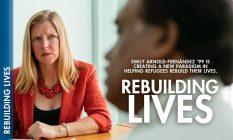
Rebuilding Lives

Rebuilding Lives: Emily Arnold-Fernández ’99 and Asylum Access are creating a new paradigm in helping refugees rebuild their lives.
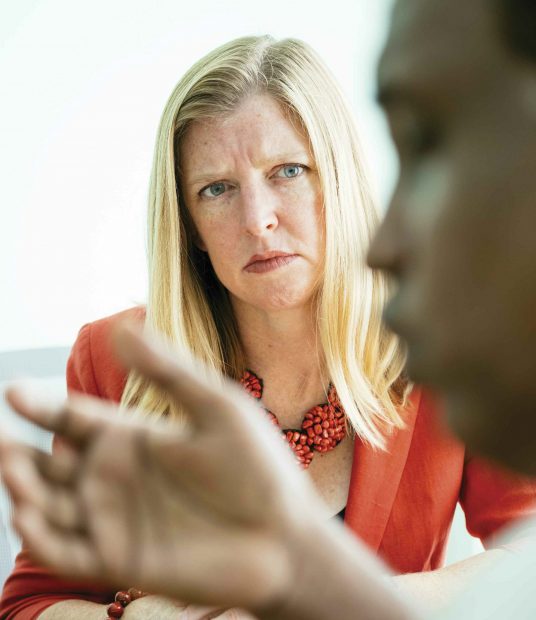
Emily Arnold-Fernández listens to a client’s story at the Asylum Access office in Bangkok, Thailand.

Emily Arnold-Fernández listens to a client’s story at the Asylum Access office in Bangkok, Thailand.


65.3 MILLION
Number of forcibly displaced people around the globe

21.3 MILLION
Total number of refugees worldwide

26 YEARS
Average time a refugee spends in exile, based on the average duration of the 32 protracted refugee situations

0.5%
Percentage of refugees accepted each year into resettlement programs

24
Number of people displaced from their homes every minute of every day

According to 2015 data from the United Nations Refugee Agency

BEFORE THE SYRIAN refugee crisis made headlines, Emily Arnold-Fernández ’99 would ask people, “What do you think is the average time spent in a refugee camp?”

Six months, they’d guess. A year, two years.

In reality, the average time is 17 years.

“We had to do a lot of education so people could understand why we are doing what we are doing,” said Arnold-Fernández, founder of Asylum Access, which empowers and advocates for refugees worldwide. “Now people understand that we’re talking about decades of upheaval.”

She was just back from Thailand, visiting Asylum Access offices and meeting with partners and potential donors. Art from her travels adorned her sunny office in downtown Oakland: a vibrant painting of a woman in a headscarf, painted by a Cairo refugee, and a black-and-white photo of a refugee boy joyously leaping into a river delta in Ecuador.

“Because we’re seeing the greatest number of people displaced since World War II, it feels more urgent,” she said. Refugees living in camps are all but locked up, rarely allowed to leave, while those outside the camps rarely have the right to work, rent an apartment or send their children to school and must do so in the shadows, lacking legal protections.

Assistance to refugees has often come in the form of humanitarian aid—beds and blankets, food and shelter—that address their immediate needs but not long-term goals. Asylum Access is changing that paradigm, helping refugees rebuild their lives by challenging legal barriers.

With 16 offices in the United States, Tanzania, Ecuador, Thailand, Malaysia and Mexico, she’s now expanding her reach by working with organizations in the Middle East and elsewhere to create programs modeled after Asylum Access.

“She’s one of those rare people who can talk to a refugee and sit in a UN council giving testimony,” according to one of her mentors, Kim Nyegaard Meredith, executive director of the Stanford Center on Philanthropy and Civil Society. “Most people can’t navigate both ends of the continuum.”

The eldest of four children, Arnold-Fernández recalls lively dinnertime conversations with her family about the news. Her parents took her ideas seriously, discussing and debating even her most outlandish childhood proposals. During the California drought in the 1980s, she proposed filling in swimming pools, making them shallow to save water.

According to 2015 data from the United Nations Refugee Agency

At Pomona, she majored in philosophy and music. Her sophomore year, she spent her spring semester in Zimbabwe. Aside from a family car trip to Tijuana and a choir tour to Italy in high school, she’d never traveled abroad. After their orientation, a few weeks spent in a rural village and a crash course in the Shona language, she was told by organizers to navigate her way to the township where she’d live next. Figuring out how left her confident she could go anywhere in the world. Yet her time in Zimbabwe was also humbling.

“I’d always understood myself as someone intelligent and capable, a leader, and all of a sudden I was in a situation where every 5-year old knew how to hand-wash socks in the river and I was the idiot who had to be taught everything from scratch,” she said. She learned firsthand the importance of not making assumptions. “If someone doesn’t speak the language, it doesn’t mean they’re not intelligent.”

After graduating, doing a stint at a domestic violence nonprofit in Los Angeles and teaching English in Spain, she enrolled in law school at Georgetown University. She had a passion for social justice issues, and on a summer internship in Cairo, she worked with refugees. Her very first client, a Liberian teenager, fled his homeland to avoid being forcibly recruited as a child soldier.

She interviewed him several times to put together his appeal. Looking down at the floor, he slouched, mumbling, hand to his mouth, and spoke in a Liberian-inflected English; Mandingo was his native language. Knowing that the United Nations officers interviewing him would be speaking English as a second language too, she advised him to request an interpreter to overcome potential communication barriers.

Six months after her internship, she learned that he’d been accorded legal status as a refugee, and he eventually resettled in the Northeast of the United States. That put him among the less than 1 percent of refugees who are resettled each year in the Global North—countries such as the U.S. and Canada. Most remain in Asia, Latin America, and Africa, often living only a border away from conflict.

“The catalyst for Asylum Access was meeting refugees with tremendous skills and potential who, while they had refugee status, still couldn’t work or go to school,” she said. She also realized that U.N. staff weren’t always equipped, motivated or sufficiently well-resourced to adequately advocate for the human rights of refugees. “Most of the world had no idea that we were condemning people who fled war or targeted violence to years, decades or generations of marginalized existence.”

Yet refugees can be a potent force for development, experts say, contributing to the economies of host countries not only by buying and selling but by creating employment. In Kampala, 40 percent of those employed by refugees are Ugandan nationals, according to a report by the University of Oxford’s Refugees Studies Center.

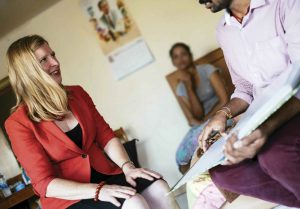
Arnold-Fernández discusses a family’s case at their home in Bangkok.

Arnold-Fernández discusses a family’s case at their home in Bangkok.

In 2005, she and others working in the refugee field started organizing, and by September, she had volunteered to become the executive director of Asylum Access while working as a civil rights attorney part time.

“I like being in charge, and starting things is a good way to get there,” she said with a grin.

She worked on the business plan, and over the holidays, while visiting her parents, she dug up old telephone directories for her high school, choir and cross-country teams and put out an appeal that raised a total of $5,000. (These days, funders include individual donors, grant-making foundations and government donors. Asylum Access raised $2.6 million in fiscal year 2016 and served more than 22,000 refugees in five countries.)

A year later, while traveling to Ecuador, she came down with food poisoning the night before a long day of meetings with government officials and potential donors. Amalia Greenberg Delgado, who was traveling with her, nursed her throughout the night. Neither woman slept well.

Though Arnold-Fernández was ailing and speaking in Spanish, her second language, she made a case for the Asylum Access model of empowerment, pushing the government to allow refugees to bring lawyers to interviews to advocate on their behalf.

“I was impressed by her strength and energy. She bounced back,” marveled Greenberg Delgado, the organization’s director of global programs. “The next morning, she went for a run.”

In the early years, Arnold-Fernández housed Asylum Access in her tiny apartment in San Francisco. In the summer of 2007, she had 10 interns who worked off her couch on TV trays and at the kitchen table—everywhere, she joked, but the bathroom. After she’d spent a week orienting and training them, she handed them keys and flew to Thailand, where she was conducting due diligence to open an office.

“My poor husband had to put up with interns arriving at our doorstep at 9 a.m.,” she said. She’d spend her days in meetings and doing field research, writing up her notes in the evening, and around midnight would respond to emails and chats from her interns, before she went to bed at 4 a.m., getting up three hours later. “A crazy time.”

Her husband, David Arnold-Fernández ’98, whom she met at Pomona, used to stage-manage the Asylum Access summer fundraisers, a skill he’d gained when they were both in a musical theatre group at Georgetown. “She was on stage, and I was behind the scenes,” he said. That same dynamic has reflected how he’s supported her work at Asylum Access, too. “I get out of her way and let her do her thing. She has this attitude that it’s going to work, come hell or high water. She’s always handled it. That’s the thing I’m most proud of her for.”

With that determination, Arnold-Fernández changed the international conversation around refugees. In 2013, Asylum Access won a landmark victory against a restrictive law in Ecuador, which has the largest refugee population in Latin America. The president had decreed that people had to file a petition for legal status within 15 days of arrival—even though many new refugees were in rural areas on the border, far from where they could file. Since the lawsuit, applicants now have three months to file for legal status and 15 days to appeal.

Also around 2013, Asylum Access started building a coalition to advance refugees’ right to safe and lawful employment globally, followed by a groundbreaking report examining those struggles. The deputy high commissioner of the UN’s refugee agency began citing that report, and it also inspired the World Bank to draw up an expanded report, with the assistance of Asylum Access.

Arnold-Fernández pushed for these rights at a time “when no one else was talking about refugees working, and now that’s a part of the common discourse,” said Greenberg Delgado, who has been with Asylum Access since its inception, first as a board member and now as member of the staff.

After more than a decade at the helm of Asylum Access, Arnold-Fernández has been training the next generation of leaders. Last fall, Saengduan Irving joined as Thailand’s country director. Though Irving felt nervous meeting her boss in person, Arnold-Fernández immediately set her at ease with encouraging feedback.

“We talked about what we are going to do to move forward and didn’t worry about the past,” Irving said. “She’s not 50 or 60 years old, like leaders from other organizations. But she’s very mature, very smart. She knows the situation well.”

To remain inspired for decades more, in June Arnold-Fernández began a three-month “CEO Sabbatical” sponsored by O2 Initiatives, designed to revitalize executive directors at nonprofits. It’s the latest in a slew of accolades, including the Dalai Lama’s Unsung Heroes of Compassion Award, the Waldzell Leadership Institute’s Architects of the Future Award, the Grinnell College Young Innovator for Social Justice Prize, and Pomona’s Inspirational Young Alumna Award.

During her sabbatical, she’s devoting herself to playing the violin and singing. In years past, she sang in a local a capella group and performed in the pit orchestra of musicals, but more recently, her travel schedule made it impossible for her to participate.

“I’m not trying to have a product, an output, because I’m so results-focused in my professional life,” she said. “I want to tap into my creativity again, and doing something that’s creative in a different way will make me more creative as a leader.”


—Photos by Thomas De Cian

Saying No to the Olympics

Saying No to the Olympics: Chris Dempsey ’92 discusses his book about the grass-roots effort he helped launch that challenged and shut down Boston’s problematic bid for the 2024 Olympics.
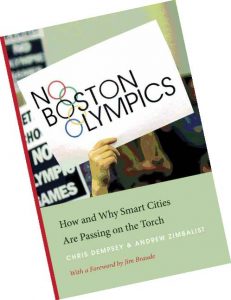
No Boston Olympics

No Boston Olympics
How and Why Smart Cities
Are Passing on the Torch
By Chris Dempsey ’05
ForeEdge 2017 | 232 pages | $27.95

YOU COULD SAY David slew Goliath in Boston—in an Olympian-scale triumph. Christopher Dempsey ‘05 was one of the leaders of the No Boston Olympics campaign that successfully shut down the Boston 2024 Olympics bid. It is a story of how a scrappy grassroots movement beat a strapping, well-armed initiative. In the book he coauthored, No Boston Olympics: How and Why Smart Cities Are Passing on the Torch, Dempsey tells the tale and offers a blueprint that shows how ordinary people can topple extraordinary giants.

Pomona College Magazine’s Sneha Abraham interviewed Dempsey. This interview has been edited for length and clarity.

PCM: Can you unpack the conventional argument that the Olympics are good for a city? What is hosting supposed to do for a city? What’s the myth, and if you can call it that, the romance behind it?

Dempsey: The International Olympic Committee has often had some success telling cities that hosting the Olympics is an opportunity for them to be seen on the world stage, and to enter an exclusive club of world-class cities that have hosted the Olympics, and to leave a legacy from the investments that are made by Olympic hosts to support the Olympic Games. The reality is that the International Olympic Committee is asking cities, in the case of the Summer Olympics, to spend somewhere between $10 billion and $20 billion in costs for a three-week event. And that event brings in revenues that are typically around $4 billion or $5 billion.

The host city and the taxpayers have to make up the difference. And, at the same time, economists have not found any evidence that the Olympics boosts your city’s economy in the long term, that it makes you a more attractive trading partner, or a place for a future business investment, or that you’re really benefiting your city in any sort of long-term way. So the actual reality of the Olympics is that they’re a very expensive and risky proposition with very little benefit. But, traditionally, the IOC has had some success getting Olympic boosters focused on some of those more ephemeral benefits to get them to ignore some of those costs.

SAYING NO TO THE OLYMPICS

PCM: When did it crystallize for you that you were going to co-helm this grassroots movement?

Dempsey: We came together in the fall of 2013, six months or so after there were initial reports in the media in Boston that a powerful group of people was coming together and forming to try to boost the games. What you saw in Boston, similar to the bidding groups in many cities, is that the people that formed that group were people who stood to benefit personally in some way from hosting the games. So the best example in Boston is that the chairman of the bidding group for Boston 2024 was also the CEO of the largest construction company in Massachusetts. Obviously, the Olympics would have been great for the construction industry in Boston because of all of the venues and stadiums that needed to be built for the games.

But there was a very powerful group of people that included the co-owner of the Boston Celtics, the owner of the New England Patriots, Mitt Romney (the former presidential candidate and former governor of Massachusetts). It eventually included the mayor of Boston himself. So it was a very powerful group of people, and a lot of the institutions in Greater Boston and Massachusetts that would typically ask some tough questions of the bid and be skeptical of a really expensive proposal like this pretty much stayed silent. And we saw that was going to be the case because it turned out that many of the people that were pushing the bid were also people that were on the boards of directors or donors to a lot of these institutions that would typically be the financial watchdogs.

So we saw that this was a real juggernaut, and we also saw that opposition was going to have to come from the grass roots because there was not going to be much institutional opposition. Seeing that, we said, “We think there’s a very good case to make that this is a bad idea for our city’s future. We don’t want to see this region become focused on a three-week event at the expense of some of our long-term goals as an economy and as a society. And so we should form a group to start to raise some of those questions and some of those arguments against the bid.”

PCM: When did the momentum start taking off for you in terms of gathering support?

Dempsey: The high-water mark for the boosters was in January of 2015, when they were victorious in a process that the United States Olympic Committee had run to determine which city would be the U.S. bid. Boston 2024 beat out Los Angeles; Washington, D.C.; and San Francisco.

There was a lot of excitement in Boston about the fact that the United States Olympic Committee chose our city. In fact, the polling in January of 2015 showed that support was around 55 percent, and opposition was only around 35 percent. So we had some pretty daunting odds at that point. I’ll always remember that day of the announcement, President Barack Obama tweeting his congratulations to Boston on winning the USOC bid. That was the kind of influence we were going up against.

Up to that point, the boosters behind Boston 2024 had shared very little information about what the bid entailed and about what the contract with the International Olympic Committee would require. Residents were just hearing the basic talking points that Boston 2024 put out, things like promises about no taxpayer money and glossy photos and images of what the bid would look like.

And that’s very typical for Olympic bids: boosters focus on these happy, positive moments. But over time the boosters were forced, by us and by others, to start sharing more information about the budget and the costs, and the contract with the IOC. And it was a death by a thousand cuts for the boosters—as more and more information came out, Bostonians liked the bid less and less.

As residents got more educated on the pros and cons, they determined that this was not a good idea for our city’s future. And so by February, the polling was pretty much split, where support and opposition were both around 45 percent. And then by March we had successfully flipped the numbers from those January numbers. From there on out, support for the bid hovered between 35 and 40 percent for the remaining life of the bid.

PCM: How were you mobilizing support?

Dempsey: Probably what we did best as an organization was work with the media to make sure that they were telling both sides of the story, arming them with facts and quotes and numbers about what was really going on with this bid.

It was very much a grassroots movement. We had an average contribution size of about $100, compared to Boston 2024, whose average contribution size was north of $40,000. They spent about $15 million on the bid. We spent less than $10,000. A lot of our organizing was social media, where we were able to build communities of supporters. But it was also old-school campaign tactics, such as holding organizing meetings and rallying people to attend a series of public meetings on the bid.

Sometimes it was as simple as making sure that we passed out signs to people at those public meetings so that they could express their opposition to the bid. The cover of the book became kind of the iconic image of Boston’s Olympic opposition—regular citizens expressing their concerns. Our brand became that of representing regular people, whereas Boston 2024 was seen as a group of very wealthy, successful and powerful people who lacked public support.

PCM: Did you find that there’s something unique about Boston citizens?

Dempsey: I don’t know if we’re unique, but I do think we have a proud history of being engaged in these types of civic debates. It is a part of the DNA of the city and the people who live here. The very first public meeting, that became the cover of our book, was held in a building that’s across the street from where some of the patriots of the American Revolution are buried. It’s part of who we are; we have that proud tradition of standing up for ourselves and not being afraid to take on some powerful forces.

So this is just one story in a long line of stories in Boston’s history where people have done that.

PCM: Was there a turning point in the campaign? There were 200 days from when the governor was inaugurated to when the bid was canceled, is that right?

Dempsey: Exactly 200 days. Which was fast, but it wasn’t sudden. Probably our most important talking point centered on the taxpayer guarantee. The International Olympic Committee requires the city that is bidding on the games to sign a contract that says that the city taxpayers are the ones who are responsible for any cost overruns.

And that fact contradicted the promises that the Boston 2024 boosters were making—that there were no taxpayer dollars needed for the games. So we kept hammering that point. It was a constant drumbeat and no single day or event. Just an educational process over many months.

PCM: You dedicate the book in part to Boston’s journalists. Why, and what was their role in this process?

Dempsey: They really are heroes in this story. This is particularly true of some young reporters who were ambitious and hardworking and willing to dig in on the details of the bid and make sure that the other side of the story was being told. Boston 2024 was spending tens of thousands of dollars a month on media and PR consultants to get their story out there. If journalists listened only to the powerful and connected, then our side never would have been able to get its message out. But because we were taken seriously, because journalists were doing independent research that uncovered some of the drawbacks and errors of the bid, the public could make an informed choice.

Here’s a specific example of the press’s impact. WBUR, which is one of the two NPR public radio stations in Boston, commissioned and published a monthly poll surveying residents about their opinions of the bid. That meant that we—and the USOC and IOC—could see support declining. We didn’t have to wait a year for a referendum or another opportunity for the public to be heard. It wasn’t cheap for WBUR to commission those polls, but it had a tangible impact on the debate—that’s great journalism.

We really feel fortunate that the media was so robust here. I think we would have had a very different outcome if it weren’t for those newsrooms.

PCM: Is there a way the Olympics can be made more egalitarian and more affordable?

Dempsey: If you think about the International Olympic Committee’s business model, it essentially started in 1896 with the first modern games in Athens. It probably made some sense in the 19th century to move the games around to different cities because that was the only way that people could experience the Olympics. It was based on the model of the World’s Fair, which was quite successful in the 19th century. But since 1896, humanity has invented the radio, television, the Internet, Pomona College Magazine, air travel. There are all these different ways to communicate and interact now that didn’t exist in 1896.

Today you beam the activities to billions of television sets. And people who want to see the Olympics in person could get on a plane and have not more than one or two airline connections to get to wherever it is, whether it would be Los Angeles or Athens or London or somewhere else. There’s a strong case to make for a permanent location or a small number of semi-permanent locations that would host the games.

Unfortunately, I’m very pessimistic about the International Olympic Committee’s willingness to change. The IOC is composed of roughly 90 people who are self-appointed. Many of their positions are hereditary, so it includes people like the princess of Lichtenstein and the prince of Monaco and the prince of Malaysia. These are fabulously wealthy people who are not used to hearing “no”—they’re used to getting their way. And as long as they still have one or two cities bidding every cycle, they’ll perpetuate this model no matter how inefficient and wasteful it is for the host cities.

I wish that I were more optimistic about the IOC changing, but as long as they stay undemocratic and unregulated, it’s hard to see them really having the right incentives to change.

PCM: Did you get a lot of push-back personally? Did anyone accuse you of poor sportsmanship for spearheading this campaign?

Dempsey: Early on, we were called cynics and naysayers—if not much worse. It was important for us to be clear that we loved Boston and that we thought Boston could host the Olympics, but that we shouldn’t because it put our city’s future at risk. And by reframing the question away from it being a kind of competition about who has the best city and instead turning it into a much more sober public-policy choice about whether this is a good proposal for us to embrace, we got people to move beyond the question of pride in your city and instead into the question of priorities. Did people want our elected leaders focused on the Olympics or on more-important challenges in transportation, education, health care, etc.?

Eventually we became seen as the scrappy underdogs—and thankfully, a lot of people root for underdogs.

PCM: What are a few things in your blueprint for citizens who want to challenge Olympic bids in their own cities? What is the advice you’d give to the powerless who are seeking to advocate for their greater, best interest?

Dempsey: First, when it comes to Olympic opposition, the facts are on your side. The boosters of an Olympics do not have a very good track record to run on, and they don’t have a lot of good data and information on their side. So you’re starting from a good place there, even though you’ll never have the power and resources that Olympic proponents will have. Second, the International Olympic Committee is truly out of touch with what regular people w want and need, and the more that you can expose the IOC as a selfish, short-sighted, opaque institution, the more you’ll help your cause, and you’ll expose that what’s best for the IOC is often the opposite of what’s best for host cities, and vice versa.

The cost and complexity of organizing citizens has come down. Underdogs and outsiders can really still make an impact on the debate—and that impact can be amplified on Twitter and Facebook. We often bemoan the negative impacts of those platforms, but they can also be powerful tools.

PCM: What is the broader significance of the story you tell for citizens who will never have an Olympics bid in their cities?

Dempsey: Olympic bids raise a lot of questions around how public resources are used to advance common goals. We should always be challenging and questioning public expenditures to make sure we’re getting the impacts and results we need as a society. Many cities decide to give public subsidies to stadiums, arenas or convention centers when those public dollars would be much better spent on education, transportation or health care.

PCM: Do you have any thoughts on the LA bid decision that’s coming down in September?

Dempsey: People in Southern California have very warm memories from the 1984 Olympics, and that is driving a lot of the support for LA’s bid for the 2024 Games. which replaced Boston’s bid in 2015. I think Angelenos and Southern Californians are forgetting that 1984 was a unique situation. For the 1984 games, there were only two cities that bid. The first was Los Angeles, and the second was Tehran, Iran. And Tehran actually had to drop out of the running on the eve of the Iranian Revolution. So that left Los Angeles as the only bidder in the IOC’s auction.

As anyone knows, when you show up to an auction and you’re the only bidder, you get a really good price. And so Los Angeles in 1984 was able to say to the IOC, “We’re not going to build new venues. We’re not going to sign the taxpayer guarantee. We’re going to negotiate the television contracts, and we’re going to get the profits from those.” Los Angeles today is not in the same position, because Paris is also bidding. In fact, Mayor Garcetti had said that he will be signing the contract that puts Los Angeles taxpayers on the hook. That’s a fundamental difference from 1984.

That’s something that Garcetti doesn’t want to talk about and the boosters behind LA 2024 don’t want to talk about, but it is a reality of what they have agreed to with the IOC.

I give LA 2024 credit because they are creating a plan that uses a lot of existing and temporary facilities, but they are still fundamentally proposing a risky deal. Imagine a corporation that wanted to locate in Southern California and said, “We want to move here and we promise to add some jobs, but if we’re not profitable as a company, we want LA taxpayers to make up the difference.”

That would be an outrageous demand for a private business to make. But that’s essentially what LA 2024 is doing, and the mayor is going along with it. I think the LA region deserves more of a discussion around what the pros and cons are here and whether this is truly a good deal for the city or whether they’re sort of coasting off of the warm feelings and warm memories that people have from 1984.

PCM: So some city somewhere needs to host the Olympics, right? Is there a place you think would be a great fit?

Dempsey: For me it’s more about the model. If you were going to choose a permanent location, I think you could make a case that Los Angeles would be a good one. LA is good at putting on TV shows, which is what the Olympics is more than anything else. Obviously Athens, because of the history with Greece, would be another interesting location to consider. Or maybe London. I don’t know what the answer is there, but I think the most important thing is that we try to make cities aware that, around the world, there are a lot of drawbacks.

Since Boston dropped out, Hamburg, Germany; Rome, Italy; and Budapest, Hungary, have all dropped their bids for the 2024 Olympics. And they’ve all pointed to Boston and said, “Boston made a smart decision here, and we’re going to make the same decision to drop out. We have other things that we want to spend our time and limited taxpayer dollars on.”

So you are seeing fewer cities bid. LA and Paris are going ahead for 2024, and we’ll see kind of what the bidding landscape looks like in years ahead.

PCM: So the romance is fading, right?

Dempsey: I think that’s true. The IOC has been greedy in a sense. They’ve extracted all of these concessions out of prior hosts, and potential host cities are realizing that the contract that they are being asked to sign is just not a reasonable one for most democracies. You’re seeing a narrowing to a couple of cities that have hosted before and feel like they have the venues in place, and then you’re seeing dictatorships—places like Russia and China that don’t care about popular opinion and are doing it for the spectacle or to glorify their autocratic leaders.

PCM: Do you have a favorite Olympics event?

Dempsey: I was about 10 years old when the Dream Team played in Barcelona, so I’d go with that. It’s also fun to watch the quirky and obscure events that you see only every four years. At No Boston Olympics, we always said the three weeks of the Olympics would be fun. But you have to look at the long-term costs, not just the party.

Thesis Season

Cinderella and Its Politics illustration

DURING THE SPRING semester, as Pomona seniors made their way through their final classes and prepared to slip into their graduation gowns, most still had one big item left on their to-do lists: their senior thesis.

The senior thesis is a capstone project that may well be the longest paper students have ever written. Intimidating as the project may sound—it normally takes a full semester or, in some cases, an entire year to complete—the consensus among students is that it lies at the heart of Pomona’s liberal arts education, giving them an opportunity to connect knowledge from across disciplines and to delve into a specific topic in depth.

As a rising senior soon to embark on a similar journey and eager to know more, I interviewed seniors from a variety of majors to learn about their experiences and seek their advice. The 10 projects featured here—ranging from a novel about the politics of fairy tales to an ambitious endeavor to teach computers how to dance—offer just a taste of the diversity of inventive work students are producing in their final year at Pomona.

Cinderella and Its Politics

Cinderella and Its Politics
Bianca Kendall Cockrell ’17, politics major

After an angry fairy sends everyone in her castle into an enchanted sleep, Princess Alexis must go to America to retrieve the one item that will break the curse: an apple. She befriends Rumpelstiltskin and a vegetarian dragon and ends up in New York City, a place where democracy reigns supreme…

This may not sound much like a politics thesis, and indeed, Bianca Cockrell’s thesis is anything but conventional. Instead of writing a traditional academic paper, Cockrell wrote a novel about the politics of fairy tales, an idea that she got excited about when she took Professor Susan McWilliams’ Politics and Literature seminar in the spring of her junior year. Over the following summer, she continued her quest with a Summer Undergraduate Research Program (SURP) project titled “Once Upon a Regime,” for which she traveled around several European countries and visited fairy tale centers, museums and universities, where she sought insights from fairy tale scholars.

As part of her overall project, Cockrell also submitted two other papers—a political theory piece about revolutions and nation building in fairy tales, and a case-study analysis of modernism and the idea of America presented in early Disney princess films. She proudly calls her thesis “a three-pronged political-theory, creative-writing and historical-case study.”

Cockrell’s reasoning for using this unique format stemmed from a “practice what you preach” idea: “I wanted to see how using classic fairy tale characteristics like ambiguous characters and clichéd storylines contributes to the success of the story and the successful transmission of the ideas and values in the story.” Through this process, Cockrell was able to explore fascinating questions, such as whether Cinderella is a revolutionary, whether too much freedom is good or bad and the role of fairy tale as a democratic vehicle.

Uber, Lyft and the Environment
David Ari Wagner ’17, environmental analysis (EA) major

Uber and Lyft, the “unregulated taxis” that are putting traditional taxi companies out of business, are expanding quickly and changing the landscape of urban transportation. David Wagner’s thesis analyzes the environmental impacts of such companies, particularly in California, with respect to travel behavior, congestion and fuel efficiency. The literature on these topics is new, which Wagner says was one of the most challenging and exciting aspects of this project. His analysis suggests that in several major urban areas, fuel-efficient taxis are being replaced by less fuel-efficient Uber and Lyft vehicles.

Wagner selected the topic while interning at UC Davis’s Sustainable Transportation Energy Pathways program, which focuses on three revolutionary developments in transportation: shared, automated and electrified vehicles.” Like the EA major, Wagner’s project is interdisciplinary, utilizing economic, statistical and political analyses, all of which he believes are essential to an understanding of environmental issues. EA can be an emotional topic, he notes—which is why it is both hard and necessary to approach it rationally.

Wagner considers it a good idea to write a thesis as an extension of another project. He also suggests that students who are about to embark on this journey treat it as seriously as they would treat a job, eventually aiming to send the completed product to employers in hopes of making a real contribution.

Estimating the Unknown
Benjamin Yenji (Benji) Lu ’17, mathematics and philosophy major

Benji Lu is a math and philosophy double-major interested in going into law or doing data science and statistical research. For his thesis in mathematics, he developed a method of enhancing the predictive power of a commonly used machine-learning algorithm known as “random forests.” His research seeks to quantify the degree of confidence associated with random-forest predictions in order to make them more meaningful and actionable. To do so, he has been working to increase understanding of the statistical theory behind the algorithm itself.

Lu’s interest in integrating statistics with machine learning began his junior year, when he took a course on computational statistics with Professor Jo Hardin. His thesis grew out of a subsequent SURP project with Hardin, during which he also worked with an applied-mathematics research group at UCLA. Over the course of his SURP project, Lu met daily with Hardin, who encouraged him to write daily reports on what he had learned, what he had done and what he still did not understand. Once the academic year began, they met weekly to continue the project as his senior thesis.

Lu says he has enjoyed working with an expert in such a close setting and applying knowledge from his classes to research. For him, mathematical reasoning can be fun, creative and exciting, and it connects well with philosophy, the other half of his double major. Both subjects, he explains, involve rigorous, purely logical argumentation that can yield both elegant theory and practical results.

So You Think You Can Dance?

So You Think You Can Dance?
Huangjian (Sean) Zhu ’17, computer science (CS) major

Sean Zhu got the idea for his unique thesis a couple of years back while playing Dance Central, a game that scores the player’s dance moves using motion capture. A computer science major and a member of the Claremont Colleges Ballroom Dance Company, Zhu thought it would be cool to combine the two interests by teaching computers how to dance.

But how does a machine learn dance steps?

“The computer learns from past data,” Zhu explains. “In this case, the data would come from past dance movements.” Using Kinect, the same device that Dance Central employs, Zhu was able to generate and input dance-movement data to his program.

“Computer creativity is a rising field of research,” says Zhu. “We may tend to think that computers cannot be creative, as creativity is a capability that is typically thought to be exclusive to humans. This project challenged me to think about what creativity is and ways to approach this question.”

The Philosophy of Political Control
Matthew Daniel Dahl ’17, politics major

While studying in China during his junior year, Matt Dahl took a Classical Chinese class that exposed him to many original texts in the literary language of ancient China. That’s when the politics major, specializing in political theory, began to question the usual interpretation of the writings of China’s most famous philosopher.

While contemporary scholars assume that Confucius was most concerned with the cultivation of benevolence, Dahl challenges that conclusion through a close reading of the Analects. His thesis argues that the true message of the text concerns methods of political control and the maintenance of power. His contention is that Confucius supports rule by the so-called “gentlemen” not because they are benevolent but rather because they know how to be crafty in their speech. In fact, Dahl claims, “gentlemanliness” is not at all coincident with any of the traditional tenets of Confucian ethics.

Such a reading has been neglected, he suggests, because scholars have overlooked the possibility that Confucius wrote the Analects in the same esoteric manner that Plato wrote the Republic. By applying new interpretive procedures, Dahl believes he has revealed some of the original, radical political teachings that Confucius subtly sought to impart.

Exploring the Pilgrimage to the Holy Land
Ana Celia Núñez ’17, late antique medieval studies (LAMS) major

Ana Núñez’s yearlong thesis examines six early Latin Christian pilgrim itineraria—the ancient equivalent of road maps. Using sources in both English and Latin, Núñez w  sought to understand the ways pilgrims experienced the Holy Land as a landscape of blurred temporal boundaries between the biblical past and the pilgrim’s own present.

She recalls that she first came across LAMS in her sophomore year of high school, when she was a prospective Pomona student and happened to attend Professor Ken Wolf’s Medieval Mediterranean class. Now, with her thesis completed and her Pomona diploma in hand, she is heading to the University of Cambridge for a master’s of philosophy in medieval history, after which she aims to return to the U.S. for a Ph.D. and a career in academia.

Núñez says she found the thesis experience memorable and rewarding, and she has one bit of advice for students yet to embark on the journey: “Trust yourself, and it will get done.”

The Screen, the Stage and Beyond
Jaya Jivika Rajani ’17, media studies and environmental analysis major

Napier Award recipient Jivika Rajani spent her senior year working on two nontraditional theses, each with a uniquely creative focus.

For her media studies thesis, she curated a multimedia experience dubbed MixBox, transforming a section of the Kallick Gallery at Pitzer College into a multimedia installation that guided participants through an interactive conversation with a stranger. The catch was that they were separated by an opaque curtain and would never see the person they had just gotten to know. Rajani then filmed debrief interviews in which her participants reflected upon the experience of making connections with strangers when they couldn’t rely on snap judgments based on appearance.

For her environmental analysis thesis, Rajani drew on her background in theatre to write a play rooted in identity politics and environmentalism. After reading other environmental plays and researching works written about the Indian diaspora, she developed her three main characters to represent different schools of environmental thought, from deep ecology to ecofeminism. As one of five winners of Pomona’s 10-Minute Play Festival, Rajani had an opportunity to direct and act in an extract of the play with some friends. She is also working on adapting her work for the screen.

Reflecting on the process, Rajani said that “juggling two theses at once was definitely hard, but I really enjoyed it because I was always working on something that I was genuinely passionate about and felt that I owned from start to finish. I also couldn’t have asked for better advisors—they’ve been very supportive of my plans to continue developing my work beyond Pomona, so I definitely see my projects as much more than just graduation requirements.”

Exploring the History of Labor and War
Jonathan Richard van Harmelen ’17, history and French major

Jonathan van Harmelen’s yearlong thesis on Japanese American history during World War II focuses on the relationship between labor and the war effort. His research began while he was interning at the Smithsonian’s National Museum of American History, where he worked under Noriko Sanefuji on an exhibit titled “Righting a Wrong.” He has also worked with Professor Samuel Yamashita through a number of history seminars.

The project involved working with public historians, collecting oral histories of survivors, reviewing newspaper articles and statistics and making site visits. Though numerous historians have examined this subject, van Harmelen believes further understanding such forgotten narratives is now needed more than ever. He notes that “the subject of Japanese-American incarceration during World War II is one of the darkest chapters in United States history. While I am not Japanese-American, understanding this crucial subject is a step that all Americans should take, and is now very timely given our unstable political climate.”

For his semester-long French thesis, Van Harmelen focused on the Algerian War and memory as represented through Alain Resnais’ 1963 film Muriel.

An Environmental Perspective on Local Issues in Claremont
Frank Connor Lyles ’17, environmental analysis (EA) major

Frank Lyles, inspired by the thesis of a 2015 EA alumnus, focused on local climate change, groundwater and water-rights issues by reviewing planning documents in Claremont.

Lyles saw the thesis, accompanied by “lots of caffeine” and many a fun conversation, as an awesome educational opportunity and took an interdisciplinary approach, applying the skills he learned from his history, geology and statistics classes to complement his work in EA. He says he thoroughly enjoyed working with Professor Char Miller, who provides feedback on all EA majors’ papers, as well as with Professor W. Bowman Cutter from the Economics Department.

During his final semester at Pomona he took an econometrics class and decided to use what he was learning there to expand his thesis. Part of the challenge was tracking down relevant people and generating interest among stakeholders.

As a Pomona College Orientation Adventure (OA) leader, Lyles likes to think about how EA changes the way he views everything: He stops looking at mountains as just mountains and now understands them as dynamic things that are constantly changing.

Law, Public Policy and Technology
Jesse Solomon Lieberfeld ’17, philosophy, politics and economics (PPE) major

Jesse Lieberfeld’s yearlong, in-depth investigation focuses on the relationship between the Fourth Amendment and modern communications, especially how laws that were developed long before the emergence of modern technology should be interpreted today and in the future. As a PPE major, Lieberfeld approached his research question from both legal and philosophical perspectives, poring over a range of U.S. Supreme Court opinions, articles on privacy, law review papers and interviews.

One of the challenges with this thesis project, says Lieberfeld, was that “there is a gap between studies that focus on law and public policy and those focused on technology; many are experts in one of these fields, but not all.” Lieberfeld’s thesis attempts to bridge this gap.

In particular, Lieberfeld says he enjoyed the interdisciplinary nature of this project and is grateful for The Claremont Colleges, since the politics and philosophy departments at each school have different specialties. He says he also appreciates the fact that Pomona does not have too many core requirements, allowing him to take a lot of niche classes.

April Xiaoyi Xu ’18 is a junior majoring in politics and minoring in Spanish.

Archives: The Cain Mystery

PCM-summer2016text58-web2_Page_14_Image_0001ITEM: Class cane
DATE: 1926
DESCRIPTION: Tapering hardwood walking cane 35 inches long, with a 5-inch curved handle.
ORIGIN: Unknown

The tradition of college canes seems to have been fairly common in the United States during the 19th century and the early part of the 20th. At Amherst College, for instance, freshmen had to wear a beanie, but as sophomores, they could wear a class top hat and carry a class cane. At Dartmouth College, the eagerness of first-year students to gain these status symbols led to a yearly competition called the Cane Rush, eventually banned for the violence it provoked. Today few remnants of that tradition survive. At Dartmouth, during Commencement, graduating seniors still carry canes topped with carvings related to their senior society—such as a griffin or a phoenix. And at Amherst, the tradition had a brief revival in 2003, when the College awarded specially designed class canes to all of its graduating seniors.
At Pomona there are only a few tantalizing references to the cane tradition. For instance, a description of campus activities in 1911 says: “If freshmen won both the Pole Rush and the subsequent freshman-sophomore football game, they got to carry around canes for a few weeks. If the sophomores won, they got to punish the freshmen by making them wear something embarrassing and smacking them with paddles if they refused.”
The cane pictured here is from the Class of 1926, as evidenced by the inlaid metal strip embossed with the totem pole design that was the symbol of that class, also to be found in the pages of that year’s Metate yearbook. Beyond that we know nothing. It was discovered in a closet of the Alumni Relations Office in Seaver House, its provenance and history unknown. If you have information to share about this cane or about the class cane tradition at Pomona, we invite you to contact us.

If you have an item from Pomona’s history that you would like to see preserved in the Pomona College Archives, please call 909-621-8138.

Backstage: Return of the Oaks

PCM-summer2016text58-web2_Page_13_Image_0001


The mesa oak, with its bluish-green leaves and majestic stature, was almost completely wiped out from the landscape of Claremont and surrounding areas more than a century ago. Now Pomona’s bringing this endangered native tree back to campus, thanks to the work of veteran groundskeeper Kevin Quanstrom.

Since 2006, crews have planted about 30 mesa oak trees, also known as the Engelmann or Pasadena oak, in and around the College. Quanstrom, assistant director of grounds and housekeeping, says adding the mesa to the campus’ much larger number—in the hundreds—of coast live oaks helps diversify and strengthen Pomona’s tree population.

More than the bluish leaf color sets the mesa oaks apart: These trees are less susceptible to sudden oak death caused by pests and disease brought on by the ongoing drought, which took its toll on some of the older coast live oak trees that once lined Bonita Avenue. Quanstrom and his team had to remove those damaged trees when the roadway was rebuilt a few years ago, replacing them with the mesa.

“It’s important to understand native plants and to put native plants where you can,” says Quanstrom, who has worked at Pomona since 2004. “When going from nonnative to native plants, you’re always going to save water because native plants tend to be dormant in the summertime. People should care—these trees were part of the ecosystem before we got here, and once the trees are more established, they will help save water.”

With new developments across campus, Quanstrom took advantage of the opportunities to lay down the mesa oak around the Studio Art Hall and Sontag Greek Theatre, along Columbia Avenue and on the east side of Oldenborg Center.

Quanstrom has extensive experience with native habitat restoration, and although the tree is not readily found at local nurseries or big-name home improvement stores, he tracked down a grower in Riverside who could provide them.

Though always outnumbered by the more prolific coast live oaks, mesa oaks were most plentiful up to the mid-19th century, thriving in an area running from Pasadena as far south as Baja California. Then numbers dwindled as a result of logging. “It was very popular for lumber because it’s a very straight oak tree,” says Quanstrom.

At the same time, settlers began to fill the area and citrus trees replaced native vegetation, says Environmental Analysis Professor Char Miller, who notes that the mesa was a key timber used to shore up the new houses and buildings.

“My bet is that some of the College’s earliest buildings may have contained lumber milled from this local tree. The mesa oak largely disappeared from its historic sites by the early 20th century, and its loss is one of the reasons my wife and I planted one in our backyard, a small reclaiming of this area’s environmental past.”

Back on campus, the oak plantings are part of a larger effort to introduce drought-tolerant plants, but Miller finds the return of the majestic trees to be a particular point of pride. “This restoration project is a marker of the College’s sustainability commitments and our willingness to invest in making the grounds less thirsty, more resilient,” he says.

Milestones: Commencement 2016

PCM-summer2016text58-web2_Page_16_Image_0001

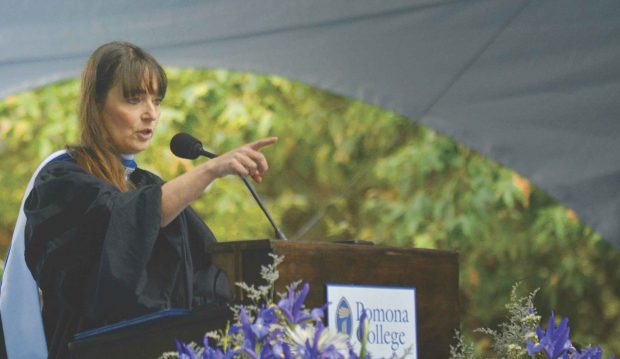
“You’re sitting here at the edge of opportunity. You have so much power and so much reach—much more reach than any generation before you. You have the same tools that we had—you can work hard, you can vote, you can speak out—but you have a whole set of new tools at your fingertips, literally, and that can help make the world not only better, but a little closer to the 9-year-old’s ideal.”

—Deborah Bial

Founder and president of the Posse Foundation,

speaking to the Class of 2016 at Commencement

PCM-summer2016text58-web2_Page_16_Image_0007

PCM-summer2016text58-web2_Page_16_Image_0002

PCM-summer2016text58-web2_Page_16_Image_0006

PCM-summer2016text58-web2_Page_16_Image_0005

New Faces

Pomona Welcomes New Academic Dean

Audrey Bilger

Audrey Bilger

Pomona’s new vice president for academic affairs and dean of the college, Audrey Bilger, took up her duties on July 1. She came to Pomona from the nearby campus of Claremont McKenna College, where she had been professor of literature and founding faculty director of the Center for Writing & Public Discourse.

“I am thrilled to welcome Audrey to Pomona, where her experience in college governance, knowledge of faculty challenges and aspirations, passion for liberal arts education and her familiarity with The Claremont Colleges will be strong assets,” said Pomona College President David Oxtoby.

In her new position, Bilger will serve as the chief academic officer and play a leading role in shaping and sustaining the intellectual life of the Pomona community.

“As a longtime member of the Claremont Consortium, I am familiar with Pomona’s strengths and history,” said Bilger. “I look forward to becoming even better acquainted with the community and to working with faculty, students, staff and other stakeholders to continue to foster the ideals of a liberal arts education in an inclusive environment.”

At Claremont McKenna, Bilger served as chair of the Department of Literature and as coordinator of gender studies. She also served on major committees, including the Board of Trustees Academic Affairs Committee, President’s Advisory Committee on Diversity, curriculum committee, WASC reaccreditation and the appointments, promotion and tenure committee. Among other significant contributions, she chaired of the working group on academic resources for international, first-generation, low-income and underrepresented minority students.

In 2014–15 she held an American Council on Education (ACE) Fellowship at the University of California, Riverside (UCR), with a placement in the Office of the Executive Vice Chancellor and Provost, where she worked closely with UCR’s leadership team. She was involved in major projects during her fellowship, including budget redesign, organizational excellence and a master planning study. She also participated in a working group charged with establishing a collaborative leadership model for faculty, staff and students.

Bilger has authored numerous scholarly articles and books, including Here Come the Brides! Reflections on Lesbian Love and Marriage, which was a finalist for the Lambda Literary Award, and Laughing Feminism: Subversive Comedy in Frances Burney, Maria Edgeworth, and Jane Austen.

She is a member of the Ms. Magazine Committee of Scholars and serves on the editorial boards of Pickering and Chatto’s Gender and Genre series and the Frances Burney Journal. Her work has appeared in Ms., the Paris Review, the San Francisco Chronicle, the Los Angeles Times and the Los Angeles Review of Books.

She received her doctoral and master of arts degrees in English at the University of Virginia and her undergraduate degree in philosophy at Oklahoma State University.

Bilger is married to Cheryl Pawelski, a Grammy Award–winning producer and cofounder of the Omnivore Entertainment Group, who serves on the National Board of Trustees for the Recording Academy.

New Faces on the Board

Three new faces and two familiar ones joined the ranks of Pomona’s Board of Trustees this summer. Elected for the first time were Kiki Ramos Gindler ’83, Osman Kibar ’92 and Jeff Parks ’02. Jennifer Doudna ’85 rejoined the Board after a four-year hiatus, and ex-officio member Christina Wire ’87 was elected to the Board in her own right.

Trustee-Doudna-JenniferJennifer Doudna ’85 is a professor of molecular and cell biology and chemistry at the University of California, Berkeley, where she holds the Li Ka Shing Chancellor’s Chair in Biomedical and Health Sciences and is a Howard Hughes Medical Institute investigator. As a co-inventor of CRISPR-Cas9, a process that revolutionized gene editing, she has received numerous honors, including the 2014 Breakthrough Prize and both the Gairdner Award and election to the Royal Society in 2016. A chemistry major, she earned her Ph.D. from Harvard University.

Trustee-Gindler, Kiki RamosKiki Ramos Gindler ’83 earned her juris doctor degree from Harvard Law School and specialized in corporate and entertainment law. Today she devotes time to writing, civic affairs and support for the arts. The first Latina president of the Board of Directors for Center Theatre Group in Los Angeles, she serves on the boards of the Los Angeles Opera and the Music Center and is a member of the Blue Ribbon and the National Council for the American Theatre. A philosophy major, she has chaired Pomona reunion committees and hosted several alumni events.

Trustee-Kibar_116Osman Kibar ’92 is founder/CEO of Samumed, LLC, a firm developing drugs for degenerative diseases, regenerative medicine and oncology. Featured on the cover of Forbes Magazine’s “Global Game Changers” issue, Kibar is an entrepreneur and inventor, has founded or co-founded numerous successful companies, and has authored or coauthored many publications and patents. An economics major, he pursued a 3-2 program that also earned him a B.S. in electrical engineering from Caltech. His M.S and Ph.D. in optoelectronics and biophotonics are from UC San Diego.

Trustee-Parks, JeffreyJeff Parks ’02 is a founding partner of Riverwood Capital Management, a globally focused private equity firm that invests in high-growth businesses in the technology and services industries, across a variety of geographic regions and company organizations. He serves on the board of directors of several prominent technology companies, including Nutanix, Spredfast and LogRhythm. A double major in mathematics and economics at Pomona, he completed his studies in three years, so he identifies with both the Class of 2002 and the Class of 2003.

Trustee-WireChristina015Since joining Google in 2007, Christina Wire ’87 has led a variety of groups across sales, marketing, operations, and corporate philanthropy. Today, she is the director of sales and business operations for Google Fiber. She has also held leadership roles at Intel, Stanford University, and the U.S. Department of State, where she began her career. She holds master’s degrees from Columbia University and Northwestern’s Kellogg Graduate School of Management. As National Chair of the Annual Fund, she was an ex-officio member of the Board from 2014 to 2016.



New Knowledge

PCM-summer2016text58-web2_Page_17_Image_0001BIOLOGY: Assistant Professor of Biology Wallace Meyer

Fireproof Ants

Even a fire won’t keep a good ant down, according to research at the Robert J. Bernard Biological Field Station (BFS) on the effects of fire on ants. But which plants grow back after fire and drought does affect ant communities.

For her senior thesis, Tessa Adams ’16 was interested in determining if the ant community changed as a result of the September 2013 brush fire that charred 17 acres at the field station and The Claremont Colleges North Campus Properties. Expectations were that the effects of fire would be significant, but it turns out ants are a hardy, fireproof lot. Results show that there was minimal immediate and no lasting impact on the species from the fire, says Assistant Professor of Biology Wallace Meyer, director of Bernard Field Station, a preserve maintained by The Claremont Colleges that protects the rare native ecosystem of California sage scrub.

“It seems like ant assemblages can withstand a fire. And it makes sense—they are this super-organism. … Fast-moving hot fires affect the surface; meanwhile the ants are down below,” says Meyer. Plus, “fire is a natural component of the ecosystem.”

However, Meyer says, following a fire, areas of land can potentially convert from native flora—in the case of BFS, California sage scrub—to nonnative grasslands, which do affect whether ants return. (Rest assured, 22 species of ants are still making their home at BFS.) Drought, too, affects whether sage scrub or nonnative grasses grow back and which species of ants make their home in each type of habitat. In fact, Meyer says, drought—while not as manifestly dramatic—is actually a larger stressor than fire.

Meyer believes this research is significant because the effects of fire on anything other than plants and mammals are largely unknown. For purposes of conservation and biodiversity management, it is important to understand these effects, since fire is going to become more common, especially in light of global climate change. Adams’ research findings will be used in conservation management plans not only at BFS, but by managers throughout Southern California.

What are the implications for conservation management? First, as long as native plant communities recover, no action is required, says Meyer. Second, which types of plants grow back favors certain ant species. Third, effects of extreme drought correlated with climate changes are real and felt, making long-term management difficult.

Thanks to her high school AP Environmental Science class, Adams came to Pomona knowing she wanted to do ecology research. She says when she stepped foot into BFS, she was awestruck by the California sage scrub habitat.

Adams’ awe quickly turned into action. Adams started working on arthropod research at BFS as a volunteer her first year at Pomona and continued through the years, setting up research sites, collecting pitfall traps, sorting specimens that were collected—and she started seeing a wide range of arthropods at the station.

“After taking Professor Meyer’s Fire Ecology in Southern California class last spring, I became interested in how fire can shape an ecosystem, and I realized that there is little research on the effect of fire on arthropods. I decided to focus my thesis on the effect of fire on ants because the lifestyle of ants, which live in colonies, has the potential to be greatly affected by fire,” says Adams.

She conducted her research by pitfall trapping. She buried a test tube in the ground, with the lip of it level with the surface of the ground. The tube was filled about halfway with a preservation solution—either ethanol or propylene glycol. As the insects ran along the ground, they fell into the trap, and the collected specimens served as a survey of the insects present in an area.

But why choose ants? Adams points to the creatures as providing crucial ecosystem services that make them important to study because of their broad impact on other organisms and their value in helping to determine ways to conserve the environment they inhabit.

So in other words, remember the old proverb: Go to the ant … consider her ways.

—Sneha Abraham

PCM-summer2016text58-web2_Page_17_Image_0002CHEMISTRY: Professor Roberto Garza-López

Molecular Origami

Pomona College Chemistry Professor Roberto Garza-López and his research colleagues have developed a new model that studies how protein molecules fold and unfold—work that has more than a few national institutes interested in the implications for understanding the development of diseases such as Alzheimer’s disease, Huntington’s disease, Type II diabetes and certain types of cancer.

The research, published in the Journal of Inorganic Biochemistry, looks at the protein called Cytochrome c, focusing on the questions of what happens to this protein’s molecules when they don’t fold properly and how this improper unfolding is linked to cancers and other diseases.

Why does a protein fold and unfold in the first place? Long protein molecules start straight, explains Garza-López, but in order to interact with other molecules, they have to fold. “And they have to fold into a very specific shape,” he says. “If they don’t fold properly, then that’s where negative things occur, especially disease. In the paper we published, we are looking at the opposite effect: we’re looking at the protein that is already folded to see how it unfolds.”

The Howard Hughes Medical Institute (HHMI) and the National Institutes of Health (NIH) are providing funding for further research and are interested in what the team’s findings reveal about the early development of diseases. Garza-López is working with Caltech Professor Harry B. Gray and DePaul University Professor John J. Kozak.

In order to visualize the protein molecule’s many folds, students working in Garza-López’s lab create 3-D structures of some of the proteins, like Cytochrome c (pictured here). “Students are very good with compu­ters, at visualizing molecules and doing calculations, but they’re also very good at visualizing what those calculations are doing to those molecules.”

Sabari Kumar ’17, a chemistry major who is working in Garza-López’s lab, was acknowledged in the published paper and is now studying the folding and unfolding of proteins related to disease by performing molecular dynamics simulations.

The research by Garza-López , Gray and Kozak continues, and they’re already finished with another manuscript looking at another protein called Intelectin-1, a protein of the intestines and lungs that is able to distinguish between human cells and the cells of bacterial invaders. “This could underpin new strategies to fight infections,” says Garza-López. He adds: “Proteins are very complex. We start with a simple model and we do a lot with that model and try to understand new things about it. That’s how science works.”

—Carla Guerrero