
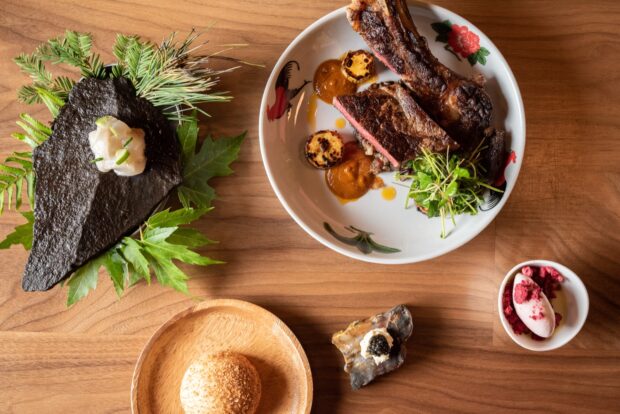
Dishes from Archipelago. Photo by Jaclyn Warren.
Samuel Yamashita remembers clearly what happened when he mentioned the word fusion at a food panel at the annual meeting of the American Historical Association held in New York in 2009. “I think I got jeered,” says the Henry E. Sheffield Professor of History with a smile.
Fusion cuisine, a popular trend in the last decades of the 20th century—think sushi burritos, curry pizza—has long fallen out of favor with the culinary cognoscenti. But while the term itself has become a pejorative, the practice of blending techniques and ingredients from different food traditions is very much alive.
Yamashita has written extensively about early modern and modern Japanese intellectual and cultural history as well as Japanese and fusion cuisine and the new hyperlocal cuisines that have appeared in global cities along the Pacific Rim.
The author of Hawai’i Regional Cuisine and the forthcoming Chefs Don’t Talk and Other Kaiseki Writings, the first English-language anthology of kaiseki chefs’ writings, Yamashita has thoughts on why fusion matters and how it has evolved into an entirely new kind of cuisine.
Was there fusion before “fusion”?
Absolutely. We see it in China very early, between the third and eighth centuries when Central Asian foods, especially dairy products, were introduced to China. One doesn’t associate cheese and milk with East Asian cuisine, but they were consumed in China and in Japan, probably Korea as well, before the early modern period. That’s an instance of natural fusion.
A brilliant writer named Zilkia Janer has also written about the imposition of Spanish culture on the Caribbean and Central and South America, beginning in the 1600s. She talks about the fusion that resulted from Spanish rule, when meat and bread became more important in the diets of those places.
How did fusion cuisine change the food world?
The Franco-Japanese fusion that happened in the ’70s, ’80s and ’90s was really important because it opened the door to Asian cuisines that classically trained French chefs had formerly turned their noses up at. Important here were the nouvelle cuisine chefs who moved away from the rich, sauce-based cuisine classique. One result is that refined Japanese haute cuisine—kaiseki—has been recognized after several hundred years. And Buddhist vegetarian cuisine, which is over a millennium old, also can now be recognized.
Nouvelle cuisine also led to the New Nordic cuisine, which in turn opened the door to a resurgence of foraging and indigenous cuisines.
Why did fusion as a trend fail?
I think there was just a lot of bad fusion. People were overdoing it. Roy Yamaguchi, one of the founders of the fusion movement known as Hawai’i Regional Cuisine, put it this way: “A lot of chefs, when they don’t know what they’re doing, may put too many Asian ingredients into a sauce, and it really doesn’t go with what they’re trying to do as a whole…”
Are we seeing a re-emergence of fusion? Would the chefs you talk to call it that?
No, we’re two steps beyond the fusion cuisine that nouvelle cuisine enabled. Many chefs are now practicing what I call “culinary hyperlocalism.” Brian Hirata, an innovative chef in Hawai’i that I’ve written about, would be very uncomfortable if we brought up the word fusion. The multiplicity of techniques he uses reflects his cultural background. He’s of Japanese descent and was a culinary arts student and instructor, so he knows French and modernist techniques. He also has an interest in reviving Hawaiian food ways—gathering, fishing, hunting and foraging most of his ingredients himself.
Chefs like Jon Yao [head chef and co-owner of Michelin-starred Kato in downtown L.A.] and Aaron Verzosa [chef/co-owner of Seattle’s Archipelago] would say they are doing something unique that reflects their own position as children of immigrants and the family food they remember eating. Yao talks, for example, about what his mother cooked at home and how it represents her journey from Taiwan to Los Angeles. So, their fusion is an unintended byproduct. The powerful drivers are really diasporic immigrant community memories.
For Verzosa in particular it’s not just about food, it’s about Filipino culture and narrative. For chefs all over the world now, especially fine dining chefs who trained in France or the U.S., narrativization has become very important—talking about oneself and one’s family. That’s something new. Everybody is searching for meaning and significance.
And they’re also looking at food and its relationship to a particular food shed—the local area where the food is sourced. When French cuisine was utterly dominant, French ingredients were imported everywhere—to the tropics, to America. But as one chef in Hawai’i put it, “the days of the FedEx chef are over.”