
Kaitlyn Casimo ’13 draws on her background in both neuroscience and theatre to explain science.
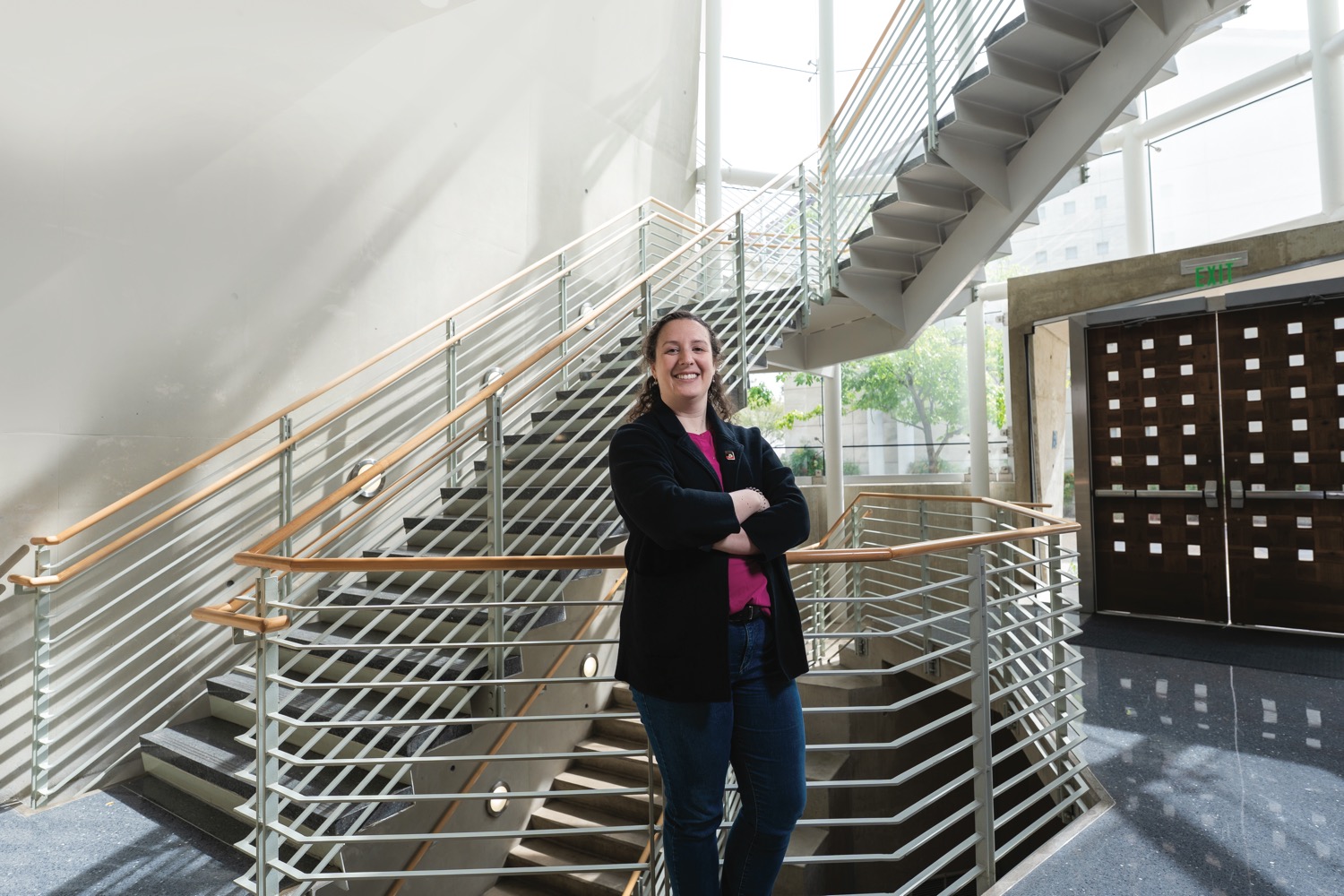
Kaitlyn Casimo ’13 visiting Claremont for a talk at CMC in Spring 2026.
Kaitlyn Casimo arrived at Pomona in 2009 planning a double major in biology and theatre. She thought of herself as a science person, fascinated by animal behavior, human-animal interactions and climate change. As a teen, she had volunteered at her local zoo talking about global warming in the shadow of the polar bear exhibit. She didn’t yet know that explaining science would become her career.
In the fall of her sophomore year, Casimo enrolled in Introduction to Neuroscience, taught by Jonathan Matsui—now at Harvard. Pomona, she notes, was one of the earliest colleges to offer this major. That matters to her now, because working with undergraduate neuroscience programs is a part of her daily mission.
She attended graduate school at the University of Washington and thought she wanted to be a teaching faculty member at a college like Pomona. But her plan shifted. As a grad student, she began doing a substantial amount of science communication work, as well as behind-the-scenes education outside of the classroom, including curriculum design. By the time she was finishing her doctorate in neuroscience, she knew she was headed toward a role in science communication or education.
Of Cyborgs and Space Colonies
In her downtime, science communicator Kaitlyn Casimo loves to geek out on sci-fi and science-related books and TV shows. Here are her top five picks:
The Murderbot Diaries series, Martha Wells
About a cyborg who has gained autonomy and uses its freedom to watch soap operas, have anxiety and eventually make friends. (It’s a comedy!) The supporting cast of scientists reflect real scientists’ personalities and group dynamics. Now also a TV show.
Stories of Your Life and Others, and Exhalation, Ted Chiang
Short story collections that dig into the implications of science and technology on life. Many of the stories are cautionary tales, and all of them have a huge amount of heart. One of the stories is the basis for the movie Arrival.
Lady Astronaut series, Mary Robinette Kowal
After a meteor strikes Earth causing massive global warming, NASA accelerates its efforts to set up human space colonies. The story follows a female astronaut dealing with sexism, racism and anti-space-travel activists while contending with the challenges of space.
Vinegar Girl, Anne Tyler
A retelling of The Taming of the Shrew set at a biomedical research lab at Johns Hopkins. Of course I’m going to pick the book that has both science and theatre in it!
Call the Midwife TV series
In a poor neighborhood of London, the midwives provide maternity and general health care and a huge dose of community support from their scrappy clinic. Every episode, infused with real health and medicine, centers on women’s science expertise.
Today, leading a nine-member team, Casimo helps people use open science data from Seattle’s Allen Institute to do their own work and to educate the next generation of scientists. The institute was created by former Microsoft executive Paul Allen, who dedicated much of his philanthropy to accelerating science discoveries.
Her team’s focus is open science: the practice of making scientific data, publications and software publicly accessible, and helping educators, students and working scientists dig deep and fully use those resources. Open science also encompasses open education, citizen science and community science projects. All of these are science—but carried out outside of the walls of research institutions.
In a full-circle moment, more than a decade after listening to Matsui talk about neuroscience at Pomona, Casimo co-authored a research study in 2023 about how to educate undergraduates in the Journal of Undergraduate Neuroscience Education. Her paper outlines how to create a student project around an open data set of neuron cells, encouraging the students to use statistical analysis.
Her team at the Allen Institute does everything from training scientists to running field trips for high school students. As leader of the program, Casimo is a frequent science communicator. She may appear on the local news, or speak at a science night for the public, using zombies to speak about motor control and other parts of the brain. She sees communication as built by skill practice, not as an innate talent.
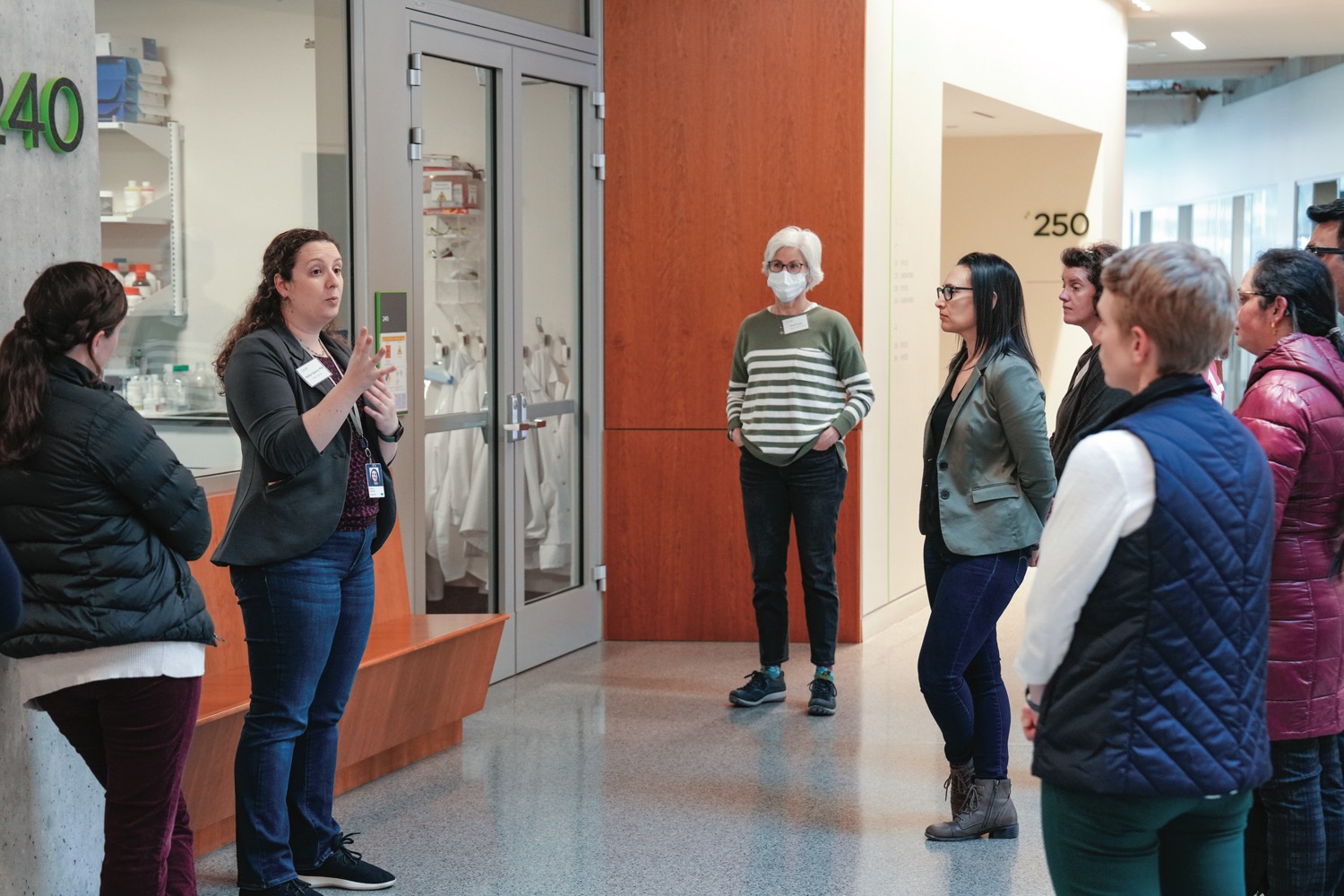
Kaitlyn Casimo ’13 leading a group at the Allen Institute’s inaugural teacher academy in 2023.
Casimo is direct about the challenge of the moment. “If we don’t go speak up for science,” she says, “then it’s the people who don’t care about accuracy who are speaking about science.” Scientists, she finds, tend to argue that the work should speak for itself. Or they may default to fun facts when doing outreach, abandoning what she sees as the more crucial sharing of the process. She wants academics to talk about the joy of, say, reasoning your way through a messy set of data.
The scientist’s misconception when communicating, she says, is forgetting that science is a way of understanding the world.
Curtains, Cue Sheets and Calling the Show
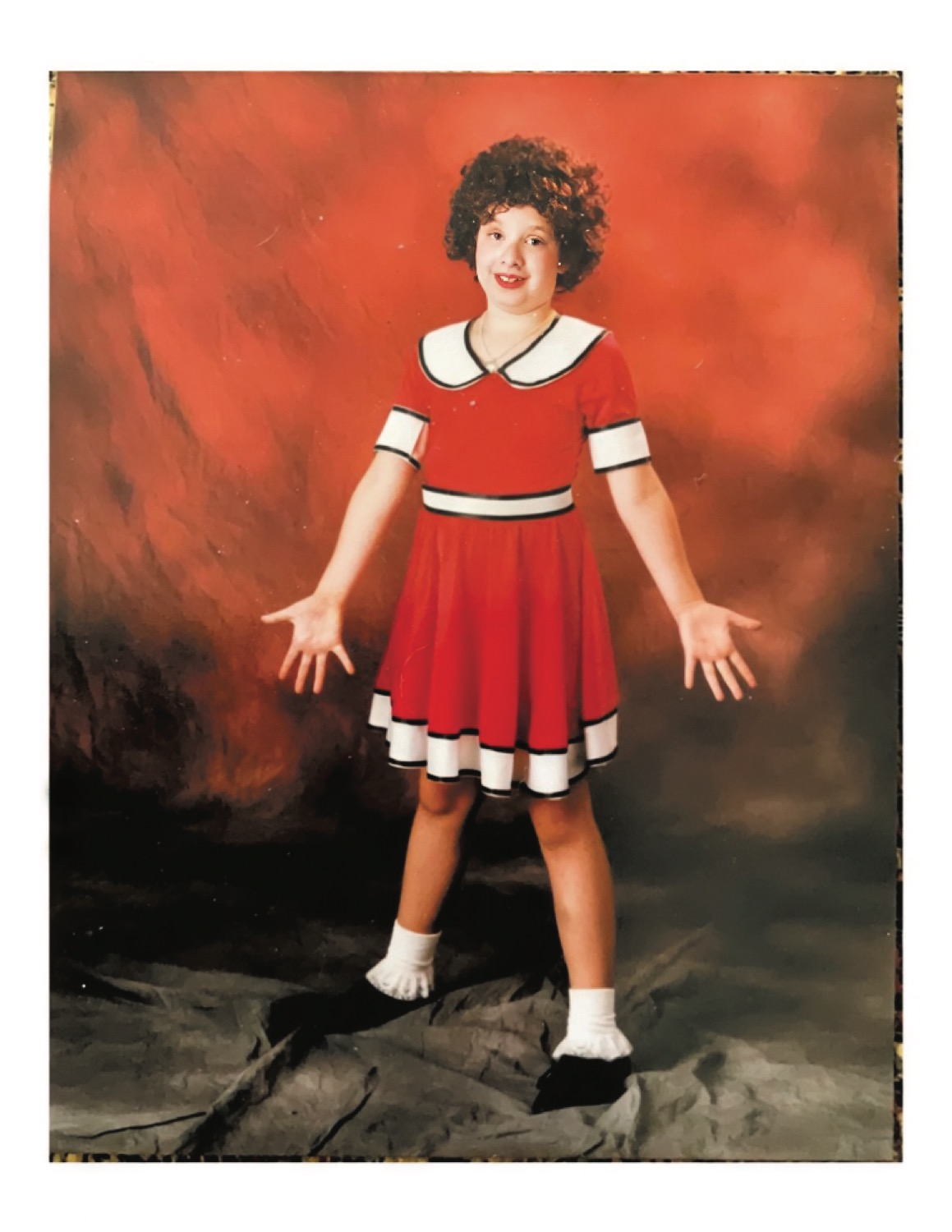
Kaitlyn Casimo as Annie at around
8 years old.
Casimo’s theatre story opens when 4-year-old Kaitlyn takes the stage in a performance as Goldilocks.
During the performance, a flat—one of the set pieces propped along the back of the classroom—began toppling toward the cast and her father grabbed it to save the day. Having survived that, she was hooked. She would go on to play Annie in a production of the musical, when she was about 8 years old. Musical theatre became a passion.
She chose Pomona specifically because she could be a science major and do theatre. She braided them together each day, often with coursework in the morning, lab in the afternoons and rehearsals and performances in the evening.
Two productions at Pomona stand out.
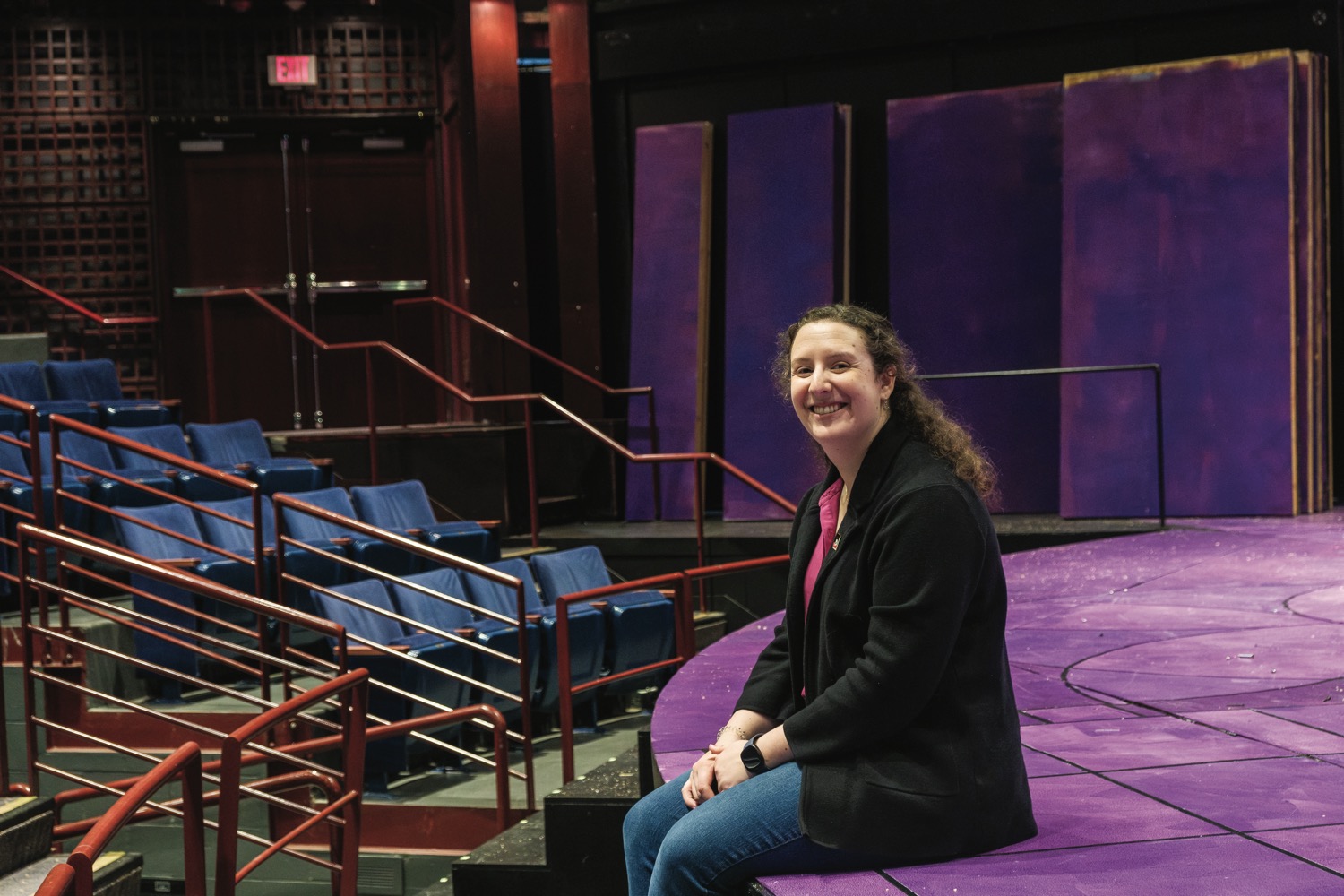
Kaitlyn Casimo ’13 sitting on the main stage in Seaver Theatre.
The first was the Henrik Ibsen play John Gabriel Borkman directed by the legendary Leonard Pronko, during her sophomore year. Casimo portrayed Borkman’s wife, her first encounter with what she calls “a classic piece of theatre.” Not knowing Ibsen’s place in Western history kept her from being intimidated. She still has that script, with comments from Pronko scribbled on. “Sit like a goddess,” he told her.
The second was not a performance at all. Fall of her senior year, she signed up to stage manage a production of Kindertransport, a play about the rescue of children from Nazi Germany. She had been working behind the scenes in theatre since she was a teen, doing run crew and costume crew on various shows. But stage managing a full play was different.
“Stage managing just changes your perspective,” she says, “because you’re looking at the whole thing.”
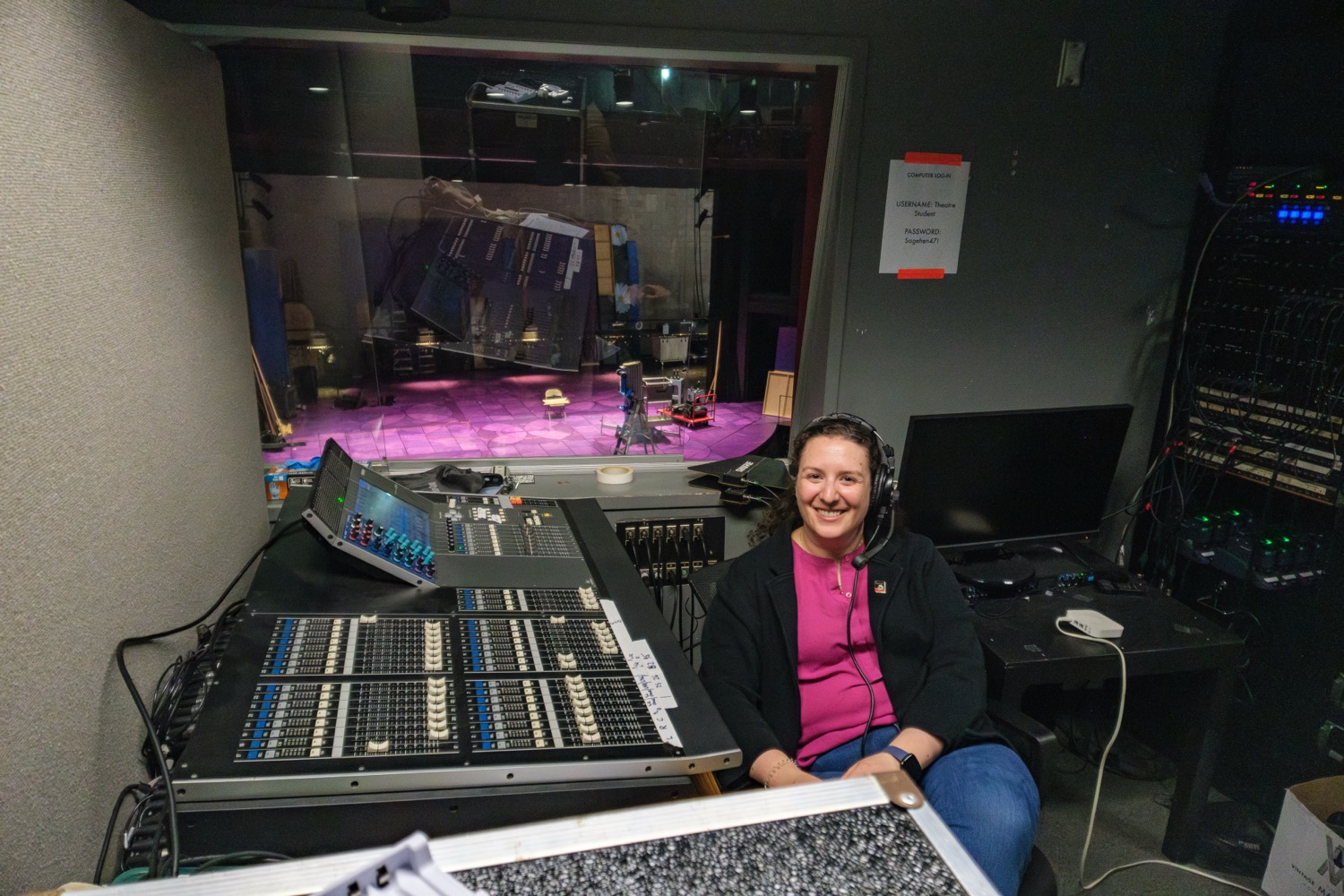
Casimo returns to the ‘hot little booth’ at Seaver Theatre.
From a hot little booth, crowded with electronics for the lights and sound, she kept her vital notebook of every cue she had to manage.
That perspective, she would realize later, is exactly what reshaped how she thinks about science communication. A stage manager’s job is, at its core, about consistency and seeing the big picture. “Running a show as a stage manager is not entirely unlike running an experiment in a lab,” she says. “You have a set of steps you want accomplished in the right order. And it has to be the same every time.” Also, she points out, she is not intimidated by technology—which is lucky, because a stage manager is typically running three to five separate pieces of electronics at any given moment.
The communications work she does with scientists on how to talk about their research is heavily influenced by her theatre background—not just in obvious ways like stage presence and projection, but in the deeper sense of thinking about oneself, and the whole production team, as performers. “You are playing the role of a scientist talking about their work,” she explains. “What is your story arc? What is the set design of the place where you are having this conversation? What are the ways that the physical environment shapes perception.”
While she no longer seeks out performing roles herself, she loves the backstage life of theatre and still does some directing at a short theatre festival in Seattle.
Her biggest regret from college is that the senior seminar for theatre and the senior seminar for neuroscience conflicted. She would love to go back and add a theatre thesis and theatre major to her record.
The advice she would give her college self is a single sentence: Ask for help. The world, she has learned, is not as rigid as it sometimes appears. If you go ask someone to work something out, more often than not, they will.
Meeting of the Passions
Casimo sees both science and theatre as ways of exploring our relationship with the world—science by breaking things down into tiny pieces to understand the mechanisms, and theatre by examining how we interact with each other. “Ultimately,” she says, “both of them are asking: what is it about the world that makes this an interesting story?”
While she once identified first and foremost as a scientist, Casimo now embraces being an interdisciplinary person.
“I could not do what I do now if I had not done research myself,” she says. “That heavily informs the way that I talk about science.”
She’s at once a scientist and a science communicator and a theatre kid, and the kind of sci-fi nerd who just casually whips out a DVD of the original Star Trek in the middle of a conversation.
“I contain multitudes,” she says, laughing.