
Alex Zylstra ’09 and Pacific Fusion are working to bring the energy that powers the sun’s core down to Earth.
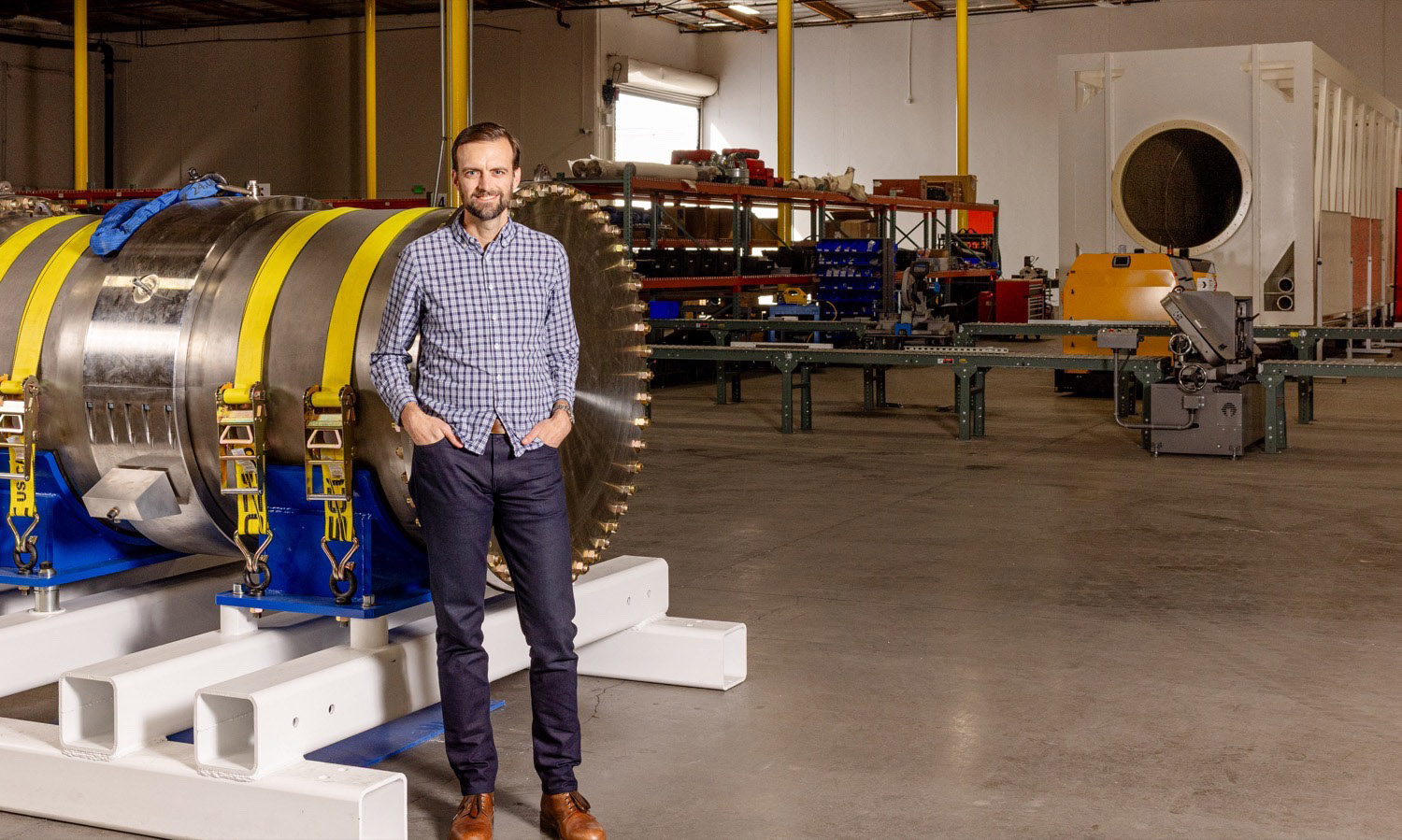
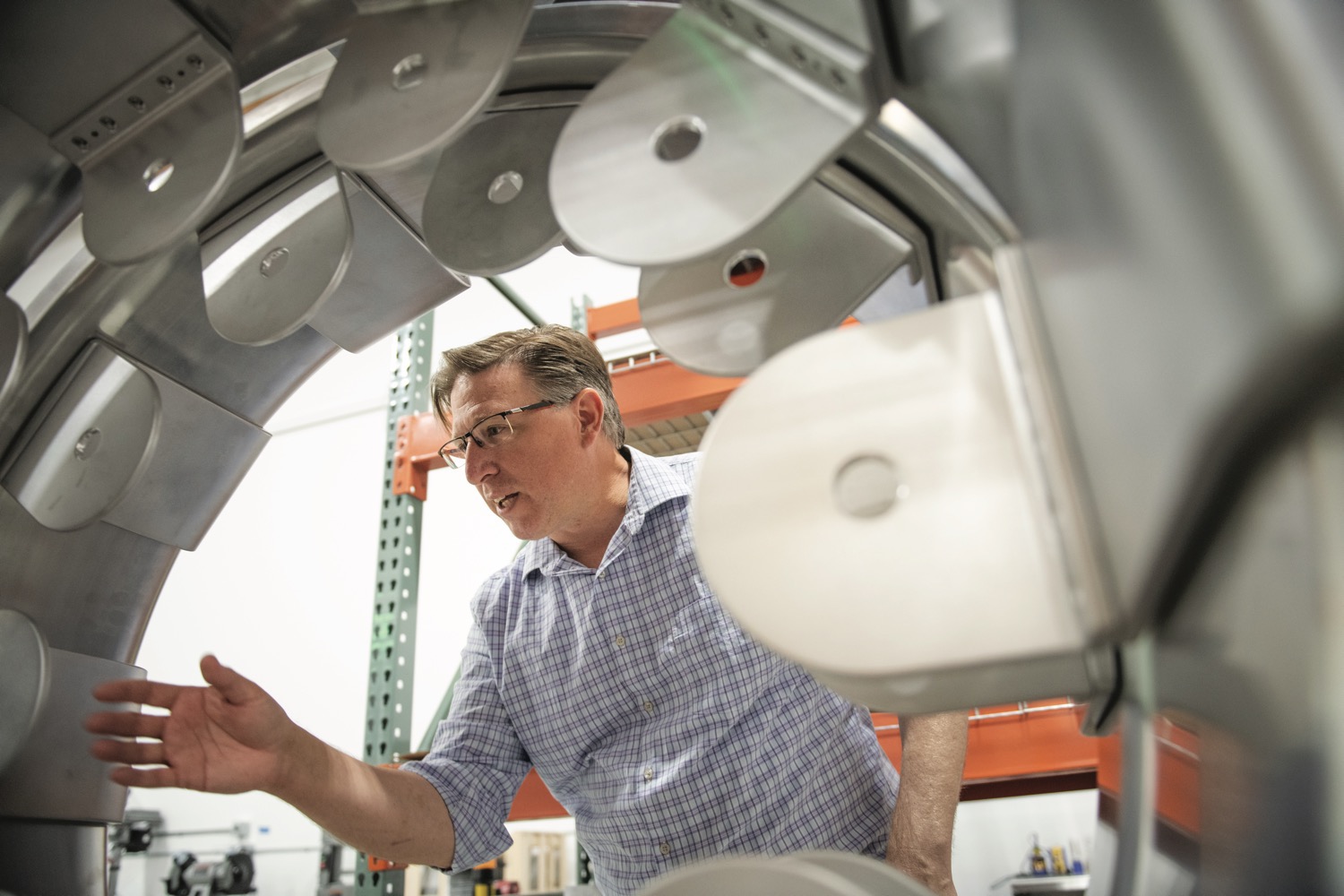
Alex Zylstra ’09 at Pacific Fusion where he works as a nuclear fusion energy scientist. Photo courtesy of Nicola Parisi ’12
Bay Area startup Pacific Fusion is developing a new technology that fires powerful electric pulses in a millionth of an eye-blink, lighting up magnetized fuel to generate fusion energy.
And they’re doing it with the help of Alex Zylstra ’09, the small-but-growing company’s experiments lead. Already, they’ve made significant strides toward ultimately building a commercial reactor with this futuristic energy source.
“When I started out, the mentality in the fusion community was that this is still a research project. There’s this joke that fusion is always decades away,” Zylstra says. “That has actually changed a lot.”
Nuclear fusion, which involves smashing atoms together at high temperature and pressure, is the same kind of energy that has powered the sun for 5 billion years. Researchers have long dreamed of harnessing fusion on Earth, a lofty goal that might one day provide nearly limitless, nearly carbon-neutral energy around the world. “Fusion has always been a sort of holy grail thing,” Zylstra says.
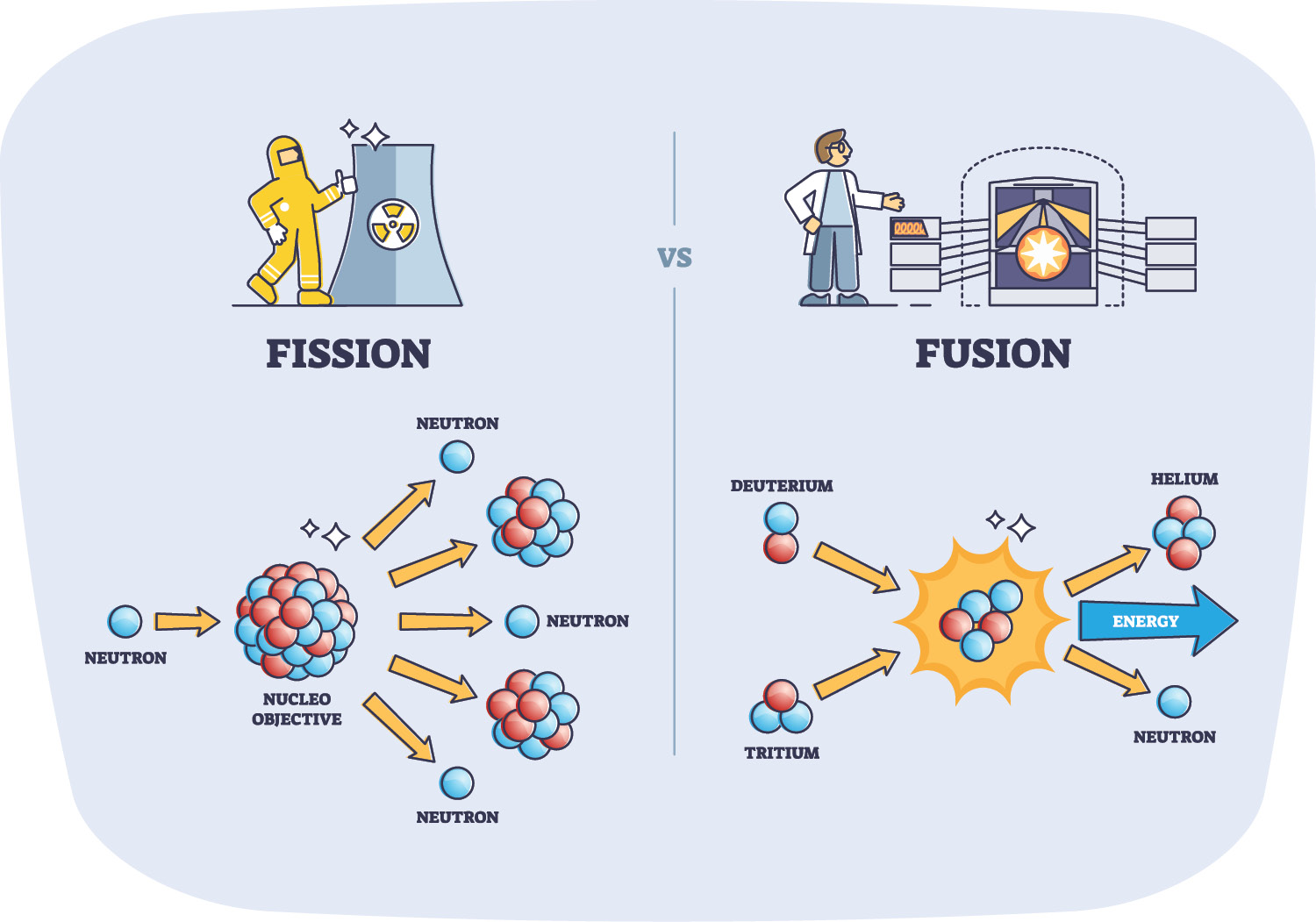
Illustrated comparison labeled “FISSION” vs “FUSION.” On the left, fission shows a neutron striking a “NUCLEO OBJECTIVE,” splitting it into smaller nuclei and releasing multiple particles labeled “NEUTRON.” On the right, fusion shows “DEUTERIUM” and “TRITIUM” combining to form “HELIUM,” releasing “ENERGY” and a “NEUTRON.”
Zylstra leapt onboard the fusion industry at a fortuitous time. Over the past few years, the fusion private sector has exploded in growth, transforming from a handful of hopeful startups into a multibillion-dollar industry promising to become the next big energy source, with the potential to join the ranks of other expanding clean energies, especially wind and solar. Pacific Fusion alone raked in $900 million in its 2024 funding round, one of the largest to date, and a sign of lofty expectations for commercial fusion.

Zylstra’s career path has taken a few twists and turns, as he ventured from Pomona to national labs, and now to Pacific Fusion. The scientific and engineering challenges of making fusion a reality particularly excite Zylstra. “I’m also kind of a big sci-fi nerd, and it’s kind of a sci-fi problem,” he says, noting that Lawrence Livermore National Laboratory’s National Ignition Facility, where he previously worked, was used as a set for the 2013 movie Star Trek Into Darkness.
The prospect of nuclear fusion as a sustainable energy source comes as ongoing global warming brings devastating wildfires, floods, droughts and heat waves, while many countries struggle to reduce their greenhouse gas emissions. “Personally, I’m passionate about developing new sources of energy, motivated by climate change,” Zylstra says, referring to it as “an enduring challenge for humanity.”
The United States, whose withdrawal from the Paris Agreement took effect in January 2026, previously pledged to achieve net-zero emissions by 2050. That means leaving most remaining fossil fuels in the ground, while shifting to new energy sources. The clean energy transition is not without its own dilemmas, however, considering the environmental and health impacts of mining for rare earths and critical minerals, the intermittency of wind and solar energy, and the rapidly growing energy demands of the tech industry’s controversial AI data centers. But perhaps, eventually, fusion energy could play a major role in that transition.
Considering that no one can re-create the sun’s gargantuan gravitational forces on Earth, labs and fusion companies typically have two ways to produce fusion energy. Researchers first need plasma, an extremely hot gas-like matter where the atomic nuclei shed their electrons. To generate the plasma, researchers heat heavy hydrogen fuel—usually deuterium or tritium—to 100 million degrees Celsius or so and keep that fuel confined and compressed densely enough for fusion to occur. A typical fusion reaction fuses fuel particles into helium nuclei, and the excess mass turns into energy.
One of the main approaches to producing fusion involves magnetic confinement, using powerful magnetic fields to manipulate the plasma and maintain fusion reactions, in a doughnut-shaped reactor called a tokamak or one with a twisted structure called a stellarator. The other method, called inertial confinement, involves using powerful lasers or electric pulses to compress the fuel, igniting the plasma and producing a shock wave that enables fusion reactions. Zylstra is working on advancing that latter technique at Pacific Fusion. A few companies are also attempting to design hybrid approaches.
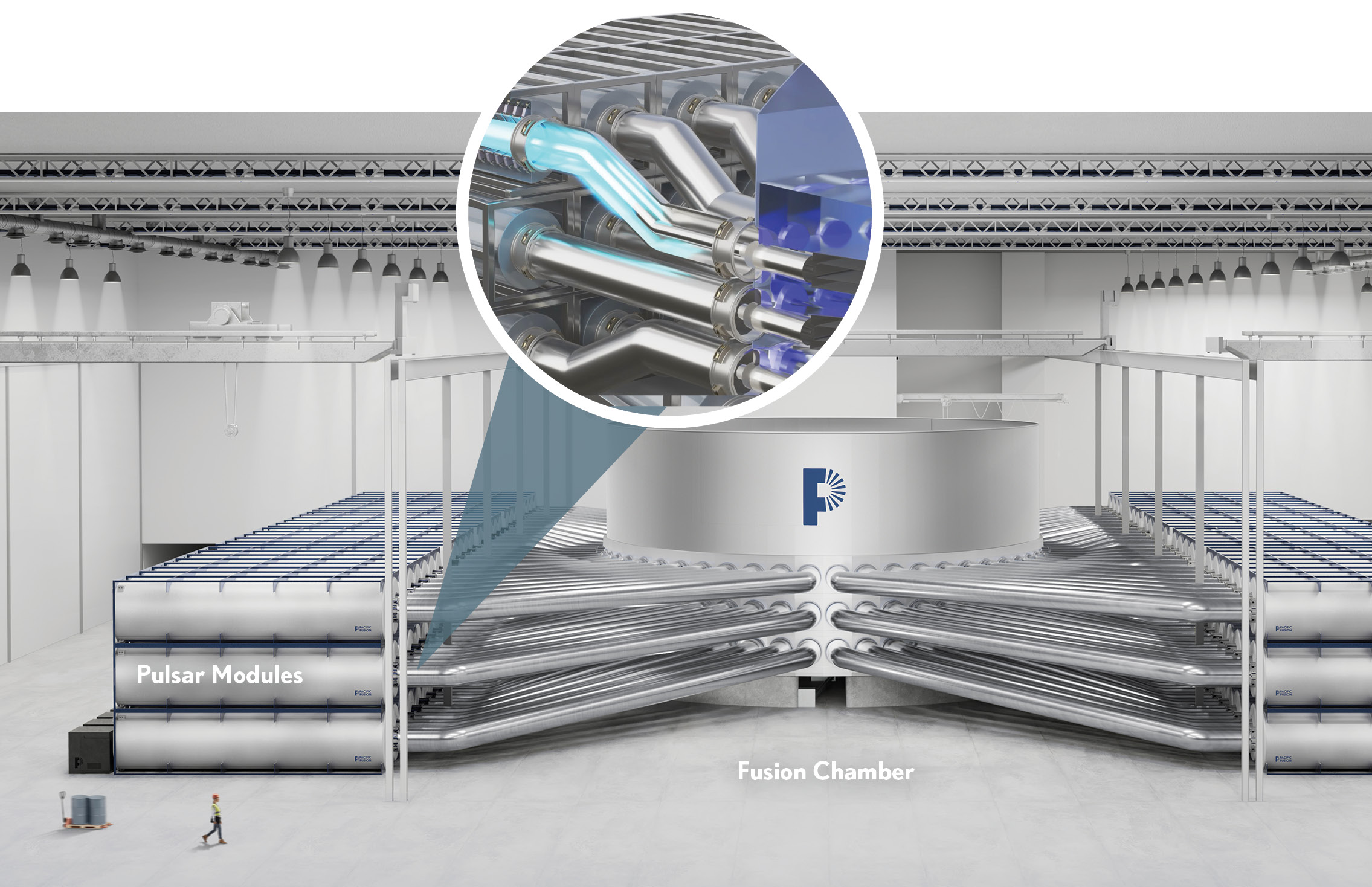
Pacific Fusion’s method of creating nuclear fusion uses electrical pulses generated in pulsar modules to compress and heat the fuel. Capacitors discharge their energy toward the fusion chamber in the center.
A fusion company needs to create high temperatures for the fusion reactions, high plasma density and long confinement time, which refers to how long particles are confined within the plasma before losing their energy. Magnetic confinement focuses on producing long confinement times, while inertial confinement produces intense pressures to increase the density.
In Pacific Fusion’s approach, they start with a cylinder of fuel inside a pencil eraser-sized conducting metal container. They then drive a large electric current through it, which generates a magnetic field, and the electromagnetic interaction generates a force that compresses the fuel. It’s like a can crusher, except much more extreme, Zylstra says.
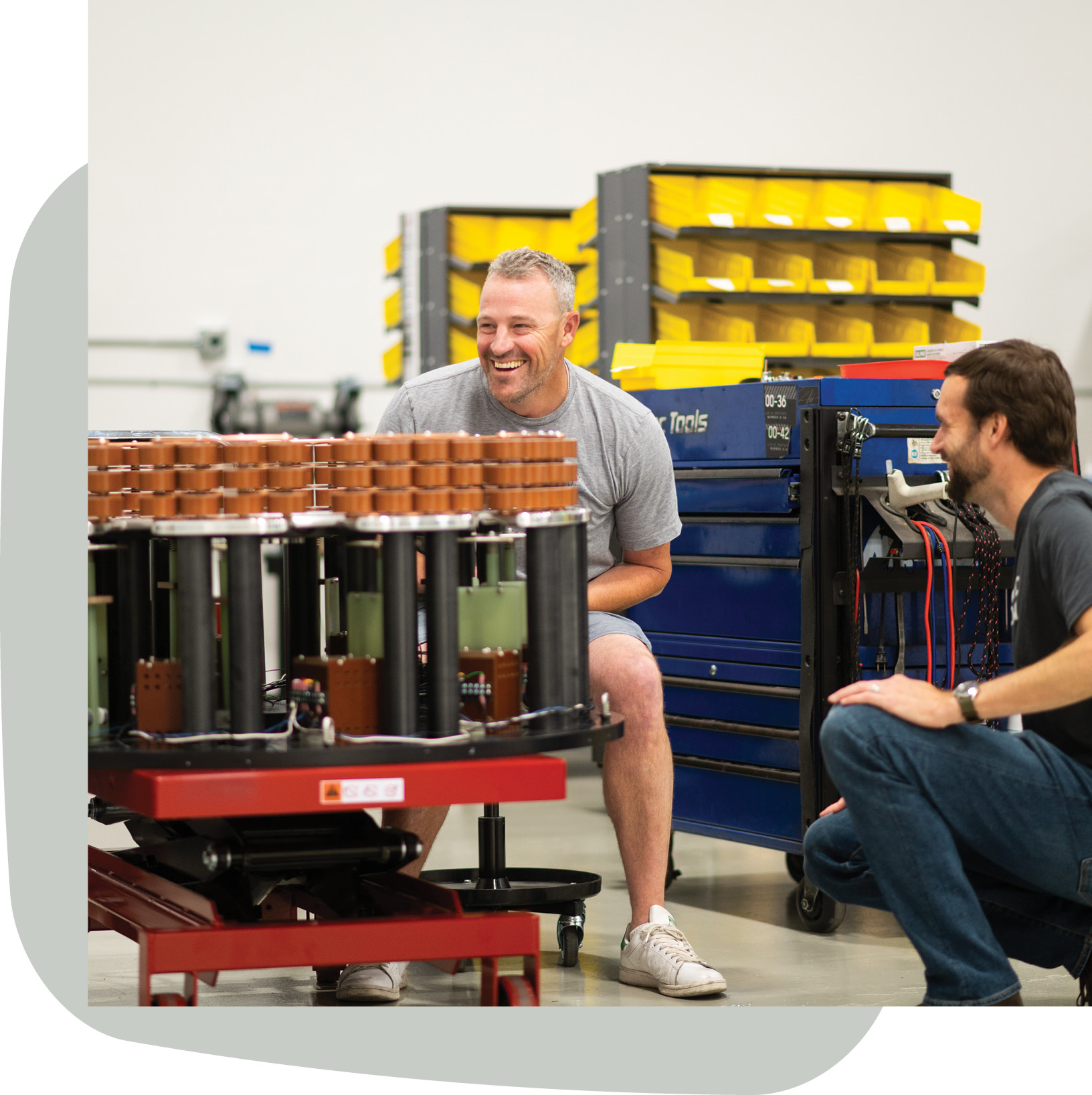
Alex Zylstra ’09 (right) with a colleague working on nuclear fusion. Photo courtesy of Pacific Fusion.
Nuclear fusion and nuclear fission sound similar, and both sometimes have associations with nuclear weapons research. (Almost all countries with multiple fusion startups also have nukes, with the exception of Germany and Japan.) But they’re rather different. Fusion refers to combining nuclei, while fission refers to breaking them apart.
For fusion, the reactions are hard to start and easy to stop, but for fission, it’s the opposite; when the reaction gets out of control, it leads to a meltdown, with safety and health risks that are well-known, thanks to the fallout of disasters like Chernobyl, Three Mile Island and Fukushima. Fission also requires environmentally harmful uranium mining and larger quantities of fuel, and it produces toxic waste that’s radioactive for millennia, while fusion only requires small amounts of tritium, which is only mildly radioactive.
As Zylstra sees it, fusion comes with some long-term challenges, such as limited global supplies of tritium for fuel, but overall, these considerations add up to huge advantages for fusion, if it can indeed become a bona fide energy source.
Keith LeChien, Pacific Fusion’s CTO and co-founder. Photo Courtesy of Pacific Fusion.
Fusion advocates got a massive boost from recent breakthrough experiments at Livermore that briefly produced more energy than was put in—more than 3 megajoules of fusion energy output with 2 megajoules of laser energy input—a milestone called scientific energy break even or fusion ignition. “The National Ignition Facility at Lawrence Livermore National Laboratory succeeded in achieving ignition in 2022, in great part thanks to Alex,” says Hans Herrmann, Zylstra’s former mentor at Los Alamos National Lab and now a consultant for Pacific Fusion.
After that quantum leap, funding started streaming into fusion startups, with several new companies forming, including Pacific Fusion. Now that ignition has finally been demonstrated, Herrmann believes that fusion companies will be “putting electrons on the grid” well within 20 years. That may or may not come soon enough to matter for combating global warming, but it does appear to offer an improvement over some current energy sources.
* * *
A historic shift has begun to take place as private sector investment in nuclear fusion—recently surpassing $10 billion—could soon outpace government funding. Fusion has expanded from the academic experiment stage to a global proliferation of companies all racing to develop commercially feasible reactors. Zylstra’s career has mirrored that shift, as he has transitioned from academia to industry.
“I consider my career to be successful if I play a role in putting fusion power on the grid.”
—Alex Zylstra
Zylstra had his first laser research experience at Pomona, learning from and working with Dwight Whitaker, a professor of experimental physics and former chair of Pomona’s Department of Physics and Astronomy. “He was outstanding, really quick to pick up how everything works. It felt like working with a colleague,” says Whitaker.
As one of Whitaker’s first thesis students, Zylstra tried to advance experiments to turn gases into a unique quantum state called a Bose-Einstein condensate. At one point, he figured out how to build an electronic box, designed so that they wouldn’t accidentally burn their detector to a crisp with the high-powered lasers. But sometimes with experiments, things don’t work, Whitaker says.
“He had the right sort of mindset to get through those difficulties. You’ve really got to take your lumps, keep moving forward and keep trying things.”
Whitaker praises Zylstra’s career path. Working in national labs and in the fusion energy industry requires becoming a multidisciplinary physicist, engineer and people manager—a rare combination of skills that Zylstra possesses, Whitaker says.
Herrmann similarly highlights Zylstra’s experimental and computational skills, which transfer well to fusion energy R&D. “He’s well-rounded and can master just about any technical problem that’s thrown at him. He’s got the most creative and brilliant problem-solving capability of just about anyone I know,” Herrmann says.
After Los Alamos, Zylstra went on to Lawrence Livermore, where he collaborated with physicist Steven Ross ’03. Their work together included an award-winning research project published in 2024 that built on the previous burning plasma experiments at the National Ignition Facility. In particular, they demonstrated the importance of symmetry, since uniformly compressing the implosion improves how much energy can be produced by such fusion reactions. Ross also compliments Zylstra on his research style. “We’re lucky to have very talented people at the lab and he fit right in: very detail-oriented, meticulous, while executing these complex experiments,” Ross says.
As ongoing investment continues to super-charge the industry, many top researchers like Zylstra have gone from labs and major universities to join startups. For example, the biggest fusion company, Commonwealth Fusion Systems, spun out of MIT, and is focused on designing tokamak reactors. First Light Fusion came out of Oxford, using an approach based on somewhat similar technology as Pacific Fusion’s, and Thea Energy spun out of stellarator research at the Princeton Plasma Physics Laboratory.
* * *
For Zylstra, commercial fusion is feasible in the near future, but success depends on advancing along three dimensions: sound science that builds upon work done at national labs; a plausible path based on known technology and engineering; and, of course, viable economics. “At the end of the day, if you can’t make a power plant that produces energy at an economically competitive price, then what’s the point?” he says.
Nuclear Fusion
By The Numbers

100 million°C, the temperature reached by plasma in reactors necessary to overcome electrostatic repulsion.

Nuclear energy can theoretically generate 4 million times more energy per kilogram of fuel than burning coal or oil.
 To confine the plasma, some fusion devices generate electrical currents 10x a bolt of lightning (making it arguably the most complex machine ever built).
 Fusion reactors use special superconductors that create compact magnetic fields by operating at roughly -196°C … which is significantly colder than the liquid nitrogen doctors use to burn off warts and skin cancers.
Pacific Fusion is now building a demonstration system in Albuquerque, and by 2030 they aim to go beyond fusion ignition and achieve “net facility gain,” where they produce more energy than is stored in the entire facility—an effort that is being led by, among others, Zylstra. They’re also working on the commercial side of things, making their fusion system modular and affordable so that it becomes possible to mass manufacture fairly simple components for easily assembling power plants. Pacific Fusion aims to have its commercial plant online in the mid-2030s.
Ultimately, a few fusion companies may find ways to successfully and economically generate energy. “It is important to have multiple efforts going, including Pacific Fusion. You never know exactly where the most perfect solutions to the engineering challenges will be,” says Keith LeChien, Pacific Fusion’s CTO and co-founder.
Other companies have similarly ambitious goals. Commonwealth Fusion wants to have its first commercial plant built and running in Richmond, Virginia, in the early 2030s. Helion Energy’s target for putting electricity on the grid is as soon as 2028. These facilities are designed to have an electricity generating capacity in the range between 50 and 400 megawatts, enough to power tens of thousands of households (or a single large data center). The race is on, even if some of these timelines turn out to be a little unrealistic.
In the meantime, other sectors of the clean energy industry have been growing. Solar and wind energy capacity continue ramping up, despite federal government recent attempts to undermine them, and they’re projected to provide most non-nuclear energy in the United States by 2050, with significant energy contributions also coming from hydropower, fission and geothermal sources. As efforts continue to advance a clean energy transition within the next decade or two, could Pacific Fusion and others in the industry transform energy generation with fusion?
“Personally, I consider my career to be successful if I play a role in putting fusion power on the grid,” says Zylstra.