 Twelve Pomona College recipients of the prestigious Fulbright fellowships are criss-crossing the globe this fall, doing research on independent projects or teaching English. Here’s a brief description of their plans:
Audrey DePaepe, a neuroscience major from Tualatin, Ore., takes her Fulbright to the Cognition & Brain Plasticity Unit of Barcelona in Spain and focuses her research on Huntington’s disease.
Jack Gomberg, a neuroscience major from Chicago, Ill., travels to Israel to explore the biopsychological effects of medical clowning on patient outcomes.
Laurel Hilliker, an Asian studies and history double major, from Pittsburgh, Penn., goes to Japan, intending to uncover the history of Zainichi Korean political activism within Osaka and Tokyo in the aftermath of the Pacific War.
Emily Rockhill, a biology major from Redmond, Wash., conducts research in southern Brazil, assisting on a project at Universidade Federal do Rio Grande do Sul to identify and describe new species of crayfish of the genus Parastacus.
Elizabeth Sun ’17, a French major from Albuquerque, N.M., is studying the teaching of English and French in Saarland, a region in western Germany that has historically been a space of French-German interactions.
Rory Taylor, an international relations major from Minneapolis, Minn., travels to New Zealand to examine how the United Nations Declaration on the Rights of Indigenous Peoples acts as a tool of legal advocacy for indigenous groups.
Victoria Vardanega, an economics and Asian studies double major from Fair Oaks, Calif., goes to South Korea to research the relationship between the press and government.
Don Chen, an international relations major from Normal, Ill., is teaching in Taiwan. He plans to focus on storytelling by hosting exhibitions of family history projects by students and an oral history event featuring local elders.
Lauren Callans, a neuroscience major from Ardmore, Penn., is teaching in Estonia. In addition to her love for teaching, she wants to explore her heritage as a third-generation Estonian and share her American culture.
Minah Choi, an environmental analysis major from Olympia, Wash., is teaching in Argentina. She hopes to contribute to the existing literature on Asian communities in Latin America.
Rhiannon Moore, a music major from South Pasadena, Calif., is teaching in Malaysia. Her interest in that country is rooted in her love for Southeast Asian music and desire to explore Malaysian music.
Inga Van Buren, a molecular biology major from Portland, Ore., is teaching in Taiwan. Drawing from her own multilingual background, she hopes to convey to her students the usefulness of being bilingual.
 Pomona professors Jerome D. Laudermilk and Philip A. Munz made headlines after traveling to the Grand Canyon to study a rare find: 20,000-year-old giant-sloth dung. According to an article in the Sept. 20, 1937, issue of Life magazine, the dung covered the floor of a cave believed to be home to giant ground sloths, which waddled on two legs and could grow as large as elephants. Laudermilk and Munz hoped to uncover the sloths’ diet and what it might reveal about plant and climate conditions of the era.
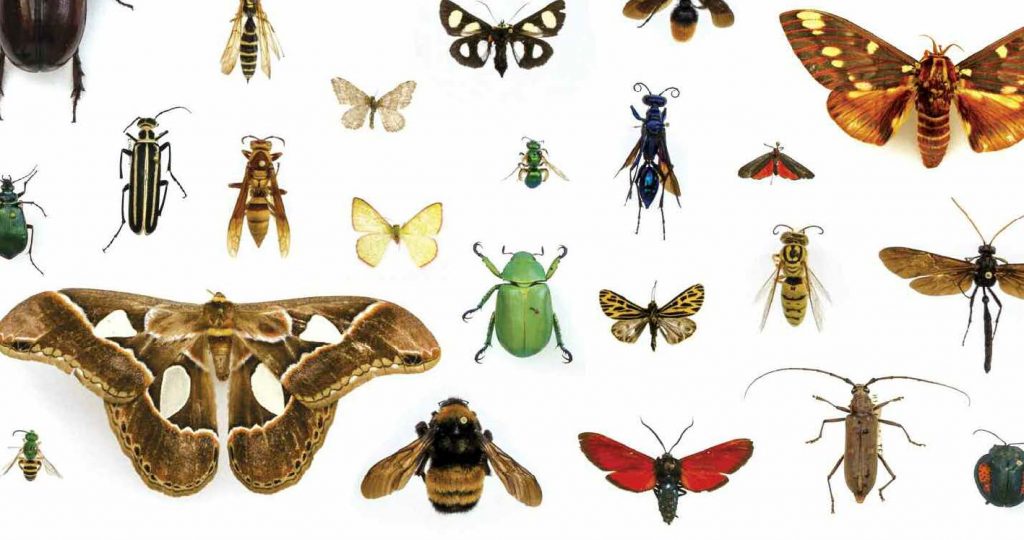
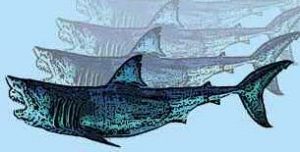 As a Pomona student, the late Lee Potter ’38 had a simple plan to pay his way through college: sell his skills embalming animals. Potter, a pre-med student, had more than four years of embalming experience by the time the LA Times profiled him on June 1, 1937. He embalmed fish, frogs, rats, earthworms, crayfish and sharks and sold them to schools for anatomical study in their labs. His best seller: sharks—once, he sent an order of 200 embalmed sharks to a nearby college. His ultimate goal was to embalm an elephant.
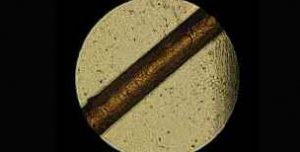 In August 1936, a Riverside woman named Ruth Muir was found brutally murdered in the San Diego woods, and the case ignited a media frenzy. A suspect claiming he “knows plenty” about Muir’s murder was found with 20 hairs that appeared to belong to a woman. In their rush to test whether the hairs were Muir’s, police turned to an unlikely source to conduct the analysis—Pomona College. Though the hairs do not seem to have matched Muir’s in the end, at least we can say: For a brief moment, Pomona operated a crime lab.
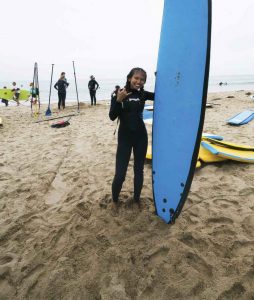 Camille Molas ’21 begins her first year at Pomona College in uniquely Southern California fashion, with surfing lessons at Mondo’s Beach in Ventura. Again this year, as part of New Student Orientation, the Orientation Adventure program, usually known simply as “OA,” offered a list of 11 outdoor opportunities across California, ranging from hiking to surfing, rock climbing to volunteerism. “What I’m really excited about,” Molas says, “is continuing to build the relationships we made at OA. You know, it’s really different having your first moments together out here on the beach or out here camping. If we can be there for each other out in the outdoors, we can be there for each other when school comes around.”
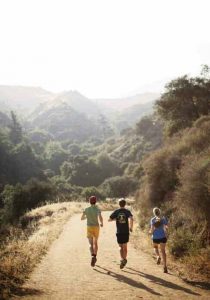 Pomona College is expanding the Claremont Hills Wilderness Park with a gift of 463 acres to the city of Claremont. The land, including Evey Canyon and three Padua Hills parcels, is to be preserved in its undeveloped state and remain available to the members of the public for hiking, biking, horseback riding and other passive recreational uses. With the new addition, the size of the park will increase to nearly 2,500 acres.