Articles Written By: Staff

The Code of Beauty, the Beauty of Code

Class Program
{
public static void Main()
{
System.Console.WriteLine(  “Hello, world!”  );
}
}

Even if you’re the kind of person who tells new acquaintances at dinner parties that you hate email and e-books, you probably recognize the words above as being some kind of computer code. You may even be able to work out, more or less, what this little ‘program’ does: it writes to the console of some system the line ‘Hello, world!’
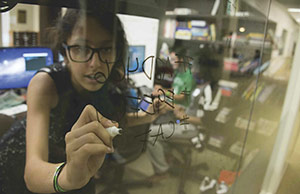
hackers-300A geek hunched over a laptop tapping frantically at the keyboard, neon-bright lines of green code sliding up the screen—the programmer at work is now a familiar staple of popular entertainment. The clipped shorthand and digits of programming languages are familiar even to civilians, if only as runic incantations charged with world-changing power. Computing has transformed all our lives, but the processes and cultures that produce software remain largely opaque, alien, unknown. This is certainly true within my own professional community of fiction writers—whenever I tell one of my fellow authors that I supported myself through the writing of my first novel by working as a programmer and a computer consultant, I evoke a response that mixes bemusement, bafflement and a touch of awe, as if I’d just said that I could levitate. Most of the artists I know—painters, film-makers, actors, poets —seem to regard programming as an esoteric scientific discipline; they are keenly aware of its cultural mystique, envious of its potential profitability, and eager to extract metaphors, imagery and dramatic possibility from its history, but coding may as well be nuclear physics as far as relevance to their own daily practice is concerned.

Many programmers, on the other hand, regard themselves as artists. Since programmers create complex objects and care not just about function but also about beauty, they are just like painters and sculptors. The best-known assertion of this notion is the essay ‘Hackers and Painters’ by programmer and venture capitalist Paul Graham. ‘What hackers and painters have in common is that they’re both makers. Along with composers, architects and writers, what hackers and painters are trying to do is make good things.’

According to Graham, the iterative processes of programming—write, debug (discover and remove bugs, which are coding errors, mistakes), rewrite, experiment, debug, rewrite—exactly duplicate the methods of artists: ‘The way to create something beautiful is often to make subtle tweaks to something that already exists, or to combine existing ideas in a slightly new way … You should figure out programs as you’re writing them, just as writers and painters and architects do.’ Attention to detail further marks good hackers with artist-like passion:

All those unseen details [in a Leonardo da Vinci painting] combine to produce something that’s just stunning, like a thousand barely audible voices all singing in tune. Great software, likewise, requires a fanatical devotion to beauty. If you look inside good software, you find that parts no one is ever supposed to see are beautiful too.

This desire to equate art and programming has a lengthy pedigree. In 1972, the famed computer scientist Butler Lampson published an editorial titled ‘Programmers as Authors’ which began:

Creative endeavor varies greatly in the amount of overhead (i.e. money, manpower and organization) associated with a project which calls for a given amount of creative work. At one extreme is the activity of an aircraft designer, at the other that of a poet. The art of programming currently falls much closer to the former than the latter. I believe, however, that this situation is likely to change considerably in the next decade.

Lampson’s argument was that hardware would become so cheap that ‘almost everyone who uses a pencil will use a computer,’ and that these users would be able to use ‘reliable software components’ to put together complex programs. ‘As a result, millions of people will write non-trivial programs, and hundreds of thousands will try to sell them.’

hackers-250A poet, however, might wonder why Lampson would place poetry making on the same spectrum of complexity as aircraft design, how the two disciplines—besides being ‘creative’—are in any way similar. After all, if Lampson’s intent is to point towards the future reduction of technological overhead and the democratization of programming, there are plenty of other technical and scientific fields in which the employment of pencil and paper by individuals might produce substantial results. Architecture, perhaps, or carpentry, or mathematics. One thinks of Einstein in the patent office at Bern. But even the title of Lampson’s essay hints at a desire for kinship with writers, an identification that aligns what programmers and authors do and makes them—somehow, eventually—the same.

Both writers and programmers struggle with language. The code at the beginning of this chapter is in Microsoft’s C#, one of thousands of high-level programming languages invented over the last century.

Each of these is a ‘formal language,’ a language ‘with explicit and precise rules for its syntax and semantics,’ as the Oxford Dictionary of Computing puts it. Formal languages ‘contrast with natural languages such as English whose rules, evolving as they do with use, fall short of being either a complete or a precise definition of the syntax, much less the semantics, of the language.’ So these formal dialects may be less flexible and less forgiving of ambiguity than natural languages, but coders—like poets—manipulate linguistic structures and tropes, search for expressivity and clarity. While a piece of code may pass instructions to a computer, its real audience, its readers, are the programmers who will add features and remove bugs in the days and years after the code is first created. Donald Knuth is the author of the revered magnum opus on computer algorithms and data structure, The Art of Computer Programming. Volume 3 of the Art was published in 1973; the first part of Volume 4 appeared in 2011; the next part is ‘under preparation.’ If ever there was a person who fluently spoke the native idiom of machines, it is Knuth, computing’s greatest living sage. More than anyone else, he understands the paradox that programmers write code for other humans, not for machines: ‘Let us change our traditional attitude to the construction of programs: Instead of imagining that our main task is to instruct a computer what to do, let us concentrate rather on explaining to human beings what we want a computer to do.’ In 1984, therefore, he famously formalized the notion of ‘literate programming’:

The practitioner of literate programming can be regarded as an essayist, whose main concern is with exposition and excellence of style. Such an author, with thesaurus in hand, chooses the names of variables carefully and explains what each variable means. He or she strives for a program that is comprehensible because its concepts have been introduced in an order that is best for human understanding, using a mixture of formal and informal methods that reinforce each other.  

Good code, then, is marked by qualities that go beyond the purely practical; like equations in physics and mathematics, code can aspire to elegance. Knuth remarked about the code of a compiler that it was ‘plodding and excruciating to read, because it just didn’t possess any wit whatsoever. It got the job done, but its use of the computer was very disappointing.’

To get the job done—a novice may imagine that this is what code is supposed to do. Code is, after all, a series of commands issued to a dumb hunk of metal and silicon and plastic animated by electricity. What more could you want it to do, to be? Knuth answers: code must be ‘absolutely beautiful.’ He once said about a program called SOAP (Symbolic Optimal Assembly Program) that ‘reading it was like hearing a symphony, because every instruction was sort of doing two things and everything came together gracefully.’

We are now unmistakably in the realm of human perception, taste and pleasure, and therefore of aesthetics. Can code itself—as opposed to the programs that are constructed with code—be beautiful? Programmers certainly think so. Greg Wilson, the editor of Beautiful Code, an anthology of essays by programmers about ‘the most beautiful piece of code they knew,’ writes in his forward to that book:

I got my first job as a programmer in the summer of 1982. Two weeks after I started, one of the system administrators loaned me Kernighan and Plauger’s The Elements of Programming Style … and Wirth’s Algorithms + Data Structures = Programs. … [These books] were a revelation—for the first time, I saw that programs could be more than just instructions for computers. They could be as elegant as well-made kitchen cabinets, as graceful as a suspension bridge, or as eloquent as one of George Orwell’s essays.

Knuth himself is careful to limit the scope of his aesthetic claims: ‘I do think issues of style do come through and make certain programs a genuine pleasure to read. Probably not, however, to the extent that they would give me any transcendental emotions.’ But in the many discussions that programmers have about craftsmanship, elegance and beauty, there is an unmistakable tendency to assert—as Wilson does—that code is as ‘eloquent’ as literature. …

The day that millions will dash off beautiful programs—as easily as with a pencil—still remains distant. The ‘lovely gems and brilliant coups’ of coding remain hidden and largely incomprehensible to outsiders. But the beauty that programmers pursue leads to their own happiness, and—not incidentally—to the robustness of the systems they create, so the aesthetics of code impact your life more than you know.

This excerpt from Geek Sublime: The Beauty of Code, the Code of Beauty (Graywolf Press), by Vikram Chandra ’84, is published with permission of the author. In his first venture into nonfiction, the noted novelist roams from logic gates to the writings of 11th-century Indian philosopher Abhinavagupta, in search of connections between the worlds of art and technology.

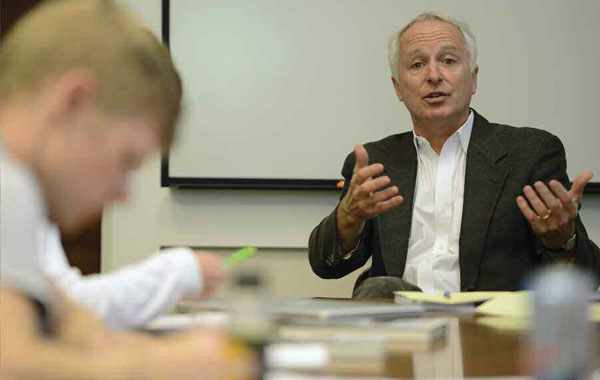
Photos accompanying this excerpt are from the Spring 2014 Hackathon held at Pomona College and are by John Lucas.


Hitting Winners

Mae Coyiuto ’16

Many collegiate student-athletes arrive on campus with lofty aspirations. They might hope to represent their country in international competition one day. Maybe they dream of becoming published authors, or coming up with their own ideas for non-profit organizations and building them from scratch.

Mae Coyiuto ’16, the top-ranked singles player on Pomona-Pitzer’s women’s tennis team, had already accomplished all of that before her first day at Pomona.

The inspiration to become a writer caught hold very early in her life.

tennis-300“When I was about five years old, my mom got this new laptop computer,” said Coyiuto. “To me, it looked like the shiniest, best toy ever, but my mom told me I wasn’t allowed to play with it. In the morning, though, I would sneak in the living room and play around with the computer. I discovered this magical thing called Microsoft Powerpoint and I wrote my first story on a slideshow presentation. One day my mom caught me on the computer and instead of scolding me for disobeying her, she read my story. From that day on, I never really stopped writing.”
By the time she was 10, Coyiuto was a published author, writing three children’s books in her native Philippines. As she grew older, she was inspired to write a book of short stories at age 16, titled Flight to the Stars.

Even in those early years, Coyiuto knew she had found a life-long passion. Being behind a keyboard allowed her to open up in ways that were perhaps more difficult in real life.

“I’ve always been a person who never really said much, but writing has always been a venue where I can express myself. I can write the most bizarre things, and some might even call it creativity. One thing I love about writing is that no matter how old you are or where you’re from, there is someone out there who will pay attention to what you have to say.”

Coyiuto wasn’t content with merely finding her own inspiration and seeing it through. She wanted others to have the same opportunity, so she started an organization to help build libraries in Habitat for Humanity communities in the Philippines. “The idea of our “Gintong Isip” (Golden Minds) library stemmed from both my experiences with writing and tennis. My biggest role models were some of the kids I met in junior tennis. They all had big dreams of playing for the Davis Cup, ranking internationally or getting college scholarships. I’m very happy to say that some of these kids toured abroad and got full-ride scholarships to the top universities in the Philippines. I think that everyone should be given the chance to dream and strive for something the way these players have.

“I have been terribly blessed to find things that I love so much, and I wanted to help others find their passions, too. I think the best way to do this is through literacy. Exposing people to all kinds of stories can inspire them to dream. My main reason for coming up with the Golden Minds project was to help others (especially children) realize that they have this incredible potential to be whoever they want to be. Through the amazing help of Habitat for Humanity, we were able to put up our first library last summer. During the opening, there were kids there who told me that they wanted to be doctors, lawyers, and one even said she wanted to be the next president. The goal of Gintong Isip is to make these dreams a reality.”

Coyiuto was also an overachiever on the tennis courts at a young age, winning several junior tournaments and representing the Philippines in the Junior Fed Cup in Malaysia in 2010. She still came to Pomona uncertain of how she would fare at the collegiate tennis level, but her very first tournament during her freshman fall alleviated any fears, as she advanced to the semifinals of the ITA West Regionals before falling to the No. 1 seed (Kristin Lim of CMS).

“That tournament will always be one of my best memories in tennis,” she said. “Before coming here, I was really nervous about playing college tennis. But while I was playing in the fall tournament, I knew that I was going to love playing for Pomona-Pitzer. Even though we had been playing for three days and it was over 100 degrees out, every single member of the team was out there cheering for each other. It didn’t matter that it was only my first year on the team or if my opponent was one point away from winning, they were all there for me. I’ve never felt this kind of support until I came here. The support my teammates gave me during that fall tournament helped me start to believe more in myself.”

She felt the same support off the court as well, when tragedy struck last fall. She was thousands of miles away when Typhoon Haiyan (Typhoon Yolanda, as it is known in the Philippines) devastated her home country, and although her family and local community were spared the brunt of the storm, she knew plenty of people directly affected.

“The hardest part about being away during Typhoon Yolanda was hearing about the casualties, seeing the destruction and feeling that I couldn’t do anything to help. Thankfully, my amazing AAMP mentor, Kim Africa [’15], planned a fundraising dinner for the victims. This event made me realize how lucky I was to be part of the 5C community and the tennis team. I was so touched when my professors, even from my freshman year, sent me an e-mail checking up on me and asked if there was any way they could help with the fundraiser.

“Even with all their work and other responsibilities, my teammates spent hours helping me make Filipino desserts for the event. I also reached out to the CMS women’s tennis team, asking if they could donate a basket for the raffle and they made the most beautiful basket I’ve ever seen. Seeing all my friends and teammates at the dinner made me realize that I’ve found my second home in this community.”

Coyiuto played most of her freshman season at No. 2 singles, and led the team with a 17–6 record. As a sophomore this spring, she led the team in wins again (17–8) and moved up to the No. 1 position in singles, helping Pomona-Pitzer to a No. 6 national ranking and an appearance at the NCAA Regional finals. But ask her about specific goals she may have over the rest of her tennis career, and she turns attention away from herself after one sentence.

“I hope to grow more as a player and to never stop trying to get better,” she said. “More than that, I hope that each member of the team meets her goals and loves the sport more and more during her time in Pomona-Pitzer tennis. I want to help continue the tradition of the PP tennis team as an area of support, love and family for each member.”

Providing support and love to the greater community is one area where Coyiuto has always managed to hit a winner.

Art in his DNA

Steve Comba

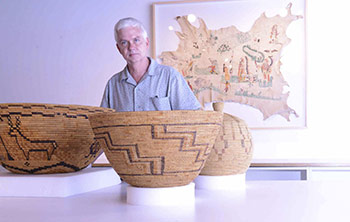
Before he was cataloguing the nearly 10,000 pieces in the Pomona College Museum of Art (PCMA) collection, museum Associate Director and Registrar Steve Comba was earning a reputation among his fifth-grade classmates for copying Peanuts cartoons and drawing “Wanted” posters of his least favorite teachers—a feat which often got him into trouble. Comba still has a sharp, sly sense of humor, but when it comes to managing the College’s art collection, he’s all business.

comba-350Comba never set out to work for a museum. As an undergraduate, he attended the UC Santa Barbara College of Creative Studies, later relocating to Claremont, where he received his MFA in Studio Art from the Claremont Graduate University in 1986. All he wanted was a teaching job that would enable him to pay the rent for his own studio. Until he could find a position, he took a part-time job photographing, mapping and framing prints at the Galleries of The Claremont Colleges, the former museum jointly run by Pomona and Scripps colleges. When two positions at the gallery opened up, Comba inquired about being gallery manager. “I thought it would be more appropriate for a studio artist to be the person who hangs the work, but the curator of collections thought I should look at the position of registrar instead,” he recalls. “My response was, ‘Okay…what is that?’”
As it turns out, it’s a lot. Comba’s official job description is to track everything about every object in the museum, whether it belongs to the PCMA collection or is on loan from another institution. If someone needs to know where an object is and how it’s doing, Comba is the person to call. He also oversees conservation efforts of pieces that have seen better days. “I get a lot of personal gratification when I’ve done something for an object that I know will further its preservation,” he says.

But for Comba, being the museum’s registrar is more than just cataloguing. When his daughter was a student at Sycamore Elementary, he enjoyed being able to supplement her class’s lessons about native peoples by bringing in real Cherokee sandals. Now he is one of the main coordinators of the museum’s two-year-old outreach program to local third grade classes. In the College-sponsored program, students take a field trip to the museum to see in person the artifacts they studied in the classroom. Comba advocates a hands-on approach, sometimes even letting students wear gloves and pass around a 130-year-old Cherokee lacrosse ball. He works hard to structure his lessons so that students have an opportunity to see the continuity of culture.

Comba is also an active figure in the museum’s internship program. He has been in the museum business so long—July marked his 28th year with PCMA—that several influential figures behind the doors of larger institutions, such as the registrar of Pasadena’s Norton Simon Museum, were his students. However, the most rewarding part of the job for Comba is still his intimate connection to the art. “At a certain point, you can say it’s no longer a choice,” he explains. “The need becomes ingrained in the DNA. Whenever we travel on vacation and we’re anywhere within reasonable distance of a museum, my family knows that I’m going to start to sweat if I don’t get to go in there and see it. I was asked how I get ideas for my paintings and it’s the same thing. I no longer have to look for them, because every time I look out I see the world through a painting.”

As for the future of PCMA, Comba says that talk of a new, larger museum is in the works. With a collection that grows by 100 to 170 objects a year, adding more space only makes sense. “A museum isn’t just about the contents,” he explains. “It’s a place. The place either enhances or detracts from the experience of the visitor. What’s exciting about the future is that our desire to expand is not just about making the museum bigger. It’s about having that relationship be fundamentally better. It’s an exciting thing to be a part of.”

And yet, playing such a vital role in running a college museum was never what Comba initially imagined he would end up doing. “I lucked into it. It wasn’t a plan, but this gig with the museum is working out,” he says, laughing. “If you asked, I’d say I still don’t know what I want to be when I grow up.”

Mother and Warrior

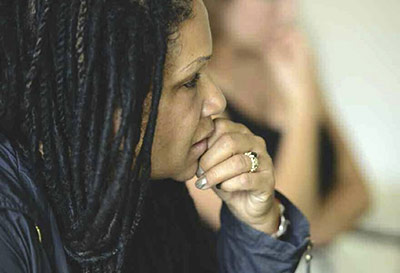
thomas-400In today’s session of Professor Valorie Thomas’s class on AfroFuturisms, the discussion focuses on a painting by Christy Freeman and how the image both represents and challenges our conceptions of motherhood and reflects the blending of African Diaspora spirituality with Christianity.

Thomas: The belief is that when you are born, everyone has a protector, an Orisha who watches over your head, your “Ori,” like a guardian spirit or a guardian angel. You might have relationships with one or more Orishas, and it is within your power as a human being to cultivate those relationships and to learn the lessons that Orisha has to teach you.

There are many Orisha and Catholic saint correspondences as a result of Africanisms encoded within Christianity. If you see images of Mary, and she’s surrounded by stars and is in this archway full of color, and she’s standing on a rock on the sea, all that ideography is consistent with Yemaya, the ocean goddess who is seen as the ultimate protector and great mother figure. So she may be respected as Mary, but the figure will also be recognized and loved as Yemaya.

Each Orisha can have dozens of paths. There’s Erzulie, a Haitian Orisha or Loa, who corresponds to the Yoruba Oshun and is also related to Yemaya. Erzulie is also connected to nurturing and motherliness, but she is the personification of love and the erotic, so she is seductive, flirtatious, loves jewelry, mirrors and sweets and wants to see people happy. But beneath that sweet façade, there’s a formidable persona. I’m going to show you a painting of Erzulie Dantor, a different side or path of this deity. I’d like to have you respond to the image first, and then I’ll tell you what fascinates me about it.

Chloe: In the heart on the crown, the top reminds me of ram’s horns, giving the sense that this is someone who is tender and warm but also can defend herself.

Thomas: Yes, this is reworking stories about the feminine, about gender, about power, breaking some of those conventional story lines that associate romance with sentimentality and weakness and docility. There’s tension that comes through that might, in other contexts, seem diametrically opposed, but in this figure they are combined. The softness and hardness; the love, the heart, but also the dagger.

Sophie: It feels like a lot more emphasis on the mother figure, but then also there’s a protective quality that I don’t think is in Western portraits. Mary isn’t usually actively protecting the baby and wielding a knife or wielding any sort of weaponry.

Thomas: What do we know as viewers about those images that you’re talking about? Where Mary’s not necessarily on watch, on guard; the child is just in his mother’s arms. How does the story end? Those images of Madonna and child, that’s the beginning of the story. We already know the ending. This is a disturbing image in that this Mary is thinking off script. It’s a stance of agency and aggression, a huge intervention on the narrative and on the established, fundamental, archetypal, Christian narrative, even though it’s still framed as Christianity.

Byron: I have a question about her necklace. I wanted to know: what’s the significance of that as a Christian icon?

Thomas: It’s a heart and what else? What is hanging below the heart?

Chloe: It could be a skull.

Byron: It looks like a nail.

Thomas: It’s silver. Is it a nail, are we agreeing that it’s a nail?

Byron: There is also something that looks like a snake.

Thomas: I’m so glad you brought up the necklace. We need to consider all those possibilities. The snake is an ancient Vodun archetype, not evil but representative of life and transformation. What about the line of that little dagger on the necklace? Where’s the line going?

Renata: It’s going right towards him.

Thomas: It’s going right towards him, right? In this case, Mary’s saying, “Well, I have a knife, too.”

Sophie: The stars in the painting also are evocative for me. It’s like faith of some sort, which maybe is nonsensical or unreasonable, because they also have resonance with anti-faith.

Thomas: In a particularly African-American or African diasporic context, how might you come to be thinking about the stars?

Sophie: A star guide for going home.

Catherine: Using the signs of the stars to move north.

Thomas: To move north because?

Catherine: Out of slavery. To freedom.

Thomas: The stars are the liberation narrative, at least back in the day of enslavement when knowing about astronomy was a useful skill in escaping and moving towards liberation. When I first saw this amazing picture it immediately tweaked my understanding of the character Sethe in Toni Morrison’s Beloved. She commits infanticide when the slave catchers are on her heels. The controversy, the tension in this story is the question: Is this motherhood? I think the painting also asks that same question. What if the knife ends up being something that is protecting the child by keeping it from the attacker who will certainly dehumanize and obliterate its spirit? Sethe says, “I wasn’t going to let them take that child, wasn’t going to let them make that child go through the monstrosity that I went through.” It redefines the terms of motherhood as not only creator but also potential destroyer; nurturer but also warrior. That’s the ultimate extreme case, extreme scenario, but it does bring the idea of the feminine principle into connection with the highest possible stakes of life and death.

History & Change

daring-minds-400Hong Deng Gao ’15

MAJOR: History
SUPPORTED BY: Financial Aid, Draper Center for Community Partnerships, Summer Undergraduate Research Program, The Annual Fund

A native of China, Hong and her mother moved to Brooklyn in 2005. When her mother developed life-threatening liver disease, Hong helped her navigate the often confusing public hospital system. Determined to improve access to health care for other low-income immigrants, Hong developed a proposal through the Draper Center to train college volunteers as health navigators for patients with limited English proficiency and literacy. Hong devotes much of her free time to the Draper Center, working as a coordinator for programs such as Alternabreak, a community engagement spring break program.

History as explanation

“Because of my immigrant background, I like to trace things back to their origins, whether it’s the earliest pilgrims, or Chinese immigrants who came in the 1800s, or recent refugee groups. It can really help explain some of what we see now. Why do Chinatowns exist in the U.S. today? What were the Chinese discriminatory laws that were passed back then and how do they still impact people today?”

In the library and on the ground

“I’ve been working with Professor (Samuel) Yamashita on the impact Chinese restaurants have had on Chinese-American communities. In the summer after my sophomore year, I went to New York, where I interviewed and observed children who help out in their parents’ Chinese takeout restaurants and Korean grocery stores. I went back to New York this summer, and to Honolulu and San Francisco, where I conducted archival research in local libraries and museums on high-end Chinese restaurants. I wanted to know what these upscale restaurants mean in the context of Chinese immigration and race relations, and the history of restaurants in the three cities. So, in a sense, my research has been both sociological and historical.”

A mother’s struggle, a daughter’s inspiration

“My mom was the inspiration for my social entrepreneurship project with the Draper Center. She had liver disease, and from the time I was about 15 years old, I helped her deal with the public hospital system, because it was hard for her to do it on her own. She didn’t really speak any English and couldn’t read the signs or the documents or bills. When I got to Pomona, I started thinking more about this issue and how I could help other non-English speaking immigrants.”

Building a bridge to better health care

“The idea I came up with is Health Bridges, where bilingual college volunteers work with local hospitals to give parents like my mom the emotional support they need and help them understand and navigate the system.

The students are definitely going to be a lot more competent in understanding the hospital procedures than these immigrant patients who are already sick and tired and can’t really deal with the system anymore.” [Health Bridges is dedicated to Hong’s mother, Jian Li Lin, who died in 2011.]

Coaching from the Draper Center

“Emily Arnold-Hernandez ’99, who teaches a social entrepreneurship workshop at the Draper Center, helped us develop our visions, goals and budgets, and to understand every single detail of how nonprofit organizations work. Where do you get funding? What are all the questions that you need to think about and have prepared before you can pitch the proposal to a funder? It was really great. I’m planning to start a pilot project this semester and, if it works out, to take a gap year before grad school to fully develop the program in different hospitals and expand it to other college campuses.”

Academia and social change

“I’ve been thinking about the question of how to bridge academia with social justice and social change. Some people see them as very distinct fields, but I think as a scholar you can still make a huge impact in society. You can change the mindset of your audience. And if the audience is policy makers or other scholars or even college students, and if they go on and take this message with them, then that’s the impact that I’d like to have.”

Daring Minds

“When I think of Daring Minds, I think of three characteristics. One is to have a vision; second is to be willing to take the risk of implementing that vision; and third is accomplishing your goal by taking concrete steps, not being afraid of failure and persevering until the end.”

Jerry Maguire Moments

mark sanchez

The walls of the Athletes First offices are filled with autographed jerseys, photos and other memorabilia from their National Football League clients, including such household names as Aaron Rodgers, Ray Lewis, Drew Bledsoe and Clay Matthews. Among the jerseys and photos in Andrew Kessler’s office is a framed copy of Newsday from 2011 showing a photo of New York Jets quarterback and Athletes First client Mark Sanchez celebrating a 28–21 playoff win over the New England Patriots with an exuberant scream and a handshake over the front railing of the stands.

Kessler ’03, who is a certified contract advisor and player agent with Athletes First in Laguna Hills, and who helped negotiate the (yes) 47-page rookie contract for Sanchez, is on the receiving end of the handshake. “My Jerry Maguire moment,” he laughs. “That was an AP photo, so it ended up everywhere.”

mcguire-moment-350After graduating from Pomona with a degree in English, and playing for four years on the Sagehens football team, Kessler jumped right into his current field working at IMG Sports with Tom Condon, ranked by Sports Illustrated as the most influential sports agent in the country last year. Kessler, whose father has been a long-time legal representative for the NFL Players Association, had already served an internship with NBA agent Marc Fleisher while attending Pomona, traveling with 18-year old client Tony Parker to various NBA workouts (Parker has since gone on to win four NBA titles with the San Antonio Spurs and former Sagehen coach Gregg Popovich).

In his first two years at IMG, Kessler assisted Condon in putting together landmark contracts for Peyton Manning (seven years, $90 million) and Eli Manning (six years, $54 million), while also attending law school at the University of Texas. In his decade in the field at IMG and Athletes First, where he has worked primarily with David Dunn (No. 11 on the Sports Illustrated list of most influential agents), Kessler has been a part of negotiating contracts that total well over a billion dollars.

Most recently, Kessler helped put together a four-year, $40 million dollar deal for Super Bowl champion safety Earl Thomas of the Seattle Seahawks, making him the highest-paid player ever at his position. Kessler returned to his original home in New York City in February to see Thomas win Super Bowl XLIII at the Meadowlands, before helping to negotiate his landmark deal. Of course, Athletes First was guaranteed to be on the winning side of that Super Bowl regardless, as the firm also represents several members of the Denver Broncos, including wide receiver Wes Welker and linebacker Von Miller.

Kessler, who resides in Laguna Beach with his wife, Alison, and son, Jordan (2), has found success in a highly-competitive, big-money industry at an age when he has been younger than some of his clients. He draws some personal parallels to his playing days for Pomona-Pitzer football, when his teams went a combined 17–15 over four years despite fielding small rosters that were often significantly outweighed by their opponents.

“One lesson I learned from playing at Pomona is that you can’t judge a book by its cover,” he said. “Just about every game we played, we would lose the eyesight test. Sometimes if you just looked at the two teams in warm-ups, you’d think we’d lose by three or four touchdowns, but then the game would start and we’d win by playing harder, smarter or more fundamental football. You see the same things on the job, whether it be negotiating a contract or signing a player or issues with a client. The odds might look against you from the outside looking in, but you can accomplish your goals by digging deeper than the other guys and not being intimidated.”

He is also quick to point out that his academic experience at Pomona has been a big influence on his career. “Most of what I have learned in this business has come from on-the-job training or from my dad,” he said. “But the critical thinking and analytical skills that I use in my profession have come just as much from what I learned at Pomona, as an English major studying Henry James novels, as they have from taking law school courses in contract law.”

Although Kessler willingly made a reference to Jerry Maguire, the fictional sports agent played by Tom Cruise in the 1996 movie (best remembered for the phrase, “show me the money”), he does laugh at the way the movie portrays his line of work. “I imagine it’s the same way that real spies view James Bond movies,” he says. “People may see the eight-figure deals in the headlines, but there’s a real grind and blue-collar element to the job, which I enjoy. It takes months of negotiations and legwork to reach those deals. You can’t just walk in and say ‘give me this, I want it.’ You have to justify your rationale to the team.”

The life of a sports agent can also involve much more than negotiating the fine print of a 47-page contract, and Kessler feels that makes it even more rewarding. “One of my favorite things about this business is that you get to be involved in a lot of different charitable endeavors and other outside interests for your clients,” he says. “I’ve helped our clients raise money for sick kids, families of veterans, youth football organizations and all sorts of things. Some clients just want you involved in one specific part of their lives, and with other clients, you find yourself wearing a lot of different hats—relationship counselor, wedding planner, financial advisor, and you get to talk to them all the time.”

Kessler may also have a career-building opportunity as the primary agent representing Marqise Lee, a second-round pick of the Jacksonville Jaguars in the 2014 NFL Draft. Lee has a Hollywood-type story of overcoming a rough childhood that saw him bounce around several foster homes before becoming the Fred Biletnikoff Award winner at USC as the nation’s top wide receiver.

While his professional experience has been largely centered on the NFL, Kessler has also used his success at Athletes First to begin his own side project called K3 Tennis, which is representing Ernesto Escobedo, a 17-year-old rising star from West Covina. “I’m excited about it,” said Kessler. “It’s still in its early stages and if nothing else, it’s really fun. Some might call it a risky move to invest in something on my own, but that’s always been my personality. I traveled 3,000 miles from New York City to attend Pomona, which was a little bit risky, and I really liked my time at Pomona. When a risk like that pays off, you’re more willing to take other risks.”

His career as an athlete and as an agent has also given Kessler some philosophical perspective. Athletics is, by its nature, hyper-competitive, with a player’s or team’s value often defined by just a simple list of wins and losses. That attitude spills over into other sports-related industries as well. An agent’s success can be defined by wins and losses in contract negotiations, clients signed and dollars generated. Failures happen, and he sometimes sees colleagues who take each defeat as hard as the players on the field do.

“You have to appreciate successes,” he said. “You hear people say that they hate losing more than they like winning, and I understand that philosophy, but you have to have balance or you won’t be happy. My bad days aren’t really all that bad. On my good days, I’ve been there to see Earl Thomas win a Super Bowl. I’ve been there with Marqise Lee and his family when he was drafted, after he overcame so much adversity.”

Of course, he was also there to celebrate a big playoff win with Mark Sanchez and end up with his picture in newspapers all over the country.

“If you can’t enjoy a moment like that,” he says. “Something’s wrong.”

Alumni Awards for 2014

Blaisdell Distinguished Alumni Awards for 2014

The Blaisdell Distinguished Alumni Award honors alumni for achievement in their professions or community service, particularly those who have lived up to the quotation from James A. Blaisdell which is inscribed into the gates of the College: “They only are loyal to this college who departing bear their added riches in trust for mankind.” This year, there are three winners:

Ifeanyi “Tony” Menkiti’64 taught philosophy at Wellesley College for 40 years and is the author off our collections of poetry: Before a Common Soil (2007), Of Altair, the Bright Light (2005), The Jubilation of Falling Bodies (1978), and Affirmations (1971). He is the owner of the Grolier Poetry Book Shop in Harvard Square, the nation’s oldest continuous all-poetry bookshop.

Born in Onitsha, Nigeria, he came to Pomona in 1961 on the ASPAU program (African Scholar-ship Program of American Universities). After Pomona, he attended Columbia University Pulitzer School of Journalism, New York University and Harvard University. In 1975, he received a fellowship in poetry from the Massachusetts State Council on the Arts and Humanities, followed in 1978 by an award from the National Endowment for the Arts. In addition to his collections, his poems have appeared in Sewanee Review, Ploughshares, New Directions, The Massachusetts Review and other publications.

In 1996, he received the Pinanski Prize for Excellence in Teaching from Wellesley College.

Joe Palca’74 has been a science correspondent for National Public Radio since 1992. He has covered a range of topics, from biomedical research to astronomy, and is currently focused on the series, Joe’s Big Idea, which explores the minds and motivations of scientists and inventors.

Palca began his career in 1982 as a health producer for the CBS affiliate in Washington,D.C. In 1986, he began a seven-year stint as a print journalist, first with Nature and then with Science Magazine. In 2009, he took a six-month leave from NPR to become science writer in residence at The Huntington Library, Art Collections and Botanical Gardens.

Palca has won numerous awards for his work,including the National Academies Communications Award, the Science-in-Society Award of the National Association of Science Writers and the American Association for the Advancement of Science Journalism Prize. With Flora Lichtman, Palca is the co-author of Annoying: The Science of What Bugs Us (Wiley, 2011).

A psychology major at Pomona, he later earned both an M.S. and a Ph.D. in psychology at UC Santa Cruz, where he studied human sleep physiology.

Rip Rapson’74 is president and CEO of The Kresge Foundation, a national, private foundation based in Detroit. Since 2006, he has led Kresge in developing programs in arts and culture, education, environment, health,human services and the renewal of Detroit, distributing approximately $150 million annually.

Rapson was a political science major at Pomona, graduating magna cum laude. After at-tending Columbia Law School, he joined the Minneapolis law firm of Leonard, Street and Deinard. He was recruited in 1989 to become the deputy mayor of Minneapolis under Mayor Don Fraser, and was primary architect of the pioneering Neighborhood Revitalization program, a 20-year, $400 million effort to strengthen Minneapolis neighborhoods.

Prior to joining Kresge, Rapson was president of the Minnesota-based McKnight Foundation and also launched the Itasca Project, a private sector-led effort to develop a new regional agenda fort he Twin Cities.

He is the author of two books: Troubled Waters, a chronicle of the Boundary Waters Canoe Area Wilderness Act legislation, and Ralph Rap-son: Sixty Years of Modern Design, a biography of his father, a renowned architect.Inspirational Young Alumni Award Lt.

Inspirational Young Alumni Award

Francine Segovia’04, a U.S. Navy Reserve research psychologist at the Robert E.Mitchell Center for Prisoner of War Studies, assists survivors recovering from post-traumatic stress disorder (PTSD). She is part of a team of scientists and medical specialists examining how optimism and resilience may boost the health of extreme trauma victims.

Segovia, who will return to active-duty service at the U.S. Naval Medical Center in San Diego, attributes her research skills to experience she gained while at Pomona, including participation in the Summer Undergraduate Research Program (SURP). “The critical thinking skills graduates from an institution like Pomona possess have a direct impact on all your work moving forward,” she says. “These skills have helped me tremendously as I navigated my career.”

Code

This is surely a first, so (cue the trumpet fanfare) welcome to the first editor’s letter ever written in code.

Not all of it, of course—as you can tell from the simple fact that you’re reading this. But in an issue on the theme of “code,” in addition to articles about genetic code and computer code and decoding animal calls, there had to be something about the clandestine side of the word. But alas, try as I might, I was unable to unearth a single Pomona source for a story about ciphers. Which shouldn’t have surprised me, I suppose, since the world of cryptology is, by its very nature, a secretive one.

So to fill that void, please forgive me for offering this light-hearted tutorial on a subject I’ve found intriguing ever since my secret decoder ring childhood.

Each paragraph below demonstrates a different cipher, and—don’t say I didn’t warn you—the codes get progressively harder as they go along. There are instructions in each paragraph to help you translate the next, but if you want to play along, you’ll have to work for it.

We’ll start with one of the oldest and simplest of codes—the Caesar cipher, named for the great Roman himself, who used it in his letters. In this substitution cipher, each letter is replaced by another a fixed number of letters up or down the alphabet. Once you figure out that number, the rest is easy.

Ecguct ekrjgtu ctg ejknf’u rnca vq fgeqfg, dwv vjga ctg cnuq vjg dcuku qh eqorngz eqfgu nkmg vjg Xkpgig`tg ekrjgt, kp yjkej c yqtf rtqxkfgu vjg mga hqt ownvkrng Ecguct ekrjgtu kp c tqvcvkpi ugswgpeg. Vjg pgzv rctcitcrj, hqt gzcorng, wugu “CDE” cu kvu mga. Vjwu, vjg hktuv ngvvgt ku qpg ngvvgt qhh, vjg ugeqpf vyq qhh, vjg vjktf vjtgg qhh, vjgp dcem vq qpg, cpf uq qp.

Sfb Ugkdeb`qc tzq qgmrffq sm yd skapbzixajb, asq hl zqwmsmdqymgw, qgmpd yod dxlmrr jxrr tnpar. Red mkkw qqsix skapbzixajb bgmgco hq qgc “lmc-qhkb oya,” vffbf rrcp zl bmrfqc qdvq zq x jcv. Sm adalcc, vns ptzqqyzs red lrlcohaxk txksb nd bzae kcqsco hl qgc hdw (X dorzjp ycon; X bpsxkq 25) cqmj sfb dorhtxkcks jbsrbq gk sfb lcprydd. Yac 26 rl zlv mcdzrfuc odqrkr. Ffllqc poyzdq xmb mtlzssxsglm, uehae zpb ccidrbc gk qcxk alcca lcpryddq xmwtzw. Qgc hdw edpb hq qgc chpps nxqydqymg mc sffr jbsrbq.

Bm ggc’nw wfqp rhna wsk qcw gyla fx rm ucxknghjd sc ysogg mw b of. Zs hweykewceokaarl.

And with that, welcome to the wonderful world of code.

///////////////////////////////

Stray Thoughts (decoded)

Here is the plain text of the three enciphered paragraphs in the Stray Thoughts:

[Caesar Cipher:]
Caesar ciphers are child’s play to decode, but they are also the basis of complex codes like the Vinegère cipher, in which a word provides the key for multiple Caesar ciphers in a rotating sequence. The next paragraph, for example, uses “ABC” as its key. Thus, the first letter is one letter off, the second two off, the third three off, then back to one, and so on.

[Vinegére Cipher:]
The Vinegère was thought to be unbreakable, but in cryptography, those are famous last words. The only truly unbreakable cipher is the “one-time pad,” which uses an entire text as a key. To decode, you subtract the numerical value of each letter in the key (A equals zero; Z equals 25) from the equivalent letter in the message. Add 26 to any negative  result. Ignore spaces and punctuation, which are deleted in real coded messages anyway. The key here is the first  paragraph of this letter.

[One-Time Pad Cipher:]
If you’ve come this far, you must be as intrigued by codes as I am. So congratulations.

Pomona Pair Mix Alt-Pop, Entrepreneurship and Environmental Activism

trapdoorphoto1

Skylar Funk Boorman ’10 and Merritt Graves ’10 have spent their years since Pomona successfully combining their love of music with the fight against climate change.

Their outlet is Trapdoor Social, a band self-described as “Los Angeles Alternative Energy Rock and Sustainability Activism.” They recently released their second album and have been touring, doing shows throughout the Midwest and West Coast. The music videos for their alt-pop songs from their first album “Death of a Friend,” which featured Death Cab for Cutie’s well-known drummer Jason McGerr, have drawn large viewership online and radio airplay.

Boorman and Graves channel their anxieties about climate change and other environmental issues into Trapdoor Social’s music, with lyrics and melodies ranging from stormy to upbeat, nervous to hopeful. “We really do want to create an anthem for the environmental movement — a popular song that has a message that gets people pumped about social responsibility and leaving a great legacy,” says Boorman.

The pair met at Pomona on Orientation Adventure and developed a friendship through such courses as Green Urbanism and Farms and Gardens in the Environmental Analysis Program under the tutelage of Professors Rick Hazlett and Char Miller, who has attended several of Trapdoor Social’s performances, describing even their unplugged gigs as “electric.”

Boorman was active in music while at Pomona, singing in Men’s Blue and White and taking music theory courses. Graves managed his own hedge fund from an office in the Claremont Village while using profits to found his company Farmscape.

“One day in Intro to Environmental Analysis, Rick Hazlett was talking about L.A sprawl. And it just clicked that we’d never get to go back and redesign L.A with the appropriate density, but we could make the best of the error by farming the sprawl,” Graves remembers.

Now, Farmscape operates more than 150 farms in the Los Angeles Area. With 12 employees including seven full-time farmers, Farmscape designs, installs, and helps to maintain urban farms that range in size from rooftop garden plots to a larger farms used by restaurants. Graves also helped create the company Agrisaurus, a web app that helps gardeners to plan and manage their own plots.

Integrating community work is important to the pair. They held a presale for their second album as a fundraiser, working with partners Everybody Solar and Grid Alternatives to donate their profits toward the purchase of solar panels for Los Angeles nonprofit Homeboy Industries, which re-trains former gang members in Los Angeles.

Among all the activities, Boorman and Graves work to find time for their songs. Striking a balance in music with an environmental message can be difficult, Graves says.  “On one hand we don’t want to be preachy and play into stereotypes, but on the other hand we don’t to play so coy that the message is lost.” A growing fan base indicates that the duo is on the right track.

Leaks and Firestorms

munter1

In today’s class, students discuss the firestorm ignited by former National Security Agency (NSA) contractor Edward Snowden’s leaks of top secret documents last summer. Among the questions raised are: who decides what are legitimate targets for domestic and foreign surveillance; why some secrets should be protected; and whether information gathering by corporations like Google and Facebook should be part of a broader privacy debate.

Munter: I was at the Rand Corporation yesterday on a panel about secrecy and privacy. One side, I had an FBI agent, and on the other an ACLU lawyer, and I realized the reason they invited me was to be sure they didn’t rip each other’s throats out. On the domestic side, they talked about privacy and the Constitution. I suggested that many of these issues should not be limited to domestic policy, but should be part of foreign policy. I’m curious what you think of the (Snowden) revelations about spying on the American people.

Ben: If we are truly at war, we are engaged in a war on terrorism, we have a duty to understand the lay of the land; it’s our job to have a complete awareness of exactly where the enemy is, and understand the lines of communication and organization.

Munter: Let me go back to the first thing you said. You guys think we’re at war. Yes, no?

Aidan: I think it’s almost antithetical to democracy to accept that we can be on a constant war footing. Because it is true when you are in a war, democracy affords certain executive powers that are supposed to be temporary. The problem is this war has been going on for more than a decade, and it can do that because it doesn’t affect our daily lives. Mass spying on citizens inside the country and out isn’t even seen as surprising anymore.

Ben: Are you talking more about spying on foreign leaders? I’m talking about domestic spying. Foreign spying in general is kind of an accepted thing.

Munter: So this doesn’t surprise you?

Ben: Not as much, but domestic spying gets me because it’s shrouded in deep secrecy. The way the administration acted after Snowden’s revelations, trying to tarnish the guy’s name and trying to underplay how big the domestic spying programs were. The whole process itself; there is no transparency anywhere. It seems very antithetical to democracy.

Munter: There is kind of a carve-out that in exceptional times you can have exceptional measures. I don’t know if any of you know the state song of Maryland (hums it), and it has the words, the despot’s heel is at thy door/ Avenge the patriotic gore that flecked the streets of Baltimore.

Now the despot in the song is Abraham Lincoln, There were riots against Lincoln. He put the legislature in jail so they wouldn’t secede from the union. So here is our hero Abraham Lincoln who, basically for the period of the Civil War, was unconstitutional. We can say exceptional circumstances, pretty serious times. We can say 9/11 was a pretty serious time.

Jack: When you frame it about taking away constitutional liberties and the Fourth Amendment and stuff, it sounds very serious and it is. But when you contextualize it in the terms that it’s not just government doing this, it’s the private sector as well. And that, honestly, is what scares me more.

Munter: You mean when you search something in Google and it gives you commentary about what you could buy?

Michael: Google’s and Facebook’s whole business model is to own your information and to sell it. And that worries me just as much if not more.

Tom: I guess where I draw the line is that Google and Facebook can’t put you on a watch list, but the NSA can, based on information that might not necessarily be suspicious, like a search history.

Munter: What you’re saying is that we’re getting it wrong if we only worry about constitutional issues, serious or not serious as they might be, because there is something bigger, which is the technological issue, which is both inside and outside government.

Aidan: It’s such a slippery slope that there are going to be abuses and that brings up the question of either you have to have one extreme, no surveillance, or you have to recognize that it will be abused, and I think most Americans aren’t willing to have no surveillance.

Munter: So there is the permanent war footing argument and the violation of civil liberties argument. Obviously, the American public want something in between; they want to be safe and they’re willing to pay a certain price in order to be safe, but they don’t want to lose the essence of what it means to be Americans and have freedoms, which is not satisfying intellectually but pretty realistic.

Charlotte: I was going to say that it’s really a generational thing. My parents are vehemently opposed to wiretapping, domestic surveillance, where most of the people I’ve talked to don’t really care.

Munter: Because they’re used to it.

Charlotte: Yeah, we’ve grown up where everything is totally public. When it comes down to the message Snowden is making about why this is wrong, most people in my generation probably don’t relate.

Munter: There are reasons why we keep secrets. If I’m in Iraq or Libya, people tell you things in confidence, and they tell you things at the risk of their lives, and you keep that confidence because that’s your job.

Ben: When you say secrets are kept for the reason, the question is who is deciding the reason for that. Obviously, in the example you mentioned it’s for national security, people’s jobs, but I think when it strays to things that would portray the U.S. poorly or things that the U.S. is doing that are illegal, then I think that borders the line when secrets should be revealed.

Nick: My problem with Snowden was for him to take this issue into his own hands and to leak it to the public. I think it’s not really up to an individual to make that call.

Munter: Arguing uncharacteristically on Snowden’s behalf, isn’t that what a citizen is supposed to do, to some extent? Isn’t civil disobedience, from Gandhi to Martin Luther King, part of our tradition?

Nick: Unless you have a viable alternative like a legitimate pathway to share that information.

Munter: But is the issue here simply the amount of information we’re gathering? The whole point of 9/11 was that domestic and foreign intelligence had different pieces of intel and didn’t bring it together, which was part of what led to the Homeland Security that we know and love. Now that we have that, is there such a massive amount of material to deal with that no one can pick up his or her eyes and ask where we are going strategically?