Articles Written By: Staff

2019’s Got Class

Here are just a few of the many interesting and unique individual accomplishments reported by members of the admitted Class of 2019:

  • One auditioned and was cast in a small role in the movie The Hunger Games (2012).
  • One authored a neuroscience textbook in 11th grade: A Friendly Guide To The Adolescent Brain.
  • One wrote five Apple Apps, which achieved 1,000,000 total downloads.
  • One has written four full-length novels.
  • One is a sous chef for a Michelin-starred restaurant.
  • One is a master bee-keeper, the youngest in the state.

Under Prometheus

PCM-summer2015-web3_Page_05b_Image_0001
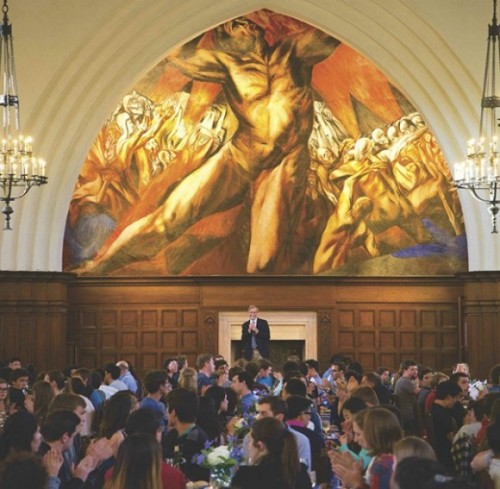
President David Oxtoby welcomes the members of the Class of 2015 to a Senior Dinner on April 7 beneath José Clemente Orozco’s fresco of Prometheus in Frary Hall.

In Quotes

“From now on, your ability to make a plan will matter a lot less than your ability to respond and adapt to unexpected new inputs, whether those new inputs come in the form of crisis or opportunity. If you should find your mind wandering a little bit in the two hours we have to go here, maybe spend a minute thinking about what kind of story you might like to tell when you’re back on the stagegetting your honorary Ph.D. in 10   or 20 years. Then get ready for it to all play out nothing like you expected.”

—Mikey Dickerson ’01 to the Class of 2015, after receiving his honorary doctorate

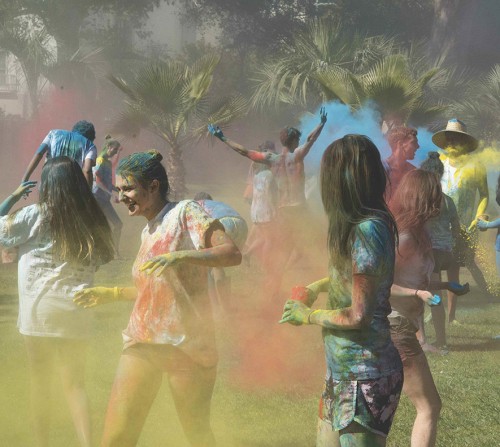
Have a Jolly Holi 

PCM-summer2015-web3_Page_06_Image_0002
Since 2000, Walker Beach has been the site of The Claremont Colleges’ increasingly popular celebration of Holi, the springtime festival of colors and love that originated in India. Organized by the Claremont Hindu Society, with the support of the Office of Chaplains, the festival is celebrated as a carnival of bright colors, with participants throwing dry colored powder or colored water at each other until both crowd and surroundings appear to have been tie-dyed. Last March, more than 400 students from across the campuses took part in the 2015 festivities.

Turf Wars

PCM-summer2015-web3_Page_07_Image_0005Drought is changing the face of Southern California, as more and more green lawns give way to desert plantings requiring a fraction of the water. At Pomona, turf removal hit a new high this summer, with the replacement of an additional 140,000 square feet (3.4 acres) of grass, according to Head of Grounds Kevin Quanstrom. Among the swaths of grass to be removed were areas around Alexander, Oldenborg, Hahn and Wig halls. Grass-lovers can take heart, however, that the broad, grassy lawn of Marston Quadrangle will remain green—at least for now.

Celebrating the Class of 2015 

PCM-summer2015-web3_Page_07_Image_0003
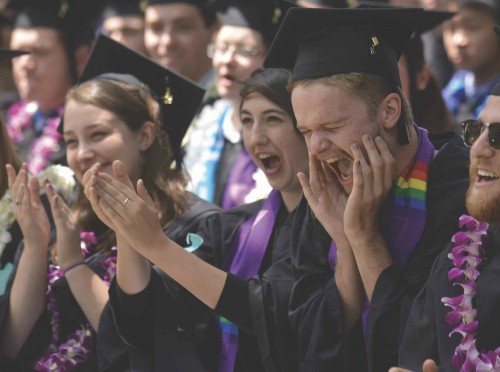
Members of the Class of 2015 show support for a classmate who just received a diploma during Pomona’s 122nd Commencement in May. During the ceremony, Michael Dickerson ’01, Andrew Hoyem ’57, Judge Stephen Reinhardt ’51, and France Córdova spoke and received honorary degrees from the College. Videos of the speakers are available at www.pomona.edu/events/commencement/archive/2015.aspx.

Eclectic Electives

Dance, Ethnicity and Nationalism looks at dance as a vehicle for achieving political goals and establishing ethnic identities. Students study such examples as Irish step dancing, Ukrainian and Russian folk dancing and the Hawaiian hula, all of which have served past regimes. Instructor: Anthony Shay

Disease, Destruction, & Disaster examines disaster as a social phenomenon and trends in managing and responding to threats and catastrophe. Students look at such case studies as Hurricane Katrina, Fuku-shima and the Ebola outbreaks. Instructor: Brady Potts

Drone Theory focuses on the drone as part of a network of ubiquitous, always-active sensors for automated data collection, processing and response. Looking at the drone through critical media theory, students think about asymmetrical power and remote control, and the historic relationship between military and media technology. Instructor: Mark Andrejevic

Founders Day and the New Millikan

Save the Date: October 3, 2015 

PCM-summer2015-web3_Page_07_Image_0002

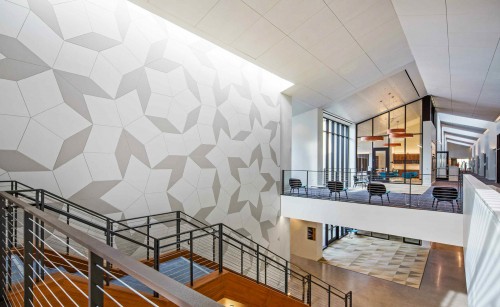
The focus will be on the wonders of physics, astronomy and mathematics during Pomona’s 2015 Founders Day, which will feature the official opening of the beautiful new Millikan Laboratory and the renovated Andrew Science Hall. The dedication ceremony is set to begin at 1:30 p.m., and to be followed by a range of interactive science and math activities for all age groups throughout the afternoon, ending around 7 p.m. Food trucks will be available for dinner from 4:30 to 6:30 p.m. The event is free and open to the public.

Stories Matter

STORIES MAKE us better.

That’s not just my opinion as a writer and editor who’s made a living telling stories for many years. It’s my opinion as a human being who, like all human beings, depends on stories to keep his heart fresh and alive.

Stories can be magical things. They have the power to break down walls, blunt prejudices, calm fears, alter points of view. As I write this, the news just came in that the Supreme Court has come down on the side of gay marriage, following a veritable tidal shift in American public opinion on the subject, following lots and lots of stories—individual stories—that slowly filtered into people’s hearts.

As human beings, we’re simply not geared to sympathize with groups of people, especially groups that are, in some seemingly significant way, different from ourselves. In fact, the opposite may well be true. We fear the collective other. We eye them with suspicion and jealousy. We create stereotypes to rationalize our fears. Some of this may even be written into the darkest corners of our genes.

Statistics—the ultimate in thinking about human beings as collectives—can bring an informative bit of reality into play, and they may nudge us intellectually in a new direction, but they don’t touch our emotions. As someone once said, a million deaths is a statistic, but one death is a tragedy.

That’s because we are also wired to feel empathy—not for groups, but for individuals. We do this largely through the stories we’re told and the stories we tell ourselves about our own experiences.

Literature, I remember reading long ago, is about the creation of complex sympathies. I’ve always liked that definition. Not simple sympathies—those are too easy. It’s easy to empathize with people very much like ourselves, especially if they’ve been victimized or unjustly accused or if they’ve been thwarted by no clear fault of their own.

It gets harder, however, when it’s someone we don’t quite understand, someone whose actions or motivations or origins go against the grain of our opinions or prejudices. It gets harder still when it’s someone from a group we actively disapprove of, someone we automatically stereotype, someone we view with suspicion or fear.

That’s why stories are so important. Good stories are subversive—they intrude upon our neatly built theories with humane sympathies. They put human faces on our straw men. They’re the bulldozers in our heads that make room for growth.

The theme of this issue, “Untold Stories” might be said to be an oxymoron. After all, isn’t a story by definition something that’s told? But there are so many stories—potential stories anyway—that for one reason or another we never hear. Sometimes they’re untold because of fear or embarrassment. Sometimes because of the walls we build to keep them in. Getting them out into the open is sometimes essential therapy for those who have been keeping them inside, but it’s also good therapy for those of us who need to hear them in order to expand our own capacity for complex and humane sympathies.

—MW
88 Years Ago

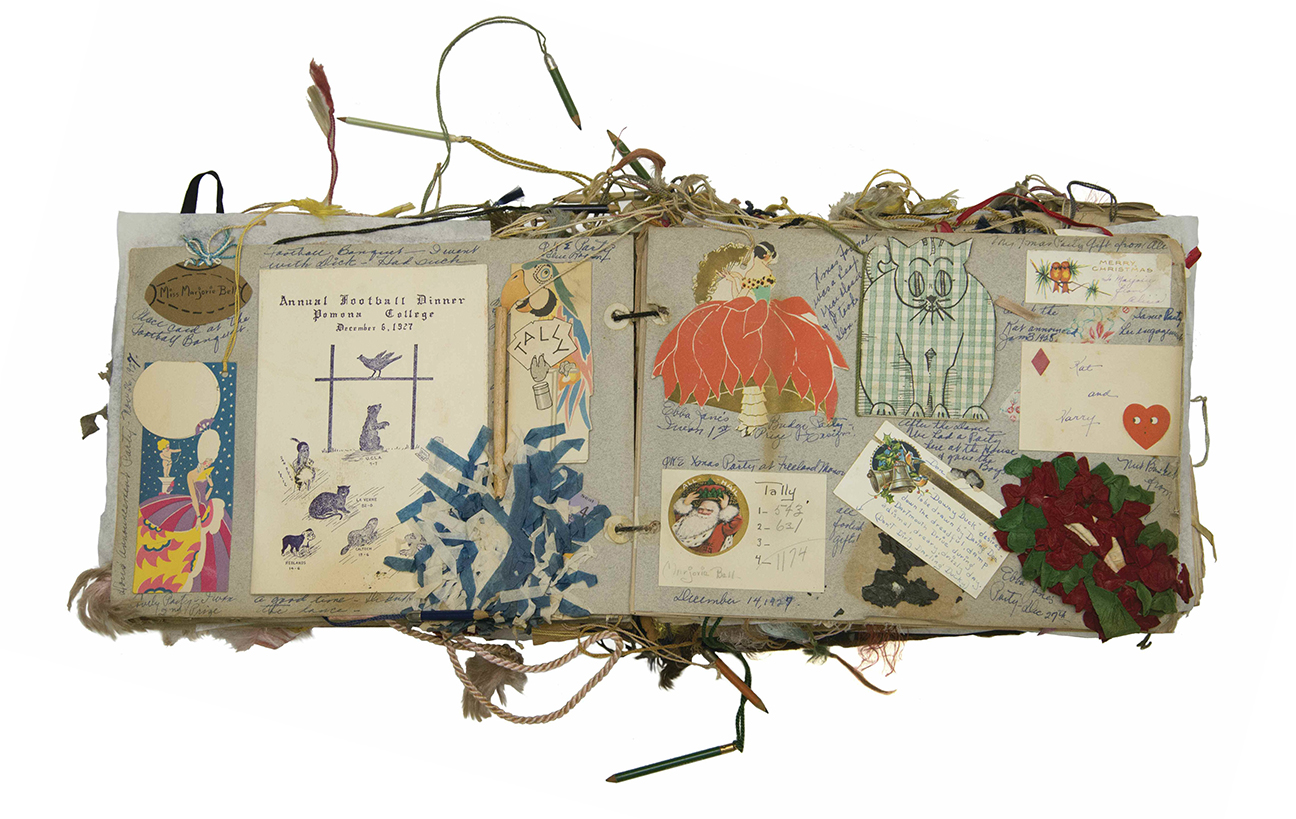
Photo of the Marjorie Maude Bell ’28 Scrapbook from the Pomona College Archives

Click for larger version

ITEM: The Marjorie Maude Bell ’28 Scrapbook
DATE: 1924–1928
COLLECTION: One of 37 scrapbooks currently in the Pomona College Archives collection, ranging from the Class of 1901 to the Class of 1972.
DESCRIPTION: 240-page scrapbook (12” X 9” X 6”), jammed with pasted-in invitations, dance cards with attached pencils, tickets, programs, clippings and other memorabilia from Southern California college life in the 1920s.
ORIGIN: The scrapbook was donated by Karen McDaniel, Ms.Bell’s niece, who explained: “She graduated in 1928, and her brother Gilbert Clyde Bell, (my grandfather) graduatedin 1927. She was a very involved student: secretary of her senior class, president of Phi Kappa Sigma literary society,sorority sister of Alpha Chi Omega, among other positions.”
If you have an item from Pomona’s history that you’d like tosee preserved in the Archives, please call 909-621-8138.