Articles Written By: Staff

Daring, Feetfirst

PCM-summer2016text58-web2_Page_27_Image_0001To enter Los Angeles County from the southeast, follow Pacific Coast Highway through Seal Beach and onto a bridge spanning Los Cerritos Wetlands and the San Gabriel River. Off to your left, the marshy expanse turns to ocean. On your right, factory smokestacks stand against a hazy mountain range. The four-lane road narrows as it rises over the swamp. Go about a quarter mile until you reach a stoplight, where the road levels and widens again. You’re in Long Beach now. There’s a Whole Foods on the left if you’d like a snack.

Crossing this kind of imaginary line on a ho-hum stretch of highway is hardly noteworthy for drivers. Likewise for cyclists, able to coast up the easy incline in their own lane. But since I’m on foot, my experience is more visceral. I toe the rightmost white line of the bike lane and feel the surprising definition of the paint underfoot. I hurdle a semicircle of fibrous black rubber, being careful not to land in a puddle of shattered window glass. Still, I’m thankful to be on the road, rather than slogging through the mud as I did several days before. As for that imaginary line, it still isn’t real, just like that tall can of coconut water isn’t really a glass of champagne. Sure tastes like sweet, small victory though. Cheers to staying alive and feeling it, too.

At a table outside the Whole Foods, four cyclists who blew right past me on the bridge sit eating fruit and potato chips.

“How long have you been running, man?”

“Since Mexico. Only 30 more miles till L.A.”

“Damn, dude! That’s wild. I’ve never even thought of going that far.”

“Ha, to be honest, I hadn’t either. Just went for it.”

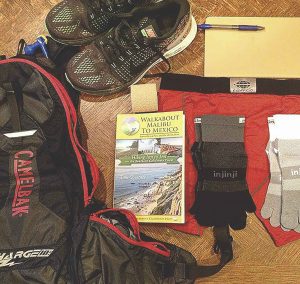
The trip had come together quickly, almost foolishly so. I remember waiting to board an afternoon flight to San Diego while I took stock of my personal effects: a small CamelBak, an outdated guidebook, a four-year-old iPhone with a faulty battery, a sore left knee. Less than two weeks prior, I’d volunteered to travel the 150 miles from the Mexican border to downtown Los Angeles on foot, by myself, blazing the trail for others to make the journey this August. It would be called El Camino del Inmigrante—the Way of the Immigrant—a display of solidarity and a rallying cry for policy reform, an initiative proposed by my father.

A few months before, my father and I had completed the Camino de Santiago together, walking 500 miles from the Pyrenees to the Atlantic across northern Spain. And as it so often does, emerging from such a crucible subconsciously compelled us to apply the principles of pilgrimage to our own lives, framing our goals and pursuits as a journey necessary for self-actualization. For me, the rite marked a return to running and a renewed will to explore. For my dad, it provided a means of mobilizing other activists and allies, using an inherently spiritual framework as a forum for discussing worldly issues. CEO of the Christian Community Development Association and longtime crusader for immigration reform, he’s lived the past 25 years of his life in La Villita, a Mexican community on Chicago’s West Side, feeling the struggle of the undocumented American on a personal level while giving voice to it on a national one. He is just the man for this mission. As for me—restless, a little reckless and perpetually in search of purpose—I make the perfect scout. Vamos.

The real thing will be a 10-day affair, with dozens of walkers, plus nightly events and fellowship. (They will also be skipping the dangerous parts, for the record.) For this scouting trip, I’m giving myself only five days, on account of professional obligations back home.

Now, standing in International Friendship Park—as far southwest as you can go on U.S. soil—I slap the wrought-iron border fence as if to start a stopwatch and take off, hoping the dirt trails will prove a safer alternative to the sidewalk-less streets. Before long I’m high-stepping through the muddy chaparral down dead-end paths, dodging boulder-sized tumbleweeds. There are helicopters patrolling overhead, trying (I imagine) to catch me runnin’ dirty. But it isn’t just the danger or the adrenaline that gets my mind running wild. Rather, it begins with the diagnostic scan any runner naturally takes of his or her own body over those first few moments or first few miles, identifying any sensations—good, bad or otherwise—and weighing them against the reality of the distance ahead. For me, it’s a hyper-awareness that can’t help but radiate outward, connecting me to the street or the buildings or passersby.

Perhaps this is why so many people claim to do their best thinking on the move. Besides simply getting the blood flowing, the movement plants a tiny seed of symbiosis, sprouting into curiosity, empathy and compassion.

I make it out of the dirt-road labyrinth and up the Silver Strand to Coronado. Into San Diego via ferry and on to La Jolla, where I sleep in a van with a minimalist friend from college. Past Torrey Pines Golf Course, merging onto the sidewalks of Highway 101, I shuffle through Del Mar, then Encinitas, then Carlsbad, straight into an ice bath in the tub of an Oceanside motel. Two days, 60 miles down. Not fully awake yet, I find myself staring down the end of an automatic rifle. One does not simply jog into Camp Pendleton, it seems. The chunky-necked marine lowers the barrel and points it toward the bus I have to take to the other side of the base. I hop out in San Clemente and continue on to Laguna Beach, fear-sprinting the last few miles on the shoulder of the narrow highway. I watch the sunset on a rock and go out on the town for some beers, at least one for each of today’s brushes with death. The fourth day is heavenly by comparison, past Newport, Huntington and Seal Beach on a long, leisurely stroll. And then, the bridge.

Back in L.A. County, mind as sharp as I can ever remember, I’m now headed in a clear direction. It’s exactly the opposite of how I left five years prior. Lining up alphabetically to take part in commencement exercises, I could see the banners strung upright from the lampposts along Stover Walk. They were beaded with water from the drizzling rain, the 2-D portraits of my outstanding friends and classmates taking on a slick, watery shine. They were the faces of Campaign Pomona: Daring Minds, celebrating an attribute supposedly shared by all of us receiving diplomas that day. It was an unsettling sight, because my own mind felt as blunt as a butter knife. I was in a fog, stuck in the mud, wondering how I would make myself useful—let alone successful—outside of Claremont.

To say that the opposite of rumination is motion—literally moving forward—seems strangely metaphorical. “Moving on” in a psychological or emotional sense somehow seems far more practical, even though this act of personal progress is itself a metaphor derived from corporeal movement. “Walk it off” is sound advice after being plunked by a fastball, but it’s hardly a tonic for indecision or identity crisis. Those are situations you reason and educate your way out of, carefully weighing the possible outcomes before starting down a path in earnest. It’s not called “Campaign Pomona: Daring Bodies,” mind you.

But as I returned home to Chicago as a new graduate, confused and neurotic, something strange began to happen. I started walking and running long distances, sometimes for exercise, sometimes because I was too broke for bus fare, but mostly because I didn’t know what else to do. And the more I moved from point to point—across the neighborhood, across the city, across finish lines—the more connected it all seemed to be. Not just this house to that house or this train station to that office building, but this community to that one, this reality to one a world apart. After an interdisciplinary education from a liberal arts college, this was my graduate course in Applied Everything. Each discrete skill was plotted on a map, and now I was learning to connect these disciplines to forge a purposeful path, one that had now led me back to where this meandering journey began.

I say goodbye to my new cyclist friends at the Whole Foods and jog the last few miles into Cambodia Town, Long Beach, where I stay for the night. Up and out of there at the crack of dawn, my fifth and final day seems almost ceremonial, just an easy 20-mile trot up the L.A. River bike path, through Skid Row and straight to the Westin Bonaventure downtown, the host hotel for the annual CCDA conference and the end point of the Camino. I slap the side of the building as if to turn off the stopwatch and call my dad. It’s done and dusted—a clear, walkable line from the wrought-iron fence to a shiny marble bench there at the valet stand. I take a seat and stare down at my shoes. They’re still caked with dried mud from the border field.

To claim that I suddenly understand the struggle of the immigrant because I ran a long way up a scenic trail would be ridiculous. I don’t; I never will. If anything, an affinity for recreational pain is proof that I’ve suffered—truly suffered—very little in my lifetime. But to reduce physical effort to mere sport may be just as misguided. I’ve seen aimless tours of a city open the mind to life’s beautiful web of alleyways and back roads. I’ve seen a cross-country trek take a father-son relationship from small talk to real talk. And I’ve felt a boldness of body spark an audacity of mind. So to say that this journey has made me a more engaged and empathetic individual, and that it may yet play a tiny role in some big change—well, that doesn’t sound ridiculous at all.

The following day I return home. There’s a letter from Pomona in my mailbox, announcing the conclusion of the historically successful Daring Minds campaign. And upon seeing it, instead of that undeserving, stuck-in-the-mud feeling from five years back, I feel proud, knowing that there was something daring in me all along. The only difference was, I had to dare feetfirst and work my way up.
Letter Box

Dying With Dignity

PCM-summer2016text58-web2_Page_10_Image_0001


I read your “Before I Die” article with interest, as I am sure most of us from the Class of 1962 did. It is called current events. However, I suggest that there is one important part of the death process that was not included in the story.

Twenty years ago Oregon passed the nation’s first Death With Dignity Act. Two years later an attempt to repeal it was soundly defeated. My wife and I voted in favor of the act both times, little suspecting that we would use it later. Since then, Washington, Vermont, California and Montana have passed virtually identical laws, and quite a few other states are considering such a law now. The law is nothing at all like the “death panels” that Gov. Palin carried on about for a long time.

In our case, my wife had colon cancer surgery and then breast cancer surgery within one year. Initially the doctors believed that the surgeries were successful. The colon cancer never returned, but the breast cancer came back three years later. After four more surgeries during the next six years, four rounds of radiology treatments (15 each) and close to 100 chemotherapy treatments, her body began to stop functioning. She did not want to get to a point that she would be a “vegetable” (her term) in a care facility, and the family could recognize that life, as any normal person would like to live it, was about over. She was bedridden and had stopped eating or processing food.

A two-week process is required, with certifications from two doctors that the patient’s life will likely end within six months. The doctors referred us to Compassion & Choices, a fabulous group of volunteers nationwide who are leading the effort to expand legislation in other states, and who provide volunteers to help with the process. My wife took the medicine and passed away in less than an hour. She was satisfied with the process, as were all of the family, and friends when told about it later.

C&C can provide much more specific information on the subject. But with the law now in effect in CA, and with so many Pomona alums living in California, I believe it is important that information about Death With Dignity should be included in the otherwise very interesting article you wrote this quarter.

—James A. (Jim) Johnson ’62

Portland, Ore. 

Face to Face

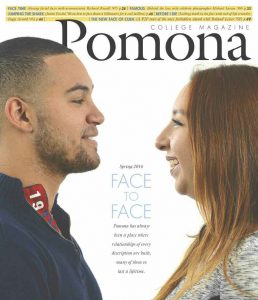
PCM-summer2016text58-web2_Page_10_Image_0002We loved the latest Pomona College Magazine “Face to Face” feature. We wanted to share our relationship to last a lifetime.
In the summer of 1963, we each received a letter from Dean of Women Ina T. Nider informing us that we had been assigned to one another as freshman roommates. It was apparently a successful pairing. We were suite-mates sophomore year and roommates again our senior year. Linda was a religion major, active in Chapel Committee and the Claremont Committee to End the War in Vietnam. Lesley was a biochemistry major and spent most of her time in the chemistry lab.

After graduation, Lesley went on to obtain a Ph.D. in molecular biology at the University of Wisconsin, did two postdoctoral fellowships at UC Berkeley and then worked for 32 years at the Oregon Health and Science University in Portland, starting as an assistant professor and serving her last 20 years as provost. She has served as president of Pacific University in Forest Grove, Ore., since 2009.

Linda worked in a garment factory in San Diego, then obtained her teaching credential and taught for 36 years in inner-city Los Angeles, the last 28 years at Manual Arts High School, retiring in 2009. Finding that unsatisfactory, she went back to school, obtained a master’s in history at Cal State Los Angeles and is now an adjunct instructor at East Los Angeles College.

Through the years, we have shared annual trips to Disneyland with our kids, weddings, divorces, an untimely funeral and innumerable photographs of adorable grandchildren. We currently see each other a couple of times a year, chat regularly on Facebook and compete daily in cutthroat games of Words With Friends.

Thanks, Ina T.

—Linda Baughn ’67

Los Angeles, Calif.

and Lesley Moore Hallick ’67

Forest Grove, Ore.

You do, indeed, publish a beautiful magazine! I usually start at the back, to see if any of my classmates are in the Class Notes. Then I page through the entire thing.

However, this month your “Face to Face” feature grabbed my attention right away, so I read all of these stories first thing. That was a clever and time-consuming project for you, I would think. Loved it! The only face I knew was that of Bob Herman ’51. As I remember, he has led our class tours of the campus on Alumni Weekends. A terrific storyteller! My husband, DeForrest ’61 and I met at Pomona, so the married couples who met there were of special interest. We’ve been married 52 years.

One of the many things I like about the magazine is how you include stories from the school’s past, along with what is currently happening on campus. Of course, I love to read what the graduates have done recently. I’m always interested in the books they’ve published. I appreciate your including very short articles as well as longer ones in just the right mix. Some college magazines are so dense with material that there is no hope of reading everything.

DeForrest and I spent a bit of time studying Jeff Hing’s gorgeous double-page photo of the campus. The snow-covered mountains with the clouds spilling over them were spectacular.

I’ve finished reading the “Letter Box.” So, what to read next … the story on Cuba, since some of my friends are traveling there? The article about the celebrity photographer? Maybe about that “youngster” Peggy Arnold, who graduated three years after I did.

My grandniece is a Pomona student at the moment, so I feel that your magazine is keeping me in touch with her there. I’m looking forward to my 55th reunion next year. How I love returning to that beautiful place, full of so many memories.

—Bonnie Bennett Home ’62

San Jose, Calif.

As a friend of Pomona College, I have enjoyed reading Pomona College Magazine for many years. The latest issue moves me to send this appreciation of the continuing quality of the publication under your most competent custodianship. I especially liked the piece about relationships. This reminder of how important and durable they can be during one’s collegiate interlude is nicely done. Thanks to you, your staff and contributors.

—Gilbert Pattison Joynt

Seattle, Wash.

Pomona Lifeline

Since my retirement in 2006, the Pomona College Magazine has become my cherished lifeline to the College and the Pomona family and community that was my home for so many years—and I miss so keenly. Each issue offers delight and fascination for me, as you offer marvelous features about the extraordinary individuals within our diverse community whose creative lives have so enriched our world. As such, the magazine is a beacon of hope for me in a world so darkened by forces of bitter divisiveness and destruction. Our Pomona students, faculty, administration, staff and alumni all have voices within your magazine, and I read every word to learn more about their lives and accomplishments and to celebrate them.

May I say, too, as an English teacher forever enamored with fine writing, that the quality of writing in every article is superb. I especially enjoy your “Stray Thoughts,” always a personal and engaging reflection on issues at hand from your marvelously unique and candid point of view.

Your layout and design are glorious indeed. You offer visual as well as verbal pleasures.

With every best wish for the flourishing of the Pomona College Magazine—and for your ongoing delight in your devoted and inspired efforts for us all.

—Martha Andresen Wilder

Professor Emerita of English

Claremont, Calif.

Note Correction

In the Class of ’59 Notes in PCM Spring 2016, there are three entries: Epps, Lathrop Wells and myself. Two of us were botany majors (there were, in total, three botany majors in 1959. How’s that for keeping the Pomona College connection? I think botany was unique because of the three-day field trip fall and spring to all of the vegetation zones of the West over a three-quarter-year span. These field trips formed a cohesion to the department and College, just as student research with faculty does today. Both Betsy and I had keys to the botany building—master keys at that—and this was a bonding element also. But somehow, my note in Class Notes ended short of the complete sentence. I intended for it to say: “I am rich in experiences, but in retirement short on pension. Pomona and Harvard shaped my life, and I will be eternally grateful for the expanding opportunities and challenges I took from them.” I appreciate the correction. We are downsizing and I found 60-year-old 8-page magazines—a far cry from now.

—Garrison Wilkes ’59

Hingham, Mass.

Alumni, parents and friends are invited to email letters to pcm@pomona.edu or “snail-mail” them to Pomona College Magazine, 550 North College Ave., Claremont, CA 91711. Letters may be edited for length, style and clarity.

New Faces

Pomona Welcomes New Academic Dean

Audrey Bilger

Audrey Bilger

Pomona’s new vice president for academic affairs and dean of the college, Audrey Bilger, took up her duties on July 1. She came to Pomona from the nearby campus of Claremont McKenna College, where she had been professor of literature and founding faculty director of the Center for Writing & Public Discourse.

“I am thrilled to welcome Audrey to Pomona, where her experience in college governance, knowledge of faculty challenges and aspirations, passion for liberal arts education and her familiarity with The Claremont Colleges will be strong assets,” said Pomona College President David Oxtoby.

In her new position, Bilger will serve as the chief academic officer and play a leading role in shaping and sustaining the intellectual life of the Pomona community.

“As a longtime member of the Claremont Consortium, I am familiar with Pomona’s strengths and history,” said Bilger. “I look forward to becoming even better acquainted with the community and to working with faculty, students, staff and other stakeholders to continue to foster the ideals of a liberal arts education in an inclusive environment.”

At Claremont McKenna, Bilger served as chair of the Department of Literature and as coordinator of gender studies. She also served on major committees, including the Board of Trustees Academic Affairs Committee, President’s Advisory Committee on Diversity, curriculum committee, WASC reaccreditation and the appointments, promotion and tenure committee. Among other significant contributions, she chaired of the working group on academic resources for international, first-generation, low-income and underrepresented minority students.

In 2014–15 she held an American Council on Education (ACE) Fellowship at the University of California, Riverside (UCR), with a placement in the Office of the Executive Vice Chancellor and Provost, where she worked closely with UCR’s leadership team. She was involved in major projects during her fellowship, including budget redesign, organizational excellence and a master planning study. She also participated in a working group charged with establishing a collaborative leadership model for faculty, staff and students.

Bilger has authored numerous scholarly articles and books, including Here Come the Brides! Reflections on Lesbian Love and Marriage, which was a finalist for the Lambda Literary Award, and Laughing Feminism: Subversive Comedy in Frances Burney, Maria Edgeworth, and Jane Austen.

She is a member of the Ms. Magazine Committee of Scholars and serves on the editorial boards of Pickering and Chatto’s Gender and Genre series and the Frances Burney Journal. Her work has appeared in Ms., the Paris Review, the San Francisco Chronicle, the Los Angeles Times and the Los Angeles Review of Books.

She received her doctoral and master of arts degrees in English at the University of Virginia and her undergraduate degree in philosophy at Oklahoma State University.

Bilger is married to Cheryl Pawelski, a Grammy Award–winning producer and cofounder of the Omnivore Entertainment Group, who serves on the National Board of Trustees for the Recording Academy.

New Faces on the Board

Three new faces and two familiar ones joined the ranks of Pomona’s Board of Trustees this summer. Elected for the first time were Kiki Ramos Gindler ’83, Osman Kibar ’92 and Jeff Parks ’02. Jennifer Doudna ’85 rejoined the Board after a four-year hiatus, and ex-officio member Christina Wire ’87 was elected to the Board in her own right.

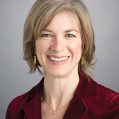
Trustee-Doudna-JenniferJennifer Doudna ’85 is a professor of molecular and cell biology and chemistry at the University of California, Berkeley, where she holds the Li Ka Shing Chancellor’s Chair in Biomedical and Health Sciences and is a Howard Hughes Medical Institute investigator. As a co-inventor of CRISPR-Cas9, a process that revolutionized gene editing, she has received numerous honors, including the 2014 Breakthrough Prize and both the Gairdner Award and election to the Royal Society in 2016. A chemistry major, she earned her Ph.D. from Harvard University.

Trustee-Gindler, Kiki RamosKiki Ramos Gindler ’83 earned her juris doctor degree from Harvard Law School and specialized in corporate and entertainment law. Today she devotes time to writing, civic affairs and support for the arts. The first Latina president of the Board of Directors for Center Theatre Group in Los Angeles, she serves on the boards of the Los Angeles Opera and the Music Center and is a member of the Blue Ribbon and the National Council for the American Theatre. A philosophy major, she has chaired Pomona reunion committees and hosted several alumni events.

Trustee-Kibar_116Osman Kibar ’92 is founder/CEO of Samumed, LLC, a firm developing drugs for degenerative diseases, regenerative medicine and oncology. Featured on the cover of Forbes Magazine’s “Global Game Changers” issue, Kibar is an entrepreneur and inventor, has founded or co-founded numerous successful companies, and has authored or coauthored many publications and patents. An economics major, he pursued a 3-2 program that also earned him a B.S. in electrical engineering from Caltech. His M.S and Ph.D. in optoelectronics and biophotonics are from UC San Diego.
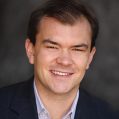
Trustee-Parks, JeffreyJeff Parks ’02 is a founding partner of Riverwood Capital Management, a globally focused private equity firm that invests in high-growth businesses in the technology and services industries, across a variety of geographic regions and company organizations. He serves on the board of directors of several prominent technology companies, including Nutanix, Spredfast and LogRhythm. A double major in mathematics and economics at Pomona, he completed his studies in three years, so he identifies with both the Class of 2002 and the Class of 2003.

Trustee-WireChristina015Since joining Google in 2007, Christina Wire ’87 has led a variety of groups across sales, marketing, operations, and corporate philanthropy. Today, she is the director of sales and business operations for Google Fiber. She has also held leadership roles at Intel, Stanford University, and the U.S. Department of State, where she began her career. She holds master’s degrees from Columbia University and Northwestern’s Kellogg Graduate School of Management. As National Chair of the Annual Fund, she was an ex-officio member of the Board from 2014 to 2016.



Archives: The Cain Mystery

PCM-summer2016text58-web2_Page_14_Image_0001ITEM: Class cane
DATE: 1926
DESCRIPTION: Tapering hardwood walking cane 35 inches long, with a 5-inch curved handle.
ORIGIN: Unknown

The tradition of college canes seems to have been fairly common in the United States during the 19th century and the early part of the 20th. At Amherst College, for instance, freshmen had to wear a beanie, but as sophomores, they could wear a class top hat and carry a class cane. At Dartmouth College, the eagerness of first-year students to gain these status symbols led to a yearly competition called the Cane Rush, eventually banned for the violence it provoked. Today few remnants of that tradition survive. At Dartmouth, during Commencement, graduating seniors still carry canes topped with carvings related to their senior society—such as a griffin or a phoenix. And at Amherst, the tradition had a brief revival in 2003, when the College awarded specially designed class canes to all of its graduating seniors.
At Pomona there are only a few tantalizing references to the cane tradition. For instance, a description of campus activities in 1911 says: “If freshmen won both the Pole Rush and the subsequent freshman-sophomore football game, they got to carry around canes for a few weeks. If the sophomores won, they got to punish the freshmen by making them wear something embarrassing and smacking them with paddles if they refused.”
The cane pictured here is from the Class of 1926, as evidenced by the inlaid metal strip embossed with the totem pole design that was the symbol of that class, also to be found in the pages of that year’s Metate yearbook. Beyond that we know nothing. It was discovered in a closet of the Alumni Relations Office in Seaver House, its provenance and history unknown. If you have information to share about this cane or about the class cane tradition at Pomona, we invite you to contact us.

If you have an item from Pomona’s history that you would like to see preserved in the Pomona College Archives, please call 909-621-8138.

Last Look

Alumni Weekend 2016

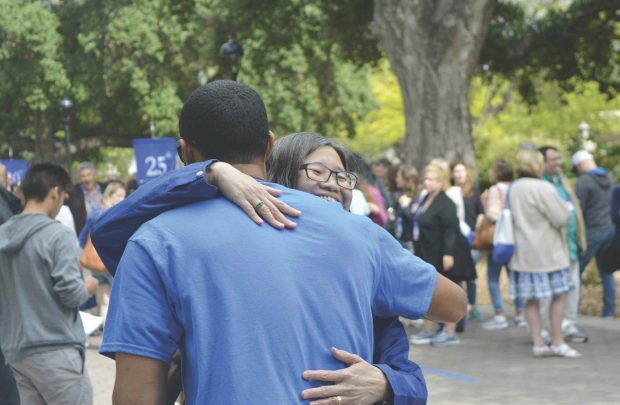
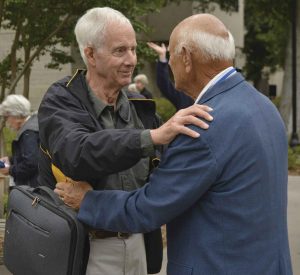
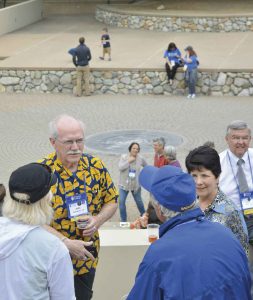
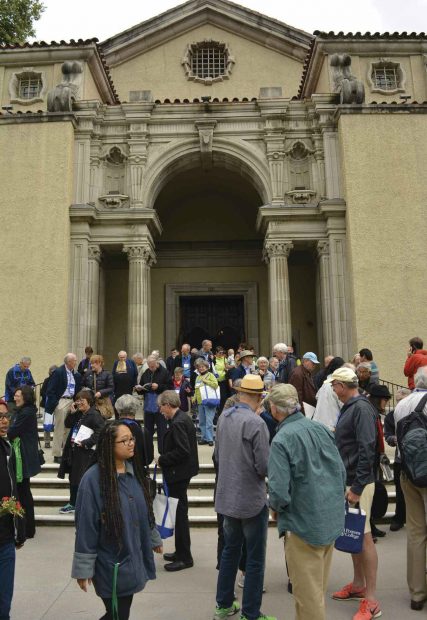
Here are a few photos from the 2016 Alumni Weekend, held in April. For information about the event, see the Alumni Bulletin Board.

—Photos by Carlos Puma

PCM-summer2016text58-web2_Page_34_Image_0001PCM-summer2016text58-web2_Page_34_Image_0002PCM-summer2016text58-web2_Page_34_Image_0003PCM-summer2016text58-web2_Page_34_Image_0004PCM-summer2016text58-web2_Page_34_Image_0005PCM-summer2016text58-web2_Page_34_Image_0006PCM-summer2016text58-web2_Page_34_Image_0007PCM-summer2016text58-web2_Page_34_Image_0008


Bulletin Board

Sagehens Celebrate 4/7 with Good Deeds

Oxtoby with students

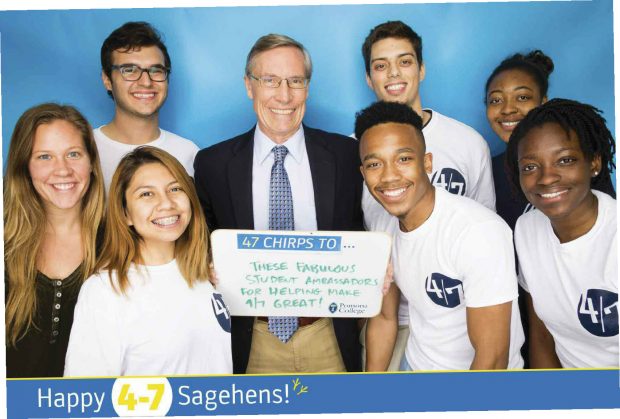
President David Oxtoby poses with a group of student volunteers on 4/7 Day, 2016

On April 7, Pomona hosted the second annual Celebration of Sagehen Impact to honor and recognize the good work and good will of our community of “everyday Daring Minds.” Sagehens around the world flooded the Pomona Alumni Facebook group with thousands of likes, comments and posts about alumni service projects, while more than 500 students braved spring rain on campus to celebrate this special day of community spirit. 47 chirps to Sagehens near and far for bearing your added riches, and for another year of uplifting community support that is solidifying the 4/7 Celebration of Sagehen Impact as a proud, new Pomona tradition! To see a sampling of posts from alumni participants, visit facebook.com/groups/sagehens and search for #SagehenImpact.

Pomona Book Club

In April, Pomona’s new Alumni Learning & Career Programs team launched the Pomona College Book Club on Goodreads. The Book Club connects Pomona alumni, professors, students, parents and staff around a common love of reading. Become a member by visiting pomona.edu/bookclub to check out a summer reading list of recommendations from some of this year’s Wig Award–winning faculty and share your own favorite books.

Alumni Weekend and Alumni Award Winners

Nava, Summers Sandoval, Tinker Salas

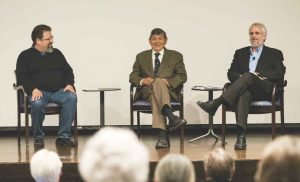
Julian Nava ’51 (center) with professors Tomás Summers Sandoval Jr. and Miguel Tinker Salas

Berland, Gretchen

Gretchen Berland ’86

Edwards, John

John Edwards ’64

Riggs, Pat

Pat Riggs ’71

Krupp, Ed

Ed Krupp ’66

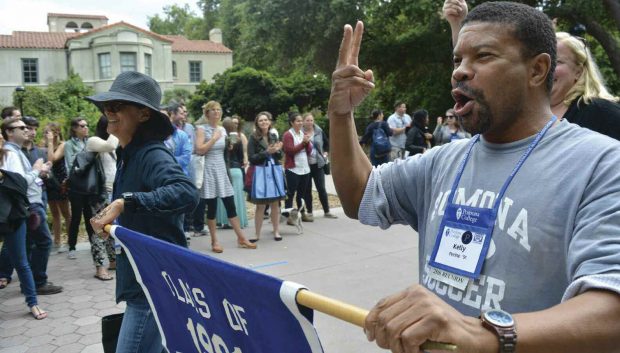
Alumni Weekend, April 28 through May 1, 2016, brought nearly 1,600 Sagehens home to Claremont for a weekend of fun and reconnection. In addition to cornerstone activities such as class dinners, guest speakers, the alumni vintner wine tasting and the parade of classes, guests of Alumni Weekend 2016 enjoyed tours of the new Studio Art Hall and Millikan Laboratory, tasted local craft beers with the Class of 2016, attended a Presidential Search Forum and engaged in discussion with executive staff in a town hall–style forum regarding current campus issues. Looking forward to your reunion year or just pining for some California sunshine among hundreds of Sagehen friends? Be sure to mark your calendars for the last weekend of April and return to campus for Alumni Weekend 2017!

Alumni Weekend 2016 was also an occasion for guests to hear from 2016 Blaisdell Distinguished Alumni Award winners Gretchen Berland ’86, Ed Krupp ’66, Julian Nava ’51 and to honor Blaisdell winner George C. Wolfe ’76, who could not attend the celebration. Alumni Distinguished Service Awards were presented to John Edwards ’64 and Pat Riggs ’71. Learn more about these annual awards and their deserving recipients at pomona.edu/alumni/services-info/awards.

(For more photos, see Last Look on page 64.)

Thanks to Onetta

Brooks, Onetta47 hearty chirps to Onetta Brooks ’74 for a year of thoughtful leadership and dedicated service as Pomona’s 2015–16 President of the Alumni Association! Onetta proved a wonderful steward for the board’s evolution to a more action-oriented group, and exhibited her commitment to a thriving alumni community throughout the year during alumni events and 4/7 activities, organization of responses to the Title IX policy and engagement in conversations about
inclusivity. Many thanks, Onetta!

Travel-Study

Burgundy: The Cradle of the Crusades

Travel Study -- BurgundyMay 29–June 10, 2017

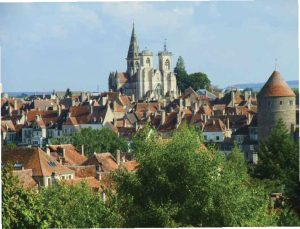
Join John Sutton Miner Professor of History and Professor of Classics Ken Wolf on a walking tour of Burgundy. Burgundy, the east-central region of France so well-known for its food and wine, was also an incubator for two of the most distinctive features of the European Middle Ages: monasticism and crusade. This trip provides the perfect context for exploring “holy violence” in the Middle Ages and its implications for the 21st century.

Backstage: Return of the Oaks

PCM-summer2016text58-web2_Page_13_Image_0001


The mesa oak, with its bluish-green leaves and majestic stature, was almost completely wiped out from the landscape of Claremont and surrounding areas more than a century ago. Now Pomona’s bringing this endangered native tree back to campus, thanks to the work of veteran groundskeeper Kevin Quanstrom.

Since 2006, crews have planted about 30 mesa oak trees, also known as the Engelmann or Pasadena oak, in and around the College. Quanstrom, assistant director of grounds and housekeeping, says adding the mesa to the campus’ much larger number—in the hundreds—of coast live oaks helps diversify and strengthen Pomona’s tree population.

More than the bluish leaf color sets the mesa oaks apart: These trees are less susceptible to sudden oak death caused by pests and disease brought on by the ongoing drought, which took its toll on some of the older coast live oak trees that once lined Bonita Avenue. Quanstrom and his team had to remove those damaged trees when the roadway was rebuilt a few years ago, replacing them with the mesa.

“It’s important to understand native plants and to put native plants where you can,” says Quanstrom, who has worked at Pomona since 2004. “When going from nonnative to native plants, you’re always going to save water because native plants tend to be dormant in the summertime. People should care—these trees were part of the ecosystem before we got here, and once the trees are more established, they will help save water.”

With new developments across campus, Quanstrom took advantage of the opportunities to lay down the mesa oak around the Studio Art Hall and Sontag Greek Theatre, along Columbia Avenue and on the east side of Oldenborg Center.

Quanstrom has extensive experience with native habitat restoration, and although the tree is not readily found at local nurseries or big-name home improvement stores, he tracked down a grower in Riverside who could provide them.

Though always outnumbered by the more prolific coast live oaks, mesa oaks were most plentiful up to the mid-19th century, thriving in an area running from Pasadena as far south as Baja California. Then numbers dwindled as a result of logging. “It was very popular for lumber because it’s a very straight oak tree,” says Quanstrom.

At the same time, settlers began to fill the area and citrus trees replaced native vegetation, says Environmental Analysis Professor Char Miller, who notes that the mesa was a key timber used to shore up the new houses and buildings.

“My bet is that some of the College’s earliest buildings may have contained lumber milled from this local tree. The mesa oak largely disappeared from its historic sites by the early 20th century, and its loss is one of the reasons my wife and I planted one in our backyard, a small reclaiming of this area’s environmental past.”

Back on campus, the oak plantings are part of a larger effort to introduce drought-tolerant plants, but Miller finds the return of the majestic trees to be a particular point of pride. “This restoration project is a marker of the College’s sustainability commitments and our willingness to invest in making the grounds less thirsty, more resilient,” he says.

Milestones: Commencement 2016

PCM-summer2016text58-web2_Page_16_Image_0001

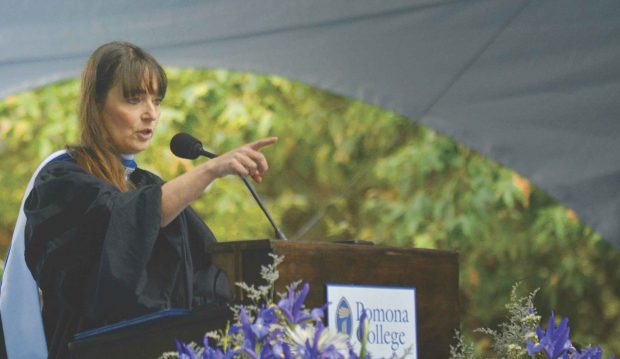
“You’re sitting here at the edge of opportunity. You have so much power and so much reach—much more reach than any generation before you. You have the same tools that we had—you can work hard, you can vote, you can speak out—but you have a whole set of new tools at your fingertips, literally, and that can help make the world not only better, but a little closer to the 9-year-old’s ideal.”

—Deborah Bial

Founder and president of the Posse Foundation,

speaking to the Class of 2016 at Commencement

PCM-summer2016text58-web2_Page_16_Image_0007

PCM-summer2016text58-web2_Page_16_Image_0002

PCM-summer2016text58-web2_Page_16_Image_0006

PCM-summer2016text58-web2_Page_16_Image_0005

Wig Winners for 2016

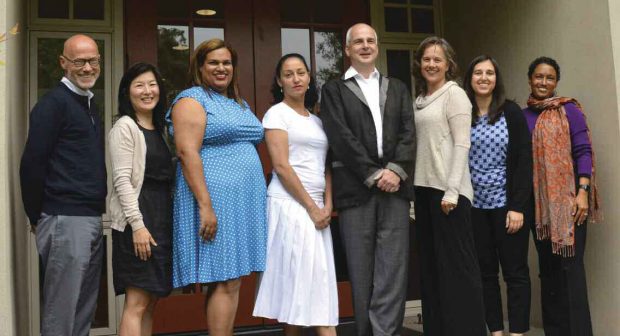
PCM-summer2016text58-web2_Page_17_Image_0003Each spring, juniors and seniors recognize outstanding Pomona professors by selecting the recipients of the Wig Distinguished Professor Award, the highest honor bestowed on faculty. This year’s recipients are (left to right in the image above):
Pierre Englebert, H. Russell Smith Professor of International Relations and professor of politics, teaches courses like Advanced Questions in African Politics, Comparative Politics of Africa, and Political Economy of Development. He has been at Pomona since 1998, and this is his fourth Wig Award.

Sharon Goto, professor of psychology and Asian American studies, teaches courses including Asian American Psychology, Industrial/Organizational Psychology, and Psych Approaches: Study of People. She has been at Pomona since 1995, and this is her second Wig Award.

April Mayes ’94, associate professor of history, teaches courses on Afro-Latin American History, Gender & Nation: Modern Latin America, and U.S.-Latin American Relations, among others. She is a graduate of Pomona, and has taught here since 2006. This is her first Wig Award.

Kyla Tompkins, associate professor of English and gender & women’s studies, teaches 19th-Century U.S. Women Writers, Literatures of U.S. Imperialism and Advanced Feminist and Queer Theory, among other classes. She has been at Pomona College since 2004, and this is her first Wig Award.

Jonathan Hall, assistant professor of media studies, teaches courses that include Freud, Film, Fantasy; Japanese Film: Canon to Fringe; and Queer Visions/Queer Theory. He has been at Pomona since 2009, and this is his first Wig Award.

Johanna Hardin ’95, professor of mathematics, teaches courses that include Linear Models, Computational Statistics, and 9 out of 10 Seniors Recommend This Freshman Seminar: Statistics in the Real World. A graduate of Pomona, she has taught at Pomona since 2002. This is her first Wig Award.

Michelle Zemel, assistant professor of economics, teaches courses that include Economic Statistics, Advanced Topics in Banking, and Risk Management in Financial Institutions. She has been at Pomona since 2012, and this is her first Wig Award.

Nicole Weekes, professor of neuroscience, teaches The Human Brain: From Cells to Behavior (with Lab), Neuropsychology (with Lab), and Introduction to Psychological Science. She has been at Pomona since 1998, and this is her fourth Wig Award.

New Knowledge

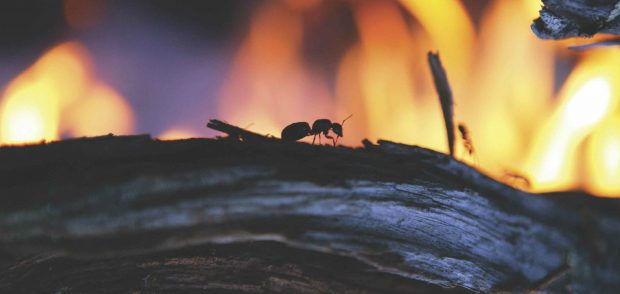
PCM-summer2016text58-web2_Page_17_Image_0001BIOLOGY: Assistant Professor of Biology Wallace Meyer

Fireproof Ants

Even a fire won’t keep a good ant down, according to research at the Robert J. Bernard Biological Field Station (BFS) on the effects of fire on ants. But which plants grow back after fire and drought does affect ant communities.

For her senior thesis, Tessa Adams ’16 was interested in determining if the ant community changed as a result of the September 2013 brush fire that charred 17 acres at the field station and The Claremont Colleges North Campus Properties. Expectations were that the effects of fire would be significant, but it turns out ants are a hardy, fireproof lot. Results show that there was minimal immediate and no lasting impact on the species from the fire, says Assistant Professor of Biology Wallace Meyer, director of Bernard Field Station, a preserve maintained by The Claremont Colleges that protects the rare native ecosystem of California sage scrub.

“It seems like ant assemblages can withstand a fire. And it makes sense—they are this super-organism. … Fast-moving hot fires affect the surface; meanwhile the ants are down below,” says Meyer. Plus, “fire is a natural component of the ecosystem.”

However, Meyer says, following a fire, areas of land can potentially convert from native flora—in the case of BFS, California sage scrub—to nonnative grasslands, which do affect whether ants return. (Rest assured, 22 species of ants are still making their home at BFS.) Drought, too, affects whether sage scrub or nonnative grasses grow back and which species of ants make their home in each type of habitat. In fact, Meyer says, drought—while not as manifestly dramatic—is actually a larger stressor than fire.

Meyer believes this research is significant because the effects of fire on anything other than plants and mammals are largely unknown. For purposes of conservation and biodiversity management, it is important to understand these effects, since fire is going to become more common, especially in light of global climate change. Adams’ research findings will be used in conservation management plans not only at BFS, but by managers throughout Southern California.

What are the implications for conservation management? First, as long as native plant communities recover, no action is required, says Meyer. Second, which types of plants grow back favors certain ant species. Third, effects of extreme drought correlated with climate changes are real and felt, making long-term management difficult.

Thanks to her high school AP Environmental Science class, Adams came to Pomona knowing she wanted to do ecology research. She says when she stepped foot into BFS, she was awestruck by the California sage scrub habitat.

Adams’ awe quickly turned into action. Adams started working on arthropod research at BFS as a volunteer her first year at Pomona and continued through the years, setting up research sites, collecting pitfall traps, sorting specimens that were collected—and she started seeing a wide range of arthropods at the station.

“After taking Professor Meyer’s Fire Ecology in Southern California class last spring, I became interested in how fire can shape an ecosystem, and I realized that there is little research on the effect of fire on arthropods. I decided to focus my thesis on the effect of fire on ants because the lifestyle of ants, which live in colonies, has the potential to be greatly affected by fire,” says Adams.

She conducted her research by pitfall trapping. She buried a test tube in the ground, with the lip of it level with the surface of the ground. The tube was filled about halfway with a preservation solution—either ethanol or propylene glycol. As the insects ran along the ground, they fell into the trap, and the collected specimens served as a survey of the insects present in an area.

But why choose ants? Adams points to the creatures as providing crucial ecosystem services that make them important to study because of their broad impact on other organisms and their value in helping to determine ways to conserve the environment they inhabit.

So in other words, remember the old proverb: Go to the ant … consider her ways.

—Sneha Abraham

PCM-summer2016text58-web2_Page_17_Image_0002CHEMISTRY: Professor Roberto Garza-López

Molecular Origami

Pomona College Chemistry Professor Roberto Garza-López and his research colleagues have developed a new model that studies how protein molecules fold and unfold—work that has more than a few national institutes interested in the implications for understanding the development of diseases such as Alzheimer’s disease, Huntington’s disease, Type II diabetes and certain types of cancer.

The research, published in the Journal of Inorganic Biochemistry, looks at the protein called Cytochrome c, focusing on the questions of what happens to this protein’s molecules when they don’t fold properly and how this improper unfolding is linked to cancers and other diseases.

Why does a protein fold and unfold in the first place? Long protein molecules start straight, explains Garza-López, but in order to interact with other molecules, they have to fold. “And they have to fold into a very specific shape,” he says. “If they don’t fold properly, then that’s where negative things occur, especially disease. In the paper we published, we are looking at the opposite effect: we’re looking at the protein that is already folded to see how it unfolds.”

The Howard Hughes Medical Institute (HHMI) and the National Institutes of Health (NIH) are providing funding for further research and are interested in what the team’s findings reveal about the early development of diseases. Garza-López is working with Caltech Professor Harry B. Gray and DePaul University Professor John J. Kozak.

In order to visualize the protein molecule’s many folds, students working in Garza-López’s lab create 3-D structures of some of the proteins, like Cytochrome c (pictured here). “Students are very good with compu­ters, at visualizing molecules and doing calculations, but they’re also very good at visualizing what those calculations are doing to those molecules.”

Sabari Kumar ’17, a chemistry major who is working in Garza-López’s lab, was acknowledged in the published paper and is now studying the folding and unfolding of proteins related to disease by performing molecular dynamics simulations.

The research by Garza-López , Gray and Kozak continues, and they’re already finished with another manuscript looking at another protein called Intelectin-1, a protein of the intestines and lungs that is able to distinguish between human cells and the cells of bacterial invaders. “This could underpin new strategies to fight infections,” says Garza-López. He adds: “Proteins are very complex. We start with a simple model and we do a lot with that model and try to understand new things about it. That’s how science works.”

—Carla Guerrero