Articles Written By: Staff

Papers, Politics, Policy

Prof. Amanda Hollis-Brusky’s paper on the promotion of a theory of executive power and its consequences is making its way to the other two branches of government

How Prof. Amanda Hollis-Brusky’s paper on the promotion of a theory of executive power and its consequences is making its way to the other two branches of government

In 2011, during her first year at Pomona College, Politics Professor Amanda Hollis-Brusky wrote a paper on the rise of the “unitary executive theory,” used in recent decades to promote the notion of the primacy of presidential power and limit the autonomy of federal agencies. The paper was part of Hollis-Brusky’s larger work on the conservative legal movement.

In January, U.S. Senators Sheldon Whitehouse, Richard Blumenthal and Mazie Hirono cited and relied heavily on Professor Hollis-Brusky’s in their amicus curiae brief filed in a big U.S. Supreme Court case Seila Law v. CFPB, which may decide the fate of the Obama-era Consumer Financial Protection Bureau. Arguments are set for March 3.

In Brief

Marshall Scholar

Isaac Cui ’20 has won a prestigious Marshall Scholarship to fund his graduate studies in the United Kingdom next year. During his two years in the U.K., Cui hopes to study at the London School of Economics as well as study political science at the University of Manchester.

Churchill Scholar

Elise Koskelo ’20 has been named one of only 16 American students to win this year’s Winston Churchill Foundation Scholarship to study and conduct research at the University of Cambridge. She plans to study quantum magnetism and superconductivity.

Sustainable Thesis

The senior thesis of Sara Sherburne ’19, titled “Let’s Get Sorted: The Path to Zero Waste,” was recognized last fall by the Association for the Advancement of Sustainability in Higher Education as one of six winners of the national Campus Sustainability Research Award.

Solar Cell Grant

Pomona and Harvey Mudd were recently awarded a National Science Foundation Major Research Instrumentation Grant of $442,960 for new lab equipment to support research and development of next generation solar cells.

Paralympic App

While attending the 2015 Paralympic National Games in his home country of India, Arhan Bagati ’21 saw athletes literally crawling up stairs. So he created an app to guide Paralympians to locations that are accessible, including bathrooms, restaurants, theatres and more. The result was InRio and its successor, the IndTokyo app for the 2020 Tokyo Paralympic Games, available on iTunes and Google Play.

Post/Truth

The theme of the Humanities Studio’s 2019–20 speaker series is “post/truth,” exploring the various facets of today’s post-truth (un)reality through a series of speakers and seminars, including a “Fake News” Colloquium.

All In on Voter Turnout

At a ceremony in Washington, D.C., in November, Lucas Carmel ’19 was honored as one of 10 students from across the country on the “All In” Campus Democracy Challenge Student Honor Role. The award is in recognition of his leadership last year in a nonpartisan voter participation drive on Pomona College’s campus.

Carmel, along with Michaela Shelton ’21, led efforts to get out the vote at Pomona. Their work paid off with voter turnout among Pomona College students almost tripling from the 2014 to 2018 midterm elections, according to a report released Sept. 20 by the National Study of Learning, Voting and Engagement (NSLVE). In 2018, 50.4% of Pomona College students voted compared to 17.4% in 2014.

A group of students at Pomona College led by Carmel and Shelton began to organize a nonpartisan effort to get out the vote in the summer of 2018. That’s when the group joined the “All In” Campus Democracy Challenge, a national awards program that encourages colleges and universities to increase student voting rates.

“So many people worked to promote voting on campus last fall, and today we get to see proof of just how successful that effort was,” Carmel said in September when the results were announced. “I think Pomona’s status as a leader in college voting has been cemented. The challenge now becomes: How do we maintain and continue to promote voter engagement on campus?”

Carmel, who graduated last May, recently launched Vote for Astra, his organization dedicated to making it easier for college students to vote.

Art on the Move

fragile art objects from the museum’s old storage Sometime this fall, the Pomona College Museum of Art will cease to exist, and the Benton Museum of Art at Pomona College will be born in its beautiful new quarters on the opposite corner of the intersection of College and Second. To prepare for that change, for the past few months, the museum’s associate director and registrar, Steve Comba, has been overseeing the effort to inventory, pack and safely move approximately 15,000 valuable and often fragile art objects from the museum’s old storage into the new. Already in their new home are the artifacts of the museum’s Native American collection, previously stored in the basement of Bridges Auditorium and brought out mainly for visiting schoolchildren.

100 Years Ago

It’s 1920, and Pomona College is entering the Roaring Twenties—facing, among other things, the challenges of dancing and Hollywood.

Everybody Dance

With the close of World War I came a push to overturn the strict college rules against dancing on campus. As recently as 1918, an editorial in The Student Life had lamented that “The principle of non-dancing has become ingrained into the very fiber of the institution for reasons which the executives can best express, and it is worse than futile for us to oppose it.” The post-war culture shift, however, soon carried away that prohibition, and, as informal campus dances became common, the efforts of the administration turned to managing them. A floor committee of four men and four women supervisors were authorized “to reprimand any undesirable form of dancing or to request any person to leave the floor.” By 1922–23, four all-college formal dances were being conducted annually in the “Big Gym”—the Senior-Freshman Dance, the Christian Dance, the Military Ball and the Junior Prom.

Silence is Golden

As Hollywood became the movie capital of the world, the Pomona campus soon came into demand as a collegiate set. The Charm School, a silent feature starring Wallace Reid, was the first known movie to be shot on campus, with much of it filmed around Pomona’s Sumner Hall in 1920.

1,000 Strong

The 1921 Metate (published in 1920) notes that for the first time the number of Pomona alumni has topped 1,000.

For more tidbits of Pomona history, go to Pomona College Timeline.

Ideas@Pomona: The Summit

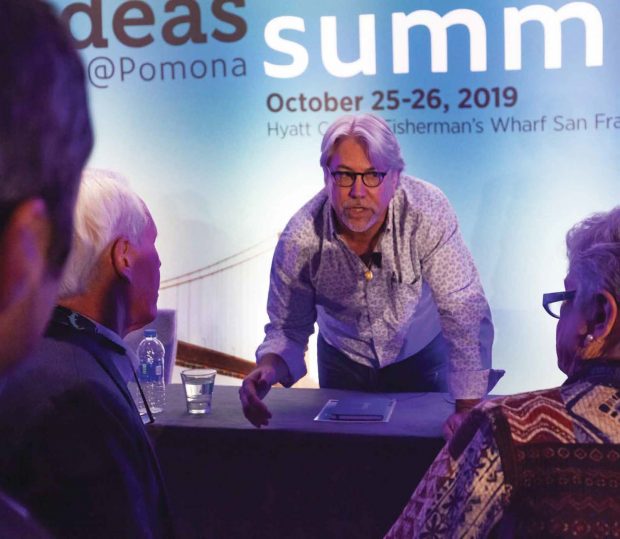
THE IDEAS@POMONA SUMMIT, Pomona’s premier lifelong learning event, brought together more than 200 Sagehen alumni, families, students and friends from around the globe for an energetic day-and-a-half conference under the theme Liberal Arts NOW and NEXT. Dedicated to meaningful connection and active dialogue around timely, newsworthy and captivating ideas, the inaugural event took place October 25-26, 2019, at the Hyatt Centric Fisherman’s Wharf in San Francisco.

What does cutting-edge research tell us about who we are and where we are going? How are liberal arts values such as critical thinking and creative learning being brought to bear on today’s unique challenges and tomorrow’s opportunities? The sold-out event featured sessions led by alumni, parents, faculty and friends of the College including featured speaker Ari Shapiro, host of NPR’s “All Things Considered,” Laszlo Bock ’93, Liz Fosslien ’09, professors Kevin Dettmar, Nicholas Ball, Nicole Holliday and more.

Attendees left invigorated, with an increased enthusiasm for the liberal arts and a strong sense of a visit back to class on campus.

Planning is underway for the next Summit in 2021. Watch for details at Ideas@Pomona Summit

Ari Shapiro gives the keynote address

Ari Shapiro of NPR’s “All Things Considered’ gives the keynote address at the Ideas@Pomona Summit in San Francisco.

Ari Shapiro speaks to a sold-out crowd

Ari Shapiro speaks to a sold-out crowd on Saturday morning.

Fabian Fernandez-Han ’20 and Peter Han P’20 lead an interactive workshop

Fabian Fernandez-Han ’20 and Peter Han P’20 lead an interactive workshop showcasing the creative power Human-Centered Design.

Professor Nicholas Ball

Professor Nicholas Ball on “The Challenges of a Petroleum-Free Society.”

Brian Prestwich P’20

“Creating a Healthcare System that Works for Everyone” panelists (Brian Prestwich P’20) take audience questions.

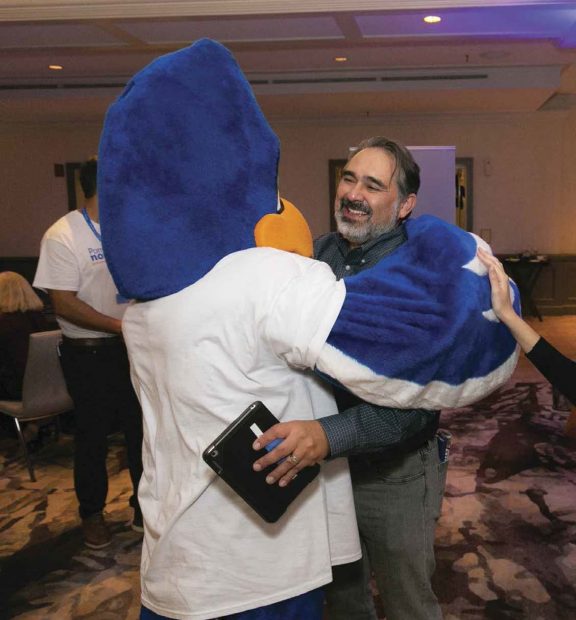
Alfredo Romero ’91 and Cecil Sagehen

Alumni Association Board member Alfredo Romero ’91 and Cecil Sagehen.

Professor Alexandra Papoutsaki and Laszlo Bock ’93

Professor Alexandra Papoutsaki and Laszlo Bock ’93 discuss “Liberal Arts and the Future of Work.”

Baseball by the Numbers

Rapsodo device provides pitching data that includes velocity, spin rate and vertical and horizontal breakGATHERED ON THE pitcher’s mound during class, Pomona College students feed balls into a pitching machine, then quickly glance down at an iPad.

On the ground between them and home plate is a boxlike device called a Rapsodo, a $4,000 radar-based system that provides data not only on pitch velocity, but also spin rate, spin axis, horizontal and vertical break, 3D trajectory and a strike zone analysis.

The Rapsodo device provides pitching data that includes velocity, spin rate and vertical and horizontal break.

Welcome to PE 086: Baseball Analytics, a new course taught by Frank Pericolosi, a professor of physical education and coach of the Pomona-Pitzer baseball team.

The class formalizes what has emerged as a notable career path for Pomona alumni: More than a dozen graduates or current students have put backgrounds in mathematics and computer science to work for Major League Baseball teams analyzing the game-changing explosion of data in baseball.

They’re following a trail blazed by Guy Stevens ’13, a former Sagehens pitcher and math major who has risen to senior director of research and development/strategy for the Kansas City Royals. He was on staff for a World Series championship in 2015, less than three years after working with Math Professor Gabe Chandler to publish a statistical analysis of minor league data.

“Talking to Guy [Stevens] over the years, I ask, ‘What do we need to be doing on campus to make these kids better candidates for these internships and for these jobs?’” Pericolosi says. “He gave some suggestions in terms of, ‘They need to be doing creative, innovative projects on their own.’ The driving force for getting this technology on campus was initially to help our kids who want to go into analytics. Also, we’re in a heavy-data era of baseball even more so than before, and it’s going to give us good data to evaluate our players as well.”

Five of the 15 students in the class play baseball for the Sagehens. One of them, catcher and math major Jack Hanley ’20, worked for the Oakland Athletics two summers ago and spent last summer as an associate in quantitative analysis with the New York Yankees. This October, he watched his former colleagues advance to the American League Championship Series.

“It’s definitely very rewarding to know that whatever small role I played this summer in making the team better, it paid dividends,” says Hanley, whose description of his research for the Yankees is vague. That’s because he had to sign a non-disclosure agreement to protect what amount to industry secrets.

Not all the alumni putting data analysis to work for major league teams are former baseball players. Jake Coleman ’13 played Ultimate Frisbee at Pomona but completed a Ph.D. in statistics at Duke University in May and joined the Los Angeles Dodgers in August as a senior quantitative analyst. Nor are they all men: Christina Williamson ’17, a former water polo player and swimmer who majored in math, was featured by The Athletic as one of 35 people under 35 shaping the game of baseball for her work with the Yankees using biomechanical data to aid player development and reduce injuries.

Pomona, Stevens is confident, is gaining a reputation in the game.

“If you think about how small the sport is, with only 30 teams, and how well-connected it is, there’s a pretty good chance if you’re in baseball, you know someone who knows someone who went to Pomona,” he says. “A lot of these jobs in baseball, it’s the same set of skills that translate anywhere: If you’re working with data, it’s curiosity and creativity and thinking outside the box. And Pomona trains you for that 100%, whether it’s baseball or finance or whatever else.”

Baseball analytics once was based on information available in a box score, but has evolved rapidly in the era since it was popularized by the 2003 book Moneyball and the movie that followed. It is now decidedly high-tech, requiring expensive equipment that Pericolosi was able to purchase for the course through Pomona’s Hahn Teaching with Technology Grants. He’s in the process of acquiring a second Rapsodo that gathers hitting data, measuring such things such as exit velocity—the speed of the ball off the bat—launch angle, 3D ball flight and expected landing location. Blast Motion swing sensors that attach to the knob of a bat are yet another tool in an array of devices that are used in training to aid the development of players and to help shape strategies.

Though some of the students in the class chose the course as an intriguing elective—Noah Sasaki ’20 thinks it could help him in a planned sports media career—those who play baseball are earnestly using the data to improve their skills and approaches. Analyzing spin data has helped catcher Jake Lialios ’20 and pitchers Luka Green ’20 and Simon Heck ’22 determine a particular pitcher on the staff should throw higher in the strike zone because the spin rate makes his fastball appear higher than it is. Green suggests data also could be used to recognize injuries.

“If your slider spin rate gets cut in half, your elbow probably hurts—and sometimes people don’t tell anyone,” he says.

Hanley plans to use bat sensor data to study swing paths in a senior thesis supervised by Chandler, the math professor and former assistant baseball coach whose mentorship helped launch Stevens’ career. After Stevens showed Chandler a trove of minor league data he was struggling to shape into a project, the pair joined forces and published an article in the Journal of Quantitative Analysis in Sports in 2012. That, plus an introduction from Chandler to an East Coast statistics professor who also worked with the New York Mets, helped Stevens break into Major League Baseball.

“At that point, people at Pomona realized this is something that one can do,” Chandler says. “I don’t know if people were thinking this before they decided to enroll here, but all of a sudden we went from having almost no math major baseball players to having two or three a year.”

Hanley, who communicated with Stevens even before arriving at Pomona, would love to follow the same sort of path. For his thesis, he is building on research he began with the A’s to study swing mechanics through functional data analysis, a statistical method Chandler calls “cutting-edge stuff.”

“What I’m really interested in is the function of position or acceleration over time—not just to reduce the entire function down to one point, but to use the entire function in data analysis,” Hanley says. “Generally, the project is to look at these swings and see how much information we can really glean. Let’s not limit ourselves in terms of format or data structure. Let’s see what we can really do with this stuff.”

After graduation, Hanley hopes to land a position with a baseball team, but he notes that more and more baseball analytics researchers have graduate school training and he might also go that route after a couple of years. Peter Xenopoulos ’18, who has worked for the Philadelphia Phillies as a quantitative analyst associate, is now a Ph.D. student in computer science at NYU, and Mike Dairyko ’13 earned a Ph.D. in applied math at Iowa State and works as a data scientist for the Milwaukee Brewers, though he is on the business side. “I do think this is something where Pomona is getting a reputation,” Hanley says. “It’s really a great breeding ground, a great incubator for baseball analytics in college.”

Pomona’s Baseball Analysts

The following is a list of recent Pomona alumni who have worked for MLB teams in roles related to data and analytics:

Drew Hedman ’09
Run Production Coordinator
Arizona Diamondbacks

Guy Stevens ’13
Senior Director, Research & Development/Strategy
Kansas City Royals

Jake Coleman ’13
Senior Quantitative Analyst
Los Angeles Dodgers

Mike Dairyko ’13
Senior Manager, Data Science, Business Analytics
Milwaukee Brewers

Jake Bruml ’15
Pro Scouting Intern
Boston Red Sox

Kevin Brice ’16
Quantitative Analysis Assistant
Los Angeles Angels

Simon Rosenbaum ’16
Assistant, Baseball Development
Tampa Bay Rays

Dylan Quantz ’16
Player Development Assistant
Atlanta Braves

Christina Williamson ’17
Research Analyst, Performance Science
New York Yankees

Peter Xenopolous ’18
Former Quantitative Analyst Associate
Philadelphia Phillies

Bryce Rogan ’18
Quantitative Analysis Assistant
Los Angeles Angels

Andrew Brown ’19
Apprentice, Baseball Analytics
Texas Rangers

Jack Hanley ’20
Former Summer Associate
New York Yankees

Nolan McCafferty ’20
Former Quantitative Analyst Intern
Baltimore Orioles

Defy the Odds

Defy the Odds pane
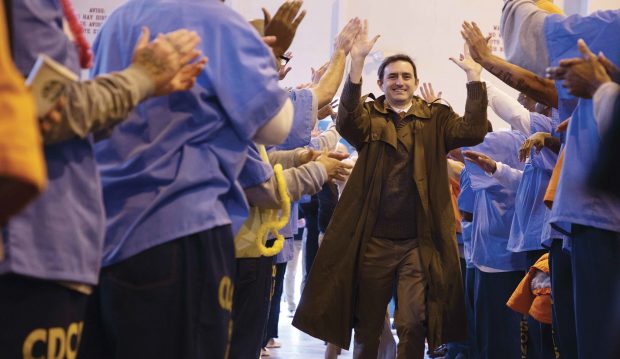
Entrepreneurs in Training (EITs) welcome Glazier and other volunteers at a prison event in Lancaster, Calif.

Entrepreneurs in Training (EITs) welcome Glazier and other volunteers at a prison event in Lancaster, Calif.

GAMES AND ICEBREAKERS are often used at business conferences to create some fun and make strangers comfortable with each other. But at a recent meeting of Defy Ventures, which helps people from prisons prepare for life on the outside, one empathy-building exercise quickly turns dead serious. It’s called Step to the Line, and though not a word is spoken, much is revealed.

On a sunny Saturday in mid-January, about a dozen former inmates from two Los Angeles halfway houses gather for the event at a modern downtown office complex. They are met there by a group of volunteers, men and women from the business world recruited to lend their expertise on writing résumés, polishing personal statements and perfecting business plans.

Defy calls the event a Business Coaching Day, and it’s led by Andrew Glazier ’97, the nonprofit’s national president and CEO. It’s part of the organization’s overall prison rehabilitation program called CEO of Your New Life, which aims to build self-confidence as well as skills.

At Defy, the group exercises are meant to be healing. They help participants develop a healthy self-image and positive attitudes. The organizers provide a well-studied set of aphorisms to live by.

Shame is destructive. Learn to forgive, not judge. You are not defined by your mistakes. You deserve a second chance. Foreswear negative labels. You are not criminals, convicts or felons. You are EITs— Entrepreneurs In Training.

Above all, realize that the solution is already inside you. Many of the same skills that brought you success as, say, a drug dealer can be applied to any legal enterprise.

In short, to quote Defy’s main motto: Transform the Hustle.

Glazier listening to an EIT share his personal statement during a coaching day.

Glazier listening to an EIT share his personal statement during a coaching day.

GLAZIER HIMSELF COMES from a privileged background that could not be more remote from the life experience of his incarcerated clientele. For the public face of Defy Ventures and its chief fundraiser, that disparity can be a handicap, he concedes. Sometimes he finds himself forced to answer questions of class and race when pitching new potential donors.

“In the funding community now there’s a lot of interest in seeing people who have ‘lived experience’ running organizations and working in the nonprofit space,” he explains. “I think part of it comes from the idea that, look, for a long time it’s been just a bunch of well-meaning white people who come and work in communities of color. So sometimes I find I still battle this credibility stuff: What are you doing here?”

Glazier understands why people perceive a disconnect between his upbringing and his prison work and why they might challenge his street cred, so to speak. But he bristles at being “on the receiving end” of that mistrust. “It can be an uncomfortable spot to be in,” he says. “Look, I can’t change who I am. I do know that it’s critical to have people with lived experience within our organization, informing our work. And we do.”

If you’re looking for personal information on Glazier, you won’t find much on social media. He’s not one to overshare; so he keeps a light digital footprint, mostly on LinkedIn and all about business. But Glazier opened up during a casual lunch recently at the Wasabi Japanese Noodle House, a five-minute walk from his Wilshire Boulevard offices in Koreatown. He talked easily about his evolving life goals, his family, education and the circuitous career path that brought him to the transformative prison work he never dreamed he’d be doing.

Unlike many other Angelenos, Glazier’s roots in the city run deep. His mother descended from immigrants with a long history in Los Angeles. Her maternal relatives arrived from Italy, just in time for his great-grandmother to be “born off the boat from Sicily” in 1908.

Glazier’s father was a doctor who worked for the Veteran’s Administration, where he met his mother, who worked as a secretary for the agency. They married, had three children and settled in Studio City, a well-to-do neighborhood in the eastern San Fernando Valley.

Glazier attended Harvard-Westlake, a college prep he calls “the most elite private school in Los Angeles.” Today, he concedes that his exclusive education had put him in a protective bubble, cloistered from the social ills mushrooming all around him.

But all that changed on April 29, 1992, the day the Los Angeles Riots erupted over the verdict in the Rodney King case.

One of Defy’s entrepreneurs in training, referred to as EIPs.

One of Defy’s entrepreneurs in training, referred to as EIPs.

GLAZIER WAS 16. “I had lived my whole childhood in the valley, and I had no idea what was going on eight miles away,” he says. “Then the riots happened. I remember seeing Rodney King getting beaten on TV. Then the city burning. And even in the valley, where it wasn’t nearly as intense, you could still see all the smoke coming over the hill.

“That was really a moment for me of waking up: Oh, my life is not their life. There are things happening that are really close-by that I’m really not aware of. And when I suddenly had greater awareness of my opportunity and privilege, it felt all the more extreme, which in part, I think, drives me to do this work.”

Yet, Glazier never actually planned to work in prison reform. Until recently, if you had told this classically trained cellist with an MBA and a medium build that he would someday wind up working with hard-core prison inmates, he would have scoffed at the notion.

Nothing was further from his mind when he applied to college. He picked Pomona because he wanted a small school, and his parents wanted him to stay close-by.

The Claremont campus also had a strong academic appeal. “I’m a huge fan of the liberal arts,” he says. “It doesn’t matter what you get a degree in, because you’re learning critical thinking and writing. And that’s the education I came out with—a degree in critical thinking and knowing how to write, both important skills that are hard to find.”

Glazier majored in international relations, studied Spanish and Japanese, and spent a semester in Pomona’s program at Tokyo’s International Christian University.  At first, he considered joining the foreign service, but that plan never materialized. (Fun fact: his suitemate during junior year was David Holmes ’97, a U.S. State Department employee based in Ukraine who recently testified during the impeachment hearings against President Donald Trump.)

After graduation, Glazier took time to explore. He returned to Japan and taught English for a year. He travelled, settled down and started a family. From 2001 to 2004, he was chief of staff to Marlene Canter, then a newly elected member of the Los Angeles City Board of Education.

“Originally, I wanted to be an elected official,” he recalls, “but five years of working in local and state government sort of cured me of that impulse.”

Nevertheless, the experience continued to stoke a civic calling. The problems he saw in L.A. schools opened his eyes to new realities—kids who are afraid to go to school, who can’t read, who smoke weed in the hallways.

“This is where you really start to see inequities in the system, to see more of the injustices that exist in society,” he says. “I spent my life in private education; now suddenly I have this front-row seat in public schools, and you think, ‘How is this even possible?’”

Glazier then switched gears and joined a small real estate development team, managing an award-winning restoration of historic bungalows in Silverlake. On that job, he recalls, he met and interacted with people with criminal histories for the first time, giving him a glimpse into the challenges they face after prison.
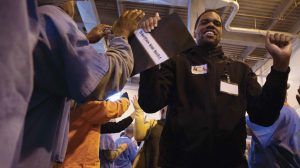
EITs welcoming a volunteer at the start of a Defy coaching day

EITs welcoming a volunteer at the start of a Defy coaching day.

Meanwhile, Glazier also went back to school, earning his master’s in business administration from UCLA’s Anderson School of Management in 2006.

Two years later, he decided he’d had enough of real estate, which “didn’t feel meaningful to me.” In October of 2009, he took a job with City Year Los Angeles, a nonprofit that plunged him back into those vexing education problems. The agency works with AmeriCorps volunteers to serve as tutors, mentors, and role models for students in Los Angeles, grades three through 10.

The job gave Glazier his entrée into nonprofit work, where he finally found his mission. He stayed eight years with the education agency, having ascended to second in command in the Los Angeles chapter.  When he decided to leave—again with no job lined up—a friend referred him to the opening at Defy, which had recently launched a new Southern California branch.

Glazier has come to see parallels between the problems in public schools and those in public prisons. “They are both large bureau­cracies within the state government that are dealing with large numbers of people who are in need of intervention and education,” he explains. “So some of the basic reform ideas that apply to public education apply to prisons too.”

In either system, steering an organization in a new direction can be a herculean task. Glazier was well aware of the enormous challenge when he entered the criminal justice reform world three years ago, full of optimism and ambition. But he had no idea of the organizational landmines that awaited him at Defy Ventures, where a scandal was about to shake the nonprofit to its foundation while abruptly catapulting Glazier to the top job.

DEFY VENTURES WAS FOUNDED in 2010 in New York by a charismatic woman named Catherine Hoke, a UC Berkeley graduate and former Wall Street executive. But in 2018, she was forced to resign in the midst of accusations of sexual harassment, misuse of funds and misleading donors with inflated performance reports.

Glazier said the controversial leader had come to personify the organization. She had a golden touch for fundraising and promotion; she courted powerful people in politics and Silicon Valley and had a knack for drawing high-profile media coverage. When she stepped down, Glazier says, Defy seemed doomed, as donors rapidly retreated.

Hoke has denied the allegations, though she previously admitted having sex with ex-prisoners participating in a similar program she had established in Houston in 2004. After being banned from Texas prisons in 2009, she resurfaced in New York where she later faced the new allegations from former Defy employees. An internal investigation, conducted by an outside law firm, found evidence of personal impropriety, but no proof that program results were embellished, donors misled or funds misused.

Glazier joined Defy in May of 2017, charged with building the new L.A. chapter. But before he had completed his first year on the job, the scandal hit, and he was suddenly promoted to president and CEO as the organization ran out of money.

Glazier recalls how he perceived the promotion: “You’re in charge. Here’s a dumpster fire.”

The newcomer scrambled to keep the sinking agency afloat. He was forced to lay off two thirds of the staff, then proceeded “to engineer a turnaround.” Today, the agency is back on solid footing.
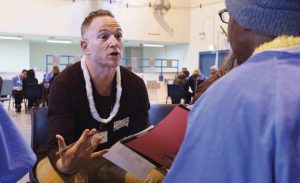
A Defy Ventures volunteer giving résumé feedback.Defy’s top goal, says Glazier, is cutting the rate of recidivism, the all-important measure that tracks the proportion of released offenders who return to prison over time. Nationwide, the rate has remained stubbornly high for decades. According to the most recent study released in 2018 by the federal Bureau of Justice Statistics, more than 83 percent of inmates released in 2005 had been re-arrested at least once within nine years. Most, 68 percent, were re-arrested within the first three years. The study followed a random sample of 67,966 prisoners from 30 states, including California, Colorado and New York, all places where Defy programs operate.

Defy’s strategy is essentially simple: Help men and women inside prisons prepare for a successful re-entry by teaching them business and career skills and personal development. Once they’re released, the agency provides continued support through a structured program to help them get a job or start a business.

While still in prison, participants engage in a seven-month curriculum that culminates in a Shark Tank-style competition, in which they pitch their ideas to a panel of business leaders and investors. After graduation and release, winners can bring their ideas to fruition through Defy’s Business Incubator.

ON ITS WEBSITE, Defy tracks results by the numbers: More than 5,200 prison participants, 4,800 volunteers, a one-year recidivism rate of 7.2 percent, an 84 percent employment rate and 143 businesses incorporated over the past eight years.

Like Defy itself, several of these small enterprises go on to employ former prisoners. Two Defy graduates work for Glazier at the agency’s spare and utilitarian offices, where the décor is corkboards and calendars.

Quan Huynh, the organization’s post-release program manager, joined the Defy program as a participant in 2015 while serving a life sentence for murder. He had been convicted in connection with a car-to-car shootout on the Santa Ana Freeway between his Vietnamese gang and members of a rival gang in the other car. He did time in some of the state’s toughest prisons, including Soledad and Pelican Bay.

“For the first 10 or 12 years, I never thought I was going to go home,” says Quan, whose parents fled the Vietnam War when he was an infant. At his parole hearing, he gambled on telling the truth, admitting he had lied in court and coached witnesses. His honesty paid off.

After his release, Defy helped him start his own cleaning company in Fountain Valley. Today, he is founder and CEO of Jade Janitors, currently with six employees, including five who were formerly incarcerated. He was Glazier’s first hire at Defy in 2017.

Another volunteer offering feedback to an EIT at a California prison.

Another volunteer offering feedback to an EIT at a California prison.

When asked, Quan thinks before offering a job assessment on his boss. “He’s very strategic and organized,” he says. “He’s all about systems and processes. He does not micromanage me at all. He empowers me. He sets the goal and sets high expectations, and we follow through with it.”

For Quan, that management style says, “I trust you.”

PRIVATELY, GLAZIER CAN “sometimes seem a little socially awkward,” Quan says, but he’s confident in the spotlight as Defy’s workshop leader. “He’s right in his comfort zone right there, actually connecting with the participants.”

During the recent Business Coaching Day, Glazier is clearly comfortable leading the icebreakers. In one, he asks people to introduce themselves by dancing their way from their seats to the front of the large hall.

“Quan, have you got some good dance music ready?”

There is no room to be bashful in this exercise. The participants, both budding entrepreneurs and volunteer counselors, make their way to the front, displaying individuality in their step. They strut, stroll, glide, vamp and slow-walk their way to the front, announcing the nicknames they gave themselves. There is Graceful Grace, Fantastic Frank, Kind Kyra and Bashful Benny. And here come Musical Michele, Ambitious Albert, Incredible Ian and Resilient Raul.

In the role of moderator, Glazier as Awesome Andrew is a cross between a motivational speaker, group therapy leader and game-show host. By the time these icebreakers work their wonder, the room is buzzing with laughter and chatter like a nightclub at midnight.

But when it comes time for Step to the Line, Glazier asks for silence. He instructs the group to form two lines along blue tape laid on the floor a few feet apart. Volunteers stand shoulder-to-shoulder on one side facing the Entrepreneurs in Training on the other. Then they all take two steps back from their respective lines, making the distance greater between them.
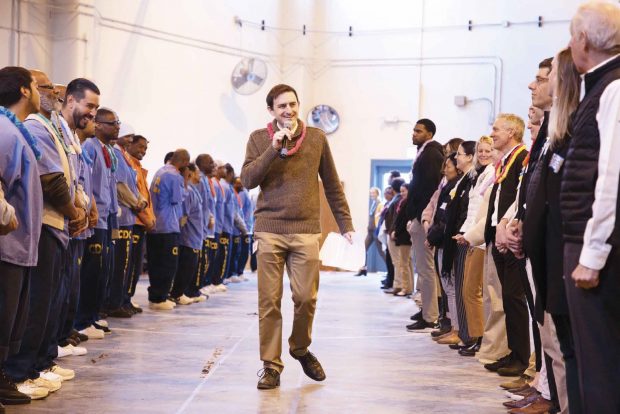
Glazier ’97 leading one of Defy's signature exercises, Step to the Line.

Glazier ’97 leading one of Defy’s signature exercises, Step to the Line.

Glazier then reads a series of questions. For each one, participants must step forward to their line if they feel the statement is “true for you.” As the exercise goes along, people on both sides of the divide step forward and back with each question, revealing both differences and commonalities.

Soothing guitar and piano music start playing, relaxing as a spa. Glazier’s words float over the room like spiritual meditations. “We don’t do shame at Defy,” he says, speaking slowly with deliberate pauses. “We’re forward-looking. We do empathy. Now, empathy is not pity. Nobody is asking for anybody to feel sorry for them. Feeling sorry for someone isn’t built on respect. But empathy is built on respect and shared humanity. Empathy says that I see you. I hear you. And I understand.”

The first few questions are for fun.

I like scary movies.

I know who Billie Eilish is.

I was the class clown.

As the statements get more probing, responses reveal social divisions. Only two of the EITs, but half of the volunteers, indicate their parents paid for private schools. Only one former prisoner earned a four-year college degree; most dropped out of high school.

Yet people on both sides share sad experiences, with random movements back and forth from the line of truth.

I struggle with my self-confidence to this day.

My mother or father have been to jail or prison.

My parents split up and their divorce deeply wounded me.

I’ve lost someone I love to violence.

An EIT hugs members of his family during an emotional Defy Ventures graduation exercise.

An EIT hugs members of his family during an emotional Defy Ventures graduation exercise.

When the questions turn to crime, the results are both surprising and shocking. Surprising to learn that many of the mostly white mentors have been stopped or questioned by police for no reason, and almost all have been arrested. Shocking to see what the EITs have endured in prison. The majority have spent more than four years behind bars, a few more than 20. The visual of men stepping back or remaining on the line as the number of years are called out makes for a powerful moment. Even more so when Glazier asks about a harsh psychological punishment.

I’ve spent time in solitary confinement. (All but two step foward.)

More than two years. (Two men step back.)

Three years. (Three men remain.)

Five years. (Two left.)

Seven. (One man still on the line.)

Ten years. (Finally, all have stepped back.)

The exercise has succeeded. It has stirred passion and compassion, even from this casual observer. And it has forged strong bonds among this unlikely team of strangers, as indicated by their collective shared movement when Glazier delivers the final statements.

I feel proud of the person I am becoming.

Everybody steps up to the lines, and a couple give high fives across the quickly closing gap.

Okay, last one. If it’s true for you, let me hear it. I love being part of the Defy community.

The session ends with cheers, laughter, spontaneous hugs all around.

In Memoriam

Leonard PronkoLeonard Pronko

Leonard Pronko

Professor Emeritus of Theatre and Dance
1927–2019

During his remarkable 57-year career as a beloved member of the Pomona faculty, Professor Emeritus of Theatre and Dance Leonard Pronko was known for his infectious love of theatre—and, particularly, for his dedication to kabuki, the traditional Japanese art form combining stylized drama and dance, on which he became one of America’s leading experts.

An embodiment of the liberal arts, Pronko possessed great depth and breadth of knowledge in several fields. He originally came to Pomona as a professor of French and continued in that capacity for almost 30 years. Coupled with his love of French literature, however, was his passion for the performing arts. He started directing theatre productions at Pomona almost as soon as he arrived in Claremont, bringing to the stage works by such playwrights as Shakespeare, Molière and Ibsen. Following his interest in acting and performance and his research interest in French avant-garde theatre and kabuki theatre, over the next half-century he would transition fully into the world of theatre. In 1985, he was officially invited to join Pomona’s Theatre Department, which he did, eventually becoming its chair.

Pronko was probably best known for offering at Pomona one of the nation’s first opportunities for students to learn the authentic basics of kabuki performance and to join in kabuki-style productions. First introduced to the art form during a sabbatical in the early 1960s, he made history in 1970 as the first non-Japanese person ever accepted to study kabuki at the National Theatre of Japan, and in the years after, as he practiced and taught the art at Pomona, he became known as its unofficial ambassador in the United States. With his broad knowledge of international theatre, he helped to turn Pomona into a hub of dramatic experimentation, infusing classic works such as Macbeth with kabuki elements and leading students in his own original productions, such as Revenge at Spider Mountain, which he termed “a kabuki western.” In 1985, the Japanese government awarded him the Order of the Sacred Treasure, Third Class, for his efforts to promote knowledge and appreciation of kabuki in the U.S.

Pronko was the author of several books, including Theatre East and West: Perspectives Toward a Total Theatre, Guide to Japanese Drama, Avant Garde: The Experimental Theatre in France and The World of Jean Anouilh. Among his diverse honors were two Wig Distinguished Professor Awards, a prestigious Guggenheim Fellowship, a 1972 Los Angeles Drama Critic’s Circle Award for his kabuki productions and the Association for Theatre in Education’s Outstanding Teacher of Theatre in Higher Education Award in 1997.

Born in the Philippines, Pronko earned his B.A. from Drury College, his master’s degree from Washington University in St. Louis and his Ph.D. in French literature from Tulane University. He also studied at the École Charles Dullin in Paris. He taught at the University of Kansas and Lake Erie College, in Painesville, Ohio, before joining the Pomona faculty in 1957.

Though he retired in 2014, Pronko had remained actively engaged with the College community and the Theatre Department right up until his recent illness.


Jonathan WrightJonathan Wright

Jonathan Wright

The William A. Hilton Zoology Professor and Professor of Biology
1962–2019

Professor Jonathan Wright will be remembered for his enormous enthusiasm for both science and music—at both of which he was equally gifted and dedicated—as well as his unsurpassed ability to communicate not only his encyclopedic knowledge in his chosen field of comparative physiology, but also his untiring sense of wonder at the big and little mysteries he had devoted his life to studying.

As one of his recent students noted, his knowledge and enthusiasm inspired his students “to see and explore how science can make the seemingly mundane seem incredible.”

A native of Great Britain, Wright earned his B.A., M.A. and D.Phil. degrees from Oxford University before coming first to Canada, then to the United States, where he spent five years on the faculty of Northern State University in Aberdeen, S.D., before coming to Pomona in 1998.

At Pomona, he rose to hold the title of the William Atwood Hilton Professor of Zoology. Wright was a two-time winner of the Wig Distinguished Professor Award for Excellence in Teaching in 2001 and 2009.

One student who nominated Wright in 2009 wrote: “Jonathan Wright cares so much about his students. A true mentor, role-model and friend to his pupils, as well as an excellent professor and an incredibly knowledgeable biologist and natural historian.”

Another student wrote in 2001 that Wright “… is one of the nicest guys I’ve met on campus. He is extremely passionate about what he teaches, and that passion rubs off on his students (I can now see the ‘beauty’ in a cockroach). … He is extremely knowledgeable in just about anything. Students have a running joke in trying to stump him with a question he can’t answer.”

Yet another student noted: “Dr. Wright is not only a fantastic teacher; he genuinely cares about all students’ success and strives to help in any way he can. … Walking through Bernard Field Station with him is so much fun because everywhere you go, he has something interesting to say about the surrounding flora and fauna. I enjoyed having him as a professor to the point where I have built my schedule for next semester around taking the other class that he teaches.”

An active scholar, Wright was also a deeply engaged member of the College community, serving in the past as associate dean of the college and as chair of the Biology Department. Recipient of numerous grants for his research from such organizations as the National Science Foundation, Wright also served on numerous committees, including the Faculty Advisory Committee for the Bernard Field Station.

His life as a musician was just as important to him as his love of science. Having studied classical violin from an early age, he performed regularly in orchestral, chamber and solo repertories. In Claremont, he played with the Pomona College Symphony, the faculty string quartet Euphoria, a violin-piano duo and other ad-hoc ensembles.

As Free as We Can Be

a school and a prisonIT’S HARD TO THINK of two greater opposites than a school and a prison.

The former is about freeing the mind—the latter, about the loss of all freedom. Of the two, I believe schools are by far the more important.

Pause for a moment to imagine a world where institutions of education did not exist, and every generation had to learn from scratch the basic requirements of life, from gathering food to caring for those who are ill. Our species would not last very long at all, and the individual costs would be high. To quote Thomas Hobbes in his Leviathan, life would be “nasty, brutish and short.”

Fast forward to the world we Sagehens have inherited, where the wealth of accumulated knowledge, hard-won by humanity as a whole, is waiting for us to share, to rediscover and to build upon. In this view, education is not a luxury. It is a human necessity.

But as proud as we are of the education Pomona provides and the world-within-a-world in which we live, pause for another moment to take stock of where we are more broadly. The United States has the highest number of incarcerated individuals in the world and the largest percent of its population in prison of any country worldwide. Most of those individuals do not have access to educational opportunities, and if they do, the opportunities are largely vocational or max out at high-school level courses. However, a variety of studies have shown that participating in an educational program in prison is the single best way of avoiding a return to prison for individuals who have been released.

Being included in learning, however, doesn’t just mean that those formerly imprisoned might live lives of productive freedom. In my estimation, being included in learning means being given access to one of the key things that makes us human: the possibility of gaining from the past in order to make the future possible.

So Pomona proudly participates in providing a liberal arts education in California prisons, and we will continue to do so. We will continue to share the liberal arts with as many students as we can at the College and across the Los Angeles area. We will continue to produce new knowledge and to test and share what is already known, for the “liberal” of the “liberal arts” originally (taken from the Latin) meant, and still means, freedom—the knowledge needed to enable all of us to be as free as we can be.