

2025 //
 

Articles from: 2025

Sound-Scouting with Def Jam CEO

Tunji Balogun portrait by Ro.Lexx

Tunji Balogun portrait by Ro.Lexx

It’s a Friday afternoon in the middle of January, and Tunji Balogun ’04 is multi-tasking. He has one hand on the wheel of his car and a Zoom call going on his phone, as he navigates to a local In-N-Out Burger for his first real meal of the day. His schedule as the CEO and chairman of Def Jam Recordings does this, sometimes: keeps him busy enough that he can’t fit in lunch until after 3 p.m.

On this particular Friday, though, Los Angeles is still reeling from the spate of wildfires that have burned up tens of thousands of acres of land across the county. The sky is blue, but you can still taste the ash in the air. So as he drives, Balogun is reflecting on his place in the order of things: what it means to dedicate your life and career to creativity when the world is quite literally burning around you.

“I would say I’ve dedicated my career to trying to uplift forward-thinking, cutting-edge artists making Black music,” he says. To him, Black music is a loose and expansive category that cuts across genres, encompassing dance, R&B and pop as well as dancehall, reggae and hip-hop.

Balogun says that the fires that surround his city bring his vision of the power of art into clear focus. “In a chaotic, wild world, people need healthy forms of escape,” he says. “Music is one of humanity’s creations that brings us closer together [and] serves as a healing force. My approach has been to try to do my part and leave a legacy that I can be proud of.”
He’s done plenty of legacy-building in the first decade of his career. Since his first internship at Warner Records, which Balogun landed while still at Pomona, he’s helped launch the careers of artists including Kendrick Lamar, Khalid, Bryson Tiller, Doja Cat and SZA. Now his role at Def Jam means he’s in charge of shepherding the work of hip-hop luminaries such as LL Cool J and Public Enemy’s Chuck D as well as newcomers like Elmiene, who Balogun says has “one of the best voices I’ve heard in my life.”

But becoming one of music’s most influential tastemakers wasn’t the plan when he first got into the business. During that Warner internship, Balogun wasn’t thinking about eventually elevating into the executive suite—he wanted to learn the ropes in order to break through himself as a rapper.

But as soon as he got into the boardroom, Balogun realized that most of the other people there were business majors, not music obsessives. He, on the other hand, was already scouring the internet for up-and-coming acts at a time when that wasn’t yet common. He had an enthusiast’s deep-rooted knowledge combined with a fan’s earnest love of the work. And as Balogun surveyed the landscape around him, it became clear that he probably could have a bigger impact helping facilitate others’ careers than narrowly focusing on his own.

He felt like his liberal arts background made him particularly well-suited to the task. “I’m a studious, well-educated Nigerian-American kid who went to schools like Deerfield and Pomona,” he says now. “I’ve always kind of had dual citizenship. I’m in the creative community, but I also can go into board meetings and talk about quarterly finance projections.” That flexibility made him an ideal “translator” between corporate and creative.

He also felt a responsibility as a Black man in an industry that has historically exploited Black artists. “Something I noticed when I got my first internship was [that] there are a lot of artists who look like me, but not a lot of executives,” he recalls. “So there’s always been a goal in the back of my head to be an advocate and a strong voice for people who don’t really have a lot of people advocating for them.”

Tunji’s Take:

Kendrick LamarKendrick Lamar

I got to work with Kendrick really early in his career. Seeing an artist like him who is such a great example of storytelling and forward-thinking, fearless art from an unapologetically Black American voice—that inspired me. It gave me the goal of, “OK, this is the type of stuff that I want to work on and be a part of throughout my career.”


Donald GloverChildish Gambino

(actor Donald Glover)

He’s a renaissance man. That guy’s talented at everything. He’s a savant. He’s a writer, producer, singer, rapper, dancer, auteur. That dude’s just a “super-creative.” He’s the closest thing we have to a modern-day Sammy Davis Jr. And also the most gracious, down-to-earth, regular person.


H.E.R.H.E.R.

She’s another supreme creative. Singer, songwriter, producer, performer. I think she’s one of the most talented performers of her generation, and someone who has only scratched the surface of her range musically. She broke as an R&B act, but she can really play any genre. I was in the studio when she and Daniel Caesar wrote “Best Part”—one of the greatest songs I’ve ever heard in person. She’s otherworldly.


Doja CatDoja Cat

Doja is a world builder. She’s another one who’s sort of genreless. She broke as a rap act and a pop act at the same time, but she can really do anything. I think she’s underrated as a rapper—her songs are so big that people kind of discount her lyrical ability. She literally went from the fringes of the internet to being one of the most popular mainstream acts. And I love that she retains her “weird”—she’s never homogenized her style, even as she’s gotten bigger.


KhalidKhalid

Khalid was a child prodigy. I think when he debuted people thought he was in his 20s or 30s because his voice was so deep and distinct. But I met him when he was 16, and we put out his album American Teen right after he turned 18. He’s another one whose genius I’ve been blessed to witness in person: I was in the room when he wrote songs like “Young, Dumb & Broke,” and “Talk” with Disclosure. He’s someone who’s wise beyond his years.

He’s been able to do that for many artists over the years—but often at the cost of his own creative pursuits. Dedicating himself to his job means that Balogun rarely makes his own music anymore. So he scratches that particular itch by collaborating with the artists he signs. It doesn’t always happen—Balogun never wants to insert his opinion where it’s not welcome. But “there are artists who I get really close with, and there would be a level of comfort where they knew that I made music, and then I could contribute as a songwriter,” Balogun says.

Sometimes that goes far enough that he earns an official songwriting credit, as he did on K CAMP’s double-platinum hit “Comfortable.” But more often he’s just in the studio spitballing, being part of the give-and-take of making something new. “Most of the time I won’t ask for or take credit,” Balogun acknowledges. “You’re my artist. If you win, I win.”

After his time at Warner Brothers, Balogun found his way to A&R Interscope, and moved from there to RCA, he went on what he calls “a special run of signings,” hooking up with artists including SZA, Childish Gambino and H.E.R. He went on to start his own label, Keep Cool, in 2018. That work earned him the chance to come aboard at Def Jam in 2022.

The idea scared him at first. He had a good thing going where he was, and the idea of taking on more responsibility—particularly on the business side—was intimidating. But ultimately Balogun opted into the opportunity to put his imprint on such a storied label. “Def Jam is one of the last labels that has a mandate to uphold Black music,” he says. “I just felt like I was being called to do the role. Spiritually it’s kind of what I’ve been trying to do this whole time.”

That transition also thrust Balogun from a largely behind-the-scenes role at RCA into a very bright spotlight at Def Jam. “RCA is an amazing label, and I had a great time working there, but no one’s checking that it is living up to the culture of what it’s supposed to be,” he says. “Things at Def Jam are scrutinized. People are checking to see the types of signings I’m making. I appreciate the accountability of it.”

The scrutiny remains intense, but he’s also come to appreciate the pressure. It reminds him of just how much Def Jam’s work matters to people, and the importance of continuous self-growth. “I tell my artists [that] you can’t get comfortable and think nothing’s going to change, because you blink and everything has shifted,” he says. “You have to remain hungry and uncomfortable in order to evolve.”

In addition to the specific pressure of life at Def Jam, Balogun also has to weather the storms of a business model that’s trying to figure out where it stands as album sales figures slump and races for TikTok virality reign. But he insists that he’s not one to chase trends, instead relying on finding good artists who make interesting work, and being patient in helping them find their audience. “I want to work with people who are staunchly themselves, no matter the platform,” Balogun says. “And then they figure out, ‘OK, how do I be myself on this new platform, as opposed to [changing] myself to fit the platform?’”

To that end, he’s less interested in digital dominance and more focused on finding fans wherever they are. “In music right now, success happens when creativity meets community,” he says. “If an artist can actually galvanize people who care about what they’re doing, those people become the ambassadors for their songs, for their albums, for their shows. They help spread your music. They put it on their stories, they run your fan accounts. You usually have to start small, but I find that most of the people who are successful in this era understand that it’s not about reaching the masses first. It’s about cultivating your own little world and double, triple, quadrupling down on it.”

As an example of this kind of fandom-building, Balogun points to rapper Doja Cat, who—long before the pandemic inspired many musicians to perform directly for fans online—was streaming on Instagram Live two or three times a week and making songs in her bedroom. “She really did build a bulletproof community of people who will never leave her, and then layered bigger and bigger songs on top of that.” he says.

It’s clear that as much as Balogun understands a balance sheet, everything he does comes from a deep-rooted passion for music and creativity. But even the hottest passions can burn out, especially when you have to engage with them in a professional setting, day after day. How does he keep the spark alive?

“I have to constantly revert to ‘Tunji the fan,’ and remember that, while all the industry stuff is cool, at the end of the day it’s really about the artist and the fan,” he says. “I have to remind myself not to overthink it. You won’t get burnt out [if] you actually love the stuff that you’re working on.”

When the non-music parts of the job threaten to take over, Balogun makes sure to follow up long days in the office with long nights in his studio staying on top of the latest themes and explorations in music. Some of his breakout picks from his current crop of artists at Def Jam include R&B singer Muni Long and Fridayy, who Balogun describes as a “hybrid artist” mixing R&B, Afrobeat and gospel. He’s also excited about Coco Jones, as well as LiAngelo Ball, whose brothers Lonzo and LaMelo are both NBA players. “He’s gonna have one of the best years in hip-hop,” Balogun predicts.

At this point in our conversation, Balogun has long since picked up his In-N-Out Burger; it’s cooling in the car next to him. More calls are coming through, and texts about an artist’s song leaking. It’s time for him to return to his work: the creative part, the corporate part, all of it. He’s tired, but he seems certain that he’ll be able to keep his compass pointed north, so to speak, even as he faces the challenges of a difficult job in an uncertain industry.

“I’ve been a fan, I’ve been an artist, I’ve been an executive, and all of those different experiences have informed my approach,” Balogun says. “Deep down, I’m still a fan, and still an artist. I’m not putting music together or making records or anything, but I think I have the heart and the soul of an artist.”


Creativity? That’s Child’s Play

Mac Barnett
Mac Marnett

Mac Marnett ’04 (photo by Chris Black)

By his senior year at Pomona, Mac Barnett ’04 knew what kind of stories captivated children.

What he didn’t know was how to write them.

Barnett, an English major fascinated by complex poetry and other pieces of fiction, spent his college summers as a camp counselor in Berkeley, California, reading to preschoolers. One book in particular, The Stinky Cheese Man and Other Fairly Stupid Tales by Jon Scieszka, kindled Barnett’s love for children’s literature.

“I thought, ‘This is the kind of thing I love and that I study, but these 4-year-olds aren’t going to get it,’” Barnett recalls. “But when I read this book to them, they were getting the most sophisticated jokes. That’s when I figured out that kids were the best audience for the kind of stories that I liked.”

Impassioned his senior year to write for children, Barnett convinced the late author and Pomona Professor David Foster Wallace to let him into his creative writing class. On top of challenging his students to shed their writing habits, Barnett says, Wallace underscored the importance of the writer-reader relationship.

“He had such a focus on taking care of the reader,” Barnett recalls. “Him explaining how you, at a desk alone in a room, should have your audience in mind and consider how a sentence or plot twist is going over with the reader—it just made so much sense, especially for picture books, which are usually read out loud to kids. Consider the adult reading and the kid listening.”

Pomona taught me how to think from different perspectives, to look at problems in different ways, to let go of certainty, which I think is often the enemy of literature.”

-Mac Barnett ’04

Twenty years after graduating from Pomona, Barnett has written more than 60 books for children and won myriad awards.

In February, The New York Times best-selling author was appointed the ninth National Ambassador for Young People’s Literature by the Library of Congress. During his two-year term, Barnett will travel the country championing children’s picture books as a quintessential American art form.

“Taking children’s books seriously requires us to take children seriously,” he says. “Children are misunderstood, overlooked, dismissed, not listened to—and really caring about the books they read requires us to see them for who they really are [as] dimensional human beings who feel deeply and think in interesting and complicated ways.”

Learning how to think

Barnett wanted to be a writer long before leaving the Bay Area for Pomona in the early 2000s.

He started writing poetry in middle school, then plays and novels as he got older. At Pomona, he wrote sketch comedy and developed an interest in journalism and nonfiction that he once thought would turn into a future in academic writing.

As Barnett pondered his career prospects, he says Pomona professors like Paul Saint-Amour encouraged him to be skeptical, thoughtful and curious.

“Pomona taught me how to think from different perspectives, to look at problems in different ways, to let go of certainty, which I think is often the enemy of literature,” Barnett adds. “I would be a much less interesting writer if I hadn’t gone to Pomona.”

One day his senior year, Barnett mentioned to a Pitzer College friend that in the summer he’d discovered the book Stinky Cheese Man while at camp. The friend was Scieszka’s daughter, who introduced Barnett to her father shortly thereafter.

In 2008, Scieszka was named the first National Ambassador for Young People’s Literature. A year later, Scieszka helped Barnett publish his first book, Billy Twitters and His Blue Whale Problem.

Barnett says that, when he left Pomona, he told himself he would take a year and try to write a picture book. If it didn’t work out, he would go back to get a Ph.D. somewhere.

“Even when I got my third book published,” he says, “I didn’t think writing would be a career.”

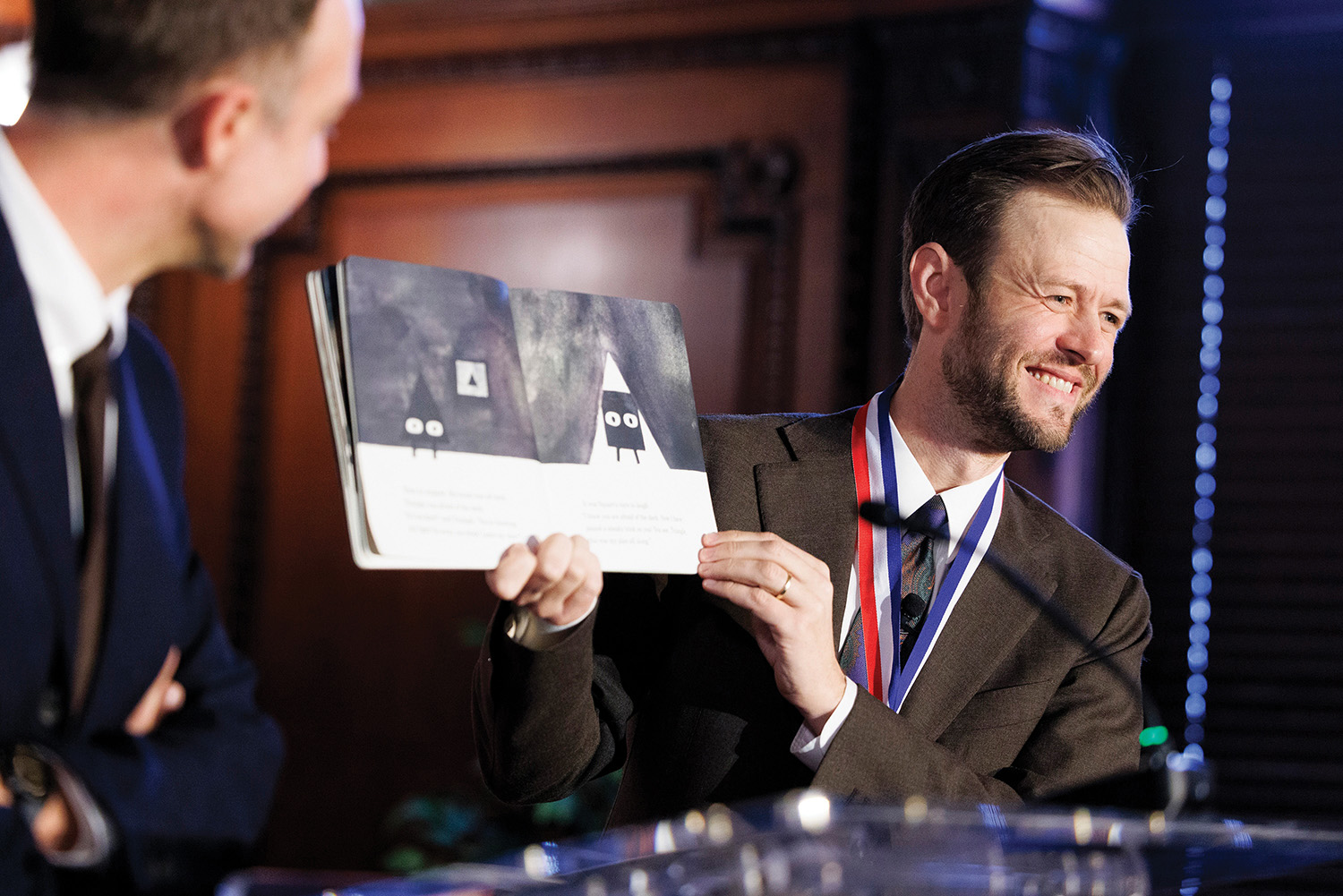
Mac Barnett holding book

Mac Barnett ’04, seen here at his inauguration as National Ambassador for Young People’s Literature, draws inspiration from art, music and theatre, and incorporates the complexities of those mediums into his stories. 
(Shawn Miller/Library of Congress)

Writing for young readers

Barnett learned early in his career to listen to children.

Writing for kids and adults is similar, he says, in that both appreciate the great themes of literature—love, jealousy, betrayal, discovery. Barnett hit his stride as an author when he started focusing on concerns children have and asking young readers questions rather than answering them.

In 2017, Barnett published The Wolf, the Duck, and the Mouse—the picture book he says epitomizes his approach to writing.

“What’s powerful about picture books is that they can go very deep very fast,” he says. “It’s a short form of literature—32 pages, sometimes 40—and not a lot of words per page. But it can get to some of life’s deepest questions, and I feel I did that [with The Wolf, the Duck, and the Mouse].”

Barnett draws inspiration from art, music and theatre, and incorporates the complexities of those creative mediums into his stories. He says that, because children tend to be insulated from much of the world, children’s books tend to feel cloistered from the rest of literary culture—but that the best ones are sophisticated, thought-provoking and challenging.

“As adults, when we encounter something we don’t understand, we often push it aside because it makes us feel stupid,” he says. “But kids just bravely charge into challenging texts. It’s really inspiring to watch.”

With more than 5 million copies sold and a stop-motion animated series on Apple TV+ based on his and co-creator Jon Klassen’s Shapes series of picture books, Barnett recognizes the responsibility he has in writing for a time in a young reader’s life.

As National Ambassador, he has the platform to enlighten adults on the power of children’s books and the brilliance of the kids who read them. He says that he appreciates living in the space of early childhood, likening it to a train station where kids are constantly passing through.

“I’m sitting there [with my] violin … [trying] to play them a beautiful piece of music that makes sense in that moment,” he says. “Maybe they’ll remember the tune when they get where they’re going, but even if they don’t, all that matters is that I played a good piece while they were there.”

Hooke(d) on sports analytics

Melissa Hooke


Growing up as a Boston Red Sox fan, Melissa Hooke ’19 never imagined herself celebrating a championship at Yankee Stadium. Yet there she was, cheering as the “Commissioner’s Trophy” was raised into a beautiful October night sky in the Bronx. Hooke, a senior quantitative analyst with the Los Angeles Dodgers, had just become a World Series champion.

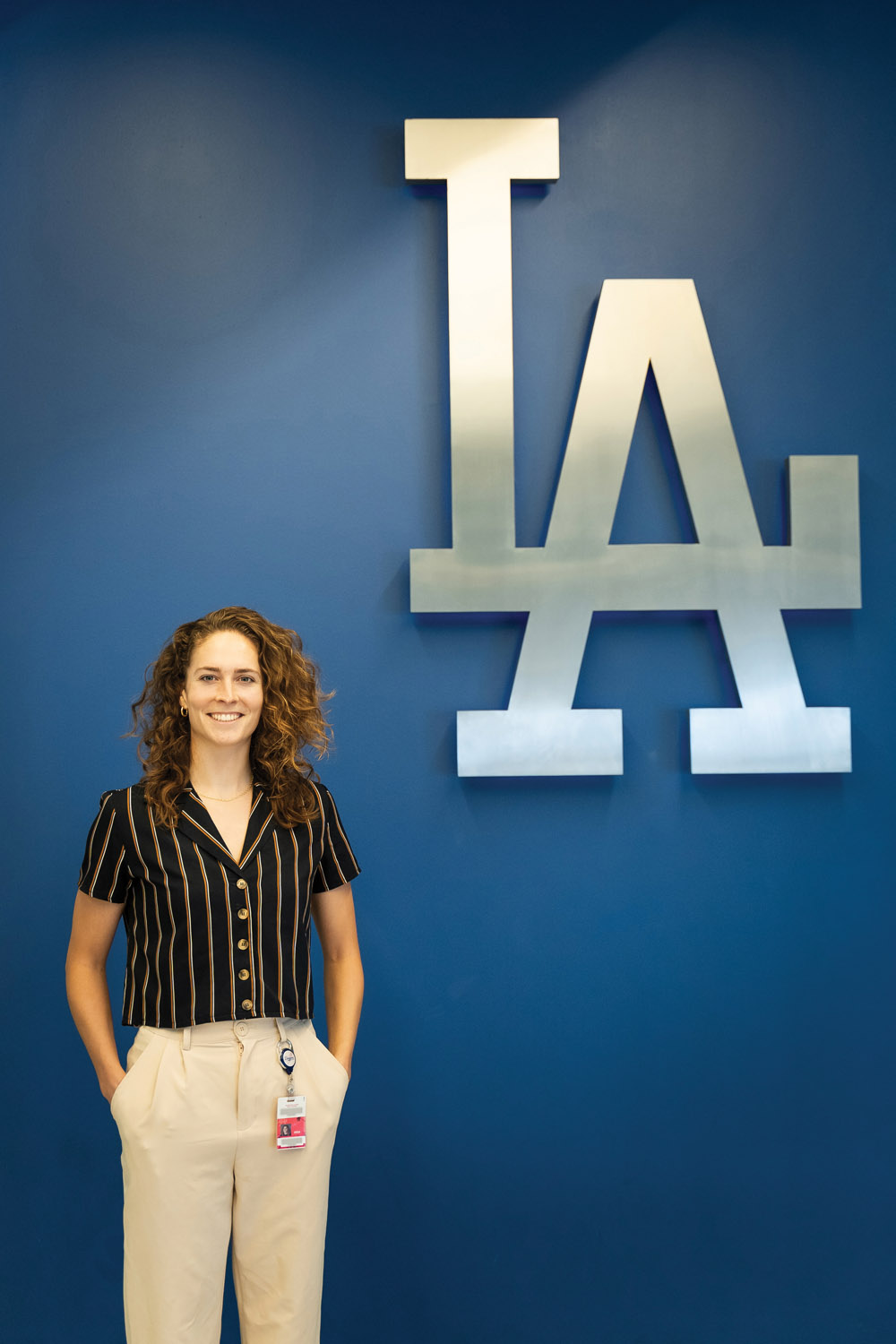
Melissa Hooke ’19 in the LA Dodgers officesStrangely enough, baseball wasn’t even her second favorite sport growing up. Hooke was recruited for basketball but also played soccer at Pomona. “I was looking at small liberal arts schools in New England, then visited Pomona and fell in love with campus,” she says. “Last minute, before early decision deadlines, I applied.”

She played midfield in soccer and guard in basketball, sometimes juggling both seasons. “Especially with our [soccer] team—we made the NCAA tournament a couple of times, so I’d join basketball midseason and have to catch up fast.”
Though an accomplished athlete, Hooke prioritized academics. “For me, it was always school first and then sports as an add-on.”

Like many incoming first years, Hooke wasn’t sure what she wanted to major in at Pomona, but after taking math and psychology courses, she ultimately declared as a math major.

“It was really my junior fall semester when I took a class with Jo Hardin [that] I decided that I really did love math and that there were career paths that attracted me,” she says.

Melissa Hooke ’19 at her computer

Hooke’s time in the math department also brought her in contact with Associate Professor Gabe Chandler, a former Sagehens baseball coach who built an impressive pipeline to Major League Baseball—not for athletes, but for data analysts. Alongside his colleagues, Chandler has seen a remarkable number of graduates land roles in professional baseball analytics. Though he became Hooke’s thesis advisor, he never pushed her toward the sport.

“I don’t think I ever mentioned working in baseball, other than [sharing that] such career paths exist, as we’ve had a lot of alumni working in that space,” Chandler says.

Hooke and Chandler’s connection extended beyond academics. Athletics took a backseat for Hooke after knee injuries ended her college career, but she joined Chandler’s intramural basketball team, “which made a deep run in the playoffs, with Melissa hitting at least one game-winner,” Chandler recalls.

Academically, Hooke thrived under Chandler’s mentorship, earning Best Paper at the 2020 Institute of Electrical and Electronics Engineers Aerospace Conference for her thesis on Bayesian modeling.

A junior-year internship at the Jet Propulsion Laboratory (JPL) at the California Institute of Technology introduced Hooke to aerospace analytics, leading to a full-time offer before her graduation in 2019. While her foray into aerospace wasn’t necessarily expected, the position fit like a glove.

“I was working on early mission concepts and designs,” Hooke says. “Basically, they’d come up with some crazy idea and say, ‘we want to fly a probe into Jupiter’s atmosphere and figure out what the composition is. And we want to fly these four science instruments.’ I would help the team come up with that architecture and estimate the cost based on previously flown historical NASA missions.”

Hooke spent five years at JPL, enjoying the space industry before an opportunity with the Dodgers emerged: A former JPL colleague working for the Dodgers and aware of her sports background sent her a job listing and “wouldn’t let [her] get away with not applying.”

Hooke started with the Dodgers near the end of the 2023 season, just as the team finished with the third-best regular-season record, only to be eliminated in the first round of the playoffs. Heading into 2024, expectations were high.

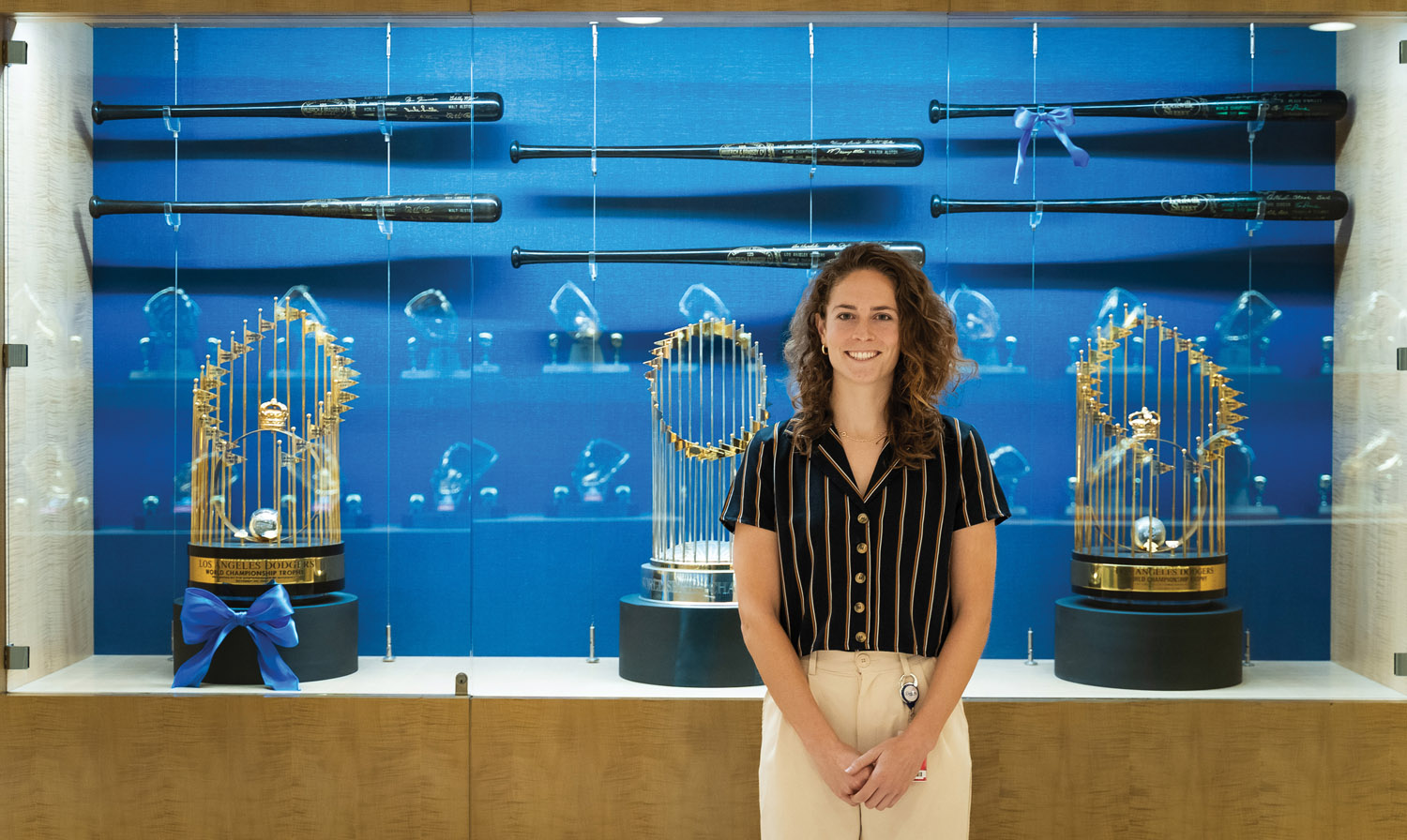
Melissa Hooke ’19 by LA Dodgers trophy cabinet

Among Hooke’s duties as part of the 2023-24 analytics team: crunching the numbers to evaluate effectiveness of pitchers lower in the Dodgers’ depth chart.

“I think this year was a challenging year for the Dodgers, in some ways, with all the expectations. Obviously, the team dealt with a lot of injuries. And as an analytics department, we had experienced a few disappointing seasons leading up to this. So, going into the playoffs, there’s a lot of angst in the office. People are really nervous. A lot of people are too nervous to watch the games.”

Hooke’s Dodgers job is about removing emotions from decision-making in areas
such as player evaluation, game strategy and team management. She primarily works on pitcher evaluation.

“Math has pushed the game of baseball forward. As we get more data, we’re able to uncover more about why certain players are good,” she explains. “For pitching mechanics, we track pitcher movement, and teams can use that data to extract information about delivery mechanics—when a delivery leads to better outcomes, worse outcomes or even injury. That’s how we’re helping teams move forward.”

While analytics can clash with instinct and tradition, Hooke sees growing acceptance of its role.

“At the Dodgers, the coaches [and] executives really buy into it,” she says. “We have a culture of accepting it, and that trickles down to the players.”

That buy-in led to another successful regular season as the Dodgers finished with the best record in the MLB. But injuries left their pitching staff short-handed in the postseason. Part of Hooke’s job was to identify pitchers in the lower ranks who could contribute to a World Series-winning team.

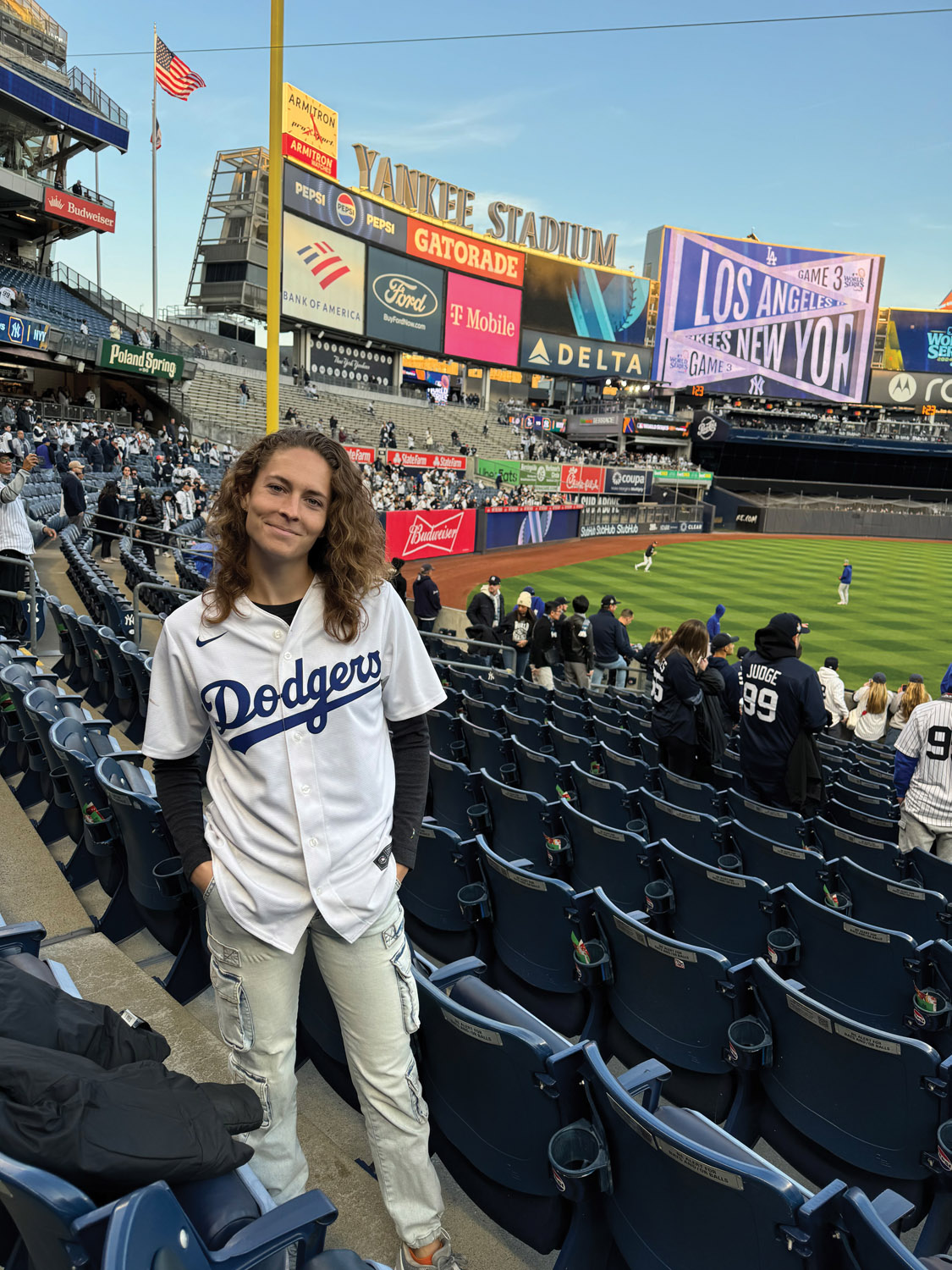
Melissa Hooke ’19 at Dodgers–Yankees game in New York.

The Dodgers made it to the World Series, and Hooke found herself on a team-chartered plane heading to New York. After falling behind 5-0 in Game 5, she recalled the team’s resolve.

“I think we kind of just said ‘well, we’ll get it done in L.A.’ And then, as the fifth inning progressed and we started coming back, we said ‘let’s just finish this off.’”

The Dodgers did finish it off, winning 7-6, and Hooke became a World Series champion.

“It was a bit of relief, but also just pent-up from the last few years,” she says. “Having a disappointing postseason ending before, everyone expected us to [disappoint again]. It was a celebration. It was different being in New York, but I’m glad that we were because it just tied together that magical experience.”

A Decade On-Board and Off-Shore With Sailor Desiree Wicht ’08

Desiree (Golen) Wicht ’08 on bow of Atticus sailboat

Desiree and Jordan Wicht overlooking the oceanAfter college Desiree (Golen) Wicht ’08 created a bestselling Tetris app, launched a pop-up restaurant startup, scrubbed the decks of John Kerry’s $100 million yacht and then quit the landlocked life entirely in 2014 when, within three months of meeting her partner Jordan Wicht, she decided to travel the globe in a 50-year-old, 30-foot sailboat—having never before hoisted a single jib.

“Project Atticus,” by the numbers

  • 10,804 miles traveled
  • 2,000+ total days on the water
  • 18 countries visited
  • 1 pirate ship evaded

Over the last decade the Wichts have cataloged the trials and tribulations of boat life through weekly YouTube videos as “Project Atticus,” with roughly 300,000 subscribers following their adventures doing everything from spearing hogfish in Belize, to fleeing Turkish warships, to spending the pandemic off-grid in Panama, to giving birth to their daughter Isabella on the island of Malta.

“We went on this adventure because we wanted the freedom to be able to go anywhere from the comfort of our economical, sustainable, floating home,” Desiree says. “As the tiny-home mantra goes, ‘the world gets a lot bigger when you’re living small.’”

Desiree (Golen) Wicht ’08 and her husband Jordan on boat

Desiree (Golen) Wicht ’08 and her husband Jordan Wicht spent more than half of the last decade on their 30-foot sailboat Atticus, braving hurricanes, Turkish warships and even pirates.

Along the way, Desiree transformed from a 20-something who’d never touched a screwdriver, to a seasoned seafarer bartering her boat-repair skills for groceries. She and Jordan had to wear an array of hats ranging from carpentry to amateur meteorology, all while dealing with unusual professional hazards like running out of water and evading Honduran pirates. (The team bootstrapped the 10-year project via merchandise sales, video sponsors, several side hustles and thousands of annual donations from followers on YouTube and Patreon.)

“We operated on the adage that, in 20 years, we’d likely be more disappointed by the things that we didn’t do than by the things we did,” says Desiree.

Desiree (Golen) Wicht on bow of Atticus sailboat

Desiree (Golen) Wicht ’08 on bow of Atticus sailboat

As of this fall, the Wichts have returned to solid ground—a decision brought about by the imminent birth of their second daughter Scarlett in January of 2025. After a few months exploring different areas of Appalachia, the couple decided to settle in Bryson City, North Carolina, nestled in the Smoky Mountains—and they continue to film and release weekly videos as they build a mountain homestead DIY-style. While Desiree has no regrets about their time on the water, she says that she’s very happy to be back on dry land for this next chapter of life.

“I always thought of myself as a traveler who needed to see and experience the world to feel fulfilled,” she says.“But what surprised me the most about our travels is that after a while I started to really understand how special my own home, my own family, and my own country is to me. Now I’m excited to make roots, without feeling like I’m missing out on what’s ‘out there’ anymore.”

30-foot sailboat Atticus

Notice Board

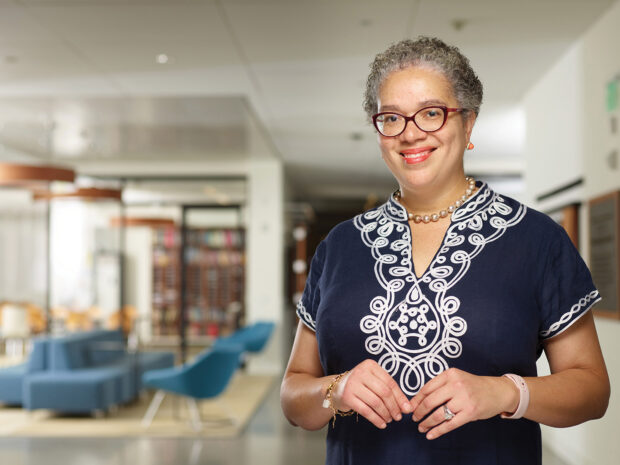
A Message from the Alumni Association

Dear Sagehens,

We’re excited to welcome alumni back to campus for Alumni Weekend and Reunion Celebrations May 1-4. Whether you’re celebrating a class reunion or just missing campus, you’ll find programs and activities created just for you. Be sure to register soon and come join the fun!

To make sure you get the latest information on chapter events, regional faculty programs and webinars created especially for alumni, we encourage you to update your contact information.

In closing, we’re sending healing chirps to our Los Angeles area alumni and families who are navigating catastrophic losses due to the devastating wildfires in January. Our hearts and thoughts are with each of you. If you are on Facebook, our alumni group page has a designated thread where members can find assistance or share ways to help. Pomona is supporting students, faculty and staff who have been affected by providing resources, crucial supplies and schedule flexibility.

Andrea Venezia ’91

All my best,
Andrea

Andrea Venezia ’91
Pomona Alumni Association Board President


Sagehens Flocked to Winter Break Parties

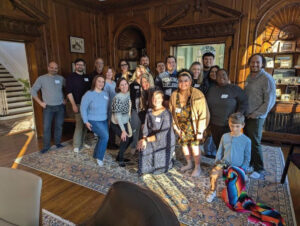
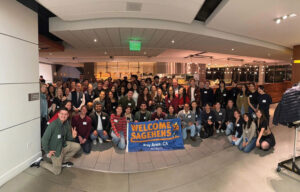
More than 350 alumni, families and friends chirped together in Beijing, Chicago, New York, Seattle, San Francisco, Singapore, St. Louis, Washington, D.C., Berkeley and Orange County, Calif. for Pomona’s annual Winter Break Parties in January. Special thanks to our hosts: Frank Albinder ’80, Andrew Brown ’77, Pomona Trustee Wei Hopeman ’92 P’28, Evelyn Nussenbaum ’84, Gladys Reyes ’09 and Krista Seymour ’03. Connect with a chapter in your area.


Los Angeles Area Alumni Attend Industry Networking Events

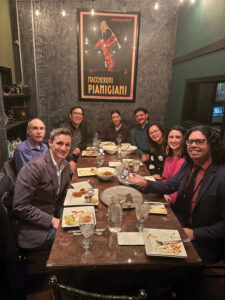
Pomona’s L.A. alumni chapter hosted a series of industry networking events in January. These events helped Sagehens learn about career paths and build their professional networks by connecting with fellow alumni in a variety of industries including education, finance, law, psychology/mental health, tech and media, urban planning and science. Many thanks to our hosts. Connect with the L.A. chapter.


4/7 Celebrates 10 Years of Sagehen Impact

This year marks the 10th anniversary of 4/7, an annual opportunity for Sagehens to come together for volunteer efforts like beach cleanups or sorting groceries at food banks in cities near and far, including San Francisco, Chicago, New York and even Hong Kong. Check your email and social media for 4/7 Day news!


Sagehens Making an Impact

Read alumni, faculty and student stories featuring the impact of Sagehen philanthropy and Pomona’s liberal arts education experience.

Stay Connected!

Join Pomona’s official online community—Sagehen Connect—to access the alumni directory, sign up to mentor students as a Sage Coach, message Sagehens directly and more.

Nature Photo Submissions

Coming on the heels of our fall nature issue featuring photographer Grant Collier ’96, we sent out a call to alums for their own nature pics. Here are a few of the highlights!

Sunset Point at Capital Reef National Park. Photo by John Carter ’78

Sunset Point at Capital Reef National Park. Photo by John Carter ’78

Upper Antelope Canyon near Page, Arizona. Photo by John Carter ’78

Upper Antelope Canyon near Page, Arizona. Photo by John Carter ’78

North Windows arch in Arches National Park. Photo by John Carter ’78

North Windows arch in Arches National Park. Photo by John Carter ’78

Chickadee Ridge, Lake Tahoe. Photo by Rosie Linkus ’22

Chickadee Ridge, Lake Tahoe. Photo by Rosie Linkus ’22

Gulfoss, Iceland. Photo by Michelle McCLendon ’90

Gulfoss, Iceland. Photo by Michelle McCLendon ’90

Pajaro Dunes on Monterey Peninsula. Photo by Dina Mitchell ’90

Pajaro Dunes on Monterey Peninsula. Photo by Dina Mitchell ’90

Sunflower. Photo by Bruce Saltzer ’75

Sunflower. Photo by Bruce Saltzer ’75

Honeybee. Photo by Bruce Saltzer ’75

Honeybee. Photo by Bruce Saltzer ’75

Cheetahs. Photo by Mark Southerland ’77

Cheetahs. Photo by Mark Southerland ’77

The drop-off on Bunaken Island, near Sulawesi, Indonesia. Photo by Sally Vogel ’57

The drop-off on Bunaken Island, near Sulawesi, Indonesia. Photo by Sally Vogel ’57

Quiver Tree in South Africa. Photo by Sally Vogel ’57

Quiver Tree in South Africa. Photo by Sally Vogel ’57

The wind- and water-eroded sandstone bank of Sucia Island in the San Juans Islands in Washington. Photo by Sally Vogel ’57

The wind- and water-eroded sandstone bank of Sucia Island in the San Juans Islands in Washington. Photo by Sally Vogel ’57

The sandstone bank of Sucia Island in the San Juan Islands in Washington. Photo by Sally Vogel ’57

The sandstone bank of Sucia Island in the San Juan Islands in Washington. Photo by Sally Vogel ’57

President Starr inducted into American Philosophical Society

Portrait of President G. Gabrielle Starr

President G. Gabrielle Starr

Last fall Pomona College President G. Gabrielle Starr was inducted into the American Philosophical Society (APS) honoring her extraordinary accomplishments as a leader in higher education.

The APS is the oldest learned society in the United States, founded in 1743 by Benjamin Franklin. Past members include George Washington, Thomas Jefferson, Charles Darwin, Thomas Edison, Marie Curie, Albert Einstein and Robert Frost. The society generally elects fewer than 30 resident members annually.

How An Exoneree Accomplished ‘The Impossible’

Ruben Piñuelas ’21

Ruben Piñuelas ’21

All Ruben Piñuelas ’21 wanted was a level playing field.

After being incarcerated for nearly 15 years—six of those wrongfully so—Piñuelas knew changing the trajectory of his life in his 40s would require overcoming biases society can put on people with such baggage.

“Pomona believed in me on day one,” he says, “and ushered me into this world of higher education.”

Ruben Piñuelas ’21

Ruben Piñuelas ’21

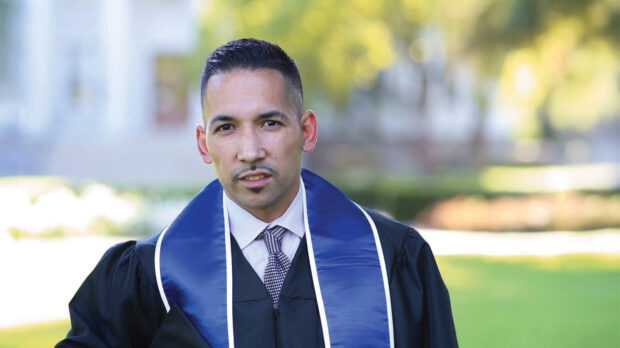
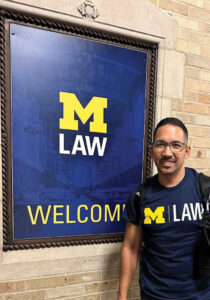
After running from the law as a young adult, Piñuelas now is a second-year law student at the University of Michigan who returned to Claremont to speak at the Athenaeum at Claremont McKenna.

“At one time society threw me away [and] told me I’ll never be good enough to be a scholar,” he says. “What I came back from—I’ve accomplished the impossible.”

Piñuelas started running with a gang in El Centro, California, in high school. In 1999, the then-20-year-old was sentenced to two years in prison for marijuana possession and erroneously placed with inmates serving life terms. He was later charged in connection with a prison riot—he says he was only defending himself in the fight, and was tricked into taking a deal to add seven years to his term.

In 2008, Piñuelas raised enough money to make bail on new conspiracy charges he was facing. While on parole, he helped local groups build houses and enrolled in night community college classes at Pierce College in Los Angeles.

Piñuelas was taken back into custody in 2010 for alleged parole violations and his alleged involvement in a 2007 prison incident involving people he says he never met. In 2011 he was convicted of conspiracy to murder, attempted murder and assault with a deadly weapon on an inmate. He was given 60 years to life and sent to solitary confinement in a maximum-security prison in Crescent City.

While in solitary, Piñuelas began studying law, and advocated for his innocence. In 2013 a panel of California appellate justices overturned his conviction based on insufficient evidence. After his 2014 release he returned to Pierce to earn two associate degrees, qualifying for financial assistance to continue his studies at Pomona.

“Sixty [years] to life, 12 years in solitary, no one comes back from that,” Piñuelas says. “I was in a dark place, but I learned it’s not what’s been done to you, but what you do with it.”

Community college students comprise about two-thirds of Pomona’s yearly transfer cohort, and while most of that group comes from California, the Office of Admissions has bolstered outreach efforts nationwide. Admissions officers attend off-campus events, host open houses and connect with local community colleges for special campus tours and financial aid workshops.

Susanne Mahoney Filback, associate director of preprofessional programs and prelaw advisor at the Career Development Office (CDO), recalls Piñuelas emailing her the summer before his first semester at Pomona about his plan to pursue law. To get accustomed to Pomona he regularly met with her and showed up at CDO law events.

“He knew he wanted to make a difference and that was directly related to what he went through,” Filback says. “He had a thoughtful understanding of why he was here and how he was going to make the most of Pomona’s resources.”

As someone who felt life would always be an uphill battle, Piñuelas was blown away by how reassuring his professors were when he questioned whether he belonged at Pomona. “They always believed in me,” he says. “They gave me everything I needed to thrive, perform and be the student I needed to be.”

As a psychological science major, Piñuelas especially admired Eric Hurley, professor of psychological science and Africana studies. “It was refreshing to hear from someone I could identify with as a student of color,” he says. Piñuelas took Hurley’s Psychology of the Black Experience course and later became a course mentor in his Intro to Psychology class.

After graduating, Piñuelas continued his studies at the University of Michigan, with aspirations of becoming a trial attorney, a civil rights lawyer and California Supreme Court justice.

“I’m trying to maximize the time I have left,” he says. “A lot of time was stolen from me, but I don’t want to mope. I want to use it as a blessing, an opportunity for others to learn about what I’ve been able to gain from my experience, and to use it to better the world.”

A Voice for Early Detection: Rhoda Au ’82

Alzheimer’s disease may afflict more than 6 million people in the United States, but according to the Alzheimer’s Association, up to half of those living with the disease have not been diagnosed. Early diagnosis can lead to better health care options and improved quality of life for those who have the disease, which makes quick detection of Alzheimer’s critical.

Rhoda Au

Rhoda Au

Now, Rhoda Au ’82 has created a promising method for determining whether a person with low level cognitive impairment is likely to lapse into more severe dementia from Alzheimer’s, using just the sound of their voice. The discovery could help patients and families deal with the devastating effects of Alzheimer’s, and also assist clinicians in identifying the best candidates for new drug therapies being developed to curb the effects of the disease.

Au is a professor of anatomy and neurobiology at the Boston University Schools of Medicine & Public Health, and a principal investigator on the Framingham Heart Study team that performed the study. The findings were published in June in the Alzheimer’s & Dementia medical journal.

Au and her colleagues at Boston University, including Ioannis Paschalidis, a professor of engineering who led the data science side of the study, built an artificial intelligence algorithm that examined recordings of the speech of persons in the program who had exhibited some cognitive issues. The algorithm determined, with 78.5 percent accuracy, whether a particular person would move from lesser cognitive problems to severe dementia within the coming six years.

The research team trained the algorithm to examine the content and syntax of speech using a portion of the recordings of study participants. They then used the AI tool to analyze the speech of a separate group of 166 participants. “Speaking is a very cognitively complex task: when we speak, we are always emitting our cognitive capabilities,” Au says. “We actually do this in a common sense way all the time, interacting with friends or family members.”

What makes the results of the study particularly powerful is the gold standard nature of the data used. After analyzing early recordings of patients with the algorithmic tool, the researchers checked the algorithm’s predictions against the later cognitive conditions of the participants, and were thus able to clearly certify whether the algorithm had diagnosed an individual correctly.

The study was possible in large part due to Au’s early intuition. She had joined the Framingham Heart Study faculty in 1990, and in 2005 persuaded those managing the study to begin to record audio of interviews with the participants.

“One of the things that I’ve always been very concerned about is that the tools that we have for cognitive assessments are not sufficiently sensitive,” Au explains. For instance, Au noticed that during cognitive tests of study participants—a regular part of the study’s regimen—verbal responses to questions varied widely, but if a response was incorrect it was simply noted as such. This binary data entry, correct or not, left out a lot of information and nuance that Au was noticing in the interviews. “I was an early adopter of big data,” Au says. “I was fortunate enough to be collecting these audio recordings while I waited for the digital voice processing and AI capabilities to develop.”

As a result of the interview recordings, by the time Au and her colleagues began their study, they had a trove of patient audio going back almost two decades.

Au’s ultimate goal is to use new AI combined with the ease and ubiquity of smartphones to create monitors and tools that can improve brain health over the course of a lifetime, what she calls the precision brain health initiative. “We can change the trajectory of brain health altogether,” says Au. “You want people to die with the healthiest brain possible. That’s our goal.”

Puzzle head with missing elements on a blue background

Six Sagehens Set for Hall of Fame

Pomona-Pitzer Hall of Fame logoSix Sagehens will be inducted into the Pomona-Pitzer Athletics Hall of Fame this summer: Alyssa Corley ’11, Anders Crabo ’12, Annie Lydens ’13, Martha Marich ’12, Luke Sweeney ’13 and Kirk Jones, Head Athletic Trainer.

Corley (softball) remains the program leader in career home runs and runs batted in.

Crabo (track and field) was a two-time All-American.

Lydens (cross country/track and field) earned All-American honors in both sports.

Marich (lacrosse), the career leader in goals, points and draw controls, is the first women’s lacrosse player to be inducted.

Sweeney (football) holds the record for career rushing yards.

Jones, who has been at Pomona-Pitzer since 1980, is head athletic trainer, as well as a mentor and expert in injury prevention and rehabilitation.

The induction ceremony is scheduled for 6 p.m. on May 1 in Edmunds Ballroom.

The Pomona-Pitzer Athletics Hall of Fame was established in 1958 with three inductees: Robert Strehle (track and field), Earl Merritt (football, baseball, basketball and track) and John McColl (football, basketball, track and field). More than 300 Sagehens and two teams have been inducted in the years since.

Athletes must be 10 years or more removed from their final seasons of competition to be considered for induction. Sagehens also can earn induction as an honorary member, or for distinguished service.

For more information, visit Pomona-Pitzer Sports Hall of Fame.