
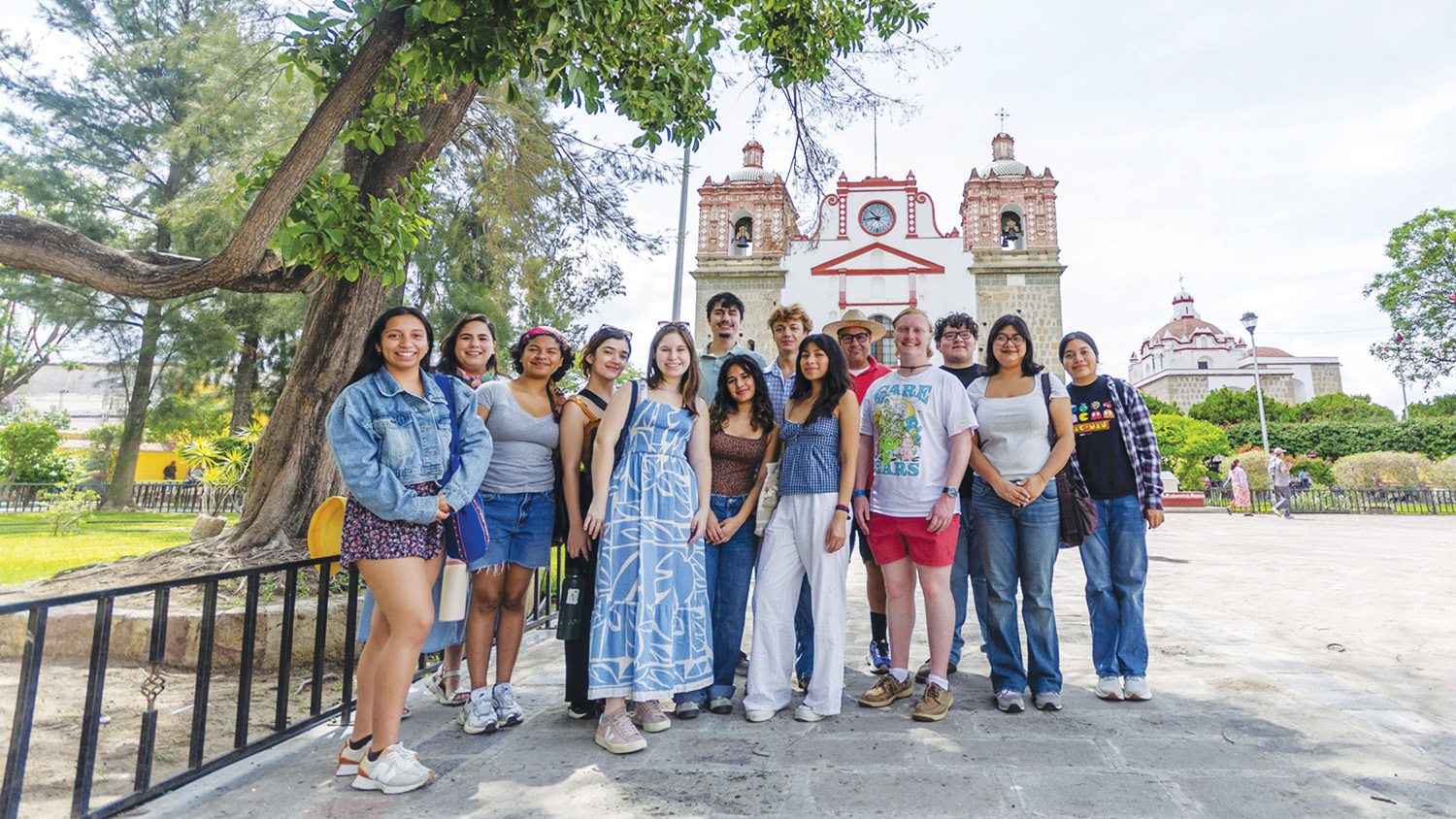
Pomona students in Mexico (photo by Barak Torres)
As of 2026, Pomona has spent 55 years sending students on one of the most immersive of educational adventures: study abroad. Now known as “study away” to reflect the growth of the College’s domestic options, Pomona’s programs currently encompass more than 70 programs in 38+ countries—and is something that roughly half of all students participate in. The stories on the next few pages will touch on different aspects of students’ study away experiences.
Students Immerse Themselves in Mexico’s Economic History
By Lorraine Wu Harry ’97
While he may have now taught economics at Pomona for 20 years, before this year Professor Fernando Lozano had never done so in his native Spanish.
This summer Lozano, Assistant Professor Karla Cordova and 12 students from their Economic History of Mexico course traveled to Oaxaca and Mexico City for 20 days as part of Pomona’s third Global Gateways program, in which faculty lead experiential study-away programs. (This fall the International and Domestic Programs Office announced the two programs Pomona will offer in the summer of 2026: an experiential history program in Berlin, Germany, and a diplomacy program in the Mediterranean that will travel to Belgium and Morocco.)
Students in the class read and discussed articles, all in Spanish, to understand how Mexico has developed economically, looking at five historical eras starting from pre-colonization to the early 20th century. Visits to museums, historical landmarks and archaeological sites animated each time period and brought to life their distinct characteristics.
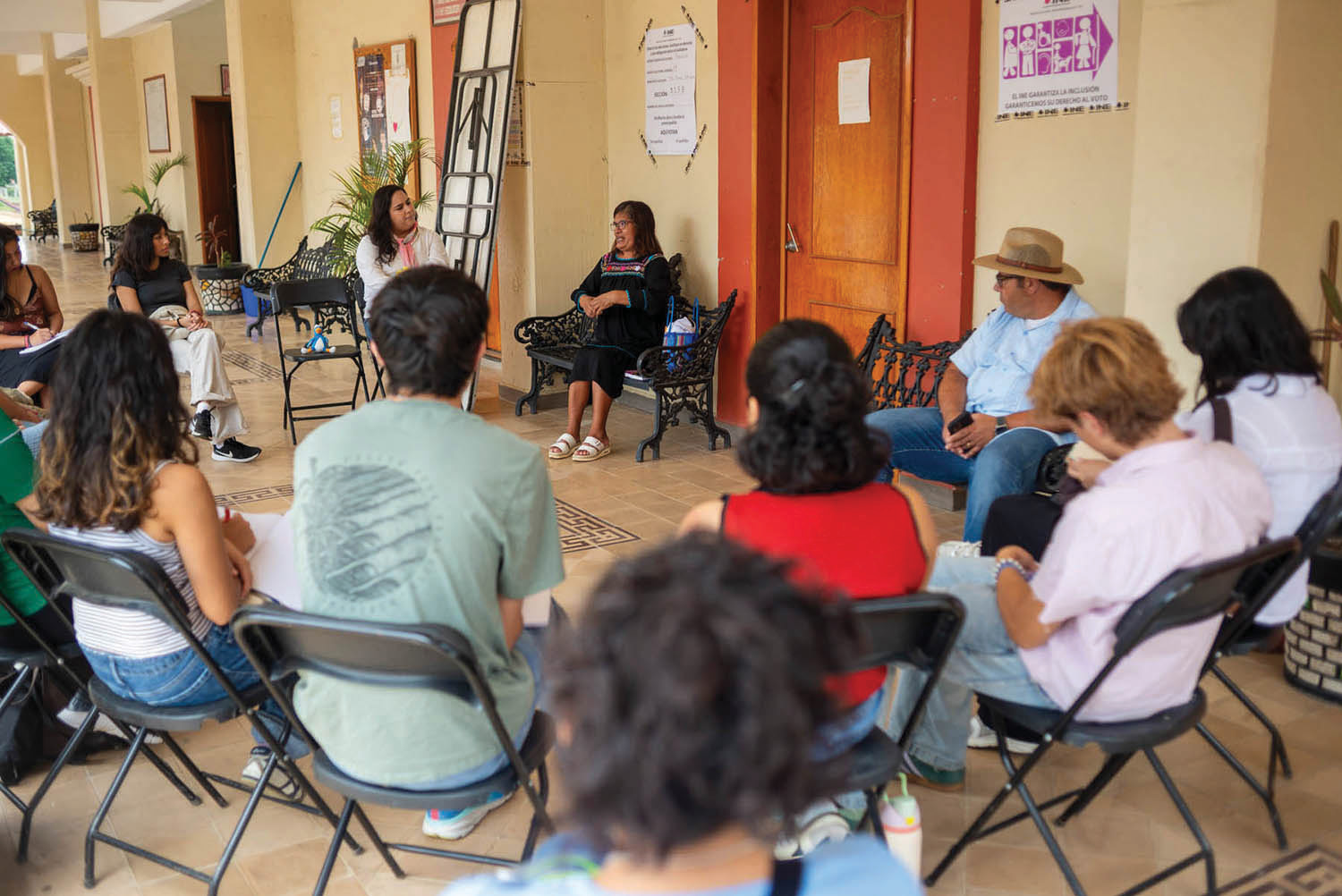
Students participate in a class discussion.
“Teaching an economic history class is something I always wanted to do,” says Cordova, “but I never expected it would happen in Mexico, seeing the places and being in the space where things happened.”
Lozano and Cordova especially wanted to expose students to the art of Mexico as a means to understand the country’s history and to complement the classroom learning. In Mexico City, students spent time at the Frida Kahlo Museum, the National Museum of Art and Museum of Modern Art.
“Art expresses the time, the place and the situation in which it was produced,” says Lozano. “The art is telling the story, and you can see the changes with different regimes.”
Mariela Tamez-Elizondo ’27, an art major and economics minor who hails from San Juan, Texas, found the museum visits deeply meaningful.
“In a U.S. context, you learn mostly about American artists,” she says. “It was so important to see pieces of art of Mexican artists up close and to know that, as a Mexican woman, I could also paint and contribute to my community.”
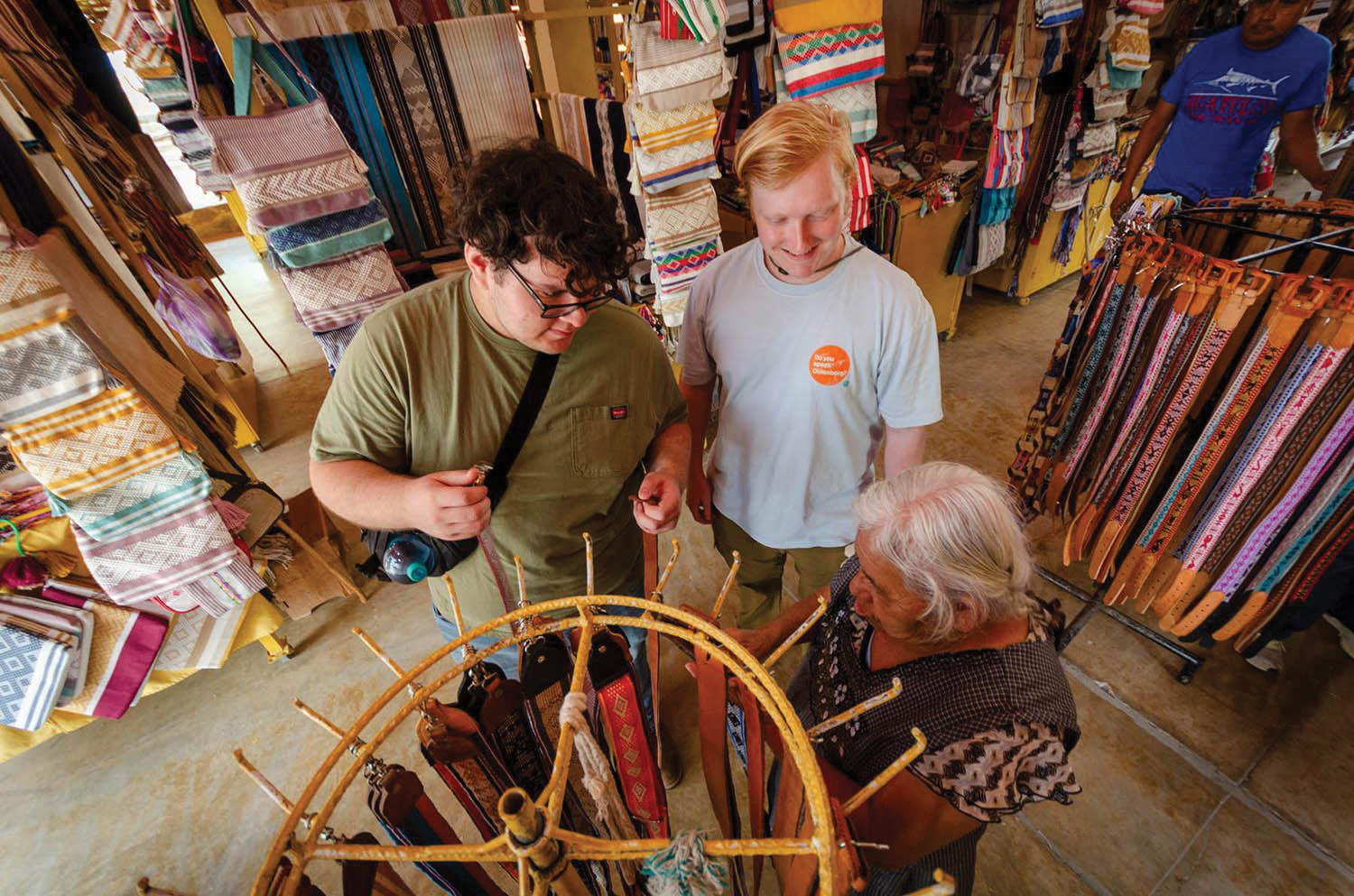
Students visit a textile shop
Meetings with historians, economists and business leaders rounded out the program.
For Andrew Shelton ’27, an international relations major from Missouri, the class appealed to his goals of broadening his worldview and learning another language in college.
Having completed fourth-semester Spanish, Shelton says that the trip afforded him the opportunity to not only practice Spanish but to get a much deeper understanding of the culture. Honing his Spanish happened both during class time and at a homestay in Oaxaca, which he calls the “number one highlight.”
For heritage speakers, the experience was also a linguistic boost. “Spanish is my native language, but I had never done anything academic with it,” says Tamez-Elizondo. “A whole class is very different than just talking conversationally.”
Student participants say they are walking away with not only improved Spanish skills but a broad interdisciplinary understanding of Mexico beyond its economics.
“My perspective on this key trade partner, this key cultural relationship we have with Mexico—I have so much more context now,” says Shelton. “I feel more confident in my understanding of Mexico’s history and where it finds itself today.”
Studying Away: A Survey
We asked alums on social media, “What was your biggest takeaway from study abroad?” Here were some of your answers!
“I studied abroad in Nantes, France. The most integral memory for me was interning in an ESL class in the French equivalent of middle school. This experience was genuinely so helpful, as I’m now a teen librarian at Brooklyn Public Library and get teens from all over the globe who have moved to New York City! Experience working with tweens in a totally different country really was useful.”
—Sarah Varenhorst ’20
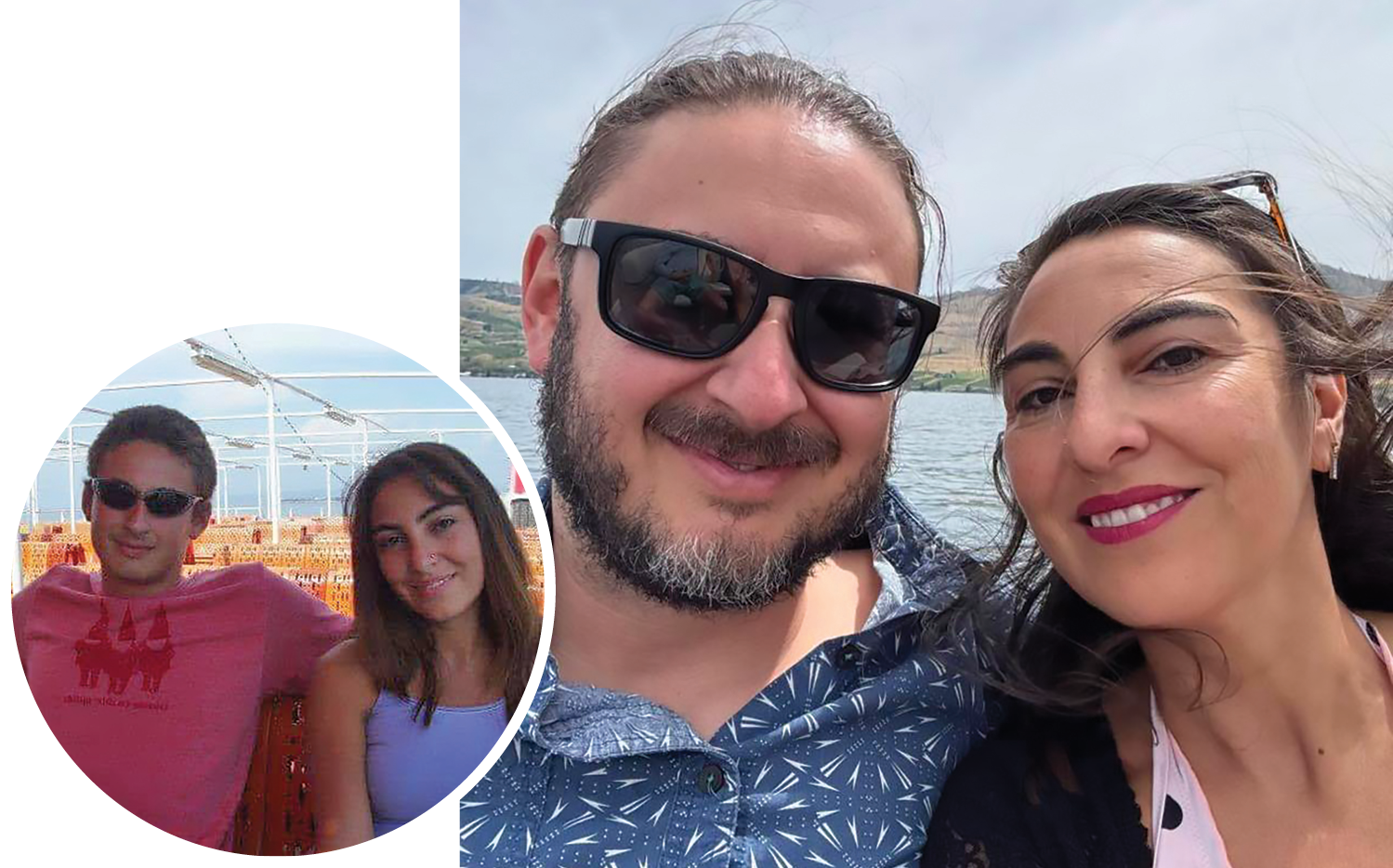
Andrew Faber and Ciara Fernandez Faber ’07 in 2005 on the left and in 2025 on the right.
“I studied in Athens, Greece in the fall of 2005. During orientation, they handed us shots of [the alcoholic beverage] raki, which gave another student the liquid courage to invite me for ice cream. The rest is history. I moved to Colorado after graduation, and we got married in 2011 and now have two young children. My study abroad experience set my entire post-Pomona trajectory.”
—Ciara Fernandez Faber ’07
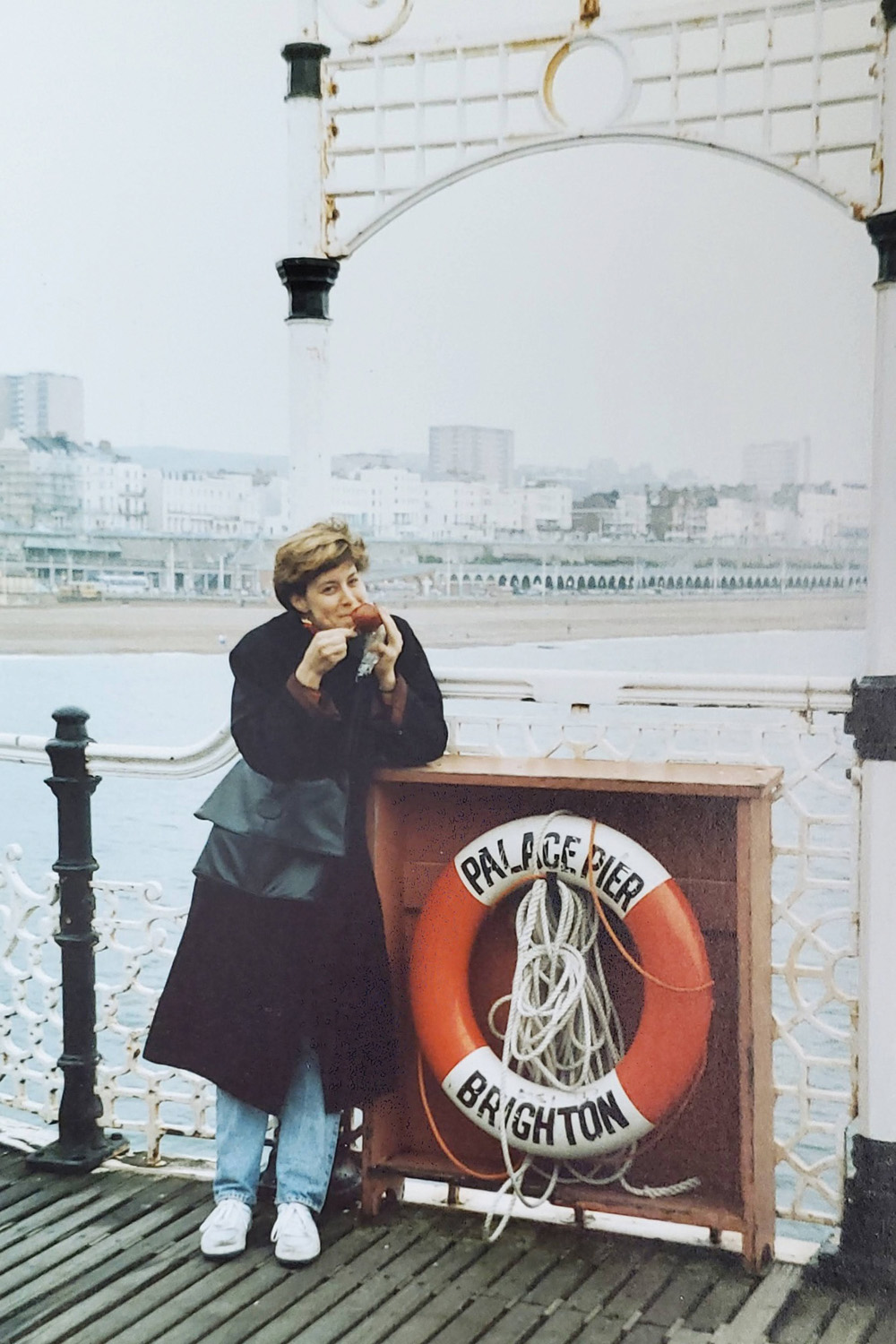
Lisa Braitwaite ’87 eating a candy apple on the pier in Brighton, 1986
“I spent a semester in London at Queen Mary University and was struck by how engaged young people were with policy and social issues. All the British students were incredibly knowledgeable about not just their own political systems but ours as well. It was the year that the U.S. bombed Libya, and students were super vocal about it. I definitely took some of that awareness and desire to be more engaged back home with me. I also discovered what good beer tasted like!”
—Lisa Braithwaite ’87
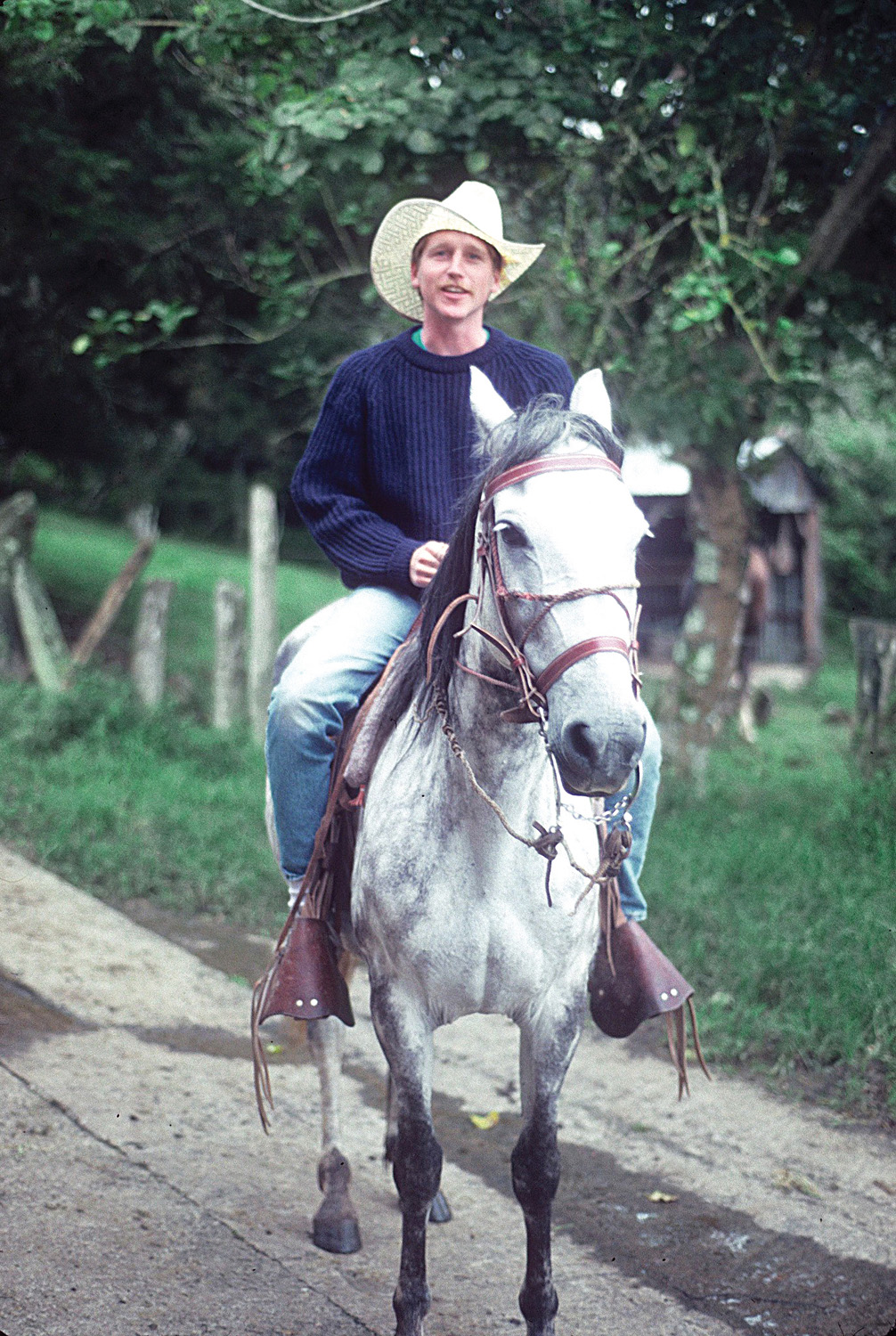
Dave Sutherland ’84 on horse-back
“I studied French in high school but switched to Spanish when I went to Pomona. Junior year I got a chance to piggyback on a semester abroad in Costa Rica to do independent biological field research. I came back pretty fluent in Spanish because there was no one for miles that spoke English! After Pomona I did the Peace Corps in Honduras, where I met my future wife. We lived for three years in the Galapagos and adopted a little Ecuadorian toddler. Now I’m a retired park ranger in Colorado, still married to my Peace Corps sweetheart and leading nature hikes in Spanish. I often wonder where my life would be if I had continued on with French!”
—Dave Sutherland ’84
“I spent my junior semester in Paris at the Sorbonne. After three days with my French family they said that I had already got ‘it’—by which they meant, a Parisian accent. To this day I treasure that experience, and that Pomona and Oldenborg made it possible. I ended up working for EuroDisney as a French translator in Glendale while they were working on designing and building the new Disneyland in Marne-la-Vallee [Paris].”
—Cheryl Nickel ’83
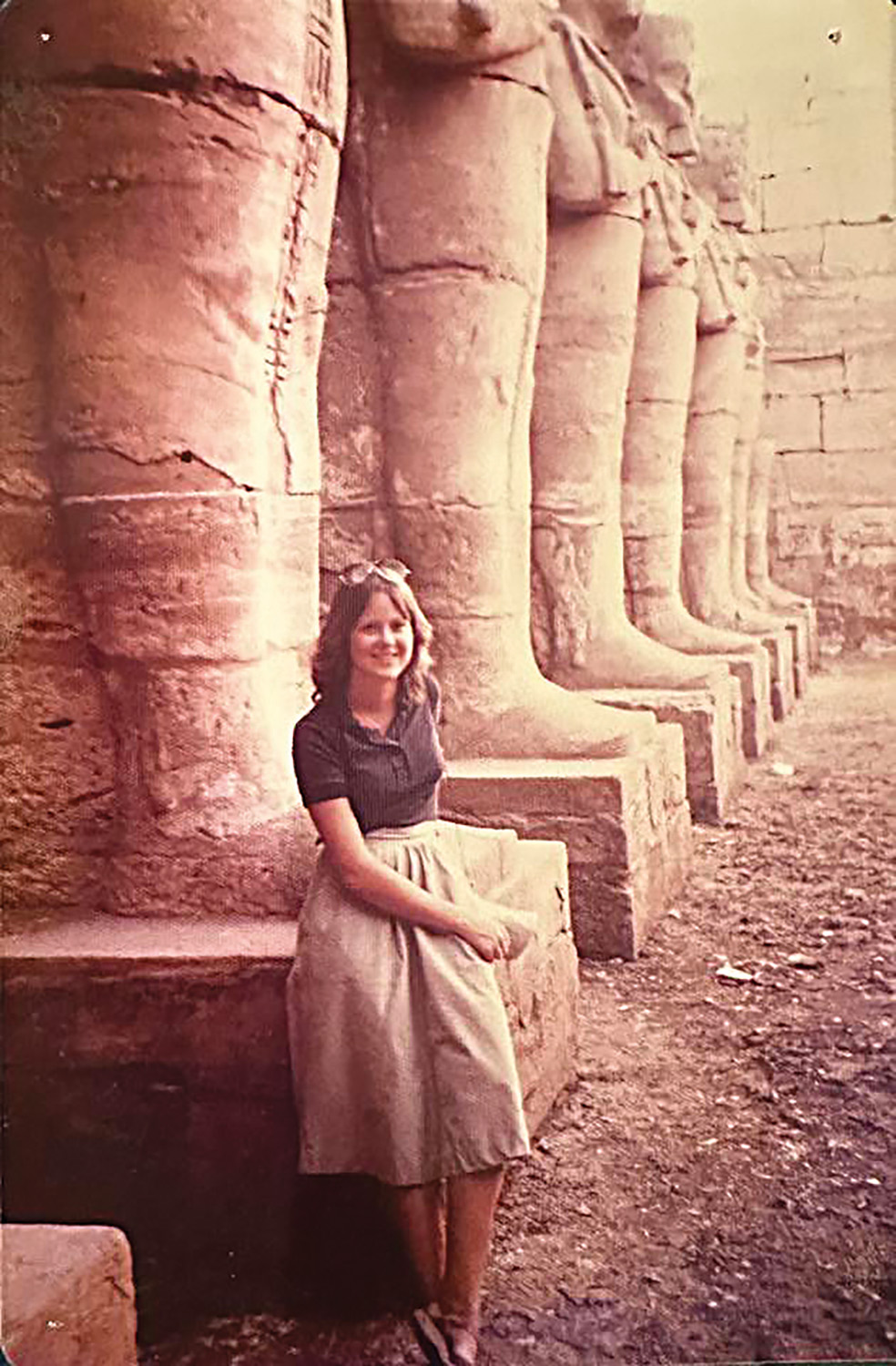
Kathleen Hill Tesluk ’81 in Cairo
“I went to Cairo on a whim, when a program I was supposed to go to in Germany fell through. It was the best ‘what the hell’ decision ever and sparked a fascination with Middle Eastern politics and the Arabic language that led to grad school at Johns Hopkins’ School of Advanced International Studies, where I met my husband. So many wonderful experiences have come from that one choice to study in Cairo!”
—Kathleen Hill Tesluk ’81
Critical Language Scholars Explore Brazil, South Korea and Latvia
By Brian Whitehead
This summer Zena Almeida-Warwin ’28, Dannhi Nguyen ’27 and Jonna Sobeloff-Gittes ’25 cultivated their language skills in intensive, immersive environments as participants in the U.S. Department of State’s Critical Language Scholarship (CLS) Program.
The highly competitive eight-week CLS program provides American students the opportunity to learn languages of strategic importance to the country’s national security, economic prosperity and engagement with the world.
More than 500 students participate in the fully funded program each summer, staying with host families or roommates to familiarize themselves with everyday life in their adopted city.
Almeida-Warwin, Nguyen and Sobeloff-Gittes traveled to Brazil, South Korea and Latvia, respectively, and agreed upon returning that language and cultural immersion are vital to becoming global citizens.
Reconnecting with Brazilian culture
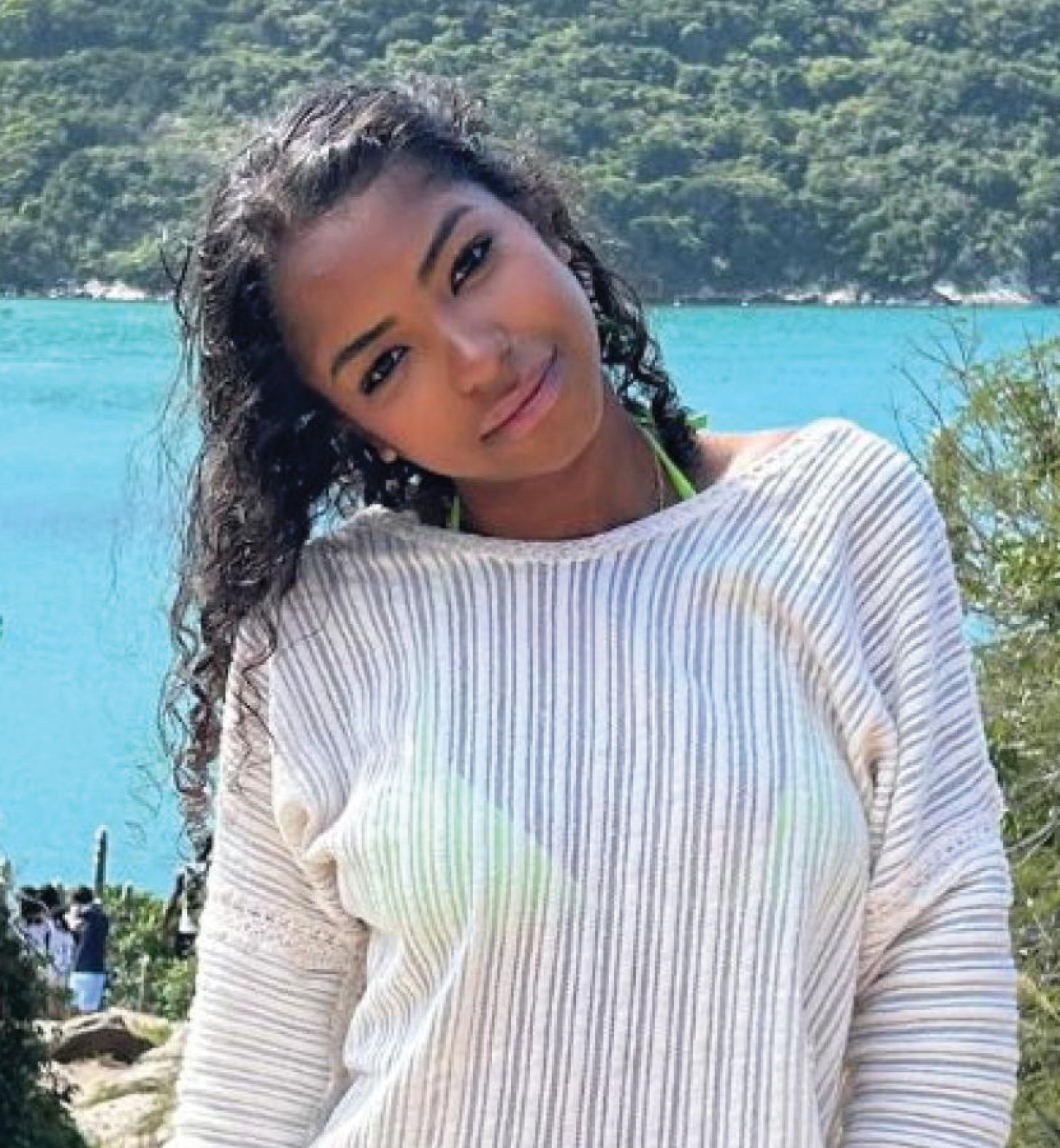
Zena Almeida-Warwin ’28
Having lived in Brazil until she was 8, Almeida-Warwin was thrilled to return to burnish her Portuguese.
A near-fluent speaker who had never had formal instruction, the Brooklyn, New York, native embraced the lessons on reading, speaking, phonetics and listening comprehension she received at Pontifical Catholic University of Rio de Janeiro.
On top of classroom learning, a handful of excursions were organized for students, including a trip to the colonial town of Tiradentes, Minas Gerais. In her spare time Almeida-Warwin hiked, played beach volleyball, explored museums and historic neighborhoods, and attended cultural events with her peers. She left the country with an even deeper affection for Brazilian Portuguese, a romance language she calls “very positive, flamboyant and airy.”
“Speaking the language, there’s almost an anticipation that you’re always happy,” she adds, “and with the climate and the people, it’s hard to be unhappy. I love how the use of the language and its slang urge [us] to be happy, open-minded and sociable.”
Slowing down in South Korea
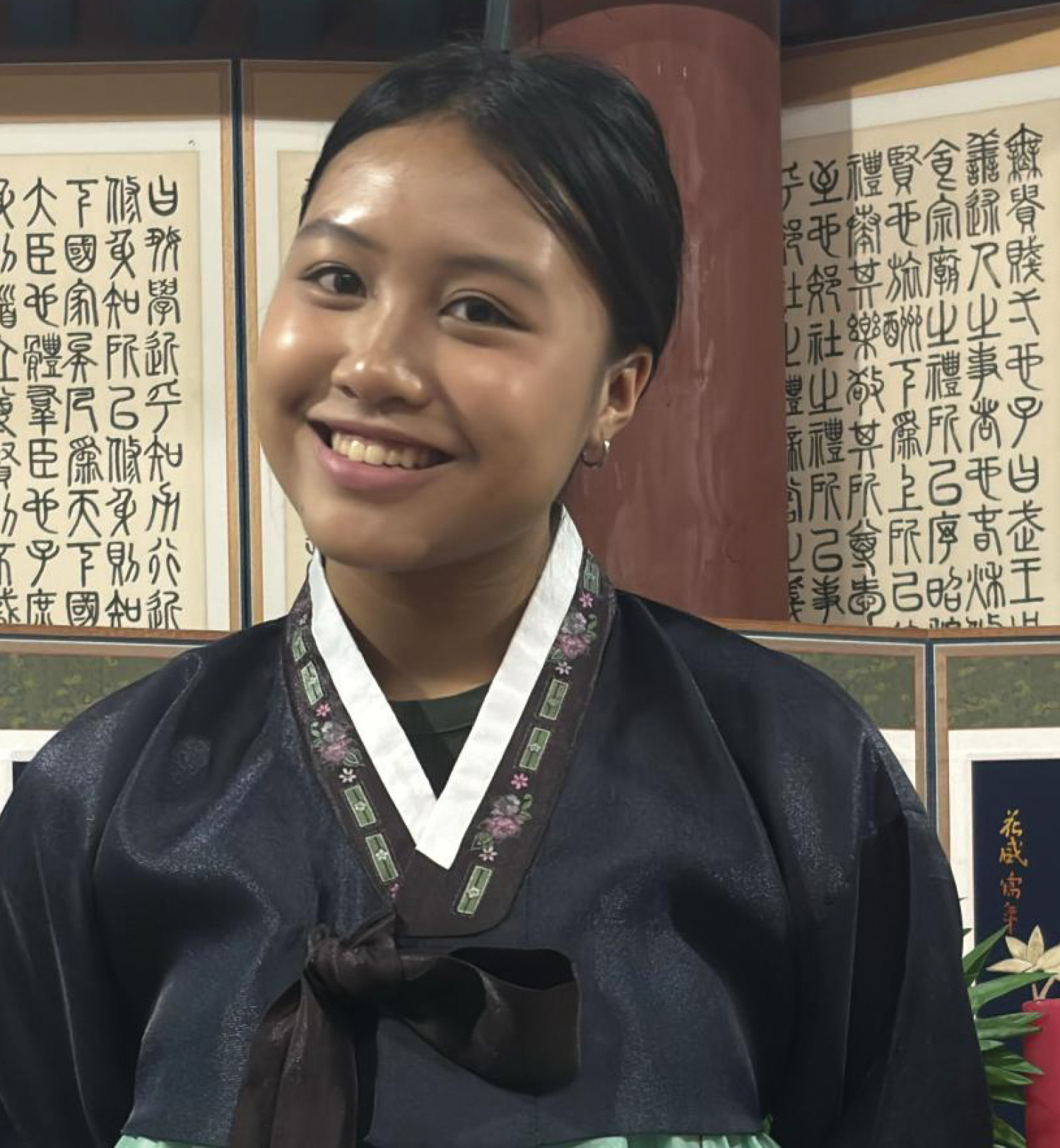
Dannhi Nguyen ’27
Nguyen, a politics major by way of Louisville, Kentucky, traces her interest in learning Korean to her plan to practice international law.
She took four semesters of Korean courses at Claremont McKenna College and lived in the Korean Hall inside the Oldenborg Center for Modern Languages and International Relations as a sophomore. Nguyen says eating at Oldenborg’s language tables did wonders for her conversational Korean.
“Inside the classroom you practice Korean, but it’s lecture-based,” she adds. “Oldenborg was a good space to use the skills I learned in the classroom in a more casual, relaxed setting.”
Over the summer, Nguyen studied the four major skills of speaking, listening, reading and writing at Chonnam National University in Gwangju, South Korea, and she used Korean in academic and non-academic settings.
“I was using Korean 24/7, which was really helpful in improving my language skills,” she says. “I found a lot of errors and mistakes that I was making before and became more confident as a person.”
‘A natural fit’ in Latvia
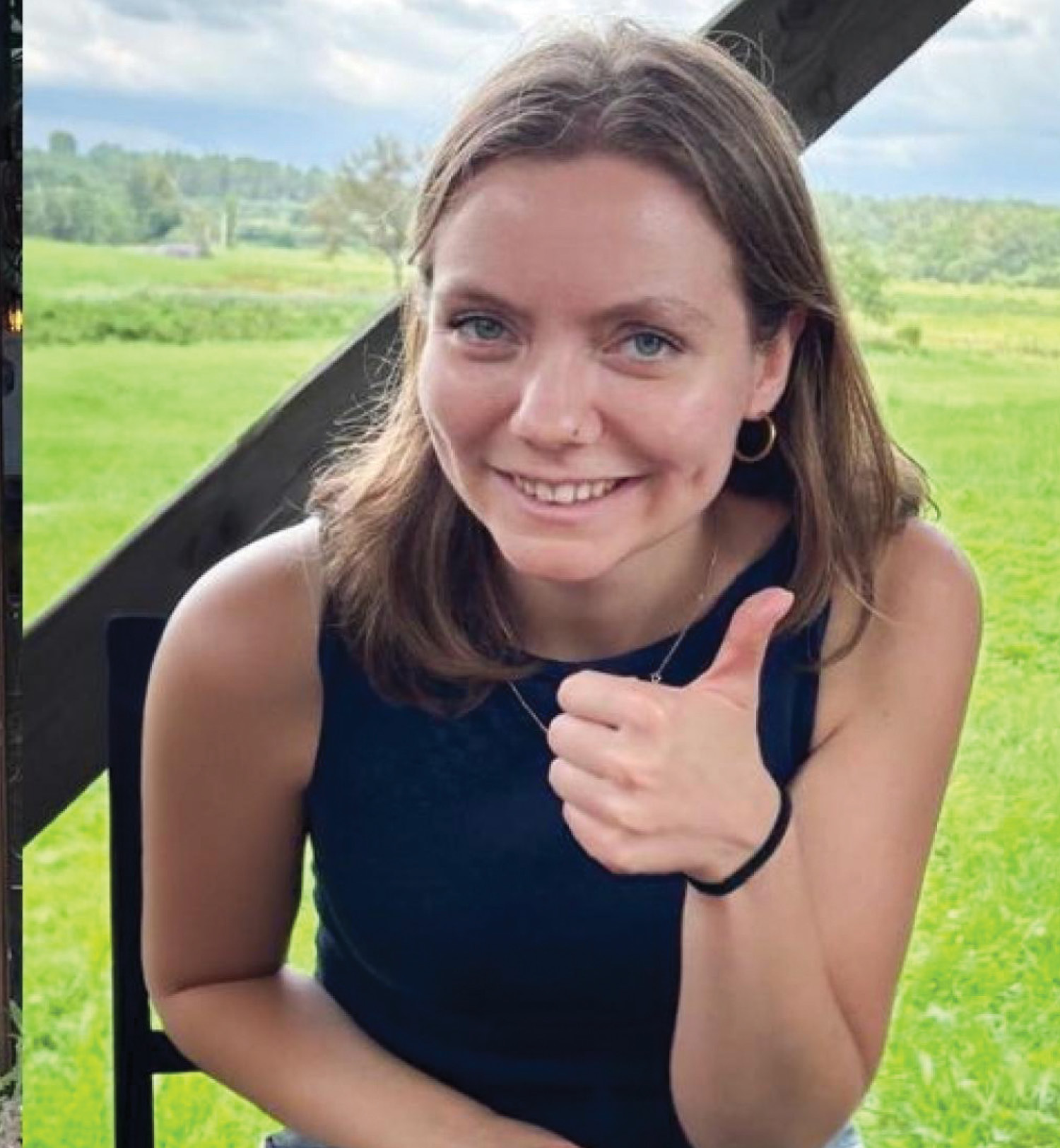
Jonna Sobeloff-Gittes ’25
Sobeloff-Gittes, a recent graduate with a degree in international relations, did her thesis on nuclear nonproliferation as it relates to Russia and Eastern Europe. She studied in the Russian-speaking city of Daugavpils, Latvia, where conversations with her host mom, classmates and language partner cultivated her conversational Russian.
By the end of her time abroad, she says she had gotten to the point where she could mostly understand what servers were saying before ordering food for herself.
This fall Sobeloff-Gittes started a research fellowship at the Center for Nuclear Security Policy within the MIT Security Studies Program. After a summer of immersive instruction, she hopes to use her boosted language skills as needed in professional settings.
“I feel really fortunate to have had this opportunity,” she says. “This kind of program is so important for equalizing access to these experiences abroad.
Where’s Dan in Japan?
By Adam Conner-Simons ’08
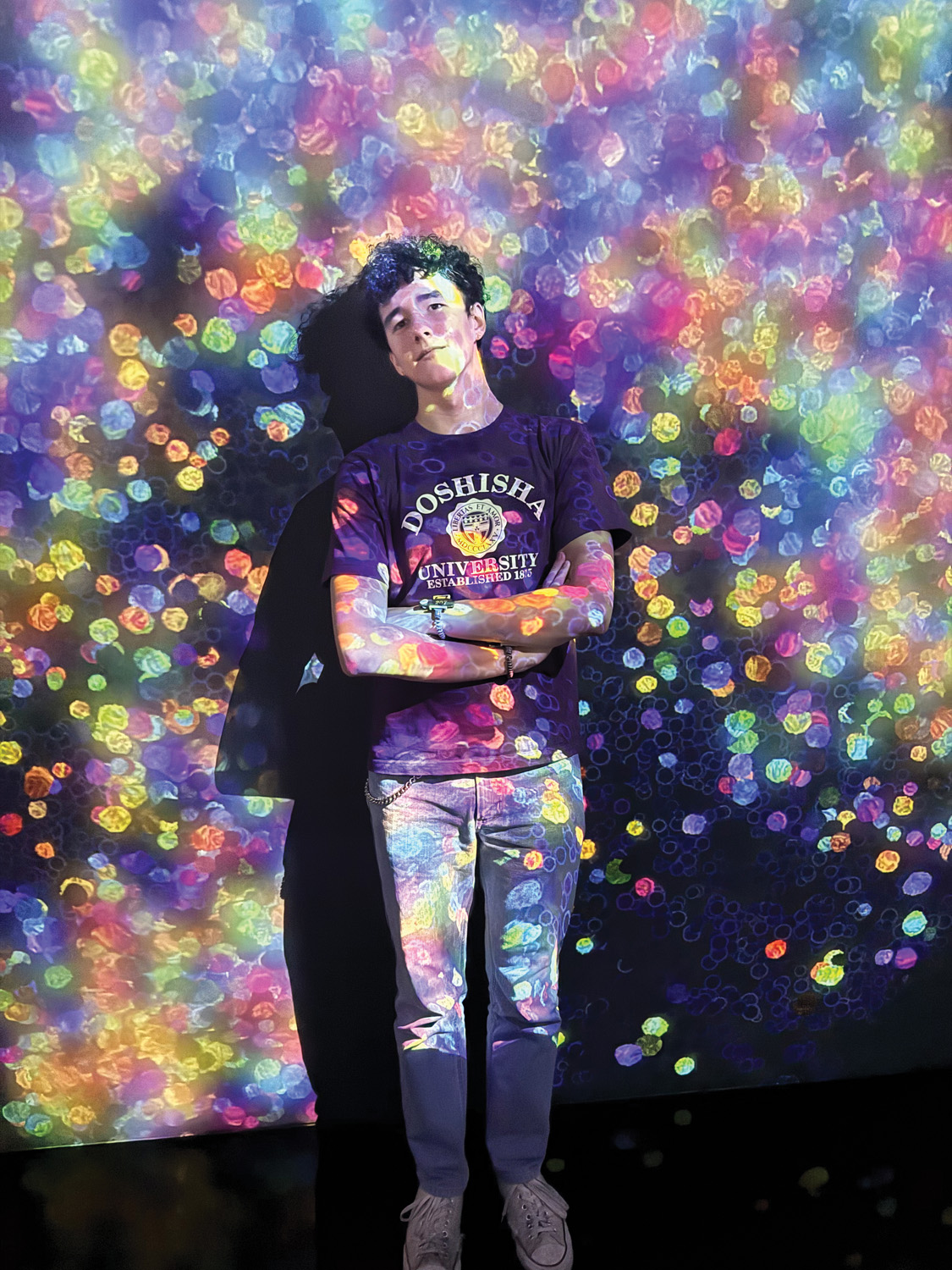
During his stint in Japan this past spring, Daniel Klein ’26 wrote up a quick blogpost—and then another, and then another. His adventures took him everywhere from meditation workshops with Zen monks to an internship at the Asian Network of Trust (ANT), which does advocacy and outreach for atomic bomb survivors. Here are a few photo highlights from his trip, which was made possible through Pomona’s study-away program by way of the Associated Kyoto Program, a Massachusetts nonprofit that works with Doshisha University on study-abroad opportunities for U.S. students.
-

- Dan Klein ’26 at teamlab, an art-collective space in Tokyo
-
- Dan with a new subway friend
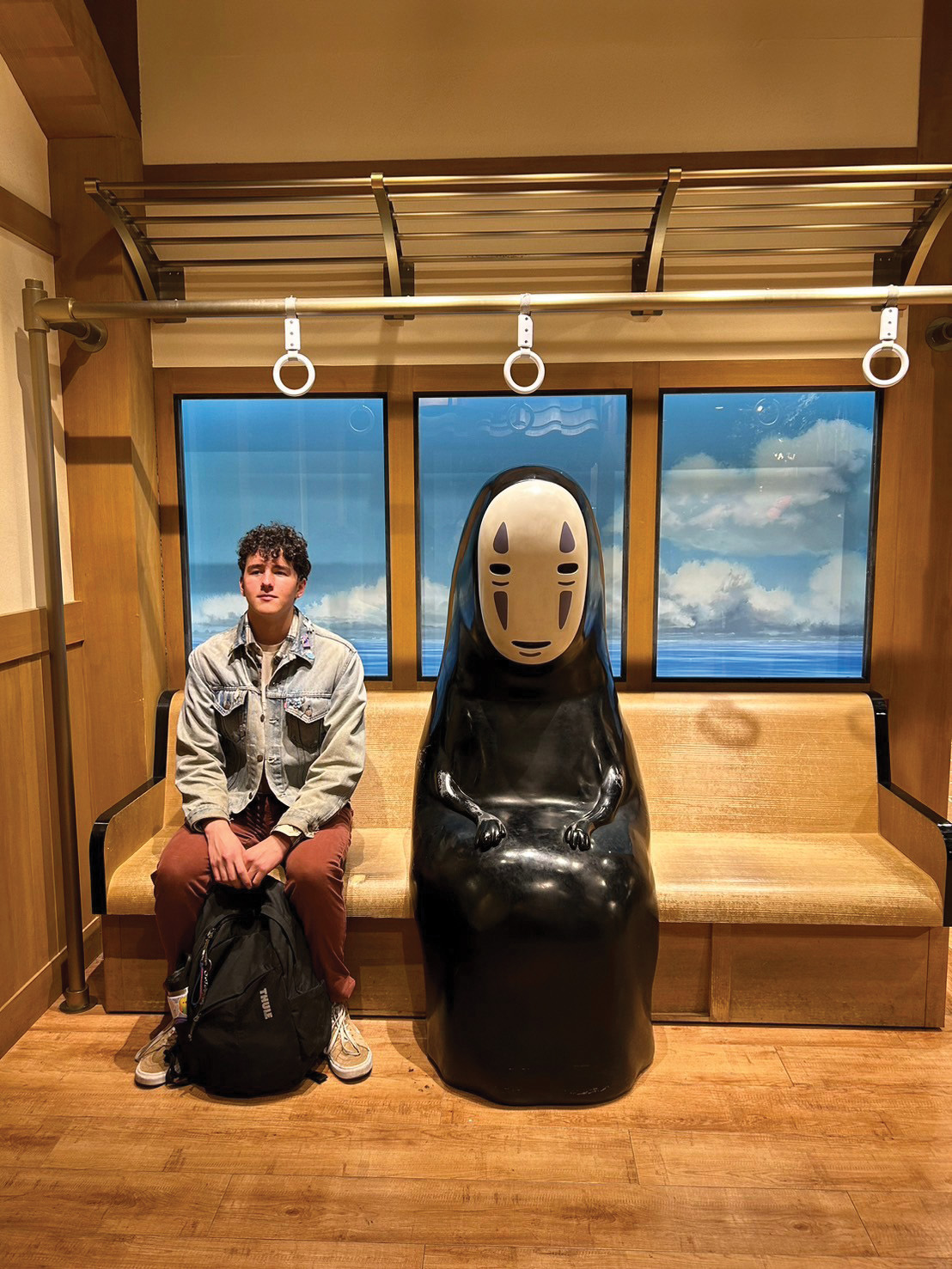
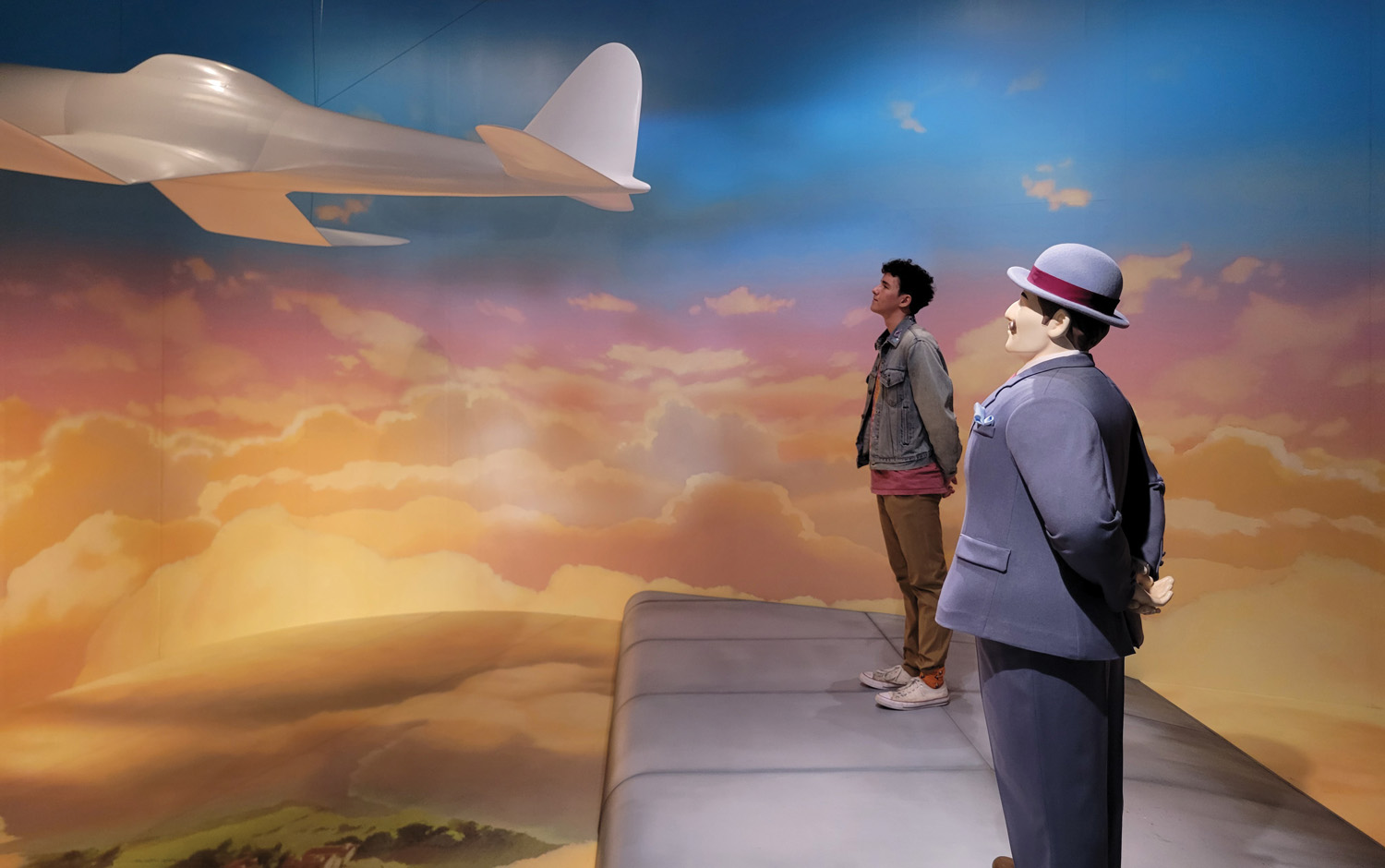
Dan Klein ’26 at Studio Ghibli
A few superlatives from Dan’s Japanese adventures
Favorite words:
Girigiri, an onomatopoeic expression for “doing something just in time.”
Yukkuri —“to relax, to act leisurely/without rushing.”
Favorite dish: “I grew accustomed to eating tamagokakegohan, or raw egg over rice, for breakfast. I was initially skeptical when my host mother first prepared it for me one morning, but it became one of my favorite meals. When I was interning at ANT, it was one of my regular breakfast foods that I’d make before going to the office.”
Strangest encounter: “I stumbled into a Buddhist sermon given by a robotic priest known as Android Kannon Mindar while wandering around Kodai-ji in Kyoto. While the sermon in itself was not strange, I was the only person in the room for its 30-minute duration.”
Favorite off-the-beaten-path adventure: “On a weekend where I felt particularly cooped-up, I made the spontaneous decision to bike between Japan’s largest island, Honshu, and its southernmost island, Shikoku, on a route called the Shimanamikaido. Before reaching Shikoku, the route took me over bridges to six different islands in Setonaikai National Park.”
Most unexpected realization/discovery: “Being from North Carolina, I was surprised to find a degree of similarity between the social cultures in Japan and at the one at home. In both places, I find that people operate on an unspoken, implied code of etiquette and are firm in offering the best hospitality to visitors and guests that they can; in other words, both groups of people are earnest in their kindness.”
Favorite “We’re not so different” moment: “Japanese people will also tell people that they live in Tokyo, Osaka, etc., rather than their tiny suburb to look cooler. I often tell Japanese people I’m from Los Angeles because it takes too long to explain what North Carolina is. I’m no better.”