
Like the proverbial blind men who each perceive an elephant to be a different object, the Oldenborg Center for Modern Languages and International Relations has been many things to many people. For nearly 60 years, it has played numerous roles and been home to a wide range of memories and experiences for people who have come through its doors.
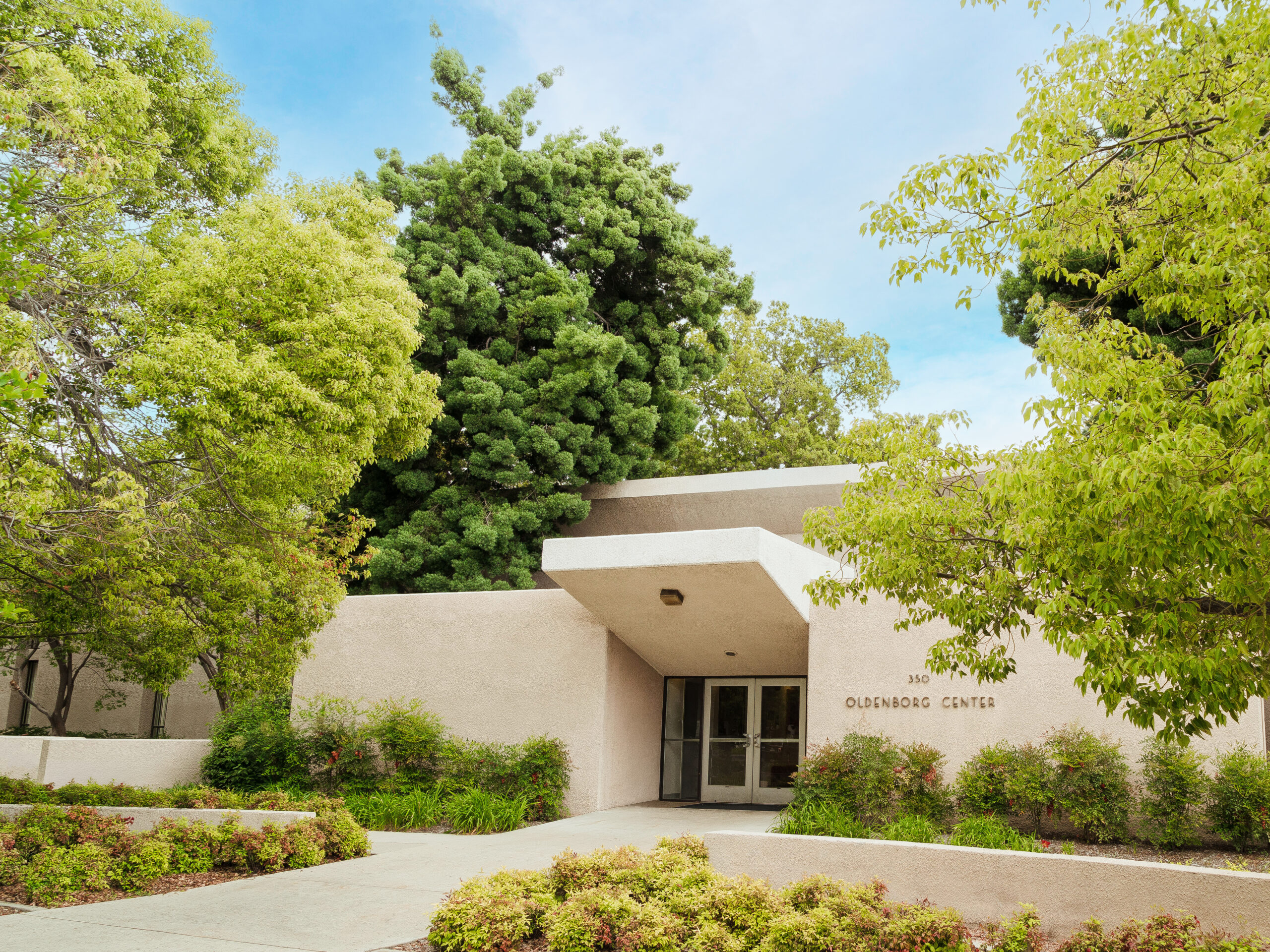
For thousands of students and alumni, the Brutalist-style structure on the corner of Bonita Avenue and College Way has served as a residence hall. Many in the community have experienced the building as a dining hall where they have spoken different languages over lunch. For others, Oldenborg has been an academic space where they have taken part in language conversation classes.
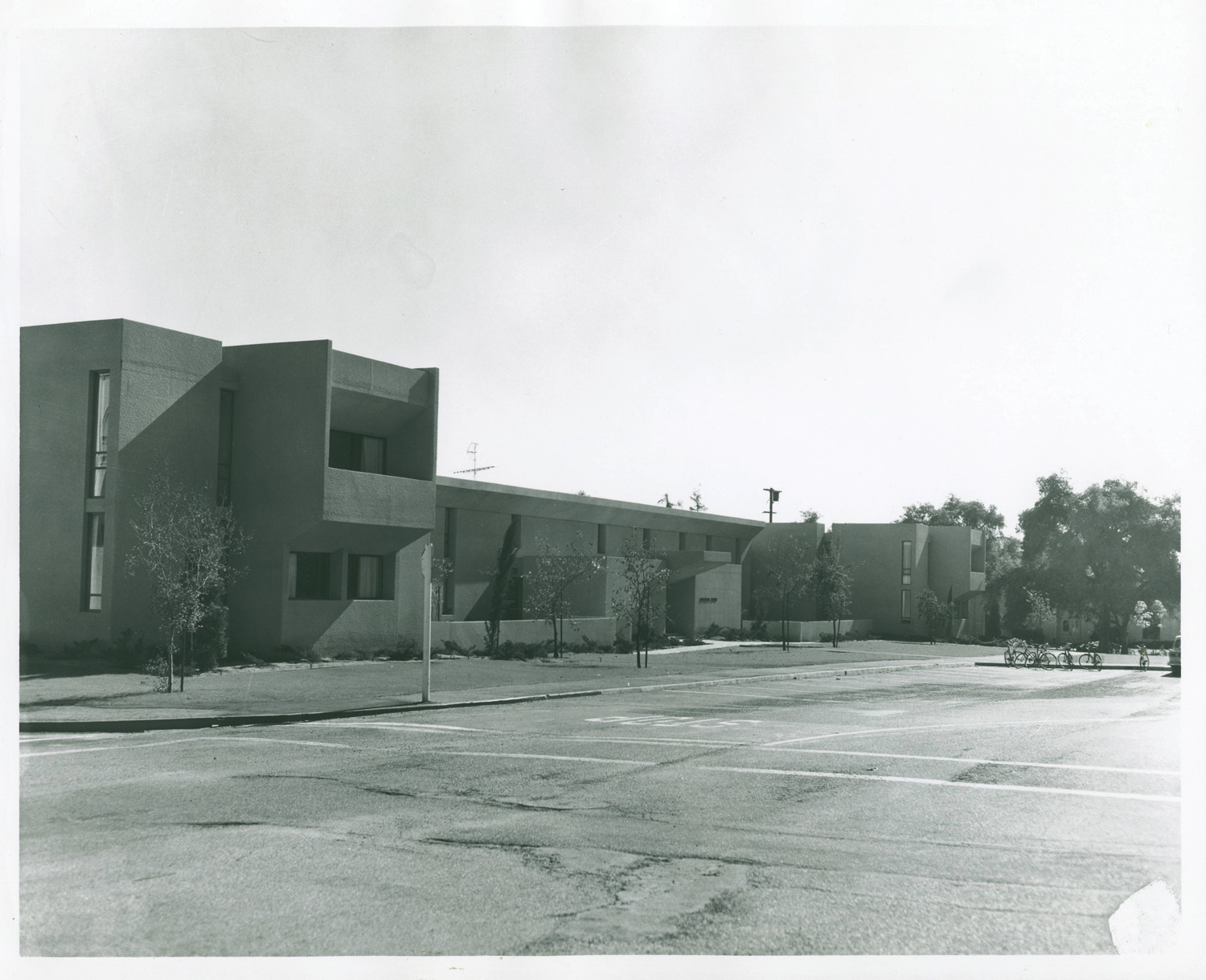
An early photo of the Oldenborg building exterior
And indeed, the versatility was the vision. The first facility of its kind in higher education, the immersive and multifaceted concept was cutting-edge when Oldenborg opened its doors in 1966. Now, six decades later, the building is showing its age, and it’s time to reimagine how Pomona College can equip students to be global contributors in the 21st century.
At the end of the 2025-2026 academic year, Oldenborg will make way for the new Center for Global Engagement (CGE). Projected to open in August 2028, the 100,000-square-foot space will build on the legacy of Oldenborg, still housing language immersion dorm rooms and a dining hall, but will expand to include a conference center and more spacious office, meeting and classroom areas, and a new vision for interdisciplinary liberal arts education.
The CGE will serve as a home for “firmly positioning Pomona as the national model for transformative, immersive, interdisciplinary global education,” says Pomona President
G. Gabrielle Starr.
Late Postwar Era Origins
In 1965, the United States was embroiled in the Vietnam War, Mao Zedong was preparing to launch the Cultural Revolution, and the Space Race was in full force.
Against this backdrop, Diederick C. Oldenborg, a retired businessman, was drawn to the idea—floated by his friend Allen Hawley ’16 and Pomona President E. Wilson Lyon—of a residential center to develop language fluency and understanding of international relations.
Born in Denmark and raised in New York, Oldenborg had been a world traveler, and his goal as a philanthropist was to “strengthen communication and understanding among nations and thereby contribute to world peace.”
Oldenborg and his wife Maisie’s gift of $1.1 million helped make the Oldenborg Center—developed by the department of Modern European Languages and Literature and College deans at the time—a reality.
When the center opened in November 1966, it contained a dining hall, dorm rooms for 144 students, and state-of-the art teaching facilities. Wings were organized by language (Chinese, French, German, Russian and Spanish) and overseen by language residents.
A Source of Pomona Lore
Two years after Oldenborg opened, residence halls at Pomona would become co-ed. But until then, its labyrinth-like layout was designed to keep men and women separated. The hard-to-navigate halls have been a hallmark of the building ever since: students who move in, especially to the second and third floors, can expect friends from other dorms to get lost trying to visit them, or to not try at all.
A popular legend holds that the alien race known as the Borg on Star Trek: The Next Generation got its name from Oldenborg. Though it has never been confirmed (or denied), the connections are too strong to ignore. Joe Menosky ’79 reportedly lived in Oldenborg—often referred to as the Borg on campus—as a student. When he became a writer for the show, the Borg collective was created. The cube where they reside is notoriously isolated, insular and full of maze-like hallways. (Menosky is also the one who started regularly dropping “47” references into episodes.)
During my time as a student at Pomona in the ’90s, a couple dozen first-year students were assigned to live in Oldenborg every year. The lore was that once someone lived there, they never left. Many students did in fact wear the badge of honor of living in the dorm all four years.
What’s your fondest Oldenborg memory?
“The dorm had a film series in the basement theater, which my pals and I took over for marathon screenings of Star Wars and a surprisingly popular showing of [Terry Gilliam’s ’80s trilogy] Time Bandits, Brazil and The Adventures of Baron Munchausen. I also remember that, because [Oldenborg] was Brutalist concrete, there was lore about what kinds of special hooks you had to buy to hammer into the walls to hang pictures. Regular nails simply did not penetrate!” —Adam Rogers ’92
“I transferred to Pomona in 1968 and, because I had three years of Chinese in high school, I was able to get into the Chinese language group. It was absolutely fabulous. A native Chinese speaker was in residence and organized activities. We often ate together at meals and went on picnics where we made dumplings and origami. It was a wonderful place to live—I hope that the new center will also encourage language immersion.” —Janet Cater ’70
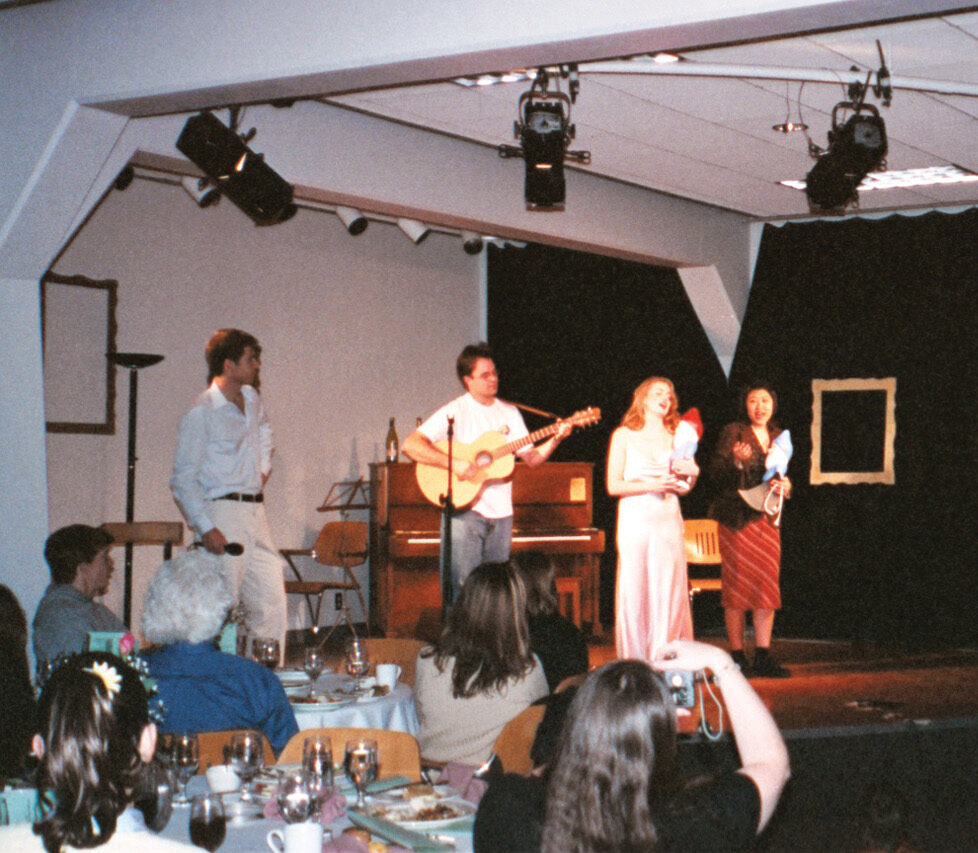
Stage performance during a French section dinner in 2003. From left, Andrew McKibben ’05, Bret Turner ’03, Alexandra (Thompson) Devendra ’05, Ngoc Thy Phan ’05, Catherine John ’05.
“I lived in the French section my sophomore year, Spanish for a semester of junior year, and German my senior year. I participated in every French, Spanish and German dinner and attended every Russian, Japanese and Chinese dinner. I ate lunch at the language tables nearly every weekday to catch up with my fellow polyglots or attend a talk. I watched extremely obscure foreign art films in the basement and cooked national dishes with residents in the lounges for study breaks. Nothing better prepared me to travel, live, study and work abroad after college. I’ll miss the ‘Borg!” —Catherine John ’05
“I could wax poetic about the home this struggling Pakistani found creating our own little special-interest floor under the vague umbrella of ‘some loose connection to South Asia.’ Or the early days of the now infamous Hindi-Urdu table, where so-called ‘enemies’ joyfully came together weekly to gab under the ever-loving eye of ‘Shaila Aunty’ (Professor Andrabi). Or sneaking in with sleeping bags to sleep in the library on the hottest of nights in one of South Campus’ only air-conditioned student spaces. While all those are worthy of essays of their own, I’d love to commemorate something else forever associated with Oldenborg: the Lucky Charms always stocked in that dining hall. To me, Lucky Charms represented the ultimate American experience: problematic but delicious, non-halal (marshmallows = pork gelatin), fake news masquerading as breakfast. In that room I connected with folks from around the world, united in our love for this most unlikely food-like object. ‘Center for Global Engagement’ indeed—one cereal bowl at a time.” —Naqiya Hussain ’08
“I remember great talks [where] they would bring in people to talk to us about international relations. One presentation was a man who had defected from Russia, where he had been the head editor of the country’s biggest newspaper. He tried to get us to understand about censorship and the Russian mentality—he said that Russia would go over every article in [the U.S. publication] Reader’s Digest with a fine tooth comb, and delete anything they didn’t want the Russian people to think about.” —Cheryl Nickel ’83
Present-Day Offerings
In recent years, Oldenborg is occupied almost exclusively by sophomores. Each language hall is anchored by a recent college graduate hailing from another country who assumes the language resident position for two years. The language residents’ apartments and adjacent lounges serve as hubs for each language wing and as venues for conversation classes, cultural programming and study breaks. In addition to the original five languages, a Japanese hall is also now in the mix.
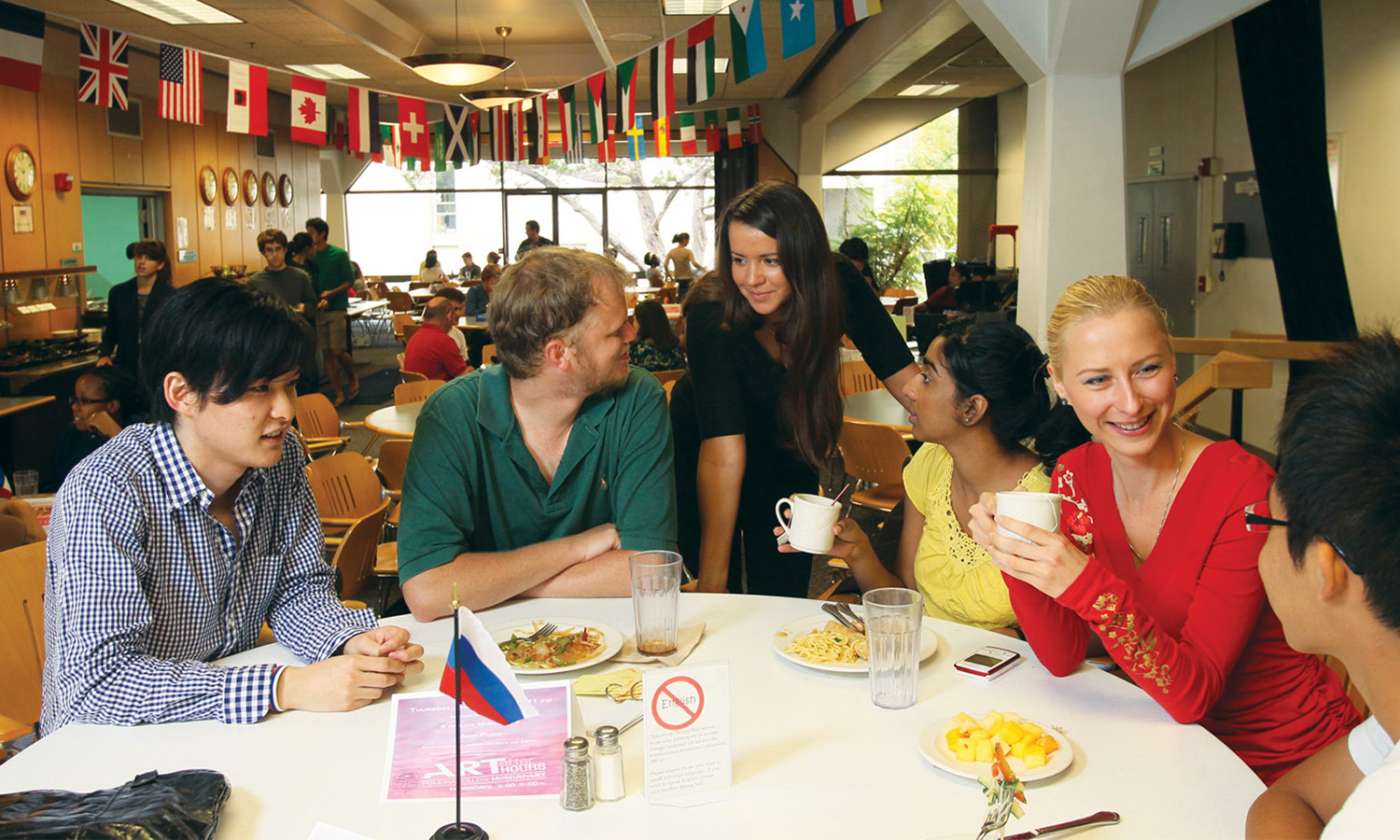
A Russian language table session at the Oldenborg Center for Modern Languages and International Relations.
Perhaps where the greatest sense of community takes place in Oldenborg is at the language tables. Happening every weekday during the noon hour, the tables bring together people in linguistic and cultural camaraderie. Tables for Chinese, German, French, Japanese, Russian and Spanish take place daily. A collection of more than 20 other languages rotate throughout the week.
More than just practicing another tongue, language-table participants also find a sense of belonging. There aren’t many places on campus—or in the world—where someone can sit at a table with people they may not know and engage in conversation. Many international students especially feel a sense of home at the tables, speaking their native language with fellow students, faculty and staff members, and other members of the community at large. Some would say that the sense of belonging outweighs even the linguistic gains.

Diana Braghis ’26 a PPE (politics, philosophy, economics) major and Japanese minor, studied Japanese on her own in high school. The summer after her sophomore year at Pomona, she interned at the Japanese Embassy in her home country of Moldova, putting her Japanese skills to use. She credits the Japanese department professors and the Oldenborg Japanese table community “for helping [her] get as far as an employable level of Japanese in just two years.”
“The Oldenborg language tables community is a very vibrant one,” says Oldenborg Faculty Fellow Pierre Engelbert, H. Russell Smith Professor of International Relations and professor of politics. “It’s a community of exchange, discovery and mutual appreciation. People from all around the world come here and speak their language, share their culture and create this microcosm of the world.”
Confronting Complex Global Challenges
Sixty years after the conception of Oldenborg, today’s students are facing critical issues like climate change, artificial intelligence and geopolitical unrest that require interdisciplinary collaboration.
“We know that global learning today must equip our students and community to confront complex challenges that defy solutions from a single discipline, linear methodologies and solitary creativity,” says Starr. “The CGE will enable Pomona to chart new paths, providing a living, immersive laboratory in which the liberal arts, global study and research intertwine.”
The new center will include two structures: a three-story, C-shaped residence hall and an L-shaped structure incorporating the dining hall, teaching and meeting spaces, and offices.
The residence hall will house 200 students and nine visiting language and academic scholars. In addition to pods focused on languages, the CGE will add two or more pods on thematic topics tied to complex global challenges.
A 24,000-square-foot dining hall and conference center will facilitate daily language tables (with 25 languages represented every day), community dialogue, exchange with local and global leaders, lectures and symposia.
“Once completed, the center will offer our students more ways to connect with partners around the globe and work across disciplines to take on the most urgent complex challenges of our time,” says Kara Godwin, assistant vice president and chief global officer.
“Through the CGE, new generations of Sagehens will work in teams with faculty and visiting scholars to analyze real-world challenges, embrace cultural diversity and ask profound questions—questions that spark creative ideas and novel solutions that transcend all kinds of boundaries.”
Oldenborg has shaped Pomona through language learning, community-building and global engagement for 60 years…and counting.
Learn about our Oldenborg celebration and share your memories at pomona.edu/dear-oldenborg