
Biologist and conservationist Naira de Gracia ’14 knows a few things about immersion. The child of journalists, as a kid she bounced between seven countries across three continents, spanning the U.S., Spain, Mexico, Chile, Argentina, South Africa and Egypt. During her Pomona summers she did fieldwork in Alaska, and from 2016 to 2018 lived in Antarctica and spent five months in a 16-by-16-foot shack with four other researchers studying penguin colonies—culminating in her 2023 book The Last Cold Place. She now focuses her work on regenerative agriculture, supporting efforts to conserve food and farming systems.
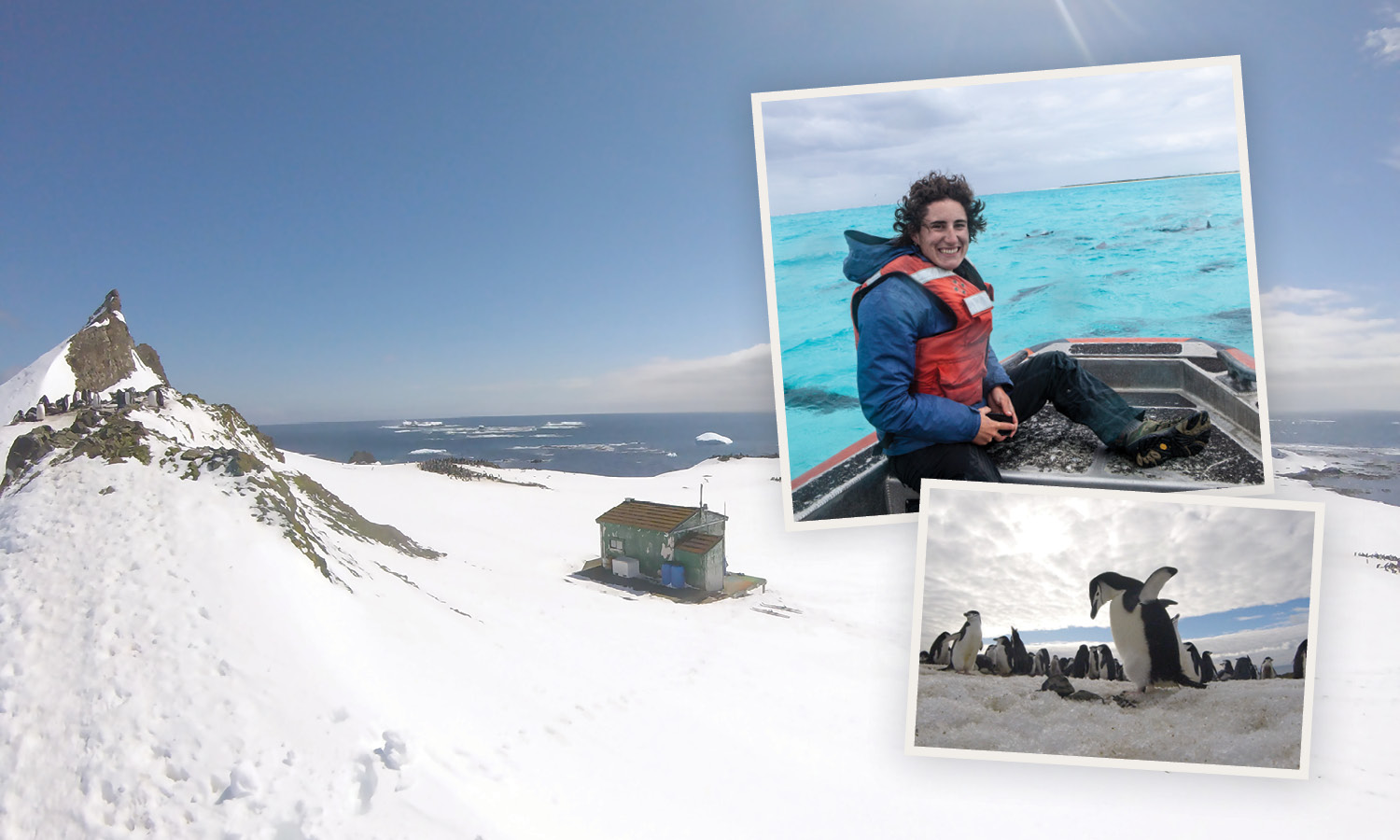
Photo of the 16 by 16 shack in Antarctica where Naira de Gracia ‘14 lived while studying penguin colonies overlayed by an image of de Gracia with dolphins in Midway Atoll in 2016 (credit Kaipo Kiaha) and a penguin colony in Antarctica (credit Naira de Gracia ’14).
Q: What aspects of your Pomona experience most informed your career trajectory?
A: I started in environmental sciences and, during an internship on seabird monitoring on the coastal islands of Maine, was blown away that this was a thing I could do professionally. I changed my major to biology, and was lucky to have an amazing mentor in Professor Nina Karnovsky. She’s still my hero. She took me for fieldwork in Alaska and helped me navigate what to study and has this joy that’s so fun and infectious.
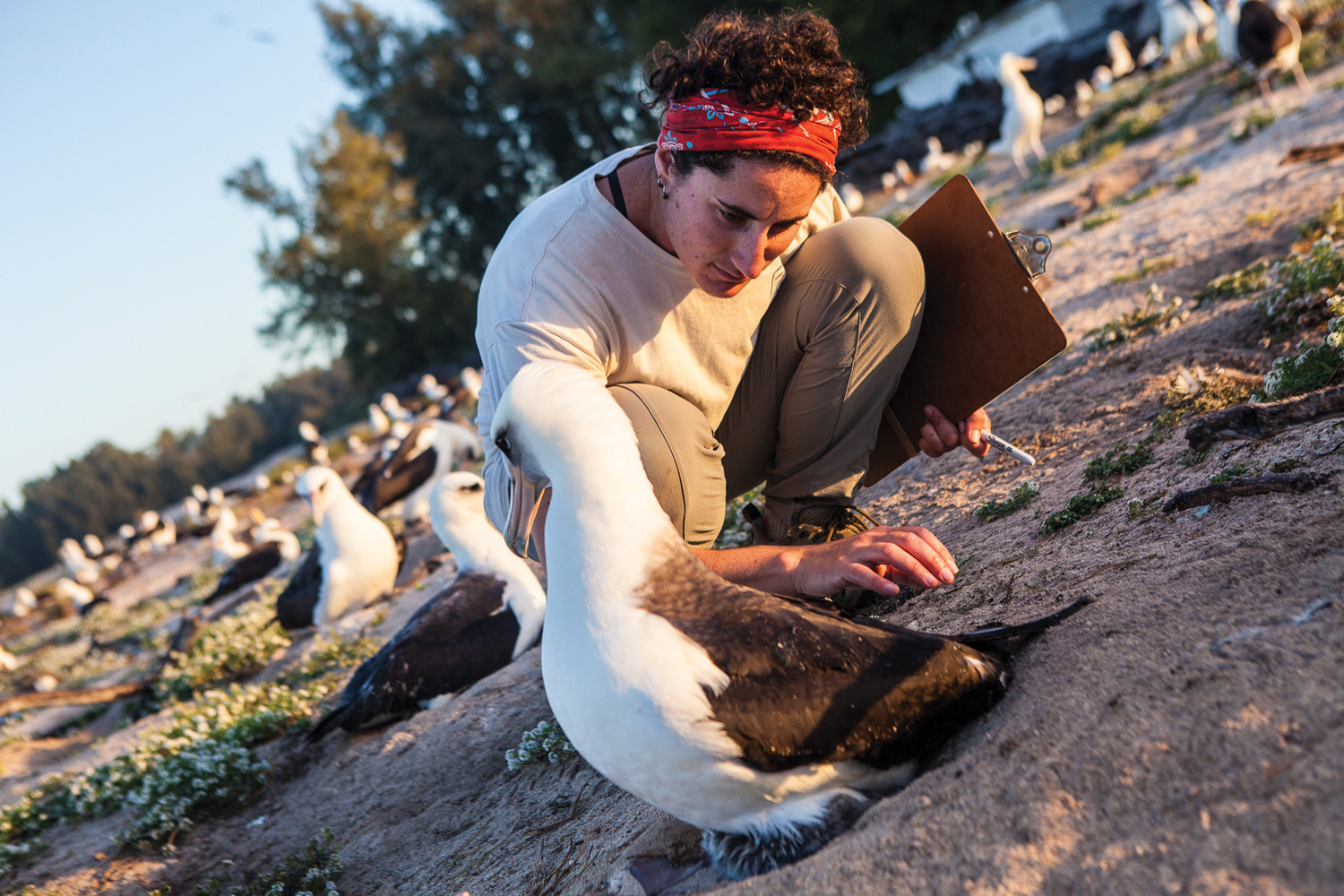
Naira de Gracia ’14 studying seabirds in Midway Atoll, in the northwest Hawaiian Islands, in 2015. Photo credit, Kaipo Kiaha.
[In Alaska] I spent a lot of time reading and thinking and cultivating a sense of awareness of my surroundings. I remember coming back and more deeply noticing birds and flowers and tree species. For me, immersion was in some ways less about the physical experience and more about a certain state of mind.
When I moved back to Pomona it felt a bit weird to be in such a different environment with people and concrete and buildings everywhere, so I would escape a lot to the farm, where I worked as manager after graduating. You spend time in class learning about ecosystems and plant biology, but I loved being able to actually interact directly with those ideas at the farm and see them laid out. It felt very inviting.
Q: What attracted you to conduct research in such isolated places as Antarctica?
A: Out of college I found myself drawn to being in more remote locations—just stripping away all the noise of society and connecting as profoundly as I can with my ecosystem. There was something beautiful about sitting on the side of a cliff and staring at a bird colony for three hours.
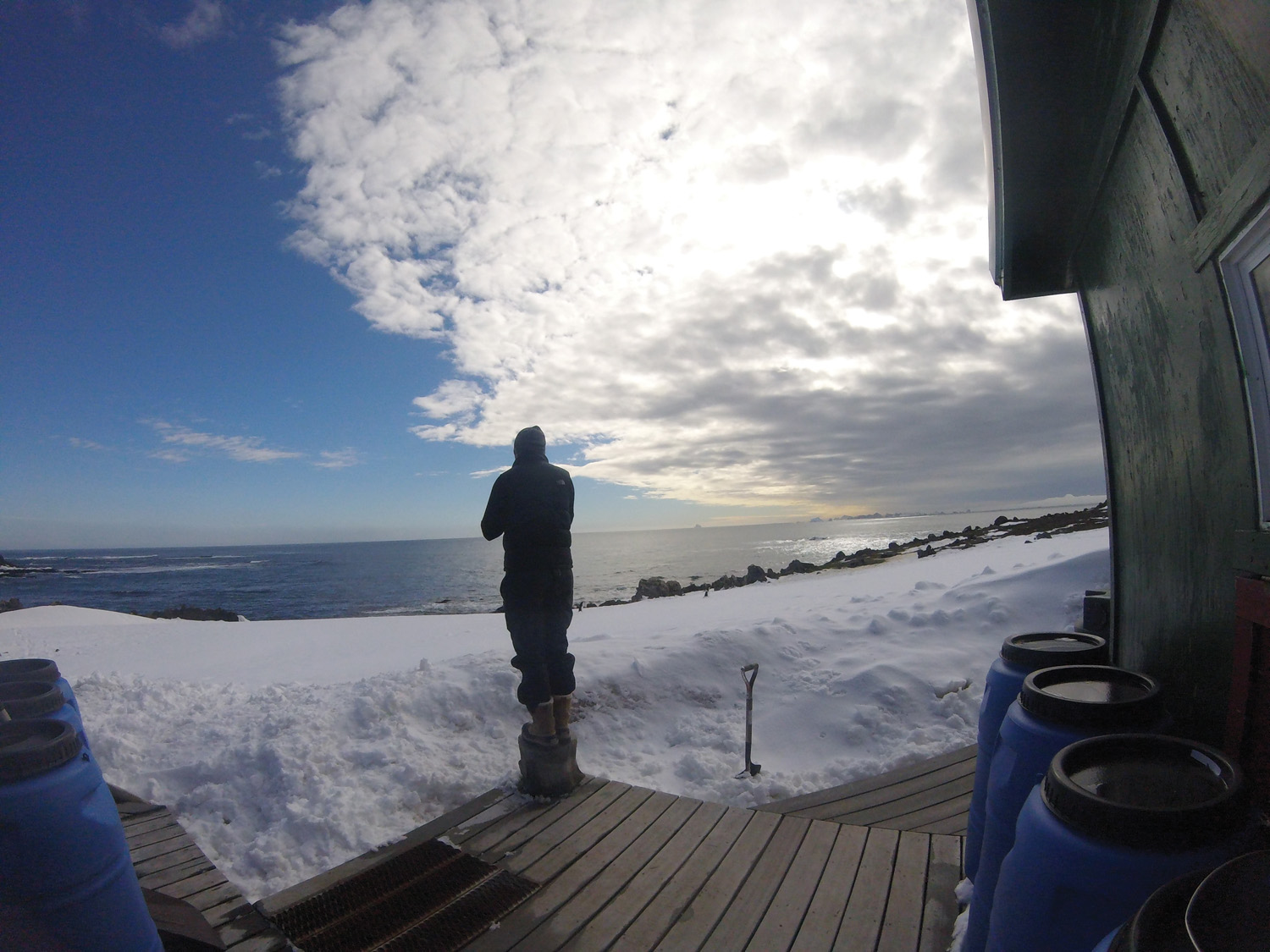
Naira de Gracia ’14’s view from the 16-by-16 cabin in Antarctica
Doing that kind of work envelops your entire life. You’re living with your co-workers on an island on a field camp, and every day you get up and monitor these animals. It lends itself to an intimacy with a place that I can sometimes otherwise struggle to find.
My job was to observe—we were noting everything that was happening on the island because it was important as part of the monitoring work. In that way, your senses are already attuned to your surroundings. It cultivates this sense of attention and intention that I really valued.
Q: One key aspect of writing is to get a reader immersed in your world. What was it like to try to do that with The Last Cold Place?
A: When I set out to write the book, part of my mission was to bring people a slice of that experience in Antarctica that most will never get to see. It was important to me to try to evoke it as vividly as I could, and I leaned a lot on all of the little details of daily life—smells, sounds, visuals. Reading a book obviously isn’t the same as being there, but you can still invoke a sense of place and emotional connection that can hopefully lead to some kind of care down the line for people to feel like they have a stake in what happens to that ecosystem.
Q: What led to your shift away from fieldwork?
A: For years I kept looking for the most remote, longest-season jobs, and had such amazing adventures. But it was also exhausting moving around every six months and living out of my duffel bag, and I wanted stability. I also felt like I wanted to understand more of the theory and the science behind the monitoring I was doing. So I went back to school and moved to New Zealand to get a master’s degree in conservation biology, then worked as a sustainability advisor, then moved to Sweden to do my agroecology master’s.
These days I’m more interested in a kind of bigger-picture immersion: what does it mean for us to apply the same attention to our agriculture and food systems? With fieldwork, it feels like we’re behind a wall to observe, and not supposed to affect anything that’s happening. I love that agriculture is not as passive—we’re influencing and restoring ecosystems, and eking out this natural abundance that helps us survive as a species. What I’m doing now isn’t so different in terms of looking at the landscape of a farm, and figuring out how the land is doing and what it needs. My career probably seems like I’ve jumped around, but I see the throughline very easily.