Jersey City’s James Solomon ’06 has seen how cities work in St. Louis, Chicago & Boston—then became mayor of “Chill Town.”
By Marilyn Thomsen
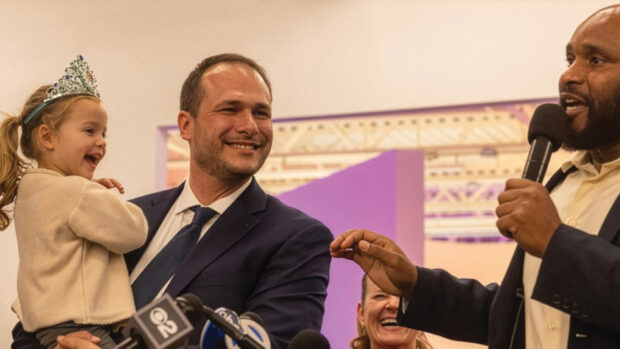
Ward E Councilman James Solomon was elected as Mayor of Jersey City and celebrated with family and the community at MANA Contemporary. Shot on December 02 2025. Photo by Jennifer Brown/City of Jersey City
In December James Solomon ’06 was elected mayor of Jersey City after two rounds of voting, outperforming six other candidates in a marathon of a race that included a runoff election and that lasted more than a year from when he announced his candidacy.
Solomon sees Jersey City’s future at stake as it becomes increasingly unaffordable. His campaign focused on independence from developers and insider politics, creating affordable housing, keeping city streets safe, and creating more summer and afterschool job programs.
“My hope and vision is that [the city] remains one of the most diverse in the country and a place where people come to start their lives in America,” he says.
Its location provides a visible reminder of that promise. Just across the Hudson River from Jersey City is Ellis Island—for centuries America’s Golden Door.
“Our nickname is ‘Chill Town,’” says Solomon, contrasting Jersey City with frenetic neighbor New York, located just a mile away by water. He says that its future will see arts and culture and small businesses thriving, and the government delivering for the people.
Solomon studied public policy analysis at Pomona, where he appreciated professors’ passion for public service and their prioritization of the oft-forgotten piece of policy implementation.
“We think about passing laws,” he explains, “but very rarely about once the law is passed, how do you ensure that it is implemented in a way to make a real-world impact?”
After college Solomon spent four years in St. Louis and Chicago developing a passion for city government and seeing its direct effect on people’s lives. Solomon then spent two years studying at Harvard University’s Kennedy School of Government, learning both in the classroom and while working for Boston Mayor Thomas Menino.
“If a pothole wasn’t filled and your car broke an axle, that could really screw up your month,” he says. “The day-to-day impacts are in your face.”
Solomon hears from residents daily and often reflects on the pervasive sense they get that their government doesn’t care about them. Cities, he says, deserve “a government as good as its people”—a concept that he is now hoping to deliver to his constituents.
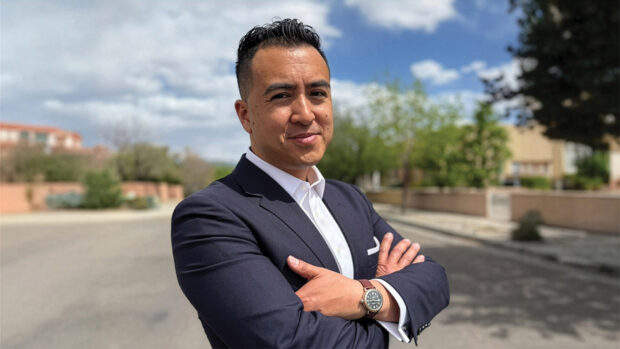
The youngest U.S. attorney in the nation, Albuquerque’s Alex Uballez ’08 led the DEA’s largest-ever fentanyl bust.
By Brian Whitehead
This fall Alex Uballez ’08, a former U.S. attorney for the District of New Mexico, ran for mayor of Albuquerque and surprised many insiders and pundits by finishing third in the race with 19 percent of the vote, forcing a runoff between the incumbent and the favored challenger.
For those who know him, it wasn’t a surprise that he would be destined for big things. Philosophy Professor Michael J. Green recalls Uballez’s senior thesis on green consumerism and sustainable development being one of the two best theses he read
that year.
“It had really interesting discussions of abstract and social theory and a lot of historical research about environmentalism,” Green says. “That’s when I got the idea he could change the world.”

Uballez and his wife Gabrielle
Uballez and his wife Gabrielle met on campus—the respective politics, philosophy and economics (PPE) and art majors hitting it off as first-years. It was Gabrielle, in fact, who convinced him to apply to Columbia Law School, from which he graduated in 2011. They then moved to her native Albuquerque, where he started his career as a state prosecutor specializing in crimes against children. In 2016 he became a federal prosecutor focusing on drug trafficking cartels in the U.S. and south of the border.
In 2022 President Joe Biden nominated him to serve as U.S. attorney for the District of New Mexico. He led an agency of 180 federal prosecutors and staff that he instilled to think beyond investigations and prosecutions to effect change.
“We thought about how to intervene and prevent,” he says. “How to see public safety through a broader lens than the court system.”
Besides leading the largest fentanyl bust in DEA history, Uballez also created Albuquerque’s Violence Intervention Program. His office uncovered 30 years of public corruption in the Albuquerque Police Department’s DWI Unit, and also established New Mexico’s first Federal Reentry Program for people returning home after incarceration.