

From traveling theme parks to immersive games you play on Netflix, Ben Hoyt ’00 describes his work as “surfing the wave of emerging technology.”
Take a look inside the world of Ben Hoyt ’00, whose “47 Games” has created immersive entertainment for Netflix, Marvel and more
Lifelong gamer Ben Hoyt ’00 has a job that many gamers dream of, working on digital games based on some of the best-known intellectual properties (IPs) in the world. Throughout his 25-year career, Hoyt has played a key role in major projects involving Marvel, Terminator, Star Trek, Def Jam, The Witcher, American Girl, Top Gun, and more.

47 Games Logo
Through his work as founder and CEO of (what else?) 47 Games, Hoyt has become known as a go-to option for projects based on licensed IP, and he has established himself as a producer with a knack for orchestrating the complex cross-disciplinary teams required to develop major games—from creative to coding—and successfully bring them to market.

Hoyt began his career making fairly traditional video games for game consoles but soon expanded his portfolio to mobile games, immersive location-based experiences, virtual reality and augmented reality projects, and more.
In that sense, Hoyt has become a kind of conductor in the world of gaming and interactive content. The musical analogy fits with Hoyt’s view of the immersive field of gaming as the 21st-century version of Gesamtkunstwerk—a work of art that makes use of virtually all other art forms.
“Almost every form of creative endeavor that you can think of—script writing, voice acting, animation, digital, visual art, cinematics, music and sound design—is among the things that each go into the creation of a video game,” he says. “As a video game producer, you have to understand how these pieces fit together and how they are created in order to ultimately be able to deliver—in the case of larger and more complicated games—a finished project.”
Hoyt began his career making fairly traditional video games for game consoles but soon expanded his portfolio to mobile games, immersive location-based experiences, virtual reality (VR) and augmented reality (AR) projects, and more.
“I like to describe it as surfing the wave of emerging technology,” he says.
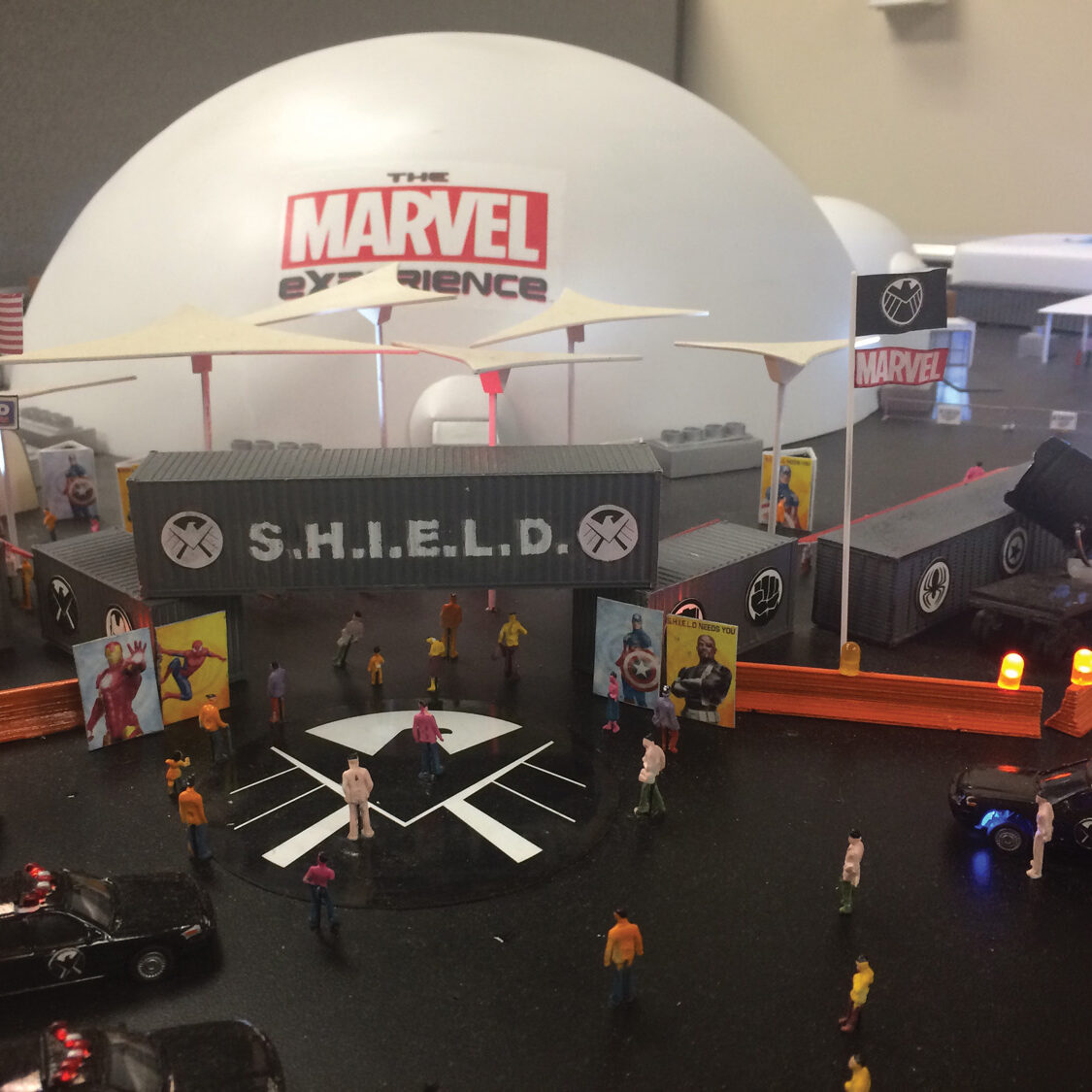
For example, his work on the touring theme-park-like production “The Marvel Experience” involved creating AR and VR experiences, interactive touchscreen activities and motion-tracking games. His team developed high-resolution stereoscopic 3D projections, as well as early versions of RFID bracelets that would track you through the park.
-

- A scale-size replica of Hoyt’s designs for a mobile interactive exhibition for Marvel Entertainment.
-

- The Marvel Experience exterior in person

-

- An installation for the Marvel Experience that incorporated motion-tracking for a more immersive user experience
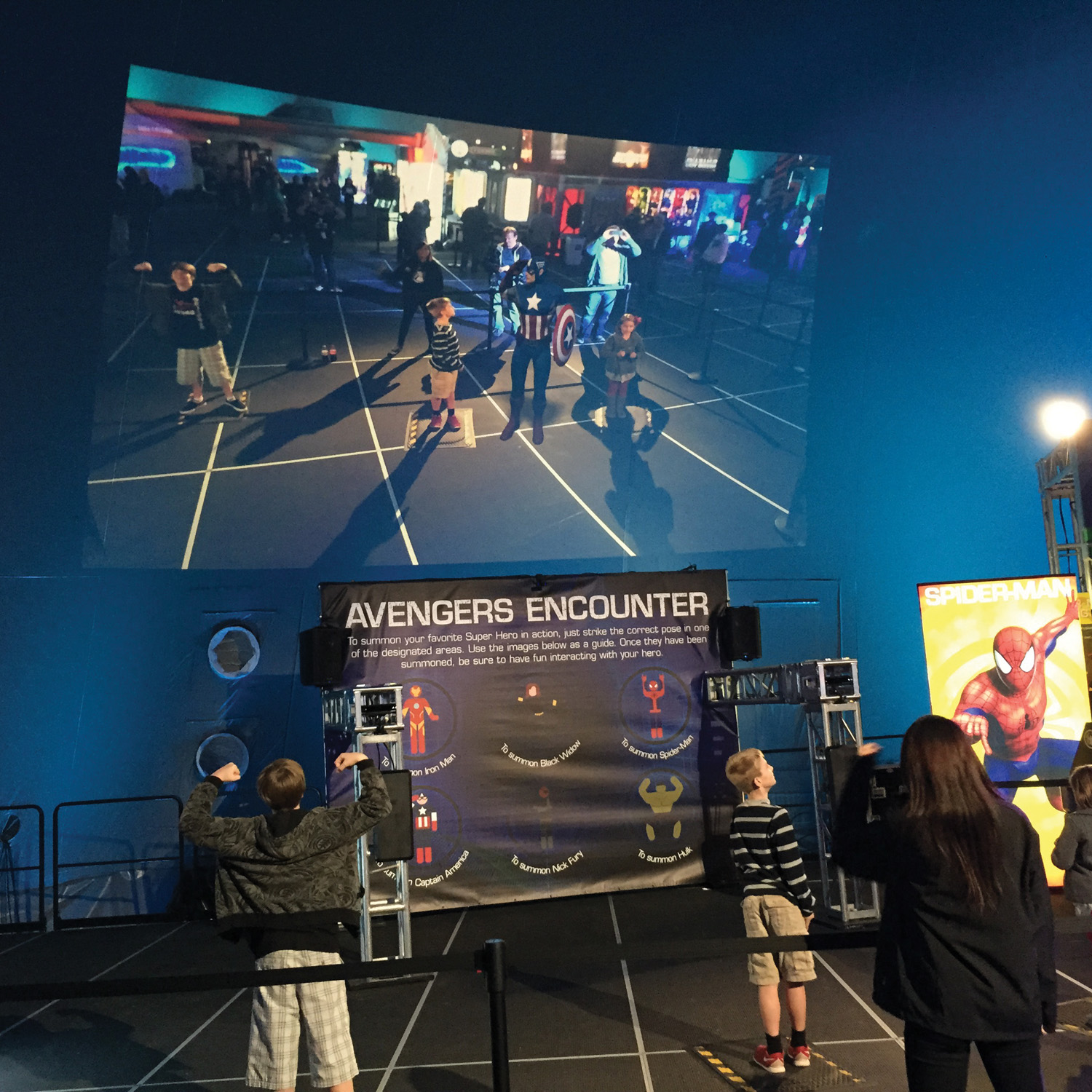
“It was called a ‘hyper-reality theme park,’ and we were trying to leverage a lot of innovative technology at the time to create an immersive experience for the guests,” Hoyt explains. “A lot of the things we used then have since become commonplace in parks like Disney World or Las Vegas’s Sphere venue.”
Hoyt’s most recent project is Squid Game: Unleashed, a multiplayer game based on the popular Squid Game series on Netflix. In the fictional TV series, created in South Korea, hundreds of cash-strapped players compete in a winner-take-all contest for a massive payout, but unbeknown to the players at first, losing means death. The macabre and dystopian show has been a huge hit, with three seasons now on view.
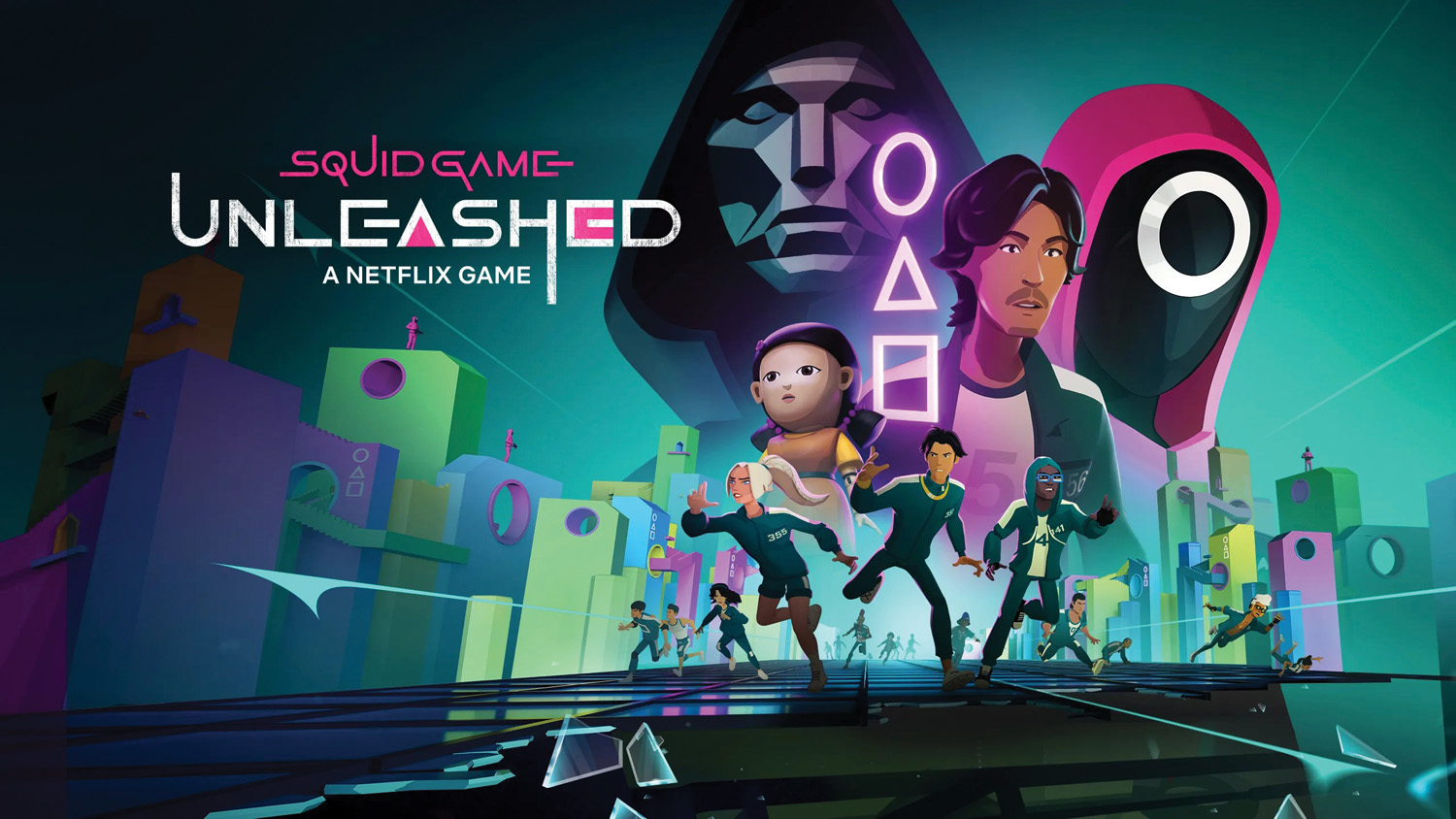
Splash screen for Squid Game: Unleashed
The tone of the game is less sinister than the series, and thankfully free of (real-world) lethality.
“The priority was to create something that would have broader appeal,” Hoyt says. “It’s a balancing act that I am used to from other projects I have worked on during my career. How do you create something authentic enough that it will appeal to fans of the IP or show, but that will also resonate beyond that audience?”
Squid Game: Unleashed has been a huge success: soon after its release in December 2024, Netflix announced it was the #1 game in Apple’s App Store in at least 24 countries, ultimately being downloaded more than 10 million times.
Hoyt joined the project early, during pre-production, as part of the core development team that would shape the contours of the game and the user experience.
“One of the things that has been critical in what I do is that, at the end of the day, the game will ultimately manifest as something that will be directly experienced by the player, so almost every decision that is made is in support of something that should matter to them,” Hoyt says. “It’s important for me to ground my advice and decision-making in the perspective of the player, and I’m able to do that because I have been a passionate gamer my entire life. I’m an advocate for the audience.”
Internally, on any given project, Hoyt may be working to advance and help curate the particulars of the game in different ways, serving in various roles as a translator, firefighter, or logistical expert. He must reconcile artistic and creative project goals across various disciplines, while providing a reality check when needed.
“I really enjoy that process of working with creatives in the different media, and being a kind of connective tissue for the projects,” he says. “You have to be able to understand how to bring all those things together in the best way possible.”
Providing a Reality Check
One challenge in Hoyt’s role is that he sometimes has to play the bad cop who vetoes enthusiastic yet unrealistic ideas. But he takes it in stride, and says that the more experienced the creative, the more they tend to appreciate a reality check.
“Creatives, by their nature, have very ambitious ideas, [yet] a project will typically only have the time and resources to achieve a part of that vision,” he says. “A good producer will be able to help identify, early on, what will be achievable, and know how to help creatives prioritize. There’s an art to delivering that news too, but experienced creators know that without boundaries the wheels can fall off the project.”
The inter-disciplinary combination of arts, media and technology can make gaming experiences uniquely immersive and potent, Hoyt says. He cites games like The Last of Us, which was later turned into a popular HBO zombie-apocalypse drama, for its ability to deliver “profoundly impactful emotional and psychological experiences” because of their interactivity, which can force players to experience stories in ways that more passive media can’t.
“The show is incredibly dramatic and impactful, but the experience of playing the game is even more visceral, because the game puts you into the shoes of the characters in the series, and that is not a situation you want to be in,” says Hoyt, referring to the unfortunate plight of the characters in the game. “It is a traumatic story, and the game shows what a unique medium this is.”
Hoyt also reports being influenced by a lo-fi computer game from 2013 that, despite modest means, creates a thought-provoking user experience. With a retro, Soviet-era aesthetic, Papers Please boasts rudimentary graphics and a simple premise: you’re a customs agent examining the documents of travelers at the border of a fictional autocratic country, and have to decide whether to let people in or out.
“Some might have a very touching reason for wanting to go through, and you have to make difficult decisions as you sit at this desk, a representative of the state,” Hoyt says. “As you make these judgment calls, depending on your choices you may rise up the ranks or be fired. I think it’s an example of how games can make people grapple with complicated real-world issues.”
The power of these games can at times feel like a double-edged sword for Hoyt, as the father of a 4-year-old daughter (California) and 6-year-old son (James). He is cognizant of the potential downsides of the industry: while Squid Game: Unleashed is family-friendly enough that Hoyt sometimes plays alongside his young son, he knows better than most about the risks of intensely immersive games.
“I don’t believe—and I think the research backs this up—that video games turn people into criminals, but there are certainly lots of games that I would not let my kids play,” he says. “I would prefer it if certain games weren’t out there at all. I just feel like they aren’t elevating us, but we live in a free society, and we have to deal with the fallout from that.”
Pomona Paved the Path
Hoyt attributes his ability to work effectively across fields in his professional life directly to his multidisciplinary studies at Pomona.
“The liberal arts education that I got at Pomona has been very valuable in my chosen career path,” he says. “I’m a generalist by nature, and I pride myself on being able to talk to anyone, from any background, and have an informed conversation with them about where they’re from and what they do. I think that’s a common attribute of Pomona people, and at least partially a product of a liberal arts education.”
He also cites his years on the college debate team as an experience that has been valuable in his career.
“I had the privilege to debate at a bunch of really fantastic institutions and tournaments, like Oxford, Cambridge, Swarthmore, the University of Glasgow, and other places,” he says. “I became comfortable with thinking and articulating on the fly, and learning how to weave a story extemporaneously. Being comfortable speaking publicly is a really valuable thing to have professionally. I’ve done press tours, met with journalists, and presented my projects in pitches to publishers or company leadership; and that debate experience was extremely helpful in all of those situations.”
Mapping Video Game Worlds
By Brian Whitehead
Inside a lab on the first floor of Edmunds Hall, Joseph Osborn, associate professor of computer science, and three rising Pomona seniors are using cutting-edge techniques to map the immersive, vibrant two-dimensional worlds of retro video games.
This summer Emma Gandonou ’26, Steven Kim ’26 and Leo Torres ’26 helped Osborn expand the scope of a project he’s been working on since graduate school—a computational system called Mappy that watches Nintendo Entertainment System (NES) games get played and constructs detailed maps of their terrain.

Joe Osborn with his students during their 2024 SURP.
For their Summer Undergraduate Research Program (SURP) project, Gandonou, Kim and Torres determined whether it’s possible to map not just NES titles, but any two-dimensional action game.
“That’s important if we want an AI agent to play a video game, or if we want to add visual or motor accessibility features to a game,” Osborn says. “Knowing the terrain, and the layout, and where the objects are, and whether they’re solid or not—all these features end up being useful for a lot of different tasks.”
Despite their varying interest in video games, Gandonou, Kim and Torres each sought a place in Osborn’s lab this summer to hone their coding chops in a practical, applicable manner.
“It’s been helpful to keep my coding skills fresh,” says Gandonou, a computer science and cognitive science double major from Dallas. “I’ve also gotten better with problem-solving and become a better coder.”
Osborn says working on an existing project as opposed to a school assignment “exercises a different set of skills.” Such work can be more efficient and effective than self-study, and give students the confidence to pursue post-grad research.
Kim, a computer science major by way of Princeton, New Jersey, grew up playing video games and has been searching for ways to get involved in their development as he ponders a career in tech.
In Osborn’s lab, he and his labmates have worked collaboratively to replace the mapping tool’s current approach, which is based on deep understanding of simulated game hardware.
“Since NES games are coded similarly, Mappy can only be used on these kinds of games,” Kim says. “Our work aims to improve Mappy by incorporating modern computer vision models and techniques.”
A computer science major from San Bernardino, California, Torres built his own gaming computer in 2024, which made Osborn’s lab seem like a natural fit.
“It’s been a very collaborative environment,” Torres says. “If we’re stuck, we give each other advice and help each other out.”
Together, Gandonou, Kim and Torres have provided Osborn fresh perspectives on a long-running project. In speaking with his students about what is and isn’t possible with Mappy, he says he’s had to confront simplifying assumptions he made more than a decade ago.
“Conversations with new collaborators, especially students, really highlight those places where I’ve made a commitment early on that might be worth revisiting at some point,” Osborn says.